Divide & Concquer: Elite Control Strategy as Old as Time

Divide & Concquer: Elite Control Strategy as Old as Time

What is DIVIDE AND RULE?
DIVIDE AND RULE meaning & explanation

A divide and conquer strategy, also known as “divide and rule strategy” is often applied in the arenas of politics and sociology. In this strategy, one power breaks another power into smaller, more manageable pieces, and then takes control of those pieces one by one. It generally takes a very strong power to implement such a strategy. In order to successfully break up another power or government, the conqueror must have access to strong political, military, and economic machines.

Julius Caesar used a divide and conquer strategy to subdue the Celtic tribes.

Furthermore, in order to maintain power and influence, large governments will often work to keep smaller powers and governments from uniting. In fact, this use of the principles within the divide and conquer strategy is most common. It is much easier to prevent small powers from linking forces than to break them apart once they have aligned.

Nations may arm rebel groups that exist within the borders of their political rivals as part of a divide and conquer strategy.

Leaders who use a divide and conquer strategy may encourage or foster feuds between smaller powers. This kind of political maneuvering requires a great understanding of the people who are being manipulated. In order to foster feuds, for example, one must understand the political and social histories of the parties intended to take part in the feuds.

The strategy also includes methods with which to control the funds and resources of the small conquered parties. For example, a powerful leader may encourage a less powerful leader to make unwise financial decisions in order to drain the smaller power’s resources. This is often successful if the leaders of the smaller powers have inflated egos and delusions of grandeur. It is important to note that this form is only effective if the smaller power allows itself to be influenced by the larger power.

The divide and conquer strategy has been widely used throughout history. Both the Roman empire and the British empire played small tribes and groups against one another in order to control their lands and territories. It was used by the Romans when they took Britain, when the British Empire took India, and when the Anglo-Normans took Ireland. A staple political strategy, divide and conquer is still used by many countries today.

Cop Reveals That Planting Evidence And Lying Are Just ‘Part Of The Game’

Cop Reveals That Planting Evidence And Lying Are Just ‘Part Of The Game’

Palm Beach County, Florida – Journalists at the DC Post were looking through message boards that are frequented by law enforcement officers, when they found a post where one officer was causally talking about planting evidence on “mouthy drivers” and “street lawyers.”

The Post then contacted the officer and conducted an anonymous interview with him where he revealed his disturbing perspective.

The officer revealed the illegal and unethical actions that he is proud of taking on the job. The DC Post has also said that they have verified the officer’s position with the Palm Beach County Sheriff’s Office, and they have verified many of the claims that he has made.

The original post was titled “Tricks of the trade – let’s exchange!” and featured the following message:

“I have a method for getting people off the street that should not be there. Mouthy drivers, street lawyers, assholes and just anyone else trying to make my job difficult. Under my floor mat, I keep a small plastic dime baggie with Cocaine in residue. Since it’s just residue, if it is ever found during a search of my car like during an inspection, it’s easy enough to explain. It must have stuck to my foot while walking through San Castle. Anyways, no one’s going to question an empty baggie. The residue is the key because you can fully charge some asshole with possession of cocaine, heroin, or whatever just with the residue. How to get it done? “I asked Mr. DOE for his identification. And he pulled out his wallet, I observed a small plastic baggie fall out of his pocket…” You get the idea. easy, right? Best part is, those baggies can be found lots of places so you can always be ready. Don’t forget to wipe the baggie on the person’s skin after you arrest them because you want their DNA on the bag if they say you planted it or fight it in court.”

Other officers on the board responded by sharing similar stories about how they falsely arrest people who don’t adequately bow to their authority.

Later in the interview, when the officer was asked if planting evidence happened regularly within his department, he responded by saying,

“Um, yes it does, on a regular basis. Probably every day in my shift. I work nights on the Road Patrol in a rough, um, mostly black neighborhood. Planting evidence and lying in your reports are just part of the game.

Then straight from the horses mouth, the officer said that this crooked behavior was actually encouraged by the drug war. Continuing his discussion about planting evidence, the officer said,

Yes, all the time. It is something I see a lot of, whether it was from deputies, supervisors or undercovers and even investigators. It’s almost like you have no emotion with it, that they attach the bodies to it, they’re going to be out of jail tomorrow anyway; nothing is going to happen to them anyway. One of the consequences of the war on drugs is that police officers are pressured to make large numbers of arrests, and it’s easy for some of the less honest cops to plant evidence on innocent people. The drug war inevitably leads to crooked policing — and quotas further incentivize such practices. It doesn’t help that your higherups all did the same thing when they were on the road. It’s like a neverending cycle. Like how molested children accept that as okay behavior and begin molesting children themselves.”

When asked if he would get in trouble with the police department for framing people, the officer laughed and said that this type of behavior was actually encouraged.

Our top boss, Sheriff Ric Bradshaw, supports this behavior and has for his entire career. As with anything, it depends on who you know in our agency. Last year, we had three deputies on the TAC unit, Kevin Drummond and Jarrod Foster, get caught falsifying information for a warrant. They got a pat on the back for a job well done. Just recently, we had a deputy, I think his name was Booth. He was caught completely lying on a car crash. Back a few more years, our Sheriff was involved a massive coverup of the death of two black deputies. He hid the report for years. This is only the beginning. The Sheriff has been involved in falsification of documents and his underling, Chief Deputy Michael Gauger, has been personally involved in an overtime scandal to steal money from the Sheriff’s Office. Does our Sheriff know about this behavior? Of course he does. We have even had a judge outright accuse my agency of committing fraud upon the court in a public hearing. She was one of the ones who saw through all the lying and covering up our department does to get away with the internal crime committed by deputies on a regular basis,” he said.

Palm Beach County Sheriff’s Office is no special police department, and this officer is not just a bad apple. The problems that are discussed in this interview are systematic, and they occur in every town across the country.

Just this week, we exposed a police department in Missouri whose officers were forced to make arrests or faced losing their job. This leads to otherwise innocent people being charged on a regular basis.

Also this week, the Free Thought Project conducted a report to show what happens to cops who try to expose this corruption. Several officers within the Chicago police department were threatened with “going home in a casket” for exposing this same vile practice within their ranks.
via FreeThoughtProject

Police Departments Retaliate Against Organized “Cop Watch” Groups Across the US

Police Departments Retaliate Against Organized “Cop Watch” Groups Across the US

film-the-police

When communities attempt to police the police, they often get, well… policed.

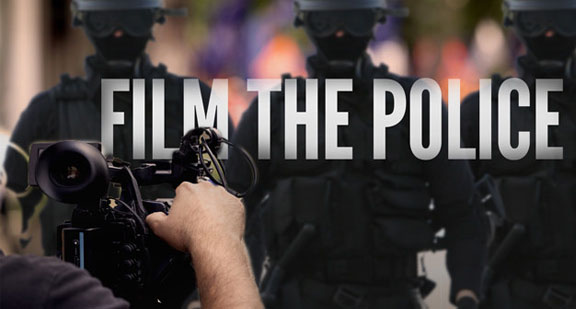
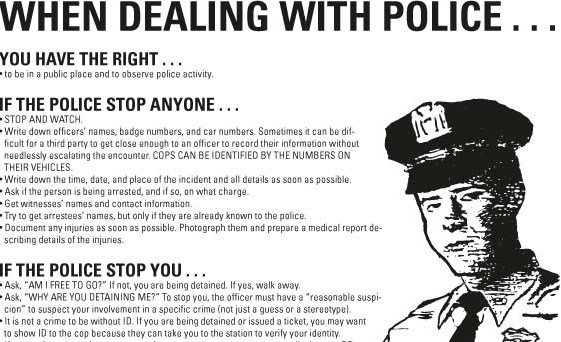
In several states, organized groups that use police scanners and knowledge of checkpoints to collectively monitor police activities by legally and peacefully filming cops on duty have said they’ve experienced retaliation, including unjustified detainment and arrests as well as police intimidation.

The groups operate under many decentralized organizations, most notably CopWatch and Cop Block, and have proliferated across the United States in the last decade – and especially in the aftermath of the events that continue to unfold in Ferguson, Missouri, after officer Darren Wilson fatally shot unarmed, black teenager Michael Brown.

Many such groups have begun proactively patrolling their communities with cameras at various times during the week, rather than reactively turning on their cameras when police enter into their neighborhoods or when they happen to be around police activity.

Across the nation, local police departments are responding to organized cop watching patrols by targeting perceived leaders, making arrests, threatening arrests, yanking cameras out of hands and even labeling particular groups “domestic extremist” organizations and part of the sovereign citizens movement – the activities of which the FBI classifies as domestic terrorism.

Courts across the nation at all levels have upheld the right to film police activity. The American Civil Liberties Union (ACLU) and photographer’s associcationshave taken many similar incidents to court, consistently winning cases over the years. The Supreme Court has ruled police can’t search an individual’s cellphone data without a warrant. Police also can’t legally delete an individual’s photos or video images under any circumstances.

“Yet, a continuing stream of these incidents (often driven by police who have been fed ‘nonsense‘ about links between photography and terrorism) makes it clear that the problem is not going away,” writes Jay Stanley, a senior policy analyst at the ACLU’s Speech, Privacy & Technology Project.

Sources who have participated in various organized cop watching groups in cities such as New York; Chicago; Cleveland; Las Vegas; Oakland; Arlington, Texas; Austin and lastly Ferguson, Missouri, told Truthout they have experienced a range of police intimidation tactics, some of which have been caught on film. Cop watchers told Truthout they have been arrested in several states, including Texas, New York, Ohio and California in retaliation for their filming activity.

More recently, in September, three cop watchers were arrested while monitoring police activity during a traffic stop in Arlington, Texas. A group of about 20 people, a few of them associated with the Tarrant County Peaceful Streets Project, gathered at the intersection of South Cooper Street and Lynda Lane during a Saturday night on September 6 to film police as they conducted a traffic stop. A video of what happened next was posted at YouTube.

Arlington police charged Janie Lucero, her husband, Kory Watkins, and Joseph Tye with interference of public duties. Lucero and Watkins were charged with obstructing a highway while Tye was arrested on charges of refusing to identify himself.

Arlington police have defended the arrests of the three cop watchers, but the watchers say they weren’t interfering with police work, and were told to move 150 feet away from the officers – around the corner of a building where they couldn’t film the officers.

“When we first started [cop watching, the police] seemed kind of bothered a little bit,” Watkins told Truthout. “There was a change somewhere where [the police] started becoming a little bit more offended, and we started having more cop watchers so I guess they felt like they needed to start bringing more officers to traffic stops.”

On the night of Watkin’s arrest, his group had previously monitored two other traffic stops without any confrontation with Arlington police officers before the incident that led to the arrests.

Sometimes, though, retaliation against cop watching groups goes far beyond arresting cop watchers on patrol.

Cops Label Cop Watch Groups Domestic Terrorists

On New Year’s Day in 2012, Antonio Buehler, a West Point graduate and former military officer, witnessed two Austin police officers assaulting a woman. He pulled out his phone.

As he began photographing the officers and asking questions about their activities, the cops assaulted and arrested him. He was charged with spitting in a cop’s face – a felony crime.

However, two witness videos of the incident surfaced and neither of them showed that Buehler spit in Officer Patrick Oborski’s face. A grand jury was finally convened in March 2013 and concluded there was not enough evidence to indict Buehler on any of the crimes he was charged with.

A few months after the New Year’s Day incident, Buehler and other Austin-based activists started the Peaceful Streets Project (PSP), an all-volunteer organization dedicated to stopping police abuse. The group has held “Know Your Rights” trainings and a Police Accountability Summit. The group also regularly organizes cop watch patrols in Austin.

Since the PSP was launched, the movement has grown, with local chapters popping up in other cities and states across the United States, including Texas’ Tarrant County chapter, which the three cop watchers arrested in Arlington were affiliated with.

But as the Peaceful Streets movement spread, police retaliation against the groups, and particularly Buehler himself, also escalated.

“[The Austin Police Department (APD)] sees us as a threat primarily because we shine a spotlight on their crimes,” Buehler said.

The group recently obtained documents from the APD through a Freedom of Information Act (FOIA) request that reveal Austin police colluded to arrest Buehler and other cop watchers affiliated with the Peaceful Streets Project. Since the New Year’s Day incident, Buehler has been arrested three more times by APD officers. At least four other members of PSP have been arrested on charges of interference or failing to identify themselves during their cop watching activities.

The emails indicate APD officers monitored Buehler’s social media posts and attempted to justify arresting him for another felony crime of online impersonation over an obviously satirical post he made on Facebook, as well as reveal that some APD officers coordinated efforts to stop PSP members’ legal and peaceful activities, even suggesting reaching out to the District Attorney’s office to see if anything could be done to incarcerate members of the group.

Another internal email from APD senior officer Justin Berry identifies PSP as a “domestic extremist” organization. Berry writes that he believes police accountability groups including PSP, CopWatch and Cop Block are part of a “national domestic extremism trend.” He believes he found “mirror warning signs” in “FBI intel.” Berry makes a strange attempt to lump police accountability activists and the hacker-collective Anonymous in with sovereign citizens groups as a collective revolutionary movement.

“Sovereign citizens” groups generally believe federal, state and local governments are illegitimate and operate illegally. Some self-described sovereign citizens create fake license plates, identification and forms of currency to circumvent official government institutions. The FBI classifies the activities of sovereign citizens groups as domestic terrorism, considering the groups a growing “domestic threat” to law enforcement.

Buehler told Truthout the APD is working with a Department of Homeland Security (DHS) fusion center to attempt to identify PSP as a sovereign citizens group to associate its members with domestic terrorism with state and federal authorities. DHS fusion centers are designed to gather, analyze and promote the sharing of intelligence information between federal and state agencies.

“They have spent a fair amount of resources tracking us, spying on us and infiltrating our group, and we are just peaceful activists who are demanding accountability for the police,” Buehler told Truthout. “They have absolutely no evidence that we’ve engaged in any criminal activity or that we’ve tried to engage in criminal activity.”

APD officials did not respond to a request for comment.

“They’ve pushed us; they’ve assaulted us for filming them; they’ve used their horses against us and tried to run us into walls; they’ve driven their cars up on us; they illegally detained us and searched us; they get in our face and they yell at us; they threaten to use violent force against us,” Buehler said. “But we didn’t realize until these emails just how deep this intimidation, how deep these efforts were to harm us for trying to hold them accountable.”

Buehler also said the group has additional internal emails which have not been released yet that reveal the APD attempted to take another charge to the District Attorney against him for felony child endangerment over the activities of a teenaged member of PSP.

He said he and other members of PSP were interested in pursuing a joint civil action against the APD over their attempts to frame and arrest them for their First Amendment activities.

This is not the first time a municipal police department has labeled a local cop watching group as an extremist organization.

In 2002, internal files from the Denver Police Department’s (DPD) Intelligence Unit were leaked to the ACLU, revealing the unit had been spying on several activist groups in the city, and keeping extensive records about members of the activist groups. Many of these groups were branded as “criminal extremist” organizations in what later became a full-scale controversy widely known as the Denver police’s “spy files.” Some of the groups falsely branded as “criminal extremist” groups included three police accountability organizations: Denver CopWatch, End the Politics of Cruelty and Justice for Mena.

Again, from October 2003 through the Republican National Convention (RNC) in August 2004, intelligence digests produced by the New York City Police Department (NYPD) on dozens of activist groups, including several police accountability organizations, were made public under a federal court order. TheNYPD labeled participants of the “Operation CopWatch” effort as criminal extremists.

Those who participated in “Operation CopWatch” during the RNC hoped to identify undercover cops who might attempt to provoke violence during demonstrations and document police violence or misconduct against protesters.

Communities Benefiting From Cop Watch Patrols Resist Police Retaliation Against Watchers

In some major urban areas, rates of police harassment of individuals drop considerably after cop watchers take to the streets – and communities band together to defend cop watch patrols that experience police retaliation, say veteran cop watchers.

Veteran police accountability activist José Martín has trained and organized with several organizations that participate in cop watch activities. Martín has been detained and arrested several times while cop watching with organized patrols in New York and Chicago.

His arrests in New York are part of a widely documented problem in the city. In fact, retaliation in New York against cop watchers has been so widespread that the NYPD had to send out an official memo to remind officers that it is perfectly legal for civilians to film cops on duty.

Martín described an experience in Chicago in which he felt police unjustly retaliated against him after a local CopWatch group formed and began regularly patrolling Chicago’s Pilsen neighborhood. After the group became well-known by the Pilsen community, residents gathered around an officer who had detained Martín after a patrol one night in 2009, calling for his release. The officer let him go shortly after.

“When cop watchers are retaliated against, if the community is organized, if there is a strong relationship between cop watch patrols and the community, but most importantly, if the cop watchers are people of the community, that community has the power to push back against retaliation and prevent its escalation,” Martín said. “Retaliation doesn’t work if you stand together.”

Another veteran cop watcher, Jacob Crawford, co-founder of Oakland’s We Copwatch, is helping the community of Ferguson, Missouri, organize cop watch patrols and prepare the community for the potential of police retaliation. His group raised $6,000 to pass out 110 cameras to organizers and residents in Ferguson, and train them to monitor police activity in the aftermath of the upheavals that rocked the city after Wilson killed Brown.

“I do expect retaliation, I do expect that these things won’t be easy, but these folks are in it,” Crawford told Truthout. “This is something that makes more sense to them than not standing up for themselves.”

via TruthOut.com

Connecticut Police Spokesman Newtown Threatens To Prosecute Independant Journalist Whistleblowers

Connecticut Police Spokesman Newtown Threatens To Prosecute Independant Journalist Whistleblowers

http://youtu.be/N4CT4boLPrU

Maybe they should prosecute the MSM.

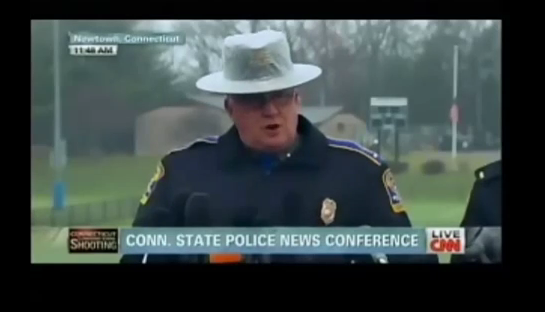
Posting Truth,Info,Questions or not believing official story Related to Mass Shooting In Newtown Connecticut at Sandy Hook Elementary School will result in arrests and prosecutions of perpetrators of WHISTLEBLOWING.
If you pay attention to what he says, he’s not talking about people impersonating the killer, he said “in any form” posting what he considers disinfo. This is a pathetic last ditch attempt to clamp down on info and try to salvage their official story.Will these guys prosecute themselves for violating First Amendment’s Rights Of The U.S. Contitution?
Now Come And Get Us Or Expect US.1-(800)-575-6330 Is how you can reach the offices of Lt J Paul Vance.

Police State Dumb-Down: Court OKs Barring High IQs for Cops

Police State Dumb-Down: Court OKs Barring High IQs for Cops

A man whose bid to become a police officer was rejected after he scored too high on an intelligence test has lost an appeal in his federal lawsuit against the city.

The 2nd U.S. Circuit Court of Appeals in New York upheld a lower court’s decision that the city did not discriminate against Robert Jordan because the same standards were applied to everyone who took the test.

“This kind of puts an official face on discrimination in America against people of a certain class,” Jordan said today from his Waterford home. “I maintain you have no more control over your basic intelligence than your eye color or your gender or anything else.”

He said he does not plan to take any further legal action.

Jordan, a 49-year-old college graduate, took the exam in 1996 and scored 33 points, the equivalent of an IQ of 125. But New London police interviewed only candidates who scored 20 to 27, on the theory that those who scored too high could get bored with police work and leave soon after undergoing costly training.

Most Cops Just Above Normal The average score nationally for police officers is 21 to 22, the equivalent of an IQ of 104, or just a little above average.

Jordan alleged his rejection from the police force was discrimination. He sued the city, saying his civil rights were violated because he was denied equal protection under the law.

But the U.S. District Court found that New London had “shown a rational basis for the policy.” In a ruling dated Aug. 23, the 2nd Circuit agreed. The court said the policy might be unwise but was a rational way to reduce job turnover.

Jordan has worked as a prison guard since he took the test.

SOURCE: ABCNews

US Police Can Copy Your iPhone’s Contents In Under Two Minutes

US Police Can Copy Your iPhone’s Contents In Under Two Minutes

It has emerged that Michigan State Police have been using a high-tech mobile forensics device that can extract information from over 3,000 models of mobile phone, potentially grabbing all media content from your iPhone in under two minutes.

The CelleBrite UFED is a handheld device that Michigan officers have been using since August 2008 to copy information from mobile phones belonging to motorists stopped for minor traffic violations. The device can circumvent password restrictions and extract existing, hidden, and deleted phone data, including call history, text messages, contacts, images, and geotags.


In short, it can copy everything on your smartphone in a matter of minutes.

Learning that the police had been using mobile forensic devices, the American Civil Liberties Union (ACLU) has issued freedom of information requests which demand that state officials open up the data collected, to better assess if penalised motorists warrant having their data copied.

Michigan State Police were more than happy to provide the information – as long as the ACLU paid $544,680. Obviously not pocket change.

“Law enforcement officers are known, on occasion, to encourage citizens to cooperate if they have nothing to hide,” ACLU staff attorney Mark P. Fancher wrote. “No less should be expected of law enforcement, and the Michigan State Police should be willing to assuage concerns that these powerful extraction devices are being used illegally by honoring our requests for cooperation and disclosure.”

Once the data is obtained, the device’s “Physical Analyzer” can map both existing and deleted locations on Google Earth, porting location data and image geotags on Google Maps.

The ACLU’s main worry is that the handheld is quietly being used to bypass Fourth Amendment protections against unreasonable searches:

“With certain exceptions that do not apply here, a search cannot occur without a warrant in which a judicial officer determines that there is probable cause to believe that the search will yield evidence of criminal activity.

A device that allows immediate, surreptitious intrusion into private data creates enormous risks that troopers will ignore these requirements to the detriment of the constitutional rights of persons whose cell phones are searched.”

The next time you are Michigan, be sure drive carefully!

SOURCE:
http://thenextweb.com/us/2011/04/20/us-police-can-copy-your-iphones-contents-in-under-two-minutes/

Map of US Police Departments’ Policies on Tracking Cell-Phone Use Without a Warrant

Map of US Police Departments’ Policies on Tracking Cell-Phone Use Without a Warrant


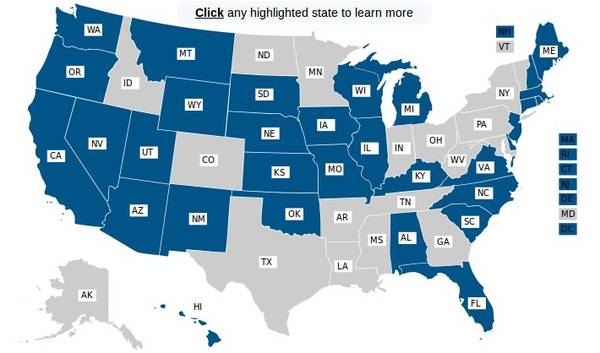
ACLU affiliates across America requested information on local law enforcement’s use of cell-phone tracking, and received a wealth of disturbing information about the extent of wireless tracking. They produced a map showing which police departments were discovered to be tracking people’s phones without a warrant, either by getting gutless phone companies to fink out their own customers for warrantless fishing expeditions, or by buying some kind of “cell phone tracking equipment.”

Many law enforcement agencies track cell phones quite frequently. For example, based on invoices from cell phone companies, it appears that Raleigh, N.C. tracks hundreds of cell phones a year. The practice is so common that cell phone companies have manuals for police explaining what data the companies store, how much they charge police to access that data, and what officers need to do to get it.

Most law enforcement agencies do not obtain a warrant to track cell phones, but some do, and the legal standards used vary widely. Some police departments protect privacy by obtaining a warrant based upon probable cause when tracking cell phones. For example, police in the County of Hawaii, Wichita, and Lexington, Ky. demonstrate probable cause and obtain a warrant when tracking cell phones. If these police departments can protect both public safety and privacy by meeting the warrant and probable cause requirements, then surely other agencies can as well.

Unfortunately, other departments do not always demonstrate probable cause and obtain a warrant when tracking cell phones. For example, police in Lincoln, Neb. obtain even GPS location data, which is more precise than cell tower location information, on telephones without demonstrating probable cause. Police in Wilson County, N.C. obtain historical cell tracking data where it is “relevant and material” to an ongoing investigation, a standard lower than probable cause.

Police use various methods to track cell phones. Most commonly, law enforcement agencies obtain cell phone records about one person from a cell phone carrier. However, some police departments, like in Gilbert, Ariz., have purchased their own cell tracking technology.

SOURCE:
http://boingboing.net/2012/04/02/map-of-us-police-departments-t.html

By: Cory Doctorow, April 2, 2012