When communities attempt to police the police, they often get, well… policed.
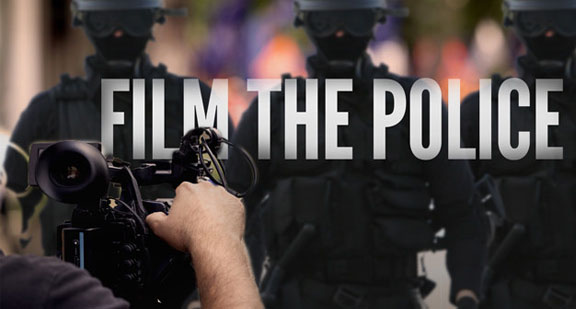
In several states, organized groups that use police scanners and knowledge of checkpoints to collectively monitor police activities by legally and peacefully filming cops on duty have said they’ve experienced retaliation, including unjustified detainment and arrests as well as police intimidation.
The groups operate under many decentralized organizations, most notably CopWatch and Cop Block, and have proliferated across the United States in the last decade – and especially in the aftermath of the events that continue to unfold in Ferguson, Missouri, after officer Darren Wilson fatally shot unarmed, black teenager Michael Brown.
Many such groups have begun proactively patrolling their communities with cameras at various times during the week, rather than reactively turning on their cameras when police enter into their neighborhoods or when they happen to be around police activity.
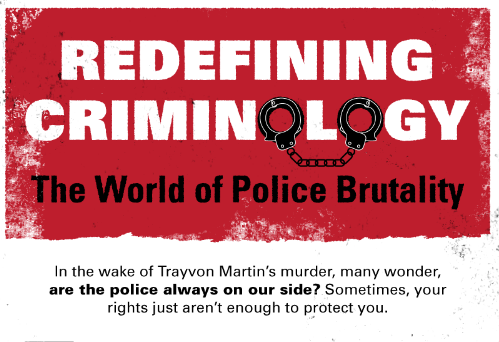
Across the nation, local police departments are responding to organized cop watching patrols by targeting perceived leaders, making arrests, threatening arrests, yanking cameras out of hands and even labeling particular groups “domestic extremist” organizations and part of the sovereign citizens movement – the activities of which the FBI classifies as domestic terrorism.
Courts across the nation at all levels have upheld the right to film police activity. The American Civil Liberties Union (ACLU) and photographer’s associcationshave taken many similar incidents to court, consistently winning cases over the years. The Supreme Court has ruled police can’t search an individual’s cellphone data without a warrant. Police also can’t legally delete an individual’s photos or video images under any circumstances.
“Yet, a continuing stream of these incidents (often driven by police who have been fed ‘nonsense‘ about links between photography and terrorism) makes it clear that the problem is not going away,” writes Jay Stanley, a senior policy analyst at the ACLU’s Speech, Privacy & Technology Project.
Sources who have participated in various organized cop watching groups in cities such as New York; Chicago; Cleveland; Las Vegas; Oakland; Arlington, Texas; Austin and lastly Ferguson, Missouri, told Truthout they have experienced a range of police intimidation tactics, some of which have been caught on film. Cop watchers told Truthout they have been arrested in several states, including Texas, New York, Ohio and California in retaliation for their filming activity.
More recently, in September, three cop watchers were arrested while monitoring police activity during a traffic stop in Arlington, Texas. A group of about 20 people, a few of them associated with the Tarrant County Peaceful Streets Project, gathered at the intersection of South Cooper Street and Lynda Lane during a Saturday night on September 6 to film police as they conducted a traffic stop. A video of what happened next was posted at YouTube.
Arlington police charged Janie Lucero, her husband, Kory Watkins, and Joseph Tye with interference of public duties. Lucero and Watkins were charged with obstructing a highway while Tye was arrested on charges of refusing to identify himself.
Arlington police have defended the arrests of the three cop watchers, but the watchers say they weren’t interfering with police work, and were told to move 150 feet away from the officers – around the corner of a building where they couldn’t film the officers.
“When we first started [cop watching, the police] seemed kind of bothered a little bit,” Watkins told Truthout. “There was a change somewhere where [the police] started becoming a little bit more offended, and we started having more cop watchers so I guess they felt like they needed to start bringing more officers to traffic stops.”
On the night of Watkin’s arrest, his group had previously monitored two other traffic stops without any confrontation with Arlington police officers before the incident that led to the arrests.
Sometimes, though, retaliation against cop watching groups goes far beyond arresting cop watchers on patrol.
Cops Label Cop Watch Groups Domestic Terrorists
On New Year’s Day in 2012, Antonio Buehler, a West Point graduate and former military officer, witnessed two Austin police officers assaulting a woman. He pulled out his phone.
As he began photographing the officers and asking questions about their activities, the cops assaulted and arrested him. He was charged with spitting in a cop’s face – a felony crime.
However, two witness videos of the incident surfaced and neither of them showed that Buehler spit in Officer Patrick Oborski’s face. A grand jury was finally convened in March 2013 and concluded there was not enough evidence to indict Buehler on any of the crimes he was charged with.
A few months after the New Year’s Day incident, Buehler and other Austin-based activists started the Peaceful Streets Project (PSP), an all-volunteer organization dedicated to stopping police abuse. The group has held “Know Your Rights” trainings and a Police Accountability Summit. The group also regularly organizes cop watch patrols in Austin.
Since the PSP was launched, the movement has grown, with local chapters popping up in other cities and states across the United States, including Texas’ Tarrant County chapter, which the three cop watchers arrested in Arlington were affiliated with.
But as the Peaceful Streets movement spread, police retaliation against the groups, and particularly Buehler himself, also escalated.
“[The Austin Police Department (APD)] sees us as a threat primarily because we shine a spotlight on their crimes,” Buehler said.
The group recently obtained documents from the APD through a Freedom of Information Act (FOIA) request that reveal Austin police colluded to arrest Buehler and other cop watchers affiliated with the Peaceful Streets Project. Since the New Year’s Day incident, Buehler has been arrested three more times by APD officers. At least four other members of PSP have been arrested on charges of interference or failing to identify themselves during their cop watching activities.
The emails indicate APD officers monitored Buehler’s social media posts and attempted to justify arresting him for another felony crime of online impersonation over an obviously satirical post he made on Facebook, as well as reveal that some APD officers coordinated efforts to stop PSP members’ legal and peaceful activities, even suggesting reaching out to the District Attorney’s office to see if anything could be done to incarcerate members of the group.
Another internal email from APD senior officer Justin Berry identifies PSP as a “domestic extremist” organization. Berry writes that he believes police accountability groups including PSP, CopWatch and Cop Block are part of a “national domestic extremism trend.” He believes he found “mirror warning signs” in “FBI intel.” Berry makes a strange attempt to lump police accountability activists and the hacker-collective Anonymous in with sovereign citizens groups as a collective revolutionary movement.
“Sovereign citizens” groups generally believe federal, state and local governments are illegitimate and operate illegally. Some self-described sovereign citizens create fake license plates, identification and forms of currency to circumvent official government institutions. The FBI classifies the activities of sovereign citizens groups as domestic terrorism, considering the groups a growing “domestic threat” to law enforcement.
Buehler told Truthout the APD is working with a Department of Homeland Security (DHS) fusion center to attempt to identify PSP as a sovereign citizens group to associate its members with domestic terrorism with state and federal authorities. DHS fusion centers are designed to gather, analyze and promote the sharing of intelligence information between federal and state agencies.
“They have spent a fair amount of resources tracking us, spying on us and infiltrating our group, and we are just peaceful activists who are demanding accountability for the police,” Buehler told Truthout. “They have absolutely no evidence that we’ve engaged in any criminal activity or that we’ve tried to engage in criminal activity.”
APD officials did not respond to a request for comment.
“They’ve pushed us; they’ve assaulted us for filming them; they’ve used their horses against us and tried to run us into walls; they’ve driven their cars up on us; they illegally detained us and searched us; they get in our face and they yell at us; they threaten to use violent force against us,” Buehler said. “But we didn’t realize until these emails just how deep this intimidation, how deep these efforts were to harm us for trying to hold them accountable.”
Buehler also said the group has additional internal emails which have not been released yet that reveal the APD attempted to take another charge to the District Attorney against him for felony child endangerment over the activities of a teenaged member of PSP.
He said he and other members of PSP were interested in pursuing a joint civil action against the APD over their attempts to frame and arrest them for their First Amendment activities.
This is not the first time a municipal police department has labeled a local cop watching group as an extremist organization.
In 2002, internal files from the Denver Police Department’s (DPD) Intelligence Unit were leaked to the ACLU, revealing the unit had been spying on several activist groups in the city, and keeping extensive records about members of the activist groups. Many of these groups were branded as “criminal extremist” organizations in what later became a full-scale controversy widely known as the Denver police’s “spy files.” Some of the groups falsely branded as “criminal extremist” groups included three police accountability organizations: Denver CopWatch, End the Politics of Cruelty and Justice for Mena.
Again, from October 2003 through the Republican National Convention (RNC) in August 2004, intelligence digests produced by the New York City Police Department (NYPD) on dozens of activist groups, including several police accountability organizations, were made public under a federal court order. TheNYPD labeled participants of the “Operation CopWatch” effort as criminal extremists.
Those who participated in “Operation CopWatch” during the RNC hoped to identify undercover cops who might attempt to provoke violence during demonstrations and document police violence or misconduct against protesters.
Communities Benefiting From Cop Watch Patrols Resist Police Retaliation Against Watchers
In some major urban areas, rates of police harassment of individuals drop considerably after cop watchers take to the streets – and communities band together to defend cop watch patrols that experience police retaliation, say veteran cop watchers.
Veteran police accountability activist José Martín has trained and organized with several organizations that participate in cop watch activities. Martín has been detained and arrested several times while cop watching with organized patrols in New York and Chicago.
His arrests in New York are part of a widely documented problem in the city. In fact, retaliation in New York against cop watchers has been so widespread that the NYPD had to send out an official memo to remind officers that it is perfectly legal for civilians to film cops on duty.
Martín described an experience in Chicago in which he felt police unjustly retaliated against him after a local CopWatch group formed and began regularly patrolling Chicago’s Pilsen neighborhood. After the group became well-known by the Pilsen community, residents gathered around an officer who had detained Martín after a patrol one night in 2009, calling for his release. The officer let him go shortly after.
“When cop watchers are retaliated against, if the community is organized, if there is a strong relationship between cop watch patrols and the community, but most importantly, if the cop watchers are people of the community, that community has the power to push back against retaliation and prevent its escalation,” Martín said. “Retaliation doesn’t work if you stand together.”
Another veteran cop watcher, Jacob Crawford, co-founder of Oakland’s We Copwatch, is helping the community of Ferguson, Missouri, organize cop watch patrols and prepare the community for the potential of police retaliation. His group raised $6,000 to pass out 110 cameras to organizers and residents in Ferguson, and train them to monitor police activity in the aftermath of the upheavals that rocked the city after Wilson killed Brown.
“I do expect retaliation, I do expect that these things won’t be easy, but these folks are in it,” Crawford told Truthout. “This is something that makes more sense to them than not standing up for themselves.”
Science fiction novels and films, historically speaking, provide writers and directors with imaginative vessels for social commentary. And even though they are always a reflection of the idiosyncrasies and anxieties which permeate society in the present, they do, on occasion, manage to predict something about the future with startling accuracy.
Previously, we’ve looked at the degree to which Orwellian projections of a dystopian future have come true, particularly fears about the misapplication of technology as a means of oppressing the general public. Another set of issues that science-fiction auteurs of the past have managed to predict relates to the proliferation of genetically modified, factory produced food.
Consider Richard Fleischman’s cult-classic film Soylent Green (1973), which was an adaptation of Harry Harrison’s novel Make Room! Make Room! (1966). The story takes place in New York City in the year 2022. The world is in shambles. Overpopulation, abject poverty, depleted natural resources, scarce food, and general demoralization and desperation, have all created for a world that is fraught with tension. Things are especially bad in NYC, where the population totals around 40 million. The general public has become entirely dependent upon the Soylent Corporation, who disperse food rations. Their latest advance is a product called Soylent Green, which is said to be made chiefly of plankton, and is also said to be more nutrient dense than any of the company’s earlier products. Robert Thorn (Charlton Heston) is a NYPD detective who is tasked with investigating the mysterious death of a man who, we learn, discovered the grim secret about Soylent Green. Soylent Green wasn’t made from Plankton…but from human remains.
Within the context of these speculative fiction narratives, it all sort of makes sense in a macabre way. Post-World War II science fiction commonly depicted future societies which struggled with both population surpluses and food shortages. Thanks to Soylent Green, accidental cannibalism has become something of a trope unto itself.
The recent film Cloud Atlas(2012) dealt with a similar theme. The film was directed by Tom Tykwer and the Wachowski’s (the latter of whom are clearly not strangers to making thrillers with subversive undertones, having made The Matrix series and V for Vendetta). The film skips around quite a bit, historically and geographically. The story begins with a violent voyage along the South Pacific during the 1800’s, and addresses mounting fears about nuclear proliferation in the seventies, and ends up showing a dystopian vision of the future wherein people are routinely “recycled” to make food.
The issues, in both real life and the classic science fiction tropes, have everything to do with the scarcity of resources. As natural resources are depleted, governments resort to ethically dubious practices at mass scale. What is somewhat comforting today is that companies who offer more ecologically friendly alternatives are gaining traction in the marketplace. In terms of nutrition and agribusiness, there have been several alternative farms sprouting up all over the country, and some smaller farmers have even become confident enough to take legal action against Monsanto. In terms of eco-friendly energy consumption, solar energy is becoming increasingly common in the United States, and in Canada you can even find alternative eco-friendly energy plans through various informational websites that can let consumers bypass the main fossil-fuel based providers altogether.
What’s especially chilling about these stories, though, is that they do offer interesting comments about the current crises surrounding agribusiness – particularly with all of the stories in recent years about the Monsanto corporation’s destructive tendencies. While there’s no disputing the fact that government farm subsidies and agriculture becoming subservient to major fast food corporations has created a lot of problems, some degree of responsibility falls on consumers. It is critical, now more than ever, that we consume conscientiously…lest we desire a future society wherein people subsist exclusively on human flesh.
The New York City Police Department (NYPD) really has gone rogue; at least that’s what a high-level FBI official believes.
Among the 5 million emails the group Anonymous hacked from the servers of private intelligence firm Stratfor in February, one seems to not only confirm the controversial NYPD surveillance activities uncovered by the Associated Press, but hints at even worse civil liberties violations not yet disclosed. Anonymous later turned the emails over to WikiLeaks, with which Truthout has entered into an investigative partnership.
I keep telling you, you and I are going to laugh and raise a beer one day, when everything Intel (NYPD’s Intelligence Division) has been involved in during the last 10 years comes out – it always eventually comes out. They are going to make [former FBI Director J. Edgar] Hoover, COINTEL, Red Squads, etc look like rank amatures [sic] compared to some of the damn right felonious activity, and violations of US citizen’s rights they have been engaged in.
The description of alleged NYPD excesses was leveled by an unnamed FBI “senior official” in late November 2011, in an email sent to Fred Burton, vice president for intelligence at the Austin, Texas-based Stratfor and former deputy chief of the counterterrorism division at the State Department. Burton then sent the official’s email to what appears to be a listserv known as the “Alpha List.”
Burton did not identify the senior FBI official in the email he sent to the listserv. He describes him as a “close personal friend,” and claims he “taught him everything that he knows.” He also instructs members of the listserv not to publish the contents of the email and to use it only for background.
Stratfor, in a statement released after some of the emails were made public, said some of the emails “may be forged or altered to include inaccuracies; some may be authentic” but “having had our property stolen, we will not be victimized twice by submitting to questioning about them.”
What’s particularly stunning about the FBI senior official’s description of NYPD Intelligence Division activities, is how he connects them to previous instances when his own agency bent and broke the law in pursuit of intelligence on perceived enemies of the state throughout the 20th century – and concludes the NYPD Intelligence Division’s violations are worse. As Pulitzer Prize-winning author and former New York Times reporter Tim Weiner writes in his new book, “Enemies: A History of the FBI,” the Bureau has been “America’s closest counterpart” to a secret police.
In the email, Burton queried the FBI official to gain a better understanding of why the FBI declined to get involved with a case involving an alleged “lone wolf” terrorist and al-Qaeda sympathizer named Jose Pimentel, a 27-year-old American of Dominican descent, accused of trying to build three pipe bombs to detonate in New York City.
The FBI official responded by describing some turf and relationship issues between NYPD intelligence officials and NYPD and FBI investigators on New York City’s Joint Terrorism Task Force. It appears the FBI senior official was responding to a news story about Pimentel’s arrest published by the far-right leaning Newsmax, headlined “FBI- NYPD Tensions Highlighted in Terror Case,” which was attached to an email Stratfor analysts had sent around the office.
There are two issues with this case (off the record of course).
One is the source (confidential informant) was a nightmare and was completely driving the investigation. The only money, planning, materials etc the bad guy got was from … the source. The source was such a maron [sic], he smoked dope with the bad guy while wearing an NYPD body recorder – I heard in open source [sic] yesterday btw [by the way], he is going to be charged with drug possession based on the tape. Ought to go over very nicely when he testifies against the bad guy, don’t you think?
Issue two is that the real rub is between NYPD Intel, [Intelligence Division] and NYPD – JTTF [Joint Terrorism Task Force], not the FBI per se. The NYPD JTTF guys are in total sync with the Bureau and the rest of the partners who make up the JTTF – I understand there are something like 100 NYPD dics [detectives] assigned to the JTTF. NYPD Intel (Cohen, et al) on the other hand, are completely running their own pass patterns. They hate their brother NYPD dics on the JTTF and are trying to undermine them at every turn. They are also listening to [former CIA official David] Cohen [the head of NYPD’s Intelligence Division] who, near as anybody can tell, never had to make a criminal case or testify in court.
Joint Terrorism Task Forces are FBI-led counterterrorism investigative units that combine federal, state and local law enforcement in an effort to detect and investigate terrorist activity and prevent attacks before they occur. Originally created in the 1980s, the creation of JTTFs nationwide was accelerated after 9-11. Currently, 104 JTTFs operate nationwide and are considered one of the most important assets in the federal government’s muscular counterterrorism architecture.
After reviewing the Stratfor email thread for Truthout, Michael German, senior policy counsel at the American Civil Liberties Union’s Washington Legislative Office and a former FBI agent who infiltrated white supremacist terrorist organizations, described the FBI official’s criticism of the NYPD’s intelligence as “doubly ironic.”
“The FBI has engaged in widespread spying on the Muslim American community as well, including counting mosques and mapping Muslim neighborhoods, infiltrating mosques with informants, and using the guise of community outreach to spy on Muslim religious and advocacy organizations,” German told Truthout. “But more critically, because the FBI is charged with enforcing the civil rights laws in this country, including violations under color of law.
“This agent suggests the FBI knew the NYPD Intelligence agents were involved in widespread ‘felonious’ activity in violation of Americans’ civil rights, yet the FBI does not appear to have opened a civil rights investigation or done anything to stop this illegal activity. Our laws are designed to apply equally to protect all of us, including to protect us from illegal police activity. When the FBI abdicates this responsibility, all Americans suffer.”
Responding to the background information from the FBI senior official, Sean Noonan, a “tactical analyst” with Stratfor, wrote in an email sent to the “Alpha List,” “The point that the divide is within NYPD is contradictory to how they would like present it. [sic]. The way the pro-NYPD stories cover it is that NYPD CT/Intel [counterterrorism/intelligence] has successfully gained influence within the JTTF, almost to the point of having infiltrated it.”
German, however, tells Truthout that the rift between the NYPD’s intelligence analysts and NYPD investigators assigned to the FBI’s JTTF, as revealed by the senior FBI official’s email, is consistent with his experience.
“Criminal investigators, like those assigned to the JTTFs, typically find information produced by these intelligence analysts to be useless, whether they’re NYPD intelligence or FBI intelligence,” he said.
And no matter how bad the mutual acrimony between NYPD intelligence analysts and New York City’s JTTF has gotten, German isn’t surprised that the FBI has declined to investigate allegations of the NYPD Intelligence Division breaking the law.
“The FBI didn’t open investigations when it discovered other government agencies engaging in torture and illegal wiretapping either,” he said.
But eventually, the senior FBI official predicts in his email to Burton, the extent of NYPD’s alleged crimes will be revealed.
“As Rush Limbaugh likes to say, ‘don’t doubt me on this,'” he wrote at the end of his correspondence.
Matthew Harwood is a journalist in Washington, DC, and a frequent contributor to the Guardian’s Comment is Free. His writing has appeared in The Washington Monthly, Progress Magazine (U.K.) as well as online at Columbia Journalism Review, CommonDreams, and Alternet. He is currently working on a book about evangelical Christian rhetoric and aggressive US foreign policy. You can follow Matt on Twitter @mharwood31.
Jason Leopold is lead investigative reporter of Truthout. He is the author of the Los Angeles Times bestseller, News Junkie, a memoir. Visit jasonleopold.com for a preview. His most recent investigative report, “From Hopeful Immigrant to FBI Informant: The Inside Story of the Other Abu Zubaidah,” is now available as an ebook. Follow Jason on Twitter: @JasonLeopold.
Remember the Occupy Movement? Since last November, when the NYPD closed the Zuccotti Park encampment in downtown Manhattan –the Movement’s birthplace and symbolic nexus—Occupy’s relevance has seriously dwindled, at least as measured by coverage in the mainstream media. We’re told that this erosion is due to Occupy’s own shortcomings—an inevitable outcome of its disjointed message and decentralized leadership.
While that may be the media’s take, the U.S. Government seems to have a different view.
If recent documents obtained by the Partnership for Civil Justice Fund (PCJF) are any indication, the Occupy Movement continues to be monitored and curtailed in a nationwide, federally-orchestrated campaign, spearheaded by the Department of Homeland Security (DHS).
The documents, many of which are partially blacked-out emails, demonstrate a surprising degree of coordination between the DHS’s National Operations Center (NOC) and local authorities in the monitoring of the Occupy movement. Cities implicated in this wide-scale snooping operation include New York, Oakland, Atlanta, Washington, D.C., Denver, Boston, Portland, Detroit, El Paso, Houston, Dallas, Seattle, San Diego, and Los Angeles.
Interest in the Occupy protesters was not limited to DHS and local law enforcement authorities. The most recently released correspondence contains Occupy-related missives between the DHS and agencies at all levels of government, including the Mayor of Portland, regional NOC “fusion centers,” the General Services Administration (GSA), the Pentagon’s USNORTHCOM (Northern Command), and the White House. Mara Verheyden-Hilliard, Executive Director of the PCJF, contends that the variety and reach of the organizations involved point to the existence of a larger, more pervasive domestic surveillance network than previously suspected.
These documents show not only intense government monitoring and coordination in response to the Occupy Movement, but reveal a glimpse into the interior of a vast, tentacled, national intelligence and domestic spying network that the U.S. government operates against its own people. These heavily redacted documents don’t tell the full story. They are likely only a subset of responsive materials and the PCJF continues to fight for a complete release. They scratch the surface of a mass intelligence network including Fusion Centers, saturated with ‘anti-terrorism’ funding, that mobilizes thousands of local and federal officers and agents to investigate and monitor the social justice movement. (justiceonline.org)
As alarmist as Verheyden-Hilliard’s charge may sound, especially given the limited, bowdlerized nature of the source material, the texts made available contain disturbing evidence of insistent federal surveillance. In particular, the role of the “Fusion Centers,” a series of 72 federally-funded information hubs run by the NOC, raises questions about the government’s expansive definition of “Homeland Security.”
Created in the wake of 9/11, the Fusion Centers were founded to expedite the sharing of information among state and local law enforcement and the federal government, to monitor localized terrorist threats, and to sidestep the regulations and legislation preventing the CIA and the military from carrying out domestic surveillance (namely, the CIA ban on domestic spying and the Posse Comitatus Act).
Is nonviolent, albeit obstructive, citizen dissent truly an issue of national security? The DHS, for its part, is aware of the contentiousness of civilian monitoring. That’s why, in a White House-approved statement to CBS News included in the dossier, DHS Press Secretary Matthew Chandler asserts that
Any decisions on how to handle specifics (sic) situations are dealt with by local authorities in that location. . . DHS is not actively coordinating with local law enforcement agencies and/or city governments concerning the evictions of Occupy encampments writ large.
However, as a reading of the documents unmistakably demonstrates, this expedient PR nugget is far from the truth. In example after example, from its seeking of “public health and safety” grounds from the City of Portland for Occupy’s ejection from Terry Schrunk Plaza, to its facilitation of information sharing between the police departments of Chicago and Boston (following a 1500-person Occupy protest in Chicago), the DHS’s active ”coordinating” with local authorities is readily apparent. Other communiqués are even more explicit in revealing a national focus, such as the DHS’s preemptive coordination with the Pentagon about a port closure in Oakland, and its collection of identity and contact information of Occupy protesters arrested at a Bank of America in Dallas.
Those Pesky Amendments
The right to public assembly is a central component of the First Amendment. The Fourth Amendment is supposed to protect Americans from warrantless searches—with the definition of “search” expanded in 1967 to include electronic surveillance, following the Supreme Court’s ruling in Katz v. United States. Assuming the Occupy protesters refrain from violence—and the vast majority do, in accord with a stated tenet of the Occupy movement—the movement’s existence is constitutionally protected, or should be.
The DHS’s monitoring, documenting, and undermining of protesters may in fact violate the First Amendment. In a recent piece for Dissent Magazine, sociologist James B. Rule explains the fundamental importance of a movement like Occupy in the American political landscape.
This surveillance campaign against Occupy is bad news for American democracy. Occupy represents an authentic, utterly home-grown, grassroots movement. Taken as a whole, it is neither terrorist nor conspiratorial. Indeed, it is hard to think of another movement so cumbersomely public in its deliberations and processes. Occupy is noisy, disorderly, insubordinate, and often inconvenient for all concerned—statements that could equally well apply to democracy in general. But it should never be targeted as a threat to the well-being of the country—quite the contrary.
Accordingly, Rule calls for the White House to rein in the ever-expanding surveillance activity of the DHS—which he contends is motivated by its own funding interests, and which prioritizes security at the expense of civil liberties.
The resource-rich Department of Homeland Security and its allies no doubt see in the rise of the movement another opportunity to justify their own claims for public legitimacy. We can be sure that many in these agencies view any noisy dissent as tantamount to a threat to national security.
[snip]
Nobody who cares about democracy wants to live in a world where simply engaging in vociferous protest qualifies any citizen to have his or her identity and life details archived by state security agencies. Specific, overt threats of civil disobedience or other law-breaking should be dealt with on a piecemeal basis—not by attempting to monitor everyone who might be moved to such actions, all the time. Meanwhile, the White House should issue clear directives that identification and tracking of lawful protesters will play no further role in any government response to this populist moment.
Optimistic as it may be, Rule’s appeal to the White House is a problematic one, given the ubiquitous influence of the DHS revealed by these documents. If the White House-approved press release is any indication, the Oval Office, while not directly authorizing the DHS’s initiatives, is certainly turning a blind eye to the Department’s focus on the Occupy movement as a potential terrorist threat. Federal surveillance of citizens in the Bush years, most visible in NSA warrantless wiretapping controversy, has apparently not ceased with Obama’s inauguration.
Which raises the question: Does Obama, as he claims, “stand with the 99 percent,” or with those who cannot stand them?
# #
WhoWhatWhy plans to continue doing this kind of groundbreaking original reporting. You can count on it. But can we count on you? We cannot do our work without your support.