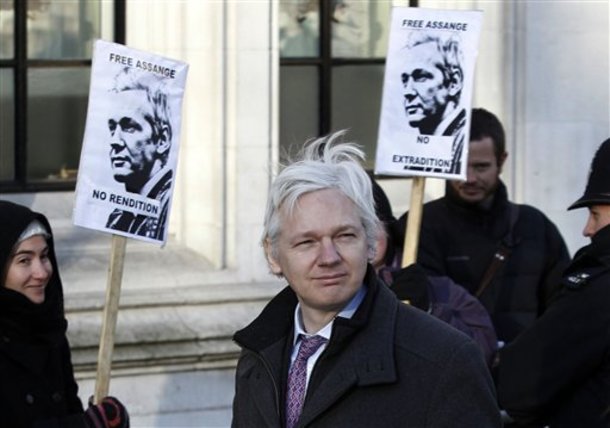
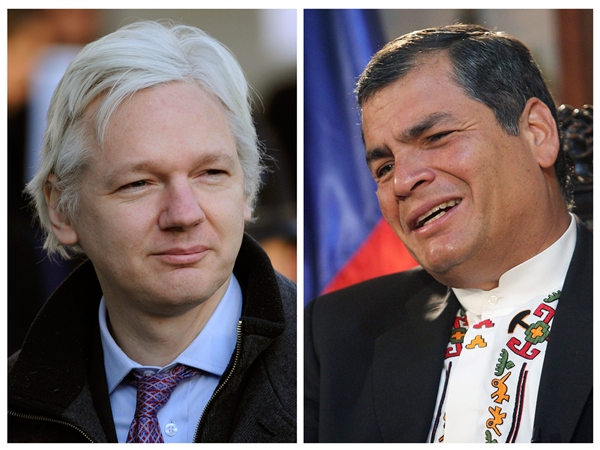
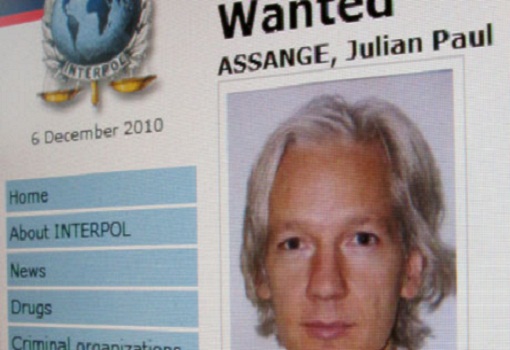
Julian Assange Julian Paul Assange is an Australian publisher and journalist. He is known as the editor-in-chief of the website WikiLeaks, which he co-founded in 2006 after an earlier career in hacking and programming.Julian Paul Assange is an Australian publisher and journalist. He is known as the editor-in-chief of the website WikiLeaks, which he co-founded in 2006 after an earlier career in hacking and programming.Julian Paul Assange is an Australian publisher and journalist. He is known as the editor-in-chief of the website WikiLeaks, which he co-founded in 2006 after an earlier career in hacking and programming.Julian Assange Julian Paul Assange is an Australian publisher and journalist. He is known as the editor-in-chief of the website WikiLeaks, which he co-founded in 2006 after an earlier career in hacking and programming.Julian Paul Assange is an Australian publisher and journalist. He is known as the editor-in-chief of the website WikiLeaks, which he co-founded in 2006 after an earlier career in hacking and programming.Julian Paul Assange is an Australian publisher and journalist. He is known as the editor-in-chief of the website WikiLeaks, which he co-founded in 2006 after an earlier career in hacking and programming.Julian Assange Julian Paul Assange is an Australian publisher and journalist. He is known as the editor-in-chief of the website WikiLeaks, which he co-founded in 2006 after an earlier career in hacking and programming.Julian Paul Assange is an Australian publisher and journalist. He is known as the editor-in-chief of the website WikiLeaks, which he co-founded in 2006 after an earlier career in hacking and programming.Julian Paul Assange is an Australian publisher and journalist. He is known as the editor-in-chief of the website WikiLeaks, which he co-founded in 2006 after an earlier career in hacking and programming.
Anonymous Hacktivists: ‘Bigger and Stronger Than Ever’
NSA’s Marching Orders to Congress: Deceive the Public, Praise NSA Effusively
Next generation of airport scanners will scan every single molecule in your body
Review: Cypherpunks: Freedom and the Future of the Internet by Julian Assange with Jacob Appelbaum, Andy Müller-Maguhn and Jérémie Zimmermann. OR Books, New York, 2012, 186 pages, Paper.
Sentry System Combines a Human Brain with Computer Vision
TSA chief will be a ‘no show’ at congressional hearing
West Bank and East Jerusalem buses are already segregated
JOINT MEDIA RELEASE:
Indigenous Social Justice Association &
Support Assange & WikiLeaks Coalition
September 9, 2012
ISJA: It is with a sense of pride and complete social justice that this Association has worked with the Sydney Support Assange and WikiLeaks Coalition to have the privilege of successfully arranging for Julian Assange to be able to be issued with an Aboriginal Nations Passport that his father, John Shipton, will accept on his behalf at the Welcome to Aboriginal Land Passport Ceremony to be held at The Settlement, 17 Edward Street, Darlington from 11am to 4pm on Saturday 15 September, 2012.
We strongly endorse the words of Ms Linda Pearson of the Support Assange and WikiLeaks Coalition, see below, on the total lack of support by our Federal Government to assist Julian against being press-ganged to America to face corrupt charges against him for informing the world’s people of the absolute lies that all Governments continue to tell their people. Whilst it is true that all Governments lie, it is well known that America leads the pack in their eternal quest for American hegemony of the world’s resources. It is well known that all Australian Governments since the dismissal of the Whitlam Government in 1975, that was assisted and orchestrated by America’s CIA, have meekly put our country at the policies of the American Foreign Policy interests. Julian is but another example.
The Ceremony is being held at the behest of many migrant, refugee and non-Aboriginal Australians who wish to fully recognise the Traditional Owners of the many Aboriginal Nations that still exist to this very day. They wish to show their full respect to the true history of this land and that is that we Aborigines still have full Sovereignty over our Lands.
Always was…always will be… Aboriginal Land.
The crimes of the 1788 Invasion and the subsequent Colonisation still need to be addressed and accounted for but we believe that the Passport Ceremony is the first of many steps that are required by those who wish to participate in a multicultural and pluralistic Reconciliation. Not the assimilationist Reconciliation wanted by Australian Governments and other racists but the real and honourable Reconciliation of removing the-white-blindfold of our joint history and allowing a mutual respect to be created.
By agreement we will be issuing both Julian Assange, via his father, and Mamdoub Habib, who will be present, an Aboriginal Nations Passport that will allow both to respectfully travel through the Aboriginal Nations. Mamdoub now and Julian on his return to Aboriginal Australia. Both these men were denied any assistance, firstly by the Howard Government and then by the Gillard Government respectively. These nefarious actions were taken by these two Governments to appease their American masters. We will attempt to right that wrong.
All those who wish to be issued with a Passport may obtain one by, firstly, signing the Pledge, giving some personal details to be added to the Passport, supplying a passport sized photo and a charge of $10 to help in affraying costs: aboriginalpassportceremony.org/how-to-get-an-aboriginal-passport/. The Passports are for use by Non-Aboriginal people only and can only be used to travel through the Aboriginal Nations. This does not apply to Aborigines as we have our own cultural methods of travelling through Country.
The Ceremony at The Settlement will include music, dancers, food and a wonderful sense of Welcome and Solidarity to all those attending. This will be an alcohol and drug free event.
We give the final word to Linda Pearson of the Support Assange and WikiLeaks Coalition:
“We are extremely grateful to the Indigenous Social Justice Association for highlighting the injustice faced by Julian Assange, and for this opportunity to show our solidarity with the Aboriginal owners of this land.
Australia is built on the injustices of invasion and colonisation. We condemn racist government polices like the Northern Territory Intervention which continue to inflict untold harm on Aboriginal and Torres Strait Islander peoples. We benefit from the occupation of stolen land, while Aboriginal people are incarcerated at five times the rate of black South Africans under apartheid.
The ISJA’s decision to issue Julian Assange an Aboriginal Passport comes as he remains confined in the Ecuadorian Embassy in London. Despite international obligations to respect Assange’s status as a political refugee, the UK government has made clear its intention to arrest him if he tries to leave the Embassy.
The Australian government should be negotiating with the UK to ensure Assange’s safe passage to Ecuador. However, our politicians have consistently put their alliance with the United States before Assange’s human rights, even when his life has been threatened.
The issuing of an Aboriginal Passport to Julian Assange brings further shame on the Australian government. It recognises that Assange’s Australian passport has been completely worthless to him.”
For further information please contact Ray Jackson 0450 651 063, Ms. Rihab Charida, Ms. Linda Pearson 0401 511 588 or Ms Anne Picot 0404 090 710.
Indigenous Social Justice Association
1303/200 Pitt Street
Waterloo NSW 2017
Phone: (02) 9318 0947
Mobile: 0450 651 063
Andrea Davison who risked her life to expose arms to Iraq and pedophillia in England and Wales has been wrongly convicted by the British Government.
Like activists and whistleblowers before her she was targeted by the State for political reasons. The State spent an estimated 1 millions pounds and 2.5 years pursuing an older lady, who even given what she was convicted of had harmed no-one at all. She is belived to have been providing intelligene to Julian Assanges network before she was arrested as the Mastermind in an international fraud early January 2010.
Claiming Andrea was the Head of a criminal network gave the Derby Police headed by DC Stephen Winnard the excuse to search her home in North Wales. This was a ploy to sieze from her thousands of documents on arms to Iraq and Iran and documents which name pedophiles in the police and the government. They also wanted to silence a lady who, working secretly with the press, had all but brought down the last Conservative Government.
The prosecution Barrister Felicity Gerry who claims to be a Human Rights Barrister set-up Andrea in collusion with Derby Police officers. It is believed that the Derby and Nottingham police blackmailed Gerry because of the Mark Kennedy Ratcliff power station case.
Gerry who knew that Mark Kennedy was an undercover cop lied to the Court. If it were not for undercover cop Mark Stone/Kennedy coming clean and admitting he had set up the Ratcliff Power Station Activists then all the innocent activists would have been convicted and jailed.
see Daily Mail http://www.dailymail.co.uk/news/article-1345707/Undercover-policeman-Mark-Kennedy-Case-collapses-offers-evidence-defence.html
Felicity Gerry did not care what lies she told to get the activists convicted because she was already embroiled deeply in corruption and easily blackmailed. She lives in Bedford with her husband and three children and is known to be involved with paedophiles. How much the Derby police know about her activities is unclear but Gerry is often chosen to Defend paedophiles
A body was set-up to investigate the Mark Kennedy affair and her role . Gerry then lied to the commission saying she knew nothing about her witness Mark Kennedy being an undercover cop. If she had not lied she would have been given a long prison sentence.
So it was easy for the Derby Fraud Squad to blackmail Gerry into setting up the innocent older lady Andrea Davison.
The Solicitors Garstangs of London were appointed by the Court against Andrea’s will and they failed to call any of her defence witnesses or present her volumes evidence proving her innocence to the jury. Important evidence to prove her innocence had been seized by the Police and they failed to make disclosure of this. The jury were not told about the thousands of documents on arms to Iraq that were seized by the police or the numerous Human Rights abuses Andrea had suffered at the hands of the Police and the State.
In August of the year of her arrest in January 2010 her friend and neighbour ‘spy in a bag’ Gareth Williams was murdered in London by the same people who are out to silence Andrea.
Even after persecuting Andrea for nearly three years they could not find any evidence that she has caused anyone any loss, or had harmed anyone and there was no complainant. For example one of the crimes she received a 2 and a half year sentence for was stealing a passport from the passport office. This was her own passport which she paid for. The passport office had put a 6 instead of an O in her date of birth and she has not complained. How could a jury convict someone of theft for stealing their own passport? they should have realised the police were clutching at straws and had no real evidence against her if they were forced to charge her with stealing her own passport.
She is now seeking Political asylum the same as Julian Assange and believed to be in Ecuador or in the Embassy.
I escaped Palestine to come to a country the world believes has a just and fair legal system only to find it is a country of deep hypocrisy where the innocent are set-up by the State who have endless resources to silence those who tell the truth,
The text below is translated from the official Spanish transcript of today’s press statement issued by Ecuadorian Foreign Minister Ricardo Patiño Aroca, explaining Ecuador’s decision to grant asylum to Julian Assange. Here is a backup text in case Ecuadorian govt. website goes down : backup 1, backup 2.
This translation was crowd-sourced with the help of @DUVFree, BCK, BM, and other anonymous volunteers. Thanks for your contribution!
Note: links inserted in brackets have been added by WLPress for reference
Declaration by the Government of the Republic of Ecuador on Julian Assange’s asylum application
Ecuadorian nationals show their support for Assange outside of the Embassy of Ecuador in London.
On June 19, 2012, the Australian national Mr. Julian Assange appeared at the premises of the Ecuadorian Embassy in London to request that the Ecuadorean State provide him with diplomatic protection, thus invoking the existing Diplomatic Asylum rules. The applicant had made his asylum request based on his fear of eventual political persecution by a third country, the same country whom could use his extradition to the Kingdom of Sweden to enable an expedited subsequent extradition.
The Government of Ecuador, faithful to the asylum procedures and with the utmost attention to this case, has reviewed and evaluated all aspects of this case, particularly the arguments presented by Mr. Assange to support the fear he feels regarding this situation as a threat to his life, personal safety and freedoms.
It is important to note that Mr. Assange has taken the decision to seek asylum and protection of Ecuador over alleged allegations of “espionage and treason,” which “instigate fear of the possibility of being handed over to the United States of America by British, Swedish or Australian authorities,“ said Mr. Assange, since the USA is chasing him for releasing compromising information sensitive to the U.S. Government. The applicant mentions that he “is a victim of persecution in various countries, which is deduced not only from their ideas and actions, but of his work of publishing information which compromises the powerful, uncovers the truth and therefore exposes corruption and abuses of human rights of citizens around the world.”
Therefore, according to the applicant, the indictment for crimes of a political nature is the basis for his asylum request, because in his judgement he is facing a situation involving an imminent danger which he cannot escape. In order to assess his fear of possible political persecution, and that this persecution could end up becoming a situation which curtails and violates his rights, integrity, and could become a risk to his personal safety and freedom, the Government of Ecuador has considered the following:
Julian Assange is an award-winning communications professional internationally known for his struggles for freedom of expression, press freedom and human rights in general;
Mr. Assange shared privileged documents and information generated by various sources that affected employees, countries and organizations with a global audience;
That there is strong evidence of retaliation by the country or countries that produced the information disclosed by Mr. Assange, retaliation that may endanger his safety, integrity, and even his life;
That, despite Ecuador’s diplomatic efforts, countries which have been asked togive adequate safeguards for the protection and safety for the life of Mr. Assange have refused to facilitate them;
That Ecuadorian authorities are certain of the possibility that Mr. Assange could be extradited to a third country outside the European Union without proper guarantees for their safety and personal integrity;
That legal evidence clearly shows that, given an extradition to the United States of America, it would be unlikely for Mr. Assange to receive a fair trial, and likely that he would be judged by special or military courts, where there is a high probability of suffering cruel and degrading treatment, and be sentenced to life imprisonment or capital punishment, which would violate his human rights;
That while Mr. Assange must answer for the investigation in Sweden, Ecuador is aware that the Swedish prosecutor has had a contradictory attitude that prevented Mr. Assange the full exercise of the legitimate right of defense;
Ecuador is convinced that the procedural rights of Mr. Assange have been infringed upon during the investigation;
Ecuador has observed that Mr. Assange lacks the protection and assistance that should be received from the State of which he is a citizen;
That, following several public statements and diplomatic communications by officials from Britain, Sweden and the USA, it is inferred that these governments would not respect international conventions and treaties, and would give priority to domestic law, in violation of explicit rules of universal application and,
That, if Mr. Assange is remanded to custody in Sweden (as is customary in this country), a chain of events would begin that would prevent further protective measures from being taken to avoid possible extradition to a third country.
Thus, the Government of Ecuador believes that these arguments lend support to the fears of Julian Assange, and it believes that he may become a victim of political persecution, as a result of his dedicated defense of freedom of expression and freedom of press as well as his repudiation of the abuses of power in certain countries, and that these facts suggest that Mr. Assange could at any moment find himself in a situation likely to endanger life, safety or personal integrity. This fear has driven him to exercise the right to seek and receive asylum in the Embassy of Ecuador in the UK.
Article 41 of the Constitution of the Republic of Ecuador clearly defines the right of asylum. Under this provision, the rights of asylum and refugee status are fully recognized in Ecuador in accordance with international law and instruments of human rights. According to this constitutional provision:
“Persons who find themselves in a situation of asylum and refuge shall enjoy special protection to ensure the full exercise of their rights. The State shall respect and ensure the principle of non-refoulement [http://en.wikipedia.org/wiki/Non-refoulement], and shall provide emergency legal and humanitarian assistance.”
Similarly, the right to asylum is enshrined in Article 4.7 of the Foreign Service Act of 2006 (Ley Orgánica del Servicio Exterior), which establishes the ability of the Ministry of Foreign Affairs, Trade and Integration of Ecuador to hear cases of diplomatic asylum, in accordance with laws, treaties, and international norms and laws.
It should be stressed that our country has stood out in recent years to accommodate a large number of people who have applied for territorial asylum or refugee status, having unconditionally respected the principle of non-refoulement and non-discrimination, while it has taken steps to provide refugee status in an expeditious manner, taking into account the circumstances of applicants, mostly Colombians fleeing armed conflicts in their own country. The UN High Commissioner for Refugees has praised Ecuador’s refugee policy, and highlighted the important fact that the country has not confined these people to camps, but has integrated them into Ecuadorian society, with full enjoyment of their human and natural rights.
Ecuador places the right of asylum in the category of universal human rights and beliefs, therefore, that the effective implementation of this right requires international cooperation that our countries can provide, without which it would be fruitless, and the institution would be totally ineffective. For these reasons, and recalling the obligation of all States to assist in the protection and promotion of human rights as provided by the United Nations Charter, we invite the British Government to lend its assistance in achieving this purpose.
To that effect, the state of Ecuador can confirm, following analysis of the legal institutions related to asylum, that the foundation of these rights has set out fundamental principles of general international law, the same as for its universal scope and importance, because of its consistance with the general interest of the entire international community, and full recognition by all states. These principles, which are set forth in various international instruments are as follows:
a) Asylum in all its forms is a fundamental human right creating obligations erga omnes, ie “for all” states.
b) Diplomatic asylum, refuge (or territorial asylum), and the right not to be extradited, expelled, delivered or transferred, are comparable human rights, since they are based on the same principles of human protection: non-refoulement and non-discrimination without any adverse distinction based on race, color, sex, language, religion or belief, political or other opinion, national or social origin, property, birth or other status or any other similar criteria.
c) All these forms of protection are governed by the principles pro person (i.e. more favorable to the individual), equality, universality, indivisibility, interrelatedness and interdependence.
d) The protection occurs when the State granting asylum, required refuge, or powers of protection, consider that there is a risk or fear that the protected person may be a victim of political persecution, or is charged with political offenses.
e) The State granting asylum qualifies the causes of asylum and extradition case, weigh the evidence.
f) No matter which of its forms or modality, asylum always has the same cause and lawful object, i.e. political persecution, which makes it permissible, and to safeguard the life, personal safety and freedom of the protected person, which is its legitimately intended purpose.
g) The right of asylum is a fundamental human right, therefore, belongs to jus cogens, i.e. the system of mandatory rules of law recognized by the international community as a whole, for which no derogation is permitted, making null all treaties and provisions of international law which oppose it.
h) In cases not covered by existing law, the human person remains under the protection of the principles of humanity and the dictates of public conscience, or are under the protection and rules of the principles of jus gentium [http://en.wikipedia.org/wiki/Jus_gentium] derived from established customs, the principles of humanity and from dictates of public conscience [http://www.icrc.org/ihl.nsf/full/470?opendocument].
i) The lack of international agreement or domestic legislation of States cannot legitimately be invoked to limit, impair or deny the right to asylum.
j) The rules and principles governing the rights to asylum or refuge, no extradition, no handing over, no expulsion and no transfer are convergent, to the extent necessary to enhance the protection and provide it with maximum efficiency. In this sense, they are complementary to the international human rights law, the right of asylum and refugee law, and humanitarian law.
k) The rights of protection of the human being are based on ethical principles and universally accepted values and therefore have a humanistic, social, solidaric, peaceful and humanitarian character.
l) All States have a duty to promote the progressive development of international human rights through effective national and international action.
Ecuador has judged that the laws applicable to the asylum case of Mr. Julian Assange comprise the entire set of principles, standards, mechanisms and procedures provided for international human rights instruments (whether regional or universal), which include among their provisions the right to seek, receive and enjoy asylum for political reasons, the conventions governing the right of asylum and refugee law, and which recognize the right not to be delivered, returned, or expelled when credible fear of political persecution exists; conventions governing extradition law recognize the right not to be extradited when this measure covers political persecution, and conventions governing humanitarian law, recognize the right not to be transferred when there is a risk of political persecution. All these forms of asylum and international protection are justified by the need to protect this person from possible political persecution, or a possible accusation of political crimes and / or crimes related to the latter, which in the opinion of Ecuador, not only endanger Mr. Assange, but also pose a serious injustice committed against him.
It is undeniable that states, having agreed to numerous and substantive international instruments (many of them legally-binding), have the obligation to provide protection or asylum to persons persecuted for political reasons and have expressed their desire to establish a legal institution to protect human rights and fundamental freedoms based on a general practice accepted as law, which confers on such obligations a mandatory nature, erga omnes [http://en.wikipedia.org/wiki/Erga_omnes], linked to the respect, protection and progressive development of human rights and fundamental freedoms that are part of jus cogens [http://en.wikipedia.org/wiki/Peremptory_norm]. Some of these instruments are mentioned below:
a) United Nations Charter of 1945, Purposes and Principles of the United Nations: the obligation of all members to cooperate in the promotion and protection of human rights;
b) Universal Declaration of Human Rights 1948: right to seek and enjoy asylum in any country, for political reasons (Article 14);
c) Declaration of the Rights and Duties of Man, 1948: right to seek and enjoy asylum for political reasons (Article 27);
d) Geneva Convention of August 12, 1949, relative to the Protection of Civilian Persons in Time of War: the protected person should in no case be transferred to a country where they fear persecution for his political views ( Article 45);
e) Convention on the Status of Refugees 1951 and Protocol of New York, 1967: prohibits returning or expelling refugees to countries where their lives and freedom would be threatened (Art. 33.1);
f) Convention on Diplomatic Asylum, 1954: The State has the right to grant asylum and classify the nature of the offense or the motives of persecution (Article 4);
g) Convention on Territorial Asylum of 1954: the State is entitled to admit to its territory such persons as it considers necessary (Article 1), when they are persecuted for their beliefs, political opinions or affiliation, or acts that may be considered political offenses ( Article 2), the State granting asylum may not return or expel a refugee who is persecuted for political reasons or offenses (Article 3); also, extradition is not appropriate when dealing with people who, according to the requested State, be prosecuted for political crimes , or common crimes committed for political purposes, or when extradition is requested obeying political motives (Article 4);
h) European Convention on Extradition of 1957, prohibits extradition if the requested Party considers that the offense is a political charge (Article 3.1);
i) 2312 Declaration on Territorial Asylum of 1967 provides for the granting of asylum to persons who have that right under Article 14 of the Universal Declaration of Human Rights, including persons struggling against colonialism (Article 1.1). It prohibits the refusal of admission, expulsion and return to any State where he may be subject to persecution (Article 3.1);
j) Vienna Convention on the Law of Treaties of 1969, provides that the rules and principles of general international law imperatives do not support a contrary agreement, the treaty is void upon conflicts with one of these rules (Article 53), and if there arises a new peremptory norm of this nature, any existing treaty which conflicts with that provision is void and is terminated (Article 64). As regards the application of these Articles, the Convention allows States to claim compliance with the International Court of Justice, without requiring the agreement of the respondent State, accepting the court’s jurisdiction (Article 66.b). Human rights are norms of jus cogens.
k) American Convention on Human Rights, 1969: right to seek and enjoy asylum for political reasons (Article 22.7);
l) European Convention for the Suppression of Terrorism of 1977, the requested State is entitled to refuse extradition when there is a danger that the person is prosecuted or punished for their political opinions (Article 5);
m) Inter-American Convention on Extradition of 1981, the extradition is not applicable when the person has been tried or convicted, or is to be tried in a court of special or ad hoc in the requesting State (Article 4.3), when, under the classification of the requested State, whether political crimes or related crimes or crimes with a political aim pursued, and when, the circumstances of the case, can be inferred that persecution for reasons of race, religion or nationality; that the situation of the person sought may be prejudiced for any of these reasons (Article 4.5). Article 6 provides, in reference to the right of asylum, that “nothing in this Convention shall be construed as limiting the right of asylum, when appropriate.”
n) African Charter on Human and Peoples of 1981, pursued individual’s right to seek and obtain asylum in other countries (Article 12.3);
p) Charter of Fundamental Rights of the European Union 2000: establishes the right of diplomatic and consular protection. Every citizen of the Union shall, in the territory of a third country not represented by the Member State of nationality, have the protection of diplomatic and consular authorities of any Member State, under the same conditions as nationals of that State (Article 46).
The Government of Ecuador believes it is important to note that the rules and principles recognized in the international instruments mentioned above and in other multilateral agreements take precedence over domestic law of States, because these treaties are based on universal rules guided by intangible principles, whereof deriving greater respect, protection and fulfillment of human rights against unilateral attitudes of such States. This would compromise international law, which should instead be strengthened in order to consolidate the respect of fundamental rights in terms of integration and ecumenical character.
Furthermore, since Assange applied for asylum in Ecuador, we have maintained high-level diplomatic talks with the United Kingdom, Sweden and the United States.
In the course of these conversations, our country has sought to obtain strict guarantees from the UK government that Assange would face, without hindrance, an open legal process in Sweden. These safeguards include that after facing his legal responsibilities in Sweden, that he would not be extradited to a third country; that is, ensuring that the Specialty Rule [http://www.publications.parliament.uk/pa/cm200203/cmstand/d/st030114/am/30114s01.htm] is not waived. Unfortunately, despite repeated exchanges of messages, the UK at no time showed signs of wanting to reach a political compromise, and merely repeated the content of legal texts.
Assange’s lawyers invited Swedish authorities to take Assange statements in the premises of the Embassy of Ecuador in London. Ecuador officially conveyed to Swedish authorities its willingness to host this interview without interference or impediment to the legal processes followed in Sweden. This measure is absolutely legally possible. Sweden did not accept.
On the other hand, Ecuador raised the possibility that the Swedish government establish guarantees to not subsequently extradite Assange to the United States. Again, the Swedish government rejected any compromise in this regard.
Finally, Ecuador wrote to the U.S. government to officially reveal its position on Assange’s case. Inquiries related to the following:
If there is an ongoing legal process or intent to carry out such processes against Julian Assange and/or the founders of the WikiLeaks organization;
Should the above be true, then under what kind of legislation, and how and under what conditions would such persons be subject to under maximum penalties;
Whether there is an intention to request the extradition of Julian Assange to the United States.
The U.S. response has been that it cannot provide information about the Assange case, claiming that it is a bilateral matter between Ecuador and the United Kingdom.
With this background, the Government of Ecuador, true to its tradition of protecting those who seek refuge in its territory or on the premises of its diplomatic missions, has decided to grant diplomatic asylum to Mr. Assange, based on the application submitted to the President of the Republic, transmitted in writing in London, dated June 19, 2012, and supplemented by letter written in London dated June 25, 2012, for which the Government of Ecuador, after a fair and objective assessment of the situation described by Mr. Assange, according to his own words and arguments, endorsed the fears of the appellant, and accepts that there are indications which lead to the conclusion that he may face political persecution, or that such persecution could occur if timely and necessary measures are not taken to avoid it.
The Government of Ecuador is certain that the British Government knows how to assess the justice and righteousness of the Ecuadorian position, and consistent with these arguments, it is confident that the UK will offer safe passage guarantees necessary and relevant to the asylum, so that their governments can honor with action the fidelity owed to law and international institutions that both nations have helped shape along their common history.
It also hopes to maintain unchanged the excellent ties of friendship and mutual respect which bind Ecuador and the United Kingdom and their people, as they are also engaged in promoting and defending the same principles and values, and because they share similar concerns about democracy, peace, and well being, which are only possible if the fundamental rights of everyone are respected.
The latest twist in the Julian Assange case, as we await Ecuador’s decision on granting him asylum (a decision which would not, as I’ve written before, in itself allow protection from arrest if he steps outside the embassy), is that people are wondering whether the UK can simply strip the embassy of its diplomatic status, so allowing police officers to enter it.
You need to be aware that there is a legal base in the UK, the Diplomatic and Consular Premises Act 1987, that would allow us to take actions in order to arrest Mr Assange in the current premises of the Embassy.
We sincerely hope that we do not reach that point, but if you are not capable of resolving this matter of Mr Assange’s presence in your premises, this is an open option for us.
In no case is land to be regarded as a State’s diplomatic or consular premises for the purposes of any enactment or rule of law unless it has been so accepted or the Secretary of State has given that State consent under this section in relation to it; and if—
(a) a State ceases to use land for the purposes of its mission or exclusively for the purposes of a consular post; or
(b) the Secretary of State withdraws his acceptance or consent in relation to land,
it thereupon ceases to be diplomatic or consular premises for the purposes of all enactments and rules of law.
On the face of it, then, the Secretary of State (in practice a foreign office minister) could now simply withdraw consent, and with one bound, police would be free to make an arrest.
But it’s not quite as simple as that. You’ll note that section 1(4) says
The Secretary of State shall only give or withdraw consent or withdraw acceptance if he is satisfied that to do so is permissible under international law
and that according to section 1(5), in deciding whether to withdraw consent, the minister
shall have regard to all material considerations, and in particular, but without prejudice to the generality of this subsection—
(a) to the safety of the public;
(b) to national security; and
(c) to town and country planning.
The “compliance with international law” requirement may present a problem, since article 21 of the Vienna Convention on Diplomatic Relations requires the UK to facilitate the acquisition by Ecuador of premises necessary for its mission, or assist it in obtaining accommodation. It’s not obvious this allows the UK to just de-recognise the current premises without helping arrange something new.
Section 1(5) is interesting because, in spite of the way the drafting clearly intends to preserve ministers’ ability to take account of anything they think relevant, I’ve no doubt lawyers for Ecuador could argue that the list of three particular concerns colours the scope of ministers’ considerations, the result being that only some particular difficulty relating to safety or to the premises themselves could justify withdrawal.
More importantly, they could argue that Assange’s presence in the embassy and Ecuador’s conduct in sheltering him is not a material consideration; and that since that clearly lay behind the withdrawal, ministers would in deciding to withdraw consent, have taken into account an irrelevant factor.
In addition, there’d be a potentially strong argument to be made that ministers had exercised their power for an improper purpose not intended by Parliament when it enacted the 1987 legislation – their desire to arrest Julian Assange.
Ecuador could judicially review any proposed withdrawal: I think the effect on Assange means this is the type of case in which, as Lord Sumption explained in a recent speech, the courts would consider intervening in a foreign policy decision. Perhaps Assange could obtain an injunction on judicial review, preventing any arrest pending the outcome of proceedings. Of course, if the government successfully fought off that judicial review, the arrest could go ahead. But I don’t think a defence would be easy, and at the very least, a judicial review would create further delay – which probably suits Assange fairly well. I’m not sure giving him a hook to hang one on would be the best tactical move for the government.
The Quito letter from the UK to Ecuador went on apparently to say
We need to reiterate that we consider the continued use of the diplomatic premises in this way incompatible with the Vienna Convention and unsustainable and we have made clear the serious implications that this has for our diplomatic relations.
If I were advising the government, I think I’d say that, if ministers are determined to allow the arrest of Assange, it might be better simply to cut off diplomatic relations with Ecuador, send the ambassador home, close the embassy and arrest Assange after that. Ending diplomatic relations is the major sort of foreign affairs decision I doubt the courts would interfere with. But that’d be a major diplomatic call.
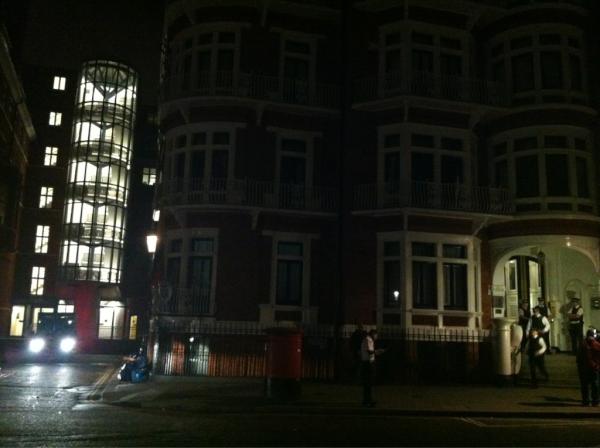
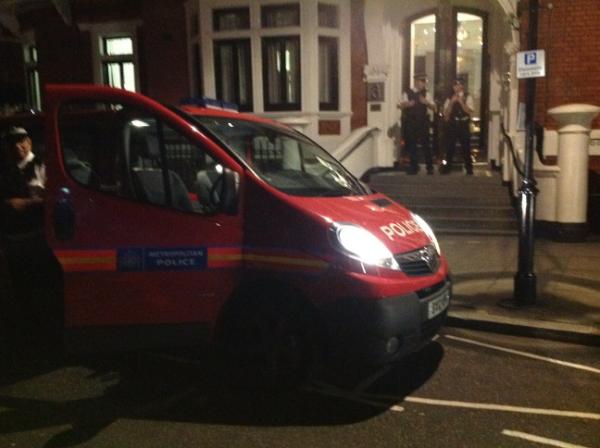
BREAKING NEWS: Police are massing at the Ecuadorian embassy in London where Australian WikiLeaks founder Julian Assange is holed up after his request for political asylum.
One personoutside the embassy, identifying himself as a “citizen journalist” with the twitter account https://twitter.com/alburyj is video streaming UK police entering the building.
Aroundt midnight, local time, WikiLeaks tweeted this morning that two large police vans had arrived ‘‘to surround the Ecuadorian embassy in London’’.
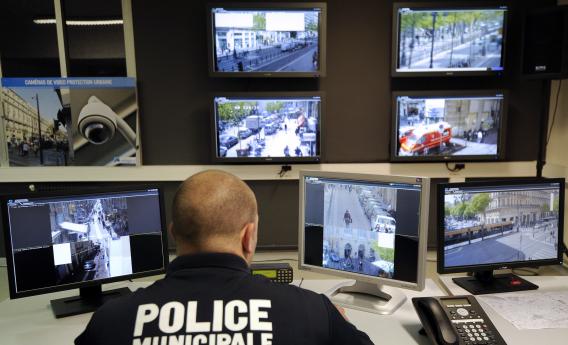
Former senior intelligence officials have created a detailed surveillance system more accurate than modern facial recognition technology — and have installed it across the US under the radar of most Americans, according to emails hacked by Anonymous.
Every few seconds, data picked up at surveillance points in major cities and landmarks across the United States are recorded digitally on the spot, then encrypted and instantaneously delivered to a fortified central database center at an undisclosed location to be aggregated with other intelligence. It’s part of a program called TrapWire and it’s the brainchild of the Abraxas, a Northern Virginia company staffed with elite from America’s intelligence community. The employee roster at Arbaxas reads like a who’s who of agents once with the Pentagon, CIA and other government entities according to their public LinkedIn profiles, and the corporation’s ties are assumed to go deeper than even documented.
The details on Abraxas and, to an even greater extent TrapWire, are scarce, however, and not without reason. For a program touted as a tool to thwart terrorism and monitor activity meant to be under wraps, its understandable that Abraxas would want the program’s public presence to be relatively limited. But thanks to last year’s hack of the Strategic Forecasting intelligence agency, or Stratfor, all of that is quickly changing.
Hacktivists aligned with the loose-knit Anonymous collective took credit for hacking Stratfor on Christmas Eve, 2011, in turn collecting what they claimed to be more than five million emails from within the company. WikiLeaks began releasing those emails as the Global Intelligence Files (GIF) earlier this year and, of those, several discussing the implementing of TrapWire in public spaces across the country were circulated on the Web this week after security researcher Justin Ferguson brought attention to the matter. At the same time, however, WikiLeaks was relentlessly assaulted by a barrage of distributed denial-of-service (DDoS) attacks, crippling the whistleblower site and its mirrors, significantly cutting short the number of people who would otherwise have unfettered access to the emails.
On Wednesday, an administrator for the WikiLeaks Twitter account wrote that the site suspected that the motivation for the attacks could be that particularly sensitive Stratfor emails were about to be exposed. A hacker group called AntiLeaks soon after took credit for the assaults on WikiLeaks and mirrors of their content, equating the offensive as a protest against editor Julian Assange, “the head of a new breed of terrorist.” As those Stratfor files on TrapWire make their rounds online, though, talk of terrorism is only just beginning.
Mr. Ferguson and others have mirrored what are believed to be most recently-released Global Intelligence Files on external sites, but the original documents uploaded to WikiLeaks have been at times unavailable this week due to the continuing DDoS attacks. Late Thursday and early Friday this week, the GIF mirrors continues to go offline due to what is presumably more DDoS assaults. Australian activist Asher Wolf wrote on Twitter that the DDoS attacks flooding the WikiLeaks server were reported to be dropping upwards of 40 gigabytes of traffic per second on the site.
According to a press release (pdf) dated June 6, 2012, TrapWire is “designed to provide a simple yet powerful means of collecting and recording suspicious activity reports.” A system of interconnected nodes spot anything considered suspect and then input it into the system to be “analyzed and compared with data entered from other areas within a network for the purpose of identifying patterns of behavior that are indicative of pre-attack planning.”
In a 2009 email included in the Anonymous leak, Stratfor Vice President for Intelligence Fred Burton is alleged to write, “TrapWire is a technology solution predicated upon behavior patterns in red zones to identify surveillance. It helps you connect the dots over time and distance.” Burton formerly served with the US Diplomatic Security Service, and Abraxas’ staff includes other security experts with experience in and out of the Armed Forces.
What is believed to be a partnering agreement included in the Stratfor files from August 13, 2009 indicates that they signed a contract with Abraxas to provide them with analysis and reports of their TrapWire system (pdf).
“Suspicious activity reports from all facilities on the TrapWire network are aggregated in a central database and run through a rules engine that searches for patterns indicative of terrorist surveillance operations and other attack preparations,” Crime and Justice International magazine explains in a 2006 article on the program, one of the few publically circulated on the Abraxas product (pdf). “Any patterns detected – links among individuals, vehicles or activities – will be reported back to each affected facility. This information can also be shared with law enforcement organizations, enabling them to begin investigations into the suspected surveillance cell.”
In a 2005 interview with The Entrepreneur Center, Abraxas founder Richard “Hollis” Helms said his signature product:
“can collect information about people and vehicles that is more accurate than facial recognition, draw patterns, and do threat assessments of areas that may be under observation from terrorists.” He calls it “a proprietary technology designed to protect critical national infrastructure from a terrorist attack by detecting the pre-attack activities of the terrorist and enabling law enforcement to investigate and engage the terrorist long before an attack is executed,” and that, “The beauty of it is that we can protect an infinite number of facilities just as efficiently as we can one and we push information out to local law authorities automatically.”
An internal email from early 2011 included in the Global Intelligence Files has Stratfor’s Burton allegedly saying the program can be used to “[walk] back and track the suspects from the get go w/facial recognition software.”
Since its inception, TrapWire has been implemented in most major American cities at selected high value targets (HVTs) and has appeared abroad as well. The iWatch monitoring system adopted by the Los Angeles Police Department (pdf) works in conjunction with TrapWire, as does the District of Columbia and the “See Something, Say Something” program conducted by law enforcement in New York City, which had 500 surveillance cameras linked to the system in 2010. Private properties including Las Vegas, Nevada casinos have subscribed to the system. The State of Texas reportedly spent half a million dollars with an additional annual licensing fee of $150,000 to employ TrapWire, and the Pentagon and other military facilities have allegedly signed on as well.
In one email from 2010 leaked by Anonymous, Stratfor’s Fred Burton allegedly writes, “God Bless America. Now they have EVERY major HVT in CONUS, the UK, Canada, Vegas, Los Angeles, NYC as clients.” Files on USASpending.gov reveal that the US Department of Homeland Security and Department of Defense together awarded Abraxas and TrapWire more than one million dollars in only the past eleven months.
News of the widespread and largely secretive installation of TrapWire comes amidst a federal witch-hunt to crack down on leaks escaping Washington and at attempt to prosecute whistleblowers. Thomas Drake, a former agent with the NSA, has recently spoken openly about the government’s Trailblazer Project that was used to monitor private communication, and was charged under the Espionage Act for coming forth. Separately, former NSA tech director William Binney and others once with the agency have made claims in recent weeks that the feds have dossiers on every American, an allegation NSA Chief Keith Alexander dismissed during a speech at Def-Con last month in Vegas.
Juice Rap News: Episode XIII – A NEWS HOPE. It is a time of corporate war; deprived of a reliable media the people of Planet Earth are kept misinformed and in a state of perpetual conflict. Is an honest Fourth Estate the only Force than can restore peace and balance to the Galaxy? To find out, we consult two of journalism’s most influential and inflammatory figures: Rebel journalist enfant terrible, Julian Assange, who awaits a verdict in London which could see him ‘extradited’ to Sweden. And on the opposite end of the journalistic spectrum: Rupert Murdoch, head of the mighty NewsCorp media Empire, embroiled in legal scandals that go to the highest and lowest levels of celebrity in Britain. In the manichean manner of some ancient laser sword and forcery epic, join the wisest news-anchor in the Galaxy, Robert Foster, as he attempts to wrangle these two figures together for a rap-debate. Will the light or the dark side prevail – and is it really that easy to know which is which? How many Bothans died to bring us this information? Is the Force Estate with Robert? Will we see THE RETURN OF THE JOURNALI before the EMPIRE EXTRADITES BACK? For answers to all these questions and more, pull down your blast shields, switch off your on-board computer and feel the Force, in this latest episode of Juice Rap News… or click play.
SUPPORT the creation of new episodes of Juice Rap News – a show which relies on private donations: http://thejuicemedia.com/donate
CREDITS:
– ARTWORK by Zoe Tame http://visualtonic.com.au
– ORIGINAL MUSIC: Main Beat: “The Golden Era” – by The GOAT, ILL Beat Constructor: http://www.thegoatbeats.com
– ORIGINAL RAP-WARS theme music composed by Adrian Sergovich.
– VIDEO: Special thanks to Jonas Schweizer in Germany for creating the animated intro and RapWars special FX. (ATM he’s working on an awesome new documentary project: http://www.indiegogo.com/CaribbeanNewcomer)
– Many thanks to the following humans for lending their time and talent to the making of this episode: Ellen (Brianna Manning and SwededTrooper_1) and Zoe (SwedeTrooper_2); Lucy for voiceovers (Admiral Gillard, Manning & SwedeTroopers); Rosie Dunlop for make-up magick; Dave Abbott for technical & video advice. And finally, to Kristinn Hrafnsson of WikiLeaks for his debut kameo.
CAPTIONS: Thanks Koolfy & Siltaar at La Quadrature du Net for English captions.
TRANSLATIONS: Thanks to Euclides for Portuguese translation :)
**If you would like to translate this episode into your language, please contact us first via: http://thejuicemedia.com/contact**
Leak Sites that publish leaks and accept submission of leaks, inspired by the original WikiLeaks.org concept.
WikiLeaks – WikiLeaks website – love them or hate them – no new submissions for 2 years – new submission system still not launched as promised on 28/11/2011 or 01/12/2011
BritiLeaks false start – BritiLeaks website – original false start: launched with less than no anonymity or security protection at all – see below for current site .
BritiLeaks – BritiLeaks website – new secure website launch promised soon, already has strong TLS Digital Certificate and Tor Hidden Services – still to be launched “in a few days”, but hosting mirrors of other whistleblowing websites.
MurdochLeaks – The Murdoch Leaks Project website – “will accept tips or evidence of wrong doing relating to Rupert Murdoch’s affiliated institutions such as News International and News Corporation”
OpenWatch – OpenWatch.net encourages the public to use their mobile phone software to record encounters with the police and authority, then submit them for posting online.
LectureLeaks – LectureLeaks – Use recording mobile software to record and leak university lectures. Has content already, open source.
CorruptionWatch.org.za – Corruption Watch – South Africa – Trades Union organised, anti-corruption pledge signatures, mapping of corruption hotspots, but no security or anonymity measures for contributors or informants at all except for “Leave this field empty, if you want to stay anonymous.“
Established Leak Sites
Websites which have been publishing censored or leaked material before, or independently in parallel with WikiLeaks
Public Intelligence – Public Intelligence website established 2009 – now back online in Luxembourg after server move from the Netherlands caused by “complaints” to the hosting company. Good Encryption, now no longer using Quantserve web bug tracking
FolhaLeaks – FolhaLeaks – Folha de S.Paulo, São Paulo, Brasil – no encryption, web form is not distinct from the main newspaper website so it betrays “anonymous” visitor details to FaceBook and to various banner advertisers etc.
Environmental Protection Whistle blowing sites
Leak Sites and Organization that accept reporting about environmental issues
NZ SIS – New Zealand Security Intelligence Service Public Contribution Form – no longer uses a hidden PGP key, still tracks IP address etc. and the rest of the website still tracks visitors with Google Analytics
Websites which have a specific topic, audience and editorial position and as part of their reporting have frequently published high level unpublished documents
Hints and Tips for Whistleblowers – ht4w.co.uk website – Technical Hints and Tips for protecting the anonymity of sources for Whistleblowers, Investigative Journalists, Campaign Activists and Political Bloggers etc.
Global Integrity Report Open-source metrics, indicators, and techniques for assessing transparent and accountable government. Strong whistleblowing protection law considered as an effective anti-corruption framework.
Public Concern at Work – UK Public Concern at Work NGO and legal advice centre set up in 1993 to address public interest whistleblowing: a) confidential advice to whistleblowers b) policy & campaigning c) public education (throughout UK, and to law/policy makers and all employers)
Whistle Blowing Consulting Businesses
Organization that do business related to WhistleBlowing and leaking (Consulting, Services, Press Agency middle men etc).
Charity and Profit organization that provide to public agencies and private corporation hotline services for whistleblowing in order to outsource the internal reporting service.
Public Concern at Work – UK Public Concern at Work A leading authority on making public interest whistleblowing work. Provide training, consultancy, audit support and access to advice line for organisations wanting to ensure they provide their staff a real alternative to silence.
GlobaLeaks – GlobaLeaks website – Open Source Whistleblowing Framework software project, which spawned this LeakDirectory.org wiki
Honest Appalachia – Honest Appalachia website – uses Tor Hidden Service and PGP and publishes its own Open Source documents submission website software and configuration scripts to help other similar whistleblowing projects
Whistle Blowing in Corporations
A Directory of corporations that implemented corporate transparency by implementing whistleblowing through the organization:
internalmemos.com Part of the fuckedcompany coverage of the internet bubble collapse. All of the 2002-2007 memos not behind the paywall are available from the internet archivehighlights include:
blackfridaywikileaks.com – Blackfriday wikileaks America – WordPress blog with no entries since June 2011, full of Google Analytics, Quantserve etc. visitor tracking, no encryption etc.
Encryption / Anonymity infrastructure services/ software used by some Whistleblower Sites
Tor – Tor project – encrypted anonymity router cloud – Tor Hidden Services and anonymised web browsing / web form submission (N.B. caveats)
The Workshop has been glued together with GlobaLeaks one, you can download slides here
SocialHacking LeakDirectorySocial Hacking
We will give an overview of what whistle blowing is and how it can be applied a wide array of different situations. Hopefully by the end of the workshop you will understand that whistle blowing is a fundamental tool for a democratic and transparent society.
We will focus in particular on the Leakdirectory Project, a shared crowd based initiative to represent most of the world of whistleblowing with the goal to became a reference for all the whistleblowing initiatives.
Bradley Manning, the U.S. Army private accused of leaking classified U.S. information to WikiLeaks in 2010, has been nominated for a Nobel Peace Prize.
Manning was arrested in May 2010 after allegedly leaking more than 250,000 U.S. diplomatic cables, 400,000 U.S. Army reports about Iraq and another 90,000 about Afghanistan, as well as the material used in the “Collateral Murder” video produced by WikiLeaks. He was detained for nine months — first in solitary confinement at the Marine Corps Brig in Quantico, Va., and then at a medium-security military prison at Fort Leavenworth, Kan. — for nine months before formal charges were brought against him last week.
Manning faces 22 charges in sum, the most serious is “aiding the enemy,” a crime punishable by death. Army prosecutors have insisted, however, that they are seeking a life imprisonment and not a death penalty sentence, should Manning be found guilty. He has also been charged with disclosing classified information to a person not authorized to receive it, wrongfully causing intelligence to be published on the Internet knowing that it is accessible to the enemy and violating Army computer use rules.
The names of 191 individuals and 43 organizations were submitted to the Norweigan Nobel Committee for consideration. Every year, the five-member Committee sends out thousands of letters to qualified individuals — lawmakers, university professors and other figures involved in the public sphere — calling for nominations. The lists of nominees are kept secret for 50 years, but some voting individuals choose to announce their nominations publicly.
In addition to Manning, former Ukrainian Prime Minister Yulia Tymoshenko and Russian human rights activist Svetlana Gannushkina were nominated for the prize, the AP reports. The winner — or winners, should the prize be shared — will be announced in October.

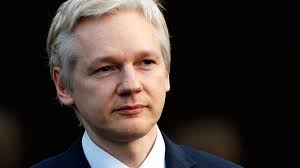
 Julian Assange Julian Paul Assange is an Australian publisher and journalist. He is known as the editor-in-chief of the website WikiLeaks, which he co-founded in 2006 after an earlier career in hacking and programming.Julian Paul Assange is an Australian publisher and journalist. He is known as the editor-in-chief of the website WikiLeaks, which he co-founded in 2006 after an earlier career in hacking and programming.Julian Paul Assange is an Australian publisher and journalist. He is known as the editor-in-chief of the website WikiLeaks, which he co-founded in 2006 after an earlier career in hacking and programming.


 <
<