Be Advised! Aspartame Changed its Name to AminoSweet

Be Advised! Aspartame Changed its Name to AminoSweet

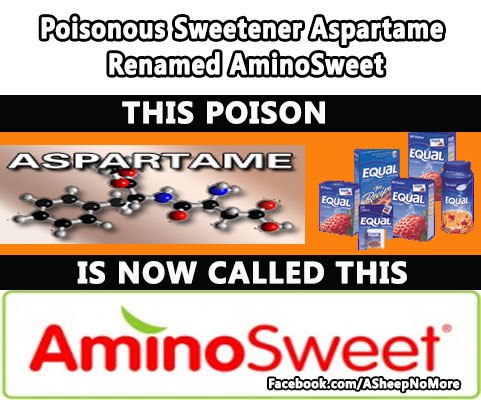
Aspartame has been renamed –  AminoSweet – and is now being marketed as a natural sweetener

Aspartame, the artificial sweetener linked to cancer, heart palpitations, seizures, weight gain and other severe medical issues, is now going by the name AminoSweet. The toxic sweetener, Aspartame, has been around over 25 years after it was accidentally discovered by chemist, James Schlatter while working for the drug company G.D. Searle & Company. It was created as an anti-ulcer pharmaceutical drug, but the chemist discovered it had a sweet taste, so the drug company switched its application to the FDA from a drug to a food. It was none other than Donald Rumsfeld, who was the CEO of Searle who pushed for Aspartame to be sold on the market in 1985. If that name sounds familiar, your right, he is the same Donald Rumsfeld, former U.S. Secretary of Defense who served under George W. Bush.  He is a perfect example of someone taking advantage of the “revolving door” between our government and corporations.

AminoSweet is Aspartame, it changed its name to fool the public, and I am guessing it did so because consumers figured out that their product made them sick. Aspartame is made up of three chemicals: aspartic acid, phenylalanine, and methanol. The book Prescription for Nutritional Healing, by James and Phyllis Balch lists aspartame under the category of “chemical poison.”

Aminosweet2

WARNING! Read labels before buying foods with the name Phenylalanine. I will go one step further — if you need to bring along a chemistry book to the store in order to understand the ingredients on the labels — DO NOT BUY IT!

Phenylalanine is an essential amino acid (that is, an amino acid which our bodies cannot make and which we must obtain from our diet). It is also one of the amino acids which is used to make aspartame. Phenylalanine is found in all protein-containing foods including milk, cheese, eggs, meat and fish.

Products which contain aspartame have a label which says ‘Contains a source of phenylalanine’. This label is there to help people with a rare inherited genetic disorder called phenylketonuria (PKU). These people cannot metabolise phenylalanine from any source and need to follow a strict diet to control their intake of this amino acid. The disorder affects approximately 1 in 10,000 babies, and is identified by screening shortly after birth. [Source]

Ten percent of this sweetener contains methanol. When it is absorbed by our intestines, it breaks down into formic acid and formaldehyde. Formaldehyde is a deadly neurotoxin that causes cancer, retinal damage, interferes with DNA replication and causes birth defects.

I went to the AminoSweet website to see what kind of “spin” they are putting on their repackaged product to entice shoppers to buy their so-called “natural” sweetener and here is their selling point:

AminoSweet aspartame is the low calorie sweetener that tastes just like sugar. It is made from two building blocks of protein just like those found naturally in many everyday foods. Aspartame is digested by the body in exactly the same way as these other protein foods and so does not bring anything new to our diet.

Makers of this artificial sweetener claim it is made from protein found “naturally” in many everyday foods. So what is the meaning of ‘natural’ when it comes to the labeling of food? The FDA’s website writes:

“From a food science perspective, it is difficult to define a food product that is ‘natural’ because the food has probably been processed and is no longer the product of the earth. That said, FDA has not developed a definition for use of the term natural or its derivatives.” [Source]

The word ‘natural’ is being thrown around to describe all sorts of genetically modified foods and AminoSweet is genetically modified. There is nothing natural about it. Why do you think these drug companies buy patents? They create them in a lab and they own it. And they know exactly what they are doing and choose to fool consumers into thinking their foods are safe when science proves differently.

In June 2013 Ben & Jerry’s Ice Cream and Campbell’s Soup became defendants in class action lawsuits that allege they misrepresented the nature of the ingredients on their product labels. The Campbell’s Soup Company is currently being sued by Florida residents for misrepresenting the genetically modified (GMO) corn in its soup as “natural.” Ben & Jerry’s decided to stop using genetically modified ingredients as a result of their suit.

Ben & Jerry’s used to be known for their healthy ‘natural’ ice creams, but I guess when they sold out to British-Dutch conglomerate Unilever, they sold their souls along with it. It looks like they haven’t updated their website since the sale either, even though Unilever has owned them since 2001. They portray themselves as another American success story — but according to the lawsuit, they are just another corporation choosing to deceive the public — much like another American success story — Monsanto who purchased Searle & Company in  1985– who make Aspartame now called AminoSweet.


http://csglobe.com/aspartame-changed-name-aminosweet/

April 18, 2013 – Decrypted Matrix Radio: Marathon Psyop, Jaden Smith’s Aliens, Hunger Striking Guantanamo, Big Pharma Fraud & Profitable Sickness

Boston Marathon Bombings Point To Government Run Terror Operation

Jaden Smith Says Obama Confirmed Aliens Are Real

Missile Used In Texas? This Sure The Hell Looks like it to me!

Hunger Striking at Guantanamo Bay – An 11 year Detainee Speaks Out

Mass Casualty Drill On Same Day As Waco Explosion

Envelope Tests Positive for Ricin at Washington Mail Facility

Revealing the Connection Between Sugar and Cancer … Again

Medical System Fraud- ‘Sick’ is Profitable, and Controllable

RIFE Machine Intro – Royal Raymond Rife designed a device to cure all diseases!

Every Week Night 12-1am EST (9-10pm PST)

– Click Image to Listen LIVE –

How Sugar May Make You Stupid

How Sugar May Make You Stupid

Bad news sugar lovers: a diet high in fructose won’t just make you fat, it may also make you stupid, according to research out of California.

A steady high-fructose diet disrupts the brain’s cognitive abilities, leading to poor learning and memory retention, says a study by Fernando Gomez-Pinilla, a neurosurgery professor at the David Geffen School of Medicine at UCLA and Rahul Agrawal, a visiting UCLA postdoctoral fellow from India.

“This type of diet. . . (affects) the transmission of information across cells. . . learning and memory and practically any type of brain function depends very much on how transmission is transported across cells,” Gomez-Pinilla said in an interview with the Star.

Health concerns

Their study, published in the May 15 edition of the Journal of Physiology, looked at high sugar consumption, focusing less on naturally occurring fructose in fruits and more on the fructose in high-fructose corn syrup.

Research has already proven a high-fructose diet leads to a slew of health concerns, including obesity, diabetes and fatty liver.

The U.S. is the world’s largest consumer of sweeteners.

High-fructose corn syrup, which acts as a preservative and sweetener, is found in a variety of processed foods, from soft drinks and baby food to salad dressings and condiments.

The average American consumes approximately 21 kilograms of cane sugar and 16 kilograms of high-fructose corn syrup annually, according to the U.S. Department of Agriculture.

Role of fatty acids

Gomez-Pinilla and Agrawal studied two groups of rats, both of which drank a fructose solution in their drinking water for six weeks. One of the groups also consumed omega-3 fatty acids, from flaxseed oil and a DHA (docosahexaenoic acid) capsule. Omega-3 fatty acids have been found to guard against heat disease, high cholesterol and mental conditions such as bipolar disorder and depression, according to the University of Maryland Medical Center.

Both rat groups were trained on a maze for five days before starting their new diet. After six weeks, Gomez-Pinilla and Agrawal retested the rats on the maze to monitor brain function and memory retention, noting the rats that consumed the fructose solution without the omega-3 fatty acids had problems with how they were able to think and recall routes in the maze.

Those rats also showed a resistance to insulin, a hormone that regulates sugar levels in the body.

“Rats fed on a (omega-3 fatty acids) deficient diet showed memory deficits in a Barnes maze, which were further exacerbated by fructose take,” the authors write.

They found that a rich diet of omega-3 fatty acids counteracted the negative affects of fructose.

Implications for humans

In terms of humans, Gomez-Pinilla predicts such changes in the brain to happen within six months to a year.

“The implication(s) here (are) the high consumption and the chronic consumption for man,” Gomez-Pinilla said, adding research needs to be done on the specific affects on humans.

“We don’t know yet how long (the damage) can last.”

The war on unhealthy food choices is a growing. In September, New York City announced it would ban sugar-filled drinks larger than 16-ounces from concession and fast-food stands, restaurants and movie theatres.

In Canada, a push on healthy eating is on the rise as the country grapples with the fact that 31.5 per cent of Canadian children aged 5 to 17 are either overweight or obese, according to a Statistics Canada report released in September.

“Diabetes is very prevalent in western society. It’s known already there is an (epidemic) of diabetes, which is highly related to a consumption of foods high in sugar,” Gomez-Pinilla said.

Gomez-Pinilla advocates a nutrient-rich diet that includes omega-3 fatty acids and a proper mix of healthy choices to offset the dangers of fructose.

Foods that are rich in omega-3 fatty acids include flax-seed oil, some types of fish, such as salmon, and nuts.


SUGAR – THE BITTER TRUTH

NEW series with Dr. Lustig “The Skinny on Obesity” http://www.uctv.tv/skinny-on-obesity. Robert H. Lustig, MD, UCSF Professor of Pediatrics in the Division of Endocrinology, explores the damage caused by sugary foods. He argues that fructose (too much) and fiber (not enough) appear to be cornerstones of the obesity epidemic through their effects on insulin. Series: UCSF Mini Medical School for the Public [7/2009] [Health and Medicine] [Show ID: 16717]

More videos about sugar: http://www.uctv.tv/sugar


“BIG SUGAR” SWEET, WHITE & DEADLY

Documentary about Big Sugar, from it’s early days with ties to slavery to modern times with it’s detrimental effects on the everglades and political ties. This is both part 1 and part 2. Written & Directed by: Brian McKenna. Produced by: Galafilm in 2005.

As good as this is, it barely touches on the negative effects it has on Florida residents, poisoning the water supply, endangering animals and plant species etc…

October 22, 2012 – DCMX Radio: Whistleblowers Gagged, Drones Tracking Faces, George Carlin on Politician Speak, Sugar Dangers

October 22, 2012 – DCMX Radio: Whistleblowers Gagged, Drones Tracking Faces, George Carlin on Politician Speak, Sugar Dangers

THIRD NORTHWEST ACTIVIST IS IMPRISONED FOR REFUSING TO TESTIFY AT GRAND JURY

Whistleblowers: gagged by those in power, admired by the public

How sugar may make you stupid

Congressional report warns drones could track faces, never leave sky

George Carlin Lying Politicians And Words

Native American Patriot Russell Means Passes at 72


Every Week Night 12-1am EST (9-10pm PST)

– Click Image to Listen LIVE –

Sugar: The Bitter Truth

Sugar: The Bitter Truth

NEW series with Dr. Lustig “The Skinny on Obesity” http://www.uctv.tv/skinny-on-obesity. Robert H. Lustig, MD, UCSF Professor of Pediatrics in the Division of Endocrinology, explores the damage caused by sugary foods. He argues that fructose (too much) and fiber (not enough) appear to be cornerstones of the obesity epidemic through their effects on insulin. Series: UCSF Mini Medical School for the Public [7/2009] [Health and Medicine] [Show ID: 16717]


Robert Lustig, MD:

Dr Lustig graduated from Franklin and Marshall College in Lancaster PA and then completed medical school at Jefferson Medical College. He completed 2 years of internal medicine training at New York Medical College followed by 2 years in the United States Navy. He returned to Philadelphia and completed his residency at Thomas Jefferson University Hospital. He practiced radiation oncology at Cooper Hospital/University Medical Center in Camden New Jersey and was on the faculty of the University of Medicine and Dentistry of New Jersey. He came to the University of Pennsylvania in 1998 and specialized in the treatment of brain tumors and head and neck cancer. He was appointed a Fellow of the American College of Radiology and has been co-chairman of the Quality Control Committee of the Radiation Therapy Oncology group which is a national organization developing and managing clinical trials in radiation therapy. He is a member of the board of the Pediatric Proton Foundation.