Iraqi from the United Kingdom. Social Justice Activist. Anti-Obama, Anti-Drone, Anti-War. Pro-Palestine.
Political activism (wikipedia)
Lowkey is a vocal opponent of Zionism and has been become well known for his pro-Palestinian activities as a patron of the Palestine Solidarity Campaign, comparing Zionism to colonialism and ethnic cleansing.[30][31][32] He is known to have coined the phrase “Nothing is more anti-semiticthan Zionism” in reference not only to the seldom acknowledged fact that Arabs are themselves Semites but also to what he called the “identical points of view” within Zionism and anti-semitism.[33]
In February 2009, he travelled to Palestinian refugee camps around the West Bank area to perform fundraising shows to help rebuild the Gaza Strip but was detained by the Israel Police for nine hours at Ben Gurion International Airport and interrogated, while having his passport confiscated.[34]Later in 2009, he travelled with M-1 of Dead Prez to carry out a humanitarian aid mission and bring medical aid to the Palestinian people in Gaza; this led to a collaboration between the two on Soundtrack to the Struggle.[35] He was detained for a second time in July 2010, en route to a number of concerts and musical workshops in refugee camps in the West Bank. After detaining him for twelve hours and an online petition was started, he was released.[36]
Lowkey has been a prominent member of the Stop The War Coalition and has spoken on many platforms regarding the occupation of Iraq.[37]Furthermore, he has been a sharp critic of United States and British foreign policy, claiming that the two powers are only interested in supporting leaders who are under their influence or are willing to assist them. He also claims American media overlooks those within the country who do not believe in American military supremacy.[30] Lowkey criticised US President Barack Obama as the “handsome face of an ugly empire” for enlargingGeorge Bush‘s “aggressive foreign policy”.[38]
Was Peaches Geldof murdered by the illuminati and the Knights of Malta for exposing pedophiles just months ago? Peaches, daughter of legendary rocker Bob Geldof, had recently tweeted the names of two mothers who had offered their babies to be raped by an alleged illuminati member who later admitted to the crimes after being outed by Geldof.
For those who don’t know Geldof, she was considered the ‘Paris Hilton’ of the UK, and she was highly involved in exposing pedophilia in the illuminati realm. She also faced charges for exposing a prominent UK pedophile on Twitter as shared in the videos as screenshots below. BeforeItsNews videographer pressResetEarth clearly proves in the first video below that Peaches untimely death has all the tell tale signs of being an ‘illuminati hit’.
A renowned American engineer was found dead in his hotel room in Salford after his heart suddenly stopped working. Mark Ferri, 59, from Tennessee, had completed two degrees in engineering as well as an MBA before becoming a nuclear engineer. At an inquest into Mr. Ferri’s death at Bolton Crown Court, it was heard that the dad-of-one was visiting Manchester on business on September 18, the day of his death. It was said Mr. Ferri had been under stress from his job. His wife, Michaela, told the inquest, “He said a number of times, this job is killing me.”. Mr. Ferri was originally due to return to the US a week earlier to see his family but was asked to remain in the UK for an extra week. On September 5, Mrs. Ferri spoke to her husband and, “he didn’t sound right”. She said, “He said it was just his work and they were giving him additional assignments and he was feeling overwhelmed and he didn’t think he would be able to complete them”.
SEC Standard Industrial Code (SIC): 8880 (UNKNOWN)
SEC Business Address: 1601 MASSACHUSETTS AVE NW WASHINGTON DC 20036
Fiscal Year End: 0630
Well, that certainly raises some questions!
Why is a company called ‘COMMONWEALTH OF AUSTRALIA’ registered in Washington DC? What reason could there be for a country to be registered as a company?
By definition, aren’t corporate and government entities mutually exclusive? And doesn’t government regulate companies?
Why would Australia be registered with the SEC in the United States? And why would it provide a ‘Prospectus’ and annual ‘Economic and Fiscal Outlook’ documents to the SEC? And be subject to SEC regulation?
Could the ‘Australian Government’ be a corporate entity masquerading as real government, for profit, and not for the purpose of governance? Does the ‘Australian Government’ truly represent “the people” and not shareholders in another country?
What happened to “we ARE government”?? Does this suggest they are NOT true government, but a company masquerading as government?
If a company registered in Washington DC is falsely claiming government status in Australia, what happened to the real (de jure) government with a similar name? And when?
And are the laws in Australia therefore just rules for employees and contractors of the corporation?
Interesting. Let’s look a little closer…
Perhaps it is a requirement that the Commonwealth of Australia registers as a company entity in order to trade with the United States of America. Are all the other countries who trade with the United States also registered on the American SEC? Is ‘the United States of America’ also registered with ASIC, the Australian Securities & Investments Commission? And is Australia similarly registered with the corresponding trade regulators in other countries?
The answer appears to be NO.
International trade implies mutual agreement; reciprocity; a common method of exchange. But the reality is that the ‘COMMONWEALTH OF AUSTRALIA’ is registered as a corporate entity with the United States SEC, but not the other way around. There appear to be no comparable corporate entities registered in other countries with which Australia trades. And nations ranking among the United States’ biggest trading partners do NOT have corporate avatars registered with the American SEC. Perhaps registration in Washington DC is for the purpose of trading Government Bonds. Interesting…
… But this strange corporate entity is only half the story. Before government bonds can even exist, surely there must first be a legitimate government.
Government and the role of Governor-General in Australia
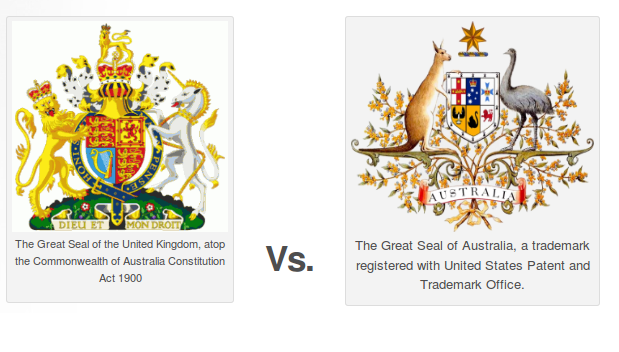
In Australia, the Governor-Generalis the representative of the Monarch (currently Queen Elizabeth II) and the Administrator of Government. Given that the Governor-General administers government in Australia, government can only exist in Australia with a valid Governor-General. The Governor-General is reliant upon the existence of the ‘Office of Governor-General’, which was originally constituted by the late Queen Victoria in Letters Patent dated 29th October 1900, passed under the Monarch’s seal – the Great Seal Of The United Kingdom (view Letters Patent 1900).
The power and authority to revoke, alter or amend those Letters Patent was reserved by the late Queen Victoria to her heirs and successors. Given those Letters Patent were issued under the ‘Great Seal of the United Kingdom’, surely any revocation, alteration or amendment must be issued by an heir and successor under the same Seal.
So what’s the problem?
In 1984, Letters Patent supposedly revoked the original Letters Patent of 1900 and provided new provisions for the Office of Governor-General (view Letters Patent 1984). This happened under the ‘Great Seal of Australia’, which we already know is a corporate trademark registered with the United States Patent & Trademark Office in the U.S. (view registration)
Surely such an attempt at revocation cannot therefore be lawful? And if not, what Office is the Governor-General in Australia presently occupying? Is the person we call “Governor-General” truly a representative of an “heir and successor” to the late Queen Victoria?
The answer appears to be NO.
Given that the Governor-General appoints Ministers, Judges, Commissioners and Justices of the Peace, and ascribes Royal Assent as the Monarch’s representative in Australia – using the Monarch’s Seal – in the absence of a valid Governor-General, are there any legitimate government offices in Australia?
Again… the answer appears to be NO.
So let’s test the theory…
A case study
Wake Up World friend and colleague Scott Bartle documented his recent dealings with ‘Australian Customs & Border Protection Service’ in his self-funded documentary “What The FUQ? – Frequently Unanswered Questions of the Australian Government”.
This simple, concise and sometimes hilarious case-study follows Scott’s ongoing interactions with a supposed “government” entity that simply does not behave as a genuine government agency should.
And all he did was ask them to demonstrate their validity!
Documentary Trailer – What The FUQ Trailer (2:47 mins)
To view this documentary in full, Click here. I highly recommended it.
So… IS the “Australian Government” the same government the original Office of Governor-General was intended to Administer?
It’s a question that officials at all levels of “Australian Government” have seem unwilling or unable to answer. Some readers may think I’m a crack-pot for even asking the question. “Break out the tin-foil hats!” they’ll cry! But please… Before you form an opinion or post a comment on this article, ask the Australian Government the same question yourself:
It is your right, after all. And there are certainly some details that don’t add up. But it gets better….
That’s odd, they certainly don’t ACT like a true government.
At first “Government” may just ignore you. But since anyone claiming government status has a responsibility to prove it, their silence is very indicative, don’t you think? So push your Government a little further, and see what happens when you really start to question who’s who. Taxes & fines are suddenly waived, and miraculously, licenses & permits are no longer required! And it doesn’t stop there.
Does this sound like the behaviour of legitimate government? NO, it does not. If challenged, does a legitimate government not simply demonstrate its validity and continue to act within its lawful authority? Or does legitimate government exempt that person’s responsibilities and wave them through the gates, quickly, quietly and with a minimum of fuss? “Nothing to see here!”
Is this situation unique to Australia?
Let’s find out!
To our friends and readers from the Commonwealth of Australia, we recommend you contact your local Members and Senators and ask them one simple question:
Can you please demonstrate that today’s Office of Governor-General is the same Office that was constituted by the late Queen Victoria in Letters Patent of 1900?
To our friends and readers outside Australia, we recommend you identify the documents that established the original offices of government in your country, then ask one simple question of your government representatives:
Can you please demonstrate that today’s government is the same one as established at the inception of this country?
Demonstrating its own legitimacy is a very simple thing that every government agency should be able to do. And in a true democracy, silence is an unacceptable response of government to questions of its very legitimacy. But today the “Australian Government” appears unwilling or unable to prove its legitimacy.
Is yours?
It only takes a few minutes to write to your local member’s office. Please come back to Wake Up World and tell our readers how your enquiry was met. Silence? Jargon? Or a simple demonstration of your government’s legitimacy?
We’d love to hear your stories, so please leave a comment or send us an email
So what the FUQ do we do next?
Written enquiries made to Ministers and Government agencies, to the Office of the Prime Minister and to the Office of Governor General remain unanswered. So in the absence of a response from Government, Wake Up World supports respectfully escalating this matter to the current Monarch, Her Majesty, The Queen.
Surely Her Majesty must know the answer; why a corporation in the United States bears the name ‘COMMONWEALTH OF AUSTRALIA’; why in 1984 her authority to amend the provisions for the Office of Governor-General was granted on a company letterhead; why those claiming to represent true government in Australia have been unable to prove that status; and why some, when challenged, may suddenly overlook one’s obligations and run silently in the other direction.
Activists threaten legal action over failure to investigate
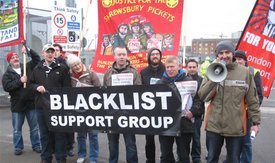
Corporations in the UK who used a secret “blacklisting” database to screen out ‘left wing trouble-makers’ and union sympathizers as potential job recruits are facing renewed scrutiny after the UK-activist group Liberty called for a fresh investigation Monday night.
A demonstration outside the Olympic site on March 1, 2011 was called in solidarity with the whistleblower who was fired for standing up for an illegally blacklisted workmate. The blacklist scandal first broke in 2008, when the UK media revealed that more than 40 leading employers had subscribed to the vetting service provided by The Consulting Association, which had surveillance files on more than 3,200 workers, including political activists, shop stewards and health and safety representatives.
Police seized the database three years ago and Ian Kerr, the founder of The Consulting Association, was fined only about $7,500. Invoices were discovered showing that 44 companies had paid to access the names on the list.
But full details of the material it contained only emerged as workers began to pursue legal action over their inclusion.
Liberty is now threatening to go to court to force the UK government to investigate the case, which it has compared in severity to the national press phone hacking scandal.
Corinna Ferguson, legal officer for Liberty, told the Independent: “We can’t believe the inaction of the Information Commissioner on a human-rights violation of such wide public interest.
“Contracting out the blacklisting of innocent workers, politicians and journalists is no better than farming out phone hacking to private detectives and the consequences for our democracy are just as grave. If we cannot persuade the Commissioner to discharge his public duty, we will consider seeking assistance from the courts.”
Mick Abbott, a 74-year-old ex-scaffolder, commented: “This nearly ruined my marriage and it meant that my children were on free meals at school. My file goes back to 1964 and the last entry says that I rekindled the campaign for justice for the Shrewsbury picketers in 2006. They have been watching me all these years and passing this information around, blighting my life over four decades.”
Steve Kelly, an electrician and spokesperson for the Blacklist Support Group said: “I was blacklisted because I was a union member and because I raised issues about safety. In 2007, [Sir Robert] McAlpine sacked me from the Colchester Barracks project after 2 days for refusing to work on a moving platform without proper training (exactly as we had been instructed in the site induction) – the dismissal is recorded on my blacklist file.
“Over the year I suffered severe financial strain, my wages were cut in half which caused immense stress paying bills and putting food on table. I was out of work for a year apart from few weeks here and there in 2001. Being sacked from Colchester Barracks after only two days piled up the stress and caused a nervous breakdown for me eventually.
“The blacklisting firms should be made to pay compensation for years lost and years in future. They should be made to employ blacklisted workers or not be awarded any public government backed contracts. An apology in national press and to individuals whose lives they ruined would be a start.”
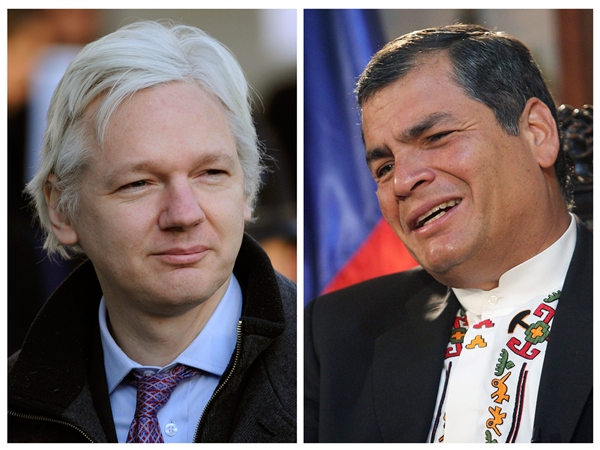
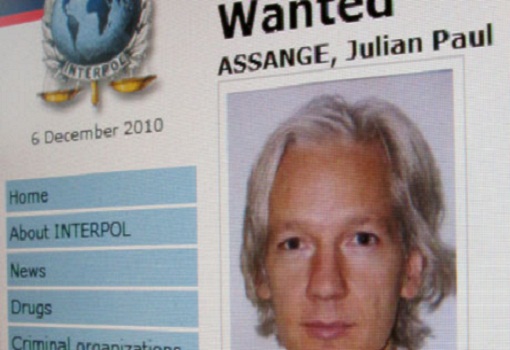
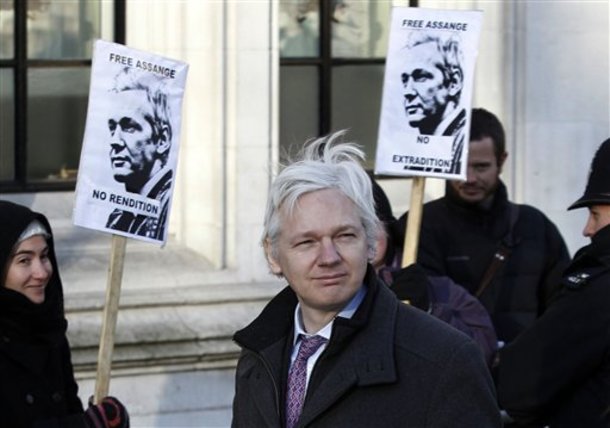
The latest twist in the Julian Assange case, as we await Ecuador’s decision on granting him asylum (a decision which would not, as I’ve written before, in itself allow protection from arrest if he steps outside the embassy), is that people are wondering whether the UK can simply strip the embassy of its diplomatic status, so allowing police officers to enter it.
You need to be aware that there is a legal base in the UK, the Diplomatic and Consular Premises Act 1987, that would allow us to take actions in order to arrest Mr Assange in the current premises of the Embassy.
We sincerely hope that we do not reach that point, but if you are not capable of resolving this matter of Mr Assange’s presence in your premises, this is an open option for us.
In no case is land to be regarded as a State’s diplomatic or consular premises for the purposes of any enactment or rule of law unless it has been so accepted or the Secretary of State has given that State consent under this section in relation to it; and if—
(a) a State ceases to use land for the purposes of its mission or exclusively for the purposes of a consular post; or
(b) the Secretary of State withdraws his acceptance or consent in relation to land,
it thereupon ceases to be diplomatic or consular premises for the purposes of all enactments and rules of law.
On the face of it, then, the Secretary of State (in practice a foreign office minister) could now simply withdraw consent, and with one bound, police would be free to make an arrest.
But it’s not quite as simple as that. You’ll note that section 1(4) says
The Secretary of State shall only give or withdraw consent or withdraw acceptance if he is satisfied that to do so is permissible under international law
and that according to section 1(5), in deciding whether to withdraw consent, the minister
shall have regard to all material considerations, and in particular, but without prejudice to the generality of this subsection—
(a) to the safety of the public;
(b) to national security; and
(c) to town and country planning.
The “compliance with international law” requirement may present a problem, since article 21 of the Vienna Convention on Diplomatic Relations requires the UK to facilitate the acquisition by Ecuador of premises necessary for its mission, or assist it in obtaining accommodation. It’s not obvious this allows the UK to just de-recognise the current premises without helping arrange something new.
Section 1(5) is interesting because, in spite of the way the drafting clearly intends to preserve ministers’ ability to take account of anything they think relevant, I’ve no doubt lawyers for Ecuador could argue that the list of three particular concerns colours the scope of ministers’ considerations, the result being that only some particular difficulty relating to safety or to the premises themselves could justify withdrawal.
More importantly, they could argue that Assange’s presence in the embassy and Ecuador’s conduct in sheltering him is not a material consideration; and that since that clearly lay behind the withdrawal, ministers would in deciding to withdraw consent, have taken into account an irrelevant factor.
In addition, there’d be a potentially strong argument to be made that ministers had exercised their power for an improper purpose not intended by Parliament when it enacted the 1987 legislation – their desire to arrest Julian Assange.
Ecuador could judicially review any proposed withdrawal: I think the effect on Assange means this is the type of case in which, as Lord Sumption explained in a recent speech, the courts would consider intervening in a foreign policy decision. Perhaps Assange could obtain an injunction on judicial review, preventing any arrest pending the outcome of proceedings. Of course, if the government successfully fought off that judicial review, the arrest could go ahead. But I don’t think a defence would be easy, and at the very least, a judicial review would create further delay – which probably suits Assange fairly well. I’m not sure giving him a hook to hang one on would be the best tactical move for the government.
The Quito letter from the UK to Ecuador went on apparently to say
We need to reiterate that we consider the continued use of the diplomatic premises in this way incompatible with the Vienna Convention and unsustainable and we have made clear the serious implications that this has for our diplomatic relations.
If I were advising the government, I think I’d say that, if ministers are determined to allow the arrest of Assange, it might be better simply to cut off diplomatic relations with Ecuador, send the ambassador home, close the embassy and arrest Assange after that. Ending diplomatic relations is the major sort of foreign affairs decision I doubt the courts would interfere with. But that’d be a major diplomatic call.
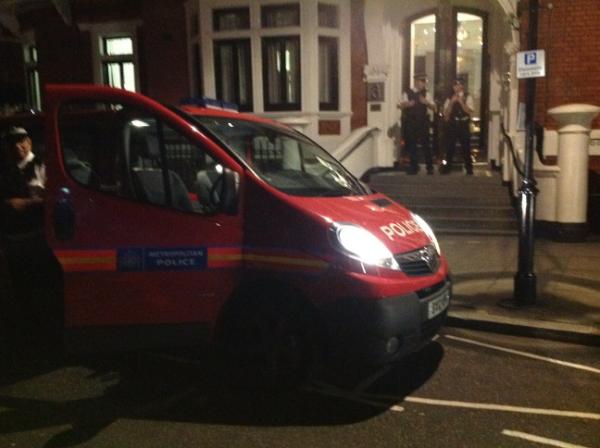
BREAKING NEWS: Police are massing at the Ecuadorian embassy in London where Australian WikiLeaks founder Julian Assange is holed up after his request for political asylum.
One personoutside the embassy, identifying himself as a “citizen journalist” with the twitter account https://twitter.com/alburyj is video streaming UK police entering the building.
Aroundt midnight, local time, WikiLeaks tweeted this morning that two large police vans had arrived ‘‘to surround the Ecuadorian embassy in London’’.
UPDATE [3:30pm PST] – “Assange asylum rumor is false,” Correa confirmed on his Twitter feed. He added that he is waiting for a Foreign Ministry report on the issue, without which a decision will not be made.
Ecuador has reportedly granted asylum to WikiLeaks founder Julian Assange, who requested it after the British Supreme Court refused to reopen his appeal against extradition to Sweden where he is wanted for questioning over alleged sex crimes.
WikiLeaks founder has been holed up in the country’s London embassy since June 19.
The asylum guarantees him safe passage from the UK to Ecuador, says Professor Donald Rothwell from the Australian National University College of Law.
In Sweden the whistleblower is wanted for questioning over accusations of sex crimes, but Assange and most of his supporters fear that once he arrived in Sweden, he would be handed over to US authorities.
Assange and his lawyers believe that the US has already lodged a sealed indictment against Assange, and that his case might outdo the one of Bradley Manning.
The whistleblower website founded by Julian Assange has leaked hundreds of thousands of classified diplomatic cables, including top secret documents from the US Department of Defense, and secret cables from the State Department.
There was some surprise in the comments of yesterday’s post over the fact that the United Kingdom has effectively outlawed encryption: the UK will send its citizens to jail for up to five years if they cannot produce the key to an encrypted data set.
First of all, references – the law is here. You will be sent to jail for refusing to give up encryption keys, regardless of whether you have them or not. Five years of jail if it’s a terrorism investigation (or child porn, apparently), two years otherwise. It’s fascinating – there are four excuses that keep coming back for every single dismantling of democracy. It’s terrorism, child porn, file sharing, and organized crime. You cannot fight these by dismantling civil liberties – they’re just used as convenient excuses.
We knew that this was the next step in the cat-and-mouse game over privacy, right? It starts with the government believing they have a right to interfere into any one of your seven privacies if they want to and find it practical. The next step, of course, is that the citizens protect themselves from snooping – at which point some bureaucrat will confuse the government’s ability to snoop on citizen’s lives for a right to snoop on citizen’s lives at any time, and create harsh punishments for any citizens who try to keep a shred of their privacy. This is not a remotely dystopic scenario; as we see, it has already happened in the UK.
But it’s worse than that. Much worse. You’re not going to be sent to jail for refusal to give up encryption keys. You’re going to be sent to jail for an inability to unlock something that the police think is encrypted. Yes, this is where the hairs rise on our arms: if you have a recorded file with radio noise from the local telescope that you use for generation of random numbers, and the police asks you to produce the decryption key to show them the three documents inside the encrypted container that your radio noise looks like, you will be sent to jail for up to five years for your inability to produce the imagined documents.
But wait – it gets worse still.
The next step in the cat-and-mouse game over privacy is to use steganographic methods to hide the fact that something is encrypted at all. You can easily hide long messages in high-resolution photos today, just to take one example: they will not appear to contain an encrypted message in the first place, but will just look like a regular photo until decoded and decrypted with the proper key. But of course, the government and police are aware of steganographic methods, and know that pretty much any innocent-looking dataset can be used as a container for encrypted data.
So imagine your reaction when the police confiscate your entire collection of vacation photos, claim that your vacation photos contain hidden encrypted messages (which they don’t), and sends you off to jail for five years for being unable to supply the decryption key?
This is not some dystopic pipe dream: this law already exists in the United Kingdom.
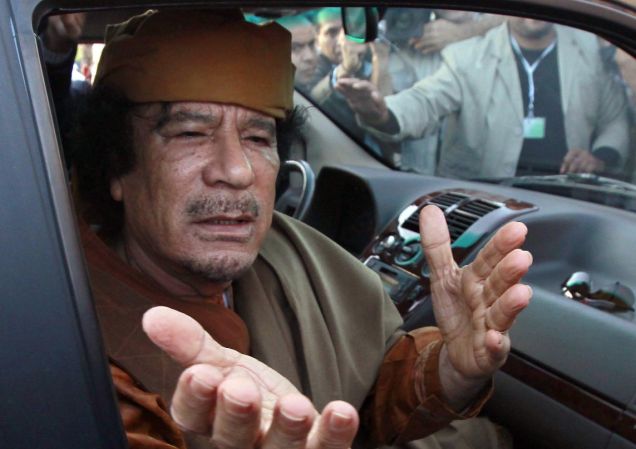
The UK’s intelligence-sharing relationship with Muammar Gaddafi’s Libyan regime before its collapse last year has come under new scrutiny amid claims MI5 handed on defectors’ details and MI6 colluded in an operation to ensnare Islamic extremists.
According to the Mail on Sunday, agents for the British Secret Service supplied confidential information to their Libyan counterparts about people who had fled Gaddafi.
And the Sunday Telegraph claims that MI6 worked in conjunction with Libya to set up a radical mosque in a western European city to lure in al-Qaida terrorists.
Both stories are the result of previously unreleased classified documents in Libyan archives being disclosed by the new government in Tripoli.
The Home Office said it would ‘take seriously’ any allegations against the security services.
Image: Abdel Hakim Belhadj is taking legal action over his alleged illegal rendition (Picture: AP)
A spokeswoman told the BBC that parliament’s Intelligence and Security Committee was already evaluating the government’s relationship with Libya and would ‘take account of any allegations raised’.
‘We do not know the full details of this case, but we take such claims seriously,’ she said.
Last week it was revealed a former Libyan rebel who helped overthrow Gaddafi was taking legal action against former foreign secretary Jack Straw over his alleged illegal rendition.
Lawyers for Abdel Hakim Belhadj claim Mr Straw personally permitted his rendition to Libya when the former rebel sought asylum in the UK in 2004.
The British government faces court action from a group of doctors over the death of weapons expert David Kelly in 2003. They’re pushing for a new inquiry after the first reached a verdict of suicide. Kelly was behind a report showing Britain knew there were no weapons of mass destruction in Iraq before joining the invasion. And as RT’s Laura Emmett found out, the evidence in the case isn’t as clear as previously thought.


 Iraqi from the United Kingdom. Social Justice Activist. Anti-Obama, Anti-Drone, Anti-War. Pro-Palestine.