That’s been the key question asked of Wall Street’s biggest banks since the September 2008 collapse of Lehman Brothers, which sent shock waves through the global financial system and led to the worst recession this country has seen since the Great Depression.
But, there is another firm far from the circles of Wall Street for which that same question should be asked, says William Hartung, author of the new book Prophets of War. The subtitle of his book says it all: Lockheed Martin and the Making of the Military-Industrial Complex.
With $40 billion in annual revenue, Lockheed Martin is the single largest recipient of U.S. tax dollars. The company receives about $36 billion in government contracts per year. In 2008, $29 billion of that was for U.S. military contracts – a dollar figure 25% higher than its competitors Boeing Co. and Northrop Grumman.
What does that mean for you, the U.S. taxpayer? According to Hartung, each taxpaying household contributes $260 to Lockheed’s coffers each year!
All evidence enough that the company is “too big to fail”, as Hartung tells Aaron in the accompanying clip.
A prime example of Washington looking out for Lockheed happened just last year when debate ensued over whether to continue the company’s grossly expensive F-22 stealth fighter program, says Hartung, who has covered the defense industry for years and is also the director of the Arms and Security Initiative at the New America Foundation.
The Pentagon eventually did suspend funds terminating Lockheed’s development of the F-22 Raptor, which has been the most costly fighter plane ever. But, at the same time the U.S. Defense Department cut off funds for the F-22, it added an additional $4 billion to the Lockheed’s F-35 fighter plane program. The government “basically took with one hand and gave back [to Lockheed] with the other,” says Hartung of a company that is the only major contractor of fighter planes for the U.S. Airforce.
Warning from the past
Two weeks from now marks the 50th anniversary of President Eisenhower’s famous “military-industrial complex” speech cautioning against “undue influence” from large and politically powerful defense companies. According to Hartung, Lockheed Martin epitomizes the exact threat Eisenhower warned about.
By now you might be wondering where the defense contractor’s remaining $7 billion in government contract goes. “They have got their fingers everywhere now,” Hartung tells Aaron. As outlined in his book, Lockheed does way more than produce military aircraft and weaponry. From the U.S. Census Bureau to the U.S. Postal Service to the Internal Revenue Service, “pretty much name a government agency and they are involved,” he says.
Despite Lockheed sheer size, its stronghold on so many government agencies is evidence enough that the company is “too big to fail.” “If the government becomes so dependent on [Lockheed], for many different activities it will be hard to hold them accountable if they underperform or if there is some sort of whiff of scandal.”
Bigger may not be better, but it’s working
Hartung’s scathing criticism of Lockheed Martin comes from his belief that “they have not done the job well, often enough,” pointing to decades of cost overruns, a corporate history littered with corruption scandals and the fact that the company was one of the first ever to receive a federal bailout back in the 1970s.
When it comes down to it, Lockheed’s dominance – even with what some might call a checkered past – has much to do with the company’s ability to influence those in power, says Hartung. In 2009, it spent nearly $15 million on campaign contributions and lobbying fees — the second highest amount for defense contractors.
Another key factor that has helped the defense contractor secure the most U.S. military contracts is the company’s ability to exploit the revolving door between Washington, the industry and itself, says Hartung. Not only has this led to the company having strong influence over those who hold the U.S. government’s purse stings, many who are former Lockheed employees or board members, it has allowed the company to influence foreign policy decisions like pressing for war with Iraq.
In the publicity notes for the book, Hartung claims “Lockheed Martin has also funded right-wing think tanks that have done everything from press for war with Iraq to lobby for the “Star Wars” missile defense program.” He tells Aaron that they are using these think tanks to make the points that are “embarrassing to make themselves.”
Hartung acknowledges that “we need companies like Lockheed Martin to defend the country,” but he says that a lot more can be done to regulate the industry by setting “stricter accountability rules.”
I ran into a cool demonstration of non-contact heating. Huettinger, a German manufacturer of induction heating generators showed this ice cube running red-hot.
(CNN) — When you buy a video game from Best Buy, you don’t give the retailer the right to barge into your house whenever it wants. So why do we give that permission to software companies?
Most popular smartphone operating systems and other electronic gadgets include what security researchers refer to as a kill switch.
This capability enables the company that makes the operating software to send a command over the Web or wireless networks that alters or removes certain applications from devices.
Apple, Google and Microsoft include this function in their platforms, along with a few lines in their usage agreements describing the policy. Google and Apple executives say this feature is important in order to protect against malicious software.
“Hopefully we never have to pull that lever, but we would be irresponsible not to have a lever like that to pull,” Apple CEO Steve Jobs told The Wall Street Journal in 2008. It’s there as a fail-safe for when the App Store gatekeepers erroneously approve an app that has problems, he said.
Apple doesn’t appear to have used this feature in the four years since introducing the iPhone. An Apple spokeswoman declined to comment on the issue.
Andy Rubin, Google’s head of Android development, said something similar in an interview with reporters Tuesday. He described the kill switch as a “safety lever” or “malware apparatus” used for “removing stuff from devices once it gets out of the Android Market, once it escapes.”
Google is believed to have used the security procedure twice — once last summer when an independent security researcher unleashed a potentially troublesome program, and again in March after malware spread to Android phones. In the latter case, Google threw the switch within about 50 minutes of learning about the trouble, Rubin said.
Those two incidents were the only times Google has used the function, according to a person familiar with the matter. A Google spokesman declined to comment.
Agreeing to allow Google to remotely delete software from your device is required in order to use its market for downloading apps. It’s unclear whether phone manufacturers, which sometimes tinker with the software, can add a kill switch of their own. Samsung Telecommunications, a top Android handset maker, didn’t respond to a request for comment.
Research in Motion’s BlackBerry and Nokia’s Symbian don’t make kill switches available to their handsets.
RIM has referred to its lack of remote access for BlackBerry as a defense for why it could not provide the United Arab Emirates access to phone users’ data. “RIM does not possess a ‘master key,’ nor does any ‘back door’ exist in the system that would allow RIM or any third party to gain unauthorized access,” the company said in a statement last year.
Like many other app store operators, Nokia has a measure in place for its Ovi Store that scans software for security risks. But the system doesn’t have a kill switch, a spokeswoman said.
However, Nokia, which produces the highest volume of cell phones worldwide, plans to shift its primary smartphone software to Microsoft’s Windows Phone 7, which does have such a capability.
Virtually every smartphone system, including RIM’s and Nokia’s, allows corporations to remotely alter or disable their employees’ phones and data. The difference is that RIM and Nokia don’t actively police their customers’ usage.
McAfee, which makes security software, sees corporate security in the mobile industry as an important growth area.
“The number one thing that we see the enterprises and corporations needing is: how do we manage mobile devices in our network?” McAfee CEO David DeWalt said last month in an interview with Forbes. “Whether or not there’s some security features from Google or features from Apple on the device, you have to manage these devices.”
Kill switches don’t just apply to phones. Nintendo recently offered owners of its 3DS, the new hand-held game system, a free music video. It came with a caveat: The video “is provided for a limited time and may be deleted from your system with subsequent updates,” the offer read.
Unlike a toaster or a paperback, apps and many other digital files cannot be resold. According to the iTunes legal agreement, customers don’t even own certain music and videos that they buy, but instead acquire a license to use them on certain devices.
For consumers, accepting the idea of a kill switch may come down to a matter of trust.
“We have always had to completely trust our platform/operating system vendor,” Chris Palmer, the technology director for the Electronic Frontier Foundation, a digital rights group, wrote in an e-mail. “It will always be that way.”
Amazon.com broke that trust in a high-profile use of the kill switch in 2009, when the company remotely erased copies of George Orwell’s “1984” and “Animal Farm” from its customers’ Kindles. The books had been mistakenly sold on its e-book store, the company said.
Amazon settled a lawsuit over the issue and agreed to limit how it uses remote deletion for books. Amazon CEO Jeff Bezos apologized for using the kill switch, calling the decision “stupid, thoughtless and painfully out of line with our principles.”
Amazon didn’t return requests for comment for this report.
“Print media, when you buy it and you have it in your house, it’s yours,” said Mark Frauenfelder, a Boing Boing blogger who covered the Amazon case. He believes that episode “points to a dangerous future, where you see some of the downsides of cloud storage, digital technology and closed systems — where you have less control over the things that you paid for.”
From mysterious robotic space planes to giant spy satellites the size of school buses, space is teeming with secret American hardware meant to gaze down on insurgents, terrorists and, well, everybody on the third rock from the sun.
For mere proles like you and me, it can be hard to get a straight answer from the Air Force, NASA and other space-faring agencies about precisely what is up there, what it’s doing and where exactly it all is at a given moment.
Now a pair of enterprising Frenchmen have decided to answer at least one of those questions for themselves, using a modified consumer-grade telescope, a small motor, a hand-held controller and a video camera. The result is a do-it-yourself satellite tracker capable of recording the movements of America’s most secretive spacecraft.
“In mid-2009, I have decided to adapt my Takahashi EM400 [telescope mount] for motorized satellite-tracking,” Legault, pictured above, wrote on his website. He fitted a Meade Schmidt-Cassegrain 10-inch telescope to the mount and teamed up with Rietsch to design a system for slowly and precisely rotating the mount to follow a distant, orbital object.
“More tricky than expected” is how Legault described the creation of the custom rotation system, which attaches a motor to the mount and, in the beginning, used a radio joystick for controlling the motor. Apparently cued by the global network of amateur satellite spotters, profiled by Wired in 2006, Legault would hunt for orbital objects using the telescope, switch on the video camera, and then use the joystick to keep the targeted spacecraft in the frame.
But there was a problem. “Despite this performing tracking system and hours of training on airplanes passing in the sky, keeping the spaceship inside a sensor of a few millimeters at a focal length of 5000mm and a speed over 1°/s needs a lot of concentration and training,” Legault wrote.
So last year Rietsch devised a new computer program, called Videos Sky, to move the telescope automatically. Now Legault uses a second telescope to “scout” for spacecraft, gets the 10-incher into place, peering at a spot the satellite is on course to pass through, and activates the computerized tracker once the target is in view. Legault has helpfully uploaded a video depicting the whole tracking process, as seen by the main telescope.
Plus, what Legault and Rietsch are doing is legally aboveboard. The effort is actually no more illegal than standing on a public street and looking around really carefully. But considering how hard the intelligence community works to keep details of its space arsenal under wraps, it’s not hard to imagine the two Frenchmen have pissed off a lot of spooks unaccustomed to having regular people spy back.
Creators of TOR:
David M. Goldschlag <goldschlag[at]itd.nrl.navy.mil>
Michael G. Reed <reed[at]itd.nrl.navy.mil>
Paul F. Syverson <syverson[at]itd.nrl.navy.mil>
Naval Research Laboratory
Date: Tue, 22 Mar 2011 16:57:39 -0400
From: Michael Reed <reed[at]inet.org>
To: tor-talk[at]lists.torproject.org
Subject: Re: [tor-talk] Iran cracks down on web dissident technology
On 03/22/2011 12:08 PM, Watson Ladd wrote:
> On Tue, Mar 22, 2011 at 11:23 AM, Joe Btfsplk<joebtfsplk[at]gmx.com> wrote:
>> Why would any govt create something their enemies can easily use against
>> them, then continue funding it once they know it helps the enemy, if a govt
>> has absolutely no control over it? It's that simple. It would seem a very
>> bad idea. Stop looking at it from a conspiracy standpoint& consider it as
>> a common sense question.
> Because it helps the government as well. An anonymity network that
> only the US government uses is fairly useless. One that everyone uses
> is much more useful, and if your enemies use it as well that's very
> good, because then they can't cut off access without undoing their own
> work.
BINGO, we have a winner! The original *QUESTION* posed that led to the
invention of Onion Routing was, "Can we build a system that allows for
bi-directional communications over the Internet where the source and
destination cannot be determined by a mid-point?" The *PURPOSE* was for
DoD / Intelligence usage (open source intelligence gathering, covering
of forward deployed assets, whatever). Not helping dissidents in
repressive countries. Not assisting criminals in covering their
electronic tracks. Not helping bit-torrent users avoid MPAA/RIAA
prosecution. Not giving a 10 year old a way to bypass an anti-porn
filter. Of course, we knew those would be other unavoidable uses for
the technology, but that was immaterial to the problem at hand we were
trying to solve (and if those uses were going to give us more cover
traffic to better hide what we wanted to use the network for, all the
better...I once told a flag officer that much to his chagrin). I should
know, I was the recipient of that question from David, and Paul was
brought into the mix a few days later after I had sketched out a basic
(flawed) design for the original Onion Routing.
The short answer to your question of "Why would the government do this?"
is because it is in the best interests of some parts of the government
to have this capability... Now enough of the conspiracy theories...
-Michael
_______________________________________________
tor-talk mailing list
tor-talk[at]lists.torproject.org
24 March 2011
A sends:
From: A
Date: Thu, 24 Mar 2011 01:41:41 +0000
Subject: Cryptome Fwd: Re: Fwd: The onion TOR network
To: cryptome[at]earthlink.net
Following the publication of the email extract on TOR, I asked
the EFF what they made of it. Here it is. You can of course publish it.
---------- Forwarded message ----------
From: Rebecca Jeschke <rebecca[at]eff.org>
Date: 23 March 2011 21:29
Subject: Fwd: Re: Fwd: The onion TOR network
To: A
Hi A. This is from Senior Staff Technologist Seth Schoen. Thanks -- Rebecca
-------- Original Message --------
Subject: Re: Fwd: The onion TOR network
Date: Wed, 23 Mar 2011 11:15:24 -0700
From: Seth David Schoen <schoen[at]eff.org>
To: Rebecca Jeschke <rebecca[at]eff.org>
CC: chris <chris[at]eff.org>, Peter Eckersley <pde[at]eff.org>,
Seth Schoen <schoen[at]eff.org>
Rebecca Jeschke writes:
any thoughts on this?
It's totally true that the military people who invented Tor werethinking about how to create a system that would protect military communications. The current iteration of that is described at https://www.torproject.org/about/torusers.html.en#militaryright on the Tor home page. However, the Tor developers also became clear early on that the system wouldn't protect military communications well unless it had a very diverse set of users. Elsewhere in that same e-mail discussion, Mike Perry (a current Tor developer) alludes to this: https://lists.torproject.org/pipermail/tor-talk/2011-March/019898.html In fact, the best known way we have right now to improve anonymity is to support more users, and more *types* of users. See: http://www.freehaven.net/doc/wupss04/usability.pdfhttp://freehaven.net/~arma/slides-weis06.pdfThe first link is to a paper called "Anonymity Loves Company", which explains the issue this way: No organization can build this infrastructure for its own sole use. If a single corporation or government agency were to build a private network to protect its operations, any connections entering or leaving that network would be obviously linkable to the controlling organization. The members and operations of that agency would be easier, not harder, to distinguish. Thus, to provide anonymity to any of its users, the network must accept traffic from external users, so the various user groups can blend together. You can read the entire (ongoing) discussion about government funding for Tor development via https://lists.torproject.org/pipermail/tor-talk/2011-March/thread.html(search for "[tor-talk] Iran cracks down on web dissident technology"). -- Seth Schoen Senior Staff Technologist schoen[at]eff.org Electronic Frontier Foundation https://www.eff.org/ 454 Shotwell Street, San Francisco, CA 94110 +1 415 436 9333 x107
Subject: Re: [tor-talk] Iran cracks down on web dissident technology
From: A3
To: John Young <jya[at]pipeline.com>
Cc: A2, cypherpunks[at]al-qaeda.net
On Tue, 2011-03-22 at 17:43 -0400, John Young wrote:
> Fucking amazing admission. No conspiracy theory needed.
Wasn't this already very common knowledge?
Subject: Re: [tor-talk] Iran cracks down on web dissident technology
To: A3, A2, cypherpunks[at]al-qaeda.net
From: John Young <jya[at]pipeline.com>
That's what the Eff-folks advocating TOR are saying. And point to a
file on Torproject.org. See:
http://cryptome.org/0003/tor-spy.htm
However, this appears to be a giant evasion perhaps a subterfuge,
even reminds of what Big Boys say when customers learn they are
siphoning customer data. Read the privacy policy the lawyer-advised
apologists bark, and upon reading the privacy policy see that it only
emphasizes the subterfuge. Openly admitting siphoning is supposed
to make it okay because everyone does it under cover of lockstep
privacy policy. Reject that.
If the Tor operators really know what they are being used for, then
they should admit to being agents of the USG, as Michael Reed had
the guts to do.
Claiming this US spying role for Tor is well known is a crock of slop,
but then spies lie all the time and care not a whit that they peddle
shit for eaters of it. If you believe them and like what they do then
don't shilly-shally, just do what Michael Reed did but others are
too ashamed to do after having been duped since 1996.
If Reed's precedent for honesty is followed, there will be an
admission that the Internet was invented for spying by its inventor.
And then cryptography and other comsec tools. And then cellphones
and the like. Hold on now, this is getting out of hand, the apologists
will bellow, everybody has always known that there is no privacy
in digital world.
Actually, no, they did not. And those who knew keep their Janusian
mouths writhing to reap the rewards of deception. Now that is a truth
everyone knows. No conspiracy theory needed.
Date: Sun, 02 Mar 1997 18:20:49 -0800
To: cryptography[at]c2.net, coderpunks[at]toad.com, weidai[at]eskimo.com
From: Lucky Green <shamrock[at]netcom.com>
Subject: PipeNet implemented?
At the FC’97 rump session, Paul Syverson from NRL presented a paper titled “Onion Routing”. The description of the system sounds very much like Wei Dai’s PipeNet. However, the development team seems to be unaware of PipeNet and the discussions about it that we had in the past.
NLR has currently five machines implementing the protocol. Connection setup time is claimed to be 500 ms. They are looking for volunteers to run “Onion Routers”. It appears the US military wants to access websites without giving away the fact that they are accessing the sites and is looking to us to provide the cover traffic. What a fortunate situation.
They said that the source would soon be on the web page, but so far it has not appeared.
To: cypherpunks[at]cyberpass.net
Date: Fri, 25 Apr 1997 01:24:29 -0700
From: Lucky Green <shamrock[at]netcom.com>
Subject: Re: A new system for anonymity on the web
At 12:59 PM 4/20/97 -0700, Steve Schear wrote:
>Hal,
>
>What do you think of the “onion routing” approach from the group at Naval
>Postgraduate? How would compare it to this newest proposal?
Neither one of them is any good in its present form. The folks at the FC’97 rump session got to watch Jim and myself poke truck sized holes into the NRL design within seconds of them ending their presentation. :-)
Here was a US military research lab presenting a system they thought would give them a way to surf the Net anonymously by using the public for cover traffic. [Let me just spell out here that I believe that the people from NRL and Cypherpunks are on the same side on this issue. Their concern is COMSEC, not SIGINT.]
Anyway, we knew how to crack their system without even having to think about it, since folks on Cypherpunks, especially Wei Dai, had discovered various venues of attack on such systems long ago. Cypherpunks are teaching the military about traffic analysis. :-)
The one good thing about NRL is that they seem to be willing to learn. [The other being that they get paid to write our code for us.] Though I get the distinct feeling that they don’t like the required solution. There is simply no way to harden the system against attack without using a constant or at least slowly varying (I would guess we are talking about periods of several hours here, certainly not minutes, but I haven’t done the math, nor do I have the time to do so) bandwidth data stream between the end user and the first Onion Router. This will invariably require special software on the end user’s machine. I think the best design would be a client side proxy. [That much Crowds got right.]
As to Crowds, they got to be kidding. How many end users are willing to become, even without their direct knowledge, the last hop to <enter evil URL here>? I believe that relatively few users would want their IP address to be the one showing up in the server log of <enter seized machine’s name here> because their jondo happened to be the exit point chosen.
— Lucky Green <mailto:shamrock[at]netcom.com> PGP encrypted mail preferred
“I do believe that where there is a choice only between cowardice and violence, I would advise violence.” Mahatma Gandhi
Documents obtained by The Wall Street Journal open a rare window into a new global market for the off-the-shelf surveillance technology that has arisen in the decade since the terrorist attacks of Sept. 11, 2001.
The techniques described in the trove of 200-plus marketing documents include hacking tools that enable governments to break into people’s computers and cellphones, and “massive intercept” gear that can gather all Internet communications in a country.
The documents—the highlights of which are cataloged and searchable here—were obtained from attendees of a secretive surveillance conference held near Washington, D.C., last month. Read more about the documents.
The documents fall into five general categories: hacking, intercept, data analysis, web scraping and anonymity. Below, explore highlights related to each type of surveillance, and search among selected documents
When the pilotless, wing-shaped warplane lifted off a runway at California’s Edwards Air Force Base for the first time on the morning of April 27, it was like the resurrection of the dead. The Boeing Phantom Ray — one of the most advanced drones ever built — came close to never flying at all.
In late 2007, according to company insiders, U.S. military officials ordered Boeing to destroy an earlier version of the Phantom Ray, the X-45C. Exactly why the feds wanted the robotic aircraft dismantled has never been fully explained.
Boeing had just lost out to rival aerospace firm Northrop Grumman in a contest to develop a so-called “Unmanned Combat Air System” for the Navy, capable of taking off from, and landing on, aircraft carriers. That contest, known by its acronym N-UCAS — “N” for “Navy” — was actually the third time in five years Boeing had gone toe-to-toe with Northrop over a government contract to build killer drones, and the second time it had lost.
With each round of competition, Boeing had made enemies.
Even so, the kill order came as a shock to the Chicago-based company. Rare if not unprecedented in the world of military contracting, the command represented the climax of a nearly decade-long drama pitting a rotating field of corporations and government agencies against each other and, bizarrely, even against themselves — all in an effort to develop a controversial, but potentially revolutionary, pilotless jet fighter.
The UCAS development story has all the trappings of a paperback technothriller: secret technology, a brilliant military scientist, scheming businessmen, and the unseen-but-decisive hand of the military’s top brass.
And the story’s not over. The X-45C barely survived the government’s alleged assassination attempt. And after three years of clandestine development, a modified version of the flying-wing ‘bot leaped into the air that day in late April, an event depicted in the video above. The Boeing drone’s first flight opened a new chapter in the ongoing struggle to build a combat-ready, jet-powered robot warplane — and to convince the military to give the new unmanned aircraft a place on the front lines of aerial warfare.
What follows is the Phantom Ray’s secret history, reconstructed from news reports, interviews with government and corporate officials, leaked documents, and a treasure trove of information from Boeing insiders who spoke to Danger Room on condition of anonymity. Officials at Northrop largely declined to answer in-depth questions about their unmanned aircraft’s development.
This isn’t a complete retelling of the competition to build the combat drone. By virtue of its subject and sources, this portrays largely Boeing’s point of view over those of its rivals and customers. And Boeing played just one role, however prominent, in the continuing drama.
With traditional manned fighters growing more expensive — and consequently rarer — by the day, unmanned warplanes are rising to take their place. Boeing isn’t alone in testing pilotless jet fighters. Northrop Grumman, Lockheed, General Atomics, European firm EADS, British BAE Systems and Swedish plane-maker Saab are also working on killer drones. Each company’s UCAS surely has its own secret history.
The future of aerial warfare is more robotic than ever. Boeing’s decade-long struggle to launch the Phantom Ray, and the drone’s ultimate takeoff, is one reason why.
Desert Storm Origins
The X-45 and other UCAS can trace their roots to the first Gulf War. In January and February 1991, a U.S.-led air armada hammered Iraqi positions in occupied Kuwait. In the course of around 100,000 sorties, 42 coalition airplanes were lost to Iraqi air defenses, and 38 aviators died.
An Air Force officer named Mike Leahy was determined to make future aerial assaults safer for pilots — by removing the pilots from the most dangerous missions. Leahy’s ambition was bound to face opposition from the Air Force establishment, symbolized by the white linen scarf worn by World War II aviators, that was determined to keep men behind the yokes of America’s warplanes.
Leahy was an unlikely pioneer. In an Air Force dominated by fighter pilots with perfect eyesight, he was a glasses-wearing, ground-bound engineer — the opposite of a white-scarfer. Leahy started his Air Force career in 1980 in a laser laboratory. He eventually published 50 academic papers and earned four degrees, including a doctorate in engineering. He was, in short, a nerd.
And a revolutionary. In the middle of his career, Leahy’s concentration shifted toward robotics, and in the late 1990s he was temporarily assigned to Defense Advanced Research Projects Agency, the Pentagon’s fringe-science wing, to continue his efforts. There, Leahy led an alphabet’s soup of programs that guided the gradual evolution of combat drones from neat idea to deadly weapon. “The father of the X-45,” is how one Boeing insider described Leahy.
On April 16, 1998, the Air Force and Darpa, under Leahy’s guidance, awarded $4 million contracts to four companies: Boeing, Northrop, Lockheed and Raytheon. Each company had 10 months to come up with a preliminary UCAS design for the “post-2010″ time frame.
Boeing produced the best studies, and in April 1999 the plane-maker was awarded a contract to continue its killer-drone work. It was a so-called “cost-share” contract, with the government ponying up $131 million. Any additional cost, Boeing would have to cover itself, to the tune of at least $300 million over the first six years.
Northrop, meanwhile, beat out Boeing in a parallel contest launched by Darpa and the Navy to produce a killer drone that could take off of, and land on, aircraft carriers. In 2001, Northrop snagged government cash to build several of its X-47A drone prototypes; Boeing said it was looking at ways of “navalizing” the X-45, likely by strengthening the landing gear for hard carrier landings.
The first of two X-45As took off on its inaugural flight on May 22, 2002, reaching an altitude of 7,500 feet and a top speed of around 200 mph. It was a modest flight for an airplane, but “a significant jump” for a combat drone, to borrow one Air Force official’s description.
At a Darpa conference in Anaheim, California, in 2002, Leahy described his strategy for developing pilotless fighters in an Air Force still proudly wearing its figurative white scarf. He directed the drone designers to optimize their robots for destroying enemy air defenses — easily the most dangerous job in all of aerial warfare. “It is a mission that doesn’t directly threaten the white scarf crowd,” Leahy said, “but enables them to better perform their primary mission of air supremacy” — that is, dogfighting.
At that point in the UCAS’ development, Leahy aimed for Boeing to build a dozen or so test drones by 2007, wring them out in a series of tough exercises, then begin manufacturing combat-ready bots around the year 2010, at a unit price lower than the roughly $100 million a typical manned fighter would cost. It was an plan: It’s rare for American warplanes to go from blueprint to flight-line in fewer than 20 years, and even rarer for per-plane price to decrease from one generation of technology to the next.
The Hive Mind
Building the robot planes themselves was relatively easy. Much tougher was writing the software needed to fly the drones. “The operating system is the part that’s hardest to deal with,” Michael Francis, Leahy’s successor, said later. Ideally, killer drones would fly in a choreographed “swarm,” swooping down to overwhelm an enemy’s defenses. But swarm behavior required a fast-reacting blend of navigation, communication, targeting and formation-flying that had never been demonstrated before.
Leahy was aware of the difficulty of pulling off what he called “multi-vehicle, coordinated control,” even using the latest data-links, GPS, sensors and algorithms. But without it, the X-45 would never match human pilots, and would go nowhere. “Demonstration of that capability will culminate in a graduation exercise” for the Boeing drone, Leahy said. He hoped that would occur sometime in 2003.
But the Pentagon had other ideas. In April 2003, before Boeing and Darpa could complete the X-45′s final graduation, the military decided what was good enough for the Air Force should work for the Navy, too. Even in the flush years following 9/11, the idea of two combat drone programs seemed a little excessive for the Pentagon. The two UCAS programs were ordered to combine into one, competitive effort, known as “Joint-UCAS.”
Blending the two initiatives essentially overturned Boeing’s and Darpa’s carefully-laid plans for the X-45. Now Boeing would have to compete again with Northrop. And there was another catch — one that planted a ticking time-bomb inside the Boeing drone team, the J-UCAS program and, arguably, the Pentagon’s entire warplane plan stretching for decades. The military required that Boeing and Northrop jointly develop common drone-control software that would be compatible with the X-45 and the X-47, pictured above.
That seemingly innocuous requirement put Boeing in an awkward position. With unmanned aircraft like the Hunter and the high-flying Global Hawk, Northrop had a proven track record as a drone-maker. Boeing, in contrast, hadn’t built many robotic planes. Their advantage lay in the software, company insiders felt.
With at least a year’s head-start on Northrop, in 2003 Boeing was in possession of a mostly complete control software, while Northrop was not. Working together basically meant Boeing handing over to its biggest rival, for free, what Leahy had described as the most important part of the drone architecture — and, by, extension the foundation of the future’s unmanned air force.
The way the Chicago company handled that awkward edict made a huge splash in the U.S. aerospace industry. The ripples are still spreading.
Strange Bedfellows
At the time of the merger, Boeing believed it was on the way to achieving Leahy’s goal of debuting swarming, combat-capable drones around 2010. The key to this progress was the company’s Distributed Information-Centralized Decision mission-control software. “Dice,” as it’s known inside Boeing, is a software suite that allows human operators on the ground to feed, via radio, mission parameters to drones in the air: Go here, do this, attack that.
Dice’s first big test was already in the works when the Navy and Air Force killer-drone programs merged in 2003. On Aug. 1 the following year, the two X-45As rolled down the runway at Edwards Air Force Base in California. The two drones took to the air and performed a series of preplanned moves, “autonomous[ly] maneuvering to hold their relative positions,” according to the company press release. A full swarm, it wasn’t — but it was the “first ever multiple air vehicle control flight demonstration,” Boeing trumpeted.
Over the next year, Boeing steadily expanded the X-45A’s autonomy and formation-flying skill. An X-45 flying solo had already dropped bombs, back in March 2004. By 2005, Boeing was flying the two X-45s simultaneously with two simulated drones that existed only in Dice’s computer brain, and doing it “over the horizon” — that is, with the drones in California and the ground-based operator sitting at a console in Seattle.
On the drones’ 50th test flight in February 2005, they orbited a simulated battlefield, scanning for “enemy” activity below. Simulated surface-to-air radars flickered on and pretend missiles arced into the sky, all merely impulses inside Dice, following a digital script prepared by Boeing engineers. The drones executed pre-programmed tactics to swoop in and drop mock satellite-guided bombs. It was the long-delayed graduation exercise that Leahy — now promoted out of the UCAS program — had hoped for years earlier.
With growing confidence in its ‘bot design — and, more importantly, in Dice — Boeing began building two larger, more powerful X-45C versions of its killer drone. They would be faster, longer-ranged, fully radar-evading like an F-117 stealth fighter and fitted with probes for in-air refueling.
As the X-45, pictured above with program officials, moved from strength to strength, the X-47 appeared to lag behind. Northrop’s diamond-shaped drone flew for the first time in January 2004, two years after the X-45′s aerial debut. Northrop’s second-generation killer drone, the X-47B, wouldn’t appear until 2007.
But because of the government’s edict that the two drones share a common operating system, Boeing was expected to help Northrop catch up. “Darpa wanted us to give Northrop all our key products,” the Boeing source said. “We felt it was criminal, but the company knew the backlash [from refusing] would have killed us.”
The U.S. military was funding a big chunk of Boeing’s killer drone work. So the sharing edict may seem perfectly reasonable. But since the Chicago company had paid for most of Dice using company funds, it could argue that all the software was proprietary until the J-UCAS program identified a clear, specific need for Boeing to share. “This led to an unusual working relationship,” the source said. “We answered questions,” but if Boeing employees saw Northrop doing something wrong with regards to its own drone, they “couldn’t say anything.”
Northrop declined to comment on the company’s work on the common operating system.
With every bit of knowledge Boeing handed over, Northrop caught up. More and more, the only major differences between the two killer drones were in the airframes themselves, as their control software — based mostly on Boeing’s Dice — converged.
Different Strokes
Though competing for the same contract according to the same requirements and with increasingly similar control systems, the X-45 and X-47 airframes could not have been more different. The X-47 originated with a Navy program; the X-45 was a response to an Air Force need. Each was optimized for its original customer.
So the X-45 was smaller, ostensibly more nimble and stealthier thanks to its thin wing and body. For long-range missions, the X-45 would rely on aerial refueling, rather than carrying lots of gas on its own. The X-47, by contrast, was built tougher to survive the brutal carrier landings. Since the Navy doesn’t have large aerial tankers of its own, to reach distant targets the X-47 had to have big fuel tanks. That increased the thickness of the Northrop drone’s wing and body, compromising its stealth.
In 2011, Navy Capt. Jaime Engdahl, the officer overseeing the X-47B, carefully described the drone as “LO-relevant.” “LO” stands for “low-observable,” or stealthy. Pressed for an explanation of the unwieldy term, Engdahl admitted that the X-47B was not actually radar-evading, per se. Rather, its design could accommodate stealthy enhancements in the future.
The X-45, by contrast, is an inherently stealthy design, Boeing officials insist — especially in its C model, pictured above. “I expect it will beat the others in that department, both heading into and away from a threat radar,” a company source said.
As long as both the Navy and Air Force were in the killer-drone business, jointly sponsoring the UCAS program, each company had reason to hope its design would win out when the two drones went head to head in a planned 2007 fly-off. As long as the two military branches were equal partners, neither bot had a clear advantage based on its origins. In principle, either could eventually be modified to satisfy — however imperfectly — the needs of the Navy and Air Force.
With the common software slowly coming together and no fewer than four war-bots buzzing around hitting test points, in 2005 Darpa decided to hand over the J-UCAS program to full Air Force and Navy control, in order to speed along the process of bringing the robots into front-line service. The transfer had unintended consequences, however, that nearly killed off the program’s original drone.
Cancelled, Once
Just a few months after Darpa bowed out of J-UCAS, the Air Force did, too. After investing a decade and several billion dollars of government money, the flying branch had changed its mind about killer drones — and just as the X-45 was proving itself ready for combat and a second generation of the drones was taking shape. J-UCAS would survive in a different form, as a Navy-only program renamed N-UCAS.
J-UCAS’ abrupt ending came as a shock to Boeing, in particular. Northrop clearly had a leg up in a Navy-only competition. Boeing had reason to fear J-UCAS’ collapse would start a domino effect that could lock the firm out of any major killer drone business for the foreseeable future.
So in March 2006, Dave Koopersmith, then Boeing’s X-45 program manager, and his boss Darryl Davis met with military officials to discuss J-UCAS’ collapse — and figure out if the company still had a future in killer drones.
The men made a powerful team. Koopersmith is tall and lean. Easygoing but inscrutable, he’s earned a reputation for technical savvy, and for being an excellent manager of engineers. Koopersmith knew his killer drones, and their makers, inside and out.
Davis is, in many ways, Koopersmith’s opposite. Small in stature, Davis is a politician and salesman more than an engineer — the kind of guy you can find forging strategic partnerships through a well-played game of golf.
The two were ready to give a pitch for the X-45, covering all possible bases, from the technical to the political. Instead, they just listened as the Air Force explained its rationale for abandoning the killer drone. To hear the Boeing employees tell it, the Air Force killed off J-UCAS to protect its new, ultra-pricey manned fighters, the F-22 and the F-35 Joint Strike Fighter, or JSF.
“The reason that was given was that we were expected to be too good in key areas and that we would have caused disruption to the efforts to ‘keep F-22 but moreover JSF sold,’” the Boeing employee said. “If we had flown and things like survivability had been assessed and Congress had gotten a hold of the data, JSF would have been in trouble.”
In other words, Leahy’s strategy had backfired. The former combat drone champion had hoped that the unmanned aircraft’s improving performance would overcome any opposition by the “white scarf crowd,” determined to preserve a human being’s place inside U.S. warplanes. Instead, the Boeing drone spooked the old guard with its advanced capabilities, provoking what seemed like an emotional, irrational backlash — one that shattered the Air Force-Navy alliance and doomed the Air Force-optimized drone.
Cancelled, Twice
Boeing made an effort to keep the X-45 viable in the Navy-run N-UCAS program, but the company knew the X-47 was the assumed winner. To beat the Northrop drone, Boeing would need to demonstrate superior technical performance and offer a lower price. “The challenger in a title fight rarely wins by decision, they must win via TKO or knock-out,” Koopersmith explained in a letter to his UCAS team.
The Navy required the winning company to launch and land its drone on an aircraft carrier no later than 2013. It’s a harder task than it sounds. Carrier decks are small and crowded by airfield standards, and constantly moving. And the airspace around a flattop teems with helicopters, fighters and resupply planes. Threading a pilot-less aircraft through this aerial tangle represents “a big challenge,” Engdahl said, as does maneuvering the bot around the carrier deck without running into anyone or anything. “Unmanned operations on the carrier: That is the big shift.”
The company prepared what it viewed as a thorough and realistic bid based on what it knew about the difficulties of perfecting drone software. The cost, according to Boeing: $1.2 billion over five years.
The answer came back from the Pentagon on August 3, 2007. It was a gut punch. Northrop had won the UCAS-N contract with a $650-million bid — just over half the price Boeing believed was realistic.
The Boeing engineers weren’t shocked that they lost, but they were shocked how they lost. How could Northrop, with what they strongly believed was inferior software, possibly pull off a robotic carrier landing cheaper than Boeing? The X-45 team was already hurt and suspicious when the Navy allegedly made their final, shocking demand. According to a company insider, the Navy ordered the company to destroy the two X-45Cs then under construction in St. Louis.
In late 2007, Koopersmith and Davis, along with corporate lawyers, went to the Pentagon, looking for an explanation.
“It got very heated,” according to a company source. When asked why the Navy had ordered the destruction of the two Boeing X-45C systems, the answer was that they didn’t “meet the mission requirements or otherwise have usefulness.” Boeing then asked: If that was true, was [Northrop’s] X-47 system developed in the same period going to be destroyed, too? A military lawyer told the Navy official not to answer.
It got worse. Just hours after the meeting, Northrop practically admitted that it had under-bid the contract. Rick Ludwig, Northrop Grumman’s director of business development, told Aviation Week that the company was still negotiating the “funding profiles.” After adding aerial refueling and other capabilities the X-45 already possessed, the cost of the X-47 carrier demonstration could, Ludwig said, rise to $1.2 billion. Exactly the price Boeing had proposed.
At Boeing, there were all kinds of threats about lawsuits in the days afterwards. But the threats never materialized. Northrop, for its part, declined to comment further on the bidding controversy.
Boeing Goes Undercover
After that, Boeing didn’t try to fight the N-UCAS award, despite the huge ramifications for an aerospace company struggling to stay in the warplane design game. To many industry insiders, it appeared Boeing had given up on killer bots, essentially surrendering the future combat drone market.
The X-45As wound up in museums. Ground equipment was placed in storage. The X-45 team disbanded and its members moved to other Boeing programs. For two years following the N-UCAS drama, not a word was heard from Boeing regarding its once record-setting killer drone.
Then in mid-2008, Boeing quietly rebuilt the X-45 team and, in May 2009, surprised everyone by announcing the UCAS’ resurrection, in the form of the bigger, smarter, more powerful X-45C, now called Phantom Ray.
The Navy never followed through on the alleged order to destroy the X-45Cs. In St. Louis, engineers were putting finishing touches on two of the enlarged killer drones. A special Boeing 747, usually used to transport the Space Shuttle, carried the first Phantom Ray on its back from St. Louis to California. First flight was slated for 2010, but some last-minute modifications delayed that to April 27 of this year.
The Dice control system was mostly unchanged. It was revolutionary in 2005, and despite Northrop’s recent advancements, remains some of the best drone-control software in the world.
In an echo of Boeing’s very first UCAS effort in the late 1990s, the revitalized killer drone was entirely company-funded, and not exclusively associated with a single government requirement. Instead of tying itself to the Air Force, Navy or Darpa for development and risk getting burned again, Boeing would refine the Phantom Ray on its own terms and at its own pace.
The approach carried a bit of a stigma; in the Pentagon’s weapons-development community, anything that’s not a military-funded “program of record” runs the risk of being seen as an ugly stepsister. But there were advantages, too. “Since we’re not a government program of record, we’re able to do some things in a rapid fashion,” Davis said. He added that the Phantom Ray would probably compete for the Navy’s follow-on program to N-UCAS and maybe the robot component of the Air Force’s next-generation bomber program.
Koopersmith had unknowingly predicted the Phantom Ray’s resurrection. “You have laid the foundation for the future of Boeing with all of the technology you developed and the aviation firsts you accomplished,” Koopersmith wrote to the drone team in 2007.
The X-45 drama has also laid the foundation of a new approach to warplane development — and to aerial warfare. Stung by the Boeing’s and Northrop’s UCAS spats and other weapons-buying disasters, the Pentagon wants more companies to pay for their own prototypes, rather than relying on the military bureaucracy to lead and fund every effort. That could have the effect of producing better weapons, faster.
With Boeing back in the UCAS game on its own terms – and with Northrop and General Atomics testing their next-generation, jet-powered drones – unmanned aircraft could be in a position to gradually gain the support that Leahy envisioned all those years ago. Drones may finally win a position in the ranks of front-line U.S. warplanes. Air combat may never be the same.
Photos, videos: Boeing, Northrop Grumman, Air Force, Darpa
Australia will soon become one of the few countries to have controlled internet censorship. Picture: Switched On Source: National Features
MOST Australian internet users will have their web access censored next month after the country’s two largest internet providers agreed to voluntarily block more than 500 websites from view.
Telstra and Optus confirmed they would block access to a list of child abuse websites provided by the Australian Communications and Media Authority and more compiled by unnamed international organisations from mid-year.
But internet experts have warned that the scheme is merely a “feel-good policy” that will not stop criminals from accessing obscene material online and could block websites unfairly.
The voluntary scheme was originally proposed by the Federal Government last year as part of a wider, $9.8 million scheme to encourage internet service providers to block all Refused Classification material from users as an optional service.
The Government dropped its funding for the scheme last month due to “limited interest” from the industry, but a spokesman for Communications Minister Stephen Conroy said a basic voluntary filter was still on track to be introduced by Telstra, Optus and two small ISPs.
“The ACMA will compile and manage a list of URLs of child abuse content that will include the appropriate subsection of the ACMA blacklist as well as child abuse URLs that are provided by reputable international organisations (to be blocked),” the spokesman said.
System Administrators Guild of Australia board member Donna Ashelford said blocking these website addresses should not affect internet speed, but was only a “cosmetic fix” that was easily circumvented by criminals.
“The effectiveness will be trivial because you’re just blocking a single website address (and) a person can get around it by changing that address with one character,” she said.
“Child abuse material is more likely to be exchanged on peer-to-peer networks and private networks anyway and is a matter for law enforcement.”
Electronic Frontiers Association board member Colin Jacobs also expressed concern at the scheme, saying the Government and internet providers needed to be more upfront about websites being blocked and offer an appeals process for website owners who felt URLs had been blocked unfairly.
“There is a question about where the links are coming from and I’d like to know the answer to that,” Mr Jacobs said.
“We’ve been waiting to hear details on this from the Government. It they turn out to be zealous with the type of material that is on the list then we’d want to have a discussion about ways to introduce more transparency.”
Expensive high-tech digital radios used by the FBI, Secret Service, and Homeland Security are designed so poorly that they can be jammed by a $30 children’s toy, CNET has learned.
A GirlTech IMME, Mattel’s pink instant-messaging device with a miniature keyboard that’s marketed to pre-teen girls, can be used to disrupt sensitive radio communications used by every major federal law enforcement agency, a team of security researchers from the University of Pennsylvania is planning to announce tomorrow.
Converting the GirlTech gadget into a jammer may be beyond the ability of a street criminal for now, but that won’t last, says associate professor Matt Blaze, who co-authored the paper that will be presented tomorrow at the Usenix Security symposium in San Francisco. CNET obtained a copy of the paper, which will be made publicly available in the afternoon.
“It’s going to be someone somewhere creating the Project 25 jamming kit and it’ll be something that you download from the Net,” Blaze said. “We’re not there right now, but we’re pretty close.”
Project 25, sometimes abbreviated as P25, is the name of the wireless standard used in the radios, which have been widely adopted across the federal government and many state and local police agencies over the last decade. The plan was to boost interoperability, so different agencies would be able to talk to one another, while providing secure encrypted communications.
The radios aren’t cheap. A handheld Midland P25 Digital sells for $3,295, and scanners are closer to $450.
But federal agents frequently don’t turn encryption on, the researchers found. (Their paper is titled “A Security Analysis of the APCO Project 25 Two-Way Radio System,” and the other authors are Sandy Clark, Travis Goodspeed, Perry Metzger, Zachary Wasserman, and Kevin Xu.)
Here’s an excerpt:
The traffic we monitored routinely disclosed some of the most sensitive law enforcement information that the government holds, including: Names and locations of criminal investigative targets, including those involved in organized crime… Information relayed by Title III wiretap plants…Plans for forthcoming arrests, raids and other confidential operations…On some days, particularly weekends and holidays, we would capture less than one minute, while on others, we captured several hours. We monitored sensitive transmissions about operations by agents in every Federal law enforcement agency in the Department of Justice and the Department of Homeland Security. Most traffic was apparently related to criminal law enforcement, but some of the traffic was clearly related to other sensitive operations, including counter- terrorism investigations and executive protection of high ranking officials…
To intercept the Project 25 radio communications, the researchers used a high-quality receiver that cost about $1,000 and can be purchased off-the-shelf. But, Blaze said, it’s possible to do it on the cheap: “You can do everything you need with equipment you can buy at Radio Shack… hobbyist-grade equipment.”
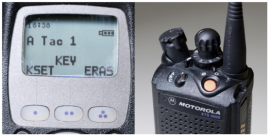
Motorola XTS5000 handheld, which uses the Project 25 standard(Credit: University of Pennsylvania)
Blaze said he has contacted the Justice Department and the Defense Department, which also uses Project 25 digital radios. “They are now aware of the problem and are trying to mitigate against it,” he said.
Representatives of the Association of Public-Safety Communications Officials (APCO), which has championed the Project 25 standard, did not respond to a request for comment this afternoon. Neither did the Telecommunications Industry Association, which maintains the standard.
The University of Pennsylvania researchers did not discover any vulnerabilities in the actual encryption algorithms used in the radios. They also chose not to disclose which agencies were the worst offenders, what cities the monitoring took place in, or what frequencies they found each agency used.
A third vulnerability they found was that each radio contains a unique identifier, akin to a phone number, that is broadcast in unencrypted form. So is the unique ID of the destination radio. That allows an eavesdropper to perform what’s known as traffic analysis, meaning tracking who’s talking to whom.
The reason jamming is relatively easy is that the Project 25 doesn’t use spread spectrum, which puts the would-be jammer at a disadvantage. By contrast, P25 relies on metadata that must be transmitted perfectly for the receiver to make sense of the rest of the communication. A pulse lasting just 1/100th of a second, it turns out, is enough to disrupt the transmission of the metadata.
This isn’t the first time that University of Pennsylvania researchers have taken a critical look at Project 25. Many of the same authors published a security analysis last November, which concluded that it’s “strikingly vulnerable to a range of attacks.”
Declan McCullaghDeclan McCullagh is the chief political correspondent for CNET. Declan previously was a reporter for Time and the Washington bureau chief for Wired and wrote the Taking Liberties section and Other People’s Money column for CBS News’ Web site.
Scientists working at the University of Southern California, home of the Department of Homeland Security’s National Center for Risk and Economic Analysis of Terrorism Events, have created an artificial memory system that allows thoughts, memories and learned behavior to be transferred from one brain to another.
In a scene right out of a George Orwell novel, a team of scientists working in the fields of “neural engineering” and “Biomimetic MicroElectronic Systems” have successfully created a chip that controls the brain and can be used as a storage device for long-term memories. In studies the scientists have been able to record, download and transfer memories into other hosts with the same chip implanted. The advancement in technology brings the world one step closer to a global police state and the reality of absolute mind control.
More terrifying is the potential for implementation of what was only a science fiction fantasy – the “Thought Police” – where the government reads people’s memories and thoughts and then rehabilitate them through torture before they ever even commit a crime based on a statistical computer analysis showing people with certain types of thoughts are likely to commit a certain type of crime in the future.
We already pre-emptively invade nations and torture alleged terrorist suspects with absolutely no due process of law, so the idea of pre-emptively torturing a terrorist suspect before hand to prevent them from committing an act of terrorism in the future really isn’t that far fetched of an idea.
Perhaps a less sensational example, than those I just depicted out of own of Orwell’s famous dystopian novels would be using the technology as it is depicted the modern day Matrix movies, in which computer programs are uploaded into people’s brains allowing them to instantly learn how to perform a wide variety of tasks.
That is exactly the example that Smart Planet uses in their write-up on the USC press release.
Today, the anti-utopian Orwellian of a regime of though police has become one step closer to realization as another instance of what was once considered science fiction fantasy has become a reality.
Researchers from the University of Berkeley, California have announced they have demonstrated the ability to read brain waves to replay the memories of movies stored in our brain.
Reconstruction Of Movie Watched Read From Brain Waves
The video below shows the results of the study displaying the actual movie watched on left and the reconstruction of the movie scientists read from the brain is on the right.
While the technology is not perfect, the break through the scientists have made is amazing.
The scientists began their research based on the hypothesis that certain parts of the cortex in the brain would be stimulated in a certain manner from certain visual stimulus.
From there they monitored brain activities, including brainwaves and blood pressure changes, using an MRI machine and were able to recreated the recollection of movies stored on the brains of test subjects.
While still the research is still in primitive stages, as more is learned about the brain and the technology advances, scientists hope they will be able to watch a live video of what you actually see. Within decades, they say the technology will be able to directly be able to read thoughts and memories.
Of course, researchers are touting the technology for the possible use in dealing with people suffering from cognitive disorders. However, the industrial military complex will find such a technology as in invaluable in the use of the so-called war on terror.
TG Daily reports:
Brain imaging reveals the movies in our minds
Scientists at the University of California, Berkeley, have managed to decode and reconstruct dynamic visual experiences processed by the human brain.
Currently, researchers are only able to reconstruct movie clips people have already viewed. However, the breakthrough is expected to pave the way for reproducing the movies inside our heads that no one else sees – such as dreams and memories.
“This is a major leap toward reconstructing internal imagery,” explained Professor Jack Gallant, a UC Berkeley neuroscientist and coauthor of the study published online today in the journal Current Biology. “We are opening a window into the movies in our minds.”
[…]Nevertheless, researchers emphasize that the brain imaging technology is “decades” away from allowing users to read thoughts and intentions – a theme which is prevalent in numerous dystopian science fiction books. Yet, the achievements of Galant’s team are particularly impressive, since the scientists actually decoded brain signals generated by moving pictures.
“Our natural visual experience is like watching a movie,” said Shinji Nishimoto, lead author of the study and a post-doctoral researcher in Gallant’s lab. ”In order for this technology to have wide applicability, we must understand how the brain processes these dynamic visual experiences.”
[…]The brain activity was recorded while subjects viewed the first set of clips which were fed into a computer program that learned, second by second, to associate visual patterns in the movie with the corresponding brain activity.
Brain activity evoked by the second set of clips was used to test the movie reconstruction algorithm. This was done by feeding 18 million seconds of random YouTube videos into the computer program so it could predict the brain activity each film clip would most likely evoke in each subject.
Finally, the 100 clips that the computer program determined were most similar to the clip that the subject had probably seen were merged to produce a blurry, yet continuous reconstruction of the original movie.
Reconstructing movies using brain scans has been somewhat of a challenge because the blood flow signals measured using fMRI change much more slowly than the neural signals that encode dynamic information in movies. As such, most previous attempts to decode brain activity tended to focus on static images.
THE HUMAN DNA IS A BIOLOGICAL INTERNET and superior in many aspects to the artificial one. Russian scientific research directly or indirectly explains phenomena such as clairvoyance, intuition, spontaneous and remote acts of healing, self healing, affirmation techniques, unusual light/auras around people (namely spiritual masters), mind’s influence on weather patterns and much more. In addition, there is evidence for a whole new type of medicine in which DNA can be influenced and reprogrammed by words and frequencies WITHOUT cutting out and replacing single genes.
Only 10% of our DNA is being used for building proteins. It is this subset of DNA that is of interest to western researchers and is being examined and categorized. The other 90% are considered “junk DNA.” The Russian researchers, however, convinced that nature was not dumb, joined linguists and geneticists in a venture to explore those 90% of “junk DNA.” Their results, findings and conclusions are simply revolutionary! According to them, our DNA is not only responsible for the construction of our body but also serves as data storage and in communication. The Russian linguists found that the genetic code, especially in the apparently useless 90%, follows the same rules as all our human languages. To this end they compared the rules of syntax (the way in which words are put together to form phrases and sentences), semantics (the study of meaning in language forms) and the basic rules of grammar. They found that the alkalines of our DNA follow a regular grammar and do have set rules just like our languages. So human languages did not appear coincidentally but are a reflection of our inherent DNA.
The Russian biophysicist and molecular biologist Pjotr Garjajev and his colleagues also explored the vibrational behavior of the DNA. [For the sake of brevity I will give only a summary here. For further exploration please refer to the appendix at the end of this article.] The bottom line was: “Living chromosomes function just like solitonic/holographic computers using the endogenous DNA laser radiation.” This means that they managed for example to modulate certain frequency patterns onto a laser ray and with it influenced the DNA frequency and thus the genetic information itself. Since the basic structure of DNA-alkaline pairs and of language (as explained earlier) are of the same structure, no DNA decoding is necessary.
One can simply use words and sentences of the human language! This, too, was experimentally proven! Living DNA substance (in living tissue, not in vitro) will always react to language-modulated laser rays and even to radio waves, if the proper frequencies are being used.
This finally and scientifically explains why affirmations, autogenous training, hypnosis and the like can have such strong effects on humans and their bodies. It is entirely normal and natural for our DNA to react to language. While western researchers cut single genes from the DNA strands and insert them elsewhere, the Russians enthusiastically worked on devices that can influence the cellular metabolism through suitable modulated radio and light frequencies and thus repair genetic defects.
Garjajev’s research group succeeded in proving that with this method chromosomes damaged by x-rays for example can be repaired. They even captured information patterns of a particular DNA and transmitted it onto another, thus reprogramming cells to another genome. ?So they successfully transformed, for example, frog embryos to salamander embryos simply by transmitting the DNA information patterns! This way the entire information was transmitted without any of the side effects or disharmonies encountered when cutting out and re-introducing single genes from the DNA. This represents an unbelievable, world-transforming revolution and sensation! All this by simply applying vibration and language instead of the archaic cutting-out procedure! This experiment points to the immense power of wave genetics, which obviously has a greater influence on the formation of organisms than the biochemical processes of alkaline sequences.
Esoteric and spiritual teachers have known for ages that our body is programmable by language, words and thought. This has now been scientifically proven and explained. Of course the frequency has to be correct. And this is why not everybody is equally successful or can do it with always the same strength. The individual person must work on the inner processes and maturity in order to establish a conscious communication with the DNA. The Russian researchers work on a method that is not dependent on these factors but will ALWAYS work, provided one uses the correct frequency.
But the higher developed an individual’s consciousness is, the less need is there for any type of device! One can achieve these results by oneself, and science will finally stop to laugh at such ideas and will confirm and explain the results. And it doesn’t end there.?The Russian scientists also found out that our DNA can cause disturbing patterns in the vacuum, thus producing magnetized wormholes! Wormholes are the microscopic equivalents of the so-called Einstein-Rosen bridges in the vicinity of black holes (left by burned-out stars).? These are tunnel connections between entirely different areas in the universe through which information can be transmitted outside of space and time. The DNA attracts these bits of information and passes them on to our consciousness. This process of hyper communication is most effective in a state of relaxation. Stress, worries or a hyperactive intellect prevent successful hyper communication or the information will be totally distorted and useless.
In nature, hyper communication has been successfully applied for millions of years. The organized flow of life in insect states proves this dramatically. Modern man knows it only on a much more subtle level as “intuition.” But we, too, can regain full use of it. An example from Nature: When a queen ant is spatially separated from her colony, building still continues fervently and according to plan. If the queen is killed, however, all work in the colony stops. No ant knows what to do. Apparently the queen sends the “building plans” also from far away via the group consciousness of her subjects. She can be as far away as she wants, as long as she is alive. In man hyper communication is most often encountered when one suddenly gains access to information that is outside one’s knowledge base. Such hyper communication is then experienced as inspiration or intuition. The Italian composer Giuseppe Tartini for instance dreamt one night that a devil sat at his bedside playing the violin. The next morning Tartini was able to note down the piece exactly from memory, he called it the Devil’s Trill Sonata.
For years, a 42-year old male nurse dreamt of a situation in which he was hooked up to a kind of knowledge CD-ROM. Verifiable knowledge from all imaginable fields was then transmitted to him that he was able to recall in the morning. There was such a flood of information that it seemed a whole encyclopedia was transmitted at night. The majority of facts were outside his personal knowledge base and reached technical details about which he knew absolutely nothing.
When hyper communication occurs, one can observe in the DNA as well as in the human being special phenomena. The Russian scientists irradiated DNA samples with laser light. On screen a typical wave pattern was formed. When they removed the DNA sample, the wave pattern did not disappear, it remained. Many control experiments showed that the pattern still came from the removed sample, whose energy field apparently remained by itself. This effect is now called phantom DNA effect. It is surmised that energy from outside of space and time still flows through the activated wormholes after the DNA was removed. The side effect encountered most often in hyper communication also in human beings are inexplicable electromagnetic fields in the vicinity of the persons concerned. Electronic devices like CD players and the like can be irritated and cease to function for hours. When the electromagnetic field slowly dissipates, the devices function normally again. Many healers and psychics know this effect from their work. The better the atmosphere and the energy, the more frustrating it is that the recording device stops functioning and recording exactly at that moment. And repeated switching on and off after the session does not restore function yet, but next morning all is back to normal. Perhaps this is reassuring to read for many, as it has nothing to do with them being technically inept, it means they are good at hyper communication.
In their book “Vernetzte Intelligenz” (Networked Intelligence), Grazyna Gosar and Franz Bludorf explain these connections precisely and clearly. The authors also quote sources presuming that in earlier times humanity had been, just like the animals, very strongly connected to the group consciousness and acted as a group. To develop and experience individuality we humans however had to forget hyper communication almost completely. Now that we are fairly stable in our individual consciousness, we can create a new form of group consciousness, namely one, in which we attain access to all information via our DNA without being forced or remotely controlled about what to do with that information. We now know that just as on the internet our DNA can feed its proper data into the network, can call up data from the network and can establish contact with other participants in the network. Remote healing, telepathy or “remote sensing” about the state of relatives etc.. can thus be explained. Some animals know also from afar when their owners plan to return home. That can be freshly interpreted and explained via the concepts of group consciousness and hyper communication. Any collective consciousness cannot be sensibly used over any period of time without a distinctive individuality. Otherwise we would revert to a primitive herd instinct that is easily manipulated.
Hyper communication in the new millennium means something quite different: Researchers think that if humans with full individuality would regain group consciousness, they would have a god-like power to create, alter and shape things on Earth! AND humanity is collectively moving toward such a group consciousness of the new kind. Fifty percent of today’s children will be problem children as soon as the go to school. The system lumps everyone together and demands adjustment. But the individuality of today’s children is so strong that that they refuse this adjustment and giving up their idiosyncrasies in the most diverse ways.
At the same time more and more clairvoyant children are born [see the book “China’s Indigo Children” by Paul Dong or the chapter about Indigos in my book “Nutze die taeglichen Wunder”(Make Use of the Daily Wonders)]. Something in those children is striving more and more towards the group consciousness of the new kind, and it will no longer be suppressed. As a rule, weather for example is rather difficult to influence by a single individual. But it may be influenced by a group consciousness (nothing new to some tribes doing it in their rain dances). Weather is strongly influenced by Earth resonance frequencies, the so-called Schumann frequencies. But those same frequencies are also produced in our brains, and when many people synchronize their thinking or individuals (spiritual masters, for instance) focus their thoughts in a laser-like fashion, then it is scientifically speaking not at all surprising if they can thus influence weather.
Researchers in group consciousness have formulated the theory of Type I civilizations. A humanity that developed a group consciousness of the new kind would have neither environmental problems nor scarcity of energy. For if it were to use its mental power as a unified civilization, it would have control of the energies of its home planet as a natural consequence. And that includes all natural catastrophes!!! A theoretical Type II civilization would even be able to control all energies of their home galaxy. In my book “Nutze die taeglichen Wunder,” I have described an example of this: Whenever a great many people focus their attention or consciousness on something similar like Christmas time, football world championship or the funeral of Lady Diana in England then certain random number generators in computers start to deliver ordered numbers instead of the random ones. An ordered group consciousness creates order in its whole surroundings!
When a great number of people get together very closely, potentials of violence also dissolve. It looks as if here, too, a kind of humanitarian consciousness of all humanity is created.(The Global Consciousness Project)
To come back to the DNA: It apparently is also an organic superconductor that can work at normal body temperature. Artificial superconductors require extremely low temperatures of between 200 and 140°C to function. As one recently learned, all superconductors are able to store light and thus information. This is a further explanation of how the DNA can store information. There is another phenomenon linked to DNA and wormholes. Normally, these supersmall wormholes are highly unstable and are maintained only for the tiniest fractions of a second. Under certain conditions stable wormholes can organize themselves which then form distinctive vacuum domains in which for example gravity can transform into electricity.
Vacuum domains are self-radiant balls of ionized gas that contain considerable amounts of energy. There are regions in Russia where such radiant balls appear very often. Following the ensuing confusion the Russians started massive research programs leading finally to some of the discoveries mentions above. Many people know vacuum domains as shiny balls in the sky. The attentive look at them in wonder and ask themselves, what they could be. I thought once: “Hello up there. If you happen to be a UFO, fly in a triangle.” And suddenly, the light balls moved in a triangle. Or they shot across the sky like ice hockey pucks. They accelerated from zero to crazy speeds while sliding gently across the sky. One is left gawking and I have, as many others, too, thought them to be UFOs. Friendly ones, apparently, as they flew in triangles just to please me. Now the Russians found in the regions, where vacuum domains appear often that sometimes fly as balls of light from the ground upwards into the sky, that these balls can be guided by thought. One has found out since that vacuum domains emit waves of low frequency as they are also produced in our brains.
And because of this similarity of waves they are able to react to our thoughts. To run excitedly into one that is on ground level might not be such a great idea, because those balls of light can contain immense energies and are able to mutate our genes. They can, they don’t necessarily have to, one has to say. For many spiritual teachers also produce such visible balls or columns of light in deep meditation or during energy work which trigger decidedly pleasant feelings and do not cause any harm. Apparently this is also dependent on some inner order and on the quality and provenance of the vacuum domain. There are some spiritual teachers (the young Englishman Ananda, for example) with whom nothing is seen at first, but when one tries to take a photograph while they sit and speak or meditate in hyper communication, one gets only a picture of a white cloud on a chair. In some Earth healing projects such light effects also appear on photographs. Simply put, these phenomena have to do with gravity and anti-gravity forces that are also exactly described in the book and with ever more stable wormholes and hyper communication and thus with energies from outside our time and space structure.
Earlier generations that got in contact with such hyper communication experiences and visible vacuum domains were convinced that an angel had appeared before them. And we cannot be too sure to what forms of consciousness we can get access when using hyper communication. Not having scientific proof for their actual existence (people having had such experiences do NOT all suffer from hallucinations) does not mean that there is no metaphysical background to it. We have simply made another giant step towards understanding our reality.
Official science also knows of gravity anomalies on Earth (that contribute to the formation of vacuum domains), but only of ones of below one percent. But recently gravity anomalies have been found of between three and four percent. One of these places is Rocca di Papa, south of Rome (exact location in the book “Vernetzte Intelligenz” plus several others). Round objects of all kinds, from balls to full buses, roll uphill. But the stretch in Rocca di Papa is rather short, and defying logic sceptics still flee to the theory of optical illusion (which it cannot be due to several features of the location).
All information is taken from the book “Vernetzte Intelligenz” von Grazyna Fosar und Franz Bludorf, ISBN 3930243237, summarized and commented by Baerbel. The book is unfortunately only available in German so far. You can reach the authors here: www.fosar-bludorf.com
The Android developer who raised the ire of a mobile-phone monitoring company last week is on the attack again, producing a video of how the Carrier IQ software secretly installed on millions of mobile phones reports most everything a user does on a phone.
Though the software is installed on most modern Android, BlackBerry and Nokia phones, Carrier IQ was virtually unknown until 25-year-old Trevor Eckhart of Connecticut analyzed its workings, revealing that the software secretly chronicles a user’s phone experience — ostensibly so carriers and phone manufacturers can do quality control.
But now he’s released a video actually showing the logging of text messages, encrypted web searches and, well, you name it.
Eckhart labeled the software a “rootkit,” and the Mountain View, California-based software maker threatened him with legal action and huge money damages. The Electronic Frontier Foundation came to his side last week, and the company backed off on its threats. The company told Wired.com last week that Carrier IQ’s wares are for “gathering information off the handset to understand the mobile-user experience, where phone calls are dropped, where signal quality is poor, why applications crash and battery life.”
The company denies its software logs keystrokes. Eckhart’s 17-minute video clearly undercuts that claim.
In a Thanksgiving post, we mentioned this software as one of nine reasons to wear a tinfoil hat.
The video shows the software logging Eckhart’s online search of “hello world.” That’s despite Eckhart using the HTTPS version of Google which is supposed to hide searches from those who would want to spy by intercepting the traffic between a user and Google.
Cringe as the video shows the software logging each number as Eckhart fingers the dialer.
“Every button you press in the dialer before you call,” he says on the video, “it already gets sent off to the IQ application.”
From there, the data — including the content of text messages — is sent to Carrier IQ’s servers, in secret. (See this update debunking that.)
By the way, it cannot be turned off without rooting the phone and replacing the operating system. And even if you stop paying for wireless service from your carrier and decide to just use Wi-Fi, your device still reports to Carrier IQ.
It’s not even clear what privacy policy covers this. Is it Carrier IQ’s, your carrier’s or your phone manufacturer’s? And, perhaps, most important, is sending your communications to Carrier IQ a violation of the federal government’s ban on wiretapping?
And even more obvious, Eckhart wonders why aren’t mobile-phone customers informed of this rootkit and given a way to opt out?
When will humanity reach Singularity, that now-famous point in time when artificial intelligence becomes greater than human intelligence? It is aptly called the Singularity proponents like Ray Kurzweil: like the singularity at the center of a black hole, we have no idea what happens once we reach it. However, the debate today is not what happens after the Singularity, but when will it happen. Presumably, if we better anticipate its timeline, we will carve a path that makes the Singularity era most beneficial to our species.
In light of the Singularity Summit approaching this week in New York, Microsoft co-founder Paul Allen and his colleague Mark Greaves have written a cautionary article in MIT Techology Review regarding the optimistic timelines of 2045 set by Kurzweil. Kurzweil, the father of the Singularity movement, has based his assumptions on the Law of Accelerating or Exponential Returns. According to Kurzweil, technologies become cheaper and their computation power increases at an exponential rate. Thus, it follows that artificial intelligence also increases exponentially in its ability to mimic the brain, enabling us to create an artificial copy of our “soul” and can live forever in robotic bodies that neither age nor die.
But Allen and Greaves challenge both the assumption that computational power will continue to increase exponentially and importantly, that such a condition implies that an exponential increase in our ability to understand, mimic and surpass the human brain. The authors underscore the complexity of the brain and how each time scientists have seen more of the brain with better imaging, they have been thrown off by new intricacies in its working – the result of millions of years of evolution. Even if we one day perfectly mimic the structural connections and biology of its neurons, humans will not automatically understand all the processes of the brain. “If we wanted to build software to simulate a bird’s ability to fly in various conditions”, they write, “simply having a complete diagram of bird anatomy isn’t sufficient. To fully simulate the flight of an actual bird, we also need to know how everything functions together.” This “complexity brake” will significantly slow down our progress towards the Singularity unless we have the kind of rare and unexpected insights that change the course of scientific progress.
Allen and Greaves points of caution should be noted. At the same, it is imperative that we also devoted attention to the “transition” period to the Singularity – this decades long age of deepening human-machine interdependence and how we as a society must come to terms with it. We call this transition phase our new Hybrid Reality.
This is the web portal to receive news and information about Andrew D. Basiago’s quest to lobby the US government to disclose its teleportation secret so that teleportation can be adopted on a global basis to help humanity achieve planetary sustainability in the 21st century.
For his revelations about the existence of time travel and life on Mars, Andy has been identified as a “planetary-level whistle blower” by the Web Bot project of futurists Clif High and George Ure. The Web Bot analyzes the content of the World Wide Web and uses Asymmetric Linguistic Trend Analysis (ALTA) to predict future global trends. Web Bot
A “peak experience” is how Andy described his lecture at the Ramtha School of Enlightenment (RSE) in Yelm, Washington on February 12, 2011. Andy received standing ovations when he entered the Great Hall at RSE to the resounding chords of Vangelis’ “Chariots of Fire,” when he called for public teleportation by 2020, and when he concluded his five-hour talk. His address was attended live by 1,250 people, viewed online by 250 others, translated into nine languages, and streamed live to 25 nations. Ramtha School of Enlightenment
“Project Pegasus and The Triumph of the Human Spirit” was the title of Andy’s talk at the Free Your Mind Conference in Philadelphia, Pennsylvania on April 9-10, 2011. During his talk, Andy provided a rare glimpse into the efforts that were made while he was serving on Project Pegasus to make him forget his time travel experiences, and how he overcame such oppression, so that today, one human being, empowered by the dream of bringing teleportation to the world, is ending the United States government’s time travel cover-up. Free Your Mind Conference
Andy spoke at Joan Ocean’s Dolphin & Teleportation Symposium in Kona, Hawaii on June 20-24, 2011. His keynote lecture “A Brief History of Time Travel” was described as a “tour d’ force.” He followed it up with “The Hidden History of The Discovery of Life on Mars,” his new lecture that relates his experiences on Mars from 1981 to 1983 to his Mars findings made since 2008. Joan Ocean
Andrew D. Basiago brought his truth campaign about the US time travel and Mars cover-ups to Maui for the first time when he lectured at the Temple of Peace in Haiku, Hawaii on July 23-24, 2011. During his talks, Andy linked President Barack Obama to the US Mars visitation program, revealing that Obama was his classmate in a Mars training program held at The College of the Siskiyous in 1980, and vowed future revelations about the US time-space program. Sacred Matrix
Andy was a guest speaker at Swedenborg Hall in San Diego, California on August 13-14, 2011. During his two-day lecture on the time travel and Mars cover-ups, The Reverend Carla A. Friedrich, pastor of the Swedenborgian Church, found numerous parallels between Andy’s time travel experiences and the notions of Emanuel Swedenborg, the 18th century theologian who inspired George Washington and Thomas Jefferson. Swedenborgian Church & Hall of San Diego
Life on Mars was the focus when Andy joined Alfred L. Webre and Laura M. Eisenhower at the Truth Event held in Port Townsend, Washington on August 26-27, 2011. After Andy spoke at the first Truth Event on November 20, 2010, he was hailed by Truth Event founder Charlie Arthur as “a rare and a great American” for bringing the truth about the US time-space program to the American people. This Truth Event focused on ending the cover-up of life on Mars and the US presence there. Truth Event
Andy was the keynote speaker when the Canadian Society of Questers met September 23 – 26, 2011 at Prestige Harbourfront and Convention Centre in Salmon Arm, British Columbia, Canada. In his keynote address on September 23rd, Andy told of the quest he has been on for over 10 years to prove his time travel experiences in DARPA’s Project Pegasus in the early 1970s and share them with others. In a workshop on September 25th, he then told of his related quest to prove and share his experiences in the CIA’s Mars visitation program during 1980 to 1983. Canadian Society of Questers
The Awakening Center in Rainier, Washington hosted Andrew D. Basiago in an all-day lecture on Saturday, October 8, 2011. During his visit to The Awakening Center, Andy told of his experiences in both DARPA’s Project Pegasus [1968-72] and the CIA’s Mars visitation program [1980-83]. The event began at 11:00 o’clock AM and ended when the last question was answered after 5:00 o’clock AM. The Awakening Center is located at 10905 138th Avenue NE, Rainier, WA 98576. They can be reached via e-mail at [email protected] and by telephone at (360) 446-7018. The Awakening Center
Andy was a guest on Coast to Coast AM on November 10, 2011. This marked his fourth appearance on Coast. Host George Noory has stated that he believes Andy’s account of having time traveled in Project Pegasus. In a Coast to Coast Insta-Poll held after Andy’s second appearance on Coast on November 11, 2010, 65% of Coast listeners agreed and 19% disagreed with Andy that the US government researched and developed time travel in the 1960s and 1970s. During this Coast broadcast, Andy’s Mars co-adventurer William B. Stillings and Mars whistle blower Laura M. Eisenhower corroborated his claim that the US government has a secret presence on Mars. Coast to Coast AM
By popular demand, The Awakening Center in Rainier, Washington again hosted Andy in an all-day lecture on Saturday, November 12, 2011 from 11:00 o’clock AM to 5:00 o’clock PM. During his talk, Andy focused in detail on his exploits in the CIA’s Mars visitation program, including his training with classmates Barack H. Obama, Regina E. Dugan, William C. McCool, and William Stillings [1980] and the trips that they took to Mars from a “jump room” in El Segundo, California [1981-83]. The Awakening Center is located at 10905 138th Avenue NE, Rainier, WA 98576. They can be reached via e-mail at [email protected] and by telephone at (360) 446-7018. The Awakening Center
Coast to Coast AM with George Noory, 11/11/09
Andrew D. Basiago: Project Pegasus
Introduction
Tonight, in a major disclosure event, the US time travel cover-up ends, as one of America’s early time-space explorers steps forward to reveal what he experienced and what he learned during the early years of time travel research and development by the United States government.
Our guest, Andrew D. Basiago, lawyer, writer, Mars researcher, and planetary whistle blower, brings his truth campaign to Coast-to-Coast AM, as he relates his childhood experiences in DARPA’s Project Pegasus, and shares with us the true history of the US time-space program.
Stay tuned, as tonight, we go in search of the past and the future, and discuss Project Pegasus, the real Philadelphia Experiment!
Biography
Andrew D. Basiago is a lawyer in private practice in Washington State, a writer, and a 21st century visionary.
He holds five academic degrees, including a BA in History from UCLA and a Master of Philosophy from the University of Cambridge.
Andy is an emerging figure in the Truth Movement, who is leading a campaign to lobby the United States government to disclose such controversial truths as the fact that Mars harbors life and that the United States has achieved “quantum access” to past and future events.
He has been identified as the first of two major planetary whistle blowers predicted by ALTA, the Web Bot project that analyzes the content of the World Wide Web to discern future trends.
Andy’s writings place him at the forefront of contemporary Mars research. His paper The Discovery of Life on Mars, published in 2008, was the first work to prove that Mars is an inhabited planet. After publishing his landmark paper, Andy founded the Mars Anomaly Research Society.
Andy is also one of America’s time travel pioneers. In the late 1960s and early 1970s, he was a child participant in the secret US time-space program, Project Pegasus.
He was the first American child to teleport and took part in probes to past and future events utilizing different forms of time travel then being researched and developed by DARPA.
For ten years, Andy has investigated his experiences in Project Pegasus on a quest to prove them and communicate them to others.
Soon, he will publish a tell-all book that will describe his awe-inspiring and terrifying experiences in Project Pegasus and the true story of the emergence of time travel in the US defense community 40 years ago.
Tonight, we will discuss Andy’s childhood experiences in Project Pegasus and his crusade as a lawyer to have the US government disclose its time travel secrets.
He will share with us the people, the places, the technologies, and the experiences that he encountered as a child time traveler in Project Pegasus, at the dawn of the time-space age!
Imagine a world in which one could jump through Grand Central Teleport in New York City, travel through a vortal tunnel in the time-space continuum, and emerge several seconds later at Union Teleport in Los Angeles. Such a world has been possible since 1968, when teleportation was first achieved by DARPA’s Project Pegasus, only to be suppressed ever since as a military secret. When my quest, Project Pegasus, succeeds, such a world will emerge, and human beings linked by teleportation around the globe will proclaim that the time-space age has begun.
— Andrew D. Basiago
Please note that this site is under development. Check back soon for additional content
On April 22, 1993, both BBC1 and BBC2 showed on their main evening news bulletins a rather lengthy piece concerning America’s latest development in weaponry – the non-lethal weapons concept. David Shukman, BBC Defense Correspondent interviewed (Retired) U.S. Army Colonel John B. Alexander and Janet Morris, two of the main proponents of the concept (1). The concept of non-lethal weapons is not new. Non-lethal weapons have been used by the intelligence, police and defense establishments in the past (2).
Several western governments have used a variety of non-lethal weapons in a more discreet and covert manner. It seems that the U.S. government is about to take the first step towards their open use.
The current interest in the concept of non-lethal weapons began about a decade ago with John Alexander. In December 1980 he published an article in the U.S. Army’s journal, MILITARY REVIEW, “The New Mental Battlefield,” referring to claims that telepathy could be used to interfere with the brain’s electrical activity. This caught the attention of senior Army generals who encouraged him to pursue what they termed “soft option kill” technologies.
After retiring from the Army in 1988, Alexander joined the Los Alamos National Laboratories and began working with Janet Morris, the Research Director of the U.S. Global Strategy Council (USGSC), chaired by Dr Ray Cline, former Deputy Director of the CIA (3). I examine the background of Janet Morris and John Alexander in more detail below.
Throughout 1990 the USGSC lobbied the main national laboratories, major defense contractors and industries, retired senior military and intelligence officers. The result was the creation of a Non-lethality Policy Review Group, led by Major General Chris S. Adams, USAF (retd.) former Chief of Staff, Strategic Air Command (4). They already have the support of Senator Sam Nunn, chair of the Senate Armed Services Committee. According to Janet Morris, the military attaché at the Russian Embassy has contacted USGSC about the possibility of converting military hardware to a non-lethal capability.
In 1991 Janet Morris issued a number of papers giving more detailed information about USGSC’s concept of non-lethal weapons (5). Shortly after, the U.S. Army Training and Doctrine Command at Fort Monroe, VA, published a detailed draft report on the subject titled “Operations Concept for Disabling Measures.” The report included over twenty projects in which John Alexander is currently involved at the Los Alamos national Laboratories.
In a memorandum dated April 10, 1991, titled “Do we need a Non-lethal Defense initiative?” Paul Wolfwitz, Under Secretary of Defense for Policy, wrote to Defense Secretary Dick Cheney,
“A U.S. lead in non-lethal technologies will increase our options and reinforce our position in the post-Cold War world. Our Research and Development efforts must be increased.”
HOW LETHAL IS NON-LETHAL?
To support their non-lethal weapons concept, Janet Morris argues that while,
“war will always be terrible… a world power deserving its reputation for humane action should pioneer the principles of non-lethal defense (6).” In “Defining a non-lethal strategy,” she seeks to establish a doctrine for the use of non-lethal weapons by the U.S. in crisis “at home or abroad in a life serving fashion.”
She totally disregards the offensive, lethal aspects inherent in some of the weapons in question, or their misuse, should they become available to “rogue” nations. Despite her arguments that non-lethal weapons should serve the U.S.’s interests,
“at home and abroad by projecting power without indiscriminately taking lives or destroying property (7),” she admits that “casualties cannot be avoided (8).”
Closer examination of the types of weapons to be used as non-lethal invalidates her assertions about their non-lethality. According to her white paper, the areas where non-lethal weapons could be useful are,
“by identifying and requiring a new category of non-lethal weapons, tactics and strategic planning” the U.S. can reshape its military capability, “to meet the already identifiable threats” that they might face in a multipolar world “where American interests are globalized and American presence widespread (10).”
THE POTENTIAL INVENTORY Janet Morris’ “White Paper” recommends “two types of life-conserving technologies“:
ANTI-MATERIAL NON-LETHAL TECHNOLOGIES
To destroy or impair electronics, or in other ways stop mechanical systems from functioning. Amongst current technologies from which this category of non- lethal weapons would or could be chosen are:
Chemical and biological weapons for their anti-materiel agents “which do not significantly endanger life or the environment, or anti-personnel agents which have no permanent effects (11).”
Laser blinding systems to incapacitate the electronic sensors, or optics, i.e. light detection and ranging. Already the Army Infantry School is developing a one-man portable and operated laser weapons system known as the Infantry Self-Defense System. The U.S. Army’s Armament Research, Development and Engineer Center (ARDEC), is also engaged in the development of non-lethal weapons under their program called “Low Collateral Damage Munitions” (LCDM). The LCDM is trying to develop technologies leading to weapons capable of dazzling and incapacitating missiles, armored vehicles and personnel.
Non-lethal electromagnetic technologies.
Non-nuclear Electromagnetic Pulse weapons(12). As General Norman Schwartzkopf has told the U.S. Joint Chiefs of Staff, one such weapons stationed in space with a wide-area-pulse capacity has the ability to fry enemy electronics. But what would be the fate of enemy personnel in such a scenario? In a join project with the Los Alamos National Laboratories and with technical support from the Army’s Harry Diamond Laboratories, ARDEC are developing High Power Microwave (HPM) Projectiles. According to ARDEC, the Diamond lab has already “completed a radio frequency effects analysis on a representative target set” for (HPM).
Among the chemical agents, so-called super caustics – “Millions of times more caustic than hydrofluoric acid (13)” – are prime candidates. An artillery round could deliver jellied super-acids which could destroy the optics of heavily armored vehicles or tanks, vision blocks or glass, and “could be used to silently destroy key weapons systems (14).”
On less lethal aspects the use of net-like entanglements for SEAL teams, or “stealthy” metal boats with low or no radar signature, “for night actions, or any sea borne or come-ashore stealthy scenario” are under consideration (15). More colorful concepts are the use of chemical metal embitterment, often called liquid metal embitterment and anti-materiel polymers which would be used in aerosol dispersal systems, spreading chemical adhesives or lubricants (i.e. Teflon-based lubricants) on enemy equipment from a distance.
ANTI-PERSONNEL NON-LETHAL TECHNOLOGIES
Hand-held lasers which are meant “to dazzle,” could also cause the eyeball to explode and to blind the target.
Isotropic radiators – explosively driven munitions, capable of generating very bright omni-directional light, with similar effects to laser guns.
High-power microwaves (HPM) – U.S. Special Operations command already has that capability within their grasp as a portable microwave weapon (16). As Myron L. Wolbarsht, a Duke University opthalamist and expert in laser weapons stated:
“U.S. Special Forces can quietly cut enemy communications but also can cook internal organs (17).”
Another candidate is Infrasound – acoustic beams. In conjunction with the Scientific Applications and Research Associates (SARA) of Huntingdon, California, ARDEC and Los Alamos laboratories are busy “developing a high power, very low frequency acoustic beam weapons.” They are also looking into methods of projecting non-diffracting (i.e. non-penetrating) high frequency acoustic bullets. ARDEC scientists are also looking into methods of using pulsed chemical lasers. This class of lasers could project,
“a hot, high pressure plasma in the air in front of a target surface, creating a blast wave that will result in variable but controlled effects on materiel and personnel.”
Infrasound. Already some governments have used it as a means of crowd control – e.g. France.
Very low frequency (VLF) sound (20-35 KHz), or low-frequency RF modulations can cause nausea, vomiting and abdominal pains.
“Some very low frequency sound generators, in certain frequency ranges, can cause the disruption of human organs and, at high power levels, can crumble masonry (18).”
The CIA had a similar program in 1978 called Operation Pique, which included bouncing radio or microwave signals off the ionosphere to affect mental functions of people in selected areas, including Eastern European nuclear installations (19).
JOHN ALEXANDER
The entire non-lethal weapon concept opens up a new Pandora’s Box of unknown consequences. The main personality behind it is retired Colonel John B. Alexander. Born in New York in 1937, he spent part of his career as a Commander of Green Berets Special Forces in Vietnam, led Cambodian mercenaries behind enemy lines, and took part in a number of clandestine programs, including Phoenix. He currently holds the post of Director of Non-lethal Programs in the Los Alamos National Laboratories.
Alexander obtained a BaS from the University of Nebraska and an MA from Pepperdine University. In 1980 he was awarded a PhD from Walden University (20) for his thesis “To determine whether or not significant changes in spirituality occur in persons who attended a Kubler-Ross life/death transition workshop during the period June through February 1979.” His dissertation committee was chaired by Elizabeth Kubler-Ross.
He has long been interested in what used to be regarded as “fringe” areas. In 1971, while a Captain in the infantry at Schofield Barracks, Honolulu, he was diving in the Bemini Islands looking for the lost continent of Atlantis. He was an official representative for the Silva mind control organization and a lecturer on Precataclysmic Civilizations(21).
Alexander is also a past President and a Board member of the International Association for Near Death Studies; and, with his former wife, Jan Northup, he helped Dr C.B. Scott Jones perform ESP experiments with dolphins (22).
PSI-TECH
Retired Major General Albert N. Stubblebine (Former Director of U.S. Army Intelligence and Security Command) and Alexander are on the board of a “remote viewing” company called PSI-TECH. The company also employs Major Edward Dames (ex Defense Intelligence Agency), Major David Morehouse (ex 82nd Airborne Division), and Ron Blackburn (former microwave scientist and specialist at Kirkland Air Force Base).
PSI-TECH has received several government contracts. For example, during the Gulf War crisis the Department for Defense asked it to use remote viewing to locate Saddam’s Scud missiles sites. Last year (1992) the FBI sought PSI-TECH’s assistance to locate a kidnapped Exxon executive (23).
With Major Richard Groller and Janet Morris as his co-authors, Alexander published THE WARRIOR’S EDGEin 1990 (24). The book describes in detail various unconventional methods which would enable the practitioner to acquire “human excellence and optimum performance” and thereby become an invincible warrior (25). The purpose of the book is “to unlock the door to the extraordinary human potentials inherent in each of us. To do this, we, like governments around the world , must take a fresh look at non-traditional methods of affecting reality. We must raise human consciousness of the potential power of the individual body/mind system – the power to manipulate reality. We must be willing to retake control of our past, present, and ultimately, our future (26).”
Alexander is a friend of Vice President Al Gore Jnr, their relationship dating back to 1983 when Gore was in Alexander’s Neuro-Linguistic Programming (NLP). NLP “presented to selected general officers and Senior Executive Service members (27)” a set of techniques to modify behavior patterns (28). Among the first generals to take the course was the then Lieutenant General Maxwell Thurman, who later went on to receive his fourth star and become Vice-Chief of Staff at the Army and Commander Southern Command(29). Among other senior participants were Tom Downey and Major General Stubblebine, former Director of the Army Intelligence Security Command.
“In 1983, the Jedi master (from the Star Wars movie – author) provided an image and a name for the Jei Project (30).”
Jedi Project’s aim was to seek and “construct teachable models of behaviorable/physical excellence using unconventional means (31).” According to Alexander the Jedi Project was to be a follow-up to Neuro-Linguistic Programming skills. By using the influence of friends such as Major General Stubblebine, who was then head of the U.S. Army Intelligence and Security Command, he managed to fund Jedi. In reality the concept was old hat, re-christened by Alexander.
The original idea which was to show how “human will power and human concentration affect performance more than any other single factor (32)” using NLP skills, was the brainchild of three independent people; Fritz Erikson, a Gestalt therapist, Virginia Satir, a family therapist and Erick Erickson, a hypnotist.
JANET MORRIS Janet Morris, co-author of THE WARRIOR’S EDGE, is best known as a science fiction writer but has been a member of the New York Academy of Sciences since 1980 and is a member of the Association for Electronic Defense. She is also the Research Director of the U.S. Global Strategy Council (USGSC). She was initiated into the Japanese art of bioenergetics, Joh-re, the Indonesian brotherhood of Subud, and graduated from the Silva course in advanced mind control.
She has been conducting remote viewing experiments for fifteen years. She worked on a research project investigating the effects of mind on probability in computer systems. Her husband, Robert Morris, is a former judge and a key member of the American Security Council (33).
In a recent telephone conversation with the author (34), Janet Morris confirmed John Alexander’s involvement in mind control and psychotronic projects in the Los Alamos National Laboratories. Alexander and his team have recently been working with Dr Igor Smirnov, a psychologist from the Moscow Institute of Psychocorrelations. They were invited to the U.S. after Janet Morris’ visit to Russia in 1991.
There she was shown the technique which was pioneered by the Russian Department of Psycho-Correction at Moscow Medical Academy. The Russians employ a technique to electronically analyze the human mind in order to influence it. They input subliminal command messages, using key words transmitted in “white noise” or music(35). Using an infrasound very low frequency-type transmission, the acoustic psycho-correction message is transmitted via bone conduction – ear plugs would not restrict the message.
To do that would require an entire body protection system. According to the Russians the subliminal messages by-pass the conscious level and are effective almost immediately.
C.B. SCOTT JONES Jones is the former assistant to Senator Clairborne Pell (Democrat, Rhode Island). Scott Jones was a member of U.S. Naval Intelligence for 15 years, as well as Assistant Naval Attaché, New Delhi, India, in the 1960s. Jones has briefed the President’s Scientific Advisory Committee, and has testified before House and Senate Committees on intelligence matters.
After the navy he,
“worked in the private sector research and development community involved in the U.S. government sponsored projects for the Defense Nuclear Agency (DNA), Defense Intelligence Agency (DIA) and U.S. Army Intelligence and Security Command.”
He has been head of the Rockefeller Foundation for some time and chairs the American Society for Psychical Research(36).
BIRDS OF A FEATHER
Alexander and C.B. Jones are members of the AVIARY, a group of intelligence and Department of Defense officers and scientists with a brief to discredit any serious research in the UFO field. Each member of the Aviary bears a bird’s name. Jones is FALCON, John Alexander is PENGUIN.
One of their agents; a UFO researcher known as William Moore, who was introduced to John Alexander at a party in 1987 by Scott Jones, confessed in front of an audience at a conference held by the MUTUAL UFO NETWORK (MUFON) on July 1, 1989, in Las Vegas, how he was promised inside information by the senior members of the AVIARY in return for his obedience and service to them. He participated in the propagation and dissemination of disinformation fed to him by various members of the AVIARY.
He also confessed how he was instructed to target one particular individual, an electronics expert, Dr Paul Bennewitz, who had accumulated some UFO film footage and electronic signals which were taking place in 1980 over the Menzano Weapons Storage areas, at Kirtland Air Force Base, New Mexico. As a result of Moore’s involvement, coupled with some surreptitious entries and psychological techniques, Bennewitz ended up in a psychiatric hospital.
Just before the publication of my first paper unmasking two members of the AVIARY (37) I was visited by two of their members (MORNING DOVE and HAWK) who had travelled to the U.K. with a message from the senior ranks advising me not to go ahead with my expose. I rejected the proposal.
Immediately after the publication of that paper, and with the full knowledge that myself and a handful of colleagues knew the true identities of their members, John B. Alexander confessed that he was indeed a member of the AVIARY, nicknamed PENGUIN. The accuracy of our information was further confirmed to me by yet another member of the AVIARY, Ron Pandolphi, PELICAN. Pandolphi is a PhD in physics and works at the Rocket and Missile section of the Office of the Deputy Director of Science and Technology, CIA.
In his book, OUT THERE(38), the NEW YORK TIMES journalist Howard Blum refers to “a UFO Working Group” within the Defense Intelligence Agency. Despite DIA’s repeated denials (39), the existence of this working group has been confirmed to me by more than one member of the group itself, including an independent source in the Office of Naval Intelligence.
The majority of the group’s members are senior members of the AVIARY:
Dr Jack Verona (RAVEN) (DoD, one of the initiators of the DIA’s Sleeping Beauty project which aimed to achieve battlefield superiority using mind-altering electromagnetic weaponry)
John Alexander (PENGUIN)
Ron Pandolphi (PELICAN)
The mysterious “Col. Harold E. Phillips” who appears in Blum’s OUT THERE is none other than John B. Alexander.
John Alexander’s position as the Program Manager for Contingency Missions of Conventional Defense Technology, Los Alamos National Laboratories, enabled him to exploit the Department of Defense’s Project RELIANCE “which encourages a search for all possible sources of existing and incipient technologies before developing new technology in-house (41)” to tap into a wide range of exotic topics, sometimes using defense contractors, e.g. McDonnel Douglas Aerospace.
I have several reports, some of which were compiled before his departure to the Los Alamos National Laboratories when he was with Army Intelligence, which show Alexander’s keen interest in any and every exotic subject:
UFOs
ESP
psychotronics
anti-gravity devices
near death experiments
psychology warfare
non-lethal weaponry
John Alexander utilizes the bank of information he has accumulated to try to develop psychotronic, psychological and mind weaponry. He began thinking about non-lethal weapons a decade ago in his paper “The New Mental Battlefield.” He seems to want to become a “Master.”
If he ever succeeds in this ambition the rest of us ordinary mortals had better watch out.
NOTES:
1. Letter dated 2 April, 1993, to author from Mrs Victoria Alexander.
2. The U.S. Army Chemical and Military Police used “Novel Effect Weapons” against the women protesters at the Greenham Common Base.
3. The United States Global Strategy Council is an independent think tank, incorporated in 1981. It focuses on long-range strategic issues. The founding members were Clare Boothe Luce, General Maxwell Taylor, General Albert Wedemeyer, Dr Ray Cline (Co-chair), Jeane Kirkpatrick (Co-chair), Morris Leibman, Henry luce III, J. William Middendorf II, Admiral Thomas H. Moorer USN (retd), General Richard Stillwell (retd), Dr Michael A. Daniles (President), Dr Dalton A. West (Executive Vice President). Its Research Directors were Dr Yona Alexander, Dr Roger Fontaine, Robert L. Katula and Janet Morris.
4. NONLETHAlITY: DEVELOPMENT OF A NATIONAL POLICY AND EMPLOYING NONLETHAL MEANS IN A NEW STATEGIC ERA – a Project of the U.S. Global Strategy Council, 1991, p.4. Other staff members of the USGSC are Steve Trevino, Dr John B. Alexander and Chris Morris.
5. The USGSC has issued a wide variety of papers on the Nonlethal Weapons Concept. For example, IN SEARCH OF NONLETHAL STRATEGY (Janet Morris); NONLETHALITY: A GLOBAL STRATEGY – WHITE PAPER; NONLETHALITY BRIEFING SUPPLEMENT No.1; and NONLETHALITY IN THE OPERATIONAL CONTINUUM.
6. IN SEARCH OF A NONLETHAL STRATEGY, Janet Morris, p.1.
7. NONLETHALITY: A GLOBAL STRATEGY – WHITE PAPER, p.3. 8. IN SEARCH OF… P.3.
9. In the recent cult siege in Waco, Texas, a “nonlethal” technique, projecting sublimal messages, was used to influence David Kuresh – without effect.
10. NONLETHALITY: A GLOBAL STRATEGY – WHITE PAPER, p.2.
11. The computer data base compiled during the CIA/Army’s Project OFTEN, examining several thousand chemical compounds, during 1976-1973, is a most likely candidate for any chemical agents for nonlethal weapons.
12. The British MoD is already developing a “microwave bomb.” Work on the weapon is going on at the Defence Research Agency at Farnborough, Hampshire. See SUNDAY TELEGRAPH September 27, 1992, partly reproduced in LOBSTER 24, p.14. The Royal Navy is already in possession of laser weapons which dazzle aircraft pilots. The Red Cross has called for them to be banned under the Geneva Convention because could permanently blind.
13. IN SEARCH OF A NONLETHAL STRATEGY, p.13.
14. Ibid.
15. The U.S. Navy, through its Project SEA SHADOW, has already developed a stealth boat. Like the Lockheed F117A, stealth fighter, it leaves no radar signature – BBC, Newsround, April 28, 1993.
16. Taped conversation with Janet Morris, March 1, 1993.
17. THE WALL STREET JOURNAL, January 4, 1993.
18. IN SEARCH OF A NONLETHAL STRATEGY, p. 14.
19. REMOTE CONTROL TECHNOLOGY, Anna Keeler (FULL DISCLOSURE, Ann Arbor, U.S.A., 1989) p.11.
20. Walden University, 801 Anchor Road Drive, Naples, Fl. 33904, U.S.A. Walden University considers itself a non-traditional university and does not offer any undergraduate courses to its students.
21. Brad Steiger, MYSTERIES OF SPACE AND TIME (Prentice Hall, Engelwood Cliffs, New Jersey) pp.72 and 3. The U.S. Army Command and General College, Fort Leavenworth, Kansas, issued this on Alexander’s career: “Colonel John B. Alexander, U.S. Army Retired, manages Antimateriel Technology at Los Alamos National Laboratories, Los Alamos, New Mexico. His military assignments included; Advanced Systems Concepts Office, Laboratory Command; manager, Technology Integration Office, Army Material Command; assistant deputy chief of staff, Technology Planning and Management, Army Material Command; and chief, Advanced Human Technology, Intelligence and Security Command.”
22. Taped telephone conversation with Dr Scott Jones, August 17, 1992.
23. Taped telephone conversation with Maj. Edward Dames, June 27, 1992; and THE BULLETIN OF ATOMIC SCIENTISTS, December 1992, p.6.
24. THE WARRIOR’S EDGE, Col. John B. Alexander, Maj. Richard Groller and Janet Morris, (William Morrow Inc., New York, 1990).
25. Ibid. p.9.
26. Ibid. pp.9 and 10.
27. Ibid p.47.
28. Ibid.
29. Ibid.
30. Ibid. pp.72 and 3.
31. Ibid. p.12.
32. Ibid. p. 13.
33. The American Security Council (ASC) Box 8, Boston, Virginia 22713, USA. ASC is militarist, anti-communist and right-wing. Formed in the mid 1950s, the Council acts as a right-wing think tank on foreign policy and lobbies for the expansion and strengthening of U.S. military forces. In 1985 the ASC had 330,000 members. See, for example, the entry for the ASC in THE RADICAL RIGHT: A WORLD DIRECTORY, compiled by Ciaran O Maolain (Longman, London 1987).
34. Taped telephone conversation with Janet Morris, March 1, 1993.
35. In 1989 a U.S. Department of Defense consultant and contractor explained to the author how he was asked to examine the possibility of devising operational methods of transmitting subliminal messages through the TV screen.
36. “Will the Real Scott Jones please stand up?” – unpublished paper by George Hansen and Robert Durant, February 20, 1990, pp.4 and 5.
37. “The Birds” Armen Victorian, in U.K. UFO Magazine, Vol.11 No.3, July/August 1992, pp 4-7.
38. OUT THERE, Howard Blum (Simon and Schuster, London 1990) pp.44, 46-51, 55-57.
39. DIA’s letters to author dated July 12, 1991, July 8, 1992 and December 18, 1992.
40. Dr Chistopher “Kit” Green, BLUEJAY, has admitted that the CIA has compiled over 30,000 files on UFOs, 200 of which are extremely interesting. Green was a key CIA member in examining the UFO problem for several years.
41. Los Alamos National Laboratory, Institutional Plan Fiscal Year 1992 – Fiscal Year 1997, p.14.
Details of an emerging data-mining and intelligence-analysis program reminiscent of the Pentagon’s controversial Total Information Awareness (TIA) project emerged yesterday, U.S. Trade & Aid Monitor has discovered.
Similar to TIA, which Congress in 2003 de-funded insofar as domestic applications, the Insight Focused Incubator initiative seeks to create a multimedia system that obtains, synthesizes, and analyzes mass volumes of data via the development of an advanced “‘plug and play’ modular architecture” of intelligence, surveillance, and reconnaissance (ISR) technologies.
According to a Special Notice that the Monitor obtained via routine database research, the Defense Advanced Research Projects Agency (DARPA) issued a call to industry for innovative ideas leading to the creation of such a system.
The Insight program at DARPA’s Information Innovation Office (I2O) became known to the public last September, when it initially met with industry representatives to discuss its vision for the program (solicitation # DARPA-SN-10-70). However, yesterday’s reference to the Insight Focused Incubator moniker appears to take the program to the next level of execution.
“As part of the Insight platform, the Insight program is developing a virtual environment (VE) capability to enable system evaluation using simulated sensor data, augmented with real-world collected data, within a simulated world of various threats, terrains, and terrain features,” the special notice/request for information says.
The key to Insight’s development extends beyond the mere collection of data and the development of virtual threat scenarios; rather, DARPA is looking for innovative ideas for an evolutionary, interoperable system of various ISR components.
From a technical standpoint, the new system that DARPA envisions would possess the ability “to easily add, remove, substitute, and modify software and hardware components” as they become available to the government.
From an operational perspective, the Insight Focused Incubator would lead to the design of a system that integrates, correlates, fuses, and exploits “multi-intelligence data.” This would include, for example, a combination of worldwide sensors and platforms that combine the use of signals intelligence, video and ground moving target indicators (VMTI and GMTI) and even “Behavioral (pattern-of-life) modeling including cultural, social, and insurgency dynamics.”
Other objectives for the system include “data mining across all sources, both real-time and forensic” as well as the creation of “an active sensing process with multiple functions occurring simultaneously.”
DARPA anticipates launching a three-phase structure for Insight Focused Incubator, during which time it would award contracts ranging from $400,000-$800,000 per phase for each contractor selected for the project. The agency did not disclose the total potential funding for the program. Proposals are due June 30.
Dec. 19 – Software developed for closed-circuit television systems can identify individuals and track them across entire networks of cameras. Joel Flynn reports.
Large-scale AFIS and multi-biometric identification
MegaMatcher technology is intended for large-scale AFIS and multi-biometric systems developers. The technology ensures high reliability and speed of biometric identification even when using large databases.
MegaMatcher is available as a software development kit that allows development of large-scale single- or multi-biometric fingerprint, iris, face, voice or palm print identification products for Microsoft Windows, Linux and Mac OS X platforms.
Complete information, including all technical specifications, licensing and prices.
The 54-page brochure can be printed on both Letter and A4 paper.
File size: 2,705 kilobytes. Updated on: November 28, 2011.
Advantages of MegaMatcher
Proven in national-scale projects, including passport issuance and voter deduplication.
200,000,000 irises or 100,000,000 fingerprints per second can be matched using MegaMatcher Accelerator.
Fingerprints, irises and faces can be matched on smart cards using MegaMatcher On Card.
Includes fingerprint, iris, face, voice and palm print modalities.
Rolled, flat and latent fingerprint matching.
BioAPI 2.0 and other ANSI and ISO biometric standards support.
Multiplatform, scalable cluster architecture for parallel matching.
Effective price/performance ratio, flexible licensing and free customer support.
References
Bangladesh Voter Registration Project registered more than 80 million citizens using biometric face and fingerprint technology.
Read the case study (PDF) or press release.
Indonesia distributed passport issuance system with a centralized biometric matching component based on MegaMatcher technology.
Read case study (PDF) or press release.
El Salvador’s National Passport System – the nationwide multi-biometric passport and immigration system based on MegaMatcher multi-biometric technology.
Read the case study (PDF).
Additional case studies and Solution Partner references are available. Read more
Technology and SDK
Requirements for large-scale biometric systems. Large-scale automatic biometric identification systems have a number of special requirements that are different from those of small- or medium-scale biometric systems. These requirements include system reliability, productivity, scalability, etc. Read more
MegaMatcher algorithm features and capabilities. MegaMatcher includes fingerprint, facial, iris, speaker and palm print recognition engines and allows to use the fused fingerprint-face-voice-iris algorithm for fast and reliable identification in large-scale systems. The fingerprint engine is NIST MINEX compliant and is capable of matching rolled and flat fingerprints between themselves. The face engine includes live face detection and processes multiple faces in live video streams. Read more
MegaMatcher SDK and MegaMatcher Accelerator in high productivity biometric systems. MegaMatcher SDK and MegaMatcher Accelerator include cluster software that allows the scaling of an AFIS or multi-biometric system to reach the required response time, database capacity and system robustness. Read more
MegaMatcher Standard and Extended SDK. The Standard SDK is intended for development of client/server-based multi-biometric fingerprint, face, voice, iris and palmprint identification products. The Extended SDK is intended for developing large-scale cluster-based AFIS or multi-biometric identification products. Read more
Fingerprint scanner support. More than 90 fingerprint scanners models are supported by MegaMatcher SDK. Read more
Face capture camera support. A number of face capture cameras and web cams are supported by MegaMatcher SDK. Read more
Iris scanner support. A number of iris capture cameras and multi-modal face-iris devices are supported by MegaMatcher SDK. Read more
Recommendations and constraints for face recognition. MegaMatcher facial recognition engine has certain requirements to the images, produced by cameras, lightning conditions, face posture and expression. Read more
Recommendations and constraints for speaker recognition. MegaMatcher speaker recognition engine has certain requirements to the microphones, their settings and position, as well as user behaviour and environment. Read more
System requirements and supported development environments. Components of MegaMatcher SDK can be run on computers with x86 32 and 64 bit processors (at least 2 GHz processor recommended). Windows, Linux and Mac OS X platforms are supported. Microsoft SQL Server, MySQL, SQLite, PostgreSQL and Oracle are supported. Read more
Technical specifications. The MegaMatcher fingerprint engine is able to match up to 148,000 fingerprints per second, 1,200,000 faces per second or 1,200,000 irises per second on a single PC; several PCs can be connected together to form a cluster for higher performance. Read more.
Reliability and performance testing results. MegaMatcher provides high identification reliability using either fingerprint, face or iris matching engines. Using fused single- or multi-biometric identification allows MegaMatcher to reach almost 0 % FRR. Read more.
MINEX compliance. In 2007 MegaMatcher 2.0 fingerprint technology was recognized by NIST as fully MINEX compliant. The recognition allowed to use MegaMatcher in personal identity verification program (PIV) applications. Read more
Licensing options. To develop a MegaMatcher-based product, an integrator should obtain MegaMatcher 4.2 Standard SDK or Extended SDK. A license for a MegaMatcher component is required for each PC or each server CPU that runs this component. Single computer licenses, concurrent network licenses and enterprise licenses are available. Read more
Prices. MegaMatcher Standard SDK costs € 2,590, the Extended SDK is € 4,990. Prices for additional component installation licenses depend on type and quantity. Read more
Pricing calculator – allows to determine the cost of ordered products and their shipping charges. Open pricing calculator
MegaMatcher Accelerator 4.0 – a solution for building the server-side of a large-scale AFIS or multi-biometric system; available in Standard and Extended versions; a single MegaMatcher Accelerator Standard matches 35 million fingerprints per second or 50 million irises per second, and the Extended matches 100 million fingerprints per second or 200 million irises per second.
MegaMatcher Embedded SDK – a product for multi-biometric fingerprint and face recognition on Android smartphones, tablets and other mobile devices. Produces fingerprint and face templates that are the same as in MegaMatcher SDK, thus can be also used for developing biometric client-side mobile applications for systems with server-side based on MegaMatcher SDK.
“Josie and the Pussycats” is a “girl band movie” aimed at children and young adolescents, especially young girls. At first glance, the flick seems to be one of those generic, God-awful teen movies. However, a closer look reveals how its overall tone and message are in sharp contrast to stereotypes of the genre. “Josie and the Pussycats” is indeed an acerbic critique of a morally bankrupt music industry. The most surprising thing about this 2001 movie is its frighteningly accurate predictions regarding today’s pop music and its Illuminati agenda: mind controlled artists, hypnotized masses, subliminal messages… it’s all there. This article will examine the movie’s themes and their relation to today’s music business context.
Josie and the Pussycats was released in 2001 by Universal. In music industry terms, 2001 is ancient history. Just to put you back in the context of the era: N’Sync were still singing Bye Bye Bye, Cisco wanted to see your thong-th-th-thong-thong-thong and everybody was wondering Who Let the Dogs Out. Teens were going crazy for boy bands like the Backstreet Boys and everybody was dancing to Ja Rule. So, yes, it was a long time ago.
Josie and the Pussycats came out during that period, but it seems to foretell the death of the era. The movie starts with members of the boy band “Du Jour,”a spoof on the Backstreet Boys, dying in a forced plane crash. The group is then replaced by a girl band with a semi-punky attitude and non-threatening pop rock music. This pretty much reflects what actually happened in the years following the release of this movie: N’Sync and the Backstreet Boys disappeared from the preteen music market and were replaced by Miley Cyrus, Hilary Duff, the Jonas Brothers, and so on.
The Jonas Brothers’ semi-punky attitude and non-threatening pop rock music replaced the Backstreet Boys. They’re the male Josie and the Pussycats.
Despite the movie’s apparent lightheartedness, it displays a harsh and sustained judgment of the music business. It is also severely critical of the state of America’s youth. Teens and preteens are constantly depicted as a herd of brainless drones who are incapable of independent thinking and prone to hysteria.
Preteens going crazy for the latest manufactured pop sensation.
But behind the usual “OMG these big corporations are so corporation-y” criticism, Josie and the Pussycats tackles, in an odd and humorous way, some of the darker sides of the music industry. These include the mind control of the masses and entertainers, and even the assassination of artists who rebel or ask too many questions.
The Boy Band That Knew Too Much
As stated above, the movie starts with Du Jour (the boy band “of the day”) enjoying their enormous success. In their private jet, the vain and half-witted group of singers complain about petty things to their record executive Wyatt, who acts more like a legal guardian. Or, in mind control terms, a handler.
The band then asks Wyatt about strange sounds they heard in the acapella tracks of their latest song… and they want some answers.
Du Jour asking their exec Wyatt the purpose of the weird background tracks found on their latest song.
Wyatt’s answer is quite extreme, for he and the plane’s pilot strap on parachutes and jump off, leaving Du Jour to die in what is afterwards called an “accidental” plane crash. This has actually happened in reality numerous times. Artists who start uncovering the darker side of the entertainment business, who ask too many questions, or worse, who plan to reveal these things to the public, are often dropped, publicly humiliated and scorned. And, as in Du Jour’s case, they are also sometimes killed for displaying such behavior.
Mega Records
Du Jour was signed with the world’s biggest record label, Mega Records. We soon learn that the company is much more than a record label.
Mega Records is, in fact, “in business” with the American government and the FBI to brainwash the “most influential demographic in the entire population”: the youth. While giving a tour of the label’s headquarters to visitors from foreign countries (who are there to learn how it’s done), Fiona, the eccentric CEO of Mega Records, has this to say:
“I’m sure you’re wondering why agent Kelly and the United States government would be so interested in what appears to be a record company. Well, I’m about to show you why.”
Fiona’s office then turns into an elevator and starts descending into a secret underground facility.
Fiona, the CEO of Mega Records, giving a tour of the secret underground headquarters of the label.
The label’s headquarters is, in fact, a control center for manipulating the minds of the American youth. It creates new fads, decides everything from “what clothes are in style to what slang is in vogue,” with the ultimate goal of making the youth continually spend money on one temporary trend after another.
Reality is, of course, more complex than that. Trends are (probably) not created in an underground control center in New York City. There is however truth in this near-cartoonish depiction of the music business. The entertainment industry is indeed connected to “higher powers” (as personified in the movie by the FBI agent) in order to sell the youth on the economic elite’s agenda. Popular culture not only attempts to sell products and brands to the audience, but also ideas, values and attitudes. In previous articles on the Vigilant Citizen, we have established that today’s agenda focuses on concepts such as transhumanism, Illuminati symbolism, premature sexualization, police state/militarization, and so forth.
Continuing her tour, Fiona says:
“But how, you may ask, can our operation be so effective? Sure these kids have brains like play dough, just waiting to be molded into shape, but something else must be going on, right?”
Fiona then explains that her label inserts subliminal messages in pop music in order to manipulate the youth into buying products and ideas. The label thus goes beyond the simple advertising of products. It conceals hidden messages in the music that bypass the audience’s conscious minds in order to directly reach their subconscious.
After the presentation, a foreigner asks Fiona “How can you control the rock bands? What if one of them discovers you are placing hidden messages in their music?” This is what she answers:
“Ever wonder why so many rock stars die in plane crashes? Overdosed on drugs? We’ve been doing this a long time. If they start to get too curious, our options are endless. Bankruptcies… shocking scandals… religious conversions!”
There are numerous real life examples of celebrities who have been silenced, one of the most shocking and evident being Michael Jackson. After decades of being controlled by the entertainment business, he attempted to break free in the late 90s. He even spoke out about it (see the article “When Insiders Reveal the Ugly Side of the Entertainment Business“). He then endured years of scandals, trials, public ridicule and financial difficulties. Michael Jackson still managed to keep singing and dancing, even organizing a world tour for 2010. Since previous attempts to destroy him failed, MJ got silenced… by force. So, it would seem that ten years after the release of this movie, shady celebrity sacrifices are still happening.
New 3D Technology
In an attempt to “take things to the next level,” Mega Records develops a new technology called “3DX Surround Sound.” This new technology “makes the music feel like it is happening all around you.” All the kids who attend Josie and the Pussycat concerts or watch them on TV have to purchase this headgear in order to hear the music.
Hypnotized, mind controlled teens testing the new 3DX Technology in a Mega Records lab. Note that the girl in the middle is a “free thinker” that got kidnapped by the label in order to have experiments conducted on her.
Back in real life, we are seeing the commercialization of a very similar technology…
3D glasses are today’s hottest trend. They are required to view 3D movies, TV shows and video games. Will this 3D technology bring new brainwashing possibilities? You betcha!
Josie and the Pussycats: From Nobodies to Sex Kittens Programming Stars
After the killing of Du Jour, record exec Wyatt is instructed to find a new band as soon as possible. The movie makes it clear that talent is absolutely irrelevant. The label just needs a good-looking group and it will take care of the rest. Then we are introduced to The Pussycats… and their lack of fans.
The Pussycats performing in a bowling alley, with nobody listening to them. Most overnight successes start from humble beginnings, until the industry takes them, changes them and sells them to the public.
The rock band comprises three young ladies who wear leopard ears as a prop. It is quite obvious that nobody wants to hear their music and even their manager Alexander doesn’t seem to like it.
After hearing about Du Jour’s plane crash on television, The Pussycats leader, Josie, is motivated to “get out there” and obtain a record contract. At the same time, Wyatt is driving around in the small town of Riverdale, looking for a band to sign. Then it happens.
Wyatt literally runs into The Pussycats crossing the street. Some dudes coincidentally walk behind them holding a sign with “#1 Band in the World” on it. That’s pretty much all Wyatt needed to see to sign them.
Wyatt sits down with the girls and tells them how happy he is “to be sitting down with The Pussyhats.” He obviously knows nothing about the band and does not care. He then offers them a record contract with Mega Records. Josie wonders briefly why her band is being offered a contract by a label that did not even hear them play. However, her hunger for fame dispels all her doubts and the band signs the contract.
The Pussycats’ story is classic: a broke, struggling band attempts to become big by performing gigs; a record label offers a shady contract; the desperate and fame-hungry band signs, not knowing what they are getting into. For the band, it’s either taking a chance and signing the contract or going back to eating Ramen noodles in a crappy apartment. So, they sign the contract.
Right after they sign, the label subjects the group to a complete metamorphosis: a make-over to “sexy them up,” and a name change, from The Pussycats to Josie and the Pussycats. The group is now completely owned by the label. It has lost control of its image, its name and even its music, as it has been modified to contain subliminal messages. But those changes pay off, as they become a #1 band in less than a week.
Josie and the Pussycats partying in Billboard’s #1 spot
Josie and the Pussycats looking at the “Megasound 8000.” On top of “digitally enhancing” the singer’s voice (is it the ancestor of Auto-Tune?), the machine inserts subliminal messages in the music in order to convince listeners they love the band and to sell them products and ideas.
Mind Control
The movie also contains numerous references to mind control programming. As stated in previous articles, numerous celebrities have been subjected to mind control in order for them to become more easily manageable by their handlers. In bolder words, they become slaves of the industry.
From wearing cute little kitty ears, the group is now draped in feline prints, a mind control meme signifying a subject’s beta programming, also known as Sex Kitten programming. The fact that they wore the ears before they got famous might signify the group’s predisposition to this kind of programming.
Monarch mind control includes numerous types of programming, one of them being Beta (or Sex Kitten programming). It is the type of programming that is the most used in the entertainment industry and it is coded with references to “cats,” “kitties,” “pussycats,” and also with the wearing of feline print clothing. This might explain why the producers chose to base the girl band on the Archie Comic of the same name. The symbolism was just too perfect.
The movie was based on this Archie Comic.
So, in less than a week, with the help of subliminal messaging, the group produces a #1 hit and sells out a huge concert. The group even earns the honour of meeting the label’s CEO, Fiona.
Fiona’s “hang out” room. Notice the painting on the left. Yes, this was years before the creation of the persona named Lady Gaga.
The girls soon realize that Fiona acts in a strange, dissociative matter, as if she were herself under some sort of mind control.
After the meeting, Fiona spies on the group using hidden cameras and learns that two members of the group, Melody and Valerie, are creeped out by her and flat-out do not trust her. So she decides to go with another tactic we often see in the music business: to keep the star of the group and drop the other band members.
In order to carry out this operation, the label proceeds to use mind control on Josie by making her listen to subliminal messages in her own music. The process completely changes her attitude and personality: Josie turns from a sweet and down-to-earth girl into an attention-hungry diva who is convinced that her friends are worthless. This scene subtly describes the hidden, mind control aspect that happens in the music business: label execs use mind control programming to create an alter persona in Josie, which they can control and manage at will.
Josie, in a dissociative state due to her mind control. Everything is “blurry” and “foggy” around her. She is completely dressed in feline prints, still representing her “sex kitten” programming.
Fortunately, Josie manages to snap out of her hypnotic state and learns everything about the 3D, mass mind control concert. Unfortunately, her band mates Melody and Valerie have been kidnapped by the label and Josie must perform in the mind control concert to avoid the “accidental killing” of her friends.
Fiona shows Josie a pre-taped segment of MTV News announcing the “accidental death” of Melody and Valerie. This is a good example of media manipulation in order to protect the elite’s interests.
I will spare you the details of the ending, but I can tell you that it involves cat fights and the girls playing generic pop rock in front of a crowd that has learned to think for itself. Thank you Josie!
In Conclusion
The least we can say is that Josie and the Pussycats is an odd movie. It strongly criticizes some aspects of the entertainment business while perpetuating more of the same. One example of this paradoxical situation is the ridiculous amount of product placements in the movie.
As a running gag, the entire movie is filled with over-the-top product placements. Directors say no money was taken for these placements…
Some of those placements are pretty hilarious (see the box of Tide above), but in the end they too perpetuate the market ideology. Imagine me repeatedly punching someone in the face. Then when asked to stop, imagine me replying: “Can’t you see that I’m pushing this face punching to an absurd level? You’re obviously not getting the brilliant second-degree message here, I’m actually denouncing violence! So sit there and think about violence in society while I keep pounding this guy’s face.” Despite what is being said, the fact remains that pounding someone in the face is itself perpetuating violence… and this movie keeps punching the viewers in the face with product placements.
In fact, the entire movie’s message gives the same odd feeling. Its clever “behind-the-scenes” look of the music industry makes the viewers feel they’re “in on the joke,” making them comfortable enough to let their guard down. However, at the end of the day, the young viewers are still the butt of the joke: all of the sleazy and gimmicky tactics are being used on real-life viewers in order to sell them mind controlling music. Furthermore, the movie fictionalizes some of the darker aspects of the entertainment business, for example by making mind controlled artists something that one can “only see in the movies.”
At the end of the film, Mega Records’ mass hypnosis plans are uncovered, and the FBI (who funded the project) immediately attempts to dissociate from the label, even arresting Fiona “on charges of conspiracy against the youth of America.” The agent then privately says to Fiona: “We were shutting down your entire project anyways… we found out that subliminal messages work much better in movies!” This is the movie’s way of saying that even though it has let you in on the joke, the movie is still part of the plans. In other words, the biggest joke in the movie… is you.
233 Comments to “Josie and the Pussycats: Blueprint of the Mind Control Music Industry”
PLEASE READ BEFORE COMMENTING In order to keep the comments section interesting to all readers, comments are moderated and the following will be deleted:
-Personal attacks and insults
-“First”
-Hate Speech
-Off Topic
-ALL-CAPS
-Abusive Net-Speak (“i thk dis iz crazi”)
-Trolling or derailing the conversation
-Spam
-Proselytizing for or against a religion
-Using the reply feature without actually replying to a comment
Your comment might take several minutes before appearing on the page.
Please keep the comments section civil and relevant to the article. THANK YOU
Amazing CGI visualization of molecular biology’s central dogma. It shows animations of DNA coiling, replication, transcription and translation.
It was created by Drew Berry of the Walter and Eliza Hall Institute of Medical Research
Man-in-the-Middle Remote Attack on Diebold Touch-screen Voting Machine
The Vulnerability Assessment Team (VAT) at the U.S. Dept. of Energy’s Argonne National Laboratory in Illinois has managed to hack a Diebold Accuvote touch-screen voting machine. Voting machines used by as many as a quarter of American voters heading to the polls in 2012 can be hacked with just $10.50 in parts and an 8th grade science education, according to computer science.
“This is a national security issue,” VAT team leader Roger Johnston told me, echoing what I’ve been reporting other computer scientists and security experts telling me for years. “It should really be handled by the Department of Homeland Security.” “The level of sophistication it took to develop the circuit board” used in the attack “was that of basically an 8th grade science shop,” says Argonne’s John Warner. “Anybody with an electronics workbench could put this together.”
The Argonne team’s demonstration of the attack on a Diebold Accuvote machine is seen in a short new video shared exclusively with the Brad Blog. The team successfully demonstrated a similar attack on a touch-screen system made by Sequoia Voting Systems in 2009.
Video Demonstration:
“The cost of the attack that you’re going to see was $10.50 in retail quantities,” explains Warner in the video. “If you want to use the RF [radio frequency] remote control to stop and start the attacks, that’s another $15. So the total cost would be $26.”