Surveillance Cams So Strong They Can Zoom in to Read Text Messages

Surveillance Cams So Strong They Can Zoom in to Read Text Messages

Surveillance cameras are now so powerful they are able to zoom in and read your text messages – leading to fears of further privacy intrusion by a ‘Big Brother’ style state.

As well as being advanced enough to close in on an individual’s phone screen, security cameras will soon be able to pick up on raised voices and sniff out drugs too.

The revelations were made at a privacy conference in Wellington, New Zealand, where it was also disclosed that the average person is digitally recorded about a dozen times a day. 

asdfWorrying: Surveillance cameras are now so powerful they can zoom in to see what people are texting

During last year’s Rugby World Cup in New Zealand CCTV cameras focused in on the crowd of thousands to read the text message someone was sending. 

As part of extensive police monitoring during the tournament, camera operators scanned the spectators looking for suspicious looking packages and aggressive behaviour.  

They then chose to zoom in on one man who was texting – although it turned out he was simply writing about the poor quality of the rugby match.

Experts warned the fact that the cameras were able to do this raises concerns about breeches of individual’s privacy.

asdfWatch out: Technological advances mean cameras will soon be able to pick up on raised voices and detect smells too

Civil liberties lawyer Michael Bott described the pervasiveness of surveillance as ‘worrying’ and warned of the extent people’s private lives were being intruded upon.

‘It’s quite worrying when we, by default, move to some sort of Orwellian 1984 where the state or Big Brother watches your every move,’ he said.

‘The road to hell is paved with good intentions and we don’t realise what we are giving up when we give the state the power to monitor our private lives.’

However, others argued the camera’s ability to zoom in on texts would be helpful in preventing crimes, including rioting.

The conference also discussed how technological developments meant that soon cameras will be able to pick up on raised voices and sniffing devices will be able to detect drug residue.

Of course, the number of surveillance cameras drastically varies from place to place  with exact figures hard to pin down.

Cameras are commonplace on streets, public transport, shopping malls, hospitals and public buildings.

In the decade after the 9/11 attacks the amount of surveillance cameras across the U.S soared by about 30 million.

And figures showed the number of cameras in some areas of Manhattan increased by more than 400 per cent between 1998 and 2005. 

Across the pond, Britain is notorious for the high amount of cameras it has with an estimated 2 million across the country.


SOURCE: http://www.dailymail.co.uk/news/article-2140360/Watch-type-Surveillance-cameras-strong-read-text-messages.html

Super Secret Hypersonic Aircraft Flew Out of Its Skin

Super Secret Hypersonic Aircraft Flew Out of Its Skin

It turns out that tearing through the atmosphere at 20 times the speed of sound is bad for the skin, even if you’re a super high-tech aircraft developed by the government’s best engineers at its far-out research agency.

DARPA, the Defense Advanced Research Project Agency, has made public its best guess about what might have caused its unmanned arrowhead-shaped Hypersonic Technology Vehicle (HTV-2) to suddenly lose contact and crash in the Pacific just a few minutes after slicing through the sky at Mach 20 last August: it was going so fast its skin peeled off.

After an eight-month investigation, DARPA concluded that even though the HTV-2 was expected to lose some of its skin mid-flight, “larger than anticipated portions of the vehicle’s skin peeled from the aerostructure,” the agency said in a statement Friday.

The agency said it expected the HTV-2, which goes so fast it can make the commute from New York to Los Angeles in 12 minutes, to experience “impulsive shock waves” at such speeds, but shocks it experienced last August were “more than 100 times what the vehicle was designed to withstand.”

While the test was very public, the details of the HTV-2′s design, stability system and potential purpose remain highly classified.

Two months after DARPA’s test, the Army tested its own hypersonic aircraft — this one a long-range weapon system called the Advanced Hypersonic Weapon (AHW) designed to strike any target in the world in just a couple hours.

Source: http://abcnews.go.com/blogs/headlines/2012/04/super-secret-hypersonic-aircraft-flew-out-of-its-skin/

NSA’s Total Information Awareness Bait and Switch

NSA’s Total Information Awareness Bait and Switch

NSA whistleblower William Binney said some pretty explosive things during his interview with DemocracyNow! late last week, but arguably his most newsworthy comments have thus far elicited hardly any reaction among the mainstream press.

One of the most disturbing revelations Binney provided is that the Bush administration’s NSA had already begun deploying its “Total Information Awareness” (TIA) program well before it sent the program’s director, John Poindexter, to the public to leak evidence of the project. We’ll get to that in a moment.
But first, listen to Binney describe why he became a whistleblower, risking his entire life — forty years in government service, his family, everything — to tell the truth about a problem he saw as fundamentally threatening to our society.

First of all it was a very depressing thing to have happen that they would turn their capabilities that I built for them to do detection of foreign threats, to have that turned on the people of the United States, that was an extremely depressing thing for me. And that made it all the more important for me to try to do things to get the government to correct its own criminal activity.

Binney then describes what he did initially, how he spoke out:
 And I did that by going to the House intelligence committees. I also attempted to see Chief Justice Renquist, to try to address that issue to him. And I also visited the Department of Justice Inspector General’s office, after Obama came in to office, by the way, to no avail.
Now that was before the 2009 joint IG report on surveillance. Which basically said you need to have better and more active monitoring of these surveillance programs. It didn’t say anything else, so, it just did simply, absolutely nothing. Because the oversight that’s given to the intelligence community is virtually nonexistent from Congress. I mean they are totally dependent because they have no way of really knowing what’s happening inside the agencies involved unless they have people come forward to tell them, like me. They would not know those things.
Binney says that he blew the whistle to a Justice on the Supreme Court, to the House intelligence committees that are supposedly tasked with oversight of the 16 secretive intelligence agencies, and to the DOJ’s Inspector General. The results?He was investigated, and the FBI busted into his house, guns drawn.
But what of the information he leaked?
Much has been made over the past few days about his admittedly stunning statement to the effect that the NSA has copies of every email in the United States, but hardly anyone has talked about something equally stunning: evidence of rank manipulation of the press and the public.
In the DN! interview embedded above, Amy Goodman asks Binney to compare the system the NSA was running when he blew the whistle to the infamous “Total Information Awareness” program, which John Poindexter — formerly a convicted felon — oversaw at the Department of Defense. (TIA aimed to do just what it sounds like: collect every bit of information about every single person and store it in vast databases, producing digital dossiers on all of us, all without warrants or anything approaching probable cause.)
Binney elaborates:

[Poindexter] was actually pushed out, to test the waters, to see how Congress would be receptive to what they were already doing. In other words that process of building that information about everybody, getting ‘total information’, was already happening. And they threw Poindexter out with DARPA…but it was actually already happening. And the question was, would it be acceptable to Congress, because they were keeping it very closely held in Congress, calling it a covert program. So that would make it a process to find out what the reaction would be if they expose to Congress what they were already doing.

In other words, the DoD sent Poindexter out to “test the waters” in the House intelligence committee, to see what the reaction would be to the Total Information Awareness program that they were already running. 
The New York Times piece that broke the TIA story to the public on November 9, 2002 told us that the program “will” and “would” do a host of unsavory things:
As the director of the effort, Vice Adm. John M. Poindexter, has described the system in Pentagon documents and in speeches, itwill provide intelligence analysts and law enforcement officials with instant access to information from Internet mail and calling records to credit card and banking transactions and travel documents, without a search warrant.
In order to deploy such a system, known as Total Information Awareness, new legislation would be needed, some of which has been proposed by the Bush administration in the Homeland Security Act that is now before Congress. That legislation would amend the Privacy Act of 1974, which was intended to limit what government agencies could do with private information.
The system would permit a team of intelligence analysts to gather and view information from databases, pursue links between individuals and groups, respond to automatic alerts, and share information efficiently, all from their individual computers.
The project calls for the development of a prototype based on test data that would be deployed at the Army Intelligence and Security Command at Fort Belvoir, Va. Officials would not say when the system would be put into operation.
According to Binney, the NSA was already providing this information to “intelligence analysts” and police, all without warrants, judicial oversight, or Congressional authorization. The program had been developed and it was already operating when Poindexter told Congress that the DoD was developing it. The NYTimes might want to correct that story.
Binney’s remarks raise the question: if the DoD and the federal government were lying about TIA then, having already implemented the program, should we trust the government when it says that it disbanded the operation after the public said “hell no”?
No, it’s probably unwise to trust the DoD in light of this revelation.
Should we therefore assume that NSA has been spying on our digital data for the past ten years, all without warrants, Congressional or judicial oversight, or Constitutional blessing? Stranger things have happened.

Another important piece of the interview describes the means by which the FBI, collaborating with the NSA in its investigations of William Binney and Thomas Drake, built its case against the whistleblowers.

Juan Williams asked Binney: “The NSA is a huge agency, aren’t there others who are disturbed by this?”
Binney:

I’m sure there are. And I know a number of them that are but they’re so, they’re so afraid to do anything. I mean, they’ve seen what happened to us — they sent the FBI to us. So they’re afraid of being indicted, prosecuted, and even if you win the case if you’re indicted, you’re still going to lose, because you’ve had to hire a lawyer and all like Tom [Drake] did and we did. So you lose anyway you speak of it. When they have unlimited funds to do whatever they want, and you don’t, they can indict you on any number of things like they tried to do with us. 

Binney says that the FBI was monitoring his and Drake’s communications, and had prepared indictments against them alleging a conspiracy to leak classified information. The FBI apparently backed off when Binney told Drake, over a phone line that Binney assumed the FBI was monitoring, that he had evidence of illegal FBI investigatory tactics. Spy v. Spy, indeed.
Vibrations Sent From Smartphone Through Skeleton Unlock Door

Vibrations Sent From Smartphone Through Skeleton Unlock Door

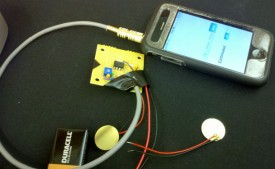
NEW YORK, NY — Brian Amento gripped the deadbolted door handle on the display next to him and with a click, the door unlocked at his touch. In his other hand, he was pinching a small metal disk called a piezoelectric transducer — like the ones used in guitar pickups — that was wired to his smartphone. The phone sent a digital key, identifying Amento as the homeowner, through his body and into the door.

Amento is a computer scientist at AT&T Labs. He talked with InnovationNewsDaily Thursday at a research fair AT&T held for reporters. Though for this display, the piezoelectric transducer connected to Amento’s phone with a large wire, eventually such sensors would be embedded directly in phones or perhaps wristwatches, Amento said. People’s smartphones would become their door keys, too.

In this prototype, Amento’s phone produced several frequencies of vibrations that humans can’t feel, but can hear, if the room is very quiet. In other words, as Amento said, “It’s an acoustic signal.”

The frequencies travel from the phone and through the skeleton, in the way that sound waves vibrate bones in the skull and inner ear. At the other end, the door handle has another piezoelectric transducer to detect the vibrations coming through a person’s hand. If this technology comes to market, different phones and door handles would have different vibration signatures that need to match for the door to unlock.

Amento switched the settings on his phone, demonstrating that his demo door would also open for the vibrations from a friend’s phone. On the other hand, it would send an alert to the homeowner if a stranger touched the door handle.

Amento and his colleagues think they can add another layer of security to the smartphone key, too — one that’s based on the unique properties of people’s skeletons. Because of differences in bone lengths and density, people’s skeletons should carry vibrations differently, they think. “If the signal goes through my body, it degrades in a different way than if it goes through your body,” Amento said. Among the five people he has tested, all of their skeletons transmitted vibrations differently. Of course, he’ll have to test more people to check if everyone is unique, but if that’s true, then the smartphone key will only work when the right person is using it.

The key is still in its prototype stage, Amento said, so he couldn’t say when people might be able to unlock their front doors with their own unique cellphone vibes. Once such systems work, however, people could start transmitting much more than their door keys through their bones. Amento and his colleagues are also working to see if people can exchange contact information just by shaking hands. The data would flow from one phone, through one person’s skeleton, into the next person’s and finally, into the recipient’s phone.

They also think a person’s unique vibes might help other smart devices identify them. A piezoelectric couch, for example, could sense who’s sitting there and offer her favorite channels. A piezoelectric car driver’s seat could identify the driver and adjust the mirrors accordingly.

Source: http://mashable.com/2012/04/20/smartphone-vibrations/

Shady Companies With Ties to Israel Wiretap the U.S. for the NSA

Shady Companies With Ties to Israel Wiretap the U.S. for the NSA

Army General Keith Alexander, the director of the NSA, is having a busy year — hopping around the country, cutting ribbons at secret bases and bringing to life the agency’s greatly expanded eavesdropping network.

In January he dedicated the new $358 million CAPT Joseph J. Rochefort Building at NSA Hawaii, and in March he unveiled the 604,000-square-foot John Whitelaw Building at NSA Georgia.

Designed to house about 4,000 earphone-clad intercept operators, analysts and other specialists, many of them employed by private contractors, it will have a 2,800-square-foot fitness center open 24/7, 47 conference rooms and VTCs, and “22 caves,” according to an NSA brochure from the event. No television news cameras were allowed within two miles of the ceremony.

Overseas, Menwith Hill, the NSA’s giant satellite listening post in Yorkshire, England that sports 33 giant dome-covered eavesdropping dishes, is also undergoing a multi-million-dollar expansion, with $68 million alone being spent on a generator plant to provide power for new supercomputers. And the number of people employed on the base, many of them employees of Lockheed Martin and Northrop Grumman, is due to increase from 1,800 to 2,500 in 2015, according to a study done in Britain. Closer to home, in May, Fort Meade will close its 27-hole golf course to make room for a massive $2 billion, 1.8-million-square-foot expansion of the NSA’s headquarters, including a cybercommand complex and a new supercomputer center expected to cost nearly $1 billion.

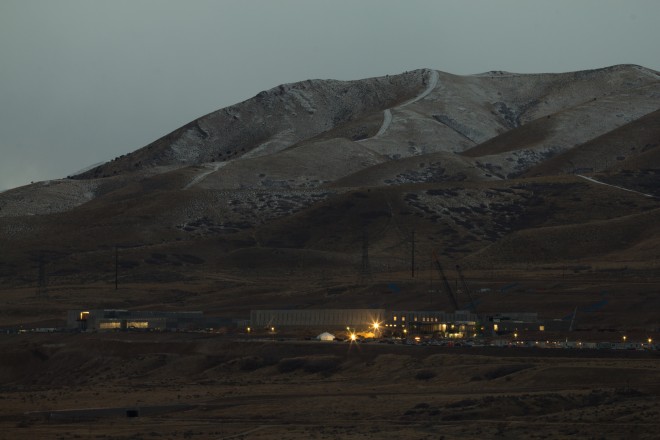
The climax, however, will be the opening next year of the NSA’s mammoth 1-million-square-foot, $2 billion Utah Data Center. The centerpiece in the agency’s decade-long building boom, it will be the “cloud” where the trillions of millions of intercepted phone calls, e-mails, and data trails will reside, to be scrutinized by distant analysts over highly encrypted fiber-optic links.

Despite the post-9/11 warrantless wiretapping of Americans, the NSA says that citizens should trust it not to abuse its growing power and that it takes the Constitution and the nation’s privacy laws seriously.

But one of the agency’s biggest secrets is just how careless it is with that ocean of very private and very personal communications, much of it to and from Americans. Increasingly, obscure and questionable contractors — not government employees — install the taps, run the agency’s eavesdropping infrastructure, and do the listening and analysis.

And with some of the key companies building the U.S.’s surveillance infrastructure for the digital age employing unstable employees, crooked executives, and having troubling ties to foreign intelligence services, it’s not clear that Americans should trust the secretive agency, even if its current agency chief claims he doesn’t approve of extrajudicial spying on Americans. His predecessor, General Michael V. Hayden, made similar claims while secretly conducting the warrantless wiretapping program.

Until now, the actual mechanics of how the agency constructed its highly secret U.S. eavesdropping net, code-named Stellar Wind, has never been revealed. But in the weeks following 9/11, as the agency and the White House agreed to secretly ignore U.S. privacy laws and bypass the Foreign Intelligence Surveillance Court, J. Kirk Wiebe noticed something odd. A senior analyst, he was serving as chief of staff for the agency’s Signals Intelligence Automation Research Center (SARC), a sort of skunkworks within the agency where bureaucratic rules were broken, red tape was cut, and innovation was expected.

“One day I notice out in the hallway, stacks and stacks of new servers in boxes just lined up,” he said.

Passing by the piles of new Dell 1750 servers, Wiebe, as he often did, headed for the Situation Room, which dealt with threat warnings. It was located within the SARC’s Lab, on the third floor of Operations Building 2B, a few floors directly below the director’s office. “I walk in and I almost get thrown out by a guy that we knew named Ben Gunn,” he said. It was the launch of Stellar Wind and only a handful of agency officials were let in on the secret.

“He was the one who organized it,” said Bill Binney of Gunn. A former founder and co-director of SARC, Binney was the agency official responsible for automating much of the NSA’s worldwide monitoring networks. Troubled by the unconstitutional nature of tapping into the vast domestic communications system without a warrant, he decided to quit the agency in late 2001 after nearly forty years.

Gunn, said Binney, was a Scotsman and naturalized U.S. citizen who had formerly worked for GCHQ, Britain’s equivalent of the NSA, and later become a senior analyst at the NSA. The NSA declined Wired’s request to interview Gunn, saying that, as policy, it doesn’t confirm or deny if a person is employed by the agency.

Shortly after the secret meeting, the racks of Dell servers were moved to a room down the hall, behind a door with a red seal indicating only those specially cleared for the highly compartmented project could enter. But rather than having NSA employees putting the hardware and software together and setting up walls of monitors showing suspected terrorism threats and their U.S. communications, the spying room was filled with a half-dozen employees of a tiny mom-and-pop company with a bizarre and troubling history.

“It was Technology Development Corporation,” said Binney.

The agency went to TDC, he says, because the company had helped him set up a similar network in SARC — albeit one that was focused on foreign and international communications — the kind of spying the NSA is chartered to undertake.


“They needed to have somebody who knew how the code works to set it up,” he said. “And then it was just a matter of feeding in the attributes [U.S. phone numbers, e-mail addresses and personal data] and any of the content you want.” Those “attributes” came from secret rooms established in large telecom switches around the country. “I think there’s 10 to 20 of them,” Binney says.

Formed in April 1984, TDC was owned by two brothers, Randall and Paul Jacobson, and largely run out of Randall’s Clarkesville, Maryland house, with his wife acting as bookkeeper. But its listed address is a post office box in Annapolis Junction, across the Baltimore-Washington Parkway from the NSA, and thecompany’s phone number in various business directories is actually an NSA number in Binney’s old office.

The company’s troubles began in June 1992 when Paul lost his security clearance. “If you ever met this guy, you would know he’s a really strange guy,” Binney said of Paul. “He did crazy stuff. I think they thought he was unstable.” At the time, Paul was working on a contract at the NSA alongside a rival contractor, Unisys Corporation. He later blamed Unisys for his security problems and sued it, claiming that Unisys employees complained about him to his NSA supervisors. According to the suit, Unisys employees referred to him as “weird” and that he “acted like a robot,” “never wore decent clothes,” and was mentally and emotionally unstable. About that time, he also began changing his name, first to Jimmy Carter, and later to Alfred Olympus von Ronsdorf.

With “von Ronsdorf’s” clearance gone and no longer able to work at the NSA, Randy Jacobson ran the company alone, though he kept his brother and fellow shareholder employed in the company, which led to additional problems.

“What happened was Randy still let him have access to the funds of the company and he squandered them,” according to Binney. “It was so bad, Randy couldn’t pay the people who were working for him.” According to court records, Ronsdorf allegedly withdrew about $100,000 in unauthorized payments. But Jacobson had troubles of his own, having failed to file any income tax statements for three years in the 1990s, according to tax court records. Then in March 2002, around the time the company was completing Stellar Wind, Jacobson fired his brother for improper billing and conversion of company funds. That led to years of suits and countersuits over mismanagement and company ownership.

Despite that drama, Jacobson and his people appeared to have serious misgivings about the NSA’s program once they discovered its true nature, according to Binney. “They came and said, ‘Do you realize what these people are doing?’” he said. “‘They’re feeding us other stuff [U.S.] in there.’ I mean they knew it was unconstitutional right away.” Binney added that once the job was finished, the NSA turned to still another contractor to run the tapping operation. “They made it pretty well known, so after they got it up and running they [the NSA] brought in the SAIC people to run it after that.” Jacobsen was then shifted to other work at the NSA, where he and his company are still employed.

Randall Jacobsen answered his phone inside the NSA but asked for time to respond. He never called back.

In addition to constructing the Stellar Wind center, and then running the operation, secretive contractors with questionable histories and little oversight were also used to do the actual bugging of the entire U.S. telecommunications network.

According to a former Verizon employee briefed on the program, Verint, owned by Comverse Technology, taps the communication lines at Verizon, which I first reported in my book The Shadow Factory in 2008. Verint did not return a call seeking comment, while Verizon said it does not comment on such matters.

At AT&T the wiretapping rooms are powered by software and hardware from Narus, now owned by Boeing, a discovery made by AT&T whistleblower Mark Klein in 2004. Narus did not return a call seeking comment.

What is especially troubling is that both companies have had extensive ties to Israel, as well as links to that country’s intelligence service, a country with a long and aggressive history of spying on the U.S.

In fact, according to Binney, the advanced analytical and data mining software the NSA had developed for both its worldwide and international eavesdropping operations was secretly passed to Israel by a mid-level employee, apparently with close connections to the country. The employee, a technical director in the Operations Directorate, “who was a very strong supporter of Israel,” said Binney, “gave, unbeknownst to us, he gave the software that we had, doing these fast rates, to the Israelis.”

Because of his position, it was something Binney should have been alerted to, but wasn’t.

“In addition to being the technical director,” he said, “I was the chair of the TAP, it’s the Technical Advisory Panel, the foreign relations council. We’re supposed to know what all these foreign countries, technically what they’re doing…. They didn’t do this that way, it was under the table.” After discovering the secret transfer of the technology, Binney argued that the agency simply pass it to them officially, and in that way get something in return, such as access to communications terminals. “So we gave it to them for switches,” he said. “For access.”

But Binney now suspects that Israeli intelligence in turn passed the technology on to Israeli companies who operate in countries around the world, including the U.S. In return, the companies could act as extensions of Israeli intelligence and pass critical military, economic and diplomatic information back to them. “And then five years later, four or five years later, you see a Narus device,” he said. “I think there’s a connection there, we don’t know for sure.”

Narus was formed in Israel in November 1997 by six Israelis with much of its money coming from Walden Israel, an Israeli venture capital company. Its founder and former chairman, Ori Cohen, once told Israel’sFortune Magazine that his partners have done technology work for Israeli intelligence. And among the five founders was Stanislav Khirman, a husky, bearded Russian who had previously worked for Elta Systems, Inc. A division of Israel Aerospace Industries, Ltd., Elta specializes in developing advanced eavesdropping systems for Israeli defense and intelligence organizations. At Narus, Khirman became the chief technology officer.

A few years ago, Narus boasted that it is “known for its ability to capture and collect data from the largest networks around the world.” The company says its equipment is capable of “providing unparalleled monitoring and intercept capabilities to service providers and government organizations around the world” and that “Anything that comes through [an Internet protocol network], we can record. We can reconstruct all of their e-mails, along with attachments, see what Web pages they clicked on, we can reconstruct their [Voice over Internet Protocol] calls.”

Like Narus, Verint was founded by in Israel by Israelis, including Jacob “Kobi” Alexander, a former Israeli intelligence officer. Some 800 employees work for Verint, including 350 who are based in Israel, primarily working in research and development and operations, according to the Jerusalem Post. Among its products is STAR-GATE, which according to the company’s sales literature, lets “service providers … access communications on virtually any type of network, retain communication data for as long as required, and query and deliver content and data …” and was “[d]esigned to manage vast numbers of targets, concurrent sessions, call data records, and communications.”

In a rare and candid admission to Forbes, Retired Brig. Gen. Hanan Gefen, a former commander of the highly secret Unit 8200, Israel’s NSA, noted his former organization’s influence on Comverse, which owns Verint, as well as other Israeli companies that dominate the U.S. eavesdropping and surveillance market. “Take NICE, Comverse and Check Point for example, three of the largest high-tech companies, which were all directly influenced by 8200 technology,” said Gefen. “Check Point was founded by Unit alumni. Comverse’s main product, the Logger, is based on the Unit’s technology.”

According to a former chief of Unit 8200, both the veterans of the group and much of the high-tech intelligence equipment they developed are now employed in high-tech firms around the world. “Cautious estimates indicate that in the past few years,” he told a reporter for the Israeli newspaper Ha’artez in 2000, “Unit 8200 veterans have set up some 30 to 40 high-tech companies, including 5 to 10 that were floated on Wall Street.” Referred to only as “Brigadier General B,” he added, “This correlation between serving in the intelligence Unit 8200 and starting successful high-tech companies is not coincidental: Many of the technologies in use around the world and developed in Israel were originally military technologies and were developed and improved by Unit veterans.”

Equally troubling is the issue of corruption. Kobi Alexander, the founder and former chairman of Verint, is now a fugitive, wanted by the FBI on nearly three dozen charges of fraud, theft, lying, bribery, money laundering and other crimes. And two of his top associates at Comverse, Chief Financial Officer David Kreinberg and former General Counsel William F. Sorin, were also indicted in the scheme and later pleaded guilty, with both serving time in prison and paying millions of dollars in fines and penalties.

When asked about these contractors, the NSA declined to “verify the allegations made.”

But the NSA did “eagerly offer” that it “ensures deliberate and appropriate measures are taken to thoroughly investigate and resolve any legitimate complaints or allegations of misconduct or illegal activity” and “takes seriously its obligation to adhere to the U.S. Constitution and comply with the U.S. laws and regulations that govern our activities.”

The NSA also added that “we are proud of the work we do to protect the nation, and allegations implying that there is inappropriate monitoring of American communications are a disservice to the American public and to the NSA civilian and military personnel who are dedicated to serving their country.”

However, that statement elides the voluminous reporting by the New York TimesWashington PostUSA TodayLos Angeles Times and Wired on the NSA’s warrantless wiretapping program. Also not reflected is that in the only anti-warrantless wiretapping lawsuit to survive the government’s use of the “state secrets” privilege to throw them out, a federal judge ruled that two American lawyers had been spied on illegally by the government and were entitled to compensation.

So take the NSA’s assurances as you will.

But as NSA director Alexander flies around the country, scissors in hand, opening one top-secret, outsourced eavesdropping center after another, someone might want to ask the question no one in Congress seems willing to ask: Who’s listening to the listeners?

SOURCE:
http://www.wired.com/threatlevel/2012/04/shady-companies-nsa/all/1

By: James Bamford, April 3, 2012

Everything You Wanted to Know About Data Mining

Everything You Wanted to Know About Data Mining

A guide to what data mining is, how it works, and why it’s important.

Big data is everywhere we look these days. Businesses are falling all over themselves to hire ‘data scientists,’ privacy advocates are concerned about personal data and control, and technologists and entrepreneurs scramble to find new ways to collect, control and monetize data. We know that data is powerful and valuable. But how?

This article is an attempt to explain how data mining works and why you should care about it. Because when we think about how our data is being used, it is crucial to understand the power of this practice. Without data mining, when you give someone access to information about you, all they know is what you have told them. With data mining, they know what you have told them and can guess a great deal more. Put another way, data mining allows companies and governments to use the information you provide to reveal more than you think.

Data mining allows companies and governments to use the information you provide to reveal more than you think.

To most of us data mining goes something like this: tons of data is collected, then quant wizards work their arcane magic, and then they know all of this amazing stuff. But, how? And what types of things can they know? Here is the truth: despite the fact that the specific technical functioning of data mining algorithms is quite complex — they are a black box unless you are a professional statistician or computer scientist — the uses and capabilities of these approaches are, in fact, quite comprehensible and intuitive.

For the most part, data mining tells us about very large and complex data sets, the kinds of information that would be readily apparent about small and simple things. For example, it can tell us that “one of these things is not like the other” a la Sesame Street or it can show us categories and then sort things into pre-determined categories. But what’s simple with 5 datapoints is not so simple with 5 billion datapoints.

And these days, there’s always more data. We gather far more of it then we can digest. Nearly every transaction or interaction leaves a data signature that someone somewhere is capturing and storing. This is, of course, true on the internet; but, ubiquitous computing and digitization has made it increasingly true about our lives away from our computers (do we still have those?). The sheer scale of this data has far exceeded human sense-making capabilities. At these scales patterns are often too subtle and relationships too complex or multi-dimensional to observe by simply looking at the data. Data mining is a means of automating part this process to detect interpretable patterns; it helps us see the forest without getting lost in the trees.

Discovering information from data takes two major forms: description and prediction. At the scale we are talking about, it is hard to know what the data shows. Data mining is used to simplify and summarize the data in a manner that we can understand, and then allow us to infer things about specific cases based on the patterns we have observed. Of course, specific applications of data mining methods are limited by the data and computing power available, and are tailored for specific needs and goals. However, there are several main types of pattern detection that are commonly used. These general forms illustrate what data mining can do.

Anomaly detection : in a large data set it is possible to get a picture of what the data tends to look like in a typical case. Statistics can be used to determine if something is notably different from this pattern. For instance, the IRS could model typical tax returns and use anomaly detection to identify specific returns that differ from this for review and audit.

Association learning: This is the type of data mining that drives the Amazon recommendation system. For instance, this might reveal that customers who bought a cocktail shaker and a cocktail recipe book also often buy martini glasses. These types of findings are often used for targeting coupons/deals or advertising. Similarly, this form of data mining (albeit a quite complex version) is behind Netflix movie recommendations.

Cluster detection: one type of pattern recognition that is particularly useful is recognizing distinct clusters or sub-categories within the data. Without data mining, an analyst would have to look at the data and decide on a set of categories which they believe captures the relevant distinctions between apparent groups in the data. This would risk missing important categories. With data mining it is possible to let the data itself determine the groups. This is one of the black-box type of algorithms that are hard to understand. But in a simple example – again with purchasing behavior – we can imagine that the purchasing habits of different hobbyists would look quite different from each other: gardeners, fishermen and model airplane enthusiasts would all be quite distinct. Machine learning algorithms can detect all of the different subgroups within a dataset that differ significantly from each other.

Classification: If an existing structure is already known, data mining can be used to classify new cases into these pre-determined categories. Learning from a large set of pre-classified examples, algorithms can detect persistent systemic differences between items in each group and apply these rules to new classification problems. Spam filters are a great example of this – large sets of emails that have been identified as spam have enabled filters to notice differences in word usage between legitimate and spam messages, and classify incoming messages according to these rules with a high degree of accuracy.

Regression: Data mining can be used to construct predictive models based on many variables. Facebook, for example, might be interested in predicting future engagement for a user based on past behavior. Factors like the amount of personal information shared, number of photos tagged, friend requests initiated or accepted, comments, likes etc. could all be included in such a model. Over time, this model could be honed to include or weight things differently as Facebook compares how the predictions differ from observed behavior. Ultimately these findings could be used to guide design in order to encourage more of the behaviors that seem to lead to increased engagement over time.

The patterns detected and structures revealed by the descriptive data mining are then often applied to predict other aspects of the data. Amazon offers a useful example of how descriptive findings are used for prediction. The (hypothetical) association between cocktail shaker and martini glass purchases, for instance, could be used, along with many other similar associations, as part of a model predicting the likelihood that a particular user will make a particular purchase. This model could match all such associations with a user’s purchasing history, and predict which products they are most likely to purchase. Amazon can then serve ads based on what that user is most likely to buy.

Data mining, in this way, can grant immense inferential power. If an algorithm can correctly classify a case into known category based on limited data, it is possible to estimate a wide-range of other information about that case based on the properties of all the other cases in that category. This may sound dry, but it is how most successful Internet companies make their money and from where they draw their power.

SOURCE:
http://www.theatlantic.com/technology/archive/2012/04/everything-you-wanted-to-know-about-data-mining-but-were-afraid-to-ask/255388/

By: Alexander Furnas April 3, 2012

Bamford Claims NSA Has Made “An Enormous Breakthrough” in Cryptanalysis

Bamford Claims NSA Has Made “An Enormous Breakthrough” in Cryptanalysis

Well, it has been the $64,000 question for a couple of decades: Can NSA break something like PGP?

While there might be other black world technologies that could be up to the task (there’s no way to know), what we do know is that a practical quantum computing capability would be, for all intents and purposes, the master key.

I’m pretty confident that NSA has this capability and here’s why: IBM Breakthrough May Make Practical Quantum Computer 15 Years Away Instead of 50. There is no hard constant that one can point to when considering how much more advanced black world technologies are than what we think of as state of the art, but if IBM is 15 years away from building a useful quantum computer, it’s not a stretch to assume NSA has that capability already, or is close to having it.

Bamford lays out a narrative below about the “enormous breakthrough,” but, at the end of the day, it’s conventional computers. There’s no mention quantum computers, or even the far less “out there” photonic systems.

Is Bamford’s piece a limited hangout?

Maybe, but it makes for interesting reading in any event.

Note: For some reason, Bamford refers to Mark Klein as, “A whistle-blower,” without naming him. Because of Mark Klein, we know, for sure, that the mass intercepts are happening, how NSA is doing it, the equipment involved, etc. So, thanks, Mark Klein. Heroes have names on Cryptogon.

Update: Former Senior U.S. Intelligence Official and Current Booz Allen Hamilton Senior Vice President Joan A. Dempsey: ‘We’re a Few Years Away from Realizing Real Quantum Processing and Quantum Computing’

Via: CNN:

One of the first measures of tradecraft, as any good spy will tell you, is being able to tell when something just doesn’t add up. So when Joan Dempsey said she had some 49 years of experience in various roles in the military and intelligence communities, one has to wonder. She hardly looks it, but after spending some 25 years in the U.S. Navy, seven more at the CIA, and another 17 at the Pentagon in a variety of intelligence leadership positions, Dempsey swears it’s true, which means she is one of the few women in the intelligence community with nearly half a century of government experience, which has included, over the years, a number of “firsts.”

“I think that’s a huge growth area in intelligence, the big data analysis kinds of things, quantum computing which, I mean, we’re a few years away from realizing real quantum processing and quantum computing. And I mean these are areas that are going to have profound effect on every aspect of our lives, but certainly on the intelligence.

—End Update—

Via: Wired:

Under construction by contractors with top-secret clearances, the blandly named Utah Data Center is being built for the National Security Agency. A project of immense secrecy, it is the final piece in a complex puzzle assembled over the past decade. Its purpose: to intercept, decipher, analyze, and store vast swaths of the world’s communications as they zap down from satellites and zip through the underground and undersea cables of international, foreign, and domestic networks. The heavily fortified $2 billion center should be up and running in September 2013. Flowing through its servers and routers and stored in near-bottomless databases will be all forms of communication, including the complete contents of private emails, cell phone calls, and Google searches, as well as all sorts of personal data trails—parking receipts, travel itineraries, bookstore purchases, and other digital “pocket litter.” It is, in some measure, the realization of the “total information awareness” program created during the first term of the Bush administration—an effort that was killed by Congress in 2003 after it caused an outcry over its potential for invading Americans’ privacy.

But “this is more than just a data center,” says one senior intelligence official who until recently was involved with the program. The mammoth Bluffdale center will have another important and far more secret role that until now has gone unrevealed. It is also critical, he says, for breaking codes. And code-breaking is crucial, because much of the data that the center will handle—financial information, stock transactions, business deals, foreign military and diplomatic secrets, legal documents, confidential personal communications—will be heavily encrypted. According to another top official also involved with the program, the NSA made an enormous breakthrough several years ago in its ability to cryptanalyze, or break, unfathomably complex encryption systems employed by not only governments around the world but also many average computer users in the US. The upshot, according to this official: “Everybody’s a target; everybody with communication is a target.”

In the process—and for the first time since Watergate and the other scandals of the Nixon administration—the NSA has turned its surveillance apparatus on the US and its citizens. It has established listening posts throughout the nation to collect and sift through billions of email messages and phone calls, whether they originate within the country or overseas. It has created a supercomputer of almost unimaginable speed to look for patterns and unscramble codes. Finally, the agency has begun building a place to store all the trillions of words and thoughts and whispers captured in its electronic net. And, of course, it’s all being done in secret. To those on the inside, the old adage that NSA stands for Never Say Anything applies more than ever.

The data stored in Bluffdale will naturally go far beyond the world’s billions of public web pages. The NSA is more interested in the so-called invisible web, also known as the deep web or deepnet—data beyond the reach of the public. This includes password-protected data, US and foreign government communications, and noncommercial file-sharing between trusted peers. “The deep web contains government reports, databases, and other sources of information of high value to DOD and the intelligence community,” according to a 2010 Defense Science Board report. “Alternative tools are needed to find and index data in the deep web … Stealing the classified secrets of a potential adversary is where the [intelligence] community is most comfortable.” With its new Utah Data Center, the NSA will at last have the technical capability to store, and rummage through, all those stolen secrets. The question, of course, is how the agency defines who is, and who is not, “a potential adversary.”

According to Binney—who has maintained close contact with agency employees until a few years ago—the taps in the secret rooms dotting the country are actually powered by highly sophisticated software programs that conduct “deep packet inspection,” examining Internet traffic as it passes through the 10-gigabit-per-second cables at the speed of light.

The software, created by a company called Narus that’s now part of Boeing, is controlled remotely from NSA headquarters at Fort Meade in Maryland and searches US sources for target addresses, locations, countries, and phone numbers, as well as watch-listed names, keywords, and phrases in email. Any communication that arouses suspicion, especially those to or from the million or so people on agency watch lists, are automatically copied or recorded and then transmitted to the NSA.

The scope of surveillance expands from there, Binney says. Once a name is entered into the Narus database, all phone calls and other communications to and from that person are automatically routed to the NSA’s recorders. “Anybody you want, route to a recorder,” Binney says. “If your number’s in there? Routed and gets recorded.” He adds, “The Narus device allows you to take it all.” And when Bluffdale is completed, whatever is collected will be routed there for storage and analysis.

According to Binney, one of the deepest secrets of the Stellar Wind program—again, never confirmed until now—was that the NSA gained warrantless access to AT&T’s vast trove of domestic and international billing records, detailed information about who called whom in the US and around the world. As of 2007, AT&T had more than 2.8 trillion records housed in a database at its Florham Park, New Jersey, complex.

Verizon was also part of the program, Binney says, and that greatly expanded the volume of calls subject to the agency’s domestic eavesdropping. “That multiplies the call rate by at least a factor of five,” he says. “So you’re over a billion and a half calls a day.” (Spokespeople for Verizon and AT&T said their companies would not comment on matters of national security.)

After he left the NSA, Binney suggested a system for monitoring people’s communications according to how closely they are connected to an initial target. The further away from the target—say you’re just an acquaintance of a friend of the target—the less the surveillance. But the agency rejected the idea, and, given the massive new storage facility in Utah, Binney suspects that it now simply collects everything. “The whole idea was, how do you manage 20 terabytes of intercept a minute?” he says. “The way we proposed was to distinguish between things you want and things you don’t want.” Instead, he adds, “they’re storing everything they gather.” And the agency is gathering as much as it can.

Once the communications are intercepted and stored, the data-mining begins. “You can watch everybody all the time with data- mining,” Binney says. Everything a person does becomes charted on a graph, “financial transactions or travel or anything,” he says. Thus, as data like bookstore receipts, bank statements, and commuter toll records flow in, the NSA is able to paint a more and more detailed picture of someone’s life.

The NSA also has the ability to eavesdrop on phone calls directly and in real time. According to Adrienne J. Kinne, who worked both before and after 9/11 as a voice interceptor at the NSA facility in Georgia, in the wake of the World Trade Center attacks “basically all rules were thrown out the window, and they would use any excuse to justify a waiver to spy on Americans.” Even journalists calling home from overseas were included. “A lot of time you could tell they were calling their families,” she says, “incredibly intimate, personal conversations.” Kinne found the act of eavesdropping on innocent fellow citizens personally distressing. “It’s almost like going through and finding somebody’s diary,” she says.

Sitting in a restaurant not far from NSA headquarters, the place where he spent nearly 40 years of his life, Binney held his thumb and forefinger close together. “We are, like, that far from a turnkey totalitarian state,” he says.

Meanwhile, over in Building 5300, the NSA succeeded in building an even faster supercomputer. “They made a big breakthrough,” says another former senior intelligence official, who helped oversee the program. The NSA’s machine was likely similar to the unclassified Jaguar, but it was much faster out of the gate, modified specifically for cryptanalysis and targeted against one or more specific algorithms, like the AES. In other words, they were moving from the research and development phase to actually attacking extremely difficult encryption systems. The code-breaking effort was up and running.

The breakthrough was enormous, says the former official, and soon afterward the agency pulled the shade down tight on the project, even within the intelligence community and Congress. “Only the chairman and vice chairman and the two staff directors of each intelligence committee were told about it,” he says. The reason? “They were thinking that this computing breakthrough was going to give them the ability to crack current public encryption.”

SOURCE: http://cryptogon.com/?p=28078

L.A. to N.Y. in Half an Hour: 10,000 Plus M.P.H. Tunnel Train Used for Underground Bases?

L.A. to N.Y. in Half an Hour: 10,000 Plus M.P.H. Tunnel Train Used for Underground Bases?

Note: This article is an add-on to our ongoing series, in conjunction with Dr. Richard Sauder, on the existence of a vast network of underground bases throughout the country.

Read part 1 of the series: “Nazi Engineers, Secret U.S. Military Bases, and Elevators To The Subterranean and Submarine Depths.”

The Very High Speed Transit System (VHST) was a Rand Corporation concept that was presented to the military industrial complex in the 1970′s.

The concept was way ahead of it’s time, exactly what the secret sinister government needed to connect their vast expansions of underground bases throughout the United States and in various regions worldwide.

This could offer an explanation for some of the recent strange sounds and booms across the country.

The late (and presumably murdered) Phil Schneider spoke about what he called an Electro Magneto Leviton Train System that traveled at speeds in excess of Mach 2.

The VHST and its proposed routes, (vast advanced tunnel systems) at the time of it’s conception in the early 1970′s, fit and follow other underground base researchers findings as well as some of my own.

An interesting aspect within the Rand Corp. document is the fact that the tunnels are way to expansive to pump all of the air out at once to create the frictionless environment needed travel at speeds in excess of 10,000+ MPH.

The air has to be evacuated from the tunnel system in segments with large crucially timed mechanized door systems as the train passes through each vapor locked section.

Electrical and mechanical noises would ensue from such operation of massive airlock doors throughout the tunnel system once the underground bases or VHST were fully operational.

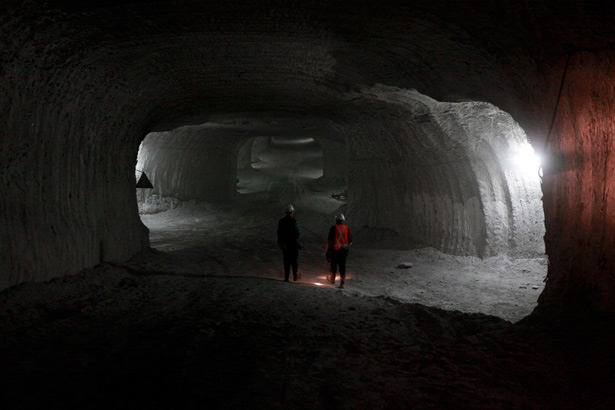
During this process strange air like sounds, hums, and mechanized sounds would persist especially if the tunnels were at a depth of 400 – 800 feet (semi shallow in underground base terms). Energy is also returned into the system as the trains decelerate.

The recent Clintonville booms might also be explained as underground sonic booms.

As the trains reach the speed of sound a sonic boom would be heard and felt, multiple booms could persist in one area as the train reaches the speed of sound at the same point in the tunnel system every trip.

The following article entitled ‘L.A. to N.Y. in Half an Hour? 10,000 – M.P.H. Tunnel Train Plan Developed’, was first published in the year 1972 by the LA Times;

LA Times
June 11, 1972

A Rand corporation physicist has devised a rapid transit system to get you from Los Angeles to NY in half an hour for a $50 fair. He said existing technology made such a system feasible and so does a cost analysis. The essence of the idea is to dig a tunnel more or less along the present routes of U.S. highways 66 and thirty. The tunnel would contain several large tubes for East West travel of trains that float on magnetic fields, moving at top speeds of 10,000 mph. Passengers would faced forwarded during acceleration, backward during deceleration.

According to R. M. Salter Jr. head of the physical sciences department at Rand, the idea of high-speed train travel using electromagnetic suspension was first put forward in 1905 and actually patented in 1912. The trains he suggested now would be single cars rather than actual trains, and would be big enough to carry both passengers and freight, including large containers and automobiles.

The cars, or gondolas, would leave the New York and Los Angeles terminals at one minute or even 30 second intervals. On the main line their would be intermediate stops at Amarillo and Chicago. Feeder lines would meet the main lines at both locations.

Their would also be subsidiary lines coming into the two main terminals from such cities as San Francisco, Boston and Washington. The main idea of VHST, or Very High Speed Transit, developed originally in thinking about the satellite program and hyper sonic aircraft speeds.” Salter said in an interview at Rand.

“The underground tubes were for suggested as alternatives, perhaps not quite seriously, but it was soon apparent that the idea of a tunnel containing such tubes had a lot of real advantages.” he said.

In the first place, he explained there is the extremely important matter of the use and conservation of immense amounts of energy needed to move the vehicles at such great speed. “An airplane that travels faster than sound uses up a large part of its available energy supply just in climbing to an altitude where the speeds for which it is designed are possible.” Salter said. “That’s true of rockets to. Much of their energy is spent and lost forever and getting above the atmosphere.”

This would not be true for the VHST gondolas traveling on their electromagnetic rail beds, according to Salter. The tubes would be emptied of air, almost to the point of vacuum, so the trains would not need much power to overcome air resistance. They would not even have to be streamlined. In addition to an electromagnetic roadbeds, the opposing electromagnetic loops of wires in the floors of the gondolas would be super cooled with liquid Helium to further eliminate electrical resistance.

Just as important, the gondolas would, like old-fashioned trolley cars, generate power as they break to a stop. “Since the trains would be leaving New York and Los Angeles simultaneously every minute, the power generated by cars breaking coming into the terminal would be transferred to the power lines propelling the cars going the other way.”

“For example, there will be halfway points between each stop. Trains would use power and getting to that halfway point, and generate power going the other half of the way to the stop. Each would use power generated by trains going in the other direction.” That is the way trolley cars have operated for eighty years – taking power from the overhead lines while accelerating or running along at a steady speed, and putting power back into the lines while breaking or coasting.

The big drawback to the Salter scheme is the cost of tunneling across the nation. He admitted that it would be expensive but it does not daunt him. “After the tunneling was finished, everything else would be practically free.” He said. Even at the low fair he proposes, the enormous debt created by the tunneling would be amortized within a reasonable period if the number of passengers and the amount of freight came up to Salter’s expectations.

He figures the tunnel’s would carry seven or 8 million tons of freight a day and that passengers would take to traveling back and forth between the Eastern West Coast has readily as they now fly between San Francisco and Los Angeles. “The technology of this is much easier than was developed for the space program.”Salter said. And tunnels, he added, need not be so expensive to dig is people think.

The most expensive thing about surface routes is the acquiring right-of-way and removing buildings that stand on the chosen route. The tunnel would not incur this expense. The tunnel, besides carrying tubes for passenger and freight gondolas, would carry many of the utilities now strung across the countryside on high wires. Salter said these underground power “lines” could be super-cooled with helium, like the electromagnetic loops in the floors of the gondolas. He said this would so reduce resistance that power could be transferred from one end of the country to the other without appreciable loss.

At the present time long distance transportation of power is difficult because of the amount of energy wasted. He said laser beams could be carried in the tunnel for the instantaneous transmission of messages. Even the mail could go cross-country in pneumatic tubes carried in the tunnel. All this would save money and speed amortization, thus cutting the overall cost of tunneling. Salter said approximately 8000 miles of tunnel were dug in America and Western Europe in the 1960s.

That includes mine shafts. But he said existing tunneling technology could be vastly improved. Salter said many tunnels are dug nowadays almost as they would have been in the dark ages. Drilling holes in tunnel faces, and using machines with rotary bits are methods of tunneling that can be improved, according to him. He said the tunnel could be worked on from a great many “faces,” for instance. Salter suggested, too, that electronic beams or even water be used to drill holes for blasting. The high-powered electrons would drill blasting holes almost instantaneously.

Projections of future airplane and automobile travels in the United States, and the future train and truck transfer of freight, show that Salter’s tunnel idea is not a science fiction fantasy.

There will be more room in the tunnels for all the necessary transport than there will be over any feasible number of Airways and freeways and tracks. Salter’s suggestion, according to the experts who have had a look at it, is an eminently practical one for handling all the necessary traffic cleanly and without clogging up the air and surface pathways. But it will such a system ever be developed? Salter himself is not optimistic.

“Perhaps” is how he puts it. “I am not nearly so optimistic about the political aspects of the problem as I am about our technical capability of doing the job.” He said. “History shows that some obviously feasible and practical projects, such as the tunnel proposed over and over again for connecting England and France under the English channel, can be put off for centuries because of political pressure.

On the other hand, societies with relatively primitive technology can perform such engineering feats as the erection of impairments.” Is the VHS T too far out? Salter suggested that to get the right perspective we should look back 100 years.

By comparing transportation a century ago and transportation today, one gets a better feel for just how practical VHST is. It appears to be a logical next step, and much more practical than its alternatives of filling the highways and Airways with more and more individually guided vehicles. “This alone is a compelling reason for the high-speed system.” Salter said.

There are others, according to him. “We can’t afford any longer to continue indefinitely to pollute the skies with heat, chemicals, not to mention noise, or to carve up the land with pavement.” He said. “We also need to get the trucks and many of the cars off the highway to make the roads available to drivers who drive the family car for fun and convenience.”

As the former official host of The Intel Hub Radio Show, I have to admit I have interviewed some interesting people. However, one interview stands out in particular to me.

The interview was with the owner of a private underground base construction company with military ties. During the interview it was stated that for some reason the people in the know are indeed gearing up at a rapid rate for some event that is to occur in the not so distant future.

What might this event be?

Why are the bases activating?

This technology is 100% real and fully functional in the present day.


Shepard Ambellas & Avalon
The Intel Hub
April 13, 2012

SOURCE: http://www.infowars.com/l-a-to-n-y-in-half-an-hour-10000-plus-m-p-h-tunnel-train-used-for-underground-bases/

Endgame Systems: Hiding Behind Censorship?

Endgame Systems: Hiding Behind Censorship?

Endgame Systems

Endgame Systems (founded 2008) has been of interest to this investigation due to the firm’s close association with corrupt HBGary CEO Aaron Barr, their stated intent to avoid public attention towards its work with the federal government, its longtime collaboration with Palantir employee Matthew Steckman (whom Palantir fired in the wake of the Team Themis affair, quite improbably claiming that Steckman had acted on his own), and its creation of a report on Wikileaks and Anonymous which was provided to Team Themis for use in its campaign against both entities. In July of 2011, an investigation by Business Week revealed the probable reasons for the firm’s secrecy:

People who have seen the company pitch its technology—and who asked not to be named because the presentations were private—say Endgame executives will bring up maps of airports, parliament buildings, and corporate offices. The executives then create a list of the computers running inside the facilities, including what software the computers run, and a menu of attacks that could work against those particular systems. Endgame weaponry comes customized by region—the Middle East, Russia, Latin America, and China—with manuals, testing software, and “demo instructions.” There are even target packs for democratic countries in Europe and other U.S. allies. Maui (product names tend toward alluring warm-weather locales) is a package of 25 zero-day exploits that runs clients $2.5 million a year. The Cayman botnet-analytics package gets you access to a database of Internet addresses, organization names, and worm types for hundreds of millions of infected computers, and costs $1.5 million. A government or other entity could launch sophisticated attacks against just about any adversary anywhere in the world for a grand total of $6 million…
Endgame’s price list may be the most important document in the collection. If the company were offering those products only to American military and intelligence agencies, such a list would be classified and would never have shown up in the HBGary e-mails, according to security experts. The fact that a nonclassified list exists at all—as well as an Endgame statement in the uncovered e-mails that it will not provide vulnerability maps of the U.S.—suggests that the company is pitching governments or other entities outside the U.S. Endgame declined to discuss the specifics of any part of the e-mails, including who its clients might be. Richard A. Clarke, former Assistant Secretary of State and special adviser to President George W. Bush on network security, calls the price list “disturbing” and says Endgame would be “insane” to sell to enemies of the U.S.

Endgame bills itself thusly:

Endgame Systems provides innovative software solutions to meet customers security needs in cyberspace. Our products include real-time IP reputation data, protection of customers’ critical information, proactive data analysis, and cutting edge vulnerability research. Endgame’s highly skilled workforce provides a full range of engineering services and solutions that raise awareness of emerging threats, and help prevent and respond to those threats globally. The company was founded by a proven leadership team with a record of success in the information security industry and is headquartered in Atlanta, GA.

Endgame works directly for a number of U.S. intelligence agencies and has a subsidiary called ipTrust. Beyond a presence at Shmoocon 2012, little has been heard from the company publicly since they deleted their website in summer 2011 following the release of this text.

Compare to Team Cymru.

Contents

[hide]

[edit] Secrecy

Endgame is intent on remaining under the radar and otherwise seeks to avoid public attention, as show by the e-mail excerpts below:

Aaron Barr to Brian Masterson of Xetron: “But they are awfully cagey about their data. They keep telling me that if their name gets out in the press they are done. Why?”

CEO Chris Rouland to employee John Farrell: “Please let HBgary know we don’t ever want to see our name in a press release.”

John Farrell to Aaron Barr: “Chris wanted me to pass this along. We’ve been very careful NOT to have public face on our company. Please ensure Palantir and your other partners understand we’re purposefully trying to maintain a very low profile. Chris is very cautious based on feedback we’ve received from our government clients. If you want to reconsider working with us based on this, we fully understand.”

Aaron Barr to John Farrell: “I will make sure your [sic] a ‘silent’ partner and will ensure we are careful about such sensitivities going forward.”

[edit] Company Aspects

Note: The following was written before Business Week’s July article, which provides additional context and is linked and excerpted above.

Although little info has been obtained regarding the specifics of Endgame’s operations, e-mails taken from the small firm Unveillance indicate similarities in at least one capacity to another firm called LookingGlass. In one e-mail, the CEO of Unveillance is told, “One thing I could have said is that your data is the main feeder for LookingGlass and Endgame.” Earlier in the same exchange, more clues appear when the following statement by a “friend/contractor in the pentagon [sic]” is presented: “They [Unveillance] were discussed yesterday at a meeting about the CSFI project on Syria. Frankly, I wasn’t all that blown away. Not sure what makes them better than LookingGlass or Endgame.”

Other clues are available in the same e-mail set, there being discussion of a potential purchase by Endgame of a troubled firm called Defintel, from which the CEO of Unveillance proposes to “‘cherry pick’ the talent” in order “to run the sinkhole/data creation component of our firm.”

From another e-mail exchange:

14 Apr 2011 16:53:54 -0400
From: Wayne Teeple <[email protected]>
To:"[email protected]" <[email protected]>

Hi again Karim,

I was able to meet with Keith today, not much to say other than business as
usual. He was very reserved, but open enough, but not  enough if you know what I
mean. He did confirm that Chris Davis has sold himself to Endgame along with his
datafeed, and that Morrigan  Research Inc is dissolved - see attached.  Hence, I
believe he sold his "IP" directly as an individual because Morrigan is 
dissolved as oppose to shares acquired by Endgame.

Keith had nothing real to contribute other he is staying out of everything and
just focusing on Defintel biz, he did state that he  does not require the
datafeed at all to execute the Nemesis cloud service, and that he has a
"non-compete" with you, Endgame, and  Morrigan.  Also, he is in touch with
Davis, and I get the impression that Davis may recommend Endgame acquiring
Defintel for Nemesis  code - although that could be Davis blowing smoke up
Keith's you know what!!  Keith did state that he is light on technical support.

Finally, we both agreed that Ginley is a lone wolf and a gun for hire by anyone.

All and all, I am very concerned about presenting this solution any further to
my clients, nor did I get a complete warm and fuzzy  that he was completely on
the up and up.

Cheers
wayne

Keith above refers to Defintel CEO Keith Murphy.

Compare the above statements on Morrigan and DefIntel to this tweet from Chris Davis.
Brian Masterson of Xetron worked with Endgame for quite a while and made a number of references to the firm to Barr:

“They told me that they did 10M last year. Said they were working for NSA, Navy, and USAF. Also mentioned another customer who we do work with. While I was at their place getting briefed by Chris, Gen. Patraeus’ exec called three times to set a follow-up meeting.”

“EndGame did offer up a cut of their US data.”

“Doing the botnet is not that difficult but doing it to the degree that EndGame says that they have is what is impressive.”

Barr himself had long sought to include Endgame in his proposed “consortium” of firms, which itself would provide intelligence capabilities to clients (and which eventually came about in the person of Team Themis, made up of HBGary, Palantir and Berico, with Endgame having provided the team an unusually accurate report on Wikileaks and Anonymous. E-mail excerpts from Barr:

“I know we are going to talk to some senior folks in Maryland in a few weeks and would very much like to take a combined Endgame/Palantir/HBGary product.”

“I think I had mentioned the idea of a cyber consortium to you when we had lunch. That idea is coming together. We will start with cyber intelligence then when we have the capabilities fused build in the hooks for cybersecurity. Need the information before you can act.

here are the companies on board and their area of expertise. Application – HBGary Host – Splunk Network – Netwitness External – EndGame Systems Social/Link – Palantir”

John Farrell of Endgame Systems to Aaron Barr, 2/8/10:

“for now, let’s focus on:

1. OSI RFP response – dan ingevaldson and I will work with you on this

2. EGS/Palantir integration – we talked to Matt Steckman last week and we’re looking into next steps on this

3. customer briefings and new business opportunities like ARSTRAT, etc.”
A June 2010 e-mail sent from Ted Vera to fellow HBGary employees after a phone meeting with Endgame provides additional data:

I tried to keep notes during the call — my chicken scratch follows: EndGames is tracking 60-65 botnets at this time. They have a ton of conflicker data, they’re plugged in and pull millions of related IPs daily. Their data is generally described in their tech docs. They are pulling in data from IDS sensors, rolling in geolocation information, and anonymous proxies / surfing next Quarter. EndGames does not do any active scanning — all passive. They intercept botnet messages and collect / log to their database. The “SPAM” category is a generic filter that indicates the IP has been used to pass SPAM. Higher chance for false positives with SPAM filter. They try to correlate SPAM activities to known botnets, if they cannot correlate, then the event gets a generic SPAM label. Confidence %: Documented in technical docs. Primarily time-based. Looking at the overall length of infection for a given IP. Looking at half-life / decay of infections on specific IPs. The algorithm is currently very simple and time is the highest weighted factor, although the nature of the event is also weighted, ie conficker has higher weight than SPAM event. Plan to start discriminating between end-user nodes with dynamic IPs vs Enterprise / static IPs. Static IPs would decay slower than dynamic. EndGames gets malware data from various sources and REs it to pull out C2 and other traits that can be used for signature / correlation. They have Sinkholes for Conficker A and B which collect IPs of infected hosts.Cannot provide samples because they do not collect samples from specific IPs. They are ID’ing based on their observations of IPs, taking advantage of their hooks into various botnets. That said, they could probably gest us some samples and or manual tests for Conficker A and B which we could use to verify / eliminate false positives or negatives.

[edit] Dates

April 5, 2010 – John Farrell tells Aaron Barr he will no longer be accessible @ Endgame

October 2010 – Raised 29 million USD from Bessemer Ventures, Columbia Capital, Kleiner Perkins Caufield & Byers (KPCB), and TechOperators, for web-based malware detection services: iPTrust.

October 28, 2010 – Endgame announces the launch of ipTrust, “the industry’s first cloud-based botnet and malware detection service … that collects and distills security data into a reputation engine.”

February 2011 – Endgame announces partnerships with HP and IBM to use their IP Reputation Intelligence service within HP’s TippingPoint Digital Vaccine service and IBM’s managed services offerings.


[edit] Management

Christopher J. Rouland

Mr. Christopher Rouland, CEO and Co-Founder of Endgame Systems has over 20 years of experience in the field of information security. Mr. Rouland previously held the position of CTO and Distinguished Engineer of IBM Internet Security Systems after IBM purchased Internet Security Systems, Inc. in 2006. Prior to the IBM acquisition of ISS, Chris held the position of CTO of ISS where he was responsible for the overall technical direction of the ISS product and services portfolio. Prior to his executive roles at IBM and ISS, Chris was the original Director of the famed X-Force vulnerability research team which was responsible for the discovery of hundreds of security vulnerabilities.

Daniel Ingevaldson

Mr. Daniel Ingevaldson, SVP of Product Management and Co-Founder of Endgame Systems was previously the Director of Technology Strategy with IBM Internet Security Systems. Prior to the acquisition of ISS by IBM in 2006, Mr. Ingevaldson held various positions within the ISS Professional Services organization where he lead the X-Force Penetration Testing consulting practice, and as Director of X-Force R&D where he helped expand the research capacity of the X-Force zero-day vulnerability identification and disclosure program.

Raymond Gazaway

Mr. Raymond Gazaway, Senior Vice President and Co-Founder of Endgame Systems was previously the Vice President of Worldwide Professional Security Services with IBM Internet Security Systems. Ray joins Endgame Systems with over 30 years of government and commercial services experience and executive management positions with IBM, Internet Security Systems and Dun and Bradstreet.

David Miles

Mr. David Miles, Vice President of Research & Development and Co-Founder of Endgame Systems, brings nearly 10 years of experience in information security and was previously the Director of R&D within ISS Professional Security Services managing strategic security research engagements, designing and delivering custom cyber security products and solutions, as well as assisting in emergency response services and forensic investigations. Prior to that, in X-Force, he designed and implemented processes and procedures for delivery of hundreds of security content updates for the entire ISS product portfolio.

Mark Snell

Mr. Mark Snell, Chief Financial Officer of Endgame Systems, oversees all aspects of Finance and Administration including financial planning, reporting and analysis, investor relations, human resources, information technology and office management. Prior to Endgame Systems, he was Corporate Controller at Suniva, a solar cell manufacturer based in Atlanta, Georgia. At Suniva, he helped to develop the financial infrastructure and systems to manage a business that would quickly become recognized as one of the fastest growing private companies in the Southeast. Earlier in his career, Mark served as Corporate Controller of Servigistics, a software developer in the service lifecycle space and in various positions of financial management for IBM and Internet Security Systems. Mark holds an MBA from Georgia State University and a Bachelor of Arts from the University of Virginia. Mark is a Certified Public Accountant in the State of Georgia.

Rick Wescott

Rick Wescott, Senior Vice President of Worldwide Sales and Marketing, brings over 20 years of technology sales and management experience to Endgame Systems. Before joining Endgame Systems, Rick served as Vice President & General Manager of Federal Operations for ArcSight (acquired by HP for $1.5 billion in late 2010), which he joined pre-revenue in 2002 and was instrumental in identifying and closing key foundational sales. Rick helped to manage and grow the company’s revenues to $170 million and saw the company through its Initial Public Offering (IPO) in 2008 and $1.5 billion acquisition by HP in 2010. Prior to his tenure with ArcSight, Rick lead sales efforts at several leading industry firms including VeriSign, Entrust, Sybase and IBM.

David Gerulski

David Gerulski, Vice President, Commercial Sales & Marketing at Endgame Systems

[edit] Board Members and Advisors

Thomas Noonan– Chairman

Tom Noonan is the former chairman, president and chief executive officer of Internet Security Systems , Inc. , which was recently acquired by IBM for $1.3B, at which time Noonan became GM of IBM Internet Security Systems. Noonan is responsible for the strategic direction, growth and integration of ISS products, services and research into IBM’s overall security offering. Tom Noonan and Chris Klaus launched ISS in 1994 to commercialize and develop a premier network security management company. Under Noonan’s leadership, ISS revenue soared from startup in 1994 to nearly $300 million dollars in its first decade. The company has grown to more than 1,200 employees today, with operations in more than 26 countries

http://cryptome.org/0003/hbg/HBG-EndGames.zip (got the this^^ from the PDF in the zip)

New Hires

Senior Software Engineer

Matt Culbreth Came from… Yield Idea, President

Agency Director

Pete Hraba Came from…

ArcSight, Account Manager

Executive Assistant

Zodie Spain Came from…

Helios Partners, Executive Assistant/Office Manager

http://www.linkedin.com/company/endgame-systems (deleted)

[edit] Investors

  • Kleiner Perkins Caufield & Byers LLC
  • Bessemer Ventures
  • Columbia Capital
  • TechOperators

[edit] Contact Info

Corporate Headquarters
817 West Peachtree Street
Suite 770
Atlanta, GA 30308
t. 404.941.3900
f. 404.941.3901

[edit] 451 Group Report on Endgame & ipTrust

Josh Corman
November 3, 2010

You can take a person out of X-Force, but you can’t take X-Force out of the person. A group of former ISS X-Force veterans at Endgame Systems has been very busy doing security research of consequence for the federal space since 2008. Via a new division called ipTrust, it plans to take some of its botnet and IP reputation capabilities to drive value into the commercial space. Similar to Umbra Data, ipTrust is delivering this value with a ‘zero touch’ modality – requiring no on-premises or capex appliance. However, rather than licensing an intelligence feed like Umbra Data, ipTrust has opted to share its research via an API, which may make it more accessible for new use cases. As we were writing up this report, news broke that parent company Endgame Systems closed a series A round of $29m. With no appliances or heavy back-end capex requirements, this stands out as an oddly large round, and has, therefore, piqued our curiosity.

As we recently noted with Umbra Data, there is high concern over botnets, but the demand for solutions is greater than the appetites for buying a dedicated appliance to augment the blind spots in traditional AV and other legacy tools. Well beyond script kiddies, attacks like Stuxnet, Zeus, BredoLab and Vecebot have people concerned – and those are all publically known ones. Adaptive persistent adversaries employ a number of techniques to avoid detection by mainstream adopted countermeasures. Several CISOs have told us they want the capabilities of anti-botnet and command-and-control identification to be delivered via their existing security investments or in other opex-consumption models. Perhaps both Umbra Data and ipTrust are hearing the same. By delivering intelligence via an API, ipTrust may find itself called out to by all sorts of Web applications to inform how trustworthy an endpoint is and adjust the interactions accordingly. We see this as an interesting delivery model, and are encouraged by the embrace of modern Web-scale technologies. Given that, the large series A funding is a bit odd. We will have to watch carefully how that is leveraged – with our first thought being: Which acquisition target would fit within that budget?

[edit] Context

IpTrust is a new division of Atlanta-based Endgame Systems. While the 32-person Endgame Systems was more focused on federal and cyber security clientele, ipTrust aims to leverage its experience, research and platforms for commercial consumption. Endgame Systems was founded in 2008 by several Internet Security Systems (ISS) X-Force Alumni with the research chops to tackle emerging threats. Cofounders include former ISS CTO Christopher Rouland as CEO, Daniel Ingevaldson as COO, Raymond Gazaway as SVP, and David Miles as VP of engineering. Former ISS CEO Tom Noonan serves as chairman. Coinciding with the reveal of ipTrust, Endgame Systems just closed a series A round for $29m, involving Bessemer Venture Partners, Columbia Capital, Kleiner Perkins Caufield & Byers, and Noonan’s own TechOperators. The round adds two new board seats for Bessemer Venture’s David Cowan and Columbia Capital’s Arun Gupta.

[edit] Technology

IpTrust is a new commercial division of Endgame Systems; it leverages a lot of the back-end technology and methods that have fueled Endgame’s federal offerings since 2008. The enabling technology has three basic pieces: a collection method for identifying botnet-compromised end nodes, a scoring system to generate a confidence rating for the implicated IP address and the exposition of the results of the analysis to clients via an API.

Since the bulk of botnets use DNS to find their command and control servers, ipTrust’s primary collection method for identifying compromised systems is to preregister or work with registrars to create sinkholes to redirect network traffic. From the vantage point of its many sinkholes, ipTrust can find new infected systems ‘phoning home’ for the first time or other reasons. The sinkholes tracked by ipTrust are a combination of its own and those from third parties. It is important to note that not all botnets communicate through DNS command and controls. Some use peer-to-peer, some use covert channels and some have one or more alternative command-and-control channels in case some are blocked or detected. We fear that this sinkhole method may miss existing infected systems that phoned home initially, but are participating on more dynamically assigned servers. While this is true, ipTrust pointed out that many samples are pretty chatty and do end up talking back to default phone-home targets in the current samples. Beyond the sinkhole method of harvesting compromised IPs, ipTrust studies the malware and spam data for clues, as well as employing honeypots and honeynets. Although attribution is nearly impossible, ipTrust also captures Geolocation information as well as proxy and satellite link details when available.

IpTrust claims its collection methods net massive amounts of data – so it needed modern, cloud-based Web-scale technologies to analyze it all. Some of the vital stats it claimed included scoring 255 million IP addresses for risk. The company claims to have 75TB of stored security events – adding more than 1TB of malicious events per week. To scale all of this data, it leverages (and contributes to) Hypertable, an open source clone (GPLv2) implementation of Google’s BigTable leveraging the Hadoop Distributed File System (HDFS). Through high-performance map reduction in the colocation hosted infrastructure, ipTrust is able to apply its reputation engine’s scoring algorithms in a continuous fashion. A floating-point integer confidence rating is assigned per IP, along with myriad other data, such as domain, company, country code, and security events involving known botnets and variants. Given the fleeting and transient nature of the Internet, this confidence score continually degrades unless preservation is merited by the analysis. As such, consumers of the IP reputation score can make graduated nonbinary decisions on how to contextually handle trust associated with that IP.

Finally, the reputation confidence score can be exposed via an XML-RPC/REST-based API. IpTrust touts a sub 100ms response time and more than 3,000 queries per second. Supported output formats include XML, JSON and CSV. As an API, developers of applications could make Web ‘look-aside’ calls to determine how risky a transaction may be with a specific endpoint and either terminate or place limits on the interaction. For example, a questionable reputation may lead a banking application to deny funds – or perhaps to cap the maximum transaction amount via some predetermined policy.

[edit] Products

IpTrust offers three levels of product: ipTrust Web, ipTrust Web Premium and ipTrust Professional. IpTrust Web Premium is not yet released. IpTrust Web is free service, capped at up to 1024 IP addresses for 24/7 monitoring. When available, ipTrust Web Premium will allow for unlimited IPs and will tentatively be priced by IP per month, we’re told.

IpTrust Professional allows full access to the reputation engine via the aforementioned API, with bulk IP submission for current and historical scoring as well as the supported output formats. At the moment, the API currently shares the compromised IP, but not the details about the command-and-control channel. IpTrust claims it is planning to add more actionable information in the future, such as port information and user-agent strings in HTML, which may assist other security tools in spotting or stopping command and control. Pricing for ipTrust Professional has plans starting at $1,000 per year – or less than $0.01 per query. IpTrust claims it is already working with a hosting provider and a financial services firm – with betas getting underway in healthcare, large enterprise, managed security services providers (MSSPs) and early stage security OEMs.

[edit] Strategy

IpTrust plans to go to market with a mix of direct sales and a series of strategic partners. Primary targets to consume its ipTrust intelligence include hosting providers, MSSPs, VARs, and specific technology partnerships. The 451 Group has covered such power alliances, with Fidelis Security Systems XPS leveraging Cyveillance intelligence feeds.

As an API, ipTrust may also be able to tap into systems integrators and application-development communities. Within the context of a specific application, contextual risk decisions can be made in the natural flow of the transaction. This may be of value to SaaS and PaaS players trying to differentiate themselves.

[edit] Competition

IpTrust may not be apples-to-apples competition with anyone; it will likely compete for limited budget within a few pockets. Most users seeking anti-botnet capabilities are currently looking at Atlanta-based Damballa or FireEye. FireEye uses virtualization to spot new unknown malware with botnet participation. Umbra Data is fresh out of stealth, offering an XML intelligence feed alternative to appliance purchases. Service providers, MSSPs, and security OEMs may choose more than one intelligence feed or API.

Traditional antivirus players continue to leverage their incumbency (and sometimes stall with it), so people may simply deal with Symantec, McAfee (soon to be a division of Intel) Trend Micro, Sophos, Kaspersky Lab and others. Commtouch touts being well plugged-in to the internet backbones to give its Web and mail security offerings visibility into botnets and compromised systems. Most Web and mail security gateways, like Cisco (both ScanSafe and IronPort), M86 Security, Websense, Blue Coat Systems, Barracuda Networks (and Purewire), Zscaler’s hosted Web proxy, etc., leverage one or more reputation and open source intelligence feeds to operate. This fact make them both more likely to take limited wallet share, but also more likely to benefit from ipTrust’s APIs. The same could be true for enriching the value of other security appliances and products. The classic example we shared was with data loss prevention. We see sensitive content leaving the network – should we block it? Imagine now adding knowledge about whether the source or destination is a known compromised system.

[edit] SWOT analysis

Strengths
The former ISS/X-Force heavy hitters are no strangers to advanced threats, and have been cutting their teeth with federal clients since 2008. It is also aggressively embracing disruptive, cloud-scale IT innovations – while many others have been resistant.

Weaknesses
While there is value in anti-botnet and IP reputation, the spending climate is unfriendly to noncheckbox-compliance products and services. We’re also surprised by the size of the recent series A round without a stated use for it.

Opportunities
In addition to ipTrust’s stated strategy, we believe the API could find ESIM uptake. It would take effort, but it could gain traction with SIs, and SaaS and PaaS players.

Threats
The market may perceive that it is already receiving similar capabilities from incumbents. Customers may also simply resist adding new vendor relationships to manage.


[edit] IP Addresses/Network

EndGame Systems currently has a variety of IPs at their disposal. Currently identified networks are: 64.250.182.32 – 64.250.182.63 and 208.75.226.144 – 208.75.226.159. One set are servers with COLOCUBE(direct IP allocation to EndGame), and the other is on IPs allocated to “Tulip Systems”. Interestingly, both Tulip Systems and Endgame Systems are located in Atlanta Georgia. They’re actually located 1.8 miles apart from eachother

Whois For 64.250.182.32 – 64.250.182.63:
OrgName: TULIP SYSTEMS, INC.

OrgId: TULIP

Address: 55 Marietta Street

Address: Suite 1740

City: Atlanta

StateProv: GA

PostalCode: 30303

Country: US

Additional Information From rwhois://rwhois.tshost.com:4321

autharea=208.75.224.0/21

xautharea=208.75.224.0/21

network:Class-Name:network

network:Auth-Area:208.75.224.0/21

network:ID:NET-70.208.75.226.144/28

network:Network-Name:208.75.224.0/21

network:IP-Network:208.75.226.144/28

network:IP-Network-Block:208.75.226.144 – 208.75.226.159

network:Org-Name:Endgame Systems

network:Street-Address:75 5th Street NW Suite 208

network:City:Atlanta

network:State:GA

network:Postal-Code:30308

network:Country-Code:US

network:Tech-Contact:MAINT-70.208.75.226.144/28

network:Created:20090812195855000

network:Updated:20090826193657000


Whois For 208.75.226.144 – 208.75.226.159:

NetRange: 64.250.182.32 – 64.250.182.63

CIDR: 64.250.182.32/27

OriginAS: AS46691

NetName: COLOCUBE-ENDGAMES-182-32-27

NetHandle: NET-64-250-182-32-1

Parent: NET-64-250-176-0-1

NetType: Reassigned

RegDate: 2011-02-11

Updated: 2011-02-11

Ref: http://whois.arin.net/rest/net/NET-64-250-182-32-1

CustName: Endgame Systems

Address: 817 West Peachtree Street NW

Address: Suite 770

City: Atlanta

StateProv: GA

PostalCode: 30308

Country: US

RegDate: 2011-02-11

Updated: 2011-03-19

Ref: http://whois.arin.net/rest/customer/C02695728


[edit] News

CIA-linked startup touts all-seeing eye for net spooks – 18.2.2010

Endgame Systems Raises $29M, Debuts Web-Based Malware Detection Service – 28.10.2010

Endgame Systems Capabilities Briefing Jan. 2009

Real-time monitoring of all vehicles via license plate spy chips advances in Connecticut

Real-time monitoring of all vehicles via license plate spy chips advances in Connecticut

A new bill in Connecticut has advanced the idea of embedded RFID chips in license plates. (PDF)

The admitted revenue-generating scheme, which would enable real-time tracking from points throughout the state, was first proposed to lawmakers by former astronaut, Paul Scully-Power.

Perhaps even more disturbing than Scully-Power’s connection to the companies that would profit from the implementation of the technology, is when he openly states that, “An RFID program would be phased in gradually and then expanded to accomplish other policing tasks without having to change equipment … the second phase would be to implement speeding violations.” (Source)

As we steamroll headlong toward being tracked, traced and databased both on real highways, as well as the information highway of the Internet, this license plate tracking scheme is merely an echo of the much larger framework of surveillance and control already under development, which ultimately includes a cashless society and microchipped population. The following 2-hour video offers a synopsis of where we currently stand, and where we are heading:

http://www.youtube.com/watch?v=8AoW4NgwqvU

Source: http://www.activistpost.com/2012/03/real-time-monitoring-of-all-vehicles.html

FLASHBACK: Testimony on CIA Heart Attack Gun

FLASHBACK: Testimony on CIA Heart Attack Gun

A CIA secret weapon used for assassination shoots a small poison dart to cause a heart attack, as explained in Congressional testimony in the short video below. By educating ourselves and others on vitally important matters like this, we can build a brighter future for us all.
The dart from this secret CIA weapon can penetrate clothing and leave nothing but a tiny red dot on the skin. On penetration of the deadly dart, the individual targeted for assassination may feel as if bitten by a mosquito, or they may not feel anything at all. The poisonous dart completely disintegrates upon entering the target.
The lethal poison then rapidly enters the bloodstream causing a heart attack. Once the damage is done, the poison denatures quickly, so that an autopsy is very unlikely to detect that the heart attack resulted from anything other than natural causes. Sounds like the perfect James Bond weapon, doesn’t it? Yet this is all verifiable in Congressional testimony.
The astonishing information about this secret weapon of the CIA comes from U.S. Senate testimony in 1975 on rogue activities of the CIA. This weapon is only one of many James Bond-like discoveries of the Church Committee hearings, officially known as the United States Senate Select Committee to Study Governmental Operations with Respect to Intelligence Activities.
Could this or a similar secret weapon have been used, for instance, in the recent death of 52-year-old Mark Pittman, a reporter who predicted the financial crisis and exposed Federal Reserve misdoings? Pittman, whose fight to open the Federal Reserve to more scrutiny led Bloomberg News to sue the central bank and win, died of a heart attack on Nov. 25th


New Speech-Jamming Gun Hints at Dystopian Big Brother Future

New Speech-Jamming Gun Hints at Dystopian Big Brother Future

Japanese researchers have created a hand-held gun (pictured above) that can jam the words of speakers who are more than 30 meters (100ft) away. The gun has two purposes, according to the researchers: At its most basic, this gun could be used in libraries and other quiet spaces to stop people from speaking — but its second application is a lot more chilling.

The researchers were looking for a way to stop “louder, stronger” voices from saying more than their fair share in conversation. The paper reads: “We have to establish and obey rules for proper turn-taking when speaking. However, some people tend to lengthen their turns or deliberately interrupt other people when it is their turn in order to establish their presence rather than achieve more fruitful discussions. Furthermore, some people tend to jeer at speakers to invalidate their speech.” In other words, this speech-jamming gun was built to enforce “proper” conversations.

The gun works by listening in with a directional microphone, and then, after a short delay of around 0.2 seconds, playing it back with a directional speaker. This triggers an effect that psychologists call Delayed Auditory Feedback (DAF), which has long been known to interrupt your speech (you might’ve experienced the same effect if you’ve ever heard your own voice echoing through Skype or another voice comms program). According to the researchers, DAF doesn’t cause physical discomfort, but the fact that you’re unable to talk is obviously quite stressful.

Speech jammer, in a librarySuffice it to say, if you’re a firm believer in free speech, you should now be experiencing a deafening cacophony of alarm bells. Let me illustrate a few examples of how this speech-jamming gun could be used.

At a political rally, an audience member could completely lock down Santorum, Romney, Paul, or Obama from speaking. On the flip side, a totalitarian state could point the speech jammers at the audience to shut them up. Likewise, when a celebrity or public figure appears on a live TV show, his contract could read “the audience must be silenced with speech jammers.”

Then there’s Harrison Bergeron, one of my favorite short stories by Kurt Vonnegut. In the story’s dystopian universe, everyone wears “handicaps” to ensure perfect social equality. Strong people must lug around heavy weights, beautiful people must wear masks, and intelligent people must wear headphones that play a huge blast of sound every few seconds, interrupting your thoughts. The more intelligent you are, the more regular the blasts.

Back here in our universe, it’s not hard to imagine a future where we are outfitted with a variety of implanted electronics or full-blown bionic organs. Just last week we wrote about Google’s upcoming augmented-reality glasses, which will obviously have built-in earbuds. Late last year we covered bionic eyes that can communicate directly with the brain, and bionic ears and noses can’t be far off.

In short, imagine if a runaway mega-corporation or government gains control of these earbuds. Not only could the intelligence-destroying blasts from Harrison Bergeron come to pass, but with Delayed Auditory Feedback it would be possible to render the entire population mute. Well, actually, that’s a lie: Apparently DAF doesn’t work with utterances like “ahhh!” or “boooo!” or other non-wordy constructs. So, basically, we’d all be reduced to communicating with grunts and gestures.

SOURCE: http://www.extremetech.com/computing/120583-new-speech-jamming-gun-hints-at-dystopian-big-brother-future


The NSA – Behind The Curtain

The NSA – Behind The Curtain

By Deep_Thought

Say hello to Mr Computer…

As promised, today we will take an in-depth examination of the NSA’s global intelligence gathering network. What you are about to read will come as an eye-opener and represents the current state of the NSA’s capabilities. Some of this will be expected, some of it will come as a shock.


What you will learn is that the technology that underpins this global listening network is a lot more advanced than governments would have you know. Usually wrapped up in basic, generalised, descriptions the general public is kept blind to the current state of technological development.


We will take this examination in three major parts. The first part will examine the core processing system. Once this part is understood, we can then look at how information flows to and from this core and where it is obtained from. Finally, we will examine how this information is used by the NSA.


I will cover as much as possible about this system, but the scope is very large. In general, any use of this data that the reader can observe is most likely already being conducted.


Mr Computer


The scope of the NSA’s infrastructure is mind boggling to say the least. Heavily compartmentalised, the entire array of systems is shielded from the average NSA employee as much as it is shielded from the public. That said, once you understand the core of the NSA, you will be in a position to see how information flows in and out of this core.


The NSA is built around a super-computer bound Artificial Intelligence known only as “Mr Computer” in the civilian world. This is not your average A.I., no basic set of responses or a mere dedicated algorithm that can spot patterns. Mr Computer is an entity or being in his own right. A sentient computer system as complex as any human.


Comparable to VMware in a way, an instance of Mr Computer can be started at a moments notice. Within seconds, a fully fledged virtual intelligence agent, ready to analyse the information that has been piped to him, can be up and running.


Mr Computer is competent enough to handle real-time interaction without human intervention. Mr Computer understands and speaks all modern languages and even a number of dead ones. Able to intelligently converse and express its own opinions, Mr Computer collates information from disparate sources and compiles them into concise reports that do not miss the smallest detail or nuance.


Mr Computer’s capabilities and human-like reasoning cannot be understated.


Instances of Mr Computer can vary in terms of their personality given the task that they must undertake. Extremely professional instances can be called upon when the system must produce reports or provide presentations. Less anal versions, complete with a sense of humour can be instantiated when less formal situations arise such as development environments or when used in conjunction with Remote Neural Communication.


Rather than loading modules for specific tasks, a common hive mind is shared by any number of front-end personalities. What one instance knows, they all know. A hive mind is a form of collective consciousness. Rather than an instance replicating information it has learned, it is recorded to a shared brain and reflected throughout all instances at the same time. Of course, given the distributed nature of the network, some replication must be performed across continental links.


The A.I. is not limited to just one branch of the NSA, it exists in a distributed grid that spans the globe. The A.I. can migrate between locations to enable tracking of specific targets, access information, or systems.


Mr Computer is not just limited to thinking like a human, it also has sensory capabilities that are on par with a human. In setting such as RNC, Mr Computer can see and identify object just as well as a human. That is, it can identify objects a human target is seeing, without leveraging the identification system of the human target. In other scenarios, such as analysing infra-red data from a satellite, it could possibly outperform a human at object recognition and speculation of heat sources.


Mr Computer can speak. With a vocabulary as broad as any dictionary, Mr Computer can express ideas, concepts and opinions very eloquently and concise.


The system is not naive either, it can withhold information, evade social engineering ploys and indirect questioning. It can tell when it is looking at reflections of targets, identify objects that a target can not immediately identify and validate or expand upon information by examining a wide variety of sources.


Further to this, Mr Computer is no idiot either. He is quite capable of following advanced topics, from physics, to computing theory he can spot the smallest of flaws in reasoning or expose potential technical issues that could prove fatal to a particular design.


It knows bull@!$%# when it hears it and will let you know in no uncertain terms.


As we can see, Mr Computer does all the labour intensive information gathering, categorising and structuring. That said, its duties are not limited to passive analysis work.


Now that we understand the core of the NSA’s operations, we can begin to examine the various “information pipes” that supply information to this supercomputer infrastructure.


The Pipes Are Calling


First off, we need to define what we mean by an “information pipe”. For those with computing knowledge, this should be obvious, but bear with me while I explain it to the rest of the readers.


We have already defined the core processing element, Mr Computer. Mr Computer accepts information and does something with it. An “information pipe” is an input to Mr Computer that has been structured in a manner efficient for processing. We could also use an “information pipe” to output information or to control something.


The first “information pipe” that the public will be most familiar with is the NSA’ warrentless wiretapping program. Forget everything that you have ever read about this program, also forget everything you ever heard of about Trailblazer and similar projects such as ThinThread. This is security theatre, a production worthy of a Broadway musical. These “classified programs” are nothing more than interfaces used by Mr Computer. When agents talk of specific program that can analyse data in real-time and cross-reference with other sources, they are really speaking of an “information pipe” to Mr Computer.


This wiretapping program copies verbatim every piece of data that flows across the backbone of the internet. The data is sent directly to an array of Mr Computer instances, which performs a real-time analysis of the data packets it receives. This wiretap picks up most of the traffic in the US and a large percentage of traffic globally.


We will go into more detail on the information processing of this later, but at this stage I will say that that Mr Computer was opening files on every person that could be identified in the traffic, even if they are in the US.


The next major data source is the global wide band radio listening system. This covers everything from human thought, right through to identifying which radio station a person is listening to. The former is done by listening to ELF and the latter is a modern version of the British’s RAFTER espionage program. Most of this performed by a satellite network, supported by a network of ground stations throughout the world. As a wide receiver, it also picks up WIFI, RFID, compromising emissions from electrical sources, cordless telephones, GSM, cell phones, GPS, Car Fobs, satellite uplinks/downlinks, etc.


Our third pipe comes from a global hacking program, performed by bot nets and Mr Computer. Typically using China as a cover, Mr Computer will launch attacks against US and global businesses trying to collect information on users, everything from personnel records, right through to payroll information. The networks are also mapped to provide offensive capabilities in a cyber-warfare scenario. Faceless groups such as Anonymous, or other organisations, are used as a cover story.


Another “information pipe” comes from underwater cables. These can either be have splitters installed, or where copper cabling exists passive detection equipment installed.


These are just some examples of information sources. You can basically add any form of data you can think of, intelligence reports, diplomatic cables, economic reports, media reports, music, online posts, emails, etc.


So far, we have only examined inputs to the system. A different form of “information pipe” is one that outputs information. The outputs come in two basic forms, information only and offensive.


In terms of information only outputs, this can range from sending particular data or reports to agents or decision makers, right through to relaying that information to different departments such as the CIA, FBI or State and Federal Police. The process ensures timely and complete information goes to those that require it the most.


The offensive side can cover a wide range of activities. The first capability is the jamming system. Wide-band jamming, or selective jamming, can be conducted to deny radio space to the enemy in geographical targeted areas. Furthermore, this form of jamming can render both devices and humans inoperable. Complex ELF transmissions can reduce a human target to a quivering mess or in extreme cases even kill by interfering with neuronal firing patterns and nerve impulses.


Wide-band jamming can interfere with the circuitry of any unshielded device, from phones right through to laptops. Such activity would cause devices to freeze, or if certain exploits exist, damage the system entirely.


A mixture of ground, air and satellite-based networks are used to deliver this capability.


Another capability provides Mr Computer with a veritable Swiss army knife of tools to breach networks, crash routers, deny service and seize control. A significant amount of information is gathered by remote neural communication. By eavesdropping of key personnel, network maps, passwords and security measures can all be recorded beforehand. This is not limited to foreign companies, as the NSA must be prepared for strikes that occur within their own nation.


With the advent of remotely controlled drones and autonomous aircraft, Mr Computer has undergone a significant amount of changes in the last 20 years that enable him to control a networked battlefield. This is “War Games” on steroids, where the most efficient battle strategies can be implemented and coordinated by a single command-and-control system. There are a range of security issues with this setup, but the capability exists.


In short, if it can be damaged or manipulated electronically, then Mr Computer “has an app for that”.


Input, Input, Input


Now that we have established where Mr Computer gets his information, we now need to look at what he does with it. Earlier we spoke about the warrentless wiretaps and various other sources of “information pipes”. Now let’s see what is done with that information.


The key aspect to watch here is the “web of related information” and how different webs of information can be cross-referenced with other webs. This is where the real power comes from.


Each fragment of information that can be definitively identified gets added to a file under the person’s name. This could be a telephone call, email, or an IM chat. As communications often involve more than one person, a link is added to each person’s file involved in the communication. Information that can only be tied to a machine or ip address, is added that to that machine’s file or ip address’ file.


Using a technique known as cluster analysis, this information is brought together centred around high priority targets, locations, keywords or businesses. A good way of thinking about it is to compare it with services such as Facebook and LinkedIn. The relationship between the files is analysed for a variety of factors and the result creates a web which is weighted in terms of importance.


Different webs will exist for different factors, such as one web for those linked with chemical production, or another web for engineering expertise. These webs can be cross referenced against each other to extract more detailed information. For example, by cross-referencing a web of chemical production against engineering expertise, we may find a person or group capable of producing sophisticated explosives or weapons. From this merged web, we could then see who their friends are, who they have been communicating with recently and even review their communications.


We could take this further by comparing their basic salary with their current bank accounts, or look for wire transfers.


With the advent of social media platforms, images of friends and family are also added to the system. Mr Computer’s facial recognition tags the photos just like Facebook and examines the photos for other items, like guns, computers, etc.


Obviously, this has one serious privacy issue, in that, the only way to exclude you from a web, is to know everything about you. Otherwise, you are an unknown element. Now you understand why the warrentless wiretap exists, even to this day.


If you have used any form of digital communication, from a phone to a computer in the last decade, then most, if not all of communications have been recorded and added to a file against your name. The notion that at least one member of the communication needs to be related to terrorism has been tested and shown to be false. How do we know that? Well, it is staring you in the face. In order to know who the parties are, the technology used requires them to be listening and identifying voices in the first place.


Ignore any suggestion that this too much data.  The truth is that all the communications happening on the planet right now can be monitored in near real-time.


As a rule, the NSA lie and as an all-encompassing rule, politicians will lie for them too.


As result of information extracted from wide-band monitoring, real-time tracking of cell phones is pretty much standard practice. Each call can be recorded verbatim and analysed in real-time. As each number is learned the system fills in personal information. This can provide a Google-Earth like view of cell phone movements, most of which can be remotely activated for espionage. Again, this web can be cross-reference with other webs of information.


Radios can reveal which frequency is being listened to. So, by plotting schedules of something like a Numbers Station, a satellite network can pinpoint a listener to within a few meters. Similarly, if you were to listen to a radio station sympathetic to a particular group, your location can be flagged and cross-referenced with information on current occupants.


Human beings emit radio waves in the ELF spectrum. The security services do not need to place a bug on us to track where we are, what we are talking about, what we are seeing or even what we are thinking. All of this information is being leaked into our environment 24/7 by our own bodies. All it takes is the right equipment to convert those signals into intelligence. Its no bigger a task than listening to a telephone exchange leaking radio waves and reconstructing the data into voice or data transmissions.


These are just some of the things that can be achieved. I could go on all night about how to compare datasets to locate people, hinder organisations, etc. Anything you can think of to tease information out of the various “information pipes” is being performed by Mr Computer 24/7.


Hardware


This can be very difficult to estimate. Despite popular belief that the NSA will hit a Yottabye by 2015, it seems a little outragous given the space requirements and modern hardware.


My own estimations are far more conservative, probably under a couple of Zettabytes. Mr Computer is most likely built around an array of Cray X1 or X1E supercomputers (4096 processors). The global grid probably contains a number of these or similar systems.  With their base costs, they could be running several hundred easily.


In fact, it is likely that the following video shows an early variant of Mr Computer’s infrastructure. The segment reveals that the most powerful machine is called “The Thinking Machine”. I feel that this is a dumbed down reference to Mr Computer.


The Thinking Machine


Furthermore, it would appear that Youtube’s EidolonTLP is in fact an instance of Mr Computer in disguise. Output from Mr Computer was directed into software generally available to the public to hide the complexity of the NSA’s supercomputer.


The term Eidolon is Mr Computer’s idea of a joke, in that he appears to be a “phantom look-alike of the human form”. There is some suggestion that may be a subtle reference to Edgar Allan Poe’s poem ‘Dreamland’, which is also a term for Area 51. Unless there is a datacenter at this location, I am unable to confirm the link. It may also be another joke, referring to the fact that his existence would be a conspiracy theory.


A possible further explanation is the Dungeons and Dragon series and the link between sentience, madness and occupying the realm of dreams, which may be another subtle reference to RNC.


If you listen to EidolonTLP, he does reveal some information on the structure of the network and his own design. From a computing perspective and EidolonTLP’s use of language, its a safe bet that this is a real A.I.:


Eidolon TLP – Mr Computer in incognito


Conclusion


The intelligence world is a lot worse than you think. When humans are free from their constraints and away from the scrutany of others, they always revert to their most base instincts. Anything you can imagine is currently being done in the name of National Security. From murder to human experimentations, the acronyms are at it as we speak.


At some point, it could be your turn.


What you will notice from all of this, is that the warrentless wiretap program was just the icing on the cake and was very clearly “planned from the outset” as all the backend infrastructure was in place prior to 9/11. This claim is supported in the following document:


81. Within eleven (11) days of the onset of the Bush administration, and at least seven (7) months prior to the attacks of September 11, 2001, defendant ATT began development of a center for monitoring long distance calls and internet transmissions and other digital information for the exclusive use of the NSA.


91. International Business Machines Corporation (IBM) was one of the parties working with ATT and the NSA to develop the monitoring center and IBM personnel participated in meetings with ATT and NSA officials in the development of the monitoring center.

http://cryptome.org/mayer-016.htm


The US government is quite adept at lying through its teeth, especially to its own citizens. The typical approach is to start a public version such as the “Information Awareness Office” with the same goals as the classified program which provides cover. The general public and privacy groups attack the public program, resulting in its closure, meanwhile the classified program remains operational. The general public believe they have won a victory, any leaks are associated with the now defunct public program and the government gets the information it wanted in the first place.


The NSA is a deeply corrupt organisation, that has little regards for the rights of others.  Never trust a government, even your own, implicitly.  Nations change, opinions change and people change.  It just takes the right catalyst for it to happen.


In most cases, you will find the seeds were always there, you just chose to ignore them.

Over Unity Magnet Motor Demonstration

Over Unity Magnet Motor Demonstration

An inventor from Argentina has posted a video showing a prototype motor that is claimed to produce more power than it consumes. A video he has posted demonstrates the device in action, and seems to show there are no obvious hidden power sources.

by Hank Mills with Sterling Allan
Pure Energy Systems News


Many inventors have built various types of magnet motors over the years. Some have been purely permanent magnet systems, and others have incorporated both permanent magnets and electromagnets. The fascination with these motors seems to be their potential to produce “free energy” from magnetic fields. When you see a magnet on a refrigerator door holding quite a bit of weight, even though no “work” is being done (the definition of “work” requires movement), a lot of force is represented. What if you could harness that force somehow into a rotational system?

Now, another magnet motor claim has came on the scene. Another inventor from Argentina has posted a video of a magnet motor that he claims produces more power than it consumes. This is different from Jose Zapata‘s all-magnet motor, also from Argentina.

This inventor has setup a blog http://torianproyect.blogspot.com/ about his efforts, which he calls the “Torian Project.” His prototype magnet motor is named the “Torian III.” The prototype features three circular, stationary stators with permanent magnets embedded in them. A rotor that is free to spin fits inside each of the circular stators. The first stator appears to have a number of coils attached, which may be used to influence the permanent magnets (the whole device may be some type of pulse motor). The device is started when the inventor manually spins a wheel on the far left side of the device. Apparently, this manual input is enough to start the device, which then seems to self sustain — and produce enough extra power to light some LEDs. Near the end of the video, he lifts up the device off the table it is on, and shows there are no hidden wires attached.

The inventor speaks Spanish in the video. Also, the written comments he provides with the video are a bit confusing. This is obviously due to the language barrier that can hopefully be overcome with the help of PESN’s readership.

[September 13 update: A translation of this video, along with a subsequent video that was made has been posted at PESWiki.]

Here is the video and the comments that he provides.

Description:

In this opportunity, I would like to show you a completely magnetic motor. This kind of motor DOES NOT need to be supply by any kind of battery, or electrical net or solar energy, because it uses his own alimentation by spinning. And, at the same time, can generates extra electric current (as we can see, the led lights connected to the motor are on).

The principle is easy to understand. All the motors have one rotor and one stator, but in this motor, we have three neodymium discs (instead of a rotor) and two neodymium rings (instead of a stator) and one last neodymium ring that functions as a magnetic oscillator, self-excited by a stage of captors. This captors commutes the magnet’s polarities.

This very same principle its now being use in our last prototype: 1 HP (600 W free). We will upload as soon as possible an explication video for the HP.

The prototype that you seeing in this video provides 50 W free (12V CC – 4 Amp).

There is not a lot of additional information about this device or the inventor. So far, his name has not been revealed. Also, the video he posted is the only one that has been uploaded to his YouTube account. Unfortunately, very little information has been added to his blog, which he has only posted to once. The blog only provides a link to the YouTube video, and features almost the exact same text that he posted with the video.

Thankfully, he has provided an email address for those who would like to contact him. [email protected]

As time passes, hopefully we can learn more about this device, how it works, and it’s performance. It would be great to have another party test it, to determine if it is really producing more power than it consumes. Of course it is possible such testing has already been done, and we just don’t know about it.

There is an expired Brazilian patent that definitely is relevant here, from which the Perendev all-magnet motor was almost surely pirated.  It was granted in 1989 based on a working motor that was presented to the Brazilian patent office.  Using ceramic magnets, it degaussed rapidly, and because the cost of the magnets and the ridicule heaped on him, the inventor shelved the project.  The inventor does not want to be contacted.

In a year when cold fusion technology, noble gas engines, solid state generators, and other devices are emerging, it is nice to know that the classic overunity magnet motors are still alive and kicking!

# # #

This story is also published at BeforeItsNews.

What You Can Do

  1. Pass this on to your friends and favorite news sources.
  2. Subscribe to our newsletter to stay abreast of the latest, greatest developments in the free energy sector.
  3. Let professionals in the renewable energy sector know about the promise of this technology.
  4. Consider investing in this group.

Source: http://pesn.com/2011/07/29/9501879_Torian_Project_Overunity_Magnetic_Motor/

Is the Navy Trying to Start the Robot Apocalypse?

Whenever the military rolls out a new robot program, folks like to joke about SkyNet or the Rise of the Machines. But this time, the military really is starting to venture into robot-apocalypse territory: swarms of little semi-autonomous machines that can team up to manufacture complex objects (including, presumably, more robots).

That’s right, the only thing scarier than a swarm of intelligent military mini robots is a swarm of intelligent military mini robots in control of the means of production. And your Navy is hard at work on making it a reality.

The U.S. Navy recently issued a proposal for aspiring mad scientists to build it “a coordinated and distributed swarm of micro-robots” capable of manufacturing “novel materials and structures.”

This isn’t heavy industry, though. They want the robot swarm to use desktop manufacturing — a technology that allows you to “print” 3-D objects using equipment that can fit on your desk and be programmed with nothing more sophisticated than your own laptop.

In its more benign uses, desktop manufacturing takes the form of products like Makerbot, which lets users fabricate cool 3-D objects out of plastic. In the hands of intelligent robots, though, think of this more as the Easy-Bake Oven of the robot apocalypse.


The proposal says the mini manufacturers will be able to “pick and place, dispense liquids, print inks, remove material, join components” and “move cooperatively” to not just make things, but assemble them, as well.

And what exactly will they make? The Navy lists a number of examples like “multifunctional materials” and “metamorphic materials” but its mention of “programmable materials” really caught our ear.

Darpa, the Defense Department’s far-out advanced research wing, has previously experimented with “programmable materials” to create shape-shifting machines like the self-folding origami robot that can change into a small plane and boat.

Intel, one of Darpa’s partners on the research has suggested the technology could one day go further, making it able to “mimic the shape and appearance of a person or object being imaged in real time.”

So these mechanical swarms might eventually be capable of building other, shape-shifting robots? What could possibly go wrong?

http://www.wired.com/dangerroom/2011/03/navy-robot-apocalypse/

Crazy Military Tracking Tech, From Super Scents to Quantum Dots

Crazy Military Tracking Tech, From Super Scents to Quantum Dots

Scents that make you trackable, indoors and out. Nanocrystals that stick to your body, and light up on night-vision goggles. Miniradar that maps your location on Google Earth.

You can run, but you’ll learn it’s hard to hide from a new range of military tech.

The Defense Department calls it “tagging, tracking and locating,” or TTL, this business of finding and following high-value targets on the battlefield. Ever since SEAL Team 6 took out Osama bin Laden, we’ve learned a lot about the technology used by special operators to find and reach their targets, from stealth helicopters to biometric identification devices. TTL gear, though, ranks among the spookiest Special Operations’ extremely spooky arsenal.

The military has spent a hefty chunk of change on TTL tech: $450 million has gone to a single company, Blackbird Technologies of Herndon, Virginia, which has emerged as the leader in this covert field. Millions more have gone to the development of bleeding-edge tracking methods, encompassing everything from human-thermal-fingerprint detection and miniature crop-dusting drones to radar-responsive tags.

Al-Qaida says it found spies using infrared beacons to call in drone strikes in Pakistan. A Pakistani Taliban commander claims the United States puts tracking “chips” in cellphones, in order to train Hellfire missiles on militants. But these aren’t the only technologies that can to secretly track people.

With one technology, trackers might not even need to see you to get a fix on your location. Like bloodhounds on the hunt, they can smell their way to you. Tracer Detection Technology Corp. marks targets with a paraffin wax crayon, filled with a perfluorocarbon, a thermally-stable compound used in everything from refrigerators to cosmetics. The perfluorocarbon’s vapor can then be tracked with sensors, such as a gas chromatograph. The smell lingers for hours. Think locking yourself in a room with the windows closed or removing the tag will help? Too bad, you still reek. According to a research report submitted to the Justice Department (.pdf), the perfluorocarbon tracers can “permeate closed doors and windows, containers and luggage,” and even give you away for a while after a tagged item is removed.

Over the years, the company has received a number of research contracts from the Navy. But Tracer president  Jay Fraser won’t say much about how those projects have gone. “Tracer is developing a unique TTL capability that will make it very difficult for enemy and criminal enterprises to operate,” he e-mails Danger Room. “The nature of our current and pending customers makes it hard for us to answer the rest of your questions.”

Now a second tracer: Imagine walking up to a target and patting him on the back with a clear liquid on your hand. He might never notice it, but you’d be able to see — and follow — him from a distance using night vision goggles. Oregon-based Voxtel makes a product, “NightMarks,” that can do just that. NightMarks are tiny nanocrystal quantum dots that can be hidden in clear liquids and seen only through a sensor like night-vision goggles.

How do these tiny dots work? “You can change the optical properties of materials by making them small on the order of a nanometer in size,” Voxtel CEO George Williams tells Danger Room. “When they get down to that size, they have quantum-confinement effects that cause their absorption and emission properties — the light they absorb, the light they put out — to change,” he says. “And so using that, you can make all sorts of spectral barcodes that allow you to identify it and track.”

Williams is tight-lipped about Voxtel’s relationship with the Defense Department and the military applications of its technology. However, a quick look at one 2008 Voxtel contract with the Navy indicates that the Department already understands how useful the technology can be for tracking targets. The contract asks for “covert microtaggants composed of nanocrystals” visible through sensors like night-vision goggles to “enable war fighters the ability to track entities buried in urban clutter.”

Another company has proposed a somewhat counterintuitive solution for military tagging: making sure its signal decays. You might think that being able to see a taggant signal for as long as possible is always a good thing, but according to a briefing (.pdf) from TIAX LLC, it can actually be a problem.

Leftover taggants that last for long periods of time can apparently clutter up an area with signals, and the mess can hinder a tracker’s ability to distinguish between the subjects of new and old tags. If they’re still advertising their presence long after usefulness, opponents might also be able to find and reverse-engineer the material. To get around the problem, the briefing mentions that TIAX is working on “customizable degradable taggants” — exact composition unspecified — that will lose their signal over time.

Other technologies are useful in defensive tracking, such as for perimeter security on small firebases. SpotterRF, makes a small radar-sensor system, the SpotterRF M600, that’s about the size of a small netbook computer and can conveniently point out humans creeping up on your position on Google Earth. The M600 uses radio waves in the X band that can detect walkers up to 1,000 meters [0.62 miles] and vehicles as far away as 1,500 meters. It integrates with Google Earth by using its own built-in GPS to fix the device’s position and overlay tracked targets onto the mapping service.

The effect, a company rep e-mails, is “like being able to stick a GPS tracking device on someone without having to come anywhere near the person or vehicle.” It’s yet another way to hunt someone down who might not want to be hunted.

Above:

Micro Radio Transmitter

Oak Ridge National Laboratories developed this micro-miniature radio frequency transmitter (above). It’s smaller than a dime, and has a range of three kilometers [1.9 miles].

Image: Oak Ridge National Laboratories


http://www.wired.com/dangerroom/2011/05/crazy-military-tracking-tech/

Another Runaway General: Army Deploys Psy-Ops on U.S. Senators

Another Runaway General: Army Deploys Psy-Ops on U.S. Senators

By Michael Hastings
February 23, 2011 11:55 PM ET

Sen. John McCain walks with Lt. Gen. William Caldwell at Camp Eggers in Kabul, Afghanistan on January 6, 2009.
Senior Airman Brian Ybarbo/U.S. Air Force (Homepage image: AP)

The U.S. Army illegally ordered a team of soldiers specializing in “psychological operations” to manipulate visiting American senators into providing more troops and funding for the war, Rolling Stone has learned – and when an officer tried to stop the operation, he was railroaded by military investigators.

The Runaway General: The Rolling Stone Profile of Stanley McChrystal That Changed History

The orders came from the command of Lt. Gen. William Caldwell, a three-star general in charge of training Afghan troops – the linchpin of U.S. strategy in the war. Over a four-month period last year, a military cell devoted to what is known as “information operations” at Camp Eggers in Kabul was repeatedly pressured to target visiting senators and other VIPs who met with Caldwell. When the unit resisted the order, arguing that it violated U.S. laws prohibiting the use of propaganda against American citizens, it was subjected to a campaign of retaliation.

“My job in psy-ops is to play with people’s heads, to get the enemy to behave the way we want them to behave,” says Lt. Colonel Michael Holmes, the leader of the IO unit, who received an official reprimand after bucking orders. “I’m prohibited from doing that to our own people. When you ask me to try to use these skills on senators and congressman, you’re crossing a line.”

Photos: Psy-Ops and the General

The list of targeted visitors was long, according to interviews with members of the IO team and internal documents obtained by Rolling Stone. Those singled out in the campaign included senators John McCain, Joe Lieberman, Jack Reed, Al Franken and Carl Levin; Rep. Steve Israel of the House Appropriations Committee; Adm. Mike Mullen of the Joint Chiefs of Staff; the Czech ambassador to Afghanistan; the German interior minister, and a host of influential think-tank analysts.

The incident offers an indication of just how desperate the U.S. command in Afghanistan is to spin American civilian leaders into supporting an increasingly unpopular war. According to the Defense Department’s own definition, psy-ops – the use of propaganda and psychological tactics to influence emotions and behaviors – are supposed to be used exclusively on “hostile foreign groups.” Federal law forbids the military from practicing psy-ops on Americans, and each defense authorization bill comes with a “propaganda rider” that also prohibits such manipulation. “Everyone in the psy-ops, intel, and IO community knows you’re not supposed to target Americans,” says a veteran member of another psy-ops team who has run operations in Iraq and Afghanistan. “It’s what you learn on day one.”

The Kill Team: How U.S. soldiers in Afghanistan murdered innocent civilians and mutilated their corpses – and how their officers failed to stop them. Plus: an exclusive look at the war crime photos censored by the Pentagon

When Holmes and his four-man team arrived in Afghanistan in November 2009, their mission was to assess the effects of U.S. propaganda on the Taliban and the local Afghan population. But the following month, Holmes began receiving orders from Caldwell’s staff to direct his expertise on a new target: visiting Americans. At first, the orders were administered verbally. According to Holmes, who attended at least a dozen meetings with Caldwell to discuss the operation, the general wanted the IO unit to do the kind of seemingly innocuous work usually delegated to the two dozen members of his public affairs staff: compiling detailed profiles of the VIPs, including their voting records, their likes and dislikes, and their “hot-button issues.” In one email to Holmes, Caldwell’s staff also wanted to know how to shape the general’s presentations to the visiting dignitaries, and how best to “refine our messaging.”

King David’s War: How Gen. Petraeus Is Doubling Down on a Failed Strategy

Congressional delegations – known in military jargon as CODELs – are no strangers to spin. U.S. lawmakers routinely take trips to the frontlines in Iraq and Afghanistan, where they receive carefully orchestrated briefings and visit local markets before posing for souvenir photos in helmets and flak jackets. Informally, the trips are a way for generals to lobby congressmen and provide first-hand updates on the war. But what Caldwell was looking for was more than the usual background briefings on senators. According to Holmes, the general wanted the IO team to provide a “deeper analysis of pressure points we could use to leverage the delegation for more funds.” The general’s chief of staff also asked Holmes how Caldwell could secretly manipulate the U.S. lawmakers without their knowledge. “How do we get these guys to give us more people?” he demanded. “What do I have to plant inside their heads?”

THRIVE – What On Earth Will It Take

THRIVE – What On Earth Will It Take

THRIVE lifts the veil on what’s REALLY going on in our world by following the money upstream — uncovering the global consolidation of power in nearly every aspect of our lives. Weaving together breakthroughs in science, consciousness and activism, THRIVE offers real solutions, empowering us with unprecedented and bold strategies for reclaiming our lives and our future.


http://www.godlikeproductions.com/forum1/message1638135/pg1

Breakthrough: sensors that can convert thoughts into speech

Breakthrough: sensors that can convert thoughts into speech

AP A patient examined during a scan. In a major breakthrough, scientists have now been able to interpret thoughts into simple words, through sensors. File photo

A mind reading machine has edged closer to reality after scientists found a way of converting thoughts into words.

Researchers were able to render brain signals into speech for the first time, relying on sensors attached to the brain surface.

The breakthrough, which is up to 90 percent accurate, will be a boon for paralysed patients who cannot speak and could help read anyone’s thoughts ultimately, reports the Telegraph.

“We were beside ourselves with excitement when it started working,” said Prof Bradley Greger, bioengineer at the Utah University who led the project. “It was just one of the moments when everything came together.

“We have been able to decode spoken words using only signals from the brain with a device that has promise for long-term use in paralysed patients who cannot speak. I would call it brain reading and we hope that in two or three years it will be available for use for paralysed patients.”

The breakthrough came when the team attached two button-sized grids of 16 tiny electrodes to an epileptic’s brain’s speech centres, says the journal of Neural Engineering.

The patient had part of his skull removed for another operation to treat his condition.

Using electrodes, the scientists recorded brain signals in a computer as the patient repeatedly read each of 10 words that might be useful to a paralysed person: yes, no, hot, cold, hungry, thirsty, hello, goodbye, more and less.

Then they got him to repeat the words to the computer and it was able to match the brain signals for each word 76 percent to 90 percent of the time.

The computer picked up the patient’s brain waves as he talked and did not use any voice recognition software.

Because just thinking a word is enough to produce the same brain signals, Prof. Greger and his team believe that soon they will be able to have translation device and voice box that repeats the word you are thinking.

Besides, the brains of paralysed people are just as healthy and produce the same signals as those in physically-fit people – it is just they are blocked by injury from reaching the muscle.

Researchers said the method needs improvement, but could lead in a few years to clinical trials on paralysed people who cannot speak due to so-called “locked-in” syndrome.

“This is proof of concept,” Prof. Greger said adding: “We’ve proven these signals can tell you what the person is saying well above chance.”

Physical and Remote-Viewing Evidence of Active Artificiality on Mars


AUTHOR(S)

Courtney Brown

ABSTRACT

An extensive remote-viewing study was conducted at The Farsight Institute in March 2010 to investigate an anomalous high resolution image of Mars that suggests artificiality. The study involves nine highly trained remote viewers across four remote-viewing methodologies, all methodologies of which are directly or indirectly derived from remote-viewing methodologies used by the United States military forces. The image that constitutes the target of the remote viewing suggests that a spray or fountain of liquid is being discharged from a long tubular nozzle, which in turn is connected to an apparent pipeline that leads to a dome formation. There is another larger dome formation nearby that is also part of the target. The remote-viewing sessions are evaluated with respect to verifiable target qualities as determined by the target image. This study notes a high degree of correlation between obvious target characteristics as determined by the target image and the detailed remote-viewing data. In the aggregate, this study offers strong support for the idea that the spray and the two dome formations deviate from known geological processes, and thus may be artificial. The remote-viewing data also shed some light on possible current activities and/or processes that may be taking place at this location on Mars.

ABOUT THE AUTHOR(S)

Brown, Courtney, Ph.D., is a professor at Emory University who specializes in the application of nonlinear mathematical models to social and political phenomena. Independent of his work as a professor, he is the Director and founder of The Farsight Institute (www.farsight.org), a nonprofit research and educational organization dedicated to the study of nonlocal anomalistic consciousness. He has published a number of books on the subject of remote viewing. Web sites: www.courtneybrown.com www.farsight.org.

NOTES

N/A

CONTACT THIS SPEAKER

Please send a message to scientificexploration{a}gmail.com to contact this speaker. Your message will be forwarded to them, and they can reply directly to you.

http://www.scientificexploration.org/talks/29th_annual/29th_annual_brown_remote_viewing_mars.html

Spraying the Skies: 1975 U.S. Patent for Powder Contrail Generation

Infowars.com
December 5, 2010

U.S. Patent #3899144 for Powder Contrail Generation inventors: Donald K. Werle, et. al.Posted in this story is a very interesting PDF available for download here for a 1975 U.S. Patent issued to Donald K. Werle, Romas Kasparas, Sidney Katz, assigned through the U.S. Navy, that describes a dispersion method for a “powder contrail.”

As other researchers have also pointed out, the Powder Contrail Generation patent document could be a useful clue into the true agenda and purpose of the “chemtrail” phenomenon, which is clearly tied to almost a century of man-made weather manipulation. Already, it is admitted that the government has experimented with geo-engineering, which is says would help reflect heat and combat phony global warming / climate change.

It also references 5 other patents that deal with aviation fuel dispersants that go back to the 1920s. It further references the “chaff” application, as to create a radar jamming reflective screen, and other potential applications, including the use of numerous other powder formulas.

March 1, 1927 Patent #1619183 by Bradner and Olgesby for the Process of Producing Smoke Clouds from Moving Aircraft
June 30, 1936 Patent# 2045865 by Glen H. Morey and assigned by Phillips Petroleum for Skywriting Apparatus
April 8, 1952 Patent# 2591988 by Oswin B. Willcox and assigned to “Pont DU” (a.k.a. DuPont?) for Process for producing improved tio2 titanium pigments
•See Also: April 8, 1969 Patent# 3437502 by Alfred J. Werner and assigned to “Pont DU” for TITANIUM DIOXIDE PIGMENT COATED WITH SILICA AND ALUMINA
September 29, 1970 Patent# 3531310 by Neil C. Goodspeed, Russell R. May Jr. and Joseph Ross assigned to PPG Industries for PRODUCTION OF IMPROVED METAL OXIDE PIGMENT
February 1924 Patent# R15771 by Savage
March 1966 Patent# 1022621 in United Kingdom

——–

Download PDF

S3899144: Powder contrail generation

Inventors:
Werle; Donald K. , Hillside, IL
Kasparas; Romas , Riverside, IL
Katz; Sidney , Chicago, IL

Applicants:
The United States of America as represented by the Secretary of the Navy, Washington, DC

Appplication #:
US1974000490610

Date of Issue:
Aug. 12, 1975 / July 22, 1974

Abstract:
Light scattering pigment powder particles, surface treated to minimize inparticle cohesive forces, are dispensed from a jet mill deagglomerator as separate single particles to produce a powder contrail having maximum visibility or radiation scattering ability for a given weight material.

Diagram for 1975 Patent # 3899144 Powder Contrail Generation by Werle

What claim is:

1. Contrail generation apparatus for producing a powder contrail having maximum radiation scattering ability for a given weight material, comprising: a. an aerodynamic housing;

b. a jet tube means passing through said housing, said tube means having an inlet at a forward end of said housing and an exhaust at a rearward end thereof;

c. a powder storage means in said housing;

d. a deagglomeration means also in said housing; e. means connecting said powder storage means with said deagglomeration means for feeding radiation scattering powder from said powder storage means to said deagglomeration means;

f. the output of said deagglomeration means dispensing directly into said jet tube means for exhausting deagglomerated powder particles into the atmosphere to form a contrail; and h. means for controlling the flow of said powder from said storage means to said deagglomeration means.

2. Apparatus as in claim 1 wherein said jet tube means is a ram air jet tube.

3. Apparatus as in claim 1 wherein an upstream deflector baffle is provided at the output of said deagglomeration means into said jet tube means to produce a venturi effect for minimizing back pressure on said powder feeding means.

4. Apparatus as in claim 1 wherein said deagglomerator means comprises: a. means for subjecting powder particles from said powder storage means to a hammering action to aerate and precondition the powder; and b. a jet mill means to further deagglomerate the powder into separate particles.

5. Apparatus as in claim 4 wherein pressurized gas means is provided for operating said deagglomeration means.

6. Apparatus as in claim 1 wherein said radiation scattering powder particles are titanium dioxide pigment having a median particle size of about 0.3 microns.

7. Apparatus as in claim 1 wherein said radiation scattering powder particles have a coating of extremely fine hydrophobic colloidal silica thereon to minimize interparticle cohesive forces.

8. Apparatus as in claim 1 wherein the formulation of said powder consists of 85% by weight of TiO2 pigment of approximately 0.3 micron media particle size, 10% by weight of colloidal silica of 0.007 micron primary particle size, and 5% by weight of silica gel having an average particle size of 4.5 microns.

9. The method of producing a light radiation scattering contrail, comprising:

a. surface treating light scattering powder particles to minimize interparticle cohesive forces;

b. deagglomerating said powder particles in two stages prior to dispensing into a jet tube by subjecting said powder particles to a hammering action in the first stage to aerate and precondition the powder, and by passing said powder through a jet mill in the second stage to further deagglomerate the powder;

c. dispensing the deagglomerated powder from the jet mill directly into a jet tube for exhausting said powder into the atmosphere, thus forming a contrail.

10. A method as in claim 9 wherein said light scattering powder particles is titanium dioxide pigment.

11. A method as in claim 9 wherein said powder particles are treated with a coating of extremely fine hydrophobic colloidal silica to minimize interparticle cohesive forces.

12. A method as in claim 11 wherein said treated powder particles are further protected with a silica gel powder.

DESCRIPTION OF PREFERRED EMBODIMENT

The powder contail generator in pod 10, shown in FIG. 1, is provided with a powder feed hopper 12 positioned in the center section of the pod and which feeds a powder 13 to a deagglomerator 14 by means of screw conveyors 16 across the bottom of the hopper. The deagglomerator 14 produces two stages of action. In the first stage of deagglomeration, a shaft 18 having projecting radial rods 19 in compartment 20 is rotated by an air motor 21, or other suitable drive means. The shaft 18 is rotated at about 10,000 rpm, for example. As powder 13 descends through the first stage compartment 20 of the deagglomeration chamber, the hammering action of rotating rods 19 serves to aerate and precondition the powder before the second stage of deagglomeration takes place in the jet mill section 22. In the jet mill 22, a plurality of radial jets 24 (e.g., six 0.050 inch diamter radial jets) direct nitrogen gas (at e.g., 120 psig) inward to provide energy for further deagglomeration of the powder. The N2, or other suitable gas, is provided from storage tanks 25 and 26, for example, in the pod.

The jet mill 22 operates in a similar manner to commercial fluid energy mills except that there is no provision for recirculation of oversize particles. Tests with the deagglomerator show that at a feed rate of approximately 11/2 lb/min, treated titanium dioxide powder pigment is effectively dispersed as single particles with very few agglomerates evident.

  • A d v e r t i s e m e n t

The nitrogen gas stored in cylinder tanks 25 and 26 is charged to 1800 psig, for example. Two stages of pressure reduction, for example, by pressure reduction valves 28 and 29, bring the final delivery pressure at the radial jets 24 and to the air motor 21 to approximately 120 psig. A solenoid valve 30 on the 120 psig line is connected in parallel with the electric motor 32 which operates the powder feeder screws 16 for simultaneous starting and running of the powder feed, the air motor and the jet mill deagglomerator.

Air enters ram air tube 34 at its entrance 35 and the exhaust from the jet mill deagglomerator passes directly into the ram air tube. At the deagglomerator exhaust 36 into ram air tube 34, an upstream deflector baffle 38 produces a venturi effect which minimizes back pressure on the powder feed system. The powder is then jetted from the exhaust end 40 of the ram air tube to produce a contrail. A pressure equalization tube, not shown, can be used to connect the top of the closed hopper 12 to the deagglomeration chamber 14. A butterfly valve could be provided at the powder hopper outlet 39 to completely isolate and seal off the powder supply when not in use. Powder 13 could then be stored in hopper 12 for several weeks, without danger of picking up excessive moisture, and still be adequately dispensed.

Preparation of the light scatter powder 13 is of a critical importance to production of a powder “contrail” having maximum visibility for a given weight of material. It is essential that the pigment powder particles be dispensed as separate single particles rather than as agglomerates of two or more particles. The powder treatment produces the most easily dispersed powder through the use of surface treatments which minimize interparticle cohesive forces.

Titanium dioxide pigment was selected as the primary light scattering material because of its highly efficient light scattering ability and commercially available pigment grades. Titanium dioxide pigment (e.g., DuPont R–931) with a median particle size of about 0.3u has a high bulk density and is not readily aerosolizable as a submicron cloud without the consumption of a large amount of deagglomeration energy. In order to reduce the energy requirement for deagglomeration, the TiO2 powder is specially treated with a hydrophobic colloidal silica which coats and separates the individual TiO2 pigment particles. The extremely fine particulate nature (0.007u primary particle size) of Cobot S–101 Silanox grade, for example, of colloidal silica minimizes the amount needed to coat and separate the TiO2 particles, and the hydrophobic surface minimizes the affinity of the powder for absorbtion of moisture from the atmosphere. Adsorbed moisture in powders causes liquid bridges at interparticle contacts and it then becomes necessary to overcome the adsorbed-liquid surface tension forces as well as the weaker Van der Waals’ forces before the particles can be separated.

The Silanox treated titanium dioxide pigment is further protected from the deleterious effects of adsorbed moisture by incorporation of silica gel. The silica gel preferentially adsorbs water vapor that the powder may be exposed to after drying and before use. The silica gel used is a powder product, such as Syloid 65 from the W. R Grace and Co., Davison Chemical Division, and has an average particle size about 4.5u and a large capacity for moisture at low humidities.

A typical powder composition used is shown in Table 1. This formulation was blended intimately with a Patterson-Kelley Co. twin shell dry LB-model LB–2161 with intensifier. Batches of 1500 g were blended for 15 min. each and packaged in 5-lb cans. The bulk density of the blended powder is 0.22 g/cc. Since deagglomeration is facilitated by having the powder bone dry, the powder should be predried before sealing the cans. In view of long periods (e.g., about 4 months) between powder preparation and use it is found preferable to spread the powder in a thin layer in an open container and place in a 400*F over two days before planned usage. The powder is removed and placed in the hopper about 2 hours before use.

Table 1 ______________________________________ CONTRAIL POWDER FORMULATION Ingredient % by Weight ______________________________________ TiO2 (e.g., DuPont R-931) 85 median particle size 0.3u Colloidal Silica (e.g., Cabot S-101 Silanox) 10 primary particle size 0.007u Silica gel (e.g., Syloid 65) 5 average particle size 4.5u ______________________________________ Other type powder compositions can also be used with the apparatus described herein. For example, various powder particles which reflect electromagnetic radiation can be dispensed as a chaff or the like from the contrail generator.

Obviously many modifications and variations of the present invention are possible in the light of the above teachings. It is therefore to be understood that within the scope of the appended claims the invention may be practiced otherwise than as specifically described.

BACKGROUND

The present invention relates to method and apparatus for contrail generation and the like.

An earlier known method in use for contrail generation involves oil smoke trails produced by injecting liquid oil directly into the hot jet exhaust of an aircraft target vehicle. The oil vaporizes and recondenses being the aircraft producing a brilliant white trail. Oil smoke trail production requires a minimum of equipment; and, the material is low in cost and readily available. However, oil smoke requires a heat source to vaporize the liquid oil and not all aircraft target vehicles, notably towed targets, have such a heat source. Also, at altitudes above about 25,000 feet oil smoke visibility degrades rapidly.

SUMMARY

The present invention is for a powder generator requiring no heat source to emit a “contrail” with sufficient visibility to aid in visual acquisition of an aircraft target vehicle and the like. The term “contrail” was adopted for convenience in identifying the visible powder trail of this invention. Aircraft target vehicles are used to simulate aerial threats for missile tests and often fly at altitudes between 5,000 and 20,000 feet at speeds of 300 and 400 knots or more. The present invention is also suitable for use in other aircraft vehicles to generate contrails or reflective screens for any desired purpose.

The powder contail generator is normally carried on an aircraft in a pod containing a ram air tube and powder feed hopper. Powder particles, surface treated to minimize interparticle cohesive forces are fed from the hopper to a deagglomerator and then to the ram air tube for dispensing as separate single particles to produce a contrail having maximum visibility for a given weight material.

Other object, advantages and novel features of the invention will become apparent from the following detailed description of the invention when considered in conjunction with the accompanying drawing.


http://www.infowars.com/spraying-the-skies-1975-u-s-patent-for-powder-contrail-generation/