Facebook Spies on Phone users Text Messages, Emails report says

Facebook Spies on Phone users Text Messages, Emails report says

INTERNET giant Facebook is accessing smartphone users’ personal text messages, an investigation revealed today.

Facebook admitted reading text messages belonging to smartphone users who downloaded the social-networking app and said that it was accessing the data as part of a trial to launch its own messaging service, The (London) Sunday Times reported.

Other well-known companies accessing smartphone users’ personal data – such as text messages – include photo-sharing site Flickr, dating site Badoo and Yahoo Messenger, the paper said.

It claimed that some apps even allow companies to intercept phone calls – while others, such as YouTube, are capable of remotely accessing and operating users’ smartphone cameras to take photographs or videos at any time.

Security app My Remote Lock and the app Tennis Juggling Game were among smaller companies’ apps that may intercept users’ calls, the paper said.

Emma Draper, of the Privacy International campaign group, said, “Your personal information is a precious commodity, and companies will go to great lengths to get their hands on as much of it as possible.”

More than 400,000 apps can be downloaded to Android phones, and more than 500,000 are available for iPhones – with all apps downloaded from Apple’s App Store covered by the same terms and conditions policy.

According to a YouGov poll for the newspaper, 70 per cent of smartphone users rarely or never read the terms and conditions policy when they download an app.

SOURCE:
http://www.news.com.au/breaking-news/facebook-spies-on-phone-users-text-messages-report-says/story-e6frfku0-1226282017490

By: NewsCore, February 26, 2012


QORVIS: Enabling, Protecting Deadly Regimes Like Bahrain

QORVIS: Enabling, Protecting Deadly Regimes Like Bahrain

Qorvis

Qorvis Communications is a “Public Relations” / lobbying firm based in Washington, DC which specializes in representing high-profile overseas clients – including Saudi Arabia, Bahrain, and Brunei. They are fond of editing Wikipedia to make themselves look better, as documented by Business Insider and Project PM.

According to a media release on 9 Aug, 2000, Qorvis was:

‘Formed through the merger of three well-known and highly regarded companies: The Poretz Group, an investor relations firm serving technology companies; The Weber/Merritt Company, a public affairs and grassroots firm; and JAS Communications, a public relations and marketing communications company. Main mover in the formation of Qorvis was Michael Petruzzello, former CEO of Shandwick North America, who will be the new firm’s managing director. The company launches with approximately $14 million in revenues and 22 employees. In addition, powerhouse law firm Patton Boggs has established an exclusive strategic alliance with Qorvis and is the company’s lead investor.’[1]


Contents

[hide]

[edit] Bahrain

Qorvis acquired its Bahrain account from Bell Pottinger in July 2010, for whom it served as a subcontractor until August 2011. [2] In its November 2011 FARA statement, the firm declared having rendered the following services to the Kingdom:

  • monitoring daily media coverage relevant to Bahrain;
  • conducting press activities for government officials
  • drafting/distributing fact sheets, op-ed pieces speeches and news articles by e-mail in order to position Bahrain as a committed player in the war on terror, an agent of peace in the Middle East and other unspecified issues “pertinent to the Kingdom.”[3]

Service began approximately one month prior to a major crackdown on Shiite opposition figures and domestic media outlets.[4] The New York Times speculated that the clampdown was part of the lead-up to the October 2010 parliamentary elections in which the Sunni establishment was expected to lose power to representatives of the Shiite demographic majority.[5]

Qorvis sparked criticism in March, 2011, after issuing a misleading press release on behalf of the Bahraini government.[6] After a draconian crackdown in which security forces in the Bahraini capital violently dispersed unarmed demonstrators, interrupted telecommunications services and reportedly hindered the treatment of injured civilians, Hilary Clinton issued a strong criticism of the government’s actions.[7] Qorvis responded by issuing a press release that emphasized Clinton’s positive comments by presenting them out of context, while completely skirting her critical statements:[8]

      PARIS, March 19, 2011 /PRNewswire-USNewswire/ -- U.S. Secretary of State Hillary Rodham Clinton today emphasized the
      commitment of the United States toward Bahrain and her hope for the success of the National Dialogue in the island
      kingdom. She also affirmed the "sovereign right" of Bahrain to invite security forces from allied countries, and
      stated that the U.S. shared the goals of the GCC regarding Bahrain.

      Since the uprising in Bahrain began, Bahrain's Crown Prince has called on all parties to engage in a dialogue to
      reconcile differences. Secretary Clinton said the goal of the United States is "a credible political process that can
      address the legitimate aspirations of all the people of Bahrain."

      Ambassador Houda Nonoo appreciated the Secretary's comments that dialogue should unfold in a peaceful, positive
      atmosphere that ensures that students can go to school, businesses can operate and people can undertake their normal
      daily activities. Said Ambassador Nonoo, "The government of Bahrain has consistently maintained that differences
      should be resolved peacefully around the negotiating table, but unfortunately, the opposition has not responded to
      this offer and instead has chosen to continue along the path of violence and disruption of normal life in Bahrain. It
      is my government's belief that wisdom will prevail among the opposition and they will come to the negotiating table to
      resolve all differences peacefully."

      This has been issued by Qorvis Communications on behalf of the Embassy of the Kingdom of Bahrain to the United States.

      SOURCE Embassy of the Kingdom of Bahrain to the United States*

Recent media:

[edit] Attack on Maryam al-Khawaja

In May, 2011, Bahrani human rights activist Maryam al-Khawaja was invited to speak as part of a panel discussion ‘Dawn of a New Arab World’ at the Oslo Freedom Forum.[11] Writing in the Huffington Post, Oslo Freedom Forum founder and CEO Thor Halvorssen[12] notes that ‘the Bahraini government has been aided by a coterie of “reputation management” experts, including professionals from the Washington, D.C., offices of Qorvis Communications and the Potomac Square Group, in addition to Bell Pottinger out of their offices in London and Bahrain.’ He goes on to describe:

‘Within minutes of Maryam’s speech (streamed live online) the global Bahraini PR machine went into dramatic overdrive. A tightly organized ring of Twitter accounts began to unleash hundreds of tweets accusing Maryam of being an extremist, a liar, and a servant of Iran. Simultaneously, the Oslo Freedom Forum’s email account was bombarded with messages, all crudely made from a simple template, arguing that Maryam al-Khawaja is an enemy of the Bahraini people and a “traitor.” Most of the U.S.-based fake tweeting, fake blogging (flogging), and online manipulation is carried out from inside Qorvis Communication’s “Geo-Political Solutions” division.
The effort is mechanical and centrally organized, and it goes beyond the online world. In fact, right before Maryam was to give her speech, she noticed two young women in the crowd who stalk her speeches and heckled her a few days earlier at an event in the U.S.
More so than intimidation, violence, and disappearances, the most important tool for dictatorships across the world is the discrediting of critics like Maryam.’[13]

An earlier Huffington Post article on Qorvis, linked to by Halvorssen, states:

‘One of the methods used by Qorvis and other firms is online reputation management — through its Geo-Political Solutions (GPS) division, the firm uses ‘”black arts” by creating fake blogs and websites that link back to positive content, “to make sure that no one online comes across the bad stuff,” says the former insider. Other techniques include the use of social media, including Facebook, YouTube and Twitter.’[14]

Attacks made on Maryam al-Khawaja through Twitter were numerous at that time and this, from @ActivateBahrain, is representative: #OFF2011 Maryam Al Khawaja is presenting a falsified presentation in #oslo about #Bahrain it is a package of lies and exaggerations.[15]

Another, from @Dand00na86, and posted to the #Bahrain hashtag included two phone numbers and the message Let Maryam Al-Khawaja know what you think of her lies by calling her direct![16]

Thor Halvorssen also writes that a second Bahrani blogger, Ali Abdulemam, had also been invited to speak at the 2011 Forum:

‘Ali was imprisoned by his government in September 2010 for “spreading false information.” After being released on February 23, he enthusiastically accepted his speaking invitation and plans were made for his travel. And then he disappeared. No one has seen or heard from him since March 18.’

The Geo-Political Solutions division of Qorvis is under the supervision of partner Matt J Lauer.

[edit] Yemen

To date, Qorvis’ work in Yemen has come about through their association with UK firm Bell Pottinger which is reported to have held contracts with Yemen’s National Awareness Authority and Ministry of Foreign Affairs.[17]

On November 29, 2010, Qorvis’ lodged a statement with the US Department of Justice’s register of lobbyists which outlined its role as a subcontractor to Bell Pottinger on a ‘one off basis’[18]. The work required Qorvis ‘to place an opinion article by a Yemeni official in a news outlet’.[19]

A secong statement was lodged on August 4, 2011. Qorvis was to be ‘subcontracted to provide media outreach for print and television media and strategic communications consulting’ and this would last ‘for the duration of Bell Pottinger’s engagement by Yemen’. The contract was worth a ‘payment of $30,000 monthly’[20].

[edit] Involvement With Saudi Government’s 9/11 Response

Three of Qorvis’s founding partners – Judy Smith, Bernie Merritt and Jim Weber – left in December 2002, probably due to the firm’s taking $200,000 a month from the Saudi government to aid in downplaying the links between Saudi Arabia and Al Qaeda after September 11th, 2001.[21]

[edit] Contact Information

  • 1201 Connecticut Avenue Northwest #500 Washington D.C., DC 20036-2612
  • PO Box 62081 Baltimore, MD 21264 [as of 03/04/2011]
  • Phone: (202) 496-1000
  • Fax: (202) 496-1300
  • Website: http://www.qorvis.com
  • Email: [email protected]

Other:

[edit] Major Players

Managing Partner & CEO:

Partners:

  • Stan Collender
  • Sam Dealey – Former editor of the Washington Times, the newspaper funded by the CIA and the Unification Church that eschews both profitability and truth-seeking in favor of sucking Ronald Regan zombie dick.
  • Ron Faucheux
  • Greg Lagana – Former SVP for communications and marketing @ DynCorp International; worked for Bush 2 at the Coalition Information Center prior to that.
  • Matt J Lauer – Former executive director of U.S. Advisory Commission on Public Diplomacy @ Department of State.
  • Rich Masters – Talking head. Manages client teams for the House of Saud as well as big pharma and the sugar industry.
  • John Reid – Partner and managing director for the Middle East.
  • Esther Thomas Smith
  • Karen Vahouny

Chairman:

  • Abdenbi Abdelmoumen

Vice Chairs:

  • Chuck Conconi
  • Nader Ayoub

[edit] Media Reports

  • ‘Yemen’s butcher, Ali Saleh hires PR firm Bell Pottinger (& Qorvis) amid murder of journo and protesters’[22]
  • ‘Lobbyists Jump Ship In Wake Of Mideast Unrest’[23]
  • ‘PR Mercenaries, Their Dictator Masters, And The Human Rights Stain’[24]
  • ‘Extreme Makeover: Mideast Autocrat Edition: From Moammar Qaddafi to the house of Saud, six repressive rulers who hired PR firms to help clean up their images’[25]
  • ‘Spinning Bahrain, the Qorvis way’[26]
  • ‘State of Virginia employing PR firm used by Middle East regimes accused of human rights abuses’[27]
  • ‘Who would like to provide PR for a brutal, US-backed dictatorship?’[28]
  • ‘Qorvis Working with Bahrain’s Ruling Family to Improve Image’[29]
  • ‘Qorvis Announces Appointment of New Partners’[30]

[edit] Further Research

Equatorial Guinea and Obiang:

  • The campaign for Theodorin

Egypt and Ahmed Ezz:

  • The two-year contract with Ezz

Saudi Arabia:

  • Introduction to campaign:
    • ‘Did Saudis Deceptively Finance Ad Campaign?’[31]
  • FBI raid:
    • ‘FBI Searches Saudi Arabia’s PR Firm’[32]

Other:

  • Astroturfing – Twitter, Blogs & PACs
  • Political Contributions
  • Petruzzello and John Edwards
  • Relationship with Patton Boggs
  • Relationship with Gulf Law Group/Brewer Law Group (Both Qorvis and Brewer occupy the same DC suite)
Corrupted Companies Supporting Cyber Intelligence Sharing and Protection Act of 2011

Corrupted Companies Supporting Cyber Intelligence Sharing and Protection Act of 2011

H.R. 3523 – Letters of Support

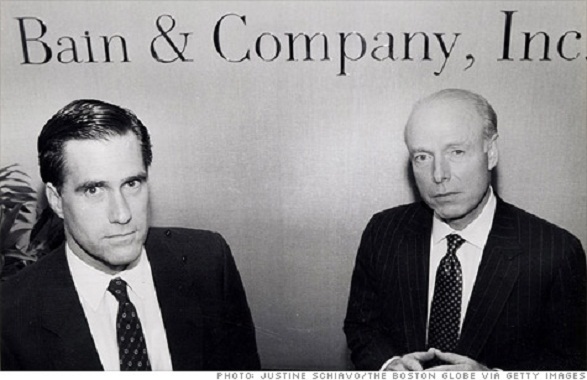
Firm Mitt Romney Founded Is Tied to Chinese Surveillance Push

Firm Mitt Romney Founded Is Tied to Chinese Surveillance Push

BEIJING — As the Chinese government forges ahead on a multibillion-dollar effort to blanket the country with surveillance cameras, one American company stands to profit: Bain Capital, the private equity firm founded by Mitt Romney.

Chinese cities are installing surveillance systems with hundreds of thousands of cameras like these at a Beijing building site.

In December, a Bain-run fund in which a Romney family blind trust has holdings purchased the video surveillance division of a Chinese company that claims to be the largest supplier to the government’s Safe Cities program, a highly advanced monitoring system that allows the authorities to watch over university campuses, hospitals, mosques and movie theaters from centralized command posts.

The Bain-owned company, Uniview Technologies, produces what it calls “infrared antiriot” cameras and software that enable police officials in different jurisdictions to share images in real time through the Internet. Previous projects have included an emergency command center in Tibet that “provides a solid foundation for the maintenance of social stability and the protection of people’s peaceful life,” according to Uniview’s Web site.

Such surveillance systems are often used to combat crime and the manufacturer has no control over whether they are used for other purposes. But human rights advocates say in China they are also used to intimidate and monitor political and religious dissidents. “There are video cameras all over our monastery, and their only purpose is to make us feel fear,” said Loksag, a Tibetan Buddhist monk in Gansu Province. He said the cameras helped the authorities identify and detain nearly 200 monks who participated in a protest at his monastery in 2008.

Mr. Romney has had no role in Bain’s operations since 1999 and had no say over the investment in China. But the fortunes of Bain and Mr. Romney are still closely tied.

The financial disclosure forms Mr. Romney filed last August show that a blind trust in the name of his wife, Ann Romney, held a relatively small stake of between $100,000 and $250,000 in the Bain Capital Asia fund that purchased Uniview.

In a statement, R. Bradford Malt, who manages the Romneys’ trusts, noted that he had put trust assets into the fund before it bought Uniview. He said that the Romneys had no role in guiding their investments. He also said he had no control over the Asian fund’s choice of investments.

Mr. Romney reported on his August disclosure forms that he and his wife earned a minimum of $5.6 million from Bain assets held in their blind trusts and retirement accounts. Bain employees and executives are also among the largest donors to his campaign, and their contributions accounted for 10 percent of the money received over the past year by Restore Our Future, the pro-Romney “super PAC.” Bain employees have also made substantial contributions to Democratic candidates, including President Obama.

Bain’s decision to enter China’s fast-growing surveillance industry raises questions about the direct role that American corporations play in outfitting authoritarian governments with technology that can be used to repress their own citizens.

It also comes at a delicate time for Mr. Romney, who has frequently called for a hard line against the Chinese government’s suppression of religious freedom and political dissent.

As with previous deals involving other American companies, critics argue that Bain’s acquisition of Uniview violates the spirit — if not necessarily the letter — of American sanctions imposed on Beijing after the deadly crackdown on protests in Tiananmen Square. Those rules, written two decades ago, bar American corporations from exporting to China “crime-control” products like those that process fingerprints, make photo identification cards or use night vision technology.

Most video surveillance equipment is not covered by the sanctions, even though a Canadian human rights group found in 2001 that Chinese security forces used Western-made video cameras to help identify and apprehend Tiananmen Square protesters.

Representative Frank R. Wolf, Republican of Virginia, who frequently assails companies that do business with Chinese security agencies, said calls by some members of Congress to pass stricter regulations on American businesses have gone nowhere. “These companies are busy making a profit and don’t want to face realities, but what they’re doing is wrong,” said Mr. Wolf, who is co-chairman of the Tom Lantos Human Rights Commission.

In public comments and in a statement posted on his campaign Web site, Mr. Romney has accused the Obama administration of placing economic concerns above human rights in managing relations with China. He has called on the White House to offer more vigorous support of those who criticize the Chinese Communist Party“Any serious U.S. policy toward China must confront the fact that China’s regime continues to deny its people basic political freedoms and human rights,” according to the statement on his Web site. “The United States has an important role to play in encouraging the evolution of China toward a more politically open and democratic order.”

In recent years, a number of Western companies, including Honeywell, General Electric, I.B.M. and United Technologies, have been criticized for selling sophisticated surveillance-related technology to the Chinese government.

Other companies have been accused of directly helping China quash perceived opponents. In 2007, Yahoo settled a lawsuit asserting that it had provided the authorities with e-mails of a journalist who was later sentenced to 10 years in prison for sending an e-mail that prosecutors charged contained state secrets.

Cisco Systems is fighting a lawsuit in the United States filed by a human rights group over Internet networking equipment it sold to the Chinese government. The lawsuit asserts that the system, tailored to government demands, allowed the authorities to track down and torture members of the religious group Falun Gong.

Bain defended its purchase of Uniview, stressing that the Chinese company’s products were advertised as instruments for crime control, not political repression. “China’s increasingly urban population will face growing needs around personal safety and property protection,” the company said in a statement. “Video surveillance is part of the solution to that, as it is anywhere in the world.” The company also said that only one-third of Uniview’s sales were to public security bureaus.

William A. Reinsch, president of the National Foreign Trade Council in Washington, said it was up to the American government, not individual companies, to set the guidelines for such business ventures. “A lot of the stuff we’re talking about is truly dual use,” said Mr. Reinsch, a former Commerce Department official in the Clinton administration. “You can sell it to a local police force that will use it to track down speeders, but you can also sell it to a ministry of state security that will use it to monitor dissidents.”

But Adam Segal, a senior fellow at the Council on Foreign Relations and an expert on the intersection of technology and domestic security in China, said American companies could not shirk responsibility for the way their technology is used, especially in the wake of recent controversies over the sales of Western Internet filtering systems to autocratic rulers in the Arab world. “Technology companies have to begin to think about the ethics and political implications of selling these technologies,” he said.

Uniview is proud of its close association with China’s security establishment and boasts about the scores of surveillance systems it has created for local security agencies in the six years since the Safe Cities program was started.

“Social management and society building pose new demands for surveillance and control systems,” Uniview says in its promotional materials, which include an interview with Zhang Pengguo, the company’s chief executive. “A harmonious society is the essential nature of socialism with Chinese characteristics,” Mr. Zhang says.

Until now, Bain’s takeover of Uniview has drawn little attention outside China. The company was formerly the surveillance division of H3C, a joint venture between 3Com and Huawei, the Chinese telecommunications giant whose expansion plans in the United States have faced resistance from Congress over questions about its ties to the Chinese military.

In 2010, 3Com, along with H3C, became a subsidiary of Hewlett-Packard in a $2.7 billion buyout deal.

H3C also sells technology unrelated to video surveillance, including Internet firewall products, but it was the video surveillance division alone that drew Bain Capital’s interest.

In December, H3C announced that Bain had bought out the surveillance division and formed Uniview, although under terms of the buyout, H3C provides Uniview with products, technical support and, for a period of time, the use of its brand name. Bain controls Uniview but says it has no role in its day-to-day operations.

Bain is, however, well positioned to profit. According to the British firm IMS Research, the Chinese market for security camera networks was $2.5 billion last year, a figure that is expected to double by 2015, with more than two-thirds of that demand coming from the government. Uniview currently has just 1 percent of the market, the firm said.

Chinese cities are rushing to construct their own surveillance systems. Chongqing, in southwest China, is spending $4.2 billion on a network of 500,000 cameras, according to the state news media. Guangdong Province, the manufacturing powerhouse adjacent to Hong Kong, is mounting one million cameras. In Beijing, the municipal government is seeking to place cameras in all entertainment venues, adding to the skein of 300,000 cameras that were installed here for the 2008 Olympics.

By marrying Internet, cellphone and video surveillance, the government is seeking to create an omniscient monitoring system, said Nicholas Bequelin, a senior researcher at Human Rights Watch in Hong Kong. “When it comes to surveillance, China is pretty upfront about its totalitarian ambitions,” he said.

For the legion of Chinese intellectuals, democracy advocates and religious figures who have tangled with the government, surveillance cameras have become inescapable.

Yang Weidong, a politically active filmmaker, said a phalanx of 13 cameras were installed in and around his apartment building last year after he submitted an interview request to President Hu Jintao, drawing the ire of domestic security agents. In January, Ai Weiwei, the artist and public critic, was questioned by the police after he threw stones at cameras trained on his front gate.

Li Tiantian, 45, a human rights lawyer in Shanghai, said the police used footage recorded outside a hotel in an effort to manipulate her during the three months she was illegally detained last year. The video, she said, showed her entering the hotel in the company of men other than her boyfriend.

During interrogations, Ms. Li said, the police taunted her about her sex life and threatened to show the video to her boyfriend. The boyfriend, however, refused to watch, she said.

“The scale of intrusion into people’s private lives is unprecedented,” she said in a phone interview. “Now when I walk on the street, I feel so vulnerable, like the police are watching me all the time.”

SOURCE: http://www.nytimes.com/2012/03/16/world/asia/bain-capital-tied-to-surveillance-push-in-china.html


Nature Assassin Patent Trolls: Monsanto Top Brass & Organizational Structure

Nature Assassin Patent Trolls: Monsanto Top Brass & Organizational Structure

Child Organizations
Monsanto Fund   Philanthropic arm of Monsanto
Leadership & Staff   board & execs »
1-10 of 74 :: see all
Memberships
Intellectual Property Committee   A coalition of thirteen US corporations …
CropLife International   International trade association for agricultural products…
Minnesota Agri-Growth Council   Agribusiness industry organization
Owners
Holdings
Alpha Technologies   Rubber and polymer laboratory instrumentation
Services/Transactions
1-10 of 25 :: see all
Ogilvy Government Relations   Federalist Group Announces Name Change to Ogilvy…
Recipients
Targets of Lobbying
1-10 of 33 :: see all
The Dark Side of Facebook

The Dark Side of Facebook

For most of us, our experience on Facebook is a benign – even banal – one. A status update about a colleague’s commute. A “friend” request from someone we haven’t seen for years (and hoped to avoid for several more). A picture of another friend’s baby, barely distinguishable from the dozen posted the day before.

Some four billion pieces of content are shared every day by 845 million users. And while most are harmless, it has recently come to light that the site is brimming with paedophilia, pornography, racism and violence – all moderated by outsourced, poorly vetted workers in third world countries paid just $1 an hour.

In addition to the questionable morality of a company that is about to create 1,000 millionaires when it floats paying such paltry sums, there are significant privacy concerns for the rest of us. Although this invisible army of moderators receive basic training, they work from home, do not appear to undergo criminal checks, and have worrying access to users’ personal details. In a week in which there has been an outcry over Google’s privacy policies, can we expect a wider backlash over the extent to which we trust companies with our intimate information?

Last month, 21-year-old Amine Derkaoui gave an interview to Gawker, an American media outlet. Derkaoui had spent three weeks working in Morocco for oDesk, one of the outsourcing companies used by Facebook. His job, for which he claimed he was paid around $1 an hour, involved moderating photos and posts flagged as unsuitable by other users.

“It must be the worst salary paid by Facebook,” he told The Daily Telegraph this week. “And the job itself was very upsetting – no one likes to see a human cut into pieces every day.”

Derkaoui is not exaggerating. An articulate man, he described images of animal abuse, butchered bodies and videos of fights. Other moderators, mainly young, well-educated people working in Asia, Africa and Central America, have similar stories. “Paedophilia, necrophilia, beheadings, suicides, etc,” said one. “I left [because] I value my sanity.” Another compared it to working in a sewer. “All the —- of the world flows towards you and you have to clean it up,” he said.

Who, one wonders, apart from the desperate, the unstable and the unsavoury, would be attracted to doing such an awful job in the first place?

Of course, not all of the unsuitable material on the site is so graphic. Facebook operates a fascinatingly strict set of guidelines determining what should be deleted. Pictures of naked private parts, drugs (apart from marijuana) and sexual activity (apart from foreplay) are all banned. Male nipples are OK, but naked breastfeeding is not. Photographs of bodily fluids (except semen) are allowed, but not if a human being is also shown. Photoshopped images are fine, but not if they show someone in a negative light.

Once something is reported by a user, the moderator sitting at his computer in Morocco or Mexico has three options: delete it; ignore it; or escalate it, which refers it back to a Facebook employee in California (who will, if necessary, report it to the authorities). Moderators are told always to escalate specific threats – “I’m going to stab Lisa H at the frat party” is given as the charming example – but not generic, unlikely ones, such as “I’m going to blow up the planet on New Year’s Eve.”

It is, of course, to Facebook’s credit that they are attempting to balance their mission “to make the world more open and connected” with a willingness to remove traces of the darker side of human nature. The company founded by Mark Zuckerberg in his Harvard bedroom is richer and more populated than many countries. These moderators are their police.

Neither is Facebook alone in outsourcing unpleasant work. Adam Levin, the US-based chief executive of Criterion Capital Partners and the owner of British social network Bebo, says that the process is “rampant” across Silicon Valley.

“We do it at Bebo,” he says. “Facebook has so much content flowing into its system every day that it needs hundreds of people moderating all the images and posts which are flagged. That type of workforce is best outsourced for speed, scale and cost.”

A spokesman for Twitter said that they have an internal moderation team, but refused to answer a question about outsourcing. Similarly, a Google spokesperson would not say how Google+, the search giant’s new social network, will be moderated. Neither Facebook nor oDesk were willing to comment on anything to do with outsourcing or moderation.

Levin, however, estimates that Facebook indirectly employs between 800 to 1,000 moderators via oDesk and others – nearly a third of its more handsomely remunerated full-time staff. Graham Cluley, of the internet security firm Sophos, calls Silicon Valley’s outsourcing culture its “poorly kept dirty secret”.

The biggest worry for the rest of us, however, is that the moderation process isn’t nearly secretive enough. According to Derkaoui, there are no security measures on a moderator’s computer to stop them uploading obscene material themselves. Despite coming into daily contact with such material, he was never subjected to a criminal record check. Where, then, is the oversight body for these underpaid global police? Quis custodiet ipsos custodes?

Facebook itself is guarding them, according to a previous statement to which the Telegraph was referred. “These contractors are subject to rigorous quality controls and we have implemented several layers of safeguards to protect the data of those using our service,” it read. “No user information beyond the content in question and the source of the report is shared. All decisions made by contractors are subject to extensive audits.”

And yet in the images due for moderation seen by the Telegraph, the name of anyone “tagged” in an offending post – as well as the user who uploaded it – could be clearly discerned. A Facebook spokesman said that these names are shared with the moderators to put the content in context – a context sufficient for Derkaoui to claim that he had as much information as “looking at a friend’s Facebook page”. He admits to having subsequently looked up more information online about the people he had been moderating. Cluley is worried that Facebook users could be blackmailed by disgruntled moderators – or even see pictures originally intended for a small circle of friends pasted all over the web.

Shamoon Siddiqui, chief executive of Develop.io, an American app-building firm that employs people in the developing world for a more generous $7 to $10 an hour, agrees that better security measures are needed. “It isn’t wrong for Facebook to have an Indian office,” he says. “But it is wrong for it to use an arbitrary marketplace with random people it doesn’t know in that country. This will have to change.”

In Britain, for example, all web moderators have to undergo an enhanced CRB check. eModeration, whose clients range from HSBC to The X-Factor, pays £10 an hour and never lets its staff spend too long on the gritty stuff. They wouldn’t go near the Facebook account. The job, says Tamara Littleton, its chief executive, is too big, the moderating too reactive, and they couldn’t compete on cost with the likes of oDesk.

So, if no one can undercut the likes of oDesk, could they not be undermined instead? If Mr Zuckerberg will not dig deeper into his $17.5 billion pockets to pay the street-sweepers of Facebook properly, maybe he could be persuaded by a little moral outrage?

Levin disagrees. “Perhaps a minute percentage of users will stop using Facebook when they hear about this,” he says. “But the more digital our society becomes, the less people value their privacy.”

Perhaps. But maybe disgruntled commuters, old schoolfriends and new mothers will think twice before sharing intimate information with their “friends” – only to find that two minutes later it’s being viewed by an under-vetted, unfulfilled person on a dollar an hour in an internet café in Marrakech.

By , and Emma Barnett

8:54PM GMT 02 Mar 2012

SOURCE: http://www.telegraph.co.uk/technology/facebook/9118778/The-dark-side-of-Facebook.html

US to Start ‘Trade Wars’ with Nations Opposed to Monsanto, GMO Crops

US to Start ‘Trade Wars’ with Nations Opposed to Monsanto, GMO Crops

The United States is threatening nations who oppose Monsanto’s genetically modified (GM) crops with military-style trade wars, according to information obtained and released by the organization WikiLeaks. Nations like France, which have moved to ban one of Monsanto’s GM corn varieties, were requested to be ‘penalized’ by the United States for opposing Monsanto and genetically modified foods. The information reveals just how deep Monsanto’s roots have penetrated key positions within the United States government, with the cables reporting that many U.S. diplomats work directly for Monsanto.

The WikiLeaks cable reveals that in late 2007, the United States ambassador to France and business partner to George W. Bush, Craig Stapleton, requested that the European Union along with particular nations that did not support GMO crops be penalized. Stapleton, who co-owned the Dallas/Fort Worth-based Texas Rangers baseball team with Bush in the 1990s, stated:

“Country team Paris recommends that we calibrate a target retaliation list that causes some pain across the EU since this is a collective responsibility, but that also focuses in part on the worst culprits. The list should be measured rather than vicious and must be sustainable over the long term, since we should not expect an early victory. Moving to retaliation will make clear that the current path has real costs to EU interests and could help strengthen European pro-biotech voices.”

The Leaked Political Agenda Behind Monsanto’s GMO Crops

The ambassador plainly calls for ‘target retaliation’ against nations who are against using Monsanto’s genetically modified corn, admittedly linked to organ damage and environmental devastation. Amazingly, this is not an isolated case. In similar newly released cables, United States diplomats are found to have pushed GMO crops as a strategic government and commercial imperative. Furthermore, the U.S. specifically targeted advisers to the pope, due to the fact that many Catholic bishops and figureheads have openly denounced GMO crops. In fact, the Vatican has openly declared Monsanto’s GMO crops as a ‘new form of slavery’.

“A Martino deputy told us recently that the cardinal had co-operated with embassy Vatican on biotech over the past two years in part to compensate for his vocal disapproval of the Iraq war and its aftermath – to keep relations with the USG [US government] smooth. According to our source, Martino no longer feels the need to take this approach,” says the cable.

Perhaps the most shocking piece of information exposed by the cables is the fact that these U.S. diplomats are actually working directly for biotech corporations like Monsanto. The cables also highlight the relationship between the U.S. and Spain in their conquest to persuade other nations to allow for the expansion of GMO crops. Not only did the Spanish government secretly correspond with the U.S. government on the subject, but the U.S. government actually knew beforehand how Spain would vote before the Spanish biotech commission reported their decision regarding GMO crops. The cable states:

“In response to recent urgent requests by [Spanish rural affairs ministry] state secretary Josep Puxeu and Monsanto, post requests renewed US government support of Spain’s science-based agricultural biotechnology position through high-level US government intervention.”

Monsanto has undoubtedly infiltrated the United States government in order to push their health-endangering agenda, and this has been known long before the release of these WikiLeaks cables. The U.S. is the only place where Monsanto’s synthetic hormone Posilac is still used in roughly 1/3 of all cows, with 27 nations banning the substance over legitimate health concerns. Despite Monsanto’s best attempts at incognito political corruption, nothing can stop the grassroots anti-Monsanto movement that is taking over cities and nations alike.

By Anthony Gucciardi

Contributing Writer for Wake Up World

About the author:

Anthony Gucciardi is an accomplished investigative journalist with a passion for natural health. Anthony’s articles have been featured on top alternative news websites such as Infowars, NaturalNews, Rense, and many others. Anthony is the co-founder of Natural Society, a website dedicated to sharing life-saving natural health techniques. Stay in touch with Natural Society via the following sites FacebookTwitterWeb

SOURCE: http://wakeup-world.com/2012/01/10/leaked-cable-us-to-start-%E2%80%98trade-wars%E2%80%99-with-nations-opposed-to-monsanto-gmo-crops/

Judge Naomi Buchwald: Corrupted By Monsatno

Judge Naomi Buchwald: Corrupted By Monsatno

On February 24, Judge Naomi Buchwald handed down her ruling on a motion to dismiss in the case of Organic Seed Growers and Trade Assn et al v. Monsanto after hearing oral argument on January 31st in Federal District Court in Manhattan. Her ruling to dismiss the case brought against Monsanto on behalf of organic farmers, seed growers and agricultural organizations representing farmers and citizens was met with great disappointment by the plaintiffs.

Plaintiff lead attorney Daniel Ravicher said, “While I have great respect for Judge Buchwald, her decision to deny farmers the right to seek legal protection from one of the world’s foremost patent bullies is gravely disappointing. Her belief that farmers are acting unreasonable when they stop growing certain crops to avoid being sued by Monsanto for patent infringement should their crops become contaminated maligns the intelligence and integrity of those farmers. Her failure to address the purpose of the Declaratory Judgment Act and her characterization of binding Supreme Court precedent that supports the farmers’ standing as ‘wholly inapposite’ constitute legal error.  In sum, her opinion is flawed on both the facts and the law. Thankfully, the plaintiffs have the right to appeal to the Court of Appeals, which will review the matter without deference to her findings.”

Monsanto’s history of aggressive investigations and lawsuits brought against farmers in America have been a source of concern for organic and non-GMO farmers since Monsanto’s first lawsuit brought against a farmer in the mid-90′s. Since then, 144 farmers have had lawsuits brought against them by Monsanto for alleged violations of  their patented seed technology.  Monsanto has brought charges against more than 700 additional farmers who have settled out-of-court rather than face Monsanto’s belligerent litigious actions. Many of these farmers claim to not have had the intention to grow or save seeds that contain Monsanto’s patented genes. Seed drift and pollen drift from genetically engineered crops often contaminate neighboring fields. If Monsanto’s seed technology is found on a farmer’s land without contract they can be found liable for patent infringement.

“Family farmers need the protection of the court,” said Maine organic seed farmer Jim Gerritsen, President of lead plaintiff OSGATA.  ”We reject as naïve and undefendable the judge’s assertion that Monsanto’s vague public relations ‘commitment’ should be ‘a source of comfort’ to plaintiffs. The truth is we are under threat and we do not believe Monsanto. The truth is that American farmers and the American people do not believe Monsanto. Family farmers deserve our day in court and this flawed ruling will not deter us from continuing to seek justice.”

The plaintiffs brought this suit against Monsanto to seek judicial protection from such lawsuits and challenge the validity of Monsanto’s patents on seeds.

“As a citizen and property owner, I find the Order by the Federal Court to be obsequious to Monsanto,” said plaintiff organic farmer Bryce Stephens of Kansas.  ”The careless, inattentive, thoughtless and negligent advertisement Monsanto has published on their website to not exercise its patent rights for inadvertent trace contamination belies the fact that their policy is in reality a presumptuous admission of contamination by their vaunted product on my property, plants, seeds and animals.”

“Seeds are the memory of life,” said Isaura Anduluz of plaintiff Cuatro Puertas and the Arid Crop Seed Cache in New Mexico.  ”If planted and saved annually, cross pollination ensures the seeds continue to adapt. In the Southwest, selection over many, many generations has resulted in native drought tolerant corn.  Now that a patented drought tolerant corn has been released how do we protect our seeds from contamination and our right to farm?”

A copy of Judge Buchwalds ruling is located here.

USDA Gives Monsanto ‘Speed Approval’

USDA Gives Monsanto ‘Speed Approval’

If you thought Monsanto’s lack of testing on their current GMO crops was bad before, prepare to now be blown away by the latest statement by the USDA. Despite links to organ damage and mutated insects, the USDA says that it is changing the rules so that genetically modified seed companies like Monsanto will get ‘speedier regulatory reviews’. With the faster reviews, there will be even less time spent on evaluating the potential dangers. Why? Because Monsanto is losing sales with longer approval terms.

The changes are expected to take full effect in March when they’re published in the Federal Register. The USDA’s goal is to cut the approval time for GMO crops in half in order to speedily implement them into the global food supply. The current USDA process takes longer than they would like due to ‘public interest, legal challenges, and the challenges associated with the advent of national organic food standards‘ says USDA deputy administrator Michael Gregoire.

According to the United States Department of Agriculture, problems like public interest (activist groups attempting to bring the dangers of GMO crops to light), legal challenges (farmers suing Monsanto over genetic contamination), and national food standards are all getting in the way of their prime goal — to helpMonsanto unleash their latest untested GMO creation. In fact, the concern is that Monsanto may be losing cash flow as nations like Brazil speed genetically modified seeds through laughable approval processes.

Steve Censky, chief executive officer of the American Soybean Association, states it quite plainly. This is a move to help Monsanto and other biotechnology giants squash competition and make profits. After all, who cares about public health?

It is a concern from a competition standpoint,” Censky said in a telephone interview.

The same statements are re-iterated by analyst Jeff Windau in an interview with Bloomberg:

“If you can reduce the approval time, you get sales that much faster,” said Windau

If you can reduce the approval time, as in the time it takes to determine if these food products are safe, then you can get sales much faster. Is the USDA working for the United States consumer, or is it working for Monsanto?

SOURCE: http://www.nationofchange.org/usda-give-monsanto-s-new-gmo-crops-special-speed-approval-1330267848


Obama Food Czar Is Former Monsanto Exec

Obama Food Czar Is Former Monsanto Exec

Obama Food Czar Is Former Monsanto Exec, One of the Four Horsemen of the Food Apocalypse

It’s not enough that former Monsanto executive Michael Taylor is the Food Czar in Obama`s administration. Monsanto recently purchased Xe Intelligence Services. Xe is the new name for Blackwater, the largest private mercenary military outfit in the world. Within that same time frame, Bill Gates purchased $23 million of Monsanto stock. –

By Paul Fassa at Natural News

Let`s take a look at each of the four horsemen.

Michael Taylor
He was Monsanto`s chief attorney and lobbyist. He knows his way around the FDA and USDA since he`s influenced both agencies. Monsanto Mike was the one who pushed Monsanto`s rBGH (recombinant Bovine Growth Hormone) to help poison milking cows and consumers` milk. Then he made it illegal for non-cooperating dairy farms to display “no rBGH” on their milk cartons. He made life financially miserable for those dairy farmers who didn`t play ball.

Some suspect a Food Czar link with the current raw milk raids. After all, milk is Monsanto Mike`s familiar turf, and his chief administrative duty is food safety.

Monsanto

In case you`re not sure of Monsanto`s destructive nature, here`s a short list of Monsanto`s toxic products: Agent Orange, PCBs, aspartame, rBGH, and Ready Roundup. Google them.

Monsanto developed terminator seeds, forcing farmers to buy new seeds because they cannot be recycled after first harvest. Monsanto is the world`s leading GMO producer. And they sue farmers for violating patent laws when non-GMO farms` crops are inadvertently infested by neighboring GMO crops.

Monsanto is making sure they own patents on almost all other non-GMO seeds as well. Their stated goal is to own the world`s food production. Think food mafia!

Bill Gates

Under the guise of philanthropy, Gates is constantly funding vaccine development and distribution. This includes GM crops containing vaccines and mosquitoes to deliver vaccines. The targets of these developments are usually developing countries.

Vaccines have been exposed as carriers for sterilization agents in developing countries over the past two decades. Perhaps Bill Gates` comment on reducing the population by ten to fifteen percent with vaccines was not a slip of the tongue or taken out of context.

Gates is also funding the Alliance for a Green Revolution in Africa (AGRA). The Gates Foundation hired Robert Horsh in 2006 when he was a director at Monsanto! The AGRA is a front for stripping African farmers of their traditional seed use and force selling them GM seeds. This type of operation has had tragic results for poor cotton farmers in India.

Xe AKA Blackwater

Blackwater has a history of black ops and secret illegal activities. Their services are available to corporate as well as government operations. They changed their name to Xe because of their soiled reputation for exposed dirty deeds in Iraq. As a private mercenary army, Blackwater has been able to terrorize targets under secret contracts, while enabling their employers to claim deniability.

Through different shell company names, Xe has developed secret contracts with several multi-national corporations. Jeremy Scahill, the author of Blackwater: The Rise of the World’s Most Powerful Mercenary Army, has recently exposed Monsanto`s relationship with Xe.

According to Scahill, Cofer Black the director of Total Intelligence, one of Blackwater`s shell companies, started pitching Monsanto in 2008. Black is former CIA director with a nasty reputation. Now Total Intelligence is part of Monsanto. That division`s purpose is to covertly infiltrate anti-GMO activists and resisting farmers. This would enable splintering those groups, or even assassinating some key individuals.

We must resist the evil synergy of this alliance. Jeffrey Smith`s anti-GMO campaign with his Institute for Responsible Technology is a starting point.

Sources for more information include:

Michael Taylor

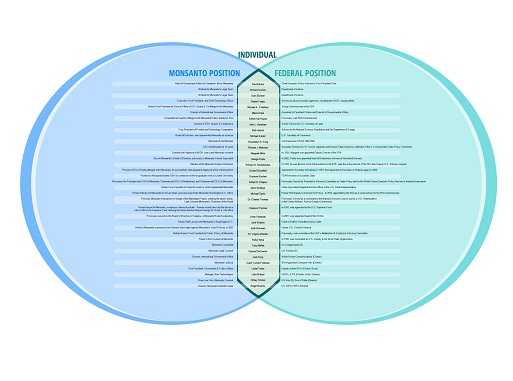
MONSANTO POSITIONS vs. FEDERAL POSITIONS

The Age of Treason: 1958 Book Exposes Chemical Attack on Humanity

The Age of Treason: 1958 Book Exposes Chemical Attack on Humanity

Dr. R. Swinburne Clymer was in many ways a man ahead of his time, and most certainly controversial. He was attacked by the medical establishment for connecting diet with disease and mental health in his 1917 book Dietetics. Dr. Clymer received his medical degree in 1902 from the College of Medicine and Surgery in Chicago and began practicing Osteopathy. Accusations of fraud surround Dr. Clymer’s career, including this 1923 edition of the Journal of the American Medical Association which claims that, “Our records fail to show that this man was ever regularly graduated by any reputable medical college.” What Clymer had to say more than likely had something to do with the denouncement that he received from the medical establishment.

Though Dr. Clymer may be surrounded with controversy, his 1958 book Your Health and Sanity in the Age of Treason exposes toxic food additives and fluoride with documentation – the majority of which are mainstream scientific studies – that can be verified many times over. What makes this book unique is the fact that Dr. Clymer was one of the first to point out that statements by the elite indicated that these toxins were to be deliberately released “…for the mental deterioration and moral debasement of the mass…”

Dr. Clymer introduces readers with a stark warning for the future

The book is appropriately subtitled; “Food and Liquids Used as a Medium in Deliberately and Carefully Planned Methods Developed by the Vicious Element of Humanity, for the Mental Deterioration and Moral Debasement of the Mass, as a Means Toward Their Enslavement.”

Dr. Clymer introduces readers with a stark warning for the future, writing, “Imagine yourself if you can, becoming conscious that you are gradually losing your manhood; that your mind is rapidly deteriorating so that you are no longer capable of thinking clearly; unable to plan your future actions. Your resistance is becoming so weakened that you are no longer master of yourself. In short, you are rapidly developing into a moron, a robot, a zombie, readily subject to the dictates of others…”

Bertrand Russell’s 1953 book The Impact of Science on Society is cited by Clymer as one example of the elite’s desire to dominate the masses. Russell stated that under scientific tyranny, “Diet, injections, and injunctions will combine, from a very early age, to produce the sort of character and the sort of beliefs that the authorities consider desirable, and any serious criticism of the powers that be will become psychologically impossible.”

Diethylstilbestrol – Endocrine Disruption

Dr. Clymer identified the synthetic estrogen Diethylstilbestrol – developed in 1938 – as a means to achieve the aims of the elite. Clymer explains that some of the toxic additives discussed in the book may not have been employed for the express purpose outlined by the elite, but “…they served their purpose admirably…” Dr. Clymer elaborates,

“The employment of Stilbestrol by the laity with absolutely no knowledge of the dangerous agent they are employing, in conditioning chickens and meats, is mass medication without license, with a dangerous toxic drug that may have universal disastrous results on all who eat such adulterated foods. This is especially true as it concerns children, youths, young women and men, resulting as it may, in their sterilization or cancer – something fervently hoped for by the enemies of mankind.”

Because Stilbestrol is a synthetic chemical, “…the natural protective activity of the bodily organs are ineffective in prohibiting harmful results. Natural Estrogen, on the other hand, is decomposed, and any of its possible harmful effects may be more or less made ineffective,” writes Dr. Clymer. Stilbestrol was used as a treatment for various types of cancer and menopausal symptoms, but as Dr. Clymer states, “Physicians versed in the use of Endocrines agree generally that Stilbestrol is a dangerous drug in all except experienced hands.”

Dr. E. Malcolm Stokes, in an article published in the Western Journal of Surgery, Obstetrics and Gynecology, September 1948, wrote: “Single large doses of [natural] estrogen substances are quickly excreted… long continued, repeated administration in relatively small doses [as in daily consumption of meats permeated with stilbestrol] may intensify tissue response to the hormone.”

Dr. Clymer warns that such chemicals are to feminize men,

“Every vigilant human being should be concerned with several important factors involved: The methods or means by which it is possible to change man’s characteristics as easily as the animal’s. Man is a warrior by nature, the protector of his family, and his own rights and privileges; an individual, a free man… A being who has wrought great things and who, if not interfered with, will do even greater things. This being is to be turned into a lesser female; unable, even unwilling, to defend himself, much less his family or country; becoming a slave…”

Dr. Clymer’s concerns over Stilbestrol have been vindicated over time, as the chemical has been phased out of use as a growth hormone in the late 1970′s due to concerns over cancer. Additionally, in 1971 the FDA advised physicians to stop prescribing Stilbestrol to pregnant women due to high cancer risk. The drug is no longer being manufactured as of 1997.

Flashforward – Bisphenol A

Today there are continuing concerns as substantial levels of Bisphenol A (BPA) have been found in a large percentage of the western world’s population. Like Diethylstilbestrol, BPA is a synthetic estrogen with similar to identical effects on the human body. BPA is perhaps a much larger threat due to the fact that unlike Stilbestrol – which was primarily consumed in meats – it is found in many household products, including the food we eat. A recent study from the Canadian Health Measures Survey found that over 90% of Canadians have detectable concentrations of BPA in their urine. Studies conducted by the CDC found Bisphenol A in the urine of 95% of adults sampled in 1988–1994 and in 93% of children and adults tested in 2003–04. Other studies have shown that Bisphenol A causes feminization of males and reduced sperm count.

As Dr. Frederick vom Saal states in this local Fox News report, levels of BPA below a trillionth of a gram have been found to alter cell function and growth. Additionally, BPA was found to feed cancer cell growth and impact the reproductive system of rats.

Fluoride

Yet another danger to human health and well being identified by Dr. Clymer is Sodium Fluoride. Fluoride, we are told, is placed in the water supply to help protect our teeth from decay. Today some are proposing that fluoride and other forms of mass medication will serve as a means of “Cognitive Enhancement.” In his expose of fluoride, Dr. Clymer quotes Rene M. Vale, a former Communist and party worker in her book Red Court, published in 1952. She writes,

“In regions of the country where resistance was most apt to develop we saw to it that virus diseases struck, and when antibiotics threatened our program, we devised other means of vitiating the populace. Fluoridation of drinking water was found to be about the most successful…”

Dr. Charles E. Perkins, who Dr. R. Swinburne Clymer was in personal contact with, was, “… sent by the United States Government to help take charge of the I. G. Farben chemical plants in Germany at the end of the second world war. What follows are quotations from a letter which Mr. Perkins wrote to the Lee Foundation for Nutritional Research, Milwaukee, Wisconsin, dated October 2, 1954.”

Mr. Perkins letter states,

“The German chemists worked out a very ingenious and far-reaching plan of mass control which was submitted to and adopted by the German General Staff. This plan was to control the population in any given area through mass medication of drinking water supplies. By this method they could control the population of whole areas, reduce population by water medication that would produce sterility in women and so on. In this scheme of mass control, sodium fluoride occupied a prominent place.

“We are told by the ideologists who are advocating the fluorination of water supplies in this country that their purpose is to reduce the incidence of tooth decay in children, and it is the plausibility of this excuse, plus the prominence of those who are responsible for the present spread of artificial water fluoridation in this country.

“However – and I want to make this very definite and very positive – the real reason behind fluorination is not to benefit children’s teeth. If this were the real reason there are many ways in which it could be done that are much easier, cheaper and far more effective. The real purpose behind water fluoridation is to reduce the resistance of the masses to domination and control and loss of liberty…

“I was told of this entire scheme by a German chemist who was an official of the great Farben chemical industries and was also prominent in the Nazi movement at the time…”

Dr. Clymer additionally cites a 1956 letter written by the then New York Water Commissioner Arthur C. Ford (available in full here). In the letter, Ford speaks out openly against fluorides as “…extremely toxic substances…” Ford writes,

“We are aware that the fluorides are extremely toxic substances, and evidence exists to show that even at the recommended level of one part per million of fluoride in drinking water, people in fluoridated communities have been harmed.

We know of reputable, independent medical authorities throughout the United States and in the local area who have found evidence of fluoride damage to persons living in fluoridated communities. These medical authorities disagree with the fluoride hypothesis, and they have raised grave questions with respect to the safety of the procedure for an entire population which includes the young, the old, the susceptible and the infirm as well as the healthy.

Fluoride, besides being a toxic substance, is not all excreted when taken into the system, a significant percentage remaining cumulatively. Fluoridation of the drinking water at any level of concentration is a very indiscriminate procedure, since children drink widely varying amounts of water…”

Australian television recently reported on fluoride’s harmful impact on human health and efforts to expand water fluoridation on the continent.

As sperm counts continue to fall world-wide and GMO crops escape into the environment, exposure to untold numbers of environmental toxins like BPA is a continuing threat. In the United States, several EPA scientists have denounced fluoridation, calling for a national moratorium on the fluoridation of water supplies. Citizens in Wichita Kansas are becoming active in raising awareness of fluoride, drawing attacks from the local media. Awareness of these issues is essential not just for those living today, but for future generations. Open admissions of the intent to chemically alter humanity should leave us with nothing but a sense of duty to warn others of the grave threat that we face.

http://www.oldthinkernews.com/?p=11

The RAND Corporation and UFOs (Pt. 2)

The RAND Corporation and UFOs (Pt. 2)

| Sep 28, 2011

We’ve published below the second part of my series on the RAND Corporation and UFOs (read part one here) published originally under the pseudonym of A. Hovni in 1982 in the weekend supplement UFOs and other Cosmic Phenomena in the long-defunct New York City newspaper The News World. Other than correcting spelling typos and adding illustrations, the text is reproduced exactly as it was written back in April of 1982

Think tank researcher pushed UFO studies

UFO riddle exists – What to do about it? – Study group option

By A. Hovni

Special to The News World

New York City, April 17, 1982

Second in a two-part series

The public’s perception towards the UFO phenomenon in the late sixties had changed considerably from that of earlier days when American citizens would readily accepted the statements spoofed by the U.S. Air Force without further questioning. But following the famous 1966 “swamp gas” episode in Ann Arbor, Michigan in which Dr. J. Allen Hynek’s quick debunking brush off literally triggered a public outcry across the nation, the Air Force decided that it was time to change its UFO policies. To that end, they contracted the services of the University of Colorado to conduct a supposedly “independent” scientific study of UFOs, popularly known as the Condon Report after its chairman, Dr. Edward U. Condon.

It was during these days of intricate governmental planning and counter-planning—which included among other things two Congressional UFO Hearings by the House’s Armed Services Committee (1966) and the Science and Astronautics Committee (1968)—when the RAND Corporation commissioned its own UFO study. Entitled “UFOs: What to Do?,” the study was written by George Kocher and published “FOR RAND USE ONLY” on November 27, 1968 as RAND DOCUMENT No. 13154-PR.

The document came out at a critical time; a few months after the Condon Committee completed its “Scientific Study of Unidentified Flying Objects” in June of 1968, yet barely a month before the Air Force released it with much fanfare in January of 1969, stressing the anti-UFO side of the study. Interestingly enough, while Condon concluded that, as put by the Air Force News Release, “further extensive study of UFO sightings is not justified in the expectation that science will be advanced” (which led to the demise of Project Blue Book later in 1969), the RAND Corporation dealt with the opposite side of the coin: what to do with UFOs?

Kocher’s RAND UFO Document cover

OBJECTIVITY STRESSED

Because of the vital importance of its work for the national defense and other related areas, the RAND think tank is expected to exercise a high degree of objectivity in its research. As far as UFOs are concerned, the two RAND papers by Dr. Joe Lipp (see article part I) and by George Kocher are written in a sober, informative and open-minded style, aimed more with proposing a rational solution to the flying saucer riddle than with trying to impose any particular view on the readers.

From the beginning, George Kocher puts a degree of caution when he warns in the introduction that “there exists a great amount of misinformation about the phenomenon not only in the minds of the public, but among educated groups such as scientists as well.” The goal of the “series of essays” describing “various aspects of the phenomenon” is, according to the author, “to suggest a means of proceeding on this interesting and potentially very significant problem.”

The full 40-pages thick document consists of 5 essays on different Aspects of the UFO phenomenon: Historical Aspects, Astronomical aspects, The Character of Reports, Phenomenological Aspects, and How to Proceed and Why. It also includes the complete 6-page “UFO Sighting Report” form of the University of Colorado’s UFO Project, and a bibliography of 26 scientifically-oriented books and articles from specialized periodicals. Although the study does not pretend to give us the final answer to the UFO riddle, it does conclude that the phenomenon exists and ought to be investigated in a responsible manner.

Moving in the opposite direction from the government’s program at the time of phasing out all official involvement with UFOs, Kocher recommended the “organization of a central report receiving agency, staffed by a permanent group of experienced UFO investigators and having on call specialists in astronomy, physics, optics, atmospheric physics, psychology and the like for application when needed.” But before analyzing Kocher’s conclusions, we should review first the supporting evidence for those conclusions.

FROM FATIMA…

Original newspaper report on the Fatima sightings.

Kocher gives a quick overview of the pre-1947 historical aspects of UFOlogy as have been researched by Vallee, B.L.P. Trench (Lord Clancarty), Carl Gustav Jung and other authors. He dedicates some space to discuss the famous miracle of Fatima in Portugal, in particular the October 13, 1917 apparition, which was witnessed “by a crowd of about 70,000 persons, including a number of scientists, reporters, atheists and agnostics, as well as faithful Catholics.” Although Fatima is better known for its religious implications, its relation to the UFO phenomenon has been noticed by a number of researchers. Consider, for instance, the following description by a Dr. A. Garrett of the University of Coimbra, quoted by Kocher: “…It looked like a burnished wheel cut out of mother-of-pearl… The disc spun dizzily round…” etc.

…TO AN INHABITED UNIVERSE

One of Mr. Kocher’s essays is devoted to the “Astronomical Aspects” of UFOs, in which he deals with some of the ground already covered in the late forties by his RAND colleague Dr. Lipp, such as the number of potential stars in the galaxy that may have inhabited planets and so on. He by-passes the much-touted astronomical argument of the huge distances in space vis-à-vis interstellar travel interstellar travel by stating: “I suggest that if a way to circumvent the speed of light restriction is possible, it has already been found by someone in our galaxy.” And he writes at the end of this section that, “thus we may conclude that it is very likely that at least one, and probably many of the 100 million planetary populations is capable of interstellar travel.”

EXTRAORDINARY CASES

In the following two essays, “The Character of Reports” and “Phenomenological Aspects,” Mr. Kocher analyses the types of reports and patterns that can be extracted from them. He states that “the really interesting class of reports is that reporting phenomenology which is clearly extraordinary,” meaning by this that the qualifications of the observer(s) are such “that the report is not only highly credible but is articulate and quantitative as well.” It is this subclass of reports variously estimated from 5 to 20 percent of the total, he writes, “that offers hope of our learning what is going on.”

In these two sections, Mr. Kocher relies mostly on the pioneer research of both the late Professor James McDonald and NICAP, in particular NICAP’s classic report “The UFO evidence,” edited by Richard Hall. He quotes liberally from these investigations which, it seems, he considers of higher scientific value than those of Major Hector Quintanilla’s Project Blue Book. But Kocher is not a stranger in the realm of personal, onsite investigations of UFO sightings, either. More than 5 pages are dedicated to describe in detail a UFO sighted by four witnesses near Newton, Illinois on October 10, 1966. Kocher was familiar with both the area and the observers, having been reared nearby.

Lack of space doesn’t permit us to describe this sighting in detail, yet Kocher remarked that “the observations are sufficiently detailed to give us adequate confidence that some sort of machine was present, behaving in a very extraordinary way.” Furthermore, Kocher wrote that, “it is this kind of sighting—the kind which is clearly inexplicable in contemporary terms, which causes me (and other interested persons) to take the whole subject so seriously.”

Another portion of the “phenomenological” essay is devoted to categorizing UFO sightings by shape, color, luminous and kinematic behavior, variations with time and interaction with the environment, etc. Displaying a vast knowledge of cases from the Air Force, NICAP and APRO files, Mr. Kocher recommends “careful interviews with witnesses and analysis of large number of reports” in order to obtain “the significant patterns of phenomenology.” If UFOs are some still unknown type of natural phenomena, they “should exhibit some patterns of appearance or behavior which would aid in identifying and predicting them,” states Kocher. Yet he also thinks that “it may be possible to anticipate appearances” if their origin is extraterrestrial.

Excerpt from Kocher’s RAND UFO report.

A CENTRAL RECEIVING AGENCY

In his final essay, “UFOS – HOW TO ROCEED AND WHY,” Mr. Kocher gives a list of categories suggested by Prof. McDonald, who believed himself that the phenomenon could be best explained by the hypothesis of extraterrestrial probes. Kocher does not commit himself to any particular hypothesis, but he indicates that several of them have, if explained, a “profound and significant” value to society. If UFOs are extraterrestrial, Kocher writes that “an identification of the phenomenon would be a task of highest potential urgency.”

Kocher finally suggests five areas of improvement in order to understand better the nature of UFOs. First, he recommends the establishment of ‘a central receiving agency,” staffed with competent UFO investigators and scientific consultants in several fields. “This agency should be readily and instantly accessible to the public for the purpose of reporting,” he writes, and links should be opened through “toll-free telephone lines,” reporting forms distributed by the Post Office, cooperation with police departments, etc.

Kocher also mentions the role of the media in this mystery, stating that “the press should be encouraged to report sightings accurately and in a non-sensational manner. Suitable reporting would encourage other witnesses to come forth.” He finally suggests the coordinated use of sensor devices to record “electric, magnetic and gravitational fields, radioactivity, optical and radio frequency anomalies.”

Such a competent and centralized research should be able to produce, after a few years of operation, “generalities about appearance and behavior and most importantly, to anticipate times and locations of appearances.” (Underlying in the original.) Without saying it, Kocher’s nationally-centralized reporting agency implies some type of coordination by the government. Yet ironically, the U.S. Air Force—which has often relied on the research of its most trusted think tank at RAND—did not pay any attention to Kocher’s recommendations. Since the Condon coup, the U.S. Government has publicly ignored the very existence of the UFO phenomenon. Instead, it seems it was the French Government who followed the recommendations set forth by the RAND Corporation, with the establishment in 1977 of its own centralized reporting agency, the GEPAN (see story “France backs UFO study,” UFO Supplement, November 14, 1981).

Kocher finally recommended to go beyond a purely national collection of UFO reports, indicating in the last paragraph that, “it would be much more convincing if data could be collected worldwide and if the most interesting reports could be intensively and completely investigated. I believe current reports justify the expanded data collection and analysis effort.” Did anybody in the government ever pay any attention to this excellent review of the UFO phenomenon and its clearly stated recommendations to solve the mystery?

*          *          *

UPDATE

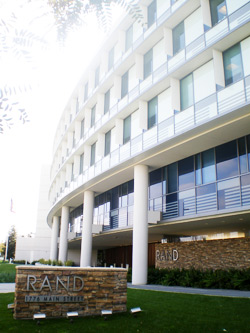
RAND Corporation Headquarters in Santa Monica, CA. (image credit: Cbl62/Wikimedia Commons)

Even though this RAND paper by George Kocher was written in 1968, its premise of creating a “Central Receiving Agency” for collecting UFO reports, which is properly staffed and funded with qualified investigators and scientific consultants, works in coordination with police departments, and doesn’t have preconceived notions or a political agenda, is just as valid and needed as it was when it was conceived by Kocher 43 years ago. MUFON and other private organizations fill that role as best as they can, but these are volunteer groups without official backing and appropriate funding.

There are still many unanswered questions about the genesis of George Kocher’s RAND paper, “UFOs: What to Do?” When nicap.org posted the full document online in both on pdf and in text format, they included some comments by experts familiar with the official history of UFOs like Jan Aldrich, Dick Hall and Brad Sparks made in 1996. Aldrich, who runs Project 1947, had this to say:

George Kocher worked at RAND. He was interested in the UFOs. He wrote up a short paper for circulation within RAND. It was personal. It was not an official RAND document. Kocher got little or no response to his privately circulated document. One copy of it did make its way to Wright-Patterson. LTC Quintanilla [head of Project Blue Book] wrote RAND a blazing letter. Once again, Quintanilla’s letter was not an official ATIC response, but from Quintanilla’s address and his personal opinion.

Kocher’s supervisor turned Quintanilla’s letter over to Kocher. RAND never responded to Quintanilla. Kocher did not follow up on his paper. The matter went no further. Kocher confirmed all this in a letter to Dr. Hynek which is now at CUFOS with a copy of Quintanilla’s letter. CUFOS made copies of Kocher’s document available years ago.

 …There were some UFO fans at RAND. Mary Rorig comes to mind. However, this paper is about as significant as some NICAP member writing a paper supporting contactees. It should be made clear that this was an individual effort within an organization which took no action, and had no discussion on the matter as the result of his effort other than to file it.

While it seems pretty obvious that Kocher’s UFO paper was not a high priority initiative and was never followed up, it was more than just a personal essay as stated by Aldrich. The original cover page clearly states “RAND DOCUMENT,” has a file number 18154-PR and states at the bottom of the page, “For RAND Use Only.” Furthermore, that it’s a legitimate RAND document is clearly established by the fact that it appears in the RAND Corporation’s own Reports and Bookstore page, where it’s listed as a “RAND Unrestricted Draft” and can be downloaded for free in pdf or purchased in print as Document Number DRU-1571. The RAND page describes Kocher’s report as:

Sightings of unidentified foreign objects (UFOs) have been reported throughout the centuries-most of them given a religious interpretation. Since World War II, however, there seems to have been a drastic increase in the number of sightings. We have enough data-both visual and photographic-on some of these sighting to know that the phenomenon is unambiguously extraordinary and clearly inexplicable in modern terms. The author examines UFO brightness, size, and maneuvers, and discusses the frequency and location of sightings. He ends by suggesting the need for more standardized reporting on UFOs, so that times and locations of appearances may be anticipated and badly needed objective data may be obtained.

The RAND Reports page provides also several other papers written by George Kocher for the California think tank—most of them on astronomical subjects—such as “Observations of the 1969 Inferior Conjunction and Greatest Western Elongation of Venus: Data Catalog and Preliminary Analysis” (1970), “A Deep-Space Triangulation Probe To Determine the Astronomical Unit” (1964), “Eclipse Observations from a Jet Aircraft” (1964), and “Environmental Problems: Their Causes, Cures, and Evolution Using Southern California Smog as an Example” (1971). Kocher was obviously a RAND scientist in good standing and 43 years after writing his UFO paper, it is still worth reading and discussing.


http://www.openminds.tv/rand-corporation-and-ufos-pt-2/

When dark deeds unfold, point the finger in this direction.

When dark deeds unfold, point the finger in this direction.

by Tony Cartalucci

This is your real government; they transcend elected administrations, they permeate every political party, and they are responsible for nearly every aspect of the average American and European’s way of life. When the “left” is carrying the torch for two “Neo-Con” wars, starting yet another based on the same lies, peddled by the same media outlets that told of Iraqi WMD’s, the world has no choice, beyond profound cognitive dissonance, but to realize something is wrong.

What’s wrong is a system completely controlled by a corporate-financier oligarchy with financial, media, and industrial empires that span the globe. If we do not change the fact that we are helplessly dependent on these corporations that regulate every aspect of our nation politically, and every aspect of our lives personally, nothing else will ever change.

The following list, however extensive, is by far not all-inclusive. However after these examples, a pattern should become self-evident with the same names and corporations being listed again and again. It should be self-evident to readers of how dangerously pervasive these corporations have become in our daily lives. Finally, it should be self-evident as to how necessary it is to excise these corporations from our lives, our communities, and ultimately our nations, with the utmost expediency.

International Crisis Group
www.crisisgroup.org

Background: While the International Crisis Group (ICG) claims to be “committed to preventing and resolving deadly conflict,” the reality is that they are committed to offering solutions crafted well in advance to problems they themselves have created in order to perpetuate their own corporate agenda.

Nowhere can this be better illustrated than in Thailand and more recently in Egypt. ICG member Kenneth Adelman had been backing Thailand’s Prime Minster Thaksin Shinwatra, a former Carlyle Group adviser who was was literally standing in front of the CFR in NYC on the eve of his ousting from power in a 2006 military coup. Since 2006, Thaksin’s meddling in Thailand has been propped up by fellow Carlyle man James Baker and his Baker Botts law firm, Belfer Center adviser Robert Blackwill of Barbour Griffith & Rogers, and now Robert Amsterdam’s Amsterdam & Peroff, a major corporate member of the globalist Chatham House.

With Thailand now mired in political turmoil led by Thaksin Shinwatra and his “red shirt” color revolution, the ICG is ready with “solutions” in hand. These solutions generally involve tying the Thai government’s hands with arguments that stopping Thaksin’s subversive activities amounts to human rights abuses, in hopes of allowing the globalist-backed revolution to swell beyond control.

The unrest in Egypt, of course, was led entirely by ICG member Mohamed ElBaradei and his US State Department recruited, funded, and supported April 6 Youth Movement coordinated by Google’s Wael Ghonim. While the unrest was portrayed as being spontaneous, fueled by the earlier Tunisian uprising, ICG’s ElBaradei, Ghonim, and their youth movement had been in Egypt since 2010 assembling their “National Front for Change” and laying the groundwork for the January 25th 2011 uprising.

ICG’s George Soros would then go on to fund Egyptian NGOs working to rewrite the Egyptian constitution after front-man ElBaradei succeeded in removing Hosni Mubarak. This Soros-funded constitution and the resulting servile stooge government it would create represents the ICG “resolving” the crisis their own ElBaradei helped create.

Notable ICG Board Members:

George Soros
Kenneth Adelman
Samuel Berger
Wesley Clark
Mohamed ElBaradei
Carla Hills

Notable ICG Advisers:

Richard Armitage
Zbigniew Brzezinski
Stanley Fischer
Shimon Peres
Surin Pitsuwan
Fidel V. Ramos

Notable ICG Foundation & Corporate Supporters:

Carnegie Corporation of New York
Hunt Alternatives Fund
Open Society Institute
Rockefeller Brothers Fund
Morgan Stanley
Deutsche Bank Group
Soros Fund Management LLC
McKinsey & Company
Chevron
Shell

Brookings Institute
www.brookings.edu

Background: Within the library of the Brookings Institute you will find the blueprints for nearly every conflict the West has been involved with in recent memory. What’s more is that while the public seems to think these crises spring up like wildfires, those following the Brookings’ corporate funded studies and publications see these crises coming years in advance. These are premeditated, meticulously planned conflicts that are triggered to usher in premeditated, meticulously planned solutions to advance Brookings’ corporate supporters, who are numerous.

The ongoing operations against Iran, including US-backed color revolutions, US-trained and backed terrorists inside Iran, and crippling sanctions were all spelled out in excruciating detail in the Brookings Institute report, “Which Path to Persia?” The more recent UN Security Council resolution 1973 regarding Libya uncannily resembles Kenneth Pollack’s March 9, 2011 Brookings report titled “The Real Military Options in Libya.”

Notable Brookings Board Members:

Dominic Barton: McKinsey & Company, Inc.
Alan R. Batkin: Eton Park Capital Management
Richard C. Blum: Blum Capital Partners, LP
Abby Joseph Cohen: Goldman, Sachs & Co.
Suzanne Nora Johnson: Goldman Sachs Group, Inc.
Richard A. Kimball Jr.: Goldman, Sachs & Co.
Tracy R. Wolstencroft: Goldman, Sachs & Co.
Paul Desmarais Jr.: Power Corporation of Canada
Kenneth M. Duberstein: The Duberstein Group, Inc.
Benjamin R. Jacobs: The JBG Companies
Nemir Kirdar: Investcorp
Klaus Kleinfeld: Alcoa, Inc.
Philip H. Knight: Nike, Inc.
David M. Rubenstein: Co-Founder of The Carlyle Group
Sheryl K. Sandberg: Facebook
Larry D. Thompson: PepsiCo, Inc.
Michael L. Tipsord: State Farm Insurance Companies
Andrew H. Tisch: Loews Corporation

Some Brookings Experts:
(click on names to see a list of recent writings.)

Kenneth Pollack
Daniel L. Byman
Martin Indyk
Suzanne Maloney
Michael E. O’Hanlon
Bruce Riedel
Shadi Hamid

Notable Brookings Foundation & Corporate Support:

Foundations & Governments

Ford Foundation
Bill & Melinda Gates Foundation
The Rockefeller Foundation
Government of the United Arab Emirates
Carnegie Corporation of New York
Rockefeller Brothers Fund

Banking & Finance

Bank of America
Citi
Goldman Sachs
H&R Block
Kohlberg Kravis Roberts & Co.
Jacob Rothschild
Nathaniel Rothschild
Standard Chartered Bank
Temasek Holdings Limited
Visa Inc.

Big Oil

Exxon Mobil Corporation
Chevron
Shell Oil Company

Military Industrial Complex & Industry

Daimler
General Dynamics Corporation
Lockheed Martin Corporation
Northrop Grumman Corporation
Siemens Corporation
The Boeing Company
General Electric Company
Westinghouse Electric Corporation
Raytheon Co.
Hitachi, Ltd.
Toyota

Telecommunications & Technology

AT&T
Google Corporation
Hewlett-Packard
Microsoft Corporation
Panasonic Corporation
Verizon Communications
Xerox Corporation
Skype

Media & Perception Management

McKinsey & Company, Inc.
News Corporation (Fox News)

Consumer Goods & Pharmaceutical

GlaxoSmithKline
Target
PepsiCo, Inc.
The Coca-Cola Company

Council on Foreign Relations
www.cfr.org

Background & Notable Membership: A better question would be, who isn’t in the Council on Foreign Relations? Nearly every self-serving career politician, their advisers, and those populating the boards of the Fortune 500 are CFR members. Many of the books, magazine articles, and newspaper columns we read are written by CFR members, along with reports, similar to Brookings Institute that dictate, verbatim, the legislation that ends up before the West’s lawmakers.

A good sampling of the most active wings of the CFR can be illustrated best in last year’s “Ground Zero Mosque” hoax, where CFR members from both America’s political right and left feigned a heated debate over New York City’s so-called Cordoba House near the 3 felled World Trade Center buildings. In reality, the Cordoba House was established by fellow CFR member Feisal Abdul Rauf, who in turn was funded by CFR financing arms including the Carnegie Corporation of New York, chaired by 9/11 Commission head Thomas Kean, and various Rockefeller foundations.

Notable CFR Corporate Support:

Banking & Finance

Bank of America Merrill Lynch
Goldman Sachs Group, Inc.
JPMorgan Chase & Co
American Express
Barclays Capital
Citi
Morgan Stanley
Blackstone Group L.P.
Deutsche Bank AG
New York Life International, Inc.
Prudential Financial
Standard & Poor’s
Rothschild North America, Inc.
Visa Inc.
Soros Fund Management
Standard Chartered Bank
Bank of New York Mellon Corporation
Veritas Capital LLC
Kohlberg Kravis Roberts & Co.
Moody’s Investors Service

Big Oil

Chevron Corporation
Exxon Mobil Corporation
BP p.l.c.
Shell Oil Company
Hess Corporation
ConocoPhillips Company
TOTAL S.A.
Marathon Oil Company
Aramco Services Company

Military Industrial Complex & Industry

Lockheed Martin Corporation
Airbus Americas, Inc.
Boeing Company,
DynCorp International
General Electric Company
Northrop Grumman
Raytheon Company
Hitachi, Ltd.
Caterpillar
BASF Corporation
Alcoa, Inc.

Public Relations, Lobbyists & Legal Firms

McKinsey & Company, Inc.
Omnicom Group Inc.
BGR Group

Corporate Media & Publishing

Bloomberg
Economist Intelligence Unit
News Corporation (Fox News)
Thomson Reuters
Time Warner Inc.
McGraw-Hill Companies

Consumer Goods

Walmart
Nike, Inc.
Coca-Cola Company
PepsiCo, Inc.
HP
Toyota Motor North America, Inc.
Volkswagen Group of America, Inc.
De Beers

Telecommunications & Technology

AT&T
Google, Inc.
IBM Corporation
Microsoft Corporation
Sony Corporation of America
Xerox Corporation
Verizon Communications

Pharmaceutical Industry

GlaxoSmithKline
Merck & Co., Inc.
Pfizer Inc.


The Chatham House
www.chathamhouse.org.uk

Background & Membership: The UK’s Chatham House, like the CFR and the Brookings Institute in America, has an extensive membership and is involved in coordinated planning, perception management, and the execution of its corporate membership’s collective agenda.

Individual members populating its “senior panel of advisers” consist of the founders, CEOs, and chairmen of the Chatham House’s corporate membership. Chatham’s “experts” are generally plucked from the world of academia and their “recent publications” are generally used internally as well as published throughout Chatham’s extensive list of member media corporations, as well as industry journals and medical journals. That Chatham House “experts” are submitting entries to medical journals is particularly alarming considering GlaxoSmithKline and Merck are both Chatham House corporate members.

No better example of this incredible conflict of interest can be given than the current Thai “red” color revolution being led by Chatham House’s Amsterdam & Peroff with consistent support lent by other corporate members including the Economist, the Telegraph and the BBC.

In one case, the Telegraph printed, “Thai protests – analysis by Dr Gareth Price and Rosheen Kabraji,” within which Price and Kabraji make a shameless attempt at defending the Western-backed, Maoist themed, violent protests. While the Telegraph mentioned that Price and Kabraji were both analysts for the Chatham House, they failed to tell readers that the Telegraph itself retains a corporate membership within the Chatham House as does the Thai protest leader’s lobbyist, Robert Amsterdam and his Amsterdam & Peroff lobbying firm.

Notable Chatham House Major Corporate Members:

Amsterdam & Peroff
BBC
Bloomberg
Coca-Cola Great Britain
Economist
GlaxoSmithKline
Goldman Sachs International
HSBC Holdings plc
Lockheed Martin UK
Merck & Co Inc
Mitsubishi Corporation
Morgan Stanley
Royal Bank of Scotland
Saudi Petroleum Overseas Ltd
Standard Bank London Limited
Standard Chartered Bank
Tesco
Thomson Reuter
United States of America Embassy
Vodafone Group

Notable Chatham House Standard Corporate Members:

Amnesty International
BASF
Boeing UK
CBS News
Daily Mail and General Trust plc
De Beers Group Services UK Ltd
G3 Good Governance Group
Google
Guardian
Hess Ltd
Lloyd’s of London
McGraw-Hill Companies
Prudential plc
Telegraph Media Group
Times Newspapers Ltd
World Bank Group

Notable Chatham House Corporate Partners:

British Petroleum
Chevron Ltd
Deutsche Bank
Exxon Mobil Corporation
Royal Dutch Shell
Statoil
Toshiba Corporation
Total Holdings UK Ltd
Unilever plc

Conclusion

These organizations represent the collective interests of the largest corporations on earth. They not only retain armies of policy wonks and researchers to articulate their agenda and form a consensus internally, but also use their massive accumulation of unwarranted influence in media, industry, and finance to manufacture a self-serving consensus internationally.

To believe that this corporate-financier oligarchy would subject their agenda and fate to the whims of the voting masses is naive at best. They have painstakingly ensured that no matter who gets into office, in whatever country, the guns, the oil, the wealth and the power keep flowing perpetually into their own hands. Nothing vindicates this poorly hidden reality better than a “liberal” Nobel Peace Prize wearing president, dutifully towing forward a myriad of “Neo-Con” wars, while starting yet another war in Libya.

Likewise, no matter how bloody your revolution is, if the above equation remains unchanged, and the corporate bottom lines left unscathed, nothing but the most superficial changes will have been made, and as is the case in Egypt with International Crisis Group stooge Mohamed ElBaradei worming his way into power, things may become substantially worse.

The real revolution will commence when we identify the above equation as the true brokers of power and when we begin systematically removing our dependence on them, and their influence on us from our daily lives. The global corporate-financier oligarchy needs us, we do not need them, independence from them is the key to our freedom.


http://landdestroyer.blogspot.com/2011/03/naming-names-your-real-government.html

Hungary Destroys All Monsanto GMO Corn Fields

Hungary Destroys All Monsanto GMO Corn Fields

Hungary has taken a bold stand against biotech giant Monsanto and genetic modification by destroying 1000 acres of maize found to have been grown with genetically modified seeds, according to Hungary deputy state secretary of the Ministry of Rural Development Lajos Bognar. Unlike many European Union countries, Hungary is a nation where genetically modified (GM) seeds are banned. In a similar stance against GM ingredients, Peru has also passed a 10 year ban on GM foods.

Vital Activism: Monsanto Declared Worst Company of 2011

Planetsave reports:

Almost 1000 acres of maize found to have been ground with genetically modified seeds have been destroyed throughout Hungary, deputy state secretary of the Ministry of Rural Development Lajos Bognar said. The GMO maize has been ploughed under, said Lajos Bognar, but pollen has not spread from the maize, he added.

Unlike several EU members, GMO seeds are banned in Hungary. The checks will continue despite the fact that seek traders are obliged to make sure that their products are GMO free, Bognar said.

During the invesigation, controllers have found Pioneer Monsanto products among the seeds planted.

The free movement of goods within the EU means that authorities will not investigate how the seeds arrived in Hungary, but they will check where the goods can be found, Bognar said. Regional public radio reported that the two biggest international seed producing companies are affected in the matter and GMO seeds could have been sown on up to the thousands of hectares in the country. Most of the local farmers have complained since they just discovered they were using GMO seeds.

With season already under way, it is too late to sow new seeds, so this years harvest has been lost.

And to make things even worse for the farmers, the company that distributed the seeds in Baranya county is under liquidation. Therefore, if any compensation is paid by the international seed producers, the money will be paid primarily to that company’s creditors, rather than the farmers.

NaturalSociety Note: This article is from July 26, 2011, but had to be re-added.

Explore More:

  1. Monsanto Declared Worst Company of 2011
  2. Anti-Monsanto Articles Surpasses 80,000 Facebook Shares, Among Most Shared in 2011
  3. France Takes Stand Against GMOs, Monsanto Despite End of Ban
  4. Monsanto Worst Company of 2011 Declaration Posted on Reuters, Yahoo, and More
  5. Busted: Monsanto Abusing Illegal Workers in ‘Slave-Like’ Conditions
  6. Poland Joins Ranks of Grassroots Anti-Monsanto Activism

http://naturalsociety.com/hungary-destroys-all-monsanto-gmo-corn-fields/

YOUR RIGHTS REGARDING SOCIAL SECURITY NUMBERS

OUTLINE

1.  PART I: YOUR RIGHTS WHEN AN SSN IS REQUESTED

1.1 Question: Do I have to get my newborn Child a social security number?

1.2 Question: Can I claim a tax deduction for dependents without using Social security numbers?

1.3. Question: Can I give some other number when I am asked to provide an SSN?

1.4. Question: Can I get a TIN?

1.5. Question: Can I rescind my social security number?

1.5.1  Rescinding Numbers Assigned to Children At Birth:

1.5.2 Applying to Have the SSN Application Removed From an Adult:

1.5.3  The Social Security Administration May Not Remove The Record of Some SSNs:

1.5.4.  Rescinding an SSN:

1.6 Social Security is Not a Contract:

2.  PART II OBJECTING TO REQUESTS FOR SSNs 

2.1  BUSINESSES REQUESTING SSNs

2.1.1 Do I have to give my SSN to “XYZ” Company in order to get [some service or goods]?

2.1.2. Do I have to give my employer my SSN?

2.2  GOVERNMENTAL AGENCIES REQUESTS FOR SSNs

2.2.1. Do I have to give the State my SSN to get a driver’s license?

2.2.2 State Driver’s License Laws:

2.2.3 Religious Objections to Requirements for a SSN as a Condition for Licensing:

2.3 QUASI-GOVERNMENTAL ENTITIES REQUESTS FOR SSNs

2.3.1 Banks (Financial Institutions):

2.3.2 U.S. Post Office:

2.3.3 Universities:

2.3.4 Airlines:

2.3.5 Utilities:

3.  PART III NEW FEDERAL FUNDING CONTINGENT REQUIREMENTS

3.1. What new requirements were imposed by the recently enacted federal laws?

3.2 Conclusion Regarding New Federal Funding Requirements for SSNs:

4.  PART IV ADDENDUM – WHO NEEDS A SOCIAL SECURITY NUMBER

4.1  Assignment of Social Security Numbers:

4.2  Treaties and Social Security

4.3  Social Security Number Court Cases

4.4 Further reading:


Your Rights Regarding Social Security Numbers

1.  PART I YOUR RIGHTS WHEN AN SSN IS REQUESTED

1.1. Question: Do I have to get my newborn child a social security number?

Answer: No. There is no law that requires parents to get a social security number for their newborn children. The Social Security Administration was recently asked this very question. In their response the Assistant Commissioner of Social Security stated:

“The Social Security Act does not require a person to have a Social Security number (SSN) to live and work in the United States, nor does it require an SSN simply for the purpose of having one.”Many hospitals automatically generate social security number application forms (Form SS-5) for newborns before they leave the hospital. This is done under the “enumeration at birth” program instituted under the GATT legislation. But hospital personnel are required to ask the parent if they want to get a SSN for their child. The parent can simply decline the service. Many people, such as those who give birth at home, never deal with this hospital paperwork at all. Once a number is assigned to a child it is difficult if not impossible to get it expunged from the SSA records. (See “5. Can I rescind my social security number?” below.)

Subsequent to the “Family Support Act of 1988” (Pub. L. 100-485) some States now require parents to give their Social Security numbers in order to get a birth certificate for a newborn.As amended, Title 42 U.S.C. 405(c)(2)(C)(ii) includes the following:”In the administration of any law involving the issuance of a birth certificate, each State shall require each parent to furnish to such State (or political subdivision thereof) or any agency thereof having administrative responsibility for the law involved, the social security account number (or numbers, if the parent has more than one such number) issued to the parent unless the State (in accordance with regulations prescribed by the Commissioner of Social Security) finds good cause for not requiring the furnishing of such number. The State shall make numbers furnished under this sub clause available to the agency administering the State’s plan under part D of subchapter IV of this chapter in accordance with Federal or State law and regulation. Such numbers shall not be recorded on the birth certificate.”The federal law (another federal funding-contingent requirement) allows the SSN requirement to be waived for “good cause.” There is no definition included in the Act for “good cause.” And more importantly, there is absolutely NO PENALTY imposed on anyone for refusing to provide the “required” [requested] SSNs.

1.2. Question: Can I claim a tax deduction for dependents without using Social security numbers?

Answer: Probably not. In 1994 Congress enacted “Uruguay Round Agreements Act,” (H.R.5110, Public Law: 103-465), to implement certain requirements imposed upon the member nations that signed on to the NAFTA and GATT treaties. The GATT implementing legislation includes the following provision: “TITLE VII–

REVENUE PROVISIONS, Subtitle E – (amendments to the U.S. Code)”SEC. 742.
TAXPAYER IDENTIFICATION NUMBERS REQUIRED AT BIRTH.
“(b) DEPENDENCY EXEMPTION- Subsection (e) of section 6109 is amended to read as follows:
“`(e) FURNISHING NUMBER FOR DEPENDENTS- Any taxpayer who claims an exemption under section 151 for any dependent on a return for any taxable year shall include on such return the identifying number (for purposes of this title) of such dependent.'”

During floor discussion on passage of this treaty-implementing legislation, the following exchange took place between Senators Moynihan and Domenici:

“Mr. DOMENICI: A final question of special concern is that GATT requires that every United States citizen receive an identification number at birth, and that this matter is unrelated and irrelevant to matters of trade. The answer is that this requirement is included in the implementing language of GATT; it is not part of the GATT itself. This language was included in the implementing legislation because to ensure accurate assessments of income taxes, improper deductions on tax returns must be minimized.

“Mr. MOYNIHAN: It is the Social Security number.

“Mr. DOMENICI: The Social Security number, that is right. As a consequence, this section is designed to reduce tax cheating by people who claim children they do not have, which has the effect of reducing their taxes. This is important because it has a significant effect on the amount of tax revenue collected, which directly correlates with the overall net cost of the agreement to the U.S. Treasury. Therefore, the United States has decided that it is critical to maintain an accurate accounting of its taxable population.” [Congressional Record, 1994, Page: S15275]

Additionally, in 1997 Congress passed the “Taxpayer Relief Act of 1997” –

(HR2014, Public Law: 105-34). Section 101 of the Act entitled “Child Tax Credit” amended the Internal Revenue Code, Title 26, section 151, subpart A of part IV of subchapter A of chapter 1, (regarding deductions for dependents), by adding Section (24), so as to now read:

“(e) No credit shall be allowed under this section to a taxpayer with respect to any qualifying child unless the taxpayer includes the name and taxpayer identification number of such qualifying child on the return of tax for the taxable year.”

Recently, the following letter was sent by the IRS to a family claiming their children on their tax return without supplying their social security number:

“Dear Taxpayer:
“This letter is your legal notice that we have disallowed your claim(s). We can’t allow your claim(s) for refund or credit for the period(s) shown above for the reason(s) listed below.

“PER SECTION 151(e) STATES THAT EACH DEPENDENT MUST HAVE AN IDENTIFICATION NUMBER IF THEY ARE BEING CLAIMED AS A DEPENDENT ON THE TAX RETURN. SECTION 152(e) HAS BEEN CORRECTLY APPLIED. (emphasis added)

“If you want to sue to recover tax, penalties, or other amounts, you may file a lawsuit with the United States District Court having jurisdiction or with the United States Court of Federal Claims. These courts are independent bodies and have no connection with the Internal Revenue Service.

“The law permits you to do this within 2 years from the mailing date of this letter. If you decide to appeal our decision first, the 2-year period still begins from the mailing date of this letter.

“However, if you signed an agreement that waived your right to the notice of disallowance (Form 2297), the period for filing a lawsuit began on the date you filed the waiver.”

The IRS Code states that the “taxpayer identification number, (TIN)” in certain cases is a social security number. Claims for dependent children without associated SSNs may be disallowed. (See also “4. Can I get a TIN?” included in this FAQ.) The 1998, Form 1040 instructions state, regarding dependents, “If you do not enter the correct SSN, at the time we process your return, we may disallow the exemption claimed for the dependent.”

1.3. Question: Can I give some other number when I am asked to provide an SSN?

Answer: Yes, with caveats.

Government Agencies:
Giving ANY false information to a government agency for any reason may result in prosecution, fines, and even imprisonment. Title 42 U.S. Code, section 408 imposes fines and penalties for misuse of social security numbers. Title 18 U.S.
Code, section 1028 imposes criminal penalties and fines for misuse of government documents. It is a violation of one or more federal laws to make a misrepresentation to a federal agency.

Private Businesses:
A person may arrange by agreement with a private concern, business, or enterprise to use a substitute number other than a social security number, but it should be made clear that the number being used is not an SSN.

1.4. Question: Can I get a TIN?

Answer: Only if you are an “alien.” A “TIN” (an IRS “Taxpayer Identification Number”) may be assigned ONLY to “alien” individuals who are not eligible to work in the United States. Additionally, TINs are issued by the Internal Revenue Service, unlike the SSN which is the only number issued by the SSA. A TIN is not an alternative or a “substitute” for a SSN.
The Code of Federal Regulations, Title 26 – Internal Revenue, ChapterI, Sec. 301.6109-1 titled “Identifying Numbers” states that:
“(a)(1)(i) [T]here are generally three types of taxpayer identifying numbers:
social security numbers, Internal Revenue Service (IRS) individual taxpayer identification numbers, and employer identification numbers. Social security numbers take the form 000-00-0000, IRS individual taxpayer identification numbers take the form 000-00-0000 but begin with a specific number designated by the IRS, and employer identification numbers take the form 00-0000000. Both social security numbers and IRS individual taxpayer identification numbers identify individual persons… For the definition of IRS individual taxpayer identification number, see paragraph (d)(3) of this section.”
“(d)(3)(i) The term IRS individual taxpayer identification number means a taxpayer identifying number issued to an alien individual by the Internal Revenue Service… the term alien individual means an individual who is not a citizen or national of the United States.”

1.5. Question: Can I rescind my social security number?

Answer: You can only file a request for the SSA to delete the record of your SSN “application,” they will not rescind a SSN once assigned. The Social Security Act Does Not Require Anyone to Obtain a SSN: It should be first noted that the Social Security Act does not require anyone to obtain a Social Security number.

The Social Security Administration has consistently stated as follows:

“The Social Security Act does not require a person to have a Social Security number (SSN) to live and work in the United States, nor does it require an SSN simply for the purpose of having one.”

The SSA only says that if someone works without a SSN the agency cannot correctly credit the person’s account for the period in which they work without a number.

1.5.1  Rescinding Numbers Assigned to Children At Birth:

As stated earlier, many hospitals have (relatively recently) begun filling out social security number application forms (SSA form SS-5) for newborn children under the enumeration at birth program. The Social Security Administration can remove the record of a number being assigned to a child, however they will resist doing so. In fact, the SSA office will likely try to intimidate a parent into keeping a number once one has been assigned. A parent requesting to have a number removed from their child will be treated in accordance with SSA Policy RM00205.95, as indicated below:—

SSN ASSIGNED THROUGH ENUMERATION AT BIRTH RM 00205.95 Parent Objects to Assignment of SSN to Child Under the Enumeration at Birth (EAB) Program 

A. POLICY – SSA does not change, void or cancel SSNs. In special situations, SSA will delete the applicant information from the SSN record.

B. PROCEDURE – PARENT OBJECTS TO SSN
– A parent may object when a child is assigned an SSN via the EAB program. If a child is issued an SSN card via the EAB program (the online Numident shows “FMC:6” for Enumeration at Birth items) and the mother states she answered “no” to the enumeration question when providing birth information for the newborn, assume that either the hospital made an error or the State inadvertently keyed “yes”. Explain that the child will need an SSN eventually if he/she will be listed as a dependent on an income tax return. If the parent accepts this explanation and will keep the SSN card, stop. If this explanation is not acceptable explain that on SSA’s records, the record will remain dormant, unless earnings are posted. If the parent accepts this explanation and will keep the SSN card, stop. If the parent accepts the explanation but does not want the SSN card:
– repossess and destroy the card (RM 00201.060).
– explain that if the parent later applies for an SSN card for the child, the same number will be assigned.

C. PROCEDURE – REQUEST FOR DELETION
If the parent insists that we delete the applicant information from the SSN record, explain that the deletion action may take several months:

– Document the parent’s objection and advise the parent that the case must be sent to the central office (C0) for review.- Explain to the parent that if we delete the applicant information from the SSN record, a subsequent SSN request (likely before the child is age one) will result in a different SSN. In addition, if and when the parent files for an SSN for the child in the future, he/she should enter “no” in item 10 on the SS-5.
– Forward all material pertinent to the situation (including F0 observation and recommendation) to the CO at:
Social Security Administration OPBP, DE, E&E 3-E-26 Operations Building, 6401 Security Boulevard, Baltimore, Maryland 21235
– Request CO review of the case and take action concerning the parent’s request for deletion of the data from the SSN record. – – Send a copy of the entire file to the appropriate regional office staff so that they can discuss ongoing problems with the involved State.


[End of Policy Statement]

The Social Security Administration will remind the parent that, (as stated elsewhere in this FAQ) a parent can no longer claim their child for a “child tax credit” on IRS tax forms without identifying their child using a SSN. The SSA representative may also say that the child will need a SSN to enroll in school and in order to work. Although schools often do ask for a SSN when a child enrolls there is no requirement that the child must have one in order to go to school. (The issue of working without a SSN is addressed in this FAQ under Part II, Number 2: “Do I have to provide a social security number to my employer?”)
With persistence a SSN assigned to a child will likely be removed under the above procedure.

1.5.2 Applying to Have the SSN Application Removed From an Adult:

If a person decided they do not need or want an SSN, they may request that SSA delete the record of their SSN application. Since the SSA policy states that in special situations, SSA will delete the “application information from the SSN record,” the agency should honor all such requests.

1.5.3  The Social Security Administration May Not Remove The Record of Some SSNs:

A question was recently posed to the Social Security Administration regarding rescinding an adult’s Social Security number. The Agency’s response indicates that once payments have been made under an assigned account number, the record of the Social Security number — and all information about the person it was assigned to — will never be removed from SSA files.

The Social Security Administration policy manual, “RM 00205.095,” addresses this issue; it states:

“SSA does not change, void or cancel SSNs. In special situations, SSA will delete the application information from the SSN record.” This specific SSA policy statement is in regard to numbers assigned to children at birth.

However, the statement appears to be a “blanket” policy. Apparently this is the SSA policy with regard to all assigned SSNs. Accordingly, it appears that the SSA does not delete or remove SSNs from their records under any circumstance. All indications are that once a SSN has ever been assigned, the record is permanently maintained by the Administration.

According to the Social Security Regulations, a person must use a SSN if they apply for public benefits. An applicant for government benefits who does not have, or does not use, a SSN will be denied.

In conclusion, once a person has ever been assigned a SSN – and paid into the Social Security system – they will ALWAYS HAVE A SSN in the records maintained by the SSA. This fact alone should be enough to make people choose to NOT get Social Security numbers assigned to their children. If they do, however, the SSN will remain associated with them forever. Only in certain cases – and then, only with persistence – will the SSA remove the record of the “application” for a SSN.

1.5.4.  Rescinding an SSN:

Some people have sent letters to the Social Security Administration stating that they were “rescinding” their social security number. They publicly “give it back” so to speak. However, the Social Security Administration continues to maintain a record pertaining to each person using their social security account number. It’s sort of analogous to the theme of the pop song “Hotel California” by the Eagles band where it says, “you can check out anytime you like, but you can never leave.” We are not aware of any cases where the SSA agreed to expunge an adults records. Neither are we aware of any occasion where the SSA refunded any amount of contributions.

1.6 Social Security is Not a Contract:

Some people argue that when they applied for a SSN, they “unknowingly” entered into a “contract” with SSA and that by rescinding their number they absolve themselves of any commitment they may have unknowingly made. But the simple fact is, Social Security is not a contract. This very important point is clearly brought out by Larry Becraft in his brief entitled “Comment Upon Voluntary Nature of Social Security.” Therein, he states:

“Is Social Security a contract? A private insurance policy is clearly a contract because the policyholder makes a promise to pay money to the insurance company, which in turn agrees to likewise pay the policyholder if certain contingencies arise. These “promise to pay” elements are essential for a contract, but they simply are not present with Social Security. First, Social Security “payments” are not premium payments, but are taxes instead.

“Secondly, there is no corresponding and enforceable ‘promise to pay’ from the Social Security Administration to its ‘beneficiaries.’ [G]overnment contracts are very special and require an appropriation from Congress before money can be expended and a contract made. Regarding Social Security, the only ‘beneficiaries’ who have any claim against the public treasury are those for whom Congress has already made an appropriation, which can last no longer than a year. The rest of the Social Security claimants in America have no enforceable claim on public funds, and all they possess is a ‘political promise,’ upon which Congress can renege at any moment. If Congress decided tomorrow to cut off all Social Security, nobody would have any claim for payment. Thus, Social Security has never been and is not now a contract.”

Simply applying for (and receiving) a Social Security number does not constitute the making of a contract. And additionally, the Social Security Administration has never asserted that Social Security was a “contractual” agreement.

2.  PART II OBJECTING TO REQUESTS FOR SSNs 

2.1  BUSINESSES REQUESTING SSNs

2.1.1 Do I have to give my SSN to “XYZ” Company in order to get [some service or goods]?

Answer: No, but you may be denied the service or goods.

When an individual and a private company engage in any business transaction they are actually entering into a contractual agreement – whether written, stated, or implied. The contractual “terms and conditions” (which may be included in a written contract or may simply be a “policy”) may include a requirement for a social security number as a condition to conducting business. In such case it is totally up to the individual to decide whether or not they want to conduct business according to the contractual terms. If the person does not agree to the terms, they will notbe able to conclude the transaction. It’s that simple. There is no “law” specifically requiring a private company to conduct business with a person who refuses to comply with their contractual terms – even if it includes a requirement for a SSN.

The Social Security Administration in their publication “SSA Publication No. 05-10064”, July 1997, regarding business requests for social security numbers states:

“If a business or other enterprise asks for your Social Security number, you can refuse to give it to them. They may have another method of keeping their records. However, this may mean doing without the benefit or service for which your number was requested. Giving your Social Security number is voluntary, even when you are asked for the number directly.

“If requested, you should ask- “- why your Social Security number is needed; “- how your Social Security number is going to be used; “- what law requires you to give your Social Security number; and “- what are the consequences if you refuse to give your Social Security number. “Answers to these questions will help you decide whether you want to give your Social Security number to get the benefit or service. The decision is yours.”

The Social Security Administration recognizes and acknowledges the fact that in some cases individuals may not be able to “buy or sell” if they refuse to give out their social security number. However, many businesses will agree to use a number other than a social security number if asked to do so.

If you decide to resist giving out your social security number to a private company but you would like to do business with them anyway, you need to determine why they want your number. The two most likely answers are: 1) They simply want a unique nine digit number to enter into a computer database so that they can identify and distinguish you from other customers within their record keeping system; or, 2) They want to obtain a “consumer credit report” for use in determining whether they want to extend you credit. In the latter case, the business may have a contract with a credit-reporting agency to “exchange” information about you and your account, typically using a SSN. Both of these “reasons” can be satisfied, upon agreement, without necessitating the use of a SSN. A credit report can be obtained without using a SSN.

Once it is determined exactly why the business wants to obtain a SSN, then determine whether an alternative arrangement can be worked out.

The “simple” answer to the question as to whether a person must give their social security number to engage in some business transaction is “NO”. But the business may refuse to conduct business with the resistor. The options here are to either: 1) give out your social security number; 2) do without the goods, benefit, service, or access; 3) persuade the other party to amend or modify the contractual terms and conditions; or, 4) sue the other party in court – the grounds for such suit would have to be determined by tort merits of the complaint (perhaps discrimination).

2.1.2. Do I have to give my employer my SSN?

Answer: No. Employment is a form of contractual agreement. Generally, the same points made in the previous answer regarding contractual agreements also apply here.

If the terms of employment include a requirement that the employee must supply their social security number then there are basically four options available: 1) supply the requested SSN; 2) ask to work out another arrangement where the SSN isn’t required; 3) don’t work for that company; or, 4) sue the business in court.

An employee or job applicant may be able to receive protection from coerced submission of a SSN for employment purposes by relying on federal anti-discrimination laws. The Civil Rights Act of 1964 Section 703(a)(1), Title VII, 42 U.S.C. Section 2000e-2(a)(1) makes it unlawful to discriminate against any employee or perspective employee on the bases of his or her religion. (This is in addition to the basic Constitutional First Amendment protection of the free exercise of religion.)

In 1992 a complaint was filed with the Equal Employment Opportunity (EEOC) by a Mr. Hanson, wherein he claimed as a “Christian Fundamentalist” he could not obtain or use a SSN. The EEOC filed suit against the business that fired Mr. Hanson on his behalf. The suit claimed that firing Mr. Hanson due to his not having or getting a SSN constituted discrimination due to his religious belief. The business claimed that they were required to either force Mr. Hanson to get a SSN or fire him because they were required by certain IRS Code sections and regulations to report all employees’ SSNs on certain IRS forms. The business also responded that it was required by federal law to report all employees’ SSNs to the Immigration and Naturalization Service (INS).

The EEOC countered that the only requirement imposed upon a businesses by the various tax laws was that employers must “request” an employee’s or potential employee’s taxpayer identification number, and that there was be no penalty for a business not succeeding in obtaining one. The EEOC, itself a federal government agency, stated in its “Plaintiff’s Response to Defendant’s Motion to Dismiss” that:

“the Internal Revenue Code and the regulations promulgated pursuant to the code do not contain an absolute requirement that an employer provide an employee social security number to the IRS.”

The EEOC further argued that employers were permitted to use any one of several acceptable forms of identification and employment eligibility verification other than a SSN and still comply with the Immigration Reform Act requirements.
The Court denied the employer’s motion to dismiss the complaint. A settlement was later reached in which Mr. Hanson was awarded back pay. The Court’s final decree setting out the terms of the settlement stated that: “The [employer] shall be permanently enjoined from terminating an employee for failure to provide a social security number because of religious beliefs.”

A sincerely held religious belief may serve as a valid basis for objecting to requirements for a social security number for employment purposes. A business could be found guilty of discrimination for taking adverse action against an employee or applicant due to their refusal to use or obtain a SSN.

2.2  GOVERNMENTAL AGENCIES REQUESTS FOR SSNs

2.2.1. Do I have to give the State my SSN to get a driver’s license?

See the following URL to read what the Social Security Administration says about this subject:

 http://ssa-custhelp.ssa.gov/cgi-bin/ssa.cfg/php/enduser/std_adp.php?p_refno=001101-000011&p_created=973082930

(The answers addressed in this section apply equally to State “Voter Registration” and “Blood Banks,” in that the same sections of law reviewed herein are worded similarly for these two additional State administered functions.)

Answer: No, but you may be unlawfully denied the license depending on the particular State you live in. Driver licensing, voter registration, and blood donation laws vary from state to state. Federal, state, and local laws regulate what information may or may not obtained from individuals by governmental agencies. These laws govern how and when information may be requested as well as what uses may or may not be made of the personal information collected by government agencies.

By far the most common “governmental” request for social security numbers comes from state driver’s licensing agencies.

When someone applies for a driver’s license and objects to giving out their SSN the license administrator will often respond, “Federal law requires that we must get it,” or “Federal law authorizes us to get it.” So, to answer the questions regarding use of SSNs by government agencies we must first look at the controlling “Federal” laws.

Title 42 of the United States Code, Section 405(c)(2)(C)(i) “PERMITS” States to use social security numbers in the administration of their driver licensing programs. However, this is not a federal “requirement” that States must obtain social security numbers when issuing driver’s licenses. Therefore, Title 42 U.S.C. 405(c)(2)(C)(i) is not an “authority” for states to require SSNs. The Social Security Administration addressed this fact in their publication “SSA Publication No. 05-10002”, October 1996, which states:

“You should not use your Social Security card as an identification card.
However, several other government agencies [other than SSA] are permitted by law to use Social Security numbers, but there is no law either authorizing or prohibiting their use.”

As shown in the above quoted publication, several government agencies are “PERMITTED” by law to use social security numbers, but THERE IS NO LAW “AUTHORIZING” such use. An important recent U.S. Supreme Court decision reaffirmed the fact that the federal government cannot compel [force] states to enforce a federal regulatory program – such as requiring SSNs. In the case “Sheriffs Mack and Printz v. The United States,” June 27, 1997, the nation’s highest court stated:

“We held in “New York” that Congress cannot compel the States to enact or enforce a federal regulatory program. Today we hold that Congress cannot circumvent that prohibition by conscripting the State’s officers directly. The Federal Government may neither issue directives requiring the States to address particular problems, nor command the States’ officers, or those of their political subdivisions, to administer or enforce a federal regulatory program. It matters not whether policymaking is involved, and no case-by-case weighing of the burdens or benefits is necessary; such commands are fundamentally incompatible with our constitutional system of dual sovereignty.”

Under the Printz line of U.S. Supreme Court cases the federal government cannot, even if it wanted to, force states to obtain a social security numbers as a condition to getting a driver’s license. To do so would constitute a federal subjugation of each State law-making lawmaking authority in direct violation of the fundamental and historical legal principle of “dual sovereignty”.

However, Congress HAS enacted a multitude of new laws (all connected to federal funding) which do require states to comply with federal “guidelines” in order to receive federal money. Several of these new laws include “requirements” that the states must enact state laws requiring their licensing agencies to obtain social security numbers. Funding contingent type laws are so relatively new that the U.S. Supreme Court has not ruled on their constitutionality. The U.S. Supreme Court did, however, comment on this very issue in Printz, and the Court indicated that the practice of enacting federal funding contingent laws is as unconstitutional as the direct commands themselves. (More on these type laws can be found below in Part III of this FAQ in the section entitled: NEW FEDERAL REQUIREMENTS FOR SOCIAL SECURITY NUMBERS.) We can safely conclude that Title 42 U.S. Code, Section 405(c)(2)(C)(i) does not, and cannot impose a requirement that the states must obtain social security numbers from driver’s license applicants.

The next point to consider then is whether there are any federal regulatory requirements which “regulate” the use of social security numbers when a State is “permitted” or “allowed” to obtain them for any purpose.Then we must determine whether or not the “regulatory” law is “inconsistent,” with section 405(c)(2) clause (i).

This brings us to the Privacy Act. The Privacy Act of 1974 By far the most significant Federal law regulating the uses that may be made of social security numbers is the “Privacy Act of 1974” (Pub. L. 93-579, Section 7). The Privacy Act clearly “regulates” the use of social security numbers by federal, state, and local government agencies. Section 7 of the Act states:

”(a)(1) It shall be unlawful for any Federal, State or local government agency to deny to any individual any right, benefit, or privilege provided by law because of such individual’s refusal to disclose his social security account number.

and,

”(b) Any Federal, State, or local government agency which requests an individual to disclose his social security account number shall inform that individual whether that disclosure is mandatory or voluntary, by what statutory or other authority such number is solicited, and what uses will be made of it.” 

An adjacent section of the Privacy Act found at 7(a)(2) states:

”(a)(2) [The] provisions of paragraph (1) of this subsection shall not apply with respect to… any disclosure which is required by Federal statute…”

As can be seen here, The Privacy Act at Section 7(a)(2) provides an exception to the prohibitive statement in paragraph (1), (the absolute prohibition against any federal, state, or local agency denying to any individual a benefit, right, or privilege due to their refusal to disclose their social security number). The key words used in the exception are found in the phrase “required by federal statute.” As we saw in “Printz,” the federal government cannot enact laws “compelling” (or requiring) a State to obtain SSNs. Which means that federal law cannot “require” a state agency to obtain social security numbers. Therefore, the “exception” found at 7(a)(2) does not, (and cannot), apply to state requests for SSNs.

Title 42 U.S.C. section 405(c)(2)(C)(v) also states:

“(v) If and to the extent that any provision of Federal law heretofore enacted is inconsistent with the policy set forth in clause (i), such provision shall, on and after October 4, 1976, be null, void, and of no effect.”

Paragraph, “(i)” is the permissive clause of Section 405 reviewed earlier which “allows” or “permits” the states to use a social security number for their driver’s licensing programs. There is nothing “inconsistent” with the above interpretation. In fact, any other interpretation would create inconsistencies. Hence, there is nothing “inconsistent” with the federal regulatory provisions of the Privacy Act with regards to the “permissive” clause found in 42 U.S.C. section 405(c)(2)(C)(i). It follows then that while 42 U.S.C. section 405(c)(2)(C)(i) does permit states to use social security numbers in the administration of their driver licensing programs, they must comply with the Privacy Act requirements and prohibitions. Unfortunately, many states are not complying. (It must be assumed that since the SSN is a federally assigned number, federal laws can be used to regulate and restrict its use.)

Are there any penalties for misuse of a person’s social security number by a state agency? In fact, there are.

Title 42 U.S. Code, section 408(a)(8) states:
“[Whoever] discloses, uses, or compels the disclosure of the social security number of any person in violation of the laws of the United States; shall be guilty of a felony and upon conviction thereof shall be fined under title 18 or imprisoned for not more than five years, or both.”

2.2.2 State Driver’s License Laws:

Some States have enacted State laws requiring social security numbers as a condition for being issued a driver’s license. Some states even use a person’s social security number as the driver’s license number. Most of these states, (but not all), have policies or laws which allow the use of alternative numbers when requested. In either case, when states require a social security number under the authority of state law, they are supposed to be regulated by the requirements and prohibitions contained within the Federal Privacy Act of 1974, Section 7.

Currently, a person living in a state with laws requiring a social security number as a condition to getting a driver’s license may have only one recourse – should they decide to force the issue they may have to file a lawsuit. As of this writing (2/0/99) two such suits are pending on appeal in both California and Alabama. (See “Religious Objections to Social Security Number Requirements” below.)

Of special note: A few states recently passed legislation which actually PROHIBITS the use of social security numbers for purposes related to the issuance of a driver’s licenses. Most notably, Georgia and Louisiana in 1997, both enacted State laws prohibiting their State’s licensing agency from obtaining a SSN from driver’s license applicants.

The answer to the driver’s license question is: No federal law “compels,” “authorizes,” or directly “requires” states to obtain social security numbers from driver’s license applicants. Even if such a federal law did exist – based upon recent U.S. Supreme Court decisions – states would be in violation of fundamental, court adjudicated constitutional principles should they decide to enforce it. All requirements for social security numbers by state government agencies, for any purpose, must comply with the regulatory requirements stipulated in the federal Privacy Act of 1974 prohibiting states from denying any right, benefit, or privilegebecause of an individual’s refusal to disclose his social security account number. Whenever a state does request a SSN it must provide the Privacy Act “notice” identifying: the uses that will be made of the number; whether supplying the SSN is mandatory or voluntary; and, the statutory authority for the request.

2.2.3 Religious Objections to Requirements for a SSN as a Condition for Licensing:

Several people have already won court cases objecting on religious grounds to State requirements for a SSN as a condition to receiving a driver’s license. In “Leahy v. District of Columbia” Circuit Judge Ruth Bader Ginsburg, (now a U.S. Supreme Court Justice), wrote the Court’s opinion upholding John C. Leahy’s religious objection to providing his social security number in order to get a driver’s license. Also, as recently as October 1997, five plaintiffs sued the City of Los Angeles, on religious objection grounds, objecting to the State’s requirement that driver’s license applicants must provide a social security number as a condition to getting a license. They won the case in the State Superior Court but the State is currently appealing. A similar case is pending in Alabama on appeal.

2.3 QUASI-GOVERNMENTAL ENTITIES REQUESTS FOR SSNs

4.Do I have to give banks and non-governmental entities a social security number?
Answer: No (For the purpose of this FAQ, entities such as banks and utility companies are classified as “quasi-governmental” entities. Public schools and universities, banks, utility companies, libraries, and even airlines are also grouped in this class. All of these entities generally provide social services and are typically regulated by federal, state, or local laws. The Postal Service is also classified in this group because they are regulated under the banking laws when issuing postal money orders.)
As publicly regulated entities these “quasi-governmental” entities must also comply with the requirements and prohibitions of the Privacy Act. However, here again, not all of them do. (See “Yeager v. Hackensack under “Social Security Number Related Court Cases” in the FAQ Addendum.) Each “misuse” of a social security number by one of these entities must be challenged on a case-by case basis. This may necessitate a lawsuit.

2.3.1 Banks (Financial Institutions):

Banks may deny service or resist opening an account or transferring funds for an individual who does not provide a social security number when requested. Banks are required by federal regulations to make and file certain reports on the purchase of money orders and other transfers of funds. This requirement is in furtherance of the federal Financial Crimes Enforcement Network (FinCEN) laws. As of January 16, 1996, Title 31 USC Sec. 5325, Subtitle IV – Chapter 53 – Subchapter II, imposes a requirement upon financial institution for the filling of reports for certain financial transactions.

Title 31 USC Sec. 5325 Section 5325, titled “Identification required to purchase certain monetary instruments” states that:
“(a) No financial institution may issue or sell a bank check, cashier’s check, traveler’s check, or money order to any individual in connection with a transaction or group of such contemporaneous transactions which involves United States coins or currency… in amounts or denominations of $3,000 or more unless the individual has a transaction account with such financial institution… or the individual furnishes the financial institution with such forms of identification as the Secretary of the Treasury may require in regulations…”

The regulations state that banks must request a social security number when establishing a bank account for an individual and from anyone that does not have an established account seeking to obtain “bank checks, cashier’s checks, traveler’s checks, or money orders.” Pursuant to Title 31, Code of Federal Regulations, Section 103.34, banks are required to ask for the Social Security number when opening a bank account or issuing a certificate of deposit for a new customer. But “in the event that a bank has been unable to secure, within the 30-day period specified, the required identification, it shall nevertheless not be deemed to be in violation of this section if (i) it has made a reasonable effort to secure such identification, and (ii) it maintains a list containing the names, addresses, and account numbers ofthose persons from whom it has been unable to secure such identification, and makes the names, addresses, and account numbers of those persons available to the Secretary as directed by him.” This provision applies also to purchases of bank checks, cashier’s checks, traveler’s checks, or money orders without providing a SSN.

Under the federal regulations (with the exception of casinos and the Postal Service) financial institutions are required to file “reports” for all financial transactions in amounts of $10,000.00 or more. And all institutions which issue or sell “bank checks and drafts, cashier’s checks, money orders and traveler’s checks” must file a report on all purchases made by a single person totaling $3,000.00 or more.

The Code of Federal Regulations, Title 31, section 103, states that(as of July 1, 1997):

“Subpart A – Definitions “Sec. 103.11 Meaning of terms.

“(l) Established customer. A person with an account with the financial institution, including a loan account or deposit or other asset account, or a person with respect to which the financial institution has obtained and maintains on file the person’s name and address, as well as taxpayer identification number (e.g., social security or employer identification number) or, if none, alien identification number or passport number and country of issuance, and to which the financial institution provides financial services relying on that information.”
“Subpart B–Reports Required To Be Made “Sec. 103.20 Determination by the Secretary.
“The Secretary hereby determines that the reports required by this subpart have a high degree of usefulness in criminal, tax, or regulatory investigations or proceedings.”

“Sec. 103.22 Reports of currency transactions.

“(a)(1) Each financial institution other than a casino or the Postal Service shall file a report of each deposit, withdrawal, exchange of currency or other payment or transfer, by, through, or to such financial institution which involves a transaction in currency of more than $10,000.”

“Sec. 103.28 Identification required (for filing reports).

“Before concluding any transaction with respect to which a report is required under Sec. 103.22, a financial institution shall verify and record the name and address of the individual presenting a transaction, as well as record the identity, account number, and the social security or taxpayer identification number, if any, of any person or entity on whose behalf such transaction is to be effected…”

“Sec. 103.29 Purchases of bank checks and drafts, cashier’s checks,money orders and traveler’s checks.
“(a) No financial institution may issue or sell a bank check or draft, cashier’s check, money order or traveler’s check for $3,000 or more in currency unless it maintains records of the following information: (2) If the purchaser does not have a deposit account with the financial institution: (i)

(A) The name and address of the purchaser; (B) The social security number of the purchaser, or if the purchaser is an alien and does not have a social security number, the alien identification number…”

2.3.2 U.S. Post Office:

The U.S. Postal Service has implemented a policy (again to implement the requirements of the federal Financial Crimes Enforcement Network (FinCEN) laws) requiring Postal employees to report “suspicious activities” when selling Postal Money Orders. Anyone attempting to purchase a Postal Money Order in amounts over $3,000.00 is requested to provide a SSN which is to be included on their Form 8105A. Anyone who resists or is reluctant about providing their SSN will be reported on Postal Form 8105B. A Money Order purchased without supplying an SSN is considered “suspicious activity” according to the new Postal guidelines.

2.3.3 Universities:

Universities are regulated by the Privacy Act. Furthermore, the U.S. Supreme Court ruled in “Plyler v. Doe”, [457 U.S.202 (1982)] that requiring SSNs from students was discriminatory. The ruling must be enforced “equally,” which means that the prohibition against universities requiring social security numbers from students applies to all students. Most universities still expect students to have and to use an SSN. Some schools will even try to coax new students into filling out an SSN application form, but most schools and universities will accommodate an alternative proposal. And none may deny admittance based on the lack of an SSN.

2.3.4 Airlines:

Title 14 CFR 121.693(e), administered by the Federal Aviation Administration (FAA), requires operators of large aircraft to collect passenger names for each flight. In recent years, air carriers have begun to routinely check identification for every passenger. Currently, there is no requirement that airlines collect, record, or copy information from identification documents.
Section 203 of Public Law 101-604 (49 USC 44909) provides that the Secretary of Transportation shall require all United States air carriers to provide passenger manifests for flights. The statute further notes that the Secretary of Transportation shall consider the necessity and feasibility of requiring United States carriers to collect passenger manifest information as a condition for passenger boarding of any flight subject to the passenger manifest requirements.

On September 9, 1996, Vice President Al Gore submitted an initial report to President Clinton from the White House Commission on Aviation Safety and Security with recommendations regarding passenger manifests. Recommendation 15 states: The Commission believes that Section 203 of the 1990 Aviation Security Improvement Act, which requires airlines to keep a comprehensive passenger manifest for international flights, should be implemented as quickly as possible. While Section 203 does not apply to domestic flights, the Commission urges the Department of Transportation to explore immediately the costs and effects of a similar requirement on the domestic aviation system. The Final Report of the Congress, issued February 12, 1997, contained the same recommendation.

On March 13, 1997 the Department of Transportation entered an “Advance Notice of Proposed Rulemaking (ANPRM)(Volume 62, Number 49) for the purpose of requesting information concerning operational and cost issues related to U.S. air carriers collecting basic information (e.g., full name, date of birth and/or social security number, emergency contact and telephone number) from passengers traveling on flights within the United States. This proposal is being issued pursuant to the Aviation Disaster Family Assistance Act of 1996. As of the date of this writing, the proposed rule which would require airlines to collect SSN from domestic passengers has not been finally adopted. Under present laws and regulations the airlines are not required to get social security numbers from passengers, but policy appears to be trending in that direction.

2.3.5 Utilities:

On June 25, 1985, a group of residential customers filed a complaint against the Hackensack New Jersey water company alleging violations of their constitutionally and statutorily protected privacy rights. Specifically, the plaintiffs claimed that the information sought by the water company, (which included the customer’s social security number), was protected by the Privacy Act of 1974, Pub.L. No. 93-579, section 7. In the final order the court ruled that in this particular case the Privacy Act did regulate the actions of the privately operated water company, Hackensack, to the extent that it functioned under State or Local regulations.

3.  PART III NEW FEDERAL FUNDING CONTINGENT REQUIREMENTS

3.1. What new requirements were imposed by the recently enacted federal laws?

Answer: Several. [see below] Although, the U.S. Supreme Court ruled in “Printz” that the federal government may not “compel” states to enforce federal regulatory programs, Congress has nevertheless recently engaged in a practice of “strong-arming” the states by threatening to withhold federal funding if the they do not conform to federal funding guidelines. Examples of the federal strong-arm tactics are widespread.

Public Law 104-193 (“The Contract With America, Welfare Reform Act”):

Title 42 U.S. Code, section 666 entitled ” Child Support and Establishment of Paternity” is a prime example of federal “enticement” legislation. This section of federal law was amended by Public Law 104-193, “The Welfare Reform Act of 1996,” and further amended by the “Balanced Budget Act of 1997,” (H.R.2015) so as to now read as follows:

“42 U.S. Code Section 666.

“(a) In order to satisfy section 654(20)(A) [the funding contingentrequirements] of this title, each State must have in effect laws requiring the use of the following procedures…:
“(13) Procedures requiring that the social security number of-

“(A) any applicant for a professional license, driver’s license, occupational license, or marriage license be recorded on the application…”

The above section appears to impose a requirement upon the states to obtain SSNs from applicants for, among other things, driver’s licenses. But, remember that this is a “funding contingent” requirement. And remember also that the Privacy Act regulates the uses that may be made of SSNs by local and state agencies.

Another clause within 42 U.S. Code section 666(a) (as most recently amended by the Balanced Budget Act of 1997) requires that states must have in place: “(16) Procedures under which the State has (and uses in appropriate cases) authority to withhold or suspend, or to restrict the use of driver’s licenses, professional and occupational licenses, and recreational licenses of individuals owing overdue support or failing… to comply with subpoenas or warrants relating to paternity or child support proceedings.”

In order to locate individuals and suspend their licenses, states will typically “key” on social security numbers (since Child Support Enforcement agencies use SSNs in the administration of their payment program).
Section 666 also requires that states must have provisions in place which allow the state’s Child Support Enforcement Agency to attach an individual’s financial holdings. This also is accomplished using an individual’s social security number.
Even private utilities such as, electric, cable television, and phone service providers must make customer records and information available to each state’s Child Support Enforcement agency. This information will be accessed using a customer’s SSN if they have one on file.

Public Law 104-193 also established the “New Hires Directory” – yet another imposition upon the states as a condition to receiving federal funding. Under the New Hires program states must establish and maintain a database directory known as the “State Directory of New Hires.” Each state must enact laws requiring every employer to report each newly hired employee – along with their social security number – to the state’s New Hires Directory.

Public Law 104-208 (Immigration Reform Act):
Another law passed in 1996, Public Law 104-208, imposes an unprecedented “threat” to the states regarding driver’s licenses. Section 656 provides that after October 1, 2000, federal agencies may not accept for any identification-related purpose a driver’s license issued by a state unless the license contains a social security account number that can be read visually or by electronic means. The only exception for this requirement is if the State does not require the license or document to contain a social security account number but requires that: “every applicant for a driver’s license, or identification document, must submit their social security account number; and an agency of the state verifies the number withthe Social Security Administration.” Due to strong public objections, as part of the 1999 budget legislation Congress placed a one-year moratorium on implementation of this provision.

Public Law 104-208 included several new enactments intended to crackdown on illegal immigration and unlawful employment of illegal immigrants. PL104-208 established what’s known as the “Employment Eligibility Confirmation System”.
And, the law provided for the establishment of the “Machine Readable Document” pilot program as part of the Employment Eligibility Confirmation System. The Machine Readable Document pilot program requires that the documents used to confirmemployment eligibility must be machine-readable and must contain the individual’s social security number. Only a few States are presently participating in this pilot program.

3.2 Conclusion Regarding New Federal Funding Requirements for SSNs:

State requirements for SSNs – based on funding contingent federal enactments – are very new. States may take the position that they are not bound by the Privacy Act prohibitions regarding the use of social security numbers because, they will argue: “federal law requires” or “authorizes” them to obtain social security numbers. However, none of the above cited sections of recently enacted federal law constitute “authority” for the states to demand social security numbers. Court challenges will likely be necessary in order to settle the matter regarding these relatively new types of federally implemented “coercion” laws.

4.  PART IV ADDENDUM – WHO NEEDS A SOCIAL SECURITY NUMBER

4.1  Assignment of Social Security Numbers:

The section of federal law that addresses issuance and assignment of social security numbers is found at Title 42 U.S. Code, Section 405(c)(B)(i), (Pub. Law 92-603, 86 Stat. 1329, Section 137 of the Social Security Amendments of 1972).
Here, it states that the Commissioner of Social Security is to take affirmative measures to assure that social security account numbers will, “to the maximum extent practicable,” be assigned to all members of the appropriate groups or categories ofindividuals who m ay be assigned numbers.

The law provides that the “appropriate” classes of individual to whom the Commissioner may assign social security numbers are: aliens; individuals who want to receive federal benefits; (including children who fall into either of those two classes); and the children of members of either of those two classes.

Code of Federal Regulations

301.6109-1 “(d) Obtaining a taxpayer identifying number-

“(1) Social security number.”Any individual required to furnish a social security number pursuant to paragraph (b) of this section shall apply for one, if he has not done so previously, on Form SS-5… Individuals who are ineligible for or do not wish to participate in the benefits of the social security program shall nevertheless obtain a social security number if they are required to furnish such a number pursuant to paragraph (b) of this section.

“(2) Employer identification number- [snip] “(3) IRS individual taxpayer identification number-

“(i) Definition.

“The term IRS individual taxpayer identification number means a taxpayer identifying number issued to an alien individual by the Internal Revenue Service, upon application, for use in connection with filing requirements under this title. The term IRS individual taxpayer identification number does not refer to a social security number…”

“(iii)An applicant for an IRS individual taxpayer identification number must submit such documentary evidence as the Internal Revenue Service may prescribe in order to establish alien status and identity.”
Note that individual “Taxpayer Identification Numbers, TINs” may only be issued to “alien individuals” who may not be issued a social security number as you will see below. The application for a “TIN,” the W-7, plainly states on the face and in the instructions that only “aliens” may apply for a TIN.
If you apply for a social security number for yourself or for your child, you must either file under the “alien” status, or otherwise it is assumed that you are, or expect to be, a recipient of some federal benefit.
In fact, if a person not qualified to receive a social security number and nevertheless applies for one, they may in violation of Title 42 U.S. Code Section 408 for falsely claiming eligibility, or Title 18 U.S. Code, section 1028 for misuse of government documents.
Federal Requirements for Social Security Numbers:Applicants for public benefits must have and use a social security number in order to receive the benefit.
Title 42 U.S. Code, Section 405(c)(F) states:
“(F) The Commissioner of Social Security shall require, as a condition for receipt of benefits under this subchapter, that an individual furnish satisfactory proof of a social security account number assigned to such individual by the Commissioner of Social Security or, in the case of an individual to whom no such number has been assigned, that such individual make proper application for assignment of such a number.”

Courts have ruled that in order to receive government benefits from any federally funded benefit program – even if the funds are State administered – a person must use a social security number when applying. In the case of “PEISTER v. STATE of Colorado, DEPARTMENT OF SOCIAL SERVICES,” Peister objected, based on freedom of religion grounds, to using a social security number in order to get Colorado’s Old Age Pension benefits. The court ruled that a person must use their social security number in order to receive benefits under the State’s Old Age Pension Benefits Program.

4.2  Treaties and Social Security

A reference to social security is included in the United Nation’s “UNIVERSAL DECLARATION OF HUMAN RIGHTS” treaty. Article 22 of the treaty declares that: “Everyone, as a member of society, has the right to social security and is entitled to realization, through national effort and international co-operation and in accordance with the organization and resources of each State, of the economic, social and cultural rights indispensable for his dignity and the free development of his personality.”

Another treaty, the UN’s “INTERNATIONAL COVENANT ON CIVIL AND POLITICAL RIGHTS,” Article 24 states:
“2. Every child shall be registered immediately after birth and shall have a name.”
Social Security is Global As a consequence of various international treaties, every industrialized nation has instituted a national “social security” program. Under the GATT agreements, every signatory country is required to “register” (number) all child at birth.

Presently, over 170 countries currently have a social security system in place. The list includes every major country in the world. In terms of population, the world’s 10 largest countries which have a social security system are:

1. China
1,210,000,000
2. India
968,000,000
3. United States
268,000,000
4. Indonesia
210,000,000
5. Brazil
165,000,000
6. Russia
148,000,000
7. Pakistan
132,000,000
8. Japan
126,000,000
9. Bangladesh
125,000,000
10. Nigeria
107,000,000

Followed by the next 15 largest countries: Germany, Mexico, Italy, France, Philippines, Turkey, Thailand, Egypt, Spain, South Korea, Poland, Iran, Burma, El Salvador, and Ethiopia, each with a population of between 30 and 80 million people.

The complete list of Countries with existing Social Security programs includes:

Afghanistan, Albania, Algeria, Andorra, Antigua-Barbuda, Argentina,Armenia, Australia, Austria, Azerbaijan, Bahamas, Bahrain, Bangladesh, Barbados, Belarus, Belgium, Belize, Benin, Bermuda, Bolivia, Botswana, Brazil, British Virgin Islands, Bulgaria, Burkina Faso, Burma (Myanmar), Burundi, Cameroon, Canada, Cape Verde, Central African Republic, Chad, Chile, China, Colombia, Congo (Brazzaville),Congo (Kinshasa), Costa Rica, Cote d’Ivoire, Croatia, Cuba, Cyprus, Czech Republic, Denmark, Dominica, Dominican Republic, Ecuador, Egypt, El Salvador, Equatorial Guinea, Estonia, Ethiopia, Fiji, Finland, France, Gabon, Gambia, Georgia, Germany, Ghana, Greece, Grenada, Guatemala, Guernsey, Guinea, Guyana, Haiti, Honduras, Hong Kong, Hungary, Iceland, India, Indonesia, Iran, Iraq, Ireland, Israel, Italy,Jamaica, Japan, Jersey, Jordan, Kazakhstan, Kenya, Kiribati, Korea-South, Kuwait, Kyrgystan, Latvia, Lebanon, Liberia, Libya, Liechtenstein, Lithuania, Luxembourg, Madagascar, Malawi, Malaysia, Mali, Malta, Marshall Islands, Mauritania, Mauritius,Mexico, Micronesia, Federated States of Moldova, Monaco, Morocco, Nepal, Netherlands, New Zealand, Nicaragua, Niger, Nigeria, Norway, Oman, Pakistan, Palau, Panama, Papua, New Guinea, Paraguay, Peru, Philippines, Poland, Portugal, Romania, Russia, Rwanda, Saint Kitts & Nevis, Saint Lucia, Saint Vincent and the Grenadines, San Marino, Sao Tome and Principe, Saudi Arabia, Senegal, Serbia and Montenegro, Seychelles, Sierra Leone, Singapore, Slovakia, Slovenia, Solomon Islands, Somalia, South Africa, Spain, Sri Lanka, Sudan, Swaziland, Sweden, Switzerland, Syria, Taiwan, Tanzania, Thailand, Togo, Trinidad and Tobago, Tunisia, Turkey, Turkmenistan, Uganda, Ukraine, United Kingdom, United States, Uruguay, Uzbekistan, Vanuatu, Venezuela, Vietnam, Western Samoa, Yemen, Zambia, and Zimbabwe [http://www.ssa.gov/statistics/ssptw97.html]

4.3  Social Security Number Court Cases

  • Callahan v. Woods 1981 religious objection to requirement that a minor must obtain a social security number to receive federal benefits.
  • Callahan v. Woods 1984 again Callahan objected to a requirement that he get a social security number for his minor daughter.
  • Yeager v. Hackensack 1985 case based on constitutional and Privacy Act objections to a New Jersey independent water company requirement for SSN.
  •  Leahy v. District of Columbia 1987 religious objection to the required use of social security number.
  • Greidinger v. Davis 1993 objection to requirement to divulge a SSN as a condition to vote.

The Privacy Act The privacy Act of 1974 (Public Law 93-579) Section 7 states that:

”(a)(1) It shall be unlawful for any Federal, State or local government agency to deny to any individual any right, benefit, or privilege provided by law because of such individual’s refusal to disclose his social security account number.

”(2) the (The) provisions of paragraph (1) of this subsection shallnot apply with respect to –

”(A) any disclosure which is required by Federal statute, or ”(B) the disclosure of a social security number to any Federal, State, or local agency maintaining a system of records in existence and operating before January 1, 1975, if such disclosure was required under statute or regulation adopted prior to such date to verify the identity of an individual.

”(b) Any Federal, State, or local government agency which requests an individual to disclose his social security account number shall inform that individual whether that disclosure is mandatory or voluntary, by what statutory or other authority such number is solicited, and what uses will be made of it.” END

4.4 Further reading:

World’s Largest Jeweler Embraces Augmented Reality

DeBeers, the world’s largest jeweler, is letting its customers try on diamonds without ever leaving home.

The company’s new “My Forevermark Fitting” software uses augmented reality to test drive earrings, necklaces, engagement rings and more. All you need is a webcam and a printer.

Once you print out DeBeers’ special marker, the software detects the mark and virtually “places” the selected jewelry on your body using your webcam. The effect is much like looking at yourself in a mirror, only with the big engagment rock you’ve been pining after.

DeBeers is just the latest company to take advantage of augmented reality tech. Do you think this is the next big trend in online shopping — or just a fad?


Wall Street Journal Secrecy

To: "Whalen, Jeanne" <Jeanne.Whalen[at]wsj.com>
From: John Young <jya[at]pipeline.com>
Date: Sun, 22 Aug 2010 12:45 +0600
Subject: RE: from the WSJ

Jeanne,

Following up our telephone exchange on Friday:

1. You said the WSJ editor turned down the use of Rupert Murdoch's
penthouse for an inteview because editorial and business are kept
separate and Murdoch is business. That is hoarily disingenuous for
no media keeps editorial and business separate, the two are
inseparable with business always in control.

2. I said there is no need for me to comment further on Wikileaks, 
the story is now a churn of publicity stunts by Wikileaks, its
supporters and detractors.

3. You said there was interest in reporting on Cryptome in addition
to Wikileaks. I said that is another story, not related to Wikileaks.

To amplify 3, Cryptome shares with Wikileaks and many others
older and newer, the aim of reducing secrecy in government,
business, organizations, institutions and individuals.

Pervasive secrecy corrupts as an essential protector of those who
want control and manipulate the citzenry and subjects. Those who 
advocate secrecy always justify it by claims of threats that require 
secrecy to prevent or fight.

In truth, secrecy protects and empowers those who use it and 
weakens those for whom it is invoked to protect.

Secrecy hides privilege, incompetence and deception of
those who depend on it and who would be disempowered
without it.

The very few legitimate uses of secrecy have served as the
seed for unjustified expanded and illegitimate uses.

A vast global enterprise of governments, institutions, organizations,
businesses and individuals dependent up the secrecy of abuse
of secrecy has evolved into an immensely valuable practice whose
cost to the public and benefits to its practitioners are concealed
by secrecy.

Secrecy has led to a very large undergournd criminal enterprise
dealing with stolen, forged, faked, and planted "secret" information
involving governments, businesses, NGOs, institutions and
individuals. Its value likely exceeds that of the drug trade, with 
which it works in concert to hide assets, procedures and operators
that is keep the secrets in emulation of the secretkeepers.

Ex-secretkeepers are involved in this undergroung enterprise
as beneficiares, informants, facilitators of exchanges with
the agoveground secretkeepers and as spies for hire.

Secrecy is the single most threatening practice against democracy
and democratic procedures such that it is highly likely that there is
no democracy or democratic institutions unsullied by secrecy.

Secrecy poses the greatest threat to the United States because
it divides the poplulation into two groups, those with access to
secret information and those without. This asymmetrial access
to information vital to the United States as a democracy will
eventually turn it into an autocracy run by those with access
to secret informaton, protected by laws written to legitimate
this privileged access and to punish those who violate these
laws.

Those with access to secret information cannot honestly
partake in public discourse due to the requirement to lie
and dissumlate about what is secret information. They can
only speak to one another never in public. Similarly those
without access to secret information cannot fully
debate the issues which affect the nation, including
alleged threats promulagsted by secretkeepers who
are forbidden by law to disclose what they know.

Senator Patrick Moynihan, among others, has explored
the damaging consequences of excessive secrecy. Attempts
to debate these consequences have been suppressed
or distorted by secrecy practices and laws.

Efforts, governmental and private, to diminish secrecy
have had modest effects, and the amount of secret information
continues to grow virtually unchecked and concealed by
the very means questioned, secrecy itself.

These secrecy-reduction efforts are continually being attacked 
by the secrets enterprise by secrecy-wielding oveseers, including 
presidents, legislators and the courts. 

While some of the privileged media challenge these practices, 
most do not and thereby reinforce the unsavory.

It should not be surprising that this leads to an increase in 
efforts to challenge secrecy practices by those excluded, 
including such initiatives as, among many others around
the globe, Cryptome and Wikileaks.

Cryptome disagrees with the use of secrecy by Wikileaks
and its monetization of secret information which mimics
those it ostensibly opposes, say, Rupert Murdoch, among
untold others.


http://cryptome.org/0002/wsj-secrecy.htm

UNITED STATES CODE

UNITED STATES CODE

Title 28 3002 (15)

(A) (B) (C).

The UNITED STATES is a corporation

U.S. Code

3002. Definitions
.
.
(15) “United States” means- a Federal corporation;

Obama is the President of the Corporation, and the citizens are the employees of the corporation

America is a British Colony. (THE UNITED STATES IS A CORPORATION, NOT A LAND MASS AND IT EXISTED BEFORE THE REVOLUTIONARY WAR, AND THE TROOPS DID NOT LEAVE UNTIL 1796.)
Republica v. Sweers 1 Dallas 43, Treaty of Commerce 8 Stat 116, V. New Haven 8 Wheat 464, Treaty of Peace 8 Stat 80, IRS Publication 6209, Articles of Association October 20, 1774

The King of England financially Backed Both Sides fo the Revolutionary war.
(Treaty at Versailles, July 16 1782, Treaty of Peace 8 Stat 80)

The United States Corporation did not declare independence from Great Britain or King George.

In 1604, a corporation called the Virginia Company was formed in anticipation of the iminent influx of white europeans, mostly British at first, into the North American continent. Its main stockholder was King James I, and the original charter for the company was completed by April 10th 1606.

The Virginia Company owned most of the land of what we now call the USA. The Virginia Company (the British Crown and bloodline families) had rights to50% of all gold and silver mined on its lands, plus percentages of other minerals and raw materials, and 5% of all profits from other ventures.

The lands of the Virginia Company were granted to the colonies under a Deed of Trust (on lease) and therefore they could not claim ownership of the land. They couild pass on the perpetual use of the land to thier heirs, but they could never own it. Ownership was retained by the British Crown.

MONSTER: Human Being by birth, but in some part resembling a lower animal.  A monster hath no inhertable blood and cannot be heir to any land.

You own no property, slaves can’t own property. Read the Deed to the property that you think is yours.  You are listed as Tenant. (Senate Document 43, 73rd Congress 1st Session)

After the first 21 years from the formation fo the Virginia Company, all ‘duties, imposts, and excises’ paid on trading activities in the colonies had to be paid directly to the British Crown through the Crown treasurer.

Queen Elizabeth controls and has amended U.S. Social Security.
(S.I. 1997 NO.1778 The Social Security)

A 1040 form is for tribute paid to Britain. (IRS Publication 6209)

Americans are slaves to the Queen and own absolutely nothing.
(Tillman v.Roberts 108 So. 62, Van Koten v. Van Koten 154 N.E. 146, Senate Document 43 & 73rd Congress 1st Session, Wynehammer v. People 13 NY REP 378, 481)

Social Security is not insurance or a contract, nor is there a Trust Fund.
(Helvering v. Davis 301 US 619, Steward Co. V. Davis 301 US 548.)

The criminal courts on the lands of the Virginia Company were operated under Admiralty Law, the law of the sea, and the civil courts were under Common Law, the law of the land. This is relevant moving forward.

The United States of America is not a country, it is a corporation owned by the same Brotherhood bloodlines who owned the Virginia Company, because the USA is the Virginia Company!

You can not use the Constitution to defend yourself because you are not a party to it.
(Padelford Fay & Co. v. The Mayor and Alderman of The City of Savannah 14 Georgia 438, 520)

“The People” does not include U.S. Citizens.
(Barron v. Mayor & City Council of Baltimore. 32 U.S. 243)

The Act of 1871 also created a separate form of government for the District of Columbia, which is a ten mile square parcel of land, and is governed with British Admiralty Law, U.C.C. “Acts of the Forty-First Congress,” Section 34, Session III, chapters 61 and 62. “An Act To Provide A Government for the District of Columbia.”

When Americans Agree to have a social security number the citizens of the united states surrender their sovereighnty and agree to become franchises of the United States (The Virginia Company of th British Crown). Americans are led to believe that there is only one United States and the Federal government is the rightful government.

THE use of  lower/upper case, is make a legal statement. Have you noticed that when you recive correspondence relating to the government, law and anything to do with finance, including taxation, your name is always spelt in upper case? Check your Drivers Licsense, Stock Portfolio, Speeding Ticket, etc.

But your upper case name is not you. It is a corporation/trust set up by the ‘government’ Corporation through the treasury department at your birth. Every time a child is born, a trust/corporation is created using his or her namein all upper case.

Law Dictionary:
person
n. 1.) a human being. 2) a corporation treated as having the rights and obligations of a person

natural person
n. a real human being, as distinguished from a corporation, which is often treated at law as a ficticious person.

corporation
n. an organization formed with state governmental approval to act as an artificial person to carry on business (or other activities), which can sue or be sued, and ….

Everything in the “United States” is For Sale: roads, bridges, schools, hospitals, prisons, airports, etc. (Executive Order 12803)

Americans are Human capital.  (Executive Order 13037)

The U.S. has two flags, a military flag and a civil flag for peacetime.
(the recognizable flag is the military version)

“MILITARY. Pertaining to the war of to the army; concerned with war.
See Note:
The Amendatory Act to the Trading with the Enemy Act of October 6,1917–namely the Emergency Banking Relief Act of March 9, 1933– defined the American people as the enemy, legally, of the United States Government because of the bankruptcy, through which the private, international FederalReserve System ‘became the Government’ (Creditor of the United States). See ‘Ramifications of the Bankruptcy — The Nature of the Federal Reserve Notes’.

The national flag of the United States always has a gold fringe when displayed in court or federa buildings, and this is also the case in federally funded schools and on the uniforms of US troops. Under the International Law of the Flags, a gold fringe indicates the jurisdiction of the commercial law, also known as the British Maritime Law, and, in the US, as the Uniform Commercial Code, UCC.

Bush launched a ‘war on terrorism’ on behalf of a private corporation to further the goals of that Corporation.  It had nothing to do with ‘America’ or ‘Americans’, because these are very different legal entities. It is the United States Corporation that owns the United States military and everything else that comes under the term ‘federal’.

It is not the duty of the U.S. police to protect Americans. Their job is to protect the  Corporation and arrest the code breakers.
Sapp v. Tallahasee, 348 So. 2nd. 363, Reiff v. City of Philadelphia, 477 F.Supp 1262, Lynch v. N.C. Dept of Justice 376 S.E 2nd 247.

There are no Judicial courts in America and there has not been since 1789. Judges do not enforce statutes and Codes. Executive Administrators enforce Statutes and Codes.
(FRC v. GE 281 US 464, Keller v. PE 261 US 428, 1 Stat. 138-178)

Sexual Intercourse:
Commerce is a term of the largest import. It comprehends intercourse for the purpose of trade in any and all its forms.

The most powerful court in America is not the United States Supreme Court, but the Supreme Court of Pennsylvania. (42 Pa.C.S.A. 502)

Pennsylvania is the keystone state.

The FCC, CIA, FBI, NASA and all the alphabet gangs were never part of the United States government. Even though the “US Government” held shares of stock in the various Agencies. (U.S. V. Strang, 254 US 491, Lewis v. US, 680 F.2d, 1239)

Americans may think that their government and legal system is pegged in some way to the Constitution, but it is not. The United States, like Britain and elsewhere, is ruled by commercial law to overcome the checks and balances of common law. Its another monumental fraud.

Britain is owned by the Vatican. (Treaty of 1213)

The Pope can abolish any law in the United States. (Elements of Ecclesiastical Law Vol. 1 53-54)

The Popes laws are obligatory on everyone. (Bened. XIV., De Syn. Dioec, lib, ix., c. vii.,n. 4. Prati, 1844) (Syllabus, prop 28, 29, 44)

Americans are the cows, the IRS is the company that milks the cows. The UNITED STATES corporation is the Veterinarian who takes care of the herd, and the British Crown is the Owner of all the farm.  The farm is held in allodium by the pope.

All this is founded on Roman law, which goes back to the babylon and Sumerian law. The Illuminati bloodlines have been playing thies same game trhoughout the centuries. It was brought into england in 1066 and has been enforced by the Pope, Kings and the Christian churches ever since. It is the total and relentless mind control, people are taught to believe in things that do not exist.

How to Terminate Your Social Security Number

I saw this in a bulletin and thought I’d pass it along…

How to Terminate Your Social Security Number

Interesting call to the Social Security Administration

So I’ve been contemplating turning in my social security number, in order to stop being a Federal United States employee, so I called the SSA today just to see what they would say.

SSA: Hello this is Dorothy, how may I help you?

ME: Hello Dorothy, I recently learned that Social Security is a voluntary insurance program, and that I may terminate my SS number at any time and get out of it, my question is, do I get all of my money back that I payed in when I turn in my number?

SSA: (pissy) No

ME: So I’d probably have to file suit for that?

SSA: Probably

ME: one more question, is there a SSA form that I fill out to cancel my number?

SSA: hold on let me check…

(2 minutes)

SSA: sir?

ME: Im here

SSA: we dont have a form for that, you would have to send in a letter and your card.
(much nicer attitude for some reason)

ME: O.K., I was surprised to find out it was voluntary, I always thought it was mandatory to have a number.

SSA: Are you in the United States

ME: do you mean in the United States as defined as the District of Columbia, or do you just mean one of the states?

SSA: one of the states (no hesitation or surprise in her voice)

ME: oh, one of the states

SSA: yeah it actually is mandatory to have one if your not paying into another pension program to the federal or state government.

ME: Oh, you mean if Im a state or Federal Employee?

SSA: Yes

ME: Oh, ok, yeah, I’m not a State or Federal employee, ok, thanks for your time.

~~~~~~~~~~~~~~~~~~~~~~~~~~~~~~~~~~~~~~~~~~~

For anyone else interested in doing so, tthe SSA can be reached at 1-800-772-1213.

Edward, ID Number DELTED, my SSA customer service rep looked into the termination section of their manual to verify the procedure for terminating my social security number.

He gave me the office address and number of my local office and told me to send it in with a letter describing the fact that I wish to terminate my number as it is voluntary.

He asked why I wish to terminate my number and I stated that I wished to stop contibuting to the program voluntarily.

“Well,” he said, “You can just tell your employer to stop withholding the money from your paycheck. That way you can still get the benefits that you have paid into so far.”

I explained to him that I tried to do so with my employer, but my employer believes that he is required to continue withholdings.

He then went on to say that if I did terminate my social security number through the process he described that I would receive a letter stating that I have terminated the number and withholdings can terminate as well.

Brilliant!!!! Absolutely brilliant.

More Links

[link to famguardian.org]

Payroll Withholding Form-Short Form Instructions…

[link to www.sedm.org]

How to Open a Bank Account with NO SSN

I did a google search, and came across this MOST USEFUL INFORMATION regarding banking with NO SSN! The only way this has ANY MEANING WHATSOEVER, IS IF WE GET OUT THERE AND USE THIS INFORMATION FOLKS! And be sure to fill us in on how it’s working out there on the front lines! I am going to try this as soon as possible!

Opening a Bank Account Without a SSN Compliments of
Craig Burkholder, Harrisonburg, VA

Hi, Just wanted to drop you a line to let you know about a recent small victory in the no-SSN corner.

I recently tried to open a bank account with my local bank , and when they asked for a SSN, I informed them that I didn’t have one. They flatly refused and said that without a SSN that they absolutely could NOT open an account of any kind. I then proceeded thus to convince them that they were in the wrong: 1) I informed them that I had terminated my SSN legally in accordance with 20 CFR 3 A7 404.1905 and 2) I informed them that the bank could not be held legally responsible by anyone for failing to obtain a SSN from me pursuant to 31 CFR 103.34(a)(1) and 3) I informed them that under the Internal Revenue Code Section 6041, that they were not even required to provide any taxpayer identification numbers on the Form 1099 that they file with the IRS at the end of the year, and 4) I informed them that pursuant to 26 CFR 301.6109-1(c) that they were under no legal obligation to obtain a SSN from me, and 5) I informed them that 42 USC 408 makes it a FELONY to use threat, duress, or coercion to try to force a person by fear or deceit to provide his SSN in an unlawful manner. After a brief meeting with the banks controller and legal counsel, I received a phone call stating that I would be allowed to open a checking account. Please pass this information along to your readers, in hopes that it may help someone else who may find themselves in this situation.

Some questions that arise:

What happens to that other voluntary program that uses your SSN? You know income taxes…

And what happens to your old SSN that people already have; like your employer or bank? What happens when they file IRS related items with that number?

Since the SSN is what is used to collect income taxes, how could the Feds track and collect taxes without it?

Does one ‘super-corporation’ run the global economy?

Does one ‘super-corporation’ run the global economy?

Research found that 147 companies formed a ‘super entity’ within group, controlling 40 per cent of its  wealth
By Rob Waugh

A University of Zurich study ‘proves’ that a small group of companies – mainly banks – wields huge power over the global economy.

The study is the first to look at all 43,060 transnational corporations and the web of ownership between them – and created a ‘map’ of 1,318 companies at the heart of the global economy.

The study found that 147 companies formed a ‘super entity’ within this, controlling 40 per cent of its  wealth. All own part or all of one another. Most are banks – the top 20 includes Barclays and Goldman Sachs. But the close connections mean that the network could be vulnerable to collapse.

The 1,318 transnational corporations that form the core of the globalised economy – connections show partial ownership of one another, and the size of the circles corresponds to revenue. The companies ‘own’ through shares the majority of the ‘real’ economy

‘In effect, less than one per cent of the companies were able to control 40 per cent of the entire network,’ says James Glattfelder, a complex systems theorist at the Swiss Federal Institute in Zurich, who co-wrote the research, to be published in the journal PLoS One.

Some of the assumptions underlying the study have come in for criticism – such as the idea that ownership equates to control. But the Swiss researchers have no axe to grind: they simply applied mathematical models usually used to model natural systems to the world economy, using data from Orbis 2007, a database listing 37 million companies and investors.


Economists such as John Driffil of the University of London, a macroeconomics expert, told New Scientist that the value of its study wasn’t to see who controlled the global economy, but the tight connections between the world’s largest companies.

The financial collapse of 2008 showed that such tightly-knit networks can be unstable.

‘If one company suffers distress,’ Glattfelder says, ‘This propagates.’

Protest against global capitalism outside St Paul’s cathedral, London: But it seems unlikely that the 147 corporations at the heart of the world economy could wield real political power – they represent too many interests

The research requires more analysis, but it could be used to look for the weaknesses in the network of global wealth, and prevent future financial disaster.

Looking at ‘connectedness’ also puts paid to conspiracy theories about the world’s wealth – companies connect to highly connected companies for business reasons, rather than world domination.

The ‘core’ of 147 companies also represents too many interests to wield real political power – but it could act ‘as one’ to defend common interests. Sadly for market reformers, resisting change may be one such common interest.
Read more: http://www.dailymail.co.uk/sciencetech/article-2051008/Does-super-corporation-run-global-economy.html#ixzz1kdnAGHeH


http://www.dailymail.co.uk/sciencetech/article-2051008/Does-super-corporation-run-global-economy.html