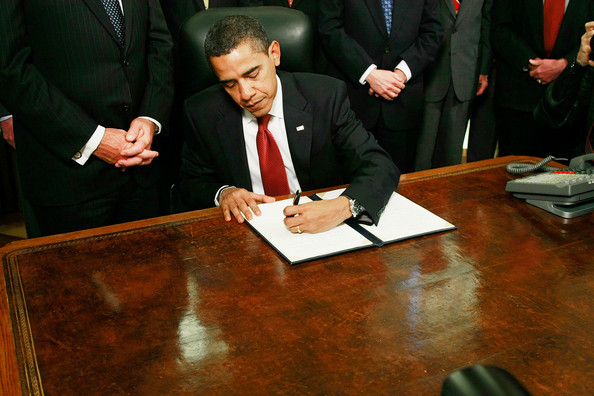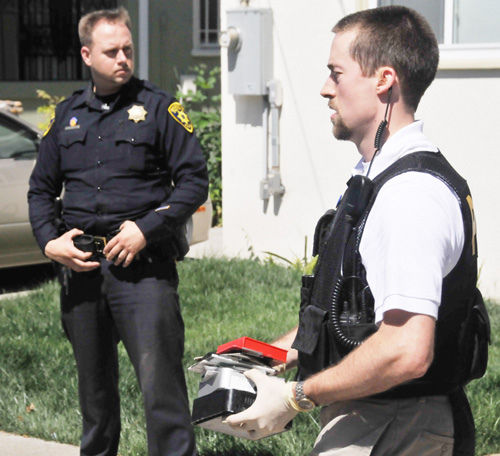
(Left) Tom Vanden Brook (on C-Span in 2010), a senior reporter for USA Today apparently targeted by a cyber-attack of misinformation and harassment. Photograph: guardiannews.com
In the case that the guilty party is found, and does indeed turn out to be one of the private firms that the Pentagon has hired to provide “information operations” for use in Afghanistan, what are the consequences likely to be?
To judge from the last known incident in which several government contractors were actually caught planning a far more sophisticated campaign of intimidation against yet another journalist, the consequences will not be so bad as to prevent others from doing the same thing. It’s easy enough, especially for those firms that are encouraged by their government clients to produce new and better ways by which to lie and discredit. And there’s money in it.
Early in 2011, four contracting firms with strong government ties – HBGary Federal, Palantir, Berico and Endgame Systems – decided to combine their capabilities and set up a high-end private info warfare unit called Team Themis. Bank of America asked them to write a proposal for a covert campaign against WikiLeaks. Aside from hacking the group’s European servers, the team raised the possibility of going after Salon contributor Glenn Greenwald, a prominent WikiLeaks supporter. “These are established professionals that have a liberal bent, but ultimately most of them if pushed will choose professional preservation over cause, such is the mentality of most business professionals,” wrote HBGary Federal CEO Aaron Barr. He resigned with a severance package a few weeks after the affair was exposed by Anonymous; soon afterwards, he got a new job with another government contractor.
What of the others? Berico simply broke ties with HBGary Federal, as if it were merely a bad influence. Endgame Systems, whose execs explicitly noted in internal emails that their government clients didn’t want its name appearing in a press release, was barely noted by the press at all – until, a few months later, Business Week discovered that their shyness may stem from the fact that they have the capability to take out West European airports via cyber attacks (if you’ve got a couple of million dollars to pay for that).
Palantir, which received seed money from the CIA’s investment arm, In-Q-Tel, and shares founders with PayPal, made a public apology to the effect that the cyber-plotting did not reflect the company’s values, and put one of the employees involved, Matthew Steckman, on leave. A few months later, when the press had lost interest, Palantir brought him back on. Nothing at all seems to have happened to another employee, Eli Bingham, who was also heavily involved. When Palantir throws its annual convention, it still attracts keynote speakers like former DHS Secretary Michael Chertoff – who happens to be on the board of another huge contractor, BAE Systems, which, in turn, happened to have done some business with HBGary Federal, as well.
To be fair, these sorts of companies provide valuable services to the US and its allies. For instance, when US Central Command (CentCom)needed software that would allow 50 of its information warfare people to pretend to be 500 entirely fake people who don’t exist outside the internet, it had the USAF put out a call for bids. A number of contractors were up for the job – including the ethically challenged HBGary Federal – but only one of them could actually win.
Perhaps the others can provide this sort of “persona management” capability to other, private clients with a need to discredit their enemies in a clandestine fashion. I can think of about a dozen journalists they might want to go after. The rest won’t be a problem.
In 2008, Congress enacted a statute that authorized the National Security Agency to carry out dragnet surveillance of Americans’ international communications. Almost four years later, the statute — called the FISA Amendments Act — has yet to be reviewed by the courts, and, if the Obama administration has its way, the courts are unlikely ever to review it. In February, the administration asked the Supreme Court to overturn acourt of appeals decision that would allow an ACLU challenge to the statute to go forward. Today we filed our brief in opposition, which asks the Supreme Court to let the appeals court’s decision stand.
As we explain in our brief, the statute gives the NSA extraordinary power:
[The FISA Amendments Act] allows the government to collect [Americans’ international communications] en masse without specifying the individuals or facilities to be monitored; without observing meaningful limitations on the retention, analysis, and dissemination of acquired information; without individualized warrants based on criminal or foreign intelligence probable cause; and without prior judicial or even administrative determinations that the targets of surveillance are foreign agents or connected in any way, however remotely, to terrorism.
We argue that the appeals court was right to rule that our plaintiffs have standing to challenge the statute, and we ask the Supreme Court to leave that ruling in place. We write:
In the end, what the government disguises as a narrow, technical argument about justiciability reveals itself to be this sweeping proposition: The courts have no meaningful role to play in protecting Americans’ international communications from wholesale government surveillance, or even in determining whether that surveillance is consistent with the Constitution. For sound strategic reasons, the government avoids stating the proposition forthrightly, but it is the inescapable consequence of the argument it advances. Nothing in this Court’s precedents countenances such a result.
The plaintiffs in the case include Amnesty International USA, the Global Fund for Women, Human Rights Watch, the International Criminal Defence Attorneys Association, The Nation Magazine, PEN American Center, Service Employees International Union, and the Washington Office on Latin America.
You can find more information about the FISA Amendments Act here, and more information about the case — called Clapper v. Amnesty International USA et al. —here.
It looks like the power of the IRS to revoke passports is merely a drop in the tyrannical bucket.
The Senate has voted to approve Bill 1813, which is now on its way to the House. The insidious bill has so many attacks on freedom that the most serious one has been largely overlooked.
There are two attacks on gun ownership in this bill. The text of the bill, all 1676 pages of it, can be found HERE.
The first attack on the right to bear arms is found on page 1323.
The Secretary may modify, suspend, or terminate a special permit or approval if the Secretary determines that—(1) the person who was granted the special permit or approval has violated the special permit or approval or the regulations issued under this chapter in a manner that demonstrates that the person is not fit to conduct the activity authorized by the special permit or approval; or (2) the special permit or approval is unsafe.
In the ambiguous language that the Congress so loves to employ in all things unconstitutional, we can translate that to the parental favorite, “Because I said so.”
The second attack on gun ownership is more subtle.
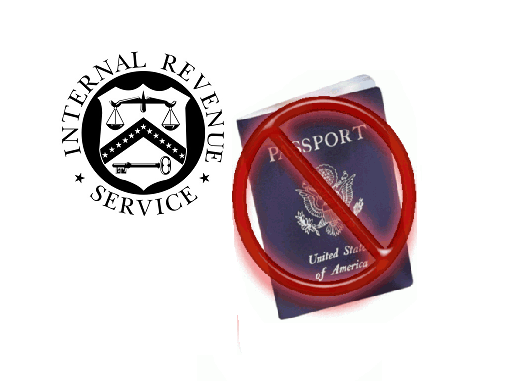
First, if this bill passes, the IRS will have the authority to take away the passports of those whom they say owe more than $50,000 in taxes. (The tax debt doesn’t have to be proven, mind you, the IRS simply has to accuse you of owing the money.) You can find this section on page 1447 of the Bill.
When your passport is revoked by the government, you are suddenly on the “no-fly list”.
Membership in the no-fly club puts you on yet another list, as a potential domestic terrorist.
Domestic terrorists are not allowed to have guns.
Don’t believe me? Listen to Raul Emanuel gloat of it. He eloquently states “If you are known as maybe a possible terrorist you cannot buy a handgun in America.” (1:13 of the video)
Emanuel, the Mayor of Chicago and former Obama Chief of Staff, makes the top of my personal treason list for this statement. In his own words, “maybe a possible terrorist” means you shouldn’t be allowed the rights guaranteed to you as an American. No proof necessary.
Bill 1813, ‘‘Moving Ahead for Progress in the 21st Century Act’’, is chock full of new ways to take away our personal freedoms. The bill would require “stalker boxes” on our vehicles, puts a huge number of restrictions on travel and transportation within the US, allows the government to revoke documents and licenses in ambiguous language and is, in essence, nearly 1700 pages of new restrictions. (You can find a summaryHERE if you don’t want to read all 1676 pages).
A Call to Action
Did your Senator vote for this bill? There’s a good chance he or she did, as only 22 Senators voted against it. You can find out how your senator voted HERE.
The bill was sponsored by Barbara Boxer (California) and co-sponsored by Max Baucus (Montana), James N. Inhofe (Oklahoma), and David Vitter (Louisiana). For your convenience, I’ve included links to the contact information for each of these Senators. Be sure and send an email to let them know how you feel about this new attack on freedom.
Email your Representatives and make it very clear that you consider this Bill an act of treason against the Constitution. This directory contains email addresses and contact information for all members of Congress.
Every bill that goes through Congress right now appears to hold another threat to the Constitution (if not multiple threats). Every word needs to be carefully analyzed so we can fight these attacks.
LOS ANGELES (CBS) — A bill authored by a Southland lawmaker that could potentially allow the federal government to prevent any Americans who owe back taxes from traveling outside the U.S. is one step closer to becoming law.
Senate Bill 1813 was introduced back in November by Senator Barbara Boxer (D-Los Angeles) to “reauthorize Federal-aid highway and highway safety construction programs, and for other purposes” .
After clearing the Senate on a 74 – 22 vote on March 14, SB 1813 is now headed for a vote in the House of Representatives, where it’s expected to encounter stiffer opposition among the GOP majority.
In addition to authorizing appropriations for federal transportation and infrastructure programs, the “Moving Ahead for Progress in the 21st Century Act” or “MAP-21″ includes a provision that would allow for the “revocation or denial” of a passport for anyone with “certain unpaid taxes” or “tax delinquencies”.
Section 40304 of the legislation states that any individual who owes more than $50,000 to the Internal Revenue Service may be subject to “action with respect to denial, revocation, or limitation of a passport”.
The bill does allow for exceptions in the event of emergency or humanitarian situations or limited return travel to the U.S., or in cases when any tax debt is currently being repaid in a “timely manner” or when collection efforts have been suspended.
However, there does not appear to be any specific language requiring a taxpayer to be charged with tax evasion or any other crime in order to have their passport revoked or limited — only that a notice of lien or levy has been filed by the IRS.
Boxer vowed last week to push House Republicans to pass the bipartisan transportation bill that would keep the Highway Trust Fund from going bankrupt.
“Thousands of businesses are at stake, and eventually we are talking about nearly three million jobs at stake,” she said in a statement. “There are many people on both sides of the aisle in the Senate who want to get our bill, MAP-21, passed into law, and I am going to do everything I can to keep the pressure on the Republican House to do just that.”
Glenn Greenwald has a horrifying look at the repeated harassment to which filmmaker Laura Poitras, who has made a series of powerful documentaries about the impact of the War on Terror, has been subject when she’s returned home to the United States from trips abroad:
She has had her laptop, camera and cellphone seized, and not returned for weeks, with the contents presumably copied. On several occasions, her reporter’s notebooks were seized and their contents copied, even as she objected that doing so would invade her journalist-source relationship. Her credit cards and receipts have been copied on numerous occasions. In many instances, DHS agents also detain and interrogate her in the foreign airport before her return, on one trip telling her that she would be barred from boarding her flight back home, only to let her board at the last minute. When she arrived at JFK Airport on Thanksgiving weekend of 2010, she was told by one DHS agent — after she asserted her privileges as a journalist to refuse to answer questions about the individuals with whom she met on her trip — that he “finds it very suspicious that you’re not willing to help your country by answering our questions.” They sometimes keep her detained for three to four hours (all while telling her that she will be released more quickly if she answers all their questions and consents to full searches).
Poitras is now forced to take extreme steps — ones that hamper her ability to do her work — to ensure that she can engage in her journalism and produce her films without the U.S. Government intruding into everything she is doing. She now avoids traveling with any electronic devices. She uses alternative methods to deliver the most sensitive parts of her work — raw film and interview notes — to secure locations. She spends substantial time and resources protecting her computers with encryption and password defenses. Especially when she is in the U.S., she avoids talking on the phone about her work, particularly to sources. And she simply will not edit her films at her home out of fear — obviously well-grounded — that government agents will attempt to search and seize the raw footage.
The New York Times did a wonderful interview with Poitras as part of its September 11 coverage last year:
Apparently, it’s threatening to set up a continuum of reactions to the War on Terror that includes both Americans’ emotional reactions to the physical reality of Ground Zero and opponents of the U.S. occupation who are running for office in Iraq. Or perhaps Poitras’s sin is suggesting that things like the wars in Iraq and Afghanistan torture and indefinite detention…”are the things that were not created on 9/11. Those are things that we chose.” Because if we chose them, we can roll them back.
Creating sympathy for people who are harmed by our actions and suggesting we take responsibility for our own are just some of the powerful things that art can do. But confusing ideas that are dangerous to your interests—for example, the suggestion that the huge growth of our security state haven’t reaped us tangible benefits and may in fact have done some damage—and dangerous to the country is a mistake intelligent people out to be ashamed to make. Greenwald points out that DHS concluded that their interrogations of Poitras had produced nothing of value, and yet continued to perform them. Maybe those agencies should answer some questions about what they expect to get next time around, and why harassing Poitras is a valuable use of their time. It’s a far milder query than the ones Poitras is being interrogated for posing.
(NaturalNews) The state of Michigan is only days away from engaging in what can only be called true “animal genocide” — the mass murder of ranch animals based on the color of their hair. It’s all part of a shocking new “Invasive Species Order” (ISO) put in place by Michigan’sDepartment of Natural Resources(DNR). This Invasive Species Order suddenly and shockingly defines virtually all open-range pigs raised by small family farms to be illegal “invasive species,” and possession of just one of these animals is now a felony crime in Michigan, punishable by up to four years in prison.
The state has said it will “destroy” these pigs beginning in April, potentially byraiding local farms with government-issued rifles, then shooting the pig herds while arresting the members of the family and charging them with the “crime” of raising pigs with the wrong hair color. This may truly be a state-sponsored serial animal killing spree.
Reality check: You may think this story is some kind of early April Fools prank, but it isn’t. This is factually true and verifiable through the documents, videos and websites linked below. The state of Michigan seriously intends to unleash amass murder spree of pigs of the wrong colorbeginning April 1.
Yet these are the very pigs that farmers and ranchers in Michigan have been raisingfor decades. The state doesn’t seem to care about this, and there are indications thatthis ISO may have been nudged into position by the conventional pork industryas a tactic to wipe out its competition of local, specialty ranching conducted by small families and dedicated farmers who don’t work for the big pork corporations. (The Michigan Pork Grower’s Association.)
Hear the shocking interview and watch the family farm video…
I have recorded an exclusive interview withMark BakerfromBaker’s Green Acres— one of many ranching operations threatened with total destruction by state bureaucrats and this new Invasive Species Order. Listen to that interview here: http://buzz.naturalnews.com/000025-Michigan-pigs-invasive_species.htm…
The Baker family has also recorded a video explaining their farming operation and how the state of Michigan is threatening to destroy their entire farming operation. Watch that stunning video (and spread the word about it) at: http://www.youtube.com/watch?v=843yH_0RMIA
Mark Baker, by the way, is a veteran of the United States Air Force. As a veteran of the U.S. armed forces, he served to protect the rights of others, yet he now finds his own rights and freedoms under assault by the state of Michigan. He told NaturalNews he is determined to protect his livelihood at all costs and to take a stand against tyranny in Michigan.
Got the wrong hair color? The state of Michigan will kill you
The state of Michigan has issued a document describing nine “traits” of what they call “feral pigs” which they claim should be destroyed on April 1.
Those traits includehaving the wrong color on the tip of the hairor evenbeing born with striped hair. The traits are written so that virtually all pigs raised by family ranchers across the state of Michigan will be targeted for destruction by the state of Michigan starting April 1. Farmers who defend their livestock may be arrested as felons and charged with multiple felony crimes by the state.
Michigan to destroy pigs based on the color of their hair – racial profiling for animal murder
Here’s some of the language from the Michigan document describing which animals are to be destroyed. Remember: For a pig to qualify as “feral” according to state tyrants, it only has to exhibit ONE of these traits, not all of them:
1) Bristle-tip coloration: exhibit bristle tips that are lighter in color (e.g., white, cream, or buff) than the rest of the hair shaft.
2) Dark point coloration: exhibits “points” (i.e., distal portions of the snout, ears, legs, and tail) that are dark brown to black in coloration, and lack light-colored tips on the bristles.
3) Coat coloration: exhibit a number of coat coloration patterns:solid black, solid red / brown, black and white spotted, black and red / brown spotted.
4) Underfur: exhibit the presence of underfur that is lighter in color (e.g., smoke gray to brown) than the overlying dark brown to black bristles/guard hairs.
5) Juvenile coat pattern: exhibit striped coat patterns — a light grayish-tan to brown base coat, with a dark brown to black spinal stripe and three to four brown irregular longitudinal stripes with dark margins along the length of the body.
6) Skeletal appearance: Structures include skull morphology, dorsal profile, and external body measurements including tail length, head-body length, hind foot length, ear length, snout length, and shoulder height.
7) Tail structure: Straight tails.
8) Ear structure: Erect ear structure.
9) “Other characteristics not currently known to the MDNR that are identified by the scientific community.”
Did you catch that last one? So now the so-called “scientific community” can simply invent whatever trait they want and the state of Michigan will legalize the mass murder of all ranch animals displaying that trait.
The state of Michigan plans to bring guns to destroy local food, local farms
What’s clear from all this is that Michigan bureaucrats plan to bring guns and handcuffs to ranches all across Michigan, shooting their family livestock dead and ruining their farming operations. They then plan to arrest these ranchers as felons and separate them from their families, then charge them with felony crimes.
This is all being done under the mantra of “government is good! Government protects you!” It’s being pushed under the guise of protecting people from “invasive species,” yet what the Michigan bureaucrats don’t tell anyone is that now your local food producers have had their own ranch animals placed on that list!
That’s the trick here: Michigan has declaredfarm animalsto be an invasive species!
An epic battle of truth, freedom and justice is being waged in Michigan
We need your help to defend farm freedom in Michigan and across the country. Here are some actions you can take:
4) DONATE to help support the legal fees of the Baker family farm. Their website is atwww.BakersGreenAcres.com
5) DEMAND farm freedom in your area! No government has the right to tell us what food we can or cannot grow, eat or trade! It’s as simple as that, and any government bureaucrat, tyrant or local dictator who thinks they can trample on your God-given right to choose what kind of food you wish to produce or consume is in desperate need of having a boot shoved deeply and forcefully up their rear ends.
Give tyrants the boot! Defend local farms. Even if you don’t eat pork (I don’t), this is still a farm freedom issue worth fighting for.
Update: I’ve clarified two aspects of this story below. First, Micro Systemation’s XRY tool often requires more than two minutes to crack the iPhone’s password. The two minutes I originally cited were a reference to the time shown in the video (now removed by Micro Systemation) below. Given that, as I originally wrote, the phone in the video used the simplest possible password (0000), the process often takes far longer.
Second, Micro Systemation had told me that XRY can gain access to phones that run the latest version of iOS. But in fact, it can only gain access to older iPhones and iPads running the latest version of the operating system, and can’t access the iPhone 4S or the iPad 2 or later. Apologies for this oversight.
Set your iPhone to require a four-digit passcode, and it may keep your private information safe from the prying eyes of the taxi driver whose cab you forget it in. But if law enforcement is determined to see the data you’ve stored on your smartphone, those four digits will slow down the process of accessing it as little as two minutes.
Here’s a video posted last week by Micro Systemation, a Stockholm, Sweden-based firm that sells law enforcement and military customers the tools to access the devices of criminal suspects or military detainees and siphon off their personal information.
Update: After this post brought widespread attention to Micro Systemation’s video, the company has removed it from YouTube.
As the video shows showed, a Micro Systemation application the firm calls XRY can quickly crack an iOS or Android phone’s passcode, dump its data to a PC, decrypt it, and display information like the user’s GPS location, files, call logs, contacts, messages, even a log of its keystrokes.
Mike Dickinson, the firm’s marketing director and the voice in its videos, says that the company sells products capable of accessing passcode-protected iOS and Android devices in over 60 countries. It supplies 98% of the U.K.’s police departments, for instance, as well as many American police departments and the FBI. Its largest single customer is the U.S. military. ”When people aren’t wearing uniforms, looking at mobile phones to identify people is quite helpful,” Dickinson says by way of explanation.
With smartphone adoption rocketing around the world, Dickinson says Micro Systemation’s “business is booming.” The small company has grown close to 25% in revenue year-over-year, earned $18 million in revenue in 2010 up from $12 million the year before, and doubled its employees since 2009.
“It’s a massive boom industry, the growth in evidence from mobile phones,” says Dickinson. “After twenty years or so, people understand they shouldn’t do naughty things on their personal computers, but they still don’t understand that about phones. From an evidential point of view, it’s of tremendous value.”
“If they’ve done something wrong,” he adds.
XRY works much like the jailbreak hacks that allow users to remove the installation restrictions on their devices, Dickinson says, though he wouldn’t say much about the exact security vulnerability that XRY exploits to gain access to the iPhone. He claims that the company doesn’t use backdoor vulnerabilities in the devices created by the manufacturer, but rather seeks out security flaws in the phone’s software just as jailbreakers do, one reason why half the company’s 75 employees are devoted to research and development. “Every week a new phone comes out with a different operating sytems and we have to reverse engineer them,” he says. “We’re constantly chasing the market.”
Update: Mike Dickinson has clarified that Micro Systemation’s XRY tool doesn’t support the iPhone 4S, iPad 2 or iPad 3. It does, however, support the latest version of Apple’s iOS operating system, so he says that older devices that have the latest software installed are still vulnerable.
After bypassing the iPhone’s security restrictions to run its code on the phone, the tool “brute forces” the phone’s password, guessing every possible combination of numbers to find the correct code, as Dickinson describes it. In the video above, the process takes seconds. (Although admittedly, the phone’s example passcode is “0000″, about the most easily-guessed password possible.)
Dicksinson acknowledges that users who set longer passcodes for devices can in fact make the devices far tougher to crack. “The more complex the password, the longer and harder it’s going to be to access the phone,” he says. “In some cases, it takes so long to brute force that it’s not worth doing it.” That may have been the situation, for instance, in one recent case involving the phone of Dante Dears, a paroled convict accused of running a prostitution ring known as “Pimping Hoes Daily” from his Android phone; The FBI, apparently unable or unwilling to crack the phone, asked Google to help in accessing it.
“A mere demarcation on parchment of the constitutional limits (of government) is not a sufficient guard against those encroachments which lead to a tyrannical concentration of all the powers of government in the same hands.” – James Madison, Federalist Paper #48, 1788.
President Obama signed an Executive Order for “National Defense” yesterday that claims executive authority to seize all US resources and persons, including during peacetime, for self-declared “national defense.”
The EO claims power to place any American into military or “allocated” labor use (analysis here and here).
“American exceptionalism” is the belief that a 200+ year-old parchment in the National Archives has magical powers to somehow guarantee limited government from 1% tyranny, despite the specific and clear warnings of the US Founders, despite world history of repeated oligarchic/1% tyranny claiming to be for the “good of the people,” and despite US history’s descent into vicious psychopathy (short version here: US war history in 2 minutes) hidden in plain view with paper-thin corporate media propaganda.
I don’t know about you, but both my grandfathers were in the US military during the gruesome WW1. My father, father-in-law, and only uncle were in a brutal WW2. Both wars were functions of colonialism; a 1%’s vicious and rapacious greed.
I don’t know about you, but I’m teaching the obvious crimes in war and money, destruction of Constitutional Rights rights (see specific links below), and asking students (of all ages) what they see to do about these clear facts. The first answer people see is to help people get over their “American exceptionalism” to recognize these massive crimes, and demand arrests of the obvious criminal “leadership.”
I don’t know about you, but I refuse to be silent in face of lying and criminal government policies that annually murder millions, harm billions, and loot trillions of the 99%’s dollars.
What will you do?
Here is the US government claiming it can Constitutionally assassinate Americans upon the non-reviewable dictate of the leader, as these criminals take psychopathic steps to murder Americans who expose their crimes.
Here is NDAA 2012 where US government claims it can Constitutionally disappear Americans and then appoint a tribunal with death sentence authority (unless unlimited detention is their choice). Here is the 2006 Military Commissions Act that says the same. This is fascist terrorism to silence Americans from communicating that the 1% are War Criminals to arrest NOW.
Here is US government claiming it can Constitutionally control-drown (waterboard) anyone they declare a “terrorist” as a 1% terror-tactic to silence Americans.
The Arizona legislature passed Arizona House Bill 2549, which would update the state’s telephone harassment law to apply to the Internet and other electronic communications. The bill is sweepingly broad, and would make it a crime to communicate via electronic means speech that is intended to “annoy,” “offend,” “harass” or “terrify,” as well as certain sexual speech. Because the bill is not limited to one-to-one communications, H.B. 2549 would apply to the Internet as a whole, thus criminalizing all manner of writing, cartoons, and other protected material the state finds offensive or annoying. The Bill is currently on Governor Jan Brewer’s desk awaiting her decision on whether to veto or sign the bill.
Media Coalition, a trade association protecting the First Amendment rights of content industries, whose membership includes CBLDF, has been active in opposing the bill. On March 14, Media Coalition sent a memo to the Senate Rules Committee regarding constitutional infirmities in H.B. 2549. Yesterday they sent a letter to Governor Brewer urging her to veto the bill.
That letter outlines the constitutional deficiencies in the bill:
H.B. 2549 would make it a crime to use any electronic or digital device to communicate using obscene, lewd or profane language or to suggest a lewd or lascivious act if done with intent to “annoy,” “offend,” “harass” or “terrify.” The legislation offers no definitions for “annoy,” “offend,” “harass” or “terrify.” “Electronic or digital device” is defined only as any wired or wireless communication device and multimedia storage device. “Lewd” and “profane” are not defined in the statute or by reference. “Lewd” is generally understood to mean lusty or sexual in nature and “profane” is generally defined as disrespectful or irreverent about religion or religious practices.
Government may criminalize speech that rises to the level of harassment and many states have laws that do so, but this legislation takes a law meant to address irritating phone calls and applies it to communication on web sites, blogs, listserves and other Internet communication. H.B. 2549 is not limited to a one to one conversation between two specific people. The communication does not need to be repetitive or even unwanted. There is no requirement that the recipient or subject of the speech actually feel offended, annoyed or scared. Nor does the legislation make clear that the communication must be intended to offend or annoy the reader, the subject or even any specific person.
Speech protected by the First Amendment is often intended to offend, annoy or scare but could be prosecuted under this law. A Danish newspaper posted pictures of Muhammad that were intended to be offensive to make a point about religious tolerance. If a Muslim in Arizona considers the images profane and is offended, the paper could be prosecuted. Some Arizona residents may consider Rush Limbaugh’s recent comments about a Georgetown law student lewd. He could be prosecuted if he intended his comments to be offensive. Similarly, much general content available in the media uses racy or profane language and is intended to offend, annoy or even terrify. Bill Maher’s stand up routines and Jon Stewart’s nightly comedy program, Ann Coulter’s books criticizing liberals and Christopher Hitchens’ expressing his disdain for religion, Stephen King’s novels or the Halloween films all could be subject to this legislation. Even common taunting about sports between rival fans done online is frequently meant to offend or annoy and is often done using salty and profane language.
While protecting people from harassment is a worthy goal, legislators cannot do so by criminalizing speech protected by the Constitution. All speech is presumptively protected by the First Amendment against content-based regulation, subject only to specific historic exceptions.
If passed, the law could create vulnerabilities for cartoonists and publishers who publish material online intended to shock, satirize, and criticize. Beyond the example of the Mohammad cartoons listed in the Media Coalition letter, the taboo-pushing work of cartoonists like R. Crumb, Johnny Ryan, and Ivan Brunetti would potentially be vulnerable to prosecution, as could incendiary works such as Frank Miller’s Holy Terror and Dave Sim’s Cerebus. Similarly, the culture of message boards, within and beyond comics, would be imperiled. With more titles released digitally each week, and an extremely active online ecosystem of professional and fan exchange, laws like this one are extremely worrisome for the creators, publishers, and readers of comics.
For more information about this bill, please visit Media Coalition.
Charles Brownstein is the Executive Director for Comic Book Legal Defense Fund
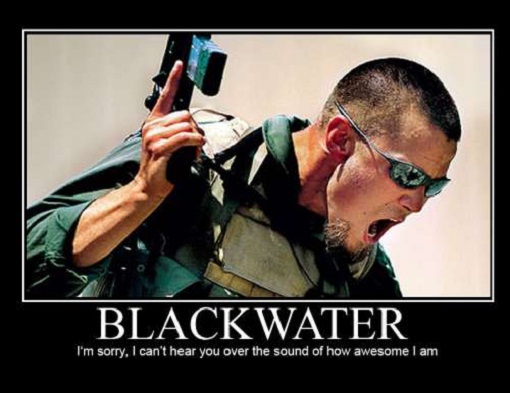
The April 2012 issue of Harper’s Magazine includes “The Warrior Class,” a feature by Charles Glass on the rise of private-security contractors since 9/11. The conclusion to the piece describes a series of videos shown to Glass by a source who had worked for the private-security company Blackwater (now Academi, formerly also Xe Services) in Iraq. Clips and photos from the videos are shown below, introduced by Glass’s descriptions:
The first , identified as “Baghdad, Iraq, May–September 2005,” showed Blackwater convoys racing through town. Suddenly, the door of a Blackwater SUV opened and a rifle fired at passing traffic. “They opened the door,” my companion said. “You should never break the seal.”
A still photo showed some graffiti scrawled on a metal beam: THIS IS FOR THE AMERICANS OF BLACKWATER THAT WERE MURDERED HERE IN 2004 SEMPER FIDELIS 3/5 PS FUCK YOU.
The next tape had been taken by a camera in the turret of an armored vehicle. An [M4A1]11. Corrected text. The gun was initially misidentified as an AK47.
fired from the turret at cars that had stopped to let the convoy pass. Whoever was firing the [gun] did so enthusiastically and often, sending rounds into parked cars and an overhead bridge. Another sequence showed a contractor vehicle rear-ending a car, shattering its back windshield.
The footage continued. A Humvee smashed into a car to move it out of the way. Guards swore at passersby. More armored vehicles smashed into civilian cars.
But what about the tape dated April 1, 2006, which was shot from the front seat of the fourth car in an armored convoy? Driving along a wide boulevard in Baghdad, the lead vehicle swerved close to the curb of a traffic island. A woman in a black full-length burka began to cross the street. The vehicle struck the woman and knocked her unconscious body into the gutter. The cars slowed for a moment, but did not stop, nor did they even determine whether the victim was dead or alive. A voice in the car taking the video said, “Oh, my God!” Yet no one was heard on the radio requesting help for her. Most sickeningly, the sequence had been set to an AC/DC song, whose pounding, metallic chorus declared: “You’ve been… thunderstruck!”
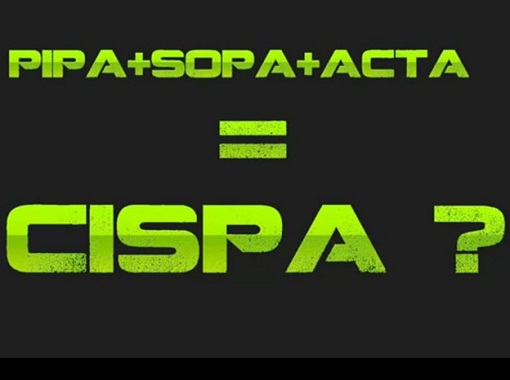
The Cyber Intelligence Sharing and Protection Act (CISPA) is quickly becoming the Internet’s new most-hated piece of legislation. But is it really “the new SOPA,” as critics are calling it? Here, a comprehensive rundown of what CISPA is, what it does, and why people think it’s dangerous.
The Internet has a new enemy. The Cyber Intelligence Sharing and Protection Act of 2011 (CISPA), also known as H.R. 3523, is a “cybersecurity” bill in the House of Representatives. CISPA is quickly gaining traction as “the new SOPA,” the infamous anti-piracy bill that was forced to crawl back into its hole after thousands of websites and millions of Web users protested with a massive, high-profile “blackout.” While CISPA does not focus primarily on intellectual property (though that’s in there, too), critics say the problems with the bill run just as deep. But what is CISPA, really, and will its presence on Congress’ agenda cause the same type of online revolt that SOPA and PIPA did?
What is CISPA?
Unveiled to the House by Rep. Mike Rogers (R-MI) and Rep. C.A. “Dutch” Ruppersberger (D-MD) late last year, CISPA is described as a “cybersecurity” bill. It proposes to amend the National Security Act of 1947 to allow for greater sharing of “cyber threat intelligence” between the U.S. government and the private sector, or between private companies. The bill defines “cyber threat intelligence” as any information pertaining to vulnerabilities of, or threats to, networks or systems owned and operated by the U.S. government, or U.S. companies; or efforts to “degrade, disrupt, or destroy” such systems or networks; or the theft or “misappropriation” of any private or government information, including intellectual property.
CISPA also removes any liability from private companies who collect and share qualified information with the federal government, or with each other. Finally, it directs the Privacy and Civil Liberties Oversight Board to conduct annual reviews of the sharing and use of the collected information by the U.S. government.
Read the full text of CISPA here, or the full official summary at the bottom of this page.
Who supports CISPA?
The bill currently has a whopping 106 co-sponsors in the House — more than twice the number SOPA ever had. Also unlike SOPA, CISPA has explicit support from some of the technology industry’s biggest players, including Internet service providers like AT&T and Verizon, Web companies like Facebook, and hardware companies like IBM and Intel.
See the full list of CISPA co-sponsors here. See a complete list of companies and groups that support CISPA here.
What CISPA supporters say it will do
According to Rep. Rogers, CISPA will help U.S. companies defend themselves “from advanced cyber threats, without imposing any new federal regulations or unfunded private sector mandate.” It will also create “new private sector jobs for cybersecurity professionals,” and protect “the thousands of jobs created by the American intellectual property that Chinese hackers are trying to steal every day.”
In a statement, Rep. Ruppersberger pushed his reasons for proposing the legislation, saying, “Without important, immediate changes to American cybersecurity policy, I believe our country will continue to be at risk for a catastrophic attack to our nation’s vital networks — networks that power our homes, provide our clean water or maintain the other critical services we use every day. This small but important piece of legislation is a decisive first step to tackle the cyber threats we face.”
Private companies like the bill because it removes some of the regulations that prevent them from sharing cyber threat information, or make it harder to do so. In short, they believe the bill will do exactly what its supporters in the House say it will do — help better protect them from cyber attacks.
What CISPA opponents are worried about
As with SOPA and PIPA, the first main concern about CISPA is its “broad language,” which critics fear allows the legislation to be interpreted in ways that could infringe on our civil liberties. The Center for Democracy and Technology sums up the problems with CISPA this way:
• The bill has a very broad, almost unlimited definition of the information that can be shared with government agencies notwithstanding privacy and other laws;
• The bill is likely to lead to expansion of the government’s role in the monitoring of private communications as a result of this sharing;
• It is likely to shift control of government cybersecurity efforts from civilian agencies to the military;
• Once the information is shared with the government, it wouldn’t have to be used for cybesecurity, but could instead be used for any purpose that is not specifically prohibited.
The Electronic Frontier Foundation (EFF) adds that CISPA’s definition of “cybersecurity” is so broad that “it leaves the door open to censor any speech that a company believes would ‘degrade the network.’” Moreover, the inclusion of “intellectual property” means that companies and the government would have “new powers to monitor and censor communications for copyright infringement.”
Furthermore, critics warn that CISPA gives private companies the ability to collect and share information about their customers or users with immunity — meaning we cannot sue them for doing so, and they cannot be charged with any crimes.
According to the EFF, CISPA “effectively creates a ‘cybersecurity’ exemption to all existing laws.”
“There are almost no restrictions on what can be collected and how it can be used, provided a company can claim it was motivated by ‘cybersecurity purposes,’” the EFF continues. “That means a company like Google, Facebook, Twitter, or AT&T could intercept your emails and text messages, send copies to one another and to the government, and modify those communications or prevent them from reaching their destination if it fits into their plan to stop cybersecurity threats.”
Is the Internet freaking out like it did over SOPA/PIPA?
Not yet — but it’s starting to. After TechDirt’s Mike Masnick — a widely followed and trusted source on matters of laws regarding technology, intellectual property, and how they might affect our civil rights — posted an article telling readers to “forget SOPA, you should be worried about this cybersecurity bill” earlier this week, concerned Web users have started to take notice. On Reddit, a community that is largely responsible for the push-back against SOPA/PIPA, an increasing number of posts (some accurate, some not) have popped up regarding the potential dangers of CISPA. Anonymous has also started to get in on the action, having released a “dox” on Rep. Rogers, and a video condemning the bill, earlier this week.
Will CISPA pass?
Nobody can say for sure, but at the moment, its passage looks likely. CISPA breezed through the House Intelligence Committee on December 1, 2011, with a bipartisan vote of 17-1. Also, as mentioned, the bill has broad support in the House, with 106 co-sponsors, 10 of whom are committee chairmen.
As with any piece of legislation, however, nothing is certain until the president signs the bill. And if the Internet community rises up in the same way it did against SOPA and PIPA, then you will certainly see support for CISPA crumble in Congress (it is an election year, after all). That said, whether or not the Internet will react with such force remains a big “if.”
Conclusion
Regardless of the value of CISPA, cyber threats are a real and serious problem, one that the U.S. government will address through legislative means. Civil liberty watchdogs are always going to be wary of any bill that could possibly threaten our privacy, or put us at the mercy of corporations and the federal government. However, CISPA does have all the problems critics claim it has, and Web users should be paying critical attention to the bill.
Remember: opposing this particular bill, or others with similar problems, is not the same as a disregard for our cybersecurity, or national security — which is precisely how CISPA supporters in Congress will attempt to frame the opposition, if or when it gathers steam.
The Cyber Intelligence Sharing and Protection Act (CISPA) is quickly becoming the Internet’s new most-hated piece of legislation. But is it really “the new SOPA,” as critics are calling it? Here, a comprehensive rundown of what CISPA is, what it does, and why people think it’s dangerous.
The Internet has a new enemy. The Cyber Intelligence Sharing and Protection Act of 2011 (CISPA), also known as H.R. 3523, is a “cybersecurity” bill in the House of Representatives. CISPA is quickly gaining traction as “the new SOPA,” the infamous anti-piracy bill that was forced to crawl back into its hole after thousands of websites and millions of Web users protested with a massive, high-profile “blackout.” While CISPA does not focus primarily on intellectual property (though that’s in there, too), critics say the problems with the bill run just as deep. But what is CISPA, really, and will its presence on Congress’ agenda cause the same type of online revolt that SOPA and PIPA did?
What is CISPA?
Unveiled to the House by Rep. Mike Rogers (R-MI) and Rep. C.A. “Dutch” Ruppersberger (D-MD) late last year, CISPA is described as a “cybersecurity” bill. It proposes to amend the National Security Act of 1947 to allow for greater sharing of “cyber threat intelligence” between the U.S. government and the private sector, or between private companies. The bill defines “cyber threat intelligence” as any information pertaining to vulnerabilities of, or threats to, networks or systems owned and operated by the U.S. government, or U.S. companies; or efforts to “degrade, disrupt, or destroy” such systems or networks; or the theft or “misappropriation” of any private or government information, including intellectual property.
CISPA also removes any liability from private companies who collect and share qualified information with the federal government, or with each other. Finally, it directs the Privacy and Civil Liberties Oversight Board to conduct annual reviews of the sharing and use of the collected information by the U.S. government.
Read the full text of CISPA here, or the full official summary at the bottom of this page.
Who supports CISPA?
The bill currently has a whopping 106 co-sponsors in the House — more than twice the number SOPA ever had. Also unlike SOPA, CISPA has explicit support from some of the technology industry’s biggest players, including Internet service providers like AT&T and Verizon, Web companies like Facebook, and hardware companies like IBM and Intel.
See the full list of CISPA co-sponsors here. See a complete list of companies and groups that support CISPA here.
What CISPA supporters say it will do
According to Rep. Rogers, CISPA will help U.S. companies defend themselves “from advanced cyber threats, without imposing any new federal regulations or unfunded private sector mandate.” It will also create “new private sector jobs for cybersecurity professionals,” and protect “the thousands of jobs created by the American intellectual property that Chinese hackers are trying to steal every day.”
In a statement, Rep. Ruppersberger pushed his reasons for proposing the legislation, saying, “Without important, immediate changes to American cybersecurity policy, I believe our country will continue to be at risk for a catastrophic attack to our nation’s vital networks — networks that power our homes, provide our clean water or maintain the other critical services we use every day. This small but important piece of legislation is a decisive first step to tackle the cyber threats we face.”
Private companies like the bill because it removes some of the regulations that prevent them from sharing cyber threat information, or make it harder to do so. In short, they believe the bill will do exactly what its supporters in the House say it will do — help better protect them from cyber attacks.
What CISPA opponents are worried about
As with SOPA and PIPA, the first main concern about CISPA is its “broad language,” which critics fear allows the legislation to be interpreted in ways that could infringe on our civil liberties. The Center for Democracy and Technology sums up the problems with CISPA this way:
• The bill has a very broad, almost unlimited definition of the information that can be shared with government agencies notwithstanding privacy and other laws;
• The bill is likely to lead to expansion of the government’s role in the monitoring of private communications as a result of this sharing;
• It is likely to shift control of government cybersecurity efforts from civilian agencies to the military;
• Once the information is shared with the government, it wouldn’t have to be used for cybesecurity, but could instead be used for any purpose that is not specifically prohibited.
The Electronic Frontier Foundation (EFF) adds that CISPA’s definition of “cybersecurity” is so broad that “it leaves the door open to censor any speech that a company believes would ‘degrade the network.’” Moreover, the inclusion of “intellectual property” means that companies and the government would have “new powers to monitor and censor communications for copyright infringement.”
Furthermore, critics warn that CISPA gives private companies the ability to collect and share information about their customers or users with immunity — meaning we cannot sue them for doing so, and they cannot be charged with any crimes.
According to the EFF, CISPA “effectively creates a ‘cybersecurity’ exemption to all existing laws.”
“There are almost no restrictions on what can be collected and how it can be used, provided a company can claim it was motivated by ‘cybersecurity purposes,’” the EFF continues. “That means a company like Google, Facebook, Twitter, or AT&T could intercept your emails and text messages, send copies to one another and to the government, and modify those communications or prevent them from reaching their destination if it fits into their plan to stop cybersecurity threats.”
Is the Internet freaking out like it did over SOPA/PIPA?
Not yet — but it’s starting to. After TechDirt’s Mike Masnick — a widely followed and trusted source on matters of laws regarding technology, intellectual property, and how they might affect our civil rights — posted an article telling readers to “forget SOPA, you should be worried about this cybersecurity bill” earlier this week, concerned Web users have started to take notice. On Reddit, a community that is largely responsible for the push-back against SOPA/PIPA, an increasing number of posts (some accurate, some not) have popped up regarding the potential dangers of CISPA. Anonymous has also started to get in on the action, having released a “dox” on Rep. Rogers, and a video condemning the bill, earlier this week.
Will CISPA pass?
Nobody can say for sure, but at the moment, its passage looks likely. CISPA breezed through the House Intelligence Committee on December 1, 2011, with a bipartisan vote of 17-1. Also, as mentioned, the bill has broad support in the House, with 106 co-sponsors, 10 of whom are committee chairmen.
As with any piece of legislation, however, nothing is certain until the president signs the bill. And if the Internet community rises up in the same way it did against SOPA and PIPA, then you will certainly see support for CISPA crumble in Congress (it is an election year, after all). That said, whether or not the Internet will react with such force remains a big “if.”
Conclusion
Regardless of the value of CISPA, cyber threats are a real and serious problem, one that the U.S. government will address through legislative means. Civil liberty watchdogs are always going to be wary of any bill that could possibly threaten our privacy, or put us at the mercy of corporations and the federal government. However, CISPA does have all the problems critics claim it has, and Web users should be paying critical attention to the bill.
Remember: opposing this particular bill, or others with similar problems, is not the same as a disregard for our cybersecurity, or national security — which is precisely how CISPA supporters in Congress will attempt to frame the opposition, if or when it gathers steam.
Cop Block is a decentralized project supported by a diverse group of individuals united by their shared goal of police accountability.
We highlight the double standard that some grant to those with badges by pointing to and supporting those harmed. By documenting police actions whether they are illegal, immoral or just a waste of time and resources then putting direct pressure on the individuals responsible (ideally while recording and then later sharing), we can work together to bring about transparency and have a real impact.
CopBlock.org is a resource for the education of individual rights through the dissemination of different viewpoints and tactics that seek to curtail the all-too-common rights-violations and unaccountability that today exists.
For more, check out CopBlock.org: FAQs – a document that addresses some of the most commonly-asked questions about CopBlock.org. It was drafted by contributors Pete Eyre and Ademo Freeman and, as CopBlock.org is decentralized, does not speak for all those involved.
This video, An Open Message to Police & Military puts it succinctly:
(NaturalNews) NaturalNews exclusive report, please credit with link. NaturalNews can now report that 65-year-old senior citizen James Stewart, a raw milk farmer with no criminal history, was nearly tortured to death in the LA County jail this past week. He survived a “week of torturous Hell” at the hands of LA County jail keepers who subjected him to starvation, sleep deprivation, hypothermia, loss of blood circulation to extremities, verbal intimidation, involuntary medical testing and even subjected him to over 30 hours of raw biological sewage filth containing dangerous pathogens.
This is from a county that has targeted and terrorized James Stewart for the supposed crime of selling fresh milk containing “dangerous pathogens.” That’s right – the only “crime” James has ever committed is being the milk man and distributing milk that is openly and honestly kept fresh and raw instead of pasteurized. So as part of his punishment of advocating raw cow’s milk, he was tortured with raw human sewage at the LA County jail.
This true story of jaw-dropping dehumanization and torture — conducted in total violation of state law as well as the Geneva Convention for prisoners of war — is told in an exclusive audio interview recorded today between Mike Adams and James Stewart.
That audio recording, which has been released by Adams into the public domain for the purpose of widespread copying and sharing, is available for download at the following links:
128kbps MP3 file (47MB, Hi-Fi, suitable for posting online):
Adams openly encourages members of the public to post these files on YouTube, Vimeo, bittorrent sites and anywhere else where they may reach the public.
“I thought I was gonna die in there…”
In this exclusive interview, you can hear James Stewart describe, in his own words, the shocking details of prisoner abuse right here in America. Among the highlights from his interview with Mike Adams:
• How James was subjected to severe food deprivation.
• How he was interrogated by deputies and accused of being a “sovereign,” then branded with a red arm band (Nazi-style) to falsely indicate that he was a danger to the general population.
• How James was shackled in long chains wrapped around his waist multiple times, then had his hands cuffed behind his back which was bound to the heavy waist chain to restrict his movement. His handcuffs were so tight he thought his wrists would break.
• James was then handcuffed to a cold bench, restricting his movement to just six inches, then left on the bench for 4-5 hours.
• James was then forcibly subjected to various medical tests, including forced chest X-rays even while he was handcuffed.
• He was placed in a cold cell wearing only a T-shirt and pants, where he soon began to suffer from hypothermia and found himself violently shivering just to stay alive.
• How he was made to suffer through total sleep deprivation all night long as other prisoners were screaming and banging on the walls.
• His cell was then flooded with raw human sewage, which flowed into his jail cell 2-3 inches deep, covering his shoes and shirt. LA County jail guards then ordered James to clean up all the raw sewage in his cell by handing him a small hand-held squeegee and demanding that he squeegee out all the raw sewage himself (which he reluctantly did).
• He was then forced to stay in the putrid raw sewage cell for over 30 hours, fighting off nausea and living in bacteriological filth that threatened his health.
• All along, the LA County prison guards gloated over their treatment of prisoners while laughing and joking about their power to subject prisoners to such abuse. This behavior openly mimics that of Gitmo guards who took pictures gloating over their torture and murder of prisoners of war.
• During this entire process, James was not allowed a single phone call nor any visit from an attorney. His right to speak to an attorney was repeatedly denied.
• At no point was James notified of what he was being charged with. He was never presented with an arrest warrant nor were any charges explained to him.
• James was mysteriously “lost” in the system and LA County officials claimed they did not know where he was. This was apparently a deliberate attempt to subject an individual to drawn-out torture without legal representation and make sure no one could locate them to check on their health or arrest status.
“Worse than torture… They’re actually torturing you mentally and physically to break you down…”
These are the actual words of James Stewart that you will hear in this interview:
• “I thought I was gonna die in there.”
• “It was worse than torture. They’re actually torturing you mentally and physically to break you down.”
• “I wrote the ‘torture’ on a piece of toilet paper to try to tell everybody what I had gone through, because I was worried they were going to mentally break me and put me in a psych ward.”
• “What I experienced in downtown LA was brutality.”
• “It’s trauma. And they create this thing where you’re not even sure what’s coming next. What has this country come to? I don’t sleep well at night right now, and I don’t think anyone would if they had been what I’ve been through.”
• “I’m shocked that this is America. Because it seems like you’re in some third world country, in a gulag, like in the movie Midnight Express, where you’re absolutely just tortured. That was the experience I had. Your mind goes, how can this be? This is America?”
NaturalNews calls on Amnesty International, ACLU to intervene
What we are witnessing here is a gross violation of civil rights and human rights, not to mention fundamental due process. The treatment unleashed upon James was not merely against the law in California, it was also a violation of federal law and a violation of the Geneva Convention and its ban on torturing prisoners of war.
“What happened to Stewart is horrendous,” health freedom attorney Jonathan Emord told NaturalNews. He’s the author of the new book “Restore the Republic” which lays out a plan to overthrow tyranny and restore a government that works on behalf of the people instead of declaring the People to be the enemy.
The bail amount set for James ($1 million) and the torture to which he was subjected clearly indicate that James Stewart is a political prisoner of the State of California, which has decided to spend millions of dollars in taxpayer money to target and incarcerate a senior citizen farmer. (By comparison, bail for alleged child rapist and sex pimp Jerry Sandusky, former Penn State sports coach, was only set at $100,000 and was unsecured!)
NaturalNews calls upon Amnesty International and the American Civil Liberties Union to intervene in this extraordinary violation of basic human rights. For the record, James Stewart has no criminal record and is a permaculture farmer and fresh food advocate. His “crime” consists entirely of arranging for the distribution of raw milk to customers who actually line up to access this nourishing food (people love it!).
NaturalNews has no financial ties to James Stewart nor Rawesome Foods and has been the leading source of free press information covering this story. The mainstream media so far refuses to cover this story, most likely out of financial loyalty to the conventional (processed) dairy industry which stands to lose tens of millions of dollars if raw milk is allowed to be openly and legally sold.
Assistance efforts for James Stewart and Sharon Palmer, the other person arrested in this case, can be emailed to:
In addition, NaturalNews has forwarded details to producers of the Alex Jones Show with the hope that Alex Jones will want to cover this for his own audience (www.InfoWars.com).
Information is also being forwarded to the Ron Paul campaign, as Ron Paul has openly spoken out against the absurdity of laws targeting raw milk producers. As Paul is extremely busy running for President, however, he is unlikely to be able to comment on this particular issue.
Tips have been forwarded to Matt Drudge for his consideration of the issue.
NaturalNews.com continues to be the breaking news source on this story with a voice of liberty and food freedom. Check NaturalNews.com for more details this weekend and all next week.
Action items:
• SHARE this story on Twitter, Facebook, LinkedIn and other social networks. You also have permission to download and share the audio files and video files of the interview. Post it on every bittorrent in the known universe…
• Contact your local newspaper editors with letters and opinion pieces to express your outrage at this vindictive arrest and torture of a California farmer.
• Write the officer of Governor Jerry Brown, who has done absolutely nothing to stop this outrageous abuse of California’s by rogue DA operatives in both LA and Ventura counties:
Japanese researchers have created a hand-held gun (pictured above) that can jam the words of speakers who are more than 30 meters (100ft) away. The gun has two purposes, according to the researchers: At its most basic, this gun could be used in libraries and other quiet spaces to stop people from speaking — but its second application is a lot more chilling.
The researchers were looking for a way to stop “louder, stronger” voices from saying more than their fair share in conversation. The paper reads: “We have to establish and obey rules for proper turn-taking when speaking. However, some people tend to lengthen their turns or deliberately interrupt other people when it is their turn in order to establish their presence rather than achieve more fruitful discussions. Furthermore, some people tend to jeer at speakers to invalidate their speech.” In other words, this speech-jamming gun was built to enforce “proper” conversations.
The gun works by listening in with a directional microphone, and then, after a short delay of around 0.2 seconds, playing it back with a directional speaker. This triggers an effect that psychologists call Delayed Auditory Feedback (DAF), which has long been known to interrupt your speech (you might’ve experienced the same effect if you’ve ever heard your own voice echoing through Skype or another voice comms program). According to the researchers, DAF doesn’t cause physical discomfort, but the fact that you’re unable to talk is obviously quite stressful.
Suffice it to say, if you’re a firm believer in free speech, you should now be experiencing a deafening cacophony of alarm bells. Let me illustrate a few examples of how this speech-jamming gun could be used.
At a political rally, an audience member could completely lock down Santorum, Romney, Paul, or Obama from speaking. On the flip side, a totalitarian state could point the speech jammers at the audience to shut them up. Likewise, when a celebrity or public figure appears on a live TV show, his contract could read “the audience must be silenced with speech jammers.”
Then there’s Harrison Bergeron, one of my favorite short stories by Kurt Vonnegut. In the story’s dystopian universe, everyone wears “handicaps” to ensure perfect social equality. Strong people must lug around heavy weights, beautiful people must wear masks, and intelligent people must wear headphones that play a huge blast of sound every few seconds, interrupting your thoughts. The more intelligent you are, the more regular the blasts.
Back here in our universe, it’s not hard to imagine a future where we are outfitted with a variety of implanted electronics or full-blown bionic organs. Just last week we wrote about Google’s upcoming augmented-reality glasses, which will obviously have built-in earbuds. Late last year we covered bionic eyes that can communicate directly with the brain, and bionic ears and noses can’t be far off.
In short, imagine if a runaway mega-corporation or government gains control of these earbuds. Not only could the intelligence-destroying blasts from Harrison Bergeron come to pass, but with Delayed Auditory Feedback it would be possible to render the entire population mute. Well, actually, that’s a lie: Apparently DAF doesn’t work with utterances like “ahhh!” or “boooo!” or other non-wordy constructs. So, basically, we’d all be reduced to communicating with grunts and gestures.
Another international conflict, another horrific taxpayer-funded sex scandal for DynCorp, the private security contractor tasked with training the Afghan police.
While the company is officially based in the DC area, most of its business is managed on a satellite campus at Alliance Airport north of Fort Worth. And if one of the diplomatic cables from the WikiLeaks archive is to be believed, boy howdy, are their doings in Afghanistan shady.
The Afghanistan cable (dated June 24, 2009) discusses a meeting between Afghan Interior Minister Hanif Atmar and US assistant ambassador Joseph Mussomeli. Prime among Atmar’s concerns was a party partially thrown by DynCorp for Afghan police recruits in Kunduz Province.
Many of DynCorp’s employees are ex-Green Berets and veterans of other elite units, and the company was commissioned by the US government to provide training for the Afghani police. According to most reports, over 95 percent of its $2 billion annual revenue comes from US taxpayers.
And in Kunduz province, according to the leaked cable, that money was flowing to drug dealers and pimps. Pimps of children, to be more precise. (The exact type of drug was never specified.)
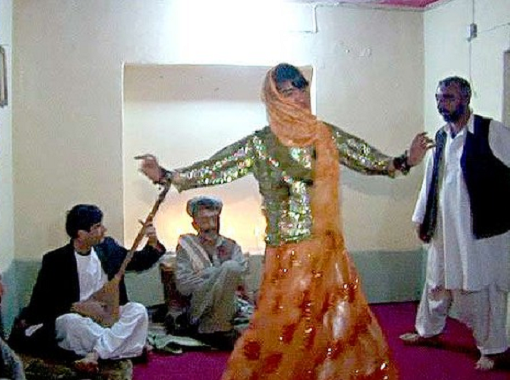
Since this is Afghanistan, you probably already knew this wasn’t a kegger. Instead, this DynCorp soiree was a bacha bazi (“boy-play”) party, much like the ones uncovered earlier this year by Frontline.
For those that can’t or won’t click the link, bacha bazi is a pre-Islamic Afghan tradition that was banned by the Taliban. Bacha boys are eight- to 15-years-old. They put on make-up, tie bells to their feet and slip into scanty women’s clothing, and then, to the whine of a harmonium and wailing vocals, they dance seductively to smoky roomfuls of leering older men.
After the show is over, their services are auctioned off to the highest bidder, who will sometimes purchase a boy outright. And by services, we mean anal sex: The State Department has called bacha bazi a “widespread, culturally accepted form of male rape.” (While it may be culturally accepted, it violates both Sharia law and Afghan civil code.)
For Pashtuns in the South of Afghanistan, there is no shame in having a little boy lover; on the contrary, it is a matter of pride. Those who can afford the most attractive boy are the players in their world, the OG’s of places like Kandahar and Khost. On the Frontline video, ridiculously macho warrior guys brag about their young boyfriends utterly without shame.
So perhaps in the evil world of Realpolitik, in which there is apparently no moral compass US private contractors won’t smash to smithereens, it made sense for DynCorp to drug up some Pashtun police recruits and turn them loose on a bunch of little boys. But according to the leaked document, Atmar, the Afghani interior minister, was terrified this story would catch a reporter’s ear.
He urged the US State Department to shut down a reporter he heard was snooping around, and was horrified that a rumored videotape of the party might surface. He predicted that any story about the party would “endanger lives.” He said that his government had arrested two Afghan police and nine Afghan civilians on charges of “purchasing a service from a child” in connection with the party, but that he was worried about the image of their “foreign mentors,” by which he apparently meant DynCorp. American diplomats told him to chill. They apparently had a better handle on our media than Atmar, because when a report of the party finally did emerge, it was neutered to the point of near-falsehood.
US diplomats cautioned against an “overreaction” and said that approaching the journalist involved would only make the story worse.”A widely-anticipated newspaper article on the Kunduz scandal has not appeared but, if there is too much noise that may prompt the journalist to publish,” the cable said.
The strategy appeared to work when an article was published in July by the Washington Post about the incident, which made little of the affair, saying it was an incident of “questionable management oversight” in which foreign DynCorp workers “hired a teenage boy to perform a tribal dance at a company farewell party”.
A tribal dance? Could illegal strip clubs stateside possibly try that one out? “Naw, those are not full-contact lap-dances, Mr. Vice Cop. Krystal and Lexxis are just performing an ancient Cherokee fertility dance. See those buck-skin thongs on and those feathers in their hair?”
As we mentioned, this isn’t DynCorp’s first brush with the sex-slavery game. Back in Bosnia in 1999, US policewoman Kathryn Bolkovac was fired from DynCorp after blowing the whistle on a sex-slave ring operating on one of our bases there. DynCorp’s employees were accused of raping and peddling girls as young as 12 from countries like Ukraine, Moldova and Romania. The company was forced to settle lawsuits against Bolkovac (whose story was recently told in the feature film The Whistleblower) and another man who informed authorities about DynCorp’s sex ring.
There’s your tax dollars at work, Joe Six-Pack. Maybe now you won’t get so worked up about the fact that KPFT gets about ten percent of its funding from the government and uses some of it to air Al-Jazeera.
The White House is signing off on a controversial new law that would authorize the U.S. military to arrest and indefinitely detain alleged al Qaeda members or other terrorist operatives captured on American soil.
As the bill neared final passage in the House of Representatives and the Senate on Wednesday, the Obama administration announced it would support passage of the National Defense Authorization Act (NDAA), which contains slightly watered-down provisions giving the military a front line role in domestic terrorism cases.
The administration abandoned its long-held veto threat due to changes in the final version of the bill, namely that in its view, the military custody mandate has been “softened.” The bill now gives the President the immediate power to issue a waiver of the military custody requirement, instead of the Defense Secretary, and gives the President discretion in implementing these new provisions.
“We have concluded that the language does not challenge or constrain the President’s ability to collect intelligence, incapacitate dangerous terrorists, and protect the American people, and the President’s senior advisors will not recommend a veto,” the White House statement said.
The detainee provisions are just one part of the annual NDAA authorizing $662 billion in federal defense spending next year.
While the bill never expanded the authority to detain American citizens indefinitely without charges, proponents said the legislation would codify court decisions finding the President does have the authority to declare “enemy combatants,” as commander-in-chief and under the post-9/11 Authorization for Use of Military Force against al Qaeda and its allies. The administration, which has pledged not to use this power, believes the bill leaves this legal issue unresolved.
“By signing this defense spending bill, President Obama will go down in history as the president who enshrined indefinite detention without trial in U.S. law,” said Kenneth Roth, executive director of Human Rights Watch. “In the past, Obama has lauded the importance of being on the right side of history, but today he is definitely on the wrong side.”
FBI Director Robert Mueller, testifying before the Senate Judiciary Committee on Wednesday, said the provisions still could create confusion among counter-terrorism professionals.
“My concern is that you don’t want FBI agents and the military showing up at the same time, with some uncertainty” as to who has control, Mueller said, and raised this hypothetical example: “A case that we’re investigating on three individuals, two of whom are American citizens and would not go to military custody and the third is not an American citizen and could go to military custody?”
Mueller was joined earlier in the detainee debate by Defense Secretary Leon Panetta and Director of National Intelligence James Clapper in opposing the military custody provision, because they said it might inhibit flexibility by counter-terrorism professionals, restrain federal, state, and local law enforcement authorities, and risk losing the cooperation of terror arrestees.
“If President Obama signs this bill, it will damage both his legacy and American’s reputation for upholding the rule of law,” said Laura Murphy, director of the ACLU Washington Legislative Office. “The last time Congress passed indefinite detention legislation was during the McCarthy era, and President Truman had the courage to veto that bill.”
Bill opponents have noted that in the decade since the 9/11, the government has successfully convicted over 300 people for terrorism-related crimes, including thwarted plots to bomb passenger jets, subway lines, and landmarks such as Times Square and the Sears Tower.
By comparison, the military justice system, although stymied by constitutional challenges, has completed only six cases in Guantanamo Bay, Cuba, where 170 detainees remain.
On March 30, Senator Chuck Schumer (D-N.Y., picture, left) and 15 co-sponsors (including Republican leaders) introduced S. 679, the “Presidential Appointment Efficiency and Streamlining Act.” The measure would remove the “advice and consent” requirement for many executive branch appointments, giving the President unchecked power to fill key administration positions.Ostensibly, the bill enjoys bipartisan support because its sole purpose is to relieve the backlog of unconfirmed appointees by eliminating the confirmation requirement for about 200 offices.The process by which heads of executive branch departments are appointed and confirmed is set forth by Article II, Section 2 of the U.S. Constitution. The “Appointments Clause” provides that the President:
… shall nominate, and by and with the Advice and Consent of the Senate, shall appoint Ambassadors, other public Ministers and Consuls, Judges of the supreme Court, and all other Officers of the United States, whose Appointments are not herein otherwise provided for, and which shall be established by Law: but the Congress may by Law vest the Appointment of such inferior Officers, as they think proper, in the President alone, in the Courts of Law, or in the Heads of Departments.
If this bill passes, the checks and balances established by our Founding Fathers as a protection against tyranny will be eliminated, as well as the concept of enumerated powers.
This history of the delicate system created by our Founders was synopsized in an article published by The Heritage Foundation:
When the delegates of the states gathered in Philadelphia in the summer of 1787 and wrote the Constitution, they distributed the powers of the federal government among two Houses of Congress, a President, and a judiciary, and required in many cases that two of them work together to exercise a particular constitutional power. That separation of powers protects the liberties of the American people by preventing any one officer of the government from aggregating too much power.
The Framers of the Constitution did not give the President the kingly power to appoint the senior officers of the government by himself. Instead, they allowed the President to name an individual for a senior office, but then required the President to obtain the Senate’s consent before appointing the individual to office. Thus, they required the cooperation of the President and the Senate to put someone in high office.
Many of the Framers had practical experience with government and recognized that not every office would be of sufficient authority and consequence as to merit the attention of both the President and the Senate to an appointment to the office. Therefore, they provided a means by which the Congress by law could decide which of the lesser offices of government could be filled by the President alone, a court, or a department head.
If enacted, S. 679 would erase these barriers between the branches and shift the powers of appointment in such a way that the very foundation of our Republic would be weakened under the crushing weight of a powerful executive branch.
In light of this impending imbalance, it must be inquired as to what could compel Congress to legislate away its own power? Why would the Senate willingly abdicate its role as bulwark against executive despotism?
Arguably, the answer is a desire to reduce its workload and improve the efficiency of government.
To exchange rightful power for a more streamlined appointment process seems like a ripoff. As The Heritage Foundation says:
The Congress should not reduce the number of Senate-confirmed appointments as a means of dealing with its cumbersome and inefficient internal process for considering nominations. Doing so gives away Senate influence over a number of significant appointments, does nothing to improve the Senate process, and still leaves nominees whose offices require nominations mired in the Senate process. The proper solution to the problem of a slow Senate is to speed up the Senate rather than to diminish the role of the Senate. The Senate should look inward and streamline its internal procedures for considering all nominations. The proper solution also is the faster one, as the Senate can accomplish the solution by acting on its own in the exercise of its power to make Senate rules, while S. 679 requires approval by both Houses of Congress.
The following lawmakers have appended their names to the bill as co-sponsors:
Sen. Lamar Alexander (R-Tenn.), Sen. Jeff Bingaman (D-N.M.), Sen. Richard Blumenthal (D-Conn.), Sen. Scott Brown (R-Mass.), Sen. Thomas Carper (D-Del.), Sen. Susan Collins (R-Maine), Sen. Richard Durbin (D-Ill.), Sen. Mike Johanns (R-Neb.), Sen. Jon Kyl (R-Ariz.), Sen. Joseph Lieberman (I-Conn.), Sen. Richard Lugar (R-Ind.), Sen. Mitch McConnell (R-Ky.), Sen. John Reed (D-R.I.), Sen. Harry Reid (D-Nev.), and Sen. Sheldon Whitehouse (D-R.I.).
Assuming for the sake of argument that there is a bottleneck in the nomination and confirmation pipeline, one solution is for the executive and legislative branches to work within the framework of enumerated powers to remove the blockage.
Alternatively, however, the Congress could obviate the problem by reducing the size of the bureaucracy through an absolute refusal to sign off on the creation of any department, program, or agency that isn’t specifically authorized by the powers granted to the federal government in the Constitution. That would eliminate the number of executive offices for which appointments would be necessary, thereby dissolving the confirmation clog by the application of the undiluted principles of constitutional liberty.
NYPD’s Deputy Inspector Anthony Bologna has been identified on Twitter as the police officer that pepper sprayed female protesters being held behind a police corral that was filmed and uploaded to YouTube. From the video it appears as if the women were blocked in by police and not allowed to leave. Seemingly without provocation Deputy Inspector Bologna sprays the women casually and walks away.
Protest supports are tweeting the phone number of the NYPD’s 1st Precinct to get people to call and complain.
@anonops: Call Mr. Bologna and ask him why he pepper sprayed innocent people? (212) 334-0611 #AnonOps #OccupyWallStreet
Michigan state police (or should we say police state?) have been using a handheld mobile forensics device to steal information from cell phones belonging to motorists stopped for minor traffic violations. The high-tech device works with 3000 different phone models and can bypass passwords to process “Complete extraction of existing, hidden, and deleted phone data, including call history, text messages, contacts, images, and geotags,” according to CelleBrite, the company behind the device. “The Physical Analyzer allows visualization of both existing and deleted locations on Google Earth. In addition, location information from GPS devices and image geotags can be mapped on Google Maps.”
So, without a warrant, without people even knowing it, police has the power to look into your entire phone’s memory, including deleted phone data. With geotags, it can retrace pretty much everywhere you’ve went with that cellphone. Since most people have their cellphones at less than 5 feet from them at all times, well, there you go.
Michigan: Police Search Cell Phones During Traffic Stops
ACLU seeks information on Michigan program that allows cops to download information from smart phones belonging to stopped motorists.
The Michigan State Police have a high-tech mobile forensics device that can be used to extract information from cell phones belonging to motorists stopped for minor traffic violations. The American Civil Liberties Union (ACLU) of Michigan last Wednesday demanded that state officials stop stonewalling freedom of information requests for information on the program.
ACLU learned that the police had acquired the cell phone scanning devices and in August 2008 filed an official request for records on the program, including logs of how the devices were used. The state police responded by saying they would provide the information only in return for a payment of $544,680. The ACLU found the charge outrageous.
“Law enforcement officers are known, on occasion, to encourage citizens to cooperate if they have nothing to hide,” ACLU staff attorney Mark P. Fancher wrote. “No less should be expected of law enforcement, and the Michigan State Police should be willing to assuage concerns that these powerful extraction devices are being used illegally by honoring our requests for cooperation and disclosure.”
A US Department of Justice test of the CelleBrite UFED used by Michigan police found the device could grab all of the photos and video off of an iPhone within one-and-a-half minutes. The device works with 3000 different phone models and can even defeat password protections.
“Complete extraction of existing, hidden, and deleted phone data, including call history, text messages, contacts, images, and geotags,” a CelleBrite brochure explains regarding the device’s capabilities. “The Physical Analyzer allows visualization of both existing and deleted locations on Google Earth. In addition, location information from GPS devices and image geotags can be mapped on Google Maps.”
The ACLU is concerned that these powerful capabilities are being quietly used to bypass Fourth Amendment protections against unreasonable searches.
“With certain exceptions that do not apply here, a search cannot occur without a warrant in which a judicial officer determines that there is probable cause to believe that the search will yield evidence of criminal activity,” Fancher wrote. “A device that allows immediate, surreptitious intrusion into private data creates enormous risks that troopers will ignore these requirements to the detriment of the constitutional rights of persons whose cell phones are searched.”
The national ACLU is currently suing the Department of Homeland Security for its policy of warrantless electronic searches of laptops and cell phones belonging to people entering the country who are not suspected of committing any crime.
EFF activist Eva Galperin interviews EFF criminal defense attorney, Hanni Fakhoury, on the newest edition of Line Noise, the EFF podcast. Whether law enforcement wants to search your home computer, tries to browse through your smart phone at a traffic stop, or seeks to thumb through your camera at customs, you should know your rights.
Learn more about your privacy rights by reading our Know Your Rights guide, or test your skills with our quiz.
This edition of Line Noise was recorded on-site from the San Francisco studio of Bamm.tv
Many wealthy executives in the financial sector have written checks to help Tim Pawlenty. But executives with Morgan Stanley, which has been ensnared in federal probes of Wall Street abuses, have opened their wallets especially wide to the former Minnesota governor.
State Department officials have used some of a multimillion dollar annual fund meant for evacuating diplomats from posts in Egypt or Libya on a kitchen renovation, on holiday parties, postage, invitations, among other non-emergency
Limousines, the very symbol of wealth and excess, are usually the domain of corporate executives and the rich. But the number of limos owned by Uncle Sam increased by 73 percent during the first two years of the Obama administration, according to an analysis of records by iWatch News.
Most of the increase was recorded in Hillary Clinton’s State Department.
Obama administration officials said most of the increase reflects an enhanced effort to protect diplomats and other government officials in a dangerous world. But a watchdog group says the abundance of limos sends the wrong message in the midst of a budget crisis. The increase in limos comes to light on the heels of an executive order from President Obama last week that charges agencies to increase the fuel efficiency of their fleets.
According to General Services Administration data, the number of limousines in the federal fleet increased from 238 in fiscal 2008, the last year of the George W. Bush administration, to 412 in 2010. Much of the 73 percent increase—111 of the 174 additional limos—took place in fiscal 2009, more than eight months of which corresponded with Obama’s first year in office. However, some of those purchases could reflect requests made by the Bush administration during an appropriations process that would have begun in the spring of 2008.
The GSA said its limousine numbers are not reliable, even though the federal fleet numbers are officially recorded every year. In a statement, GSA spokeswoman Sara Merriam said, “The categories in the Fleet Report are overly broad, and the term ‘limousine’ is not defined,” adding that “vehicles represented as limousines can range from protective duty vehicles to sedans.” Asked whether the GSA actually knows how many limos it has in its fleet, Merriam responded that GSA “cannot say that its report accurately reflects the number of limousines.”
Leslie Paige, a spokeswoman for the nonprofit watchdog group Citizens Against Government Waste, was outraged that the GSA’s numbers may not be accurate. “They can’t figure out a way to define a limo? How hard can it be? If the government can’t track limos, I’m not sure we should trust the numbers they put out there on anything,” she said.
Although the overall limo numbers in the fleet report were up in 2010, federal agencies and departments did not benefit equally. The State Department, with 259, had more limos than any other agency in 2010 and has gained 194 limos just since fiscal 2008. Of those new limos, 98 were defined as “law enforcement,” which the GSA said means they are equipped with sirens or lights, high-performance drivetrains, or are used for surveillance or undercover operations.
The State Department in a statement said its limos are deployed by overseas diplomats and in the United States by Secretary of State Clinton and “distinguished foreign visitors.” Many of the limos in its fleet are armored to protect against attack. The department said its Obama-era increase in armored limos is “both in proportion to the increased threat to diplomats serving overseas and is in proportion to the increase number of diplomats we have serving in high threat environments.” Appropriations documents indicate the State Department was engaged in a longer-term effort to increase the number of armored vehicles that would have stretched back to at least 2007.
The department said it defines a limo as a vehicle that carries a VIP or “other protectee,” rather than by the type of car, but said most of its limos are Cadillac DTSs, which cost the taxpayer more than $60,000 for a 2011 base model and support the additional weight of armoring. The department said it also purchased a limited number of 7-Series BMWs for ambassadors in countries where vehicles are right-hand drive.
The Department of Homeland Security, which in 2010 had the second largest number of limos at 118, dropped four limos from 2008 to 2010. A spokesman for DHS said the majority of its limos are used by the Secret Service, which is part of the department, but declined to elaborate on exact numbers, citing security concerns.
Paige, of CAGW, called the new federal limos “one more reason why there is so much cynicism in the public about what goes on in Washington.” She said terrorism and security has become the catchall justification for increased federal spending.
The increase in limos comes at a time when the Obama administration is increasingly working to burnish its green energy credentials by targeting the federal fleet. On Tuesday, Obama released a presidential memorandum requiring agencies to purchase only alternative fuel vehicles by 2015. The memorandum limits executive fleets to mid-sized and smaller cars “except where larger sedans are essential to the agency mission.” It also exempts law enforcement and security vehicles, which could make up the majority of the federal limo fleet.
According to a March report by the GAO, the federal government spent $1.9 billion on new vehicles in fiscal 2009, and burned through 963,000 gallons of fuel a day with its fleet of 600,00 vehicles.
The number of limousines in the federal fleet has varied over the years. In 2007, the number dropped to 217 from 318 a year before. But due to the fuzzy GSA accounting, it’s unclear exactly how many federal limos have been on the road.
According to the GSA report, for example, the U.S. Agency for International Development, which had zero limos in 2008, added six limos to its fleet in 2009. But agency spokesman Lars Anderson said that’s because six standard overseas sedans, including a 1997 Ford Crown Victoria in Bangladesh, and a 2009 Mercury Grand Marquis in El Salvador, were incorrectly recorded as limos.
If the data is correct, some federal employees who once rode in style now face more proletarian transportation options. The Department of Veterans Affairs, for example, ran a fleet of 21 limousines in 2008 under George W. Bush, according to the fleet report. It now makes do with only one. The Government Printing Office also lost all of its six limos between 2009 and 2010. The VA and the Government Printing Office did not respond to calls for comment.