A speech by 85 year old, Austrian born, American Citizen in South Dakota, Kitty Werthmann.
“What I am about to tell you is something you’ve probably never heard or read in history books,” she likes to tell audiences.
“I am a witness to history.
“I cannot tell you that Hitler took Austria by tanks and guns; it would distort history.
If you remember the plot of the Sound of Music, the Von Trapp family escaped over the Alps rather than submit to the Nazis. Kitty wasn’t so lucky. Her family chose to stay in her native Austria. She was 10 years old, but bright and aware. And she was watching.
“We elected him by a landslide – 98 percent of the vote,” she recalls.
She wasn’t old enough to vote in 1938 – approaching her 11th birthday. But she remembers.
“Everyone thinks that Hitler just rolled in with his tanks and took Austria by force.”
Not so.
Hitler is welcomed to Austria
“In 1938, Austria was in deep Depression. Nearly one-third of our workforce was unemployed. We had 25 percent inflation and 25 percent bank loan interest rates.
Farmers and business people were declaring bankruptcy daily. Young people were going from house to house begging for food. Not that they didn’t want to work; there simply weren’t any jobs.
“My mother was a Christian woman and believed in helping people in need. Every day we cooked a big kettle of soup and baked bread to feed those poor, hungry people – about 30 daily.’
“We looked to our neighbor on the north, Germany, where Hitler had been in power since 1933.” she recalls. “We had been told that they didn’t have unemployment or crime, and they had a high standard of living.
Austrian girls welcome Hitler
“Nothing was ever said about persecution of any group – Jewish or otherwise. We were led to believe that everyone in Germany was happy. We wanted the same way of life in Austria. We were promised that a vote for Hitler would mean the end of unemployment and help for the family. Hitler also said that businesses would be assisted, and farmers would get their farms back.
“Ninety-eight percent of the population voted to annex Austria to Germany and have Hitler for our ruler.
“We were overjoyed,” remembers Kitty, “and for three days we danced in the streets and had candlelight parades. The new government opened up big field kitchens and everyone was fed.
Austrians saluting
“After the election, German officials were appointed, and like a miracle, we suddenly had law and order. Three or four weeks later, everyone was employed. The government made sure that a lot of work was created through the Public Work Service.
“Hitler decided we should have equal rights for women. Before this, it was a custom that married Austrian women did not work outside the home. An able-bodied husband would be looked down on if he couldn’t support his family. Many women in the teach- ing profession were elated that they could retain the jobs they previously had been re- quired to give up for marriage.
“Then we lost religious education for kids
Poster promoting “Hitler Youth”
“Our education was nationalized. I attended a very good public school.. The population was predominantly Catholic, so we had religion in our schools. The day we elected Hitler (March 13, 1938), I walked into my schoolroom to find the crucifix replaced by Hitler’s picture hanging next to a Nazi flag. Our teacher, a very devout woman, stood up and told the class we wouldn’t pray or have religion anymore. Instead, we sang ‘Deutschland, Deutschland, Uber Alles,’ and had physical education.
“Sunday became National Youth Day with compulsory attendance. Parents were not pleased about the sudden change in curriculum. They were told that if they did not send us, they would receive a stiff letter of warning the first time. The second time they would be fined the equivalent of $300, and the third time they would be subject to jail.” And then things got worse.
“The first two hours consisted of political indoctrination. The rest of the day we had sports. As time went along, we loved it. Oh, we had so much fun and got our sports equipment free.
“We would go home and gleefully tell our parents about the wonderful time we had.
“My mother was very unhappy,” remembers Kitty. “When the next term started, she took me out of public school and put me in a convent. I told her she couldn’t do that and she told me that someday when I grew up, I would be grateful. There was a very good curriculum, but hardly any fun – no sports, and no political indoctrination.
“I hated it at first but felt I could tolerate it. Every once in a while, on holidays, I went home. I would go back to my old friends and ask what was going on and what they were doing.
A pro-Hitler rally
“Their loose lifestyle was very alarming to me. They lived without religion. By that time, unwed mothers were glorified for having a baby for Hitler.
“It seemed strange to me that our society changed so suddenly. As time went along, I realized what a great deed my mother did so that I wasn’t exposed to that kind of humanistic philosophy.
“In 1939, the war started and a food bank was established. All food was rationed and could only be purchased using food stamps. At the same time, a full-employment law was passed which meant if you didn’t work, you didn’t get a ration card, and if you didn’t have a card, you starved to death.
“Women who stayed home to raise their families didn’t have any marketable skills and often had to take jobs more suited for men.
“Soon after this, the draft was implemented.
Young Austrians
“It was compulsory for young people, male and female, to give one year to the labor corps,” remembers Kitty. “During the day, the girls worked on the farms, and at night they returned to their barracks for military training just like the boys.
“They were trained to be anti-aircraft gunners and participated in the signal corps. After the labor corps, they were not discharged but were used in the front lines.
“When I go back to Austria to visit my family and friends, most of these women are emotional cripples because they just were not equipped to handle the horrors of combat.
“Three months before I turned 18, I was severely injured in an air raid attack. I nearly had a leg amputated, so I was spared having to go into the labor corps and into military service.
“When the mothers had to go out into the work force, the government immediately established child care centers. “You could take your children ages four weeks old to school age and leave them there around-the-clock, seven days a week, under the total care of the government.
“The state raised a whole generation of children. There were no motherly women to take care of the children, just people highly trained in child psychology. By this time, no one talked about equal rights. We knew we had been had.
“Before Hitler, we had very good medical care. Many American doctors trained at the University of Vienna.. “After Hitler, health care was socialized, free for everyone. Doctors were salaried by the government. The problem was, since it was free, the people were going to the doctors for everything.
“When the good doctor arrived at his office at 8 a.m., 40 people were already waiting and, at the same time, the hospitals were full.
“If you needed elective surgery, you had to wait a year or two for your turn. There was no money for research as it was poured into socialized medicine. Research at the medical schools literally stopped, so the best doctors left Austria and emigrated to other countries.
“As for healthcare, our tax rates went up to 80 percent of our income. Newlyweds immediately received a $1,000 loan from the government to establish a household. We had big programs for families.
“All day care and education were free. High schools were taken over by the government and college tuition was subsidized. Everyone was entitled to free handouts, such as food stamps, clothing, and housing.
“We had another agency designed to monitor business. My brother-in-law owned a restaurant that had square tables. “ Government officials told him he had to replace them with round tables because people might bump themselves on the corners. Then they said he had to have additional bathroom facilities. It was just a small dairy business with a snack bar. He couldn’t meet all the demands.
“Soon, he went out of business. If the government owned the large businesses and not many small ones existed, it could be in control.
“We had consumer protection, too
Austrian kids loyal to Hitler
“We were told how to shop and what to buy. Free enterprise was essentially abolished. We had a planning agency specially designed for farmers. The agents would go to the farms, count the live-stock, and then tell the farmers what to produce, and how to produce it.
“In 1944, I was a student teacher in a small village in the Alps. The villagers were surrounded by mountain passes which, in the winter, were closed off with snow, causing people to be isolated.
“So people intermarried and offspring were sometimes retarded. When I arrived, I was told there were 15 mentally retarded adults, but they were all useful and did good manual work.
“I knew one, named Vincent, very well. He was a janitor of the school. One day I looked out the window and saw Vincent and others getting into a van.
“I asked my superior where they were going. She said to an institution where the State Health Department would teach them a trade, and to read and write. The families were required to sign papers with a little clause that they could not visit for 6 months.
“They were told visits would interfere with the program and might cause homesickness.
“As time passed, letters started to dribble back saying these people died a natural, merciful death. The villagers were not fooled. We suspected what was happening. Those people left in excellent physical health and all died within 6 months. We called this euthanasia.
“Next came gun registration. People were getting injured by guns. Hitler said that the real way to catch criminals (we still had a few) was by matching serial numbers on guns. Most citizens were law abiding and dutifully marched to the police station to register their firearms. Not long afterwards, the police said that it was best for everyone to turn in their guns. The authorities already knew who had them, so it was futile not to comply voluntarily.
“No more freedom of speech. Anyone who said something against the government was taken away. We knew many people who were arrested, not only Jews, but also priests and ministers who spoke up.
“Totalitarianism didn’t come quickly, it took 5 years from 1938 until 1943, to realize full dictatorship in Austria. Had it happened overnight, my countrymen would have fought to the last breath. Instead, we had creeping gradualism. Now, our only weapons were broom handles. The whole idea sounds almost unbelievable that the state, little by little eroded our freedom.”
“This is my eye-witness account.
“It’s true. Those of us who sailed past the Statue of Liberty came to a country of unbelievable freedom and opportunity.
“America is truly is the greatest country in the world. “Don’t let freedom slip away.
SHTFplan Editor’s Note: The following interview is both informative and terrifying, and essential reading for anyone concerned about what comes next.
What the DHS Insider suggests is about to happen is exactly what many of us fear – a police state takeover of America, with urban centers to be pacified first, all outspoken critics of the government to be silenced, and travel restrictions across the United States to come shortly thereafter.
The dollar collapse, riots, the mobilization of domestic law enforcement, gun control, rationing of food and gas, suspension of the U.S. Constitution and a complete lock-down of America as we know it. According to the report, sinister forces within the U.S. government operating at the highest levels of our country’s political, financial, intelligence and military hierarchies have set into motion a series of events that will leave the populace so desperate for government intervention that they’ll willingly surrender their liberty for the perceived security of a militarized police state.
Interviewer Doug Hagmann cites an anonymous source operating deep inside the Department of Homeland Security, which may leave many skeptical of the accuracy of the reports. But the fact is, were such events being planned behind the scenes we certainly wouldn’t be given official mainstream warning. If real, the report is a game changer, and it makes sense that anyone privy to such information would want to keep their identity hidden. Whistle blowers in America who expose the corruption of officials in our government are treated not as patriots, but as traitors, and are often branded as psychos or terrorists.
What’s most alarming is the speed at which these events may play out.
23 December 2012: After a lengthy, self-imposed informational black-out, my high-level DHS contact known as “Rosebud” emerged with new, non-public information about plans being discussed and prepared for implementation by the Department of Homeland Security (DHS) in the near future. It is important to note that this black-out was directly related to the aggressive federal initiative of identifying and prosecuting “leakers,” at least those leaks and leakers not sanctioned by the executive office – the latter of which there are many.
Due to those circumstances, my source exercised an abundance of caution to avoid compromising a valuable line of communication until he had information he felt was significant enough to risk external contact. The following information is the result of an in-person contact between this author and “Rosebud” within the last 48 hours. With his permission, the interview was digitally recorded and the relevant portions of the contact are provided in a conversational format for easier reading. The original recording was copied onto multiple discs and are maintained in secure locations for historical and insurance purposes.
Meeting
The following began after an exchange of pleasantries and other unrelated discussion:
DH: Do I have your permission to record this conversation?
RB: You do.
DH: I’ve received a lot of e-mail from people wondering where you went and why you’ve been so quiet.
RB: As I told you earlier, things are very dicey. Weird things began to happen before the election and have continued since. Odd things, a clampdown of sorts. I started looking and I found [REDACTED AT THE REQUEST OF THIS SOURCE], and that shook me up. I’m not the only one, though, that found a [REDACTED], so this means there’s surveillance of people within DHS by DHS. So, that explains this cloak and dagger stuff for this meeting.
DH: I understand. What about the others?
RB: They are handling it the same way.
DH: I’ve received many e-mails asking if you are the same person giving information to Ulsterman. Are you?
RB: No, but I think I know at least one of his insiders.
DH: Care to elaborate?
RB: Sorry, no.
DH: Do you trust him or her. I mean, the Ulsterman source?
RB: Yes.
DH: Okay, so last August, you said things were “going hot.” I printed what you said, and things did not seem to happen as you said.
RB: You’d better recheck your notes and compare [them] with some of the events leading up to the election. I think you’ll find that a full blown campaign of deception took place to make certain Obama got back into office. The polls, the media, and a few incidents that happened in the two months before the election. I guess if people are looking for some big event they can point to and say “aha” for verification, well then I overestimated people’s ability to tell when they are being lied to.
DH: What specific incidents are you referring to?
RB: Look at the threats to Obama. Start there. The accusations of racism. Then look at the polls, and especially the judicial decisions about voter ID laws. Bought and paid for, or where there was any potential for problems, the judges got the message, loud and clear. Then look at the voter fraud. And not a peep from the Republicans. Nothing. His second term was a done deal in September. This was planned. Frankly, the Obama team knew they had it sewn up long before election day. Benghazi could have derailed them, but the fix was in there, so I never saw anything on my end to suggest a ready-made solution had to be implemented.
DH: What’s going on now?
RB: People better pay close attention over the next few months. First, there won’t be any meaningful deal about the fiscal crisis. This is planned, I mean, the lack of deal is planned. In fact, it’ necessary to pave the way for what is in the short term agenda.
DH: Wait, you’re DHS – not some Wall Street insider.
RB: So you think they are separate agendas? That’s funny. The coming collapse of the U.S. dollar is a done deal. It’s been in the works for years – decades, and this is one of the most important cataclysmic events that DHS is preparing for. I almost think that DHS was created for that purpose alone, to fight Americans, not protect them, right here in America. But that’s not the only reason. There’s the gun issue too.
DH: So, what are you seeing at DHS?
RB: We don’t have a lot of time, tonight – our meeting – as well as a country. I mean I have heard – with my own ears – plans being made that originate from the White House that involve the hierarchy of DHS. You gotta know how DHS works at the highest of levels. It’s Jarrett and Napolitano, with Jarrett organizing all of the plans and approaches. She’s the one in charge, at least from my point of view, from what I am seeing. Obama knows that’s going on and has say, but it seems that Jarrett has the final say, not the other way around. It’s [screwed] up. This really went into high gear since the election.
But it’s a train wreck at mid management, but is more effective at the lower levels. A lot of police departments are being gifted with federal funds with strings attached. That money is flowing out to municipal police departments faster than it can be counted. They are using this money to buy tanks, well, not real tanks, but you know what I mean. DHS is turning the police into soldiers.
By the way, there has been a lot of communication recently between Napolitano and Pistole [TSA head]. They are planning to use TSA agents in tandem with local police for certain operations that are being planned right now. This is so [deleted] important that you cannot even begin to imagine. If you get nothing else out of this, please, please make sure you tell people to watch the TSA and their increasing involvement against the American public. They are the stooges who will be the ones to carry out certain plans when the dollar collapses and the gun confiscation begins.
DH: Whoa, wait a minute. You just said a mouthful. What’s the agenda here?
RB: Your intelligence insider – he knows that we are facing a planned economic collapse. You wrote about this in your articles about Benghazi, or at least that’s what I got out of the later articles. So why the surprise?
DH: There’s a lot here. Let’s take it step by step if you don’t mind.
RB: Okay, but I’m not going to give it to you in baby steps. Big boy steps. This is what I am hearing. Life for the average American is going to change significantly, and not the change people expect. First, DHS is preparing to work with police departments and the TSA to respond to civil uprisings that will happen when there is a financial panic. And there will be one, maybe as early as this spring, when the dollar won’t get you a gumball. I’m not sure what the catalyst will be, but I’ve heard rumblings about a derivatives crisis as well as an oil embargo. I don’t know, that’s not my department. But something is going to happen to collapse the dollar, which has been in the works since the 1990′s. Now if it does not happen as soon as this, it’s because there are people, real patriots, who are working to prevent this, so it’s a fluid dynamic. But that doesn’t change the preparations.
And the preparations are these: DHS is prepositioning assets in strategic areas near urban centers all across the country. Storage depots. Armories. And even detainment facilities, known as FEMA camps. FEMA does not even know that the facilities are earmarked for detainment by executive orders, at least not in the traditional sense they were intended. By the way, people drive by some of these armories everyday without even giving them a second look. Commercial and business real estate across the country are being bought up or leased for storage purposes. Very low profile.
Anyway, I am hearing that the plan from on high is to let the chaos play out for a while, making ordinary citizens beg for troops to be deployed to restore order. but it’s all organized to make them appear as good guys. That’s when the real head knocking will take place. We’re talking travel restrictions, which should no be a problem because gas will be rationed or unavailable. The TSA will be in charge of travel, or at least be a big part of it. They will be commissioned, upgraded from their current status.
They, I mean Jarrett and Obama as well as a few others in government, are working to create a perfect storm too. This is being timed to coincide with new gun laws.
DH: New federal gun laws?
RB: Yes. Count on the criminalization to possess just about every gun you can think of. Not only restrictions, but actual criminalization of possessing a banned firearm. I heard this directly from the highest of my sources. Plans were made in the 90′s but were withheld. Now, it’s a new day, a new time, and they are riding the wave of emotion from Sandy Hook., which, by the way and as tragic as it was, well, it stinks to high heaven. I mean there are many things wrong there, and first reports are fast disappearing. The narrative is being changed. Look, there is something wrong with Sandy Hook, but if you write it, you’ll be called a kook or worse.
DH: Sure
RB: But Sandy Hook, there’s something very wrong there. But I am hearing that won’t be the final straw. There will be another if they think it’s necessary.
DH: Another shooting?
RB: Yes.
DH: That would mean they are at least complicit.
RB: Well, that’s one way of looking at it.
DH: Are they? Were they?
RB: Do your own research. Nothing I say, short of bringing you photographs and documents will convince anyone, and even then, it’s like [DELETED] in the wind.
DH: So…
RB: So what I’m telling you is that DHS, the TSA and certain, but not all, law enforcement agencies are going to be elbow deep in riot control in response to an economic incident. At the same time or close to it, gun confiscation will start. It will start on a voluntary basis using federal registration forms, then an amnesty, then the kicking-in of doors start.
Before or at the same time, you know all the talk of lists, you know, the red and blue lists that everyone made fun of? Well they exist, although I don’t know about their colors. But there are lists of political dissidents maintained by DHS. Names are coordinated with the executive branch, but you know what? They did not start with Obama. They’ve been around in one form or another for years. The difference though is that today, they are much more organized. And I’ll tell you that the vocal opponents of the politics of the global elite, the bankers, and the opponents of anything standing in their way, well, they are on the top of the list of people to be handled.
DH: Handled?
RB: As the situations worsen, some might be given a chance to stop their vocal opposition. Some will, others won’t. I suppose they are on different lists. Others won’t have that chance. By that time, though, it will be chaos and people will be in full defensive mode. They will be hungry, real hunger like we’ve never experienced before. They will use our hunger as leverage. They will use medical care as leverage.
DH: Will this happen all at once?
RB: They hope to make it happen at the same time. Big cities first, with sections being set apart from the rest of the country. Then the rural areas. There are two different plans for geographical considerations. But it will all come together.
DH: Wait, this sounds way, way over the top. Are you telling me… [Interrupts]
RB: [Over talk/Unintelligible] …know who was selected or elected twice now. You know who his associates are. And you are saying this is way over the top? Don’t forget what Ayers said – you talked to Larry Grathwohl. This guy is a revolutionary. He does not want to transform our country in the traditional sense. He will destroy it. And he’s not working alone. He’s not working for himself, either. He has his handlers. So don’t think this is going to be a walk in the park, with some type of attempt to rescue the country. Cloward-Piven. Alinsky. Marx. All rolled into one. And he won’t need the rest of his four years to do it.
DH: I need you to be clear. Let’s go back again, I mean, to those who speak out about what’s happening.
RB: [Edit note: Obviously irritated] How much clearer do you want it? The Second Amendment will be gone, along with the first, at least practically or operationally. The Constitution will be gone, suspended, at least in an operational sense. Maybe they won’t actually say that they are suspending it, but will do it. Like saying the sky is purple when it’s actually blue. How many people will look a the sky and say yeah, it’s purple? They see what they want to see.
So the DHS, working with other law enforcement organizations, especially the TSA as it stands right now, will oversee the confiscation of assault weapons, which includes all semi-automatic weapons following a period of so-called amnesty. It also includes shotguns that hold multiple rounds, or have pistol grips. They will go after the high capacity magazines, anything over, say 5 rounds.
They will also go after the ammunition, especially at the manufacturer’s level. They will require a special license for certain weapons, and make it impossible to own anything. More draconian than England. This is a global thing too. Want to hunt? What gives you the right to hunt theiranimals? Sound strange? I hope so, but they believe they own the animals. Do you understand now, how sick and twisted this is? Their mentality?
The obvious intent is to disarm American citizens. They will say that we’ll still be able to defend ourselves and go hunting, but even that will be severely regulated. This is the part that they are still working out, though. While the plans were made years ago, there is some argument over the exact details. I know that Napalitano, even with her support of the agenda, would like to see this take place outside of an E.O. [Executive Order] in favor of legislative action and even with UN involvement.
DH: But UN involvement would still require legislative approval.
RB: Yes, but your still thinking normal – in normal terms. Stop thinking about a normal situation. The country is divided, which is exactly where Obama wants us to be. We are as ideologically divided as we were during the Civil War and that rift is growing every day. Add in a crisis – and economic crisis – where ATM and EBT cards will stop working. Where bank accounts will contain nothing but air. They are anticipating a revolution and a civil war rolled into one (emphasis added by this author).
Imagine when talk show hosts or Bloggers or some other malcontent gets on the air or starts writing about the injustice of it all, and about how Obama is the anti-Christ or something. They will outlaw such talk or writing as inciting the situation – they will make it illegal by saying that it is causing people to die. The Republicans will go along with everything as it’s – we have – a one party system. Two parties is an illusion. It’s all so surreal to talk about but you see where this is headed, right?
DH: Well, what about the lists?
RB: Back to that again, okay. Why do you think the NSA has surveillance of all communications? To identify and stop terrorism? Okay, to be fair, that is part of it, but not the main reason. The federal agencies have identified people who present a danger to them and their agendas. I don’t know if they are color coded like you mentioned, red blue purple or peach mango or whatever, but they exist. In fact, each agency has their own. You know, why is it so [deleted] hard for people to get their heads around the existence of lists with names of people who pose a threat to their plans? The media made a big deal about Nixon’s enemies list and everyone nodded and said yeah, that [deleted], but today? They’ve been around for years and years.
DH: I think it’s because of the nature of the lists today. What do they plan to do with their enemies?
RB: Go back to what Ayers said when, in the late 60′s? 70′s? I forget. Anyway, he was serious. But to some extent, the same thing that happened before. They – the people on some of these lists – are under surveillance, or at least some, and when necessary, some are approached and made an offer. Others, well, they can be made to undergo certain training. Let’s call it sensitivity training, except on a much different level. Others, most that are the most visible and mainstream are safe for the most part. And do you want to know why? It’s because they are in the pockets of the very people we are talking about, but they might or might not know it. Corporate sponsorship – follow the money. You know the drill. You saw it happen before, with the birth certificate.
It’s people that are just under the national radar but are effective. They have to worry. Those who have been publicly marginalized already but continue to talk or write or post, they are in trouble. It’s people who won’t sell out, who think that they can make a difference. Those are the people who have to worry.
Think about recent deaths that everybody believes were natural or suicides. Were they? People are too busy working their [butts] off to put food on the table to give a damn about some guy somewhere who vapor locks because of too many doughnuts and coffee and late nights. And it seems plausible enough to happen. This time, when everything collapses, do you think they will care if it is a bullet or a heart attack that takes out the opposition? [Deleted] no.
DH: That’s disturbing. Do you… [interrupts]
RB: Think about the Oklahoma City bombing in ’95. Remember how Clinton blamed that on talk radio, or at least in part. Take what happened then and put it in context of today. Then multiply the damnation by 100, and you will begin to understand where this is going. People like Rush and Hannity have a narrow focus of political theater. They’ll still be up and running during all of this to allow for the appearance of normal. Stay within the script, comrade.
But as far as the others, they have certain plans. And these plans are becoming more transparent. They are getting bolder. They are pushing lies, and the bigger the lie, the easier it is to sell to the people. They will even try to sell a sense of normalcy as things go absolutely crazy and break down. It will be surreal. And some will believe it, think that it’s only happening in certain places, and we can draw everything back once the dust settles. But when it does, this place will not be the same.
DH: Will there be resistance within the ranks of law enforcement? You know, will some say they won’t go along with the plan, like the Oath Keepers?
RB: Absolutely. But they will not only be outnumbered, but outgunned – literally. The whole objective is to bring in outside forces to deal with the civil unrest that will happen in America. And where does their allegiance lie? Certainly not to Sheriff Bob. Or you or me.
During all of this, and you’ve got to remember that the dollar collapse is a big part of this, our country is going to have to be redone. I’ve seen – personally – a map of North America without borders. Done this year. The number 2015 was written across the top, and I believe that was meant as a year. Along with this map – in the same area where this was – was another map showing the United States cut up into sectors. I’m not talking about what people have seen on the internet, but something entirely different. Zones. And a big star on the city of Denver.
Sound like conspiracy stuff on the Internet? Yup. But maybe they were right. It sure looks that way. It will read that way if you decide to write about this. Good luck with that. Anyway, the country seemed to be split into sectors, but not the kind shown on the internet. Different.
DH: What is the context of that?
RB: Across the bottom of this was written economic sectors. It looked like a work in progress, so I can’t tell you any more than that. From the context I think it has to do with the collapse of the dollar.
DH: Why would DHS have this? I mean, it seems almost contrived, doesn’t it?
RB: Not really, when you consider the bigger picture. But wait before we go off into that part. I need to tell you about Obamacare, you know, the new health care coming up. It plays a big part – a huge [deleted] part in the immediate reshaping of things.
DH: How so?
RB: It creates a mechanism of centralized control over people. That’s the intent of this monster of a bill, not affordable health care. And it will be used to identify gun owners. Think your health records are private? Have you been to the doctor lately? Asked about owning a gun? Why do you think they ask, do you think they care about your safety? Say yes to owning a gun and your information is shared with another agency, and ultimately, you will be identified as a security risk. The records will be matched with other agencies.
You think that they are simply relying on gun registration forms? This is part of data collection that people don’t get. Oh, and don’t even think about getting a script for some mood enhancement drug and being able to own a gun.
Ayers and Dohrn are having the times of their lives seeing things they’ve worked for all of their adult lives actually coming to pass. Oh, before I forget, look at the recent White House visitor logs.
DH: Why? Where did that come from?
RB: Unless they are redacted, you will see the influence of Ayers. Right now. The Weather Underground has been reborn. So has their agenda.
DH: Eugenics? Population control?
RB: Yup. And re-education camps. But trust me, you write about this, you’ll be called a kook. It’s up to you, it’s your reputation, not mine. And speaking about that, you do know that this crew is using the internet to ruin people, right? They are paying people to infiltrate discussion sites and forums to call people like you idiots. Show me the proof they say. Why doesn’t you source come forward? If he knows so much, why not go to Fox or the media? To them, if it’s not broadcast on CNN, it’s not real. Well, they’ve got it backwards. Very little on the news is real. The stock market, the economy, the last presidential polls, very little is real.
But this crew is really internet savvy. They’ve got a lot of people they pay to divert issues on forums, to mock people, to marginalize them. They know what they’re doing. People think they’ll take sites down – hack them. Why do that when they are more effective to infiltrate the discussion? Think about the birth certificate, I mean the eligibility problem of Obama. Perfect example.
DH: How soon do you see things taking place?
RB: They already are in motion. If you’re looking for a date I can’t tell you. Remember, the objectives are the same, but plans, well, they adapt. They exploit. Watch how this fiscal cliff thing plays out. This is the run-up to the next beg economic event.
I can’t give you a date. I can tell you to watch things this spring. Start with the inauguration and go from there. Watch the metals, when they dip. It will be a good indication that things are about to happen. I got that little tidbit from my friend at [REDACTED].
NOTE: At this point, my contact asked me to reserve further disclosures until after the inauguration.
Douglas J. Hagmann and his son, Joe Hagmann host The Hagmann & Hagmann Report, a live Internet radio program broadcast each weeknight from 8:00-10:00 p.m. ET.
Douglas Hagmann, founder & director of the Northeast Intelligence Network, and a multi-state licensed private investigative agency. Doug began using his investigative skills and training to fight terrorism and increase public awareness through his website.
Alex Jones RANT- Invalidating the resistance to gun legislation
Anonymous – Activism in Action
Westboro Baptist Church Response, Keystone XL Pipeline – Tar Sands Blockade, Steubenville Rape Case, India Police Officers rape woman – Anon responds
FEATURE DISCUSSION:
Most Dangerous U.S. Government Agencies
CRAZY RANDOM
Sandy Hook – Blown Wide Open – United Way ‘Tradgedy’ Fund, set up days before Emilie Parker – definitely still alive- pictured with Obama
A communication professor known for conspiracy theories has stirred controversy at Florida Atlantic University with claims that last month’s Newtown, Conn., school shootings did not happen as reported — or may not have happened at all.
FPS Russia – manager killed!?!?! John Noveske Car Accident!?!
Anti-coal activist wipes $314 million from coal company’s stock value with one hoax press release!
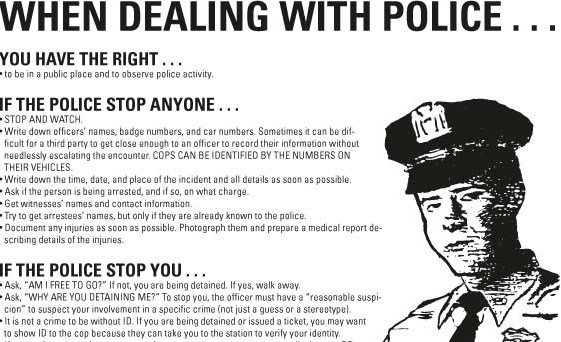
Talk to someone who has never dealt with the cops about police behaving badly, and he or she will inevitably say, “But they can’t do that! Can they?” The question of what the cops can or can’t do is natural enough for someone who never deals with cops, especially if their inexperience is due to class and/or race privilege. But a public defender would describe that question as naïve. In short, the cops can do almost anything they want, and often the most maddening tactics are actually completely legal.
There are many reasons for this, but three historical developments stand out: the war on drugs provided the template for social control based on race; 9/11 gave federal and local officials the opportunity to ensnare Muslims (and activists) in the ever-increasing surveillance and incarceration state; and a lack of concern from the public at large means these tactics can be applied, often controversy-free, to anyone who resists them.
What follows are 10 of the innumerable tactics the police can use against a population often incapable of constraining their behavior.
1. Infiltration, informants and monitoring. The NYPD’s Demographics Unit has engaged in a massive surveillance program directed at Muslims throughout the entire Northeast region, ignoring any jurisdictional limitations and acting as a secret police and intelligence gathering agency – a regional FBI of sorts. The AP’s award-winning reports [3] on the Demographics Unit helped bring some information about the program to light, including the revelation that its efforts have resulted in exactly zero terrorism leads. [4]
Although a lawsuit from 1971, the Handschu case, [4] “resulted in federal guidelines that prohibit the NYPD from collecting information about political speech unless it is related to potential terrorism,” legal experts worry that privacy rights have been so diminished that Muslims who are spied on may not be able to seek recourse. The AP quoted [5] Donna Lieberman in November 2011, who said, “It’s really not clear that people can do anything if they’ve been subjected to unlawful surveillance anymore.”
Muslims are not the only group that has been targeted. The AP reported [6] that the NYPD has also infiltrated liberal groups and protest organizers. Other cases of entrapment of activists, such as the NATO 5 [7] and the Cleveland 5, are also troubling. [8]
2. Warrantless home surveillance. Just in case you still think there must be some limit on how the authorities can surveil you, there’s this — a federal agency, not the police, but the larger point stands. The Ninth Circuit Court of Appeals recently ruled that it is legal for a law enforcement agent [9] to enter your house and videotape you without your consent. The case, United States v. Wahchumwah, revolved around a U.S. Fish and Wildlife undercover agent who recorded Wahchumwah without a warrant. The Ninth Circuit found the search to be “voluntary,” which led the EFF to write on its Web site: “The sad truth is that as technology continues to advance, surveillance becomes ‘voluntary’ only by virtue of the fact we live in a modern society where technology is becoming cheaper, easier and more invasive.”
“CNET has learned that U.S. District Judge William Griesbach [11] ruled that it was reasonable for Drug Enforcement Administration agents to enter rural property without permission — and without a warrant — to install multiple ‘covert digital surveillance cameras’ in hopes of uncovering evidence that 30 to 40 marijuana plants were being grown.”
During the Bush years, Congress had to grant retroactive immunity to giant telecoms that engaged in warrantless wiretapping. It seems, the judicial branch wants to save Congress the trouble.
3. Preemptive visits and harassment. One of the favorite tactics of police departments is targeting activists a day before a large event. We saw this on May Day in New York City, as cops descended on several activists’ apartments before the day of action, [12] and in Chicago before the massive No NATO protests. [13] The Cleveland 5 were also arrested before May Day, and back in 2008 the RNC8 were also preemptively arrested. [7]
4. Creating call logs from stolen phones. If you lose your phone in NYC and report it to the police, they’ll help you find it. So far, so good. Where the agreement turns pear-shaped, however, is what they do with your call logs. The NYPD subpoenas your call log from the day it was stolen onward, under the logic that the records could help find your phone.
But — and here’s the kicker — they get info for the calls you made on the day it was swiped, and possibly even info from your new cell phone if you keep your number. The information is added to a database called the Enterprise Case Management System, and the numbers are hyperlinked for cross-referencing. The call logs, all obtained without a court order and often without the victim’s permission or knowledge, could “conceivably be used for any investigative purpose,” according to the New York Times. [14]
5. Consent searches. Sometimes a cop gives you a command, but phrases it as a question, like, “Would you open your bag so I can look inside?” If you’re anything like the vast majority of people in the United States, you have no idea that you’re under no lawful obligation to answer in the affirmative. You can, legally speaking, ask if you are being detained, and if the answer is no, you are free to walk away. Or at the very least, not open your bag.
Cops are aware that they can intimidate someone they decide to search, and once they obtain “consent” – e.g. “Yes, man with a gun who is towering over me, you can look in my bag” – any evidence of criminality they find can be used in court. This method of searching people was developed, like several other tactics on this list, during the early 1980s when the Reagan administration ramped up the so-called war on drugs.
Many critics argue that the very idea of a “consensual” interaction between police and the public is impossible, if the police initiate contact. As Justin Peters writes [15], “[Police] know the average person doesn’t feel they’re in a position to decline a conversation with a cop.” A common tactic [16] is for officers to say they’ll let someone off with a warning, then proceed to ask a bunch of questions, even though the person is technically free to go.
6. Stop and frisk. You’ve probably heard about stop and frisk by now, but for years this odious tactic – and close cousin to consent searches – went woefully underreported in establishment media. The NYCLU released staggering statistics for the year 2011 detailing the massive size of the program in New York City. One particularly memorable figure was that the NYPD stopped more young men of color than there are men of color in NYC. [17] (More information at stopmassincarceration.org [18].)
7. Pretext stops (Operation Pipeline). The Supreme Court has repeatedly ruled that cops are free to use minor traffic violations as a pretext to pull over people they suspect of committing drug crimes. Once pulled over, the police obtain “consent” – “Would you get out of the car and empty your pockets?” – and can go on fishing expeditions.
In the Supreme Court’s ruling in Ohio v. Robinette, “The Court made clear to all lower courts that, from now on, the Fourth Amendment should place no meaningful constraints on the police in the War on Drugs,” writes Michelle Alexander in The New Jim Crow. The Court determined [19] that cops don’t have to tell motorists they’re free to leave before getting “permission” to search their car.
In the mid-1980s, the DEA rolled out Operation Pipeline, a federal program that trained city cops in the shady art of leveraging pretext stops into consent searches. The discretionary nature of many of these searches resulted in massive amounts of racial profiling, so much so that some officials say [20] “the reason racial profiling is a national problem is that it was initiated, and in many ways encouraged, by the federal government’s war on drugs.”
8. Police dogs. Don’t consent to cops searching your bag? If you’re in a car or an airport, police can bring in the dogs to smell your stuff, and if the dog responds, they have probable cause to search you without your consent. “The Supreme Court has ruled that walking a drug-sniffing dog around someone’s vehicle (or someone’s luggage) does not constitute a ‘search,’ and therefore does not trigger Fourth Amendment scrutiny,” Michelle Alexander writes.
But if a dog barks or sits, shouldn’t we be comfortable with that triggering probable cause? Radley Balko has reported on the phenomenon of drug dogs giving false positives after reading cues from their handlers [16]:
The problem isn’t that the dogs aren’t capable of picking up the scent; it’s that dogs have been bred to please and interact with humans. A dog can easily be manipulated to alert whenever needed. But even with conscientious cops, a dog without the proper training may pick up on its handler’s body language and alert whenever it detects its handler is suspicious.
This is called the “Clever Hans effect,” [21] named after the horse who could do arithmetic by tapping his hoof. In reality, the horse could recognize the shift in his owner’s body language when he had arrived at the right number.
9. Surveillance drones. The drones are coming, and the few illusions of privacy we cling to will soon disappear. The domestic market for drones in the next decade is estimated in the billions, [22] and police departments are chomping at the bit to implement this new technology. Drones already patrol the US-Mexico border, [23] and cities such as Seattle are moving toward using surveillance drones [24]. In August, a North Dakota court ruled [25] that the first-ever drone-assisted arrest was perfectly legal.
In our ever more authoritarian society, [26] expect politicians and the lobbyists who fund their campaigns to justify increased incursions into privacy in the name of security. The short-term incentives to value privacy have been all but forgotten, as “if you’re not doing anything wrong you’ve got nothing to fear” has gone from self-evidently absurd cliché to national motto.
10. Enlist the private sector. The comedian Chris Laker says of privatization: “You can’t privatize everything. Learned that from RoboCop.” But it seems police departments haven’t learned that lesson. In Arizona, police enlisted the help of the Corrections Corporation of America, a private, for-profit prison corporation, in a drug sweep of a public school. PRWatch reports: [27]
“To invite for-profit prison guards to conduct law enforcement actions in a high school is perhaps the most direct expression of the ‘schools-to-prison pipeline’ I’ve ever seen,” said Caroline Isaacs, program director of the Tucson office of the American Friends Service Committee (AFSC), a Quaker social justice organization that advocates for criminal justice reform.
The privatization of nearly all aspects of public life, from education to law enforcement, is a trend we should all find disturbing, not least of all when a company that profits from locking humans in cages is directly involved in the arrest process.
The larger point here is obvious. In the last decade, the Bill of Rights has been shredded at the federal level and the local level. There are few constraints on police, FBI, NSA, and private intelligence companies when it comes to surveillance of the public. That many of these programs and tactics are discretionary exacerbates and magnifies conscious and subconscious racist and classist attitudes among those who carry them out.
Editor’s note: a formatting error which has since been corrected erased a block quote from the text of this article, leading to inadvertently incorrect attribution of a quote.
Max Interviews guest Ryan Hunter – Author of INdivisible
PLOT: Brynn Aberdie has everything but freedom … but everything has a way of changing. When Brynn loses her family, her security, and her handouts, she is left with one last option, and it guarantees one of two things: freedom or death. Brynn vows to find that freedom, and soon learns a lesson many in One United have already learned – by failing to protect their rights, Citizens have forfeited their lives with little hope to ever recover them.
Exploration of ‘Proof of Heaven’
Long before this book was ever written, Dr. Alexander was a practicing neurosurgeon and a lifelong “science skeptic.” He did not believe in consciousness, free will or the existence of a non-physical spirit. Trained in western medical school and surrounded by medical colleagues who are deeply invested in the materialism view of the universe, Dr. Alexander believed that so-called “consciousness” was only an illusion created by the biochemical functioning of the brain.
Dr. Alexander would have held this view to his own death bed had it not been for his experiencing an event so bizarre and miraculous that it defies all conventional scientific explanation: Dr. Alexander “died” for seven days and experienced a vivid journey into the afterlife. He then returned to his physical body, experienced a miraculous healing, and went on to write the book “Proof of Heaven.”
“Disturbing, powerful and emotionally devastating, Tears of Gaza is less a conventional documentary than a record — presented with minimal gloss — of the 2008 to 2009 bombing of Gaza (dubbed ‘Operation Cast Lead’) by the Israeli military. Filmed by several Palestinian cameramen both during and after the offensive, this powerful film by director Vibeke Løkkeberg focuses on the impact of the attacks on the civilian population.
Tears of Gaza makes no overriding speeches or analyses. The situation leading up to the incursion (in which the Jewish state broke a truce unprovoked) is never mentioned. Similar events certainly occurred in Dresden, Tokyo, Baghdad and Sarajevo, but of course Gaza isn’t those places. Tears of Gaza demands that we examine the costs of war on a civilian populace.”
(Excerpt from Steve Gravestock, 2011 Toronto International Film Festival) http://tearsofgazamovie.com/
About nine months before a Senate subcommittee for investigations report blasted DHS fusion centers as colossal wastes of money, redundant bureaucracies and threats to our liberty, the Department delivered testimony to the House Permanent Select Committee on Intelligence called “Homeland Security and Intelligence: Next Steps in Evolving the Mission.”
The testimony might as well have been called “We Are Doing Important Stuff, Seriously Guys, C’mon, Please Don’t Cut Our Budget!” It seems like every third sentence in it is an implicit acknowledgement and desperate rebuttal of the fact that DHS’ “intelligence mission” is largely redundant. There are 17 intelligence agencies in the United States at present. As the Senate subcommittee for investigations report on fusion centers observed, the “intelligence mission” DHS has spent hundreds of billions of dollars to implement is being more effectively executed by the FBI’s Joint Terrorism Task Force (JTTF) operations.
So what’s left for poor DHS? According to the January 2012 testimony: more of the same, with a (bad) twist. Read the following paragraph from the testimony keeping in mind what we learned here in Boston about the local fusion center’s spying on peaceful First Amendment protected speech and assembly. (We found that the DHS-funded Boston Regional Intelligence Center (BRIC) has been spying on peace activists and labeling them “Extremists” and “HomeSec-Domestic” threats in “intelligence reports” that could easily be shared with the federal government.)
As threat grows more localized, the prospect that a state/local partner will generate the first lead to help understand a new threat, or even an emerging cell, will grow. And the federal government’s need to train, and even staff, local agencies, such as major city police departments, will grow. Because major cities are the focus for threat, these urban areas also will become the sources of intelligence that will help understand these threats at the national level, DHS might move toward decentralizing more of its analytic workforce to partner with state/local agencies in the collection and dissemination of intelligence from the local level.
A translation into non-beltway English: DHS is doubling down on its quest to transform local police departments into mini intelligence agencies. That’s a terrible idea and it is up to us to stop it.
Why resist police federalization? Put simply: we need police departments to respond to local issues, not serve as foot soldiers for the federal spy agencies. Fortunately, terrorism isn’t a major problem in 99% of cities in the United States. As Micah Zenko observes, if you live in the US you are as likely to be killed by your furniture as you are by a terrorist. But that fact has not stopped and will not stop DHS from showering your local police department with money and technology to enable its militarization and federalization, with terror threats as the alibi. Only we can stop this dangerous trend.
And it will likely take some serious organizing. After all, it’s highly unlikely that departments will easily give up access to the “free” federal money for surveillance gadgets and data sharing programs they’ve been raking in for the past ten years. The only way to bring some democracy to this largely shadowy process is to bring it yourself, like people in Oakland are doing right now by stirring up a storm about Alameda County’s plans to acquire surveillance drones.
How can you resist the federal government trying to turn your local police department into a mini-FBI? First you need to know what is going on. Visit your local police department’s website and see if it has posted any information about federal grants for equipment or information sharing programs. File public records requests to the department to learn how any federal monies have been spent over the past five years. (You can file public records requests quickly and easily here.) Then take what you find to the people.
After you’ve learned about what the police department is doing with federal funds, write about it for your local paper. Most local newspapers are happy to accept op-eds from people who live in town. If your area has a Patch online newspaper, write something for that. Spread the word in whatever way you can and make it clear to the local government that you are paying attention to what goes on at the police department.
Finally, bring the issue to your town or city governing body. Here in Massachusetts we have a very strong town government system (the strength of these local offices varies state by state, but it’s a good place to start no matter where you live).
So for example, if your research shows you that the local police department got lots of DHS cash for surveillance cameras and simply installed them without a public conversation on the merits of the enhanced spying, raise the issue with the governing body that controls the police department. Make it clear that you want all future federal grants to the police to be discussed and debated publicly, and that you want your elected officials to play a role in deciding policing procedures. Ask about data policies and whether the information from the cameras can be shared with outside agencies. If there’s the political will in the community, maybe you can get the cameras turned off like people did here in Cambridge, MA.
Let it be known that you want your community to retain local control over your local police. The bureaucrats at DHS will likely be sad if we can work together to reverse the troubling federalization and militarization of our local police departments — it very well might put many of them out of work — but our democracy will be much better off.
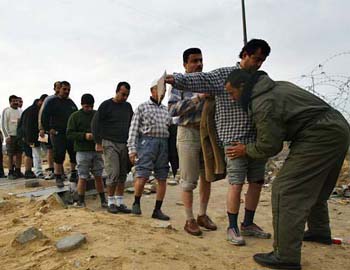
Palestinian workers line up to get checked by a Palestinian security officer before entering the Israeli controlled industrial zone in Erez area between Israel and the Gaza Strip.
A look at life under occupation.
Gaza has the look of a Third World country, with pockets of wealth surrounded by hideous poverty. It is not, however, undeveloped. Rather it is “de-developed,” and very systematically so, to borrow the term from Sara Roy, the leading academic specialist on Gaza.
Even a single night in jail is enough to give a taste of what it means to be under the total control of some external force.
And it hardly takes more than a day in Gaza to appreciate what it must be like to try to survive in the world’s largest open-air prison, where some 1.5 million people on a roughly 140-square-mile strip of land are subject to random terror and arbitrary punishment, with no purpose other than to humiliate and degrade.
Such cruelty is to ensure that Palestinian hopes for a decent future will be crushed, and that the overwhelming global support for a diplomatic settlement granting basic human rights will be nullified. The Israeli political leadership has dramatically illustrated this commitment in the past few days, warning that they will “go crazy” if Palestinian rights are given even limited recognition by the U.N.
This threat to “go crazy” (“nishtagea”)–that is, launch a tough response–is deeply rooted, stretching back to the Labor governments of the 1950s, along with the related “Samson Complex”: If crossed, we will bring down the Temple walls around us.
Thirty years ago, Israeli political leaders, including some noted hawks, submitted to Prime Minister Menachem Begin a shocking report on how settlers on the West Bank regularly committed “terrorist acts” against Arabs there, with total impunity.
Disgusted, the prominent military-political analyst Yoram Peri wrote that the Israeli army’s task, it seemed, was not to defend the state, but “to demolish the rights of innocent people just because they are Araboushim (a harsh racial epithet) living in territories that God promised to us.”
Gazans have been singled out for particularly cruel punishment. Thirty years ago, in his memoir “The Third Way,” Raja Shehadeh, a lawyer, described the hopeless task of trying to protect fundamental human rights within a legal system designed to ensure failure, and his personal experience as a Samid, “a steadfast one,” who watched his home turned into a prison by brutal occupiers and could do nothing but somehow “endure.”
Since then, the situation has become much worse. The Oslo Accords, celebrated with much pomp in 1993, determined that Gaza and the West Bank are a single territorial entity. By that time, the U.S. and Israel had already initiated their program to separate Gaza and the West Bank, so as to block a diplomatic settlement and punish the Araboushim in both territories.
Punishment of Gazans became still more severe in January 2006, when they committed a major crime: They voted the “wrong way” in the first free election in the Arab world, electing Hamas.
Displaying their “yearning for democracy,” the U.S. and Israel, backed by the timid European Union, immediately imposed a brutal siege, along with military attacks. The U.S. turned at once to its standard operating procedure when a disobedient population elects the wrong government: Prepare a military coup to restore order.
Gazans committed a still greater crime a year later by blocking the coup attempt, leading to a sharp escalation of the siege and attacks. These culminated in winter 2008-09, with Operation Cast Lead, one of the most cowardly and vicious exercises of military force in recent memory: A defenseless civilian population, trapped, was subjected to relentless attack by one of the world’s most advanced military systems, reliant on U.S. arms and protected by U.S. diplomacy.
Of course, there were pretexts–there always are. The usual one, trotted out when needed, is “security”: in this case, against homemade rockets from Gaza.
In 2008, a truce was established between Israel and Hamas. Not a single Hamas rocket was fired until Israel broke the truce under cover of the U.S. election on Nov. 4, invading Gaza for no good reason and killing half a dozen Hamas members.
The Israeli government was advised by its highest intelligence officials that the truce could be renewed by easing the criminal blockade and ending military attacks. But the government of Ehud Olmert–himself reputedly a dove–rejected these options, resorting to its huge advantage in violence: Operation Cast Lead.
The internationally respected Gazan human-rights advocate Raji Sourani analyzed the pattern of attack under Cast Lead. The bombing was concentrated in the north, targeting defenseless civilians in the most densely populated areas, with no possible military basis. The goal, Sourani suggests, may have been to drive the intimidated population to the south, near the Egyptian border. But the Samidin stayed put.
A further goal might have been to drive them beyond the border. From the earliest days of the Zionist colonization it was argued that Arabs have no real reason to be in Palestine: They can be just as happy somewhere else, and should leave–politely “transferred,” the doves suggested.
This is surely no small concern in Egypt, and perhaps a reason why Egypt doesn’t open the border freely to civilians or even to desperately needed supplies.
Sourani and other knowledgeable sources have observed that the discipline of the Samidin conceals a powder keg that might explode at any time, unexpectedly, like the first Intifada in Gaza in 1987, after years of repression.
A necessarily superficial impression after spending several days in Gaza is amazement, not only at Gazans’ ability to go on with life but also at the vibrancy and vitality among young people, particularly at the university, where I attended an international conference.
But one can detect signs that the pressure may become too hard to bear. Reports indicate that there is simmering frustration among young people–a recognition that under the U.S.-Israeli occupation the future holds nothing for them.
Gaza has the look of a Third World country, with pockets of wealth surrounded by hideous poverty. It is not, however, undeveloped. Rather it is “de-developed,” and very systematically so, to borrow the term from Sara Roy, the leading academic specialist on Gaza.
The Gaza Strip could have become a prosperous Mediterranean region, with rich agriculture and a flourishing fishing industry, marvelous beaches and, as discovered a decade ago, good prospects for extensive natural gas supplies within its territorial waters. By coincidence or not, that’s when Israel intensified its naval blockade. The favorable prospects were aborted in 1948, when the Strip had to absorb a flood of Palestinian refugees who fled in terror or were forcefully expelled from what became Israel – in some cases months after the formal cease-fire. Israel’s 1967 conquests and their aftermath administered further blows, with terrible crimes continuing to the present day.
The signs are easy to see, even on a brief visit. Sitting in a hotel near the shore, one can hear the machine-gun fire of Israeli gunboats driving fishermen out of Gaza’s territorial waters and toward land, forcing them to fish in waters that are heavily polluted because of U.S.-Israeli refusal to allow reconstruction of the sewage and power systems they destroyed.
The Oslo Accords laid plans for two desalination plants, a necessity in this arid region. One, an advanced facility, was built: in Israel. The second one is in Khan Yunis, in the south of Gaza. The engineer in charge at Khan Yunis explained that this plant was designed so that it can’t use seawater, but must rely on underground water, a cheaper process that further degrades the meager aquifer, guaranteeing severe problems in the future.
The water supply is still severely limited. The U.N. Relief and Works Agency (UNRWA), which cares for refugees but not other Gazans, recently released a report warning that damage to the aquifer may soon become “irreversible,” and that without quick remedial action, Gaza may cease to be a “livable place” by 2020.
Israel permits concrete to enter for UNRWA projects, but not for Gazans engaged in the huge reconstruction efforts. The limited heavy equipment mostly lies idle, since Israel does not permit materials for repair.
All this is part of the general program that Dov Weisglass, an adviser to Prime Minister Olmert, described after Palestinians failed to follow orders in the 2006 elections: “The idea,” he said, “is to put the Palestinians on a diet, but not to make them die of hunger.”
Recently, after several years of effort, the Israeli human rights organization Gisha succeeded in obtaining a court order for the government to release its records detailing plans for the “diet.” Jonathan Cook, a journalist based in Israel, summarizes them: “Health officials provided calculations of the minimum number of calories needed by Gaza’s 1.5 million inhabitants to avoid malnutrition. Those figures were then translated into truckloads of food Israel was supposed to allow in each day … an average of only 67 trucks–much less than half of the minimum requirement–entered Gaza daily. This compared to more than 400 trucks before the blockade began.”
The result of imposing the diet, Middle East scholar Juan Cole observes, is that “about 10 percent of Palestinian children in Gaza under age 5 have had their growth stunted by malnutrition. … In addition, anemia is widespread, affecting over two-thirds of infants, 58.6 percent of schoolchildren, and over a third of pregnant mothers.”
Sourani, the human-rights advocate, observes that “what has to be kept in mind is that the occupation and the absolute closure is an ongoing attack on the human dignity of the people in Gaza in particular and all Palestinians generally. It is systematic degradation, humiliation, isolation and fragmentation of the Palestinian people.”
This conclusion has been confirmed by many other sources. In The Lancet, a leading medical journal, Rajaie Batniji, a visiting Stanford physician, describes Gaza as “something of a laboratory for observing an absence of dignity,” a condition that has “devastating” effects on physical, mental and social well-being.
“The constant surveillance from the sky, collective punishment through blockade and isolation, the intrusion into homes and communications, and restrictions on those trying to travel, or marry, or work make it difficult to live a dignified life in Gaza,” Batniji writes. The Araboushim must be taught not to raise their heads.
There were hopes that Mohammed Morsi’s new government in Egypt, which is less in thrall to Israel than the western-backed Hosni Mubarak dictatorship was, might open the Rafah Crossing, Gaza’s sole access to the outside that is not subject to direct Israeli control. There has been a slight opening, but not much.
The journalist Laila el-Haddad writes that the reopening under Morsi “is simply a return to status quo of years past: Only Palestinians carrying an Israeli-approved Gaza ID card can use Rafah Crossing.” This excludes a great many Palestinians, including el-Haddad’s own family, where only one spouse has a card.
Furthermore, she continues, “the crossing does not lead to the West Bank, nor does it allow for the passage of goods, which are restricted to the Israeli-controlled crossings and subject to prohibitions on construction materials and export.”
The restricted Rafah Crossing doesn’t change the fact that “Gaza remains under tight maritime and aerial siege, and continues to be closed off to the Palestinians’ cultural, economic and academic capitals in the rest of the (Israeli-occupied territories), in violation of U.S.-Israeli obligations under the Oslo Accords.”
The effects are painfully evident. The director of the Khan Yunis hospital, who is also chief of surgery, describes with anger and passion how even medicines are lacking, which leaves doctors helpless and patients in agony.
One young woman reports on her late father’s illness. Though he would have been proud that she was the first woman in the refugee camp to gain an advanced degree, she says, he “passed away after six months of fighting cancer, aged 60 years.
“Israeli occupation denied him a permit to go to Israeli hospitals for treatment. I had to suspend my study, work and life and go to sit next to his bed. We all sat, including my brother the physician and my sister the pharmacist, all powerless and hopeless, watching his suffering. He died during the inhumane blockade of Gaza in summer 2006 with very little access to health service.
“I think feeling powerless and hopeless is the most killing feeling that a human can ever have. It kills the spirit and breaks the heart. You can fight occupation but you cannot fight your feeling of being powerless. You can’t even ever dissolve that feeling.”
A visitor to Gaza can’t help feeling disgust at the obscenity of the occupation, compounded with guilt, because it is within our power to bring the suffering to an end and allow the Samidin to enjoy the lives of peace and dignity that they deserve.
Noam Chomsky is Institute Professor & Professor of Linguistics (Emeritus) at the Massachusetts Institute of Technology, and the author of dozens of books on U.S. foreign policy. He writes a monthly column for The New York Times News Service/Syndicate.
While the TSA can’t explain why invasive patdowns without probable cause are legal, that isn’t stopping TSA from future plans to track all your daily travels, anywhere you go, from work, to stores, or even when you go out to play.
Meanwhile at airports, the TSA is rolling out “less-invasive gingerbread man” body scanners to a tune of $2.7 million for 240 machines. At this point, I don’t think skinnier versions of the Pillsbury Doughboy via kinder and gentler naked body scans are going to placate people who are secretly murmuring that America is truly becoming a police state. Spending countless billions of dollars on all this ‘security theater’ makes it look like the TSA is “doing their best to ensure that if there’s a terrorist attack the public doesn’t blame the TSA for missing it.”
According to TSA Blogger Bob, in the 10 years after 9/11, there have been vast improvements and new technology as well as a “professionalized workforce” of Transportation Security Officers. Professional as in claiming no more enhanced groping of children under 12, only to break that promise and seemingly molest this little boy dressed as Spiderman?
The Los Angeles Times reported on TSA launching a behavior-detection program at Boston’s Logan International Airport. These TSA officers received a whopping two weeks of training and are supposed to ask each passenger a “few” questions “in an effort to detect suspicious behavior.” Doesn’t this seem like yet another strike at your privacy? Some people are stressed or even nervous when they are traveling. What if you don’t feel like talking or being questioned? Is this too going to become yet another TSA-mandated “you will answer if you want the privilege of flying?”
A MSNBC travel article warned that when it comes to airport security, “you ain’t seen nothing yet.” Some security analysts suggest Big Brother will employ an even Bigger Brother in the form of “chip-embedded passports that someday tell the federal transportation watchdogs all about your daily commutes to work, the mall — even to parties.”
Other security analysts suggest it will all be about “gathering intelligence technologically” or that increased biometrics is the security answer. The Known Traveler Program will launch this fall so previously known and trusted travelers will “have bar codes stamped on their boarding passes, authorizing TSA screeners to allow those passengers to skip shoe and laptop removals.” TSA Administrator John Pistole said, “Enhancing identity-based screening is another common sense step in the right direction as we continue to strengthen overall security and improve the passenger experience whenever possible.”
So even though the TSA is building up its ranks with bomb-sniffing dogs, there will be dramatic changes in store for travelers within the next 30 years. There will be biometric fingerprinting as well as other biometric and personal info stored in government databases.
Senior policy analyst at the Center for Health and Homeland Security Vernon R. Herron told MSNBC that your official travel document “will not only have information as to who you are and where you have traveled, but it will also … allow government officials to track your travel not only in the air, but your daily travels to work, grocery stores and social events.” In the future the “government will detain passengers who have traveled to places that are suspicious in nature” once they enter an airport, Herron added. “All these measures seem extreme. However, after we declared a war on terror, we must be more proactive than reactive when it comes to airport security.”
Ah, again with the “suspicious” lists even if it’s places to which you traveled this time. Regarding the dreaded list after list of supposed suspicious activity, are they meant to keep the public in a state of paranoia and fear so they just roll over and watch it happen? Digg commenter leodin said, “Strange… The actual threat of terrorism hasn’t increased, and the odds of actually dying in a terrorist attack make the lottery look like a sound investment, and yet the government seems insistent upon taking more and more measures to protect us from these imaginary threats.”
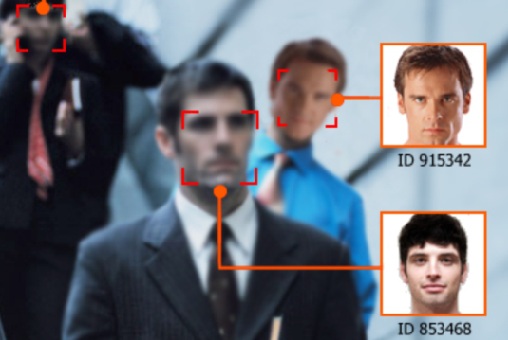
New Tips and Tricks to Fool Surveillance Cameras now Known to be using advanced algorithm technology for automated Facial Recognition and profiling. With a few of the right LED lights, and a 9 volt battery on the brim of a hat, one can walk around with a veil of protection yet not stand out in public.
“I do solemnly swear that I will support and defend the Constitution of the United States against all enemies, foreign and domestic…”
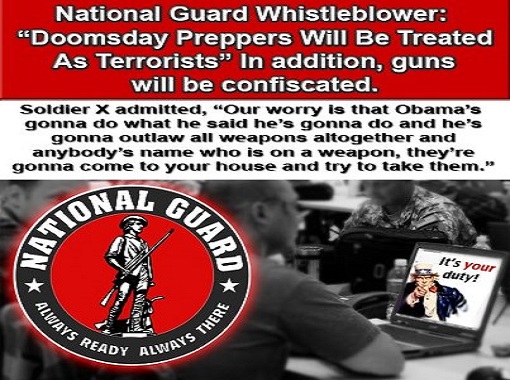
So begins the Oath of Enlistment for the U.S. military, but in an explosive interview with a National Guard whistleblower shown below, soldiers are now being advised they will be ordered to break that oath should civil unrest erupt across the country.
Referred to only as “Soldier X” under promise of anonymity, an Army National Guardsman spoke via phone with Infowars Nightly News Producer Rob Dew regarding a recent briefing his unit underwent on actions the military would take in the event that an Obama election loss sparked rioting in America’s streets.
Citing not only recent widespread threats to riot if Mitt Romney were to become the next U.S. president, but threats to actually assassinate him should he win, Soldier X’s superiors dispensed plans of how the National Guard would be responsible for “taking over” and quelling such unrest.
The soldiers were reportedly told “Doomsday preppers will be treated as terrorists.”
In addition, guns will be confiscated.
“They have a list compiled of all these doomsday preppers that have gone public and they plan to go after them first,” Soldier X said. He claimed those in charge are acting under the belief that preppers will be “the worst part” of any potential civil unrest.
Soldier X was also told that any soldiers in the ranks who are known as preppers will be deemed “defects.” He explained the label meant these soldiers would be treated as traitors. “If you don’t conform, they will get rid of you,” he added.
Unit members also warned not to associate with any fellow soldiers who are preppers.
Not only does the military reportedly plan to target preppers should mass chaos break out, but Soldier X also voiced his concerns regarding civilian gun confiscation.
Soldier X admitted, “Our worry is that Obama’s gonna do what he said he’s gonna do and he’s gonna outlaw all weapons altogether and anybody’s name who is on a weapon, they’re gonna come to your house and try to take them.”
It would not be the first time the National Guard has been used to unconstitutionally disarm law-abiding citizens, robbing them of their Second Amendment right to bear arms. In the aftermath of hurricane Katrina, police and military took to the streets disarming lawful gun owners, including those who were on dry land and had plenty of stored food and water.
Fast forward to this past summer when a leaked Army manual dated 2006 entitled, “Civil Disturbance Operations” surfaced outlining plans not only to confiscate firearms domestically during mass unrest, but to actually detain and even kill American citizens who refuse to hand over their guns. This manual works in conjunction with “FM 3-39.40 Internment and Resettlement Operations,” another Army manual leaked this year, which instructs troops on how to properly detain and intern Americans into re-education camps, including ways that so-called “psy-op officers” will “indoctrinate” incarcerated “political activists” into developing an “understanding and appreciation of U.S. policies and actions.”
Add these manuals to the plethora of Executive Orders Obama has signed during his term which have dismantled our Constitution piece by piece, including the martial law implementing National Defense Resources Preparedness Executive Order which gives the president the power to confiscate citizens’ private property in the event of any national emergency, including economic.
Add it all to the National Defense Authorization Act (NDAA) in which Obama granted powers to disappear and indefinitely detain American citizens without any due process, and it is easy to see the tyrannical big picture our government has painted.
When asked if he would go along with gun confiscation, Soldier X replied he and his fellow like-minded guardsmen planned to stand down — not answer the phone or show up to post.
“I’m sorry but I don’t believe in suicide,” he said.
Preppers are becoming regular government targets these days, most recently when a Missisippi prepper group member with a clean record was suddenly taken off his flight halfway to Japan and informed he was on the no-fly list, an FBI terrorist watchlist, stranding him in Hawaii. Other preppers have been denied their Second Amendment rights without legitimate cause.
It is beyond glaringly obvious at this point the U.S. government is gearing up for mass civil unrest. Not only has the DHS sparked controversy by purchasing billions of rounds of ammo, but the department even went so far as to begin classifying further purchases, blacking out bullet figures it is using taxpayer money to buy.
In addition, while FEMA can procure a billion dollars in bulk food supplies, the FBI’s Communities Against Terrorism project released a flier instructing military surplus store owners to report any customers who “make bulk purchases of items” including “meals ready to eat”.
Should society as we know it collapse following the election, it would seem the ultimate prepper and the ultimate terrorist is, indeed, the U.S. government.
On Friday, EFF and the ACLU submitted an amicus brief in United States v. Rigmaiden, a closely-followed case that has enormous consequences for individuals’ Fourth Amendment rights in their home and on their cell phone. As the Wall Street Journal explained today, the technology at the heart of the case invades the privacy of countless innocent people that have never even been suspected of a crime.
Rigmaiden centers around a secretive device that federal law enforcement and local police have been using with increased frequency: an International Mobile Subscriber Identity locator, or “IMSI catcher.” These devices allows the government to electronically search large areas for a particular cell phone’s signal—sucking down data on potentially thousands of innocent people along the way—while attempting to avoid many of the traditional limitations set forth in the Constitution.
How Stingrays Work
The Stingray is a brand name of an IMSI catcher targeted and sold to law enforcement. A Stingray works by masquerading as a cell phone tower—to which your mobile phone sends signals to every 7 to 15 seconds whether you are on a call or not— and tricks your phone into connecting to it. As a result, the government can figure out who, when and to where you are calling, the precise location of every device within the range, and with some devices, even capture the content of your conversations. (Read the Wall Street Journal’s detailed explanation for more.)
In Rigmaiden, the government asked a federal judge in Northern California to order Verizon to assist in locating the defendant, who was a suspect in a tax fraud scheme. But after they received an order telling Verizon to provide the location information of an Aircard they thought to be the defendant’s, the government took matters into their own hands: they claimed this authorization somehow permitted its own use of a Stingray.
Not only did the Stringray find the suspect, Rigmaiden, but it also got the records of every other innocent cell phone user nearby.
The government now concedes that the use of the device was a “search” under the Fourth Amendment and claims it had a warrant, despite the fact that, as we explain in our brief, “the Order directs Verizon to provide the government with information and assistance, but nowhere authorizes the government to search or seize anything.”
In fact, the government’s application made no mention of an IMSI catcher or a Stingray, and only has a brief sentence about its plans buried at the end of an 18-page declaration: “the mobile tracking equipment ultimately generate[s] a signal that fixes the geographic position of the Target Broadband Access Card/Cellular Telephone.”
A judge initially signed off on this order, but clearly, the government did not accurately and adequately explain what it was really up to.
General Warrants: Unconstitutional, All You Can Eat Data Buffets
Beyond the government’s conduct in this specific case, there is an even broader danger in law enforcement using these devices to locate suspects regardless of whether they explain the technology to judges: these devices allow the government to conduct broad searches amounting to “general warrants,” the exact type of search the Fourth Amendment was written to prevent.
A Stingray—which could potentially be beamed into all the houses in one neighborhood looking for a particular signal—is the digital version of the pre-Revolutionary war practice of British soldiers going door-to-door, searching Americans’ homes without rationale or suspicion, let alone judicial approval. The Fourth Amendment was enacted to prevent these general fishing expeditions. As the Supreme Court has explained, a warrant requires probable cause for all places searched, and is supposed to detail the scope of the search to ensure “nothing is left to the discretion of the officer executing the warrant”.
But if uninformed courts approve the unregulated use of Stingrays, they are essentially allowing the government to enter into the home via a cellular signal at law enforcement’s discretion and rummage at will without any supervision. The government can’t simply use technology to upend centuries of Constitutional law to conduct a search they would be prevented from doing physically.
Stingrays Collect Data on Hundreds of Innocent People
And when police use a Stingray, it’s not just the suspects’ phone information the device sucks up, but all the innocent people around such suspect as well. Some devices have a range of “several kilometers,” meaning potentially thousands of people could have their privacy violated despite not being suspected of any crime. This is another fact the government didn’t fully explain to the magistrate judge in Rigmaiden.
The government now claims it protected privacy by deleting all third-party data on its own after it collected it. But the government’s unilateral decision to binge and purge comes with its own consequences. Now there’s no way to know what exactly the government obtained when it used the device.
Had the government told the court what it really was planning on doing and the amount of information it would obtain, the court may have exercised its constitutional role of ensuring the government narrowed its search. After all, it was for the court, not the government, to decide how best to balance the government’s need for information with third-party privacy, and any suspect’s future interest in access to potentially exculpatory information.
Enough Warrantless Excursions
Unfortunately, US government excuses for conducting warrantless searches are becoming all too familiar. Whether it’s the hundreds of thousands of searches for cell phone location information, the skyrocketing of warrantless surveillance of who and when you’re calling, or the NSA’s still-active warrantless wiretapping program, Americans are seeing their Fourth Amendment privacy rights under attack from all angles. We hope in this case and others like it, the court will prevent such violations of privacy from occuring again.
You’ve probably seen the news all over the ‘net: If Romney wins the election on November 6, many Obama supporters plan to riot in the streets. A surprising number have announced their plans to “kill Romney.” Simultaneously, FEMA has announced it is preparing for an event involving “mass casualties.”
Regardless of who you support in the coming election, the possibility of post-election riots is a reality. Here are 12 things you need to realize right now if you hope to stay safe should such an outcome unfold.
#1) The riots will likely occur in the inner cities. If at all possible, get out of the inner cities. In fact, you might want to think about moving out of the city altogether. Middle-class and upper-class suburbs will be safe, by the way. It’s mostly the inner cities that are likely to riot.
#2) The police will be almost instantly overwhelmed. Local peace officers are ridiculously short-staffed in cities all across the country, largely due to budget cuts. They have very little capacity to deal with any real outbreak of riots, so don’t expect calling 911 to have any impact at all.
#3) One of the greatest risks from riots is FIRES. Rioters love to set things on fire, as if burning down your own neighborhood is somehow an act of defiance against “The Man.” Even worse, rioters tend to shoot firearms at firemen who are trying to put out the fires. This causes firemen to evacuate the scene, after which fires burn out of control and do a lot more damage than they would have otherwise caused. The risk of fires spreading out of control in the inner city is surprisingly high.
#4) Innocent bystanders may be targeted with violence. Don’t be a “bystander” and you won’t be targeted (because you’re not around). The primary strategy is to simply not be in the wrong place at the wrong time.
#5) Don’t join in the riots. Even if you’re angry at the election outcome, taking part in any sort of violent protest or riot is only asking for trouble. Even if you don’t bring weapons to the riot, somebody from the other side very well might. You could easily find yourself arrested, beaten, pepper sprayed or even shot. STAY HOME and find other outlets for expressing your frustration (such as tweeting all your friends to say how much the winner “sucks bad!” which is always a sign of astounding intelligence).
#6) Think long and hard about the possible ramifications of having an Obama sign (or a Romney sign) in your yard or on your property. If your candidate wins, the haters on the other side of the aisle may take revenge on you and your property. You may wish to pull the signs on election day, before the results are publicized, in order to avoid being vandalized. Everybody has already made up their mind by that time anyway. Only a tiny percentage of the U.S. population is undecided even right now.
#7) Stock up on at least a 72-hour supply of extra necessities such as water, food, medicine and so on. Because if there are riots, there may be fires. And if there are fires, there may be infrastructure damage which could cause a 3-day outage of power, water, food supplies and so on. Election day in the inner city is not the time to be running out of food in the pantry and needing to head to the grocery store.
#8) If you’re in an at-risk area, stock up on pepper spray and bear spray. Pepper spray devices are not my favorite self defense item, but they can be surprisingly effective in crowd control. In fact, you can even buy “pepper spray grenades” online, which are really just canisters of pepper spray that you activate and then lob into, say, your apartment’s entryway if it’s under attack from a crowd of rioters. It will clear out the crazies in just a few seconds, giving you time to call 911.
Oh wait, 911 will be flooded with calls and police won’t be responding, so you’d better have a revolver or some other self defense weapon at the ready just in case you’re threatened with violence. This is the moment you’ll wish you had something more powerful than pepper spray…
#9) On election day, stay tuned in to not just the mainstream media but also the alternative media like Natural News and Info Wars. While the mainstream media may censor stories for political reasons, alternative news websites will be providing uncensored reporting throughout the day.
#10) Don’t be stupid enough to actually make threats against anybody on your Twitter feed or your Facebook page. The act of threatening a Presidential candidate is, of course, a felony crime, and those who make such threats on their own accounts should expect a visit from the U.S. Secret Service. Making such threats online only makes you look like a complete moron, providing yet more evidence to the other side that “supporters of candidate X are all complete morons” and thus furthering the divide.
As you may have noticed, neither Obama nor Romney has a monopoly on moronic supporters, although from what I can see so far, Obama supporters seem to be making a lot more violent threats online so far.
For the record, I’m not voting for either one. What you wish to do on election day is up to you, but I’ve decided to stop participating in the two-party fraud which operates much like a gang. Neither the DemoCRIPS nor the ReBLOODlicans gets my vote.
Additional predictions
If OBAMA wins:
• Expect gun sales to immediately surge to all-time highs.
• Watch for a revolt by small business owners who are fed up with healthcare mandates that are putting them out of business.
• Watch for a surge in gold prices and a sharp drop in the stock market.
• Get ready for mass arrests of government whistleblowers, journalists and critics who will be rounded up under the NDAA and sent to secret military prisons.
• Watch out for a massive increase in the signing of executive orders, where Obama will bypass Congress on everything from gun control to immigration.
If ROMNEY wins:
• Expect to see inner city riots in cities like L.A., Detroit and possibly even Houston.
• Watch for a joint U.S.-Israeli military attack on Iran to happen before February.
• Watch for a temporary DROP in gold prices to occur as the business sector experiences a (short-lived) surge in confidence.
• Expect a temporary stock market surge, reflecting optimism in business and finance sectors.
No matter who wins…
… expect MORE banker bailouts, MORE expansion of big government, MORE prosecutions against farmers and home gardeners, MORE fiat currency creation by the Fed, MORE welfare handouts to the masses, MORE TSA roadside checkpoints, MORE abuses of civil liberties by the government and MORE erosion of the Bill of Rights, which is already largely ignored by the government.
“The restructuring of media in the United States is creating forms of censorship that are as potentially damaging as overt censorship.”
“Media corporations have been undergoing a massive merging process that is realigning our sources of information in America,”
The 11 largest or most influential media corporations in the United States – General Electric Company (NBC), Viacom Inc. (cable), The Walt Disney Company (ABC), Time Warner Inc.(CNN), Westinghouse Electric Corporation (CBS), The News Corporation Ltd. (Fox), Gannett Co. Inc., Knight-Ridder Inc., New York Times Co., Washington Post Co. and the Times Mirror Co. – represent the interests of corporate America, and that the media elite are the watchdogs of acceptable ideological messages, the parameters of news and information content and the general use of media resources. Your Mainstream Media is manipulating the news you are allowed to see.
Project Censored has been documenting inadequate media coverage of crucial stories since it began in 1967 at Sonoma State University.
Each year, the group considers hundreds of news stories submitted by readers, evaluating their merits. Students search Lexis Nexis and other databases to see if the stories were underreported, and if so, the stories are fact-checked by professors and experts in relevant fields.
.” Project Censored Director Mickey Huff told us the idea was to show how various undercovered stories fit together into an alternative narrative, not to say that one story was more censored than another.
Here’s Project Censored’s Top 10 list for 2013:
1. Signs of an emerging police state
President George W. Bush is remembered largely for his role in curbing civil liberties in the name of his “war on terror.” But it’s President Obama who signed the 2012 NDAA, including its clause allowing for indefinite detention without trial for terrorism suspects.
Obama promised that “my administration will interpret them to avoid the constitutional conflict” — leaving us adrift if and when the next administration chooses to interpret them otherwise.
Another law of concern is the National Defense Resources Preparedness Executive Order that Obama issued in March 2012. That order authorizes the president, “in the event of a potential threat to the security of the United States, to take actions necessary to ensure the availability of adequate resources and production capability, including services and critical technology, for national defense requirements.”
The president is to be advised on this course of action by “the National Security Council and Homeland Security Council, in conjunction with the National Economic Council.” Journalist Chris Hedges, along with co-plaintiffs including Noam Chomsky and Daniel Ellsberg, won a case challenging the NDAA’s indefinite detention clause on Sept. 1, when a federal judge blocked its enforcement, but her ruling was overturned on Oct. 3, so the clause is back.
People who get their information exclusively from Mainstream Media sources may be surprised at the lack of enthusiasm on the left for President Barack Obama in this crucial election.
But that’s probably because they weren’t exposed to the full online furor sparked by Obama’s continuation of his predecessor’s (George Bush)overreaching approach to national security, such as Obama signing the 2012 National Defense Authorization Act, which allows the indefinite detention of those accused of supporting terrorism, even U.S. citizens.
2. Oceans in peril
Big banks aren’t the only entities that our country has deemed “too big to fail.” But our oceans won’t be getting a bailout anytime soon, and their collapse could compromise life itself. In a haunting article highlighted by Project Censored, Mother Jones reporter Julia Whitty paints a tenuous seascape — overfished, acidified, warming — and describes how the destruction of the ocean’s complex ecosystems jeopardizes the entire planet, not just the 70 percent that is water.
Whitty compares ocean acidification, caused by global warming, to acidification that was one of the causes of the “Great Dying,” a mass extinction 252 million years ago.
Life on Earth took 30 million years to recover. In a more hopeful story, a study of 14 protected and 18 non-protected ecosystems in the Mediterranean Sea showed dangerous levels of biomass depletion.
But it also showed that the marine reserves were well-enforced, with five to 10 times larger fish populations than in unprotected areas. This encourages establishment and maintenance of more reserves.
3. U.S. deaths from Fukushima
A plume of toxic fallout floated to the U.S. after Japan’s tragic Fukushima nuclear disaster on March 11, 2011. The U.S. Environmental Protection Agency found radiation levels in air, water and milk that were hundreds of times higher than normal across the United States.
One month later, the EPA announced that radiation levels had declined, and they would cease testing. But after making a Freedom of Information Act request, journalist Lucas Hixson published emails revealing that on March 24, 2011, the task of collecting nuclear data had been handed off from the U.S. Nuclear Regulatory Commission to the Nuclear Energy Institute, a nuclear industry lobbying group.
And in one study that got little attention, scientists Joseph Mangano and Jeanette Sherman found that in the period following the Fukushima meltdowns, 14,000 more deaths than average were reported in the U.S., mostly among infants. Later, Mangono and Sherman updated the number to 22,000.
4. FBI agents responsible for terrorist plots
We know that FBI agents go into communities such as mosques, both undercover and in the guise of building relationships, quietly gathering information about individuals.
This is part of an approach to finding what the FBI now considers the most likely kind of terrorists, “lone wolves.” Its strategy: “seeking to identify those disgruntled few who might participate in a plot given the means and the opportunity. And then, in case after case, the government provides the plot, the means, and the opportunity,” writes Mother Jones journalist Trevor Aaronsen.
The publication, along with the Investigative Reporting Program at the University of California-Berkeley, examined the results of this strategy, 508 cases classified as terrorism-related that have come before the U.S. Department of Justice since the 9/11 terrorist attacks of 2001. In 243 of these cases, an informant was involved; in 49 cases, an informant actually led the plot.
And “with three exceptions, all of the high-profile domestic terror plots of the last decade were actually FBI stings.” facilitated by the F.B.I., whose undercover agents and informers posed as terrorists offering a dummy missile, fake C-4 explosives, a disarmed suicide vest and rudimentary training. Suspects naïvely played their parts until they were arrested.
5. Federal Reserve loaned trillions to major banks
The Federal Reserve, the U.S.’s quasi-private central bank, was audited for the first time in its history this year. The audit report states, “From late 2007 through mid-2010, Reserve Banks provided more than a trillion dollars … in emergency loans to the financial sector to address strains in credit markets and to avert failures of individual institutions believed to be a threat to the stability of the financial system.” These loans had significantly less interest and fewer conditions than the high-profile TARP bailouts, and were rife with conflicts of interest. Some examples: the CEO of JP Morgan Chase served as a board member of the New York Federal Reserve at the same time that his bank received more than $390 billion in financial assistance from the Fed. William Dudley, who is now the New York Federal Reserve president, was granted a conflict of interest waiver to let him keep investments in AIG and General Electric at the same time the companies were given bailout funds. The audit was restricted to Federal Reserve lending during the financial crisis. On July 25, 2012, a bill to audit the Fed again, with fewer limitations, authored by Rep. Ron Paul, passed the House of Representatives. H.R. 459 was expected to die in the Senate, but the movement behind Paul and his calls to hold the Fed accountable, or abolish it altogether, seem to be growing.
6. Small network of corporations run the global economy
Reporting on a study by researchers from the Swiss Federal Institute in Zurich didn’t make the rounds nearly enough, according to Censored 2013. They found that, of 43,060 transnational companies, 147 control 40 percent of total global wealth. The researchers also built a model visually demonstrating how the connections between companies — what it calls the “super entity” — works. Some have criticized the study, saying control of assets doesn’t equate to ownership. True, but as we clearly saw in the 2008 financial collapse, corporations are capable of mismanaging assets in their control to the detriment of their actual owners. And a largely unregulated super entity like this is vulnerable to global collapse.
7. The International Year of Cooperative
Can something really be censored when it’s straight from the United Nations? According to Project Censored evaluators, the corporate media underreported the U.N. declaring 2012 to be the International Year of the Cooperative, based on the co-op business model’s stunning growth. The U.N. found that, in 2012, 1 billion people worldwide are co-op member-owners, or one in five adults over age 15. The largest is Spain’s Mondragon Corporation, with more than 80,000 member-owners. The U.N. predicts that by 2025, worker-owned co-ops will be the world’s fastest growing business model. Worker-owned cooperatives provide for equitable distribution of wealth, genuine connection to the workplace, and, just maybe, a brighter future for our planet.
8. NATO war crimes in Libya
In January 2012, the BBC “revealed” how British Special Forces agents joined and “blended in” with rebels in Libya to help topple dictator Muammar Gadaffi, a story that alternative media sources had reported a year earlier. NATO admits to bombing a pipe factory in the Libyan city of Brega that was key to the water supply system that brought tap water to 70 percent of Libyans, saying that Gadaffi was storing weapons in the factory. In Censored 2013, writer James F. Tracy makes the point that historical relations between the U.S. and Libya were left out of mainstream news coverage of the NATO campaign; “background knowledge and historical context confirming Al-Qaeda and Western involvement in the destabilization of the Gadaffi regime are also essential for making sense of corporate news narratives depicting the Libyan operation as a popular ‘uprising.’”
9. Prison slavery in the U.S.
On its website, the UNICOR manufacturing corporation proudly proclaims that its products are “made in America.” That’s true, but they’re made in places in the U.S. where labor laws don’t apply, with workers often paid just 23 cents an hour to be exposed to toxic materials with no legal recourse. These places are U.S. prisons. Slavery conditions in prisons aren’t exactly news.
It’s literally written into the Constitution; the 13th Amendment, which abolished slavery, outlaws “slavery nor involuntary servitude, except as a punishment for crime whereof the party shall have been duly convicted.” But the articles highlighted by Project Censored this year reveal the current state of prison slavery industries, and its ties to war.
The majority of products manufactured by inmates are contracted to the Department of Defense. Inmates make complex parts for missile systems, battleship anti-aircraft guns and landmine sweepers, as well as night-vision goggles, body army and camouflage uniforms.
Of course, this is happening in the context of record high imprisonment in the U.S., where grossly disproportionate numbers of African Americans and Latinos are imprisoned, and can’t vote even after they’re freed. As psychologist Elliot D. Cohen puts it in this year’s book: “This system of slavery, like that which existed in this country before the Civil War, is also racist, as more than 60 percent of U.S. prisoners are people of color.”
10. H.R. 347 criminalizes protest
H.R. 347, sometimes called the “criminalizing protest” or “anti-Occupy” bill, made some headlines. But concerned lawyers and other citizens worry that it could have disastrous effects for the First Amendment right to protest. Officially called the Federal Restricted Grounds Improvement Act, the law makes it a felony to “knowingly” enter a zone restricted under the law, or engage in “disorderly or disruptive” conduct in or near the zones.
The restricted zones include anywhere the Secret Service may be — places such as the White House, areas hosting events deemed “National Special Security Events,” or anywhere visited by the president, vice president and their immediate families; former presidents, vice presidents and certain family members; certain foreign dignitaries; major presidential and vice presidential candidates (within 120 days of an election); and other individuals as designated by a presidential executive order.
These people could be anywhere, and NSSEs have notoriously included the Democratic and Republican National Conventions, Super Bowls and the Academy Awards. So far, it seems the only time H.R. 347 has kicked in is with George Clooney’s high-profile arrest outside the Sudanese embassy.
Clooney ultimately was not detained without trial — information that would be almost impossible to censor — but what about the rest of us who exist outside of the mainstream media’s spotlight?
Information about tactics can be derived from accounts of battles, but the very military manuals known to have existed and to have been used extensively by commanders, have not survived. Perhaps the greatest loss is the book of Sextus Julius Frontinus. But parts of his work were incorporated in the records of the historian Vegetius.
The importance of the choice of ground is pointed out.
There is an advantage of height over the enemy and if you are pitting infantry against cavalry, the rougher the ground the better. The sun should be behind you to dazzle the enemy. If there is strong wind it should blow away from you, giving advantage to your missiles and blinding the enemy with dust.
In the battle line, each man should have three feet of space, while the distance between the ranks is given as six feet.
Thus 10’000 men can be placed in a rectangle about 1’500 yards by twelve yards, and it was advised not to extend the line beyond that.
The normal arrangement was to place the infantry in the centre and the cavalry on the wings. The function of the latter was to prevent the centre from being outflanked and once the battle turned and the enemy started to retreat the cavalry moved forward and cut them down. – Horsemen were always a secondary force in ancient warfare, the main fighting being done by the infantry.
It was recommended that if your cavalry was weak it was to be stiffened with lightly armed foot soldiers.
Vegetius also stresses the need for adequate reserves. These could prevent an enemy from trying to envelope one’s own forces, or could fend off enemy cavalry attacking the rear of the infantry.
Alternatively, they could themselves move to the sides and perform an enveloping manoeuver against an opponent.
The position to be taken up by the commander was normally on the right wing.
The tortoise was a essentially defensive formation by which the legionaries would hold their shields overhead, except for the front rows, thereby creating a kind of shell-like armour shielding them against missiles from the front or above.
A school district in Texas came under fire earlier this year when it announced that it would require students to wear microchip-embedded ID cards at all times. Now students who refuse to be monitored say they are feeling the repercussions.
Since October 1, students at John Jay High School and Anson Jones Middle School in San Antonia, Texas have been asked to attend class clasping onto photo ID cards equipped with radio-frequency identification chips to keep track of each and every pupil’s personal location. Educators insist that the endeavor is being rolled out in Texas to relax the rampant truancy rates devastating the state’s school and the subsequent funding they are failing to receive as a result, and pending the program’s success the RFID chips could soon come to 112 schools in all and affect nearly 100,000 students.
Some pupils say they are already seeing the impact, though, and it’s not one they are very anxious to experience. Students who refuse to walk the schoolhouse halls with a location-sensitive sensor in their pocket or around their neck are being tormented by instructors and being barred from participating in certain school-wide functions, with some saying they are even being turned away from common areas like cafeterias and libraries.
Andrea Hernandez, a sophomore at John Jay, says educators have ignored her pleas to have her privacy respected and have told her she can’t participate in school elections if she doesn’t submit to the tracking program.
To Salon, Hernandez says subjecting herself to constant monitoring by way of wearing a RFID chip is comparable to clothing herself in the “mark of the beast.” When she reached out to WND.com to reveal the school’s response, though, she told them that she was threatened with exclusion from picking a homecoming king and queen for not adhering to the rules.
“I had a teacher tell me I would not be allowed to vote because I did not have the proper voter ID,” Hernandez told WND. “I had my old student ID card which they originally told us would be good for the entire four years we were in school. He said I needed the new ID with the chip in order to vote.”
Even after Hernandez politely refused to wear an RFID chip, Deputy Superintendent Ray Galindo offered a statement that suggests that both the student’s religious and civil liberty-anchored arguments will only allow her some leeway for so long.
“We are simply asking your daughter to wear an ID badge as every other student and adult on the Jay campus is asked to do,” Galindo wrote to the girl’s parents, WND reports. If she is allowed to forego the tracking now, he continued, it could only be a matter of time before the school signs off on making location-monitoring mandatory and the repercussions will be more than just revoking voting rights for homecoming contests.
“I urge you to accept this solution so that your child’s instructional program will not be affected. As we discussed, there will be consequences for refusal to wear an ID card as we begin to move forward with full implementation,” Galindo continued.
The girl’s father, Steve Hernandez, tells WND that the school has been somewhat willing to work with the daughter’s demands, but insists that her family “would have to agree to stop criticizing the program” and start publically supporting it.
“I told him that was unacceptable because it would imply an endorsement of the district’s policy and my daughter and I should not have to give up our constitutional rights to speak out against a program that we feel is wrong,” Mr. Hernandez responded.
By reversing the poor attendance figures, the Northside Independent School District is expected to collect upwards of $2 million in state funding, with the program itself costing around one-quarter of that to roll out and another $136,005 annually to keep it up and running. The savings the school stands to make in the long run won’t necessarily negate the other damages that could arise: Heather Fazio, of Texans for Accountable Government tells WND that for $30 she filed a Freedom of Information Act request and received the names and addresses of every student in the school district.
“Using this information along with an RFID reader means a predator could use this information to determine if the student is at home and then track them wherever they go. These chips are always broadcasting so anyone with a reader can track them anywhere,” she says.
Kirsten Bokenkamp of the ACLU told the San Antonio Express-News earlier this year that her organization was expecting to challenge the board’s decision this to roll out the tracking system, but the school has since gone ahead anyway. Steve Hernandez tells WND that he approached the ACLU for possible representation in his daughter’s case, but Rebecca Robertson of a local branch of the organization said, “the ACLU of Texas will not be able to represent you or your daughter in this matter,” saying his daughter’s case in particular fails to meet the criteria they use to pick and choose civil liberties cases to take on.
The ranking Republican on a Senate panel on Wednesday accused the Department of Homeland Security of hiding embarrassing information about its so-called “fusion” intelligence sharing centers, charging that the program has wasted hundreds of millions of dollars while contributing little to the country’s counterterrorism efforts.
In a 107-page report released late Tuesday, the Senate Permanent Subcommittee on Investigations said that Homeland Security has spent up to $1.4 billion funding fusion centers — in effect, regional intelligence sharing centers– that have produced “useless” reports while at the same time collecting information on the innocent activities of American Muslims that may have violated a federal privacy
The fusion centers, created under President George W. Bush and expanded under President Barack Obama, consist of special teams of federal , state and local officials collecting and analyzing intelligence on suspicious activities throughout the country. They have been hailed by Homeland Security Secretary Janet Napolitano as “one of the centerpieces” of the nation’s counterterrorism efforts.
But Sen. Tom Coburn of Oklahoma, the ranking Republican on the panel, charged Wednesday that Homeland Security had tried to bury evidence of problems at the centers.
“Unfortunately, DHS has resisted oversight of these centers,” he said. “The Department opted not to inform Congress or the public of serious problems plaguing its fusion centers and broader intelligence efforts. When this subcommittee requested documents that would help it identify these issues, the department initially resisted turning them over, arguing that they were protected by privilege, too sensitive to share, were protected by confidentiality agreements, or did not exist at all. The American people deserve better. I hope this report will help generate the reforms that will help keep our country safe.”
A spokesman for Homeland Security said in a statement to NBC News Tuesday that the Senate report was “out of date, inaccurate and misleading.” Matt Chandler, a spokesman for Napolitano, said the Senate panel “refused to review relevant data, including important intelligence information pertinent to their findings.” Another Homeland Security official, who spoke with NBC News on condition of anonymity, said the department has made improvements to the fusion centers and that the skills of officials working in them are “evolving and maturing.”
The American Civil Liberties Union also issued a statement saying the report underscores problems that it and other civil liberity groups have been flagging for years. “The ACLU warned back in 2007 that fusion centers posed grave threats to Americans’ privacy and civil liberties, and that they needed clear guidelines and independent oversight,” said Michael German, ACLU senior policy counsel. “This report is a good first step, and we call upon Congress to hold public hearings to investigate fusion centers and their ongoing abuses.”
In addition to the value of much of the fusion centers’ work, the Senate panel found evidence of what it called “troubling” reports by some centers that may have violated the civil liberties and privacy of U.S. citizens. The evidence cited in the report could fuel a continuing controversy over claims that the FBI and some local police departments, notably New York City’s, have spied on American Muslims without a justifiable law enforcement reason for doing so. Among the examples in the report:
One fusion center drafted a report on a list of reading suggestions prepared by a Muslim community group, titled “Ten Book Recommendations for Every Muslim.” The report noted that four of the authors were listed in a terrorism database, but a Homeland Security reviewer in Washington chastised the fusion center, saying, “We cannot report on books and other writings” simply because the authors are in a terrorism database. “The writings themselves are protected by the First Amendment unless you can establish that something in the writing indicates planning or advocates violent or other criminal activity.”
A fusion center in California prepared a report about a speaker at a Muslim center in Santa Cruz who was giving a daylong motivational talk—and a lecture on “positive parenting.” No link to terrorism was alleged.
Another fusion center drafted a report on a U.S. citizen speaking at a local mosque that speculated that — since the speaker had been listed in a terrorism data base — he may have been attempting “to conduct fundraising and recruiting” for a foreign terrorist group.
“The number of things that scare me about this report are almost too many to write into this (form),” a Homeland Security reviewer wrote after analyzing the report. The reviewer noted that “the nature of this event is constitutionally protected activity (public speaking, freedom of assembly, freedom of religion.)”
The Senate panel found 40 reports — including the three listed above — that were drafted at fusion centers by Homeland Security officials, then later “nixed” by officials in Washington after reviewers “raised concerns the documents potentially endangered the civil liberties or legal privacy protections of the U.S. persons they mentioned.”
Despite being scrapped, however, the Senate report concluded that “these reports should not have been drafted at all.” It also noted that the reports were stored at Homeland Security headquarters in Washington, D.C., for a year or more after they had been canceled —a potential violation of the U.S. Privacy Act, which prohibits federal agencies from storing information on U.S. citizens’ First Amendment-protected activities if there is no valid reason to do so.
The report said the retention of these reports also appears to contradict Homeland Security’s own guidelines, which state that once a determination is made that a document should not be retained, “The U.S person identifying information is to be destroyed immediately.”
The investigation was led by the Republican staff of the subcommittee but the report was approved by chairman Sen. Carl Levin, D-Mich and Coburn. It stated that much basic information about the fusion centers – including exactly how much they cost the federal government — was difficult to obtain. Although the fusion centers are overseen by Homeland Security, they are funded primarily through grants to local governments by the Federal Emergency Management Agency. Although Homeland Security “was unable to provide an accurate tally,” the panel estimated the federal dollars spent on the centers between 2003 and 2011 at between $289 million and $1.4 billion.
The panel’s criticism of the fusion centers was shared in part by Michael Leiter, the former director of the National National Counter-Terrorism Center and now an NBC News analyst. “Since 9/11, the growth of state and local fusion centers has been exponential and regrettably in many instances it has produced an ill-planned mishmash rather than a true national system that is well-integrated with existing organizations like the FBI-led Joint Terrorism Task Forces,” Leiter wrote in an email when asked about the report.
In its response to the Senate panel , Homeland Security said that the canceled reports could still be retained “for administrative purposes such as audit and oversight.”
The report cited multiple examples of what it called fusion center reports that had little if any value to counterterrorism efforts.
One fusion center report cited described how a certain model car had folding rear seats to the trunk, a feature that it said could be useful to human traffickers. This prompted a Homeland Security reviewer to note that such folding rear seats are “featured on MANY different makes and model of vehicles” and “there is nothing of any intelligence value in this report.”
Another fusion center report, entitled “Possible Drug Smuggling Activity,” recounted the experiences of two state wildlife officials who spotted a pair of men in a bass boat “operating suspiciously” in the body of water off the U.S.-Mexico border. The report noted that the fishermen “avoided eye contact” and that their boat appeared to be low in the water, “as if it were laden with cargo” with high winds and choppy waters.
“The fact that some guys were hanging out in a boat where people normally do not fish MIGHT be an indicator of something abnormal, but does not reach the threshold of something we should be reporting,” a Homeland Security reviewer wrote, according to the Senate panel. “I … think that this should never have been nominated for production, nor passed through three reviews.”
In the Homeland Security Department’s response, spokesman Matt Chandler said the Senate subcommittee “refused to review relevant data, including important intelligence information pertinent to their findings.”
The senior Homeland Security official who spoke to NBC News said that, while the Senate panel reviewed fusion center reports from 2009 and 2010, a more recent June 2011 case in Seattle shows that a fusion center played a key role in helping to thwart a terrorist plot against a local U.S. military processing center.
Chandler added: “The (Senate) report fundamentally misunderstands the role of the federal government in supporting fusion centers and overlooks the significant benefits of this relationship to both state and local law enforcement and the federal government. Among other benefits, fusion centers play a key role by receiving classified and unclassified information from the federal government and assessing its local implications, helping law enforcement on the frontlines better protect their communities from all threats, whether it is terrorism or other criminal activities.”