In 2008, Congress enacted a statute that authorized the National Security Agency to carry out dragnet surveillance of Americans’ international communications. Almost four years later, the statute — called the FISA Amendments Act — has yet to be reviewed by the courts, and, if the Obama administration has its way, the courts are unlikely ever to review it. In February, the administration asked the Supreme Court to overturn acourt of appeals decision that would allow an ACLU challenge to the statute to go forward. Today we filed our brief in opposition, which asks the Supreme Court to let the appeals court’s decision stand.
As we explain in our brief, the statute gives the NSA extraordinary power:
[The FISA Amendments Act] allows the government to collect [Americans’ international communications] en masse without specifying the individuals or facilities to be monitored; without observing meaningful limitations on the retention, analysis, and dissemination of acquired information; without individualized warrants based on criminal or foreign intelligence probable cause; and without prior judicial or even administrative determinations that the targets of surveillance are foreign agents or connected in any way, however remotely, to terrorism.
We argue that the appeals court was right to rule that our plaintiffs have standing to challenge the statute, and we ask the Supreme Court to leave that ruling in place. We write:
In the end, what the government disguises as a narrow, technical argument about justiciability reveals itself to be this sweeping proposition: The courts have no meaningful role to play in protecting Americans’ international communications from wholesale government surveillance, or even in determining whether that surveillance is consistent with the Constitution. For sound strategic reasons, the government avoids stating the proposition forthrightly, but it is the inescapable consequence of the argument it advances. Nothing in this Court’s precedents countenances such a result.
The plaintiffs in the case include Amnesty International USA, the Global Fund for Women, Human Rights Watch, the International Criminal Defence Attorneys Association, The Nation Magazine, PEN American Center, Service Employees International Union, and the Washington Office on Latin America.
You can find more information about the FISA Amendments Act here, and more information about the case — called Clapper v. Amnesty International USA et al. —here.
If the Pentagon gets its way, the gentleman doodling on his notepad as your next overseas business trip goes on endlessly could be a soldier, sailor, airman or marine in disguise.
This extraordinary redefinition of the U.S. military’s authorities for clandestine action overseas is officially part of a Pentagon wish list for revisions to its legal authorities recently sent to Congress.
There’s another change the proposal would make — one that seems boring and bureaucratic, but explains a great deal. Authority for overseeing the Defense Department’s human spying lies with the Defense Intelligence Agency. The proposal would give it instead to the Undersecretary of Defense for Intelligence, the top aide for intel to the secretary of defense. And that undersecretary, Michael Vickers, is one of the Pentagon’s leading advocates of the transformation of special operations forces into elite intelligence operatives. Basically, Vickers would take control of a broad expansion in clandestine military activity.
Notice how the proposal says that using the cover of “commercial activities” would “provide an important safeguard for U.S. military forces.” Perhaps it would. But it would also place businessmen in danger. Once civilian commercial activities become a front for U.S. military spying, then foreign governments will likely view normal businessmen as targets for their own counterspying, or even detention.
This is why medical aid workers had such a negative reaction to the CIA’s use of a Pakistani doctor tocollect DNA in the town where Osama bin Laden was hiding under the cover of a vaccination program. If civilian activities become tied up with military activities, then the civilians who perform them will be seen as military targets, even if they have nothing to do with the military themselves.
“Additional classified background information regarding the Department’s conduct of its commercial cover program will be made available to the armed services committees,” the Pentagon promises in the proposal. Perhaps the generals will brief congressional staff in business suits.
It looks like the power of the IRS to revoke passports is merely a drop in the tyrannical bucket.
The Senate has voted to approve Bill 1813, which is now on its way to the House. The insidious bill has so many attacks on freedom that the most serious one has been largely overlooked.
There are two attacks on gun ownership in this bill. The text of the bill, all 1676 pages of it, can be found HERE.
The first attack on the right to bear arms is found on page 1323.
The Secretary may modify, suspend, or terminate a special permit or approval if the Secretary determines that—(1) the person who was granted the special permit or approval has violated the special permit or approval or the regulations issued under this chapter in a manner that demonstrates that the person is not fit to conduct the activity authorized by the special permit or approval; or (2) the special permit or approval is unsafe.
In the ambiguous language that the Congress so loves to employ in all things unconstitutional, we can translate that to the parental favorite, “Because I said so.”
The second attack on gun ownership is more subtle.
First, if this bill passes, the IRS will have the authority to take away the passports of those whom they say owe more than $50,000 in taxes. (The tax debt doesn’t have to be proven, mind you, the IRS simply has to accuse you of owing the money.) You can find this section on page 1447 of the Bill.
When your passport is revoked by the government, you are suddenly on the “no-fly list”.
Membership in the no-fly club puts you on yet another list, as a potential domestic terrorist.
Domestic terrorists are not allowed to have guns.
Don’t believe me? Listen to Raul Emanuel gloat of it. He eloquently states “If you are known as maybe a possible terrorist you cannot buy a handgun in America.” (1:13 of the video)
Emanuel, the Mayor of Chicago and former Obama Chief of Staff, makes the top of my personal treason list for this statement. In his own words, “maybe a possible terrorist” means you shouldn’t be allowed the rights guaranteed to you as an American. No proof necessary.
Bill 1813, ‘‘Moving Ahead for Progress in the 21st Century Act’’, is chock full of new ways to take away our personal freedoms. The bill would require “stalker boxes” on our vehicles, puts a huge number of restrictions on travel and transportation within the US, allows the government to revoke documents and licenses in ambiguous language and is, in essence, nearly 1700 pages of new restrictions. (You can find a summaryHERE if you don’t want to read all 1676 pages).
A Call to Action
Did your Senator vote for this bill? There’s a good chance he or she did, as only 22 Senators voted against it. You can find out how your senator voted HERE.
The bill was sponsored by Barbara Boxer (California) and co-sponsored by Max Baucus (Montana), James N. Inhofe (Oklahoma), and David Vitter (Louisiana). For your convenience, I’ve included links to the contact information for each of these Senators. Be sure and send an email to let them know how you feel about this new attack on freedom.
Email your Representatives and make it very clear that you consider this Bill an act of treason against the Constitution. This directory contains email addresses and contact information for all members of Congress.
Every bill that goes through Congress right now appears to hold another threat to the Constitution (if not multiple threats). Every word needs to be carefully analyzed so we can fight these attacks.
A witness is someone who has firsthand knowledge about an event. An expert witness is a person who, by virtue of education, training or experience, is believed to have expertise in a particular area. A different type of witness is an eyewitness, who is a person that saw a specific event first hand. A witness can be extremely important for court proceedings. They are vital for news articles that expose government secrets. In some cases, investigative journalists can become an expert witness after conducting deep research into a controversial subject. This article will examine ten famous witnesses that suddenly died. In every case, the deaths are suspicious and have spawned a collection of conspiracy theories.
10 – David Wherley Jr.
Witnessed Event: U.S. Response to September 11, 2001
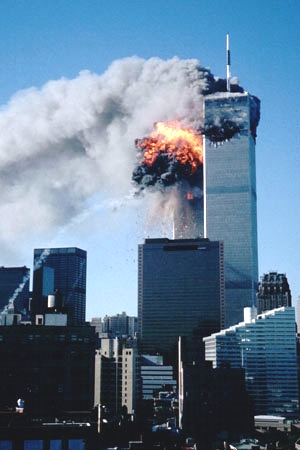
On September 11, 2001, David Wherley Jr. was the commander in charge of the 113th Fighter Wing at Andrews Air Force base, in Maryland. After the attack on New York City he took orders from the Secret Service to dispatch a fleet of aircraft to protect the White House and the Capitol. Wherley was an important 9/11 witness. He played a role in ordering the tactics used by the U.S. government in response to the terrorist activity. Wherley was mentioned on multiple occasions in the 9/11 Commission report. He later acted as the commanding general of the District of Columbia National Guard, from 2003 to 2008.
On June 22, 2009, David Wherley and his wife Ann boarded a Red Line Washington Metro train (#214) in Northeast Washington, D.C. While waiting for their train to leave Fort Totten station, it was struck by an oncoming Red Line train. The Wherley’s train was rear-ended at a high speed. Nine people were killed in the accident, including David Wherley and his wife. It was the deadliest crash in the history of the Washington Metro. Several survivors were trapped in the rubble for hours, and approximately 80 people were injured.
A preliminary investigation found that the accident occurred when the replacement of a track circuit component failed, which prevented certain signals from being reported. Survivors described the crash as like “hitting a concrete wall.” According to Daniel Kaniewski, a former Bush administration homeland security official, the overall emergency response to the event was “calm and ordered.” He indicated that the U.S. response “during extraordinary incidents has significantly improved” since September 11, 2001.
9 – Dwight Dixon
Witnessed Event: North Philadelphia Shooting
On April 29, 2008, a convicted drug dealer named Dwight Dixon got into an altercation with former NFL star Marvin Harrison, at a North Philadelphia car wash named Chuckie’s Garage. The two men had previously gotten into an argument when Harrison denied Dixon entry into a sports bar he owned and operated. On the day in question, Dixon and Harrison got into a fight outside the car wash. Someone pulled out a gun and started shooting. A collection of witnesses at the scene, including Dwight Dixon, said that it was Marvin Harrison who was firing with two separate weapons. Three people were injured in the gunfire. Dixon was shot in the left hand. A man named Robert Nixon was struck in his back and a child sitting in a nearby car suffered an eye injury from shattered glass.
Robert Nixon initially told police he knew nothing about what happened, but four days after the shooting he signed a statement saying he was positive that he saw Harrison with a gun in his hand at the time of the altercation. After an investigation, ballistics tests confirmed that five of the shell casings found at the crime scene had come from a high-powered Belgian handgun owned by Marvin Harrison. The gun was recovered from Harrison’s car wash.
After the story reached ESPN, Marvin Harrison’s personality was reported in a different light. For 12 NFL seasons, Marvin was one of most prolific wide receivers in the league. He was a true professional that rarely celebrated after any of his 128 touchdowns. Harrison stepped away from the game after the 2008 season.
In the spring of 2009, Dwight Dixon gave an interview to the ESPN program E:60, claiming that Harrison was the man that shot him. A few months later on July 21, 2009, Dwight Dixon was shot and killed in the Fairmount section of Philadelphia. A gunman approached the driver’s side of his Toyota Camry and fired four times through the back window and then fired three more times into the passenger side. Dwight Dixon was shot 7 times. Moments after the shooting, he told police that he believed the incident was related to the April 2008 assault. Dixon fell into a coma shortly after being shot and died a few months later. His murder remains unsolved.
In the summer of 2010, Marvin Harrison was pulled over by the police for traveling the wrong way down a one-way street. The officers claimed to have seen Harrison conceal a gun in the car. They searched his vehicle and found a 9mm weapon that was tested against three spent 9mm shell casings that were found inside the truck driven by the late Dwight Dixon at the scene of an April 2008 shooting. Since the discovery, the FBI has become involved in the investigation, with no recent news to report.
8 – Barbara Olson
Witnessed Event: American Airlines Flight 77
Barbara Olson was a lawyer, author and conservative American television commentator. In 1994, she joined the United States House of Representatives, becoming chief investigative counsel for the House Government Reform and Oversight Committee. In that position, Olson led a number of different investigations into the Clinton administration. She exposed the White House travel office scandal and the FBI files controversy. Olson published a collection of books that examine the history of Hillary Clinton and the actions of Bill Clinton in the final days of his presidency. Some of her accusations include unlawful pardons by Bill Clinton, the looting of the White House and executive orders that were sheer abuses of presidential power. On January 20, 2001, Bill Clinton pardoned 140 people in the final hours of his presidency.
In 1996, Barbara Olson married a man named Ted Olson. Ted successfully represented presidential candidate George W. Bush in the Supreme Court case of Bush v. Gore, which effectively determined the final result of the contested 2000 Presidential election. He subsequently served as United States Solicitor General in the Bush administration. On September 11, 2001, Barbara Olson boarded American Airlines Flight 77 traveling from Virginia to Los Angeles. She was visiting Los Angeles for a taping of Politically Incorrect with Bill Maher.
On September 11, 2001, Flight 77 was hijacked at 8:54. Between 9:16 and 9:26, Olson called her husband. According to him, she reported that the flight had been hijacked, and that the hijackers had knives and box-cutters. A minute into the conversation, the call was cut off. Shortly after, Barbara reached her husband again. Ted Olson asked for her location and she replied that the plane was flying over houses. Ted informed Barbara of the two previous hijackings and crashes. She didn’t display signs of panic over the phone. American Airlines Flight 77 crashed into the western side of the Pentagon at 09:37 EDT. All 64 people on board were killed, including Barbara Olson. Following her death, Politically Incorrect host, Bill Maher, left a panel seat vacant for a week.
The two phone calls Barbara Olson made from Flight 77 are an important factor to the accepted story of 9/11. They provide evidence that American 77 had been aloft after it had disappeared from FAA radar around 9:00 AM. The calls are also the only source of the widely accepted idea that the hijackers had box cutters. The story has been scrutinized by a collection of researchers, who have accused Ted Olson of changing his account. He originally indicated that Barbara used a cell phone to call him, but later said she called using an airline phone. The technology to enable cell phone calls from high-altitude flights wasn’t developed until 2004.
7 – Milton William Cooper
Witnessed Event: U.S. Naval Intelligence Gathering
After graduating from high school, William Cooper joined the U.S. Air Force and later the U.S. Navy. He served in the Vietnam War and then worked for Naval Security and Intelligence. Cooper gained notoriety after publishing a book titled Behold a Pale Horse. The text documents various UFO and paranormal activities he encountered while serving for Naval Intelligence. It examines government corruption, secret societies, and a collection of conspiracy theories. In the 1990s, William Cooper became a popular speaker on the UFO lecture circuit. He was the host of a worldwide shortwave radio show named Hour of the Time.
William Cooper was the first person to provide evidence of explosive material inside the Murrah Building in Oklahoma City on April 19, 1995. He publicly identified the type of explosives used in the Oklahoma City bombing. In his early writings, Cooper was convinced that the United States was hiding evidence of alien technology. Towards the end of his life Cooper turned his attention towards covert government programs and the militia movement. He became an outspoken critic of U.S. government abuses. William Cooper felt that the UFO phenomenon was a misinformation campaign organized to hide secret military operations. He asserted that the Internal Revenue Service (IRS) is actually the same organization as the Bureau of Alcohol, Tobacco and Firearms. Cooper felt the two organizations were involved in a broad, premeditated conspiracy to defraud the Citizens of the United States of America.
William Cooper produced several documentaries covering subjects such as the John F. Kennedy assassination and government black projects. He felt that JFK was shot and killed by his driver, a man named William Greer. In the Zapruder film Greer can be seen turning towards Kennedy the moment before he receives the fatal head wound. Following the death of her husband, Jacqueline Kennedy was bitterly critical of William Greer’s performance. William Cooper suggested that Jacqueline was attempting to get away from William Greer when she famously jumped on the back of the vehicle following the assassination. In the Zapruder film, Greer’s recorded front to back movement is extremely abnormal. The tape shows evidence of possible tampering.
In June 2001, three months before 9/11, William Cooper warned publicly about an important terrorist attack on United States, that would be blamed on Osama Bin Laden. During his June 28 broadcast, William Cooper said “I’m telling you be prepared for a major attack. But it won’t be Osama Bin Laden. It will be those behind the New World Order.” On 9/11 Cooper said “what we’re witnessing today is most probably the herald of the, at least, the redefinition of freedom, and probably its death.”
William Cooper was charged with various crimes in his lifetime, including tax evasion from 1992 to 1994, and bank fraud for giving false information on a loan application. In July and September 2001, Cooper was accused of brandishing a handgun near his home in Eagar, Arizona. On November 6, 2001, two months after September 11, William Cooper was fatally shot by a large collection of Arizona deputies who were attempting to serve him an arrest warrant. According to police accounts, Cooper, who was physically disabled, fled officers and pulled out a weapon. A gun fight ensued and William Cooper was killed. A deputy was critically injured in the incident.
6 – Kenneth Johannemann
Witnessed Event: Collapse of the Twin Towers
Kenny Johannemann worked as a part-time janitor in the World Trade Center when it was attacked and destroyed on September 11, 2001. He was in the North Tower waiting for an elevator when the first explosion occurred. The blast created a fireball that engulfed the elevator shaft. Johannemann responded by saving the life of a man that was badly burned in the event. He was in a similar position as William Rodriguez, who was also a janitor in the WTC North Tower, and who became internationally recognized for his heroic efforts on September 11. Rodriguez was the last person to leave the collapsing North Tower alive.
Following the events of September 11, 2001, Kenneth Johannemann and William Rodriguez provided a detailed account of their experience. One aspect of their stories is similar, but contradicts the official report presented by the 9/11 commission. Both men reported that they heard loud explosions in the basement of the North Tower immediately before and after the plane impacted. Kenneth Johannemann was adamant about the fact that he heard explosions not associated with the crash. William Rodriguez also claimed to have heard a massive rumble in the basement of the North Tower, seconds before the plane hit.
On August 31, 2008, Kenneth Johannemann committed suicide by way of a gunshot wound to the head. Mr Johannemann’s suicide note stated that he was depressed after being evicted from his residence. The testimony given by Kenneth Johannemann and William Rodriguez are identical in the fact that they describe large explosions in the WTC towers. Before his death, Johannemann regularly told his story to public crowds. His death was a surprise to everyone and instantly raised suspicion amongst 9/11 researchers.
5 – Gary Webb
Witnessed Event: Research into the Cocaine Trade
Gary Webb was a Pulitzer prize-winning American investigative journalist. In August of 1996, the San Jose Mercury News published Webb’s Dark Alliance, a 20,000 word, three-part investigative series which alleged that Nicaraguan drug traffickers had sold and distributed crack cocaine in Los Angeles during the 1980s. Webb alleged that drug profits were used to fund the CIA-supported Nicaraguan Contras. He never asserted that the CIA directly aided drug dealers to raise money for the Contras, but he did document that the CIA was aware of the cocaine transactions and the large shipments of cocaine into the U.S. by the Contra personnel.
According to the Columbia Journalism Review, the Dark Alliance series became “the most talked-about piece of journalism in 1996, and arguably the most famous set of articles of the decade.” Webb supported his research with documents obtained through the Freedom of Information Act. He investigated Nicaraguans linked to the CIA-backed Contras who had allegedly smuggled cocaine into the U.S. Their product was distributed as crack cocaine in Los Angeles. Webb also alleged that this influx of Nicaraguan-supplied cocaine sparked, and significantly fueled, the widespread crack cocaine epidemic that swept through many U.S. cities during the 1980s. He charged that the Reagan administration shielded inner-city drug dealers from prosecution in order to raise money for the Contras.
Gary Webb’s research generated fierce controversy around the world, and the San Jose Mercury News backed away from the story, effectively ending Webb’s career as a mainstream media journalist. On December 10, 2004, Gary Webb was found dead from two gunshot wounds to the head. The Sacramento County coroner Robert Lyons asserted that it was suicide. He said that a suicide note was found at the scene, although Lyons was unable to explain how Webb could shoot himself twice in the head with a .38 caliber pistol. Since the publication of Dark Alliance, many of Gary Webb’s accusations have been validated. Journalist George Sanchez wrote that “the CIA’s internal investigation by Inspector General Frederick Hitz vindicated much of Gary’s reporting” and observed that, despite the campaign against Webb, “the government eventually admitted to more than Gary had initially reported.”
4 – Ramin Pourandarjani
Witnessed Event: Misconduct at the Kahrizak Jail
Dr. Ramin Pourandarjani was an Iranian physician that worked at the Kahrizak detention center in southern Tehran. Following the 2009 Iranian election protests, Ramin Pourandarjani was made responsible for the medical care of several prisoners believed to have been tortured. One of his patients was Mohsen Ruholamini, a government scientist’s son, who was arrested following his participation in the post-election protests.
Mohsen Ruholamini, who was only 25-years-old, died in prison in July of 2009. His death certificate originally identified the cause of death as multiple blows to the head. A report given by the Iranian judicial authorities stated that Ruholamini died of “physical stress, the effects of being held in bad conditions, multiple blows and severe injuries to the body.”
Dr. Pourandarjani testified before a parliamentary committee investigating misconduct at the Kahrizak jail. The jail was subsequently closed by order of Ayatollah Khamenei. Presidential candidate and cleric, Mehdi Karroubi, publicly accused the Iranian police of having tortured and raped detainees in the prison. In response, the police raided Karroubi’s office, and confiscated names, addresses and testimonies of witnesses.
Following his testimony, Pourandarjani was one of the people arrested. He was interrogated by the Iranian police and released on bail. On November 10, 2009, at the age of 26, Ramin Pourandarjani died of poisoning from a salad laced with an overdose of blood pressure medication. Iranian authorities initially claimed Pourandarjani had died in a car accident, committed suicide, or died of a heart attack. They prohibited Pourandarjani’s family from performing an autopsy. The judiciary unit in Iran remains reluctant to investigate the sudden death of Dr. Ramin Pourandarjani.
3 – Lee Bowers Jr.
Witnessed Event: John F. Kennedy Assassination
Lee Bowers Jr. was a key witness to the assassination of John F. Kennedy. At the moment of the shooting he was operating the Union Terminal Company’s two-story interlocking tower, which was overlooking the parking lot just north of the grassy knoll and west of the Texas School Book Depository. Bowers had an unobstructed view of the stockade fence atop the knoll. He gave a detailed account of the assassination saying he had witnessed two unfamiliar men standing near the grassy knoll at the edge of the parking lot, within 10 or 15 feet of each other, “one man was middle-aged, fairly heavy-set, in a white shirt and dark trousers. The other was a younger man, about mid-twenties, in either a plaid shirt or a plaid coat or jacket.”
Lee Bowers also described a strange truck that was parked in the location of the assassination seven to ten minutes before Kennedy arrived. When the shots rang out, Bowers’ attention was drawn to the grassy knoll where he had witnessed the two men. He observed “some commotion” at that spot, “…something out of the ordinary, a sort of milling around…which attracted my eye for some reason, which I could not identify.” In an interview that Lee Bowers gave with attorney Mark Lane, he explained that the “commotion” that caught his eye may have been “a flash of light or smoke.”
Lee Bowers testified that immediately following the assassination a motorcycle policeman left the presidential motorcade and roared up the grassy knoll straight to where the two mysterious gentlemen were standing behind the fence. The policeman dismounted, but then climbed on his motorcycle and drove off. On the morning of August 9, 1966, Lee Bowers was driving south from Dallas on business. He was two miles from Midlothian when his brand new company car veered from the road and hit a bridge abutment. Bowers was killed in the accident. There was no autopsy performed and he was cremated soon afterward. A doctor from Midlothian, who rode in the ambulance with Bowers, noticed something peculiar about the victim. “He was in a strange state of shock. I’ve never seen anything like it.”
2 – Barry Jennings
Witnessed Event: Collapse of the Twin Towers
On the morning of September 11, 2001, Barry Jennings, who was a housing authority official in New York City, was near the World Trade Center Towers when they were attacked. Following the incident Barry reported to the city’s command center, which was located on the 23rd floor of the 7 World Trade Center structure. After reaching the office, Jennings and a man named Michael Hess realized that the room was completely empty. In an interview taped for the Loose Change film series, Jennings discussed the moment. “There was steaming coffee and sandwiches on the tables. It seemed that the room had recently been vacated.”
After getting word to evacuate, Jennings and Hess started to move down the staircase of 7 WTC. When the pair reached the 6th floor they were hit by a large explosion. The stairs underneath the men gave way and they were forced to climb over rubble to reach the 8th floor. While on the 8th floor Barry Jennings reported the sound of multiple loud explosions from below. Jennings and Hess were eventually saved by a collection of New York City firefighters and taken to an area called the “lobby.” The area was completely obliterated. While traveling through the lobby, Barry Jennings commented on dead bodies.
“And the firefighter who took us down kept saying, “Do not look down.” I kept saying, “Why?” We were stepping over people. And you know when you can feel when you are stepping over people.”
At 5:21 on the evening of September 11, 2001, the 7 World Trade Center building suffered a complete failure. The official cause of the collapse was due to damage sustained when the nearby North Tower of the WTC collapsed. The debris ignited fires, which continued to burn throughout the afternoon. The building’s internal fire suppression system lacked water pressure to fight the fires, and the building collapsed. The destruction of 7 WTC is a controversial subject among conspiracy theorists. Along with the Twin Towers, 7 WTC was the first steel building to experience a complete failure due to fire. The structure didn’t crumble as you might expect from fire damage. Instead it fell in an absolute free-fall (about 8 seconds).
Barry Jennings finished his interview for Loose Change by saying “I’m just confused about one thing, why World Trade Center 7 went down in the first place – I’m very confused about that – I know what I heard, I heard explosions.” Barry Jennings challenged the official 9/11 report. He said that while in the building he heard multiple explosions and witnessed damage not caused by fire. For this reason, many people found the testimony of Jennings contradictory to the official story of what happened on 9/11. Barry Jennings died on August 19, 2008, from an unknown cause. He passed away only a couple days before a report was to be released by the National Institute of Standards and Technology’s (NIST) on the collapse of 7 WTC.
1 – David Kelly
Witnessed Event: Biological Warfare Research in Iraq
David Kelly was a British scientist and expert on biological warfare. He was employed by the British Ministry of Defense, and served as a United Nations weapons inspector in Iraq. The Iraq War began on March 20, 2003. After the end of the initial ground attack, David Kelly was involved with a team attempting to find any trace of weapons of mass destruction in Iraq.
After analyzing photographs of two alleged mobile weapons laboratories in Iraq, Kelly was unhappy with the presented results. In response, he organized an interview with The Observer. On June 15, 2003, the newspaper published an article using Kelly as a confidential source. It said that “a British scientist and biological weapons expert who examined the trailers in Iraq said they are not mobile germ warfare laboratories. You could not use them for making biological weapons. They do not even look like them. They are exactly what the Iraqis said they were. Facilities for the production of hydrogen gas to fill balloons.”
On May 22, 2003, David Kelly met with Andrew Gilligan, a BBC journalist. A few weeks later, using information provided by Kelly, Gilligan published a series of articles about the British government’s dossier on weapons of mass destruction in Iraq. He said that the government had “sexed up” the military capabilities of Iraq in order to bolster the argument for going to war with the country. Gilligan quoted his source, David Kelly, as identifying Alastair Campbell, the former Prime Minister’s Director of Communications and Strategy, as being responsible for the suppressions. He suggested that the claim that Iraq was able to deploy biological weapons within 45 minutes was false.
On July 15, 2003, David Kelly was called before the parliamentary foreign affairs select committee. He was questioned aggressively about his actions. Two days later, on July 17, David Kelly went missing near his home in Oxfordshire. His body was discovered in area of woodlands known as Harrowdown Hill, about a mile away from his home. David Kelly had ingested up to 29 tablets of painkillers. He also slashed his left wrist with a knife. After an investigation, Kelly’s death was ruled a suicide. Since that time, a collection of medical experts have raised concerns over his cause of death.
Doctors have argued that the autopsy finding of a transected ulnar artery could not have caused a degree of blood loss that would kill someone, particularly when outside in the cold. In December 2010, The Times reported that Dr. Kelly had a rare abnormality in his arteries which could have contributed to his death. On December 5, 2009, six doctors began legal action to demand a formal inquest into the death of David Kelly, saying there was “insufficient evidence to prove beyond reasonable doubt he killed himself.” In January 2010, it was disclosed that Lord Hutton had requested that all files relating to his postmortem remain secret for 70 years. Hutton explained that he had done so to protect David Kelly’s wife and daughters from the distress of further media reports.
LOS ANGELES (CBS) — A bill authored by a Southland lawmaker that could potentially allow the federal government to prevent any Americans who owe back taxes from traveling outside the U.S. is one step closer to becoming law.
Senate Bill 1813 was introduced back in November by Senator Barbara Boxer (D-Los Angeles) to “reauthorize Federal-aid highway and highway safety construction programs, and for other purposes” .
After clearing the Senate on a 74 – 22 vote on March 14, SB 1813 is now headed for a vote in the House of Representatives, where it’s expected to encounter stiffer opposition among the GOP majority.
In addition to authorizing appropriations for federal transportation and infrastructure programs, the “Moving Ahead for Progress in the 21st Century Act” or “MAP-21″ includes a provision that would allow for the “revocation or denial” of a passport for anyone with “certain unpaid taxes” or “tax delinquencies”.
Section 40304 of the legislation states that any individual who owes more than $50,000 to the Internal Revenue Service may be subject to “action with respect to denial, revocation, or limitation of a passport”.
The bill does allow for exceptions in the event of emergency or humanitarian situations or limited return travel to the U.S., or in cases when any tax debt is currently being repaid in a “timely manner” or when collection efforts have been suspended.
However, there does not appear to be any specific language requiring a taxpayer to be charged with tax evasion or any other crime in order to have their passport revoked or limited — only that a notice of lien or levy has been filed by the IRS.
Boxer vowed last week to push House Republicans to pass the bipartisan transportation bill that would keep the Highway Trust Fund from going bankrupt.
“Thousands of businesses are at stake, and eventually we are talking about nearly three million jobs at stake,” she said in a statement. “There are many people on both sides of the aisle in the Senate who want to get our bill, MAP-21, passed into law, and I am going to do everything I can to keep the pressure on the Republican House to do just that.”
The following collection of 25 flyers produced by the FBI and the Department of Justice are distributed to local businesses in a variety of industries to promote suspicious activity reporting. The flyers are not released publicly, though several have been published in the past by news media and various law enforcement agencies around the country. We have compiled this collection from a number of online sources.
To view the documents, click on a threat area in the menu to the left and the PDF will appear on the right side of the page. You can also download the complete collection of files (ZIP Archive, 6.27 MB).
Is there any truth in the allegations that informed circles made substantial profits in the financial markets in connection to the terror attacks of September 11, 2001, on the United States?
Arguably, the best place to start is by examining put options, which occurred around Tuesday, September 11, 2001, to an abnormal extent, and at the beginning via software that played a key role: the Prosecutor’s Management Information System, abbreviated as PROMIS. [i]
PROMIS is a software program that seems to be fitted with almost “magical” abilities. Furthermore, it is the subject of a decades-long dispute between its inventor, Bill Hamilton, and various people/institutions associated with intelligence agencies, military and security consultancy firms. [1]
One of the “magical” capabilities of PROMIS, one has to assume, is that it is equipped with artificial intelligence and was apparently from the outset “able to simultaneously read and integrate any number of different computer programs or databases, regardless of the language in which the original programs had been written or the operating systems and platforms on which that database was then currently installed.” [2]
And then it becomes really interesting:
What would you do if you possessed software that could think, understand every major language in the world, that provided peep-holes into everyone else’s computer “dressing rooms”, that could insert data into computers without people’s knowledge, that could fill in blanks beyond human reasoning, and also predict what people do – before they did it? You would probably use it, wouldn’t you? [3]
Granted, these capabilities sound hardly believable. In fact, the whole story of PROMIS, which Mike Ruppert develops in the course of his book Crossing the Rubicon in all its bizarre facets and turns, seems as if someone had developed a novel in the style of Philip K Dick and William Gibson. However, what Ruppert has collected about PROMIS is based on reputable sources as well as on results of personal investigations, which await a jury to take a first critical look at.
This seems all the more urgent if you add to the PROMIS capabilities “that it was a given that PROMIS was used for a wide variety of purposes by intelligence agencies, including the real-time monitoring of stock transactions on all the world´s major financial markets”. [4]
We are therefore dealing with a software that
a) Infiltrates computer and communication systems without being noticed.
b) Can manipulate data.
c) Is capable to track the global stock market trade in real time.
Point c is relevant to all that happened in connection with the never completely cleared up transactions that occurred just before September 11, [5] and of which the former chairman of the Deutsche Bundesbank Ernst Weltke said “could not have been planned and carried out without a certain knowledge”. [6]
I specifically asked financial journalist Max Keiser, who for years had worked on Wall Street as a stock and options trader, about the put option trades. Keiser pointed out in this context that he “had spoken with many brokers in the towers of the World Trade Center around that time. I heard firsthand about the airline put trade from brokers at Cantor Fitzgerald days before.” He then talked with me about an explosive issue, on which Ruppert elaborated in detail in Crossing the Rubicon.
Max Keiser: There are many aspects concerning these option purchases that have not been disclosed yet. I also worked at Alex Brown & Sons (ABS). Deutsche Bank bought Alex Brown & Sons in 1999. When the attacks occurred, ABS was owned by Deutsche Bank. An important person at ABS was Buzzy Krongard. I have met him several times at the offices in Baltimore. Krongard had transferred to become executive director at the CIA. The option purchases, in which ABS was involved, occurred in the offices of ABS in Baltimore. The noise which occurred between Baltimore, New York City and Langley was interesting, as you can imagine, to say the least.
Under consideration here is the fact that Alex Brown, a subsidiary of Deutsche Bank (where many of the alleged 9/11 hijackers handled their banking transactions – for example Mohammed Atta) traded massive put options purchases on United Airlines Company UAL through the Chicago Board Option Exchange (CBOE) – “to the embarrassment of investigators”, as British newspaper The Independent reported. [7]
On September 12, the chairman of the board of Deutsche Bank Alex Brown, Mayo A Shattuck III, suddenly and quietly renounced his post, although he still had a three-year contract with an annual salary of several million US dollars. One could perceive that as somehow strange.
A few weeks later, the press spokesperson of the Central Intelligence Agency (CIA) at that time, Tom Crispell, declined all comments, when he was contacted for a report for Ruppert´s website From the Wilderness, and had being asked “whether the Treasury Department or FBI [Federal Bureau of Investigation] had questioned CIA executive director and former Deutsche Bank-Alex Brown CEO [chief executive officer], A B ‘Buzzy’ Krongard, about CIA monitoring of financial markets using PROMIS and his former position as overseer of Brown’s ‘private client’ relations.” [8]
Just before he was recruited personally by former CIA chief George Tenet for the CIA, Krongard supervised mainly private client banking at Alex Brown. [9]
In any case, after 9/11 on the first trading day, when the US stock markets were open again, the stock price of UAL declined by 43%. (The four aircraft hijacked on September 11 were American Airlines Flight 11, American Airlines Flight 77 and UAL flights 175 and 93.)
With his background as a former options trader, Keiser explained an important issue to me in that regard.
Max Keiser: Put options are, if they are employed in a speculative trade, basically bets that stock prices will drop abruptly. The purchaser, who enters a time-specific contract with a seller, does not have to own the stock at the time when the contract is purchased.
Related to the issue of insider trading via (put or call) options there is also a noteworthy definition by the Swiss economists Remo Crameri, Marc Chesney and Loriano Mancini, notably that an option trade may be “identified as informed” – but is not yet (legally) proven – “when it is characterized by an unusual large increment in open interest and volume, induces large gains, and is not hedged in the stock market”. [10]
Open interest describes contracts which have not been settled (been exercised) by the end of the trading session, but are still open. Not hedged in the stock market means that the buyer of a (put or call) option holds no shares of the underlying asset, by which he might be able to mitigate or compensate losses if his trade doesn’t work out, or phrased differently: one does not hedge, because it is unnecessary, since one knows that the bet is one, pardon, “dead sure thing.” (In this respect it is thus not really a bet, because the result is not uncertain, but a foregone conclusion.)
In this case, the vehicle of the calculation was “ridiculously cheap put options which give the holder the ‘right’ for a period of time to sell certain shares at a price which is far below the current market price – which is a highly risky bet, because you lose money if at maturity the market price is still higher than the price agreed in the option. However, when these shares fell much deeper after the terrorist attacks, these options multiplied their value several hundred times because by now the selling price specified in the option was much higher than the market price. These risky games with short options are a sure indication for investors who knew that within a few days something would happen that would drastically reduce the market price of those shares.” [11]
Software such as PROMIS in turn is used with the precise intent to monitor the stock markets in real time to track price movements that appear suspicious. Therefore, the US intelligence services must have received clear warnings from the singular, never before sighted transactions prior to 9/11.
Of great importance with regard to the track, which should lead to the perpetrators if you were seriously contemplating to go after them, is this:
Max Keiser: The Options Clearing Corporation has a duty to handle the transactions, and does so rather anonymously – whereas the bank that executes the transaction as a broker can determine the identity of both parties.
But that may have hardly ever been the intention of the regulatory authorities when the track led to, amongst others, Alvin Bernard “Buzzy” Krongard, Alex Brown & Sons and the CIA. Ruppert, however, describes this case in Crossing the Rubicon in full length as far as possible. [12]
In addition, there are also ways and means for insiders to veil their tracks. In order to be less obvious, “the insiders could trade small numbers of contracts. These could be traded under multiple accounts to avoid drawing attention to large trading volumes going through one single large account. They could also trade small volumes in each contract but trade more contracts to avoid drawing attention. As open interest increases, non-insiders may detect a perceived signal and increase their trading activity. Insiders can then come back to enter into more transactions based on a seemingly significant trade signal from the market. In this regard, it would be difficult for the CBOE to ferret out the insiders from the non-insiders, because both are trading heavily.” [13]
The matter which needs clarification here is generally judged by Keiser as follows:
Max Keiser: My thought is that many (not all) of those who died on 9/11 were financial mercenaries – and we should feel the same about them as we feel about all mercenaries who get killed. The tragedy is that these companies mixed civilians with mercenaries, and that they were also killed. So have companies on Wall Street used civilians as human shields maybe?
According to a report by Bloomberg published in early October 2001, the US Securities and Exchange Commission (SEC) began a probe into certain stock market transactions around 9/11 that included 38 companies, among them: American Airlines, United Airlines, Continental Airlines, Northwest Airlines, Southwest Airlines, Boeing, Lockheed Martin Corp., American Express Corp., American International Group, AXA SA, Bank of America Corp., Bank of New York Corp., Bear Stearns, Citigroup, Lehman Brothers Holdings Inc., Morgan Stanley, General Motors and Raytheon. [14]
So far, so good. In the same month, however, the San Francisco Chronicle newspaper reported that the SEC took the unprecedented step to deputize hundreds, if not even thousands of key stakeholders in the private sector for their investigation. In a statement that was sent to almost all listed companies in the US, the SEC asked the addressed companies to assign senior staff for the investigation, who would be aware of “the sensitive nature” of the case and could be relied on to “exercise appropriate discretion”. [15]
In essence, it was about controlling information, not about provision and disclosure of facts. Such a course of action involves compromising consequences. Ruppert:
What happens when you deputize someone in a national security or criminal investigation is that you make it illegal for them to disclose publicly what they know. Smart move. In effect, they become government agents and are controlled by government regulations rather than their own conscience. In fact, they can be thrown into jail without a hearing if they talk publicly. I have seen this implied threat time after time with federal investigators, intelligence agents, and even members of United States Congress who are bound so tightly by secrecy oaths and agreements that they are not even able to disclose criminal activities inside the government for fear of incarceration. [16]
Among the reports about suspected insider trading which are mentioned in Crossing the Rubicon/From the Wilderness is a list that was published under the heading “Black Tuesday: The World’s Largest Insider Trading Scam?” by the Israeli Herzliyya International Policy Institute for Counterterrorism on September 21, 2001:
Between September 6 and 7, the CBOE saw purchases of 4,744 put options on United Airlines, but only 396 call options. Assuming that 4,000 of the options were bought by people with advance knowledge of the imminent attacks, these “insiders” would have profited by almost $5 million.
On September 10, 4,516 put options on American Airlines were bought on the Chicago exchange, compared to only 748 calls. Again, there was no news at that point to justify this imbalance; again, assuming that 4,000 of these options trades represent “insiders”, they would represent a gain of about $4 million.
[The levels of put options purchased above were more than six times higher than normal.]
No similar trading in other airlines occurred on the Chicago exchange in the days immediately preceding Black Tuesday.
Morgan Stanley Dean Witter & Co, which occupied 22 floors of the World Trade Center, saw 2,157 of its October $45 put options bought in the three trading days before Black Tuesday; this compares to an average of 27 contracts per day before September 6. Morgan Stanley’s share price fell from $48.90 to $42.50 in the aftermath of the attacks. Assuming that 2,000 of these options contracts were bought based upon knowledge of the approaching attacks, their purchasers could have profited by at least $1.2 million.
Merrill Lynch & Co, with headquarters near the Twin Towers, saw 12,215 October $45 put options bought in the four trading days before the attacks; the previous average volume in those shares had been 252 contracts per day (a 1200% increase). When trading resumed, Merrill’s shares fell from $46.88 to $41.50; assuming that 11,000 option contracts were bought by “insiders”, their profit would have been about $5.5 million.
European regulators are examining trades in Germany’s Munich Re, Switzerland’s Swiss Re, and AXA of France, all major reinsurers with exposure to the Black Tuesday disaster. (Note: AXA also owns more than 25% of American Airlines stock, making the attacks a “double whammy” for them.) [17]Concerning the statements of the former chairman of the Deutsche Bundesbank Ernst Welteke, their tenor in various press reports put together is as follows:
German central bank president Ernst Welteke later reports that a study by his bank indicates, “There are ever clearer signs that there were activities on international financial markets that must have been carried out with the necessary expert knowledge,” not only in shares of heavily affected industries such as airlines and insurance companies, but also in gold and oil. [Daily Telegraph, 9/23/2001] His researchers have found “almost irrefutable proof of insider trading”. [Miami Herald, 9/24/2001] “If you look at movements in markets before and after the attack, it makes your brow furrow. But it is extremely difficult to really verify it.” Nevertheless, he believes that “in one or the other case it will be possible to pinpoint the source”. [Fox News, 9/22/2001] Welteke reports “a fundamentally inexplicable rise” in oil prices before the attacks [Miami Herald, 9/24/2001] and then a further rise of 13 percent the day after the attacks. Gold rises nonstop for days after the attacks. [Daily Telegraph, 9/23/2001] [18]
Related to those observations, I sent a request via e-mail to the press office of the Deutsche Bundesbank on August 1, 2011, from which I was hoping to learn:
How did the Bundesbank deal with this information? Did US federal agencies ask to see the study? With whom did the Bundesbank share this information? And additionally:1. Can you confirm that there is such a study of the Bundesbank concerning 9/11 insider trading, which was carried out in September 2001?
2. If Yes: what is the title?
3. If Yes: who were the authors?
4. If Yes: has the study ever been made available to the public?
On August 2, I was then informed: “Your mail has been received by us and is being processed under the number 2011 / 011551.” Ultimately, however, the press office of the Deutsche Bundesbank was only available for an oral explanation on the phone. With this explanation, I then turned to the press office of the federal financial regulator in Germany, the Bundesanstalt fur Finanzdienstleistungsaufsicht, BaFin, with the following e-mail – and that because of obvious reasons:
Yesterday, I sent a request (see end of this e-mail) to the press office of the Deutsche Bundesbank relating to insider trading connected to the terrorist attacks on September 11, 2001, and respectively relating to an alleged study carried by the Deutsche Bundesbank. The request carries the reference number 2011 / 011551.
The press office or respectively Mr Peter Trautmann was only available for an oral explanation. I repeat this now, because it is related to your entity. This will be followed by my further questions.
According to an oral explanation from the press office of the Deutsche Bundesbank, there has never been a detailed and official study on insider trading from the Bundesbank. Rather, there has been probably ad-hoc analysis with corresponding charts of price movements as briefings for the Bundesbank board. In addition, it would have been the duty of the Bundesfinanzaufsicht to investigate this matter. The press office of the Bundesbank was also not willing to give out any written information, not even after my hint that this alleged study by the Bundesbank has been floating around the Internet for years without any contradiction. That was the oral information from the Bundesbank press office, or respectively from Mr Peter Trautmann.
Now my questions for you:
1. Has the BaFin ever investigated the 9/11 insider trading?
2. With what result? Have the results been made public?
3. Have there not been any grounds for suspicion that would have justified an investigation, for example as damaged enterprise: Munich Re, and as buyers of put options of UAL’s United Airlines Company: Deutsche Bank/Alex Brown?
4. Has the Deutsche Bundesbank ever enquired with BaFin what information they have regarding the 9/11 insider trading – for example for the creation of ad-hoc analysis for the Bundesbank?
5. Have the US federal agencies ever inquired if the BaFin could cooperate with them in an investigation?
Could you reply to me in writing, unlike the Deutsche Bundesbank, please? I would be very grateful for that!
The next day I did indeed receive an e-mail concerning this topic from Anja Engelland, the press officer of the BaFin in which she answered my questions as follows:
1. Yes, the former Bundesaufsichtsamt fur Wertpapierhandel, BAWe (federal supervisory for securities trading), has carried out a comprehensive analysis of the operations.
2. As a result, no evidence of insider trading has been found. Their approach and results have been published by the BAWe or BaFin in the annual reports for the years 2001 (cf S 26/27) and 2002 (cf p 156 above first paragraph). Here are the links. [See here and here.]
3. See annual reports 2001 and 2002. Put options on United Airlines were not traded on German stock exchanges (the first EUREX options on US equities were introduced only after the attacks on 9/11/2001); there were warrants on UAL and other US stocks, but those traded only in low volumes.
4. I personally do not know about such a request. Furthermore, the Bundesbank itself would have to comment on this.
5. BaFin is fundamentally entitled to the exchange of information with foreign supervisory authorities, like SEC, on the basis of written agreements, so-called memoranda of understanding (MoU). Regarding potential inquiries from foreign supervisory authorities, the BaFin can unfortunately not comment, this would be a matter of respective authority. For this I ask for understanding.
Then I wrote another brief note to BaFin, “in order to prevent any misunderstanding: your answers refers, as far as I understand, solely to the financial markets in Germany and Frankfurt, or not?” The reply from BaFin:
The answers refer to the German financial market as a whole and not only on the Frankfurt Stock Exchange. In terms of the assessment of foreign financial markets, the relevant authorities are the competent points of contact.
In my inquiries, I mentioned, among other things, a scientific study by US economist Allen M Poteshman from the University of Illinois at Urbana-Champaign, which had been carried out in 2006 regarding the put option trading around 9/11 related to the two airlines involved, United Airlines and American Airlines. Poteshman came to this conclusion: “Examination of the option trading leading up to September 11 reveals that there was an unusually high level of put buying. This finding is consistent with informed investors having traded options in advance of the attacks.” [19]
Lars Schall is a German financial journalist. This article published by the Asian Times is a slightly modified and updated excerpt from the book Mordanschlag 9/11. Eine kriminalistische Recherche zu Finanzen, Ol und Drogen (Assassination 9/11: A criminalistic research on finance, oil and drugs),published in Germany by Schild Verlag.
Army General Keith Alexander, the director of the NSA, is having a busy year — hopping around the country, cutting ribbons at secret bases and bringing to life the agency’s greatly expanded eavesdropping network.
In January he dedicated the new $358 million CAPT Joseph J. Rochefort Building at NSA Hawaii, and in March he unveiled the 604,000-square-foot John Whitelaw Building at NSA Georgia.
Designed to house about 4,000 earphone-clad intercept operators, analysts and other specialists, many of them employed by private contractors, it will have a 2,800-square-foot fitness center open 24/7, 47 conference rooms and VTCs, and “22 caves,” according to an NSA brochure from the event. No television news cameras were allowed within two miles of the ceremony.
Overseas, Menwith Hill, the NSA’s giant satellite listening post in Yorkshire, England that sports 33 giant dome-covered eavesdropping dishes, is also undergoing a multi-million-dollar expansion, with $68 million alone being spent on a generator plant to provide power for new supercomputers. And the number of people employed on the base, many of them employees of Lockheed Martin and Northrop Grumman, is due to increase from 1,800 to 2,500 in 2015, according to a study done in Britain. Closer to home, in May, Fort Meade will close its 27-hole golf course to make room for a massive $2 billion, 1.8-million-square-foot expansion of the NSA’s headquarters, including a cybercommand complex and a new supercomputer center expected to cost nearly $1 billion.
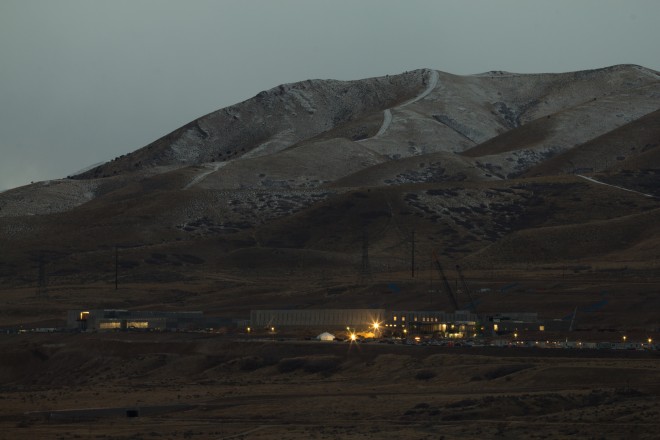
The climax, however, will be the opening next year of the NSA’s mammoth 1-million-square-foot, $2 billion Utah Data Center. The centerpiece in the agency’s decade-long building boom, it will be the “cloud” where the trillions of millions of intercepted phone calls, e-mails, and data trails will reside, to be scrutinized by distant analysts over highly encrypted fiber-optic links.
Despite the post-9/11 warrantless wiretapping of Americans, the NSA says that citizens should trust it not to abuse its growing power and that it takes the Constitution and the nation’s privacy laws seriously.
But one of the agency’s biggest secrets is just how careless it is with that ocean of very private and very personal communications, much of it to and from Americans. Increasingly, obscure and questionable contractors — not government employees — install the taps, run the agency’s eavesdropping infrastructure, and do the listening and analysis.
And with some of the key companies building the U.S.’s surveillance infrastructure for the digital age employing unstable employees, crooked executives, and having troubling ties to foreign intelligence services, it’s not clear that Americans should trust the secretive agency, even if its current agency chief claims he doesn’t approve of extrajudicial spying on Americans. His predecessor, General Michael V. Hayden, made similar claims while secretly conducting the warrantless wiretapping program.
Until now, the actual mechanics of how the agency constructed its highly secret U.S. eavesdropping net, code-named Stellar Wind, has never been revealed. But in the weeks following 9/11, as the agency and the White House agreed to secretly ignore U.S. privacy laws and bypass the Foreign Intelligence Surveillance Court, J. Kirk Wiebe noticed something odd. A senior analyst, he was serving as chief of staff for the agency’s Signals Intelligence Automation Research Center (SARC), a sort of skunkworks within the agency where bureaucratic rules were broken, red tape was cut, and innovation was expected.
“One day I notice out in the hallway, stacks and stacks of new servers in boxes just lined up,” he said.
Passing by the piles of new Dell 1750 servers, Wiebe, as he often did, headed for the Situation Room, which dealt with threat warnings. It was located within the SARC’s Lab, on the third floor of Operations Building 2B, a few floors directly below the director’s office. “I walk in and I almost get thrown out by a guy that we knew named Ben Gunn,” he said. It was the launch of Stellar Wind and only a handful of agency officials were let in on the secret.
“He was the one who organized it,” said Bill Binney of Gunn. A former founder and co-director of SARC, Binney was the agency official responsible for automating much of the NSA’s worldwide monitoring networks. Troubled by the unconstitutional nature of tapping into the vast domestic communications system without a warrant, he decided to quit the agency in late 2001 after nearly forty years.
Gunn, said Binney, was a Scotsman and naturalized U.S. citizen who had formerly worked for GCHQ, Britain’s equivalent of the NSA, and later become a senior analyst at the NSA. The NSA declined Wired’s request to interview Gunn, saying that, as policy, it doesn’t confirm or deny if a person is employed by the agency.
Shortly after the secret meeting, the racks of Dell servers were moved to a room down the hall, behind a door with a red seal indicating only those specially cleared for the highly compartmented project could enter. But rather than having NSA employees putting the hardware and software together and setting up walls of monitors showing suspected terrorism threats and their U.S. communications, the spying room was filled with a half-dozen employees of a tiny mom-and-pop company with a bizarre and troubling history.
“It was Technology Development Corporation,” said Binney.
The agency went to TDC, he says, because the company had helped him set up a similar network in SARC — albeit one that was focused on foreign and international communications — the kind of spying the NSA is chartered to undertake.
“They needed to have somebody who knew how the code works to set it up,” he said. “And then it was just a matter of feeding in the attributes [U.S. phone numbers, e-mail addresses and personal data] and any of the content you want.” Those “attributes” came from secret rooms established in large telecom switches around the country. “I think there’s 10 to 20 of them,” Binney says.
Formed in April 1984, TDC was owned by two brothers, Randall and Paul Jacobson, and largely run out of Randall’s Clarkesville, Maryland house, with his wife acting as bookkeeper. But its listed address is a post office box in Annapolis Junction, across the Baltimore-Washington Parkway from the NSA, and thecompany’s phone number in various business directories is actually an NSA number in Binney’s old office.
The company’s troubles began in June 1992 when Paul lost his security clearance. “If you ever met this guy, you would know he’s a really strange guy,” Binney said of Paul. “He did crazy stuff. I think they thought he was unstable.” At the time, Paul was working on a contract at the NSA alongside a rival contractor, Unisys Corporation. He later blamed Unisys for his security problems and sued it, claiming that Unisys employees complained about him to his NSA supervisors. According to the suit, Unisys employees referred to him as “weird” and that he “acted like a robot,” “never wore decent clothes,” and was mentally and emotionally unstable. About that time, he also began changing his name, first to Jimmy Carter, and later to Alfred Olympus von Ronsdorf.
With “von Ronsdorf’s” clearance gone and no longer able to work at the NSA, Randy Jacobson ran the company alone, though he kept his brother and fellow shareholder employed in the company, which led to additional problems.
“What happened was Randy still let him have access to the funds of the company and he squandered them,” according to Binney. “It was so bad, Randy couldn’t pay the people who were working for him.” According to court records, Ronsdorf allegedly withdrew about $100,000 in unauthorized payments. But Jacobson had troubles of his own, having failed to file any income tax statements for three years in the 1990s, according to tax court records. Then in March 2002, around the time the company was completing Stellar Wind, Jacobson fired his brother for improper billing and conversion of company funds. That led to years of suits and countersuits over mismanagement and company ownership.
Despite that drama, Jacobson and his people appeared to have serious misgivings about the NSA’s program once they discovered its true nature, according to Binney. “They came and said, ‘Do you realize what these people are doing?’” he said. “‘They’re feeding us other stuff [U.S.] in there.’ I mean they knew it was unconstitutional right away.” Binney added that once the job was finished, the NSA turned to still another contractor to run the tapping operation. “They made it pretty well known, so after they got it up and running they [the NSA] brought in the SAIC people to run it after that.” Jacobsen was then shifted to other work at the NSA, where he and his company are still employed.
Randall Jacobsen answered his phone inside the NSA but asked for time to respond. He never called back.
In addition to constructing the Stellar Wind center, and then running the operation, secretive contractors with questionable histories and little oversight were also used to do the actual bugging of the entire U.S. telecommunications network.
According to a former Verizon employee briefed on the program, Verint, owned by Comverse Technology, taps the communication lines at Verizon, which I first reported in my book The Shadow Factory in 2008. Verint did not return a call seeking comment, while Verizon said it does not comment on such matters.
What is especially troubling is that both companies have had extensive ties to Israel, as well as links to that country’s intelligence service, a country with a long and aggressive history of spying on the U.S.
In fact, according to Binney, the advanced analytical and data mining software the NSA had developed for both its worldwide and international eavesdropping operations was secretly passed to Israel by a mid-level employee, apparently with close connections to the country. The employee, a technical director in the Operations Directorate, “who was a very strong supporter of Israel,” said Binney, “gave, unbeknownst to us, he gave the software that we had, doing these fast rates, to the Israelis.”
Because of his position, it was something Binney should have been alerted to, but wasn’t.
“In addition to being the technical director,” he said, “I was the chair of the TAP, it’s the Technical Advisory Panel, the foreign relations council. We’re supposed to know what all these foreign countries, technically what they’re doing…. They didn’t do this that way, it was under the table.” After discovering the secret transfer of the technology, Binney argued that the agency simply pass it to them officially, and in that way get something in return, such as access to communications terminals. “So we gave it to them for switches,” he said. “For access.”
But Binney now suspects that Israeli intelligence in turn passed the technology on to Israeli companies who operate in countries around the world, including the U.S. In return, the companies could act as extensions of Israeli intelligence and pass critical military, economic and diplomatic information back to them. “And then five years later, four or five years later, you see a Narus device,” he said. “I think there’s a connection there, we don’t know for sure.”
Narus was formed in Israel in November 1997 by six Israelis with much of its money coming from Walden Israel, an Israeli venture capital company. Its founder and former chairman, Ori Cohen, once told Israel’sFortune Magazine that his partners have done technology work for Israeli intelligence. And among the five founders was Stanislav Khirman, a husky, bearded Russian who had previously worked for Elta Systems, Inc. A division of Israel Aerospace Industries, Ltd., Elta specializes in developing advanced eavesdropping systems for Israeli defense and intelligence organizations. At Narus, Khirman became the chief technology officer.
A few years ago, Narus boasted that it is “known for its ability to capture and collect data from the largest networks around the world.” The company says its equipment is capable of “providing unparalleled monitoring and intercept capabilities to service providers and government organizations around the world” and that “Anything that comes through [an Internet protocol network], we can record. We can reconstruct all of their e-mails, along with attachments, see what Web pages they clicked on, we can reconstruct their [Voice over Internet Protocol] calls.”
Like Narus, Verint was founded by in Israel by Israelis, including Jacob “Kobi” Alexander, a former Israeli intelligence officer. Some 800 employees work for Verint, including 350 who are based in Israel, primarily working in research and development and operations, according to the Jerusalem Post. Among its products is STAR-GATE, which according to the company’s sales literature, lets “service providers … access communications on virtually any type of network, retain communication data for as long as required, and query and deliver content and data …” and was “[d]esigned to manage vast numbers of targets, concurrent sessions, call data records, and communications.”
In a rare and candid admission to Forbes, Retired Brig. Gen. Hanan Gefen, a former commander of the highly secret Unit 8200, Israel’s NSA, noted his former organization’s influence on Comverse, which owns Verint, as well as other Israeli companies that dominate the U.S. eavesdropping and surveillance market. “Take NICE, Comverse and Check Point for example, three of the largest high-tech companies, which were all directly influenced by 8200 technology,” said Gefen. “Check Point was founded by Unit alumni. Comverse’s main product, the Logger, is based on the Unit’s technology.”
According to a former chief of Unit 8200, both the veterans of the group and much of the high-tech intelligence equipment they developed are now employed in high-tech firms around the world. “Cautious estimates indicate that in the past few years,” he told a reporter for the Israeli newspaper Ha’artez in 2000, “Unit 8200 veterans have set up some 30 to 40 high-tech companies, including 5 to 10 that were floated on Wall Street.” Referred to only as “Brigadier General B,” he added, “This correlation between serving in the intelligence Unit 8200 and starting successful high-tech companies is not coincidental: Many of the technologies in use around the world and developed in Israel were originally military technologies and were developed and improved by Unit veterans.”
When asked about these contractors, the NSA declined to “verify the allegations made.”
But the NSA did “eagerly offer” that it “ensures deliberate and appropriate measures are taken to thoroughly investigate and resolve any legitimate complaints or allegations of misconduct or illegal activity” and “takes seriously its obligation to adhere to the U.S. Constitution and comply with the U.S. laws and regulations that govern our activities.”
The NSA also added that “we are proud of the work we do to protect the nation, and allegations implying that there is inappropriate monitoring of American communications are a disservice to the American public and to the NSA civilian and military personnel who are dedicated to serving their country.”
However, that statement elides the voluminous reporting by the New York Times, Washington Post, USA Today, Los Angeles Times and Wired on the NSA’s warrantless wiretapping program. Also not reflected is that in the only anti-warrantless wiretapping lawsuit to survive the government’s use of the “state secrets” privilege to throw them out, a federal judge ruled that two American lawyers had been spied on illegally by the government and were entitled to compensation.
So take the NSA’s assurances as you will.
But as NSA director Alexander flies around the country, scissors in hand, opening one top-secret, outsourced eavesdropping center after another, someone might want to ask the question no one in Congress seems willing to ask: Who’s listening to the listeners?
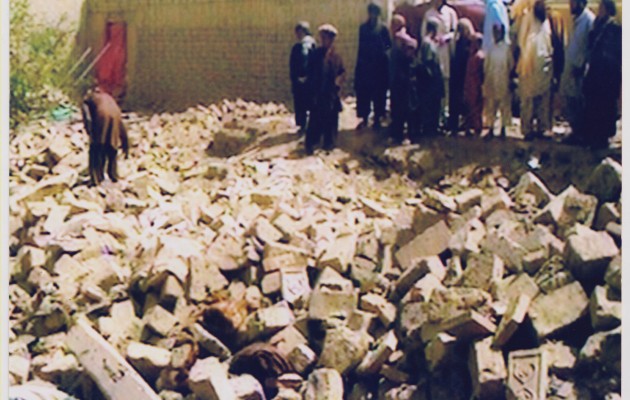
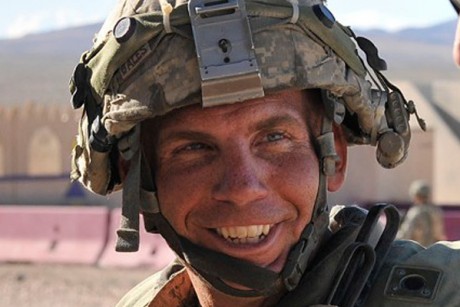
It’s a familiar argument in the annals of American violence: is some specific heinous deed the work of a disturbed individual acting alone? Or is it the work of unidentified conspirators? That’s the question hanging over the case of Sgt. Robert Bales, accused of killing 16 Afghan civilians last weekend. With U.S. officials releasing no information on how many soldiers are under investigation, it is premature to rule out the possibility that Bales had no accomplices.
A group of Afghan parliamentary investigators has concluded that Bales was part of a group of 15-20 soldiers. As Outlook Afghanistan reported Monday, “The team spent two days in the province, interviewing the bereaved families, tribal elders, survivors and collecting evidences at the site in Panjwai district.” One of the parliamentarians told Pajhwok Afghan News that investigators believed 15 to 20 American soldiers carried out the killings.
“I have encountered almost no Afghan who believes it could have been one person acting alone, whether they think it was a group or people back at the base somehow organizing or facilitating it,” Kate Clark of the Afghanistan Analysts Network told the Guardian. (The AAN is funded by four Scandanavian governments, all of which have troops in Afghanistan).
By contrast, few U.S. news account question that the massacre was the work of one man acting alone. In the U.S. media accounts Bales is described as the proverbial “lone nut,” a man under pressure from former investors and foreclosing banks who may have had too many tours of duties and too many drinks. In testimony to the House Armed Services Committee today, Gen. John Allen, commander of the international forces in Afghanistan, emphasized the singular nature of Bales’ actions. “We are now investigating what appears to be the murder of 16 innocent Afghan civilians at the hands of a U.S. service member,” he said. Allen also announced a separate administrative investigation into “command relationships associated with [Bales’] involvement in that combat outpost,” which suggests the scope of the probe may be broadening.
“He just snapped,” an unnamed senior U.S. official told the New York Times. “When it all comes out, it will be a combination of stress, alcohol and domestic issues.” This official’s comments reportedly drew from “accounts of the sergeant’s state of mind from two other soldiers with whom he illicitly drank alcohol on the night of the shootings, the official said, and those soldiers face disciplinary action.”
Leave aside this official’s willingness to draw sweeping conclusions from limited evidence. The passing admission that two other soldiers face disciplinary action for drinking with Bales on the night of the massacre might cast doubt on the notion that no one else knew what Bales was going to do. Army spokeswoman Lt. Col Amy Hannah said in telephone interview that she could not confirm the Times’ account. “I am not aware of any releases of information” about other soldiers facing disciplinary action, Hannah said. If the U.S. official’s remarks to the Times were accurate, then the Army is refraining from disclosing how many soldiers are under investigation.
Then there is conflicting eyewitness testimony. In this CNN video, one man describes the actions of a group in carrying out the killings. “They took him my uncle out of the room and shot him,” he says. “They came to this room and martyred all the children.” But one boy seen on the tape says there was only a single gunman. Still other witnesses pointed out a place outside the home, where they said they found footprints of more than one U.S. soldier.
Journalists seeking to clarify the question have been thwarted. In Afghanistan, Pajhaowk Afghan News reports that Lewis Boone, the public affairs director for coalition forces, declined to answer questions about the massacre, saying that a joint Afghan-ISAF team was investigating the killings. As the Seattle Times noted yesterday, the Army has been struggling “to regulate information on the Afghanistan suspect.”
Ryan Evans, who worked with ISAF in Afghanistan and is now a research fellow at the Center for National Policy in Washington, said the thought “a cover up is very unlikely.”
“I think the most likely story is that Bales was acting on his own,” he said in an email, “but that either (a) he was using multiple weapons systems and using standard small unit tactics (basically re-positioning and moving around) which gave the illusion of a larger force or (b) the local ODA went out looking for him at some point and people saw them or (c) a mixture of the two.”
That may be, but the military’s silence is only fueling alternative theories. “An attack carried out by a group can worsen Kabul-Washington relations more than it is now,” says Washington-based Afghan journalist, Farzad Lemeh. “Secondly, it would affect all U.S. military for showing mismanagement.”
With the Obama’s Afghan war policy facing another crisis, it is understandable that the White House and the Pentagon want to control the story. But the evidence does not entirely support the narrative they’re pushing.
Glenn Greenwald has a horrifying look at the repeated harassment to which filmmaker Laura Poitras, who has made a series of powerful documentaries about the impact of the War on Terror, has been subject when she’s returned home to the United States from trips abroad:
She has had her laptop, camera and cellphone seized, and not returned for weeks, with the contents presumably copied. On several occasions, her reporter’s notebooks were seized and their contents copied, even as she objected that doing so would invade her journalist-source relationship. Her credit cards and receipts have been copied on numerous occasions. In many instances, DHS agents also detain and interrogate her in the foreign airport before her return, on one trip telling her that she would be barred from boarding her flight back home, only to let her board at the last minute. When she arrived at JFK Airport on Thanksgiving weekend of 2010, she was told by one DHS agent — after she asserted her privileges as a journalist to refuse to answer questions about the individuals with whom she met on her trip — that he “finds it very suspicious that you’re not willing to help your country by answering our questions.” They sometimes keep her detained for three to four hours (all while telling her that she will be released more quickly if she answers all their questions and consents to full searches).
Poitras is now forced to take extreme steps — ones that hamper her ability to do her work — to ensure that she can engage in her journalism and produce her films without the U.S. Government intruding into everything she is doing. She now avoids traveling with any electronic devices. She uses alternative methods to deliver the most sensitive parts of her work — raw film and interview notes — to secure locations. She spends substantial time and resources protecting her computers with encryption and password defenses. Especially when she is in the U.S., she avoids talking on the phone about her work, particularly to sources. And she simply will not edit her films at her home out of fear — obviously well-grounded — that government agents will attempt to search and seize the raw footage.
The New York Times did a wonderful interview with Poitras as part of its September 11 coverage last year:
Apparently, it’s threatening to set up a continuum of reactions to the War on Terror that includes both Americans’ emotional reactions to the physical reality of Ground Zero and opponents of the U.S. occupation who are running for office in Iraq. Or perhaps Poitras’s sin is suggesting that things like the wars in Iraq and Afghanistan torture and indefinite detention…”are the things that were not created on 9/11. Those are things that we chose.” Because if we chose them, we can roll them back.
Creating sympathy for people who are harmed by our actions and suggesting we take responsibility for our own are just some of the powerful things that art can do. But confusing ideas that are dangerous to your interests—for example, the suggestion that the huge growth of our security state haven’t reaped us tangible benefits and may in fact have done some damage—and dangerous to the country is a mistake intelligent people out to be ashamed to make. Greenwald points out that DHS concluded that their interrogations of Poitras had produced nothing of value, and yet continued to perform them. Maybe those agencies should answer some questions about what they expect to get next time around, and why harassing Poitras is a valuable use of their time. It’s a far milder query than the ones Poitras is being interrogated for posing.
(NaturalNews) The state of Michigan is only days away from engaging in what can only be called true “animal genocide” — the mass murder of ranch animals based on the color of their hair. It’s all part of a shocking new “Invasive Species Order” (ISO) put in place by Michigan’sDepartment of Natural Resources(DNR). This Invasive Species Order suddenly and shockingly defines virtually all open-range pigs raised by small family farms to be illegal “invasive species,” and possession of just one of these animals is now a felony crime in Michigan, punishable by up to four years in prison.
The state has said it will “destroy” these pigs beginning in April, potentially byraiding local farms with government-issued rifles, then shooting the pig herds while arresting the members of the family and charging them with the “crime” of raising pigs with the wrong hair color. This may truly be a state-sponsored serial animal killing spree.
Reality check: You may think this story is some kind of early April Fools prank, but it isn’t. This is factually true and verifiable through the documents, videos and websites linked below. The state of Michigan seriously intends to unleash amass murder spree of pigs of the wrong colorbeginning April 1.
Yet these are the very pigs that farmers and ranchers in Michigan have been raisingfor decades. The state doesn’t seem to care about this, and there are indications thatthis ISO may have been nudged into position by the conventional pork industryas a tactic to wipe out its competition of local, specialty ranching conducted by small families and dedicated farmers who don’t work for the big pork corporations. (The Michigan Pork Grower’s Association.)
Hear the shocking interview and watch the family farm video…
I have recorded an exclusive interview withMark BakerfromBaker’s Green Acres— one of many ranching operations threatened with total destruction by state bureaucrats and this new Invasive Species Order. Listen to that interview here: http://buzz.naturalnews.com/000025-Michigan-pigs-invasive_species.htm…
The Baker family has also recorded a video explaining their farming operation and how the state of Michigan is threatening to destroy their entire farming operation. Watch that stunning video (and spread the word about it) at: http://www.youtube.com/watch?v=843yH_0RMIA
Mark Baker, by the way, is a veteran of the United States Air Force. As a veteran of the U.S. armed forces, he served to protect the rights of others, yet he now finds his own rights and freedoms under assault by the state of Michigan. He told NaturalNews he is determined to protect his livelihood at all costs and to take a stand against tyranny in Michigan.
Got the wrong hair color? The state of Michigan will kill you
The state of Michigan has issued a document describing nine “traits” of what they call “feral pigs” which they claim should be destroyed on April 1.
Those traits includehaving the wrong color on the tip of the hairor evenbeing born with striped hair. The traits are written so that virtually all pigs raised by family ranchers across the state of Michigan will be targeted for destruction by the state of Michigan starting April 1. Farmers who defend their livestock may be arrested as felons and charged with multiple felony crimes by the state.
Michigan to destroy pigs based on the color of their hair – racial profiling for animal murder
Here’s some of the language from the Michigan document describing which animals are to be destroyed. Remember: For a pig to qualify as “feral” according to state tyrants, it only has to exhibit ONE of these traits, not all of them:
1) Bristle-tip coloration: exhibit bristle tips that are lighter in color (e.g., white, cream, or buff) than the rest of the hair shaft.
2) Dark point coloration: exhibits “points” (i.e., distal portions of the snout, ears, legs, and tail) that are dark brown to black in coloration, and lack light-colored tips on the bristles.
3) Coat coloration: exhibit a number of coat coloration patterns:solid black, solid red / brown, black and white spotted, black and red / brown spotted.
4) Underfur: exhibit the presence of underfur that is lighter in color (e.g., smoke gray to brown) than the overlying dark brown to black bristles/guard hairs.
5) Juvenile coat pattern: exhibit striped coat patterns — a light grayish-tan to brown base coat, with a dark brown to black spinal stripe and three to four brown irregular longitudinal stripes with dark margins along the length of the body.
6) Skeletal appearance: Structures include skull morphology, dorsal profile, and external body measurements including tail length, head-body length, hind foot length, ear length, snout length, and shoulder height.
7) Tail structure: Straight tails.
8) Ear structure: Erect ear structure.
9) “Other characteristics not currently known to the MDNR that are identified by the scientific community.”
Did you catch that last one? So now the so-called “scientific community” can simply invent whatever trait they want and the state of Michigan will legalize the mass murder of all ranch animals displaying that trait.
The state of Michigan plans to bring guns to destroy local food, local farms
What’s clear from all this is that Michigan bureaucrats plan to bring guns and handcuffs to ranches all across Michigan, shooting their family livestock dead and ruining their farming operations. They then plan to arrest these ranchers as felons and separate them from their families, then charge them with felony crimes.
This is all being done under the mantra of “government is good! Government protects you!” It’s being pushed under the guise of protecting people from “invasive species,” yet what the Michigan bureaucrats don’t tell anyone is that now your local food producers have had their own ranch animals placed on that list!
That’s the trick here: Michigan has declaredfarm animalsto be an invasive species!
An epic battle of truth, freedom and justice is being waged in Michigan
We need your help to defend farm freedom in Michigan and across the country. Here are some actions you can take:
4) DONATE to help support the legal fees of the Baker family farm. Their website is atwww.BakersGreenAcres.com
5) DEMAND farm freedom in your area! No government has the right to tell us what food we can or cannot grow, eat or trade! It’s as simple as that, and any government bureaucrat, tyrant or local dictator who thinks they can trample on your God-given right to choose what kind of food you wish to produce or consume is in desperate need of having a boot shoved deeply and forcefully up their rear ends.
Give tyrants the boot! Defend local farms. Even if you don’t eat pork (I don’t), this is still a farm freedom issue worth fighting for.
Update: I’ve clarified two aspects of this story below. First, Micro Systemation’s XRY tool often requires more than two minutes to crack the iPhone’s password. The two minutes I originally cited were a reference to the time shown in the video (now removed by Micro Systemation) below. Given that, as I originally wrote, the phone in the video used the simplest possible password (0000), the process often takes far longer.
Second, Micro Systemation had told me that XRY can gain access to phones that run the latest version of iOS. But in fact, it can only gain access to older iPhones and iPads running the latest version of the operating system, and can’t access the iPhone 4S or the iPad 2 or later. Apologies for this oversight.
Set your iPhone to require a four-digit passcode, and it may keep your private information safe from the prying eyes of the taxi driver whose cab you forget it in. But if law enforcement is determined to see the data you’ve stored on your smartphone, those four digits will slow down the process of accessing it as little as two minutes.
Here’s a video posted last week by Micro Systemation, a Stockholm, Sweden-based firm that sells law enforcement and military customers the tools to access the devices of criminal suspects or military detainees and siphon off their personal information.
Update: After this post brought widespread attention to Micro Systemation’s video, the company has removed it from YouTube.
As the video shows showed, a Micro Systemation application the firm calls XRY can quickly crack an iOS or Android phone’s passcode, dump its data to a PC, decrypt it, and display information like the user’s GPS location, files, call logs, contacts, messages, even a log of its keystrokes.
Mike Dickinson, the firm’s marketing director and the voice in its videos, says that the company sells products capable of accessing passcode-protected iOS and Android devices in over 60 countries. It supplies 98% of the U.K.’s police departments, for instance, as well as many American police departments and the FBI. Its largest single customer is the U.S. military. ”When people aren’t wearing uniforms, looking at mobile phones to identify people is quite helpful,” Dickinson says by way of explanation.
With smartphone adoption rocketing around the world, Dickinson says Micro Systemation’s “business is booming.” The small company has grown close to 25% in revenue year-over-year, earned $18 million in revenue in 2010 up from $12 million the year before, and doubled its employees since 2009.
“It’s a massive boom industry, the growth in evidence from mobile phones,” says Dickinson. “After twenty years or so, people understand they shouldn’t do naughty things on their personal computers, but they still don’t understand that about phones. From an evidential point of view, it’s of tremendous value.”
“If they’ve done something wrong,” he adds.
XRY works much like the jailbreak hacks that allow users to remove the installation restrictions on their devices, Dickinson says, though he wouldn’t say much about the exact security vulnerability that XRY exploits to gain access to the iPhone. He claims that the company doesn’t use backdoor vulnerabilities in the devices created by the manufacturer, but rather seeks out security flaws in the phone’s software just as jailbreakers do, one reason why half the company’s 75 employees are devoted to research and development. “Every week a new phone comes out with a different operating sytems and we have to reverse engineer them,” he says. “We’re constantly chasing the market.”
Update: Mike Dickinson has clarified that Micro Systemation’s XRY tool doesn’t support the iPhone 4S, iPad 2 or iPad 3. It does, however, support the latest version of Apple’s iOS operating system, so he says that older devices that have the latest software installed are still vulnerable.
After bypassing the iPhone’s security restrictions to run its code on the phone, the tool “brute forces” the phone’s password, guessing every possible combination of numbers to find the correct code, as Dickinson describes it. In the video above, the process takes seconds. (Although admittedly, the phone’s example passcode is “0000″, about the most easily-guessed password possible.)
Dicksinson acknowledges that users who set longer passcodes for devices can in fact make the devices far tougher to crack. “The more complex the password, the longer and harder it’s going to be to access the phone,” he says. “In some cases, it takes so long to brute force that it’s not worth doing it.” That may have been the situation, for instance, in one recent case involving the phone of Dante Dears, a paroled convict accused of running a prostitution ring known as “Pimping Hoes Daily” from his Android phone; The FBI, apparently unable or unwilling to crack the phone, asked Google to help in accessing it.
“We want the Syrian Army posted on the roofs of the houses, with helicopters and tanks.”
“Stop these snipers from killing us.”
~ The Residents of Homs, Syria.
Moscow has accused the West and co’ of stirring up tensions in the Arab world by calling for the overthrow of President Assad and the Syrian Government. Russia has commented that those nations who are calling for the “Syrian opposition” to avoid dialogue with the government, are only encouraging and provoking further violence.
Author and journalist Webster Tarpley, from a visit to Syria, says it’s very simple: the Western powers, Israel and the Gulf States are the true forces behind the violence in Syria. They are funding Foreign Terrorist Snipers; “Death Squads”, to come into Syria and Murder Innocent Syrians randomly in their twisted bid to destabilize Syria.
Many of the so called “free syrian army” are in FACT just foreign fighters and fanatics, brought into Syria by the Western Powers, the CIA and Mossad, so as to engineer a false and highly exaggerated impression of the situation there, in order to intervene militarily in Syria and depose Assad’s Government.
What worked so wonderfully for them in Libya, they are trying to repeat in Syria. This engineered and false situation the Western Powers, Israel and the Corrupt Gulf Monarchies are engineering and cultivating is ultimately part of their unjust Zionist agenda and War against Iran and must be Exposed for the Pure Evil it is.
“A mere demarcation on parchment of the constitutional limits (of government) is not a sufficient guard against those encroachments which lead to a tyrannical concentration of all the powers of government in the same hands.” – James Madison, Federalist Paper #48, 1788.
President Obama signed an Executive Order for “National Defense” yesterday that claims executive authority to seize all US resources and persons, including during peacetime, for self-declared “national defense.”
The EO claims power to place any American into military or “allocated” labor use (analysis here and here).
“American exceptionalism” is the belief that a 200+ year-old parchment in the National Archives has magical powers to somehow guarantee limited government from 1% tyranny, despite the specific and clear warnings of the US Founders, despite world history of repeated oligarchic/1% tyranny claiming to be for the “good of the people,” and despite US history’s descent into vicious psychopathy (short version here: US war history in 2 minutes) hidden in plain view with paper-thin corporate media propaganda.
I don’t know about you, but both my grandfathers were in the US military during the gruesome WW1. My father, father-in-law, and only uncle were in a brutal WW2. Both wars were functions of colonialism; a 1%’s vicious and rapacious greed.
I don’t know about you, but I’m teaching the obvious crimes in war and money, destruction of Constitutional Rights rights (see specific links below), and asking students (of all ages) what they see to do about these clear facts. The first answer people see is to help people get over their “American exceptionalism” to recognize these massive crimes, and demand arrests of the obvious criminal “leadership.”
I don’t know about you, but I refuse to be silent in face of lying and criminal government policies that annually murder millions, harm billions, and loot trillions of the 99%’s dollars.
What will you do?
Here is the US government claiming it can Constitutionally assassinate Americans upon the non-reviewable dictate of the leader, as these criminals take psychopathic steps to murder Americans who expose their crimes.
Here is NDAA 2012 where US government claims it can Constitutionally disappear Americans and then appoint a tribunal with death sentence authority (unless unlimited detention is their choice). Here is the 2006 Military Commissions Act that says the same. This is fascist terrorism to silence Americans from communicating that the 1% are War Criminals to arrest NOW.
Here is US government claiming it can Constitutionally control-drown (waterboard) anyone they declare a “terrorist” as a 1% terror-tactic to silence Americans.
Director, Center for Counter-terrorism & World Peace
Nikola Tesla was one of the greatest and most gifted men ever to have walked this Earth.
A huge amount has been written about the prodigal genius of Nikola Tesla and so there may not be a great need to say more here about his life, his brilliance, his vision, and his achievements.
But in brief, Tesla was an extraordinary, intuitive, creative genius who, among a great deal else, invented alternating current (which powers the the modern world) and radio (for which Marconi is often falsely given credit).
Contemporary biographers of Tesla have deemed him “the father of physics”, “the man who invented the twentieth century”, and “the patron saint of modern electricity”.
Much of his life’s work was about providing for the world free (i.e. zero-cost) energy, which Tesla envisaged would be broadcast wirelessly through the air or through the Earth itself with no need for powerlines – but despite years of trying, he never obtained the funding to achieve this, one of his dreams.
It has long since been rumored that he invented or developed a significant number of electrical and electronic devices which were decades ahead of their time and would have been of special interest to US military and intelligence circles. Around 300 patents were issued to Tesla in 25 countries, many of them major and far-reaching in concept.
The reality of Tesla’s murder was brought home to us after listening to this Youtube presentation. Eric Bermen tells Greg Syzmanski how he discovered his former girlfriend was the daughter of ex-Nazi SS Commando Otto Skorzeny, and thereby quite by chance met the elderly Skorzeny who had been living for years in the US, working as a carpenter with a new identity supplied by the CIA after WWII.
Bermen (who sometimes uses the pseudonym Eric Orion) heard a full confession from Skorzeny, who was nearing the end of his life, and was given a shoebox full of over a hundred photographs to substantiate his claims.
Among a number of other highly significant revelations, Bermen heard from Skorzeny that he had personally suffocated Nikola Tesla on January 6, 1943, assisted by fellow-Nazi Reinhard Gehlen. Tesla was then 86 years old.
According to Skorzeny, he and Gehlen had tricked Tesla the previous day into revealing the full details of his most important discoveries. After the murder, they stole the contents of Tesla’s safe, which were delivered to Hitler. (Note, of course, that the US military would have fully repatriated this treasure trove of innovation through Project Paperclip at the end of the war.)
Otto Skorzeny was Hitler’s bodyguard & also an assassin, one of the many Nazis who ex-filtrated to the USA after WWII, as part of Project Paperclip. Many of these Nazi scientists ended up working for NASA, the CIA, and other US secret services.
Although he supposedly died in 1975 in Spain, Skorzeny resurfaced in 1999. Otto Skorzeny described how (“contrary to the CIA-written history books”) he helped Hitler escape to Austria in a plane flown by a female pilot, Hanna Reitsch.
“Hitler did not commit suicide,” Skorzeny recounted. “His double was shot between the eyes, and the dental records proved he was not Hitler. The Americans kept it a secret, worried the truth might anger the Russians.”
A Young Tesla
Despite conflicting literary and historical accounts, Nikola Tesla, a Serb, was born on July 10, 1856, in Smiljan, Lika Serbian province, Austro-Hungarian Empire of that time, or what is now modern-day Croatia. Prior to World War I, Smiljan was on the border of the Austro-Hungarian empire.
The son of a Serbian Orthodox priest who rose to the rank of Archbishop, Tesla had the opportunity to study a variety of topics contained in his father’s personal library. As a young boy, he accompanied his father on trips to Rome, where he was able to study the lesser-known works stored in the Vatican’s vast scientific repository.
Upon completing his studies in engineering and physics at the Polytechnic Institute in Graz, Austria, Tesla attended the University at Prague. He demonstrated, early on, an innate ability to solve mechanical and scientific problems, especially in the area of electricity and its applications in power production.
After working for Edison Telephone Company subsidiaries in Budapest, Paris, and other cities throughout Europe, Nikola Tesla went to America, to meet the man whose company gave him his first job, Thomas Edison.
Tesla found it difficult to work for Edison (due to Edison’s reneging on financial promises), but soon found backers to finance his research and development projects and his new inventions.
Financiers, such as John Pierpont (J.P.) Morgan, George Westinghouse and John Jacob Astor were among those who saw the potential in Tesla’s pioneering, entrepreneurial spirit to capitalize on his technological discoveries in electricity, wireless communications, and physics.
The only official documentation of Nikola Tesla’s arrival to the United States was, again, produced at the Port of New York. [9] On April 7, 1882 a 25-year old Tesla arrived via the SS Nordland, which departed from Antwerp. He had returned, on this trip to the U.S., after lecturing in Paris.
Tesla’s destination: New York. Tesla immigrated as a “laborer,” though this label hardly befit the man who would become the most prolific inventor in history, with some 700 technological patents to his credit. Previous accounts of Tesla’s association with Thomas Edison’s projects place him in the United States in the 1870s.
Tesla in Colorado Springs Lab
His many technological discoveries were certain to have drawn the attention of those hungry for world domination and superiority.
By and large, Tesla’s inventions and his career were excluded from our history books because his inventions and patents were stolen and then weaponized.
It was never intended for us to learn about the suppression of Tesla’s advanced scientific discoveries, nor about those who profited from their theft—the orchestrators of the master plan.
Though much has been written about Tesla’s successes and failures, few have detailed the behind-the-scenes financial activities which disclose a Nazi plot to acquire his technology, while research and development costs had largely been paid (unknowingly) by U.S. taxpayers.
Many of Tesla’s patents fell into Nazi hands prior to and during World Wars I and II. As a result, Tesla continuously found himself in litigation over patent rights and other issues.
Although he had succeeded in winning the majority of his patent lawsuits, his technology had been repeatedly stolen and sold to the German Nazis and other foreign governments, so he never achieved the financial success he deserved.
The embezzlement of his capitalization went unchecked throughout Tesla’s career. At the time of his death (by murder, according to Skorzeny) on January 6, 1943, Tesla died virtually penniless.
On Good Friday, Ortodox Christmas Eve, he was found in bed, dressed in solemn black suit, arms folded on his chest. They say that a great mind felt his death is coming , he put on the solemn black suit – and then died. An incredible lie and mission impossible, even for a great mind as it was Nikola Tesla.
Tesla’s Ashes are preserved in a Gilded Sphere – His Favorite Shape
This is the ultimate proof that he was murdered and his killers dressed him in a suit and left him in the bed! His killers: Otto Skorzeny and Reinhard Gehlen. Nikola Tesla’s successes in discovering new technologies did not go unnoticed by many industrial capitalists and world governments.
In fact, many of his inventions were developed through secret government programs which began soon after his discoveries in alternating current (AC), electromagnetic energy, electric motors, generators, coils, radio transmission, energy-saving devices, and wireless transmission technologies.
Since Tesla was often buried deep in research at remote labs, many of his financial and legal affairs were supervised by his closest associate, George H. Scherff.
Scherff often advised Tesla about pending patent litigation, contracts, proposals, demonstrations, and financial affairs.
As any trusty associate would, Scherff stood beside Tesla through all the ups and downs of his financial nightmares, sometimes arranging for extended credit at the Waldorf-Astoria, where Tesla often resided, or by obtaining a cash advance toward research he had been contracted to perform.
Near the end of his career, Tesla was evicted from the Waldorf for an outstanding bill which exceeded $20,000 — a rather large sum for those days.
As Tesla worked on secret U.S. government projects at Colorado Springs, Colorado, Scherff communicated to Tesla the status of his business affairs. Tesla spoke of hopeful, future financial successes, though Scherff repeatedly delivered the news of dwindling funds. Tesla had begun construction of a wireless power transmission tower (“Wardenclyffe,” Shoreham, Long Island) with funds invested by J.P. Morgan.
Tesla’s Tower
When Morgan discovered that the tower would transmit free electricity and radio waves, he cancelled the project and had the tower dismantled, then sold for scrap. Morgan was not about to allow Americans to receive free electricity, television and radio.
Tesla was devastated when he received the news, but continued on with his new inventions. The Rockefeller Connection Records show that 17 Battery Place is the Whitehall Building and was owned by Frank Rockefeller, who, with his brothers William and John D., also owned many of the companies with offices located there.
The International Longshoremen’s Association (ILA) had its world headquarters there, as well as a variety of oil, mining, and chemical companies.
Though Union Sulphur Company was run by its president, Herman Frasch, a German chemist who patented extraction methods for sulphur and petroleum, Frasch also worked for John D. Rockefeller’s Standard Oil Company (in New York, New Jersey, and Cleveland, Ohio), developing similar extraction methods.
Frank Rockefeller was also an investor of Buckeye Steel Castings in Columbus, Ohio. Buckeye manufactured automatic couplers and chassis for railroad cars owned by the Harrimans, the Rockefellers, and J.P. Morgan. Eventually, Samuel P. Bush was promoted from general manager to president of the company after producing gigantic profits.
Samuel P. Bush’s association with the Rockefellers and his subsequent position as Director of the War Industries Board afforded him the opportunity to create contracts with Remington Arms during the war, courtesy of Percy Rockefeller. Nikola Tesla’s trusted assistant (sometimes referred to as “accountant” or “secretary”) George Scherff, Sr., worked at Union Sulphur Company.
Normally, this association would not set off alarms, considering the state of Tesla’s affairs. Scherff had every right to earn a decent living in order to support his family. That was “the American Way.” But a careful examination of Union Sulphur Co. might reveal that someone was being deceived — Tesla, and Scherff was at the root of this deception.
Who was George Scherff? Who was George Scherff? Better yet, who was George H. Scherff, Sr.? There exists no legitimate record of a George H. Scherff being born in the U.S. from the late-1800s through 1925, yet, George Scherff was Nikola Tesla’s assistant/accountant.
Only one photograph in public circulation records the face of George Scherff, Sr. -at the Association of Radio Engineers banquet of 1915 (above). Tesla is seen standing tallest in the middle of the back row, while Scherff stands at the end of the same row to Tesla’s left, his hands visible at his sides.
If he was born in Germany, could his birthplace shed some light on this mystery? Probably—if they exist (it has become apparent that individuals associated with the Nazi Party commonly have all or parts of their genealogical records expunged—we will explore this further in the section of this article dealing with the “Bush” family tree).
In short, Otto Skorzeny claimed that the true identity of George H.W. Bush was “George H. Scherff, Jr., the son of Nikola Tesla’s illegal-immigrant, German-born accountant, George H. Scherff, Sr.”
Worth a thousand words: But this was not the only bombshell Otto Skorzeny delivered that day in late-1999. Skorzeny, producing a shoe box full of 60-years worth of his personal photographs, showed them to Berman, describing each one in great detail.
The collection featured a photo of a young, majestic Skorzeny in full S.S. Nazi military dress, next to his Fьhrer, Adolph Hitler. Then there were photos of Reinhard Gehlen (S.S. spy and assassin) Dr. Joseph Mengele (the “Angel of Death”) Martin Bormann (Hitler aide and S.S. assassin) .
Eric “Orion” (Berman), in a live radio interview on Republic Broadcasting Network, January 17, 2006, detailed how:
“Skorzeny died on December 31, 1999. His body was cremated, I have a copy of his death certificate, and I saw his ashes. After the war, he helped George Bush found the CIA through Operation Paperclip and ODESSA.”
Berman recounted how Skorzeny was found “not guilty” at the Nuremburg trials, and then ushered into the CIA. “Some 50,000+ S.S. Nazi war criminals, not just rocket scientists, were brought to America after the war.”
Skorzeny, about age 90 at the time, was described by Berman as “very focused and very lucid, and he was still very mobile. He was still able to walk around—he was still very impressive and he had about the biggest hands I have ever shaken. He was 6’-4”and was a giant for his day. He towered over me, and I’m 5’-8”.”
When asked why he thought Skorzeny entrusted this information to him, Berman responded,
“I was dating one of his daughters. He knew that I’m Jewish, first of all, I’m an honest guy and he thought that I would really try to do something about this and bring some justice, yeah, to these wanted Nazi war criminals.
His whole goal was…. they had screwed him over, including George Bush, they screwed him over….. and out of large sums of money over the years. This was his one last way of… you know, getting even with them.”
A biographical article about Nikola Tesla appeared in the Tesla Tech, Inc. magazine, “Extraordinary Technology,” Volume 4, Number 3, Aug., Sept., Oct., 2006. The article, written by Dustin Wallace, spoke of Tesla’s childhood, some of his inventions, and his last days. Wallace wrote (pp. 21-22), “The Yugoslav Monarchy in Exile was summoned to visit Tesla in the fall of 1942.
However, Charlotte Muzar, a secretary, paid Tesla the visit. From his condition upon her arrival she felt as though he may not live through the night. Another friend of Tesla’s, Kenneth Swezey visited him during the time and noted that he was existing on warm milk and Nabisco crackers alone.
It was apparent that Tesla was nearing the end of his time. By late December of 1942, Tesla began meeting with two U.S. government agents in order to share some of his most sensitive discoveries. These men carried away many of his documents for microfilming.”
“On January 4, 1943, Tesla’s faithful assistant, George Scherff, visited Tesla for the last time, Tesla was found deceased in his hotel room on the morning of January 8. 1943. He had passed away between those four days since Scherff’s visit.”
The article continued, “Following Tesla’s death the United States Office of Alien Property, under the instructions of the Federal Bureau of Investigation, confiscated all of Tesla’s papers and property. This was an interesting maneuver considering that Tesla was a United States citizen.”
The significance of this benign description of Tesla’s inventions and his last days has a direct relationship to the previously unknown claims of Otto Skorzeny. As Skorzeny described (to Berman) in detail his involvement with George H. W. Bush (George H. Scherff, Jr.) in organizing the CIA by absorbing Nazi S.S. agents,” he intimated that it was Reinhard Gehlen and himself who murdered Nikola Tesla on January 6, 1943 by strangulation/suffocation.
Prior to the murder, Skorzeny and Gehlen “spoke in great detail to Tesla about his most-advanced technologies and then stole the blueprints of his best, most-secret inventions.”
Were these the “two U.S. government agents” about whom Dustin Wallace wrote? The timing of George Scherff’s last visit to Nikola Tesla was suspicious, as well.
Skorzeny did not stop with these soul-cleansing disclosures. He went on to describe the aliases of himself Frank Edward P_ _ _ _ _, of south Florida (according to Berman, who claims he is trying to protect Skorzeny’s daughter), Reinhard Gehlen (Hank Janowicz, Wayne, N.J.), and Dr. Joseph Mengele (Steven Rabel).
According to Berman,
“Gehlen was tipped off by the FBI about Skorzeny’s unveiling of his identity and location, and Gehlen (Janowicz) then went into hiding. Mengele (Rabel), through a series of anti-aging hormone injections, a black hairpiece, and ‘cannibalism’ has maintained a youthful appearance.”
Having investigated some of Skorzeny’s claims, Berman had contacted the U.S. Justice Department to inform them that Nazi spies were being harbored by certain factions of the U.S. intelligence agencies, in particular, the CIA. “My thoughts were that, uh, I needed to try to bring these wanted SS Nazi war criminal, holocaust killers—terrorists, basically—to justice.
I wanted to call our government and tell ‘em, ‘Hey, that they’re still alive.’ I wanted to bring ‘em to justice. That was my whole intention. I initially had contacted, or tried to contact Eli Rosenbaum, who was the Director of the United States Justice Department, Office of Special Investigations.
Basically, they, uh, thought it was a hoax and they told me that I was mistaken, and that according to the CIA, ‘all of them were all dead and I was mistaken.’ That’s what they told me. I was wrong.“
The CIA admits that the U.S. overthrew the moderate, suit-and-tie-wearing, Democratically-elected prime minister of Iran in 1953. He was overthrown because he had nationalized Iran’s oil, which had previously been controlled by BP and other Western oil companies. As part of that action, the CIA admits that it hired Iranians to pose as Communists and stage bombings in Iran in order to turn the country against its prime minister
If the U.S. hadn’t overthrown the moderate Iranian government, the fundamentalist Mullahs would have never taken over. (Moreover, the U.S. has had a large hand in strengthening radical Islam in the Middle East by supporting radicals to fight the Soviets and others)
The U.S. armed and supported Iraq after it invaded Iran and engaged in a long, bloody war which included the use of chemical weapons. Here is former Secretary of Defense Donald Rumsfeld meeting with Saddam Hussein in the 1980′s, several months after Saddam had used chemical weapons in a massacre:
* The U.S. has been claiming for more than 30 years that Iran was on the verge of nuclear capability
* The U.S. helped fund Iran’s nuclear program
* The U.S. has been actively planning regime change in Iran – and throughout the oil-rich Middle East and North Africa – for 20 years
* The decision to threaten to bomb Iran was made before 9/11
* America and Israel both support a group designated by the U.S. as a terrorist organization which is trying to overthrow the Iranian government
* Top American and Israeli military and intelligence officials say that Iran has not decided to build a nuclear bomb
* Top American and Israeli military and intelligence officials say that – even if Iran did build a nuclear bomb – it would not be that dangerous, because Israel and America have so many more nukes. And see this
* American military and intelligence chiefs say that attacking Iran would only speed up its development of nuclear weapons, empower its hardliners, and undermine the chance for democratic reform
* The people pushing for war against Iran are the same people who pushed for war against Iraq, and said it would be a “cakewalk”.
* Well-known economist Nouriel Roubini says that attacking Iran would lead to global recession. The IMF says that Iran cutting off oil supplies could raise crude prices 30%. War with Iran would kill the American economy. And see this and this
* China and Russia have warned that attacking Iran could lead to World War III
The Arizona legislature passed Arizona House Bill 2549, which would update the state’s telephone harassment law to apply to the Internet and other electronic communications. The bill is sweepingly broad, and would make it a crime to communicate via electronic means speech that is intended to “annoy,” “offend,” “harass” or “terrify,” as well as certain sexual speech. Because the bill is not limited to one-to-one communications, H.B. 2549 would apply to the Internet as a whole, thus criminalizing all manner of writing, cartoons, and other protected material the state finds offensive or annoying. The Bill is currently on Governor Jan Brewer’s desk awaiting her decision on whether to veto or sign the bill.
Media Coalition, a trade association protecting the First Amendment rights of content industries, whose membership includes CBLDF, has been active in opposing the bill. On March 14, Media Coalition sent a memo to the Senate Rules Committee regarding constitutional infirmities in H.B. 2549. Yesterday they sent a letter to Governor Brewer urging her to veto the bill.
That letter outlines the constitutional deficiencies in the bill:
H.B. 2549 would make it a crime to use any electronic or digital device to communicate using obscene, lewd or profane language or to suggest a lewd or lascivious act if done with intent to “annoy,” “offend,” “harass” or “terrify.” The legislation offers no definitions for “annoy,” “offend,” “harass” or “terrify.” “Electronic or digital device” is defined only as any wired or wireless communication device and multimedia storage device. “Lewd” and “profane” are not defined in the statute or by reference. “Lewd” is generally understood to mean lusty or sexual in nature and “profane” is generally defined as disrespectful or irreverent about religion or religious practices.
Government may criminalize speech that rises to the level of harassment and many states have laws that do so, but this legislation takes a law meant to address irritating phone calls and applies it to communication on web sites, blogs, listserves and other Internet communication. H.B. 2549 is not limited to a one to one conversation between two specific people. The communication does not need to be repetitive or even unwanted. There is no requirement that the recipient or subject of the speech actually feel offended, annoyed or scared. Nor does the legislation make clear that the communication must be intended to offend or annoy the reader, the subject or even any specific person.
Speech protected by the First Amendment is often intended to offend, annoy or scare but could be prosecuted under this law. A Danish newspaper posted pictures of Muhammad that were intended to be offensive to make a point about religious tolerance. If a Muslim in Arizona considers the images profane and is offended, the paper could be prosecuted. Some Arizona residents may consider Rush Limbaugh’s recent comments about a Georgetown law student lewd. He could be prosecuted if he intended his comments to be offensive. Similarly, much general content available in the media uses racy or profane language and is intended to offend, annoy or even terrify. Bill Maher’s stand up routines and Jon Stewart’s nightly comedy program, Ann Coulter’s books criticizing liberals and Christopher Hitchens’ expressing his disdain for religion, Stephen King’s novels or the Halloween films all could be subject to this legislation. Even common taunting about sports between rival fans done online is frequently meant to offend or annoy and is often done using salty and profane language.
While protecting people from harassment is a worthy goal, legislators cannot do so by criminalizing speech protected by the Constitution. All speech is presumptively protected by the First Amendment against content-based regulation, subject only to specific historic exceptions.
If passed, the law could create vulnerabilities for cartoonists and publishers who publish material online intended to shock, satirize, and criticize. Beyond the example of the Mohammad cartoons listed in the Media Coalition letter, the taboo-pushing work of cartoonists like R. Crumb, Johnny Ryan, and Ivan Brunetti would potentially be vulnerable to prosecution, as could incendiary works such as Frank Miller’s Holy Terror and Dave Sim’s Cerebus. Similarly, the culture of message boards, within and beyond comics, would be imperiled. With more titles released digitally each week, and an extremely active online ecosystem of professional and fan exchange, laws like this one are extremely worrisome for the creators, publishers, and readers of comics.
For more information about this bill, please visit Media Coalition.
Charles Brownstein is the Executive Director for Comic Book Legal Defense Fund
Well, it has been the $64,000 question for a couple of decades: Can NSA break something like PGP?
While there might be other black world technologies that could be up to the task (there’s no way to know), what we do know is that a practical quantum computing capability would be, for all intents and purposes, the master key.
I’m pretty confident that NSA has this capability and here’s why: IBM Breakthrough May Make Practical Quantum Computer 15 Years Away Instead of 50. There is no hard constant that one can point to when considering how much more advanced black world technologies are than what we think of as state of the art, but if IBM is 15 years away from building a useful quantum computer, it’s not a stretch to assume NSA has that capability already, or is close to having it.
Bamford lays out a narrative below about the “enormous breakthrough,” but, at the end of the day, it’s conventional computers. There’s no mention quantum computers, or even the far less “out there” photonic systems.
Is Bamford’s piece a limited hangout?
Maybe, but it makes for interesting reading in any event.
Note: For some reason, Bamford refers to Mark Klein as, “A whistle-blower,” without naming him. Because of Mark Klein, we know, for sure, that the mass intercepts are happening, how NSA is doing it, the equipment involved, etc. So, thanks, Mark Klein. Heroes have names on Cryptogon.
—
Update: Former Senior U.S. Intelligence Official and Current Booz Allen Hamilton Senior Vice President Joan A. Dempsey: ‘We’re a Few Years Away from Realizing Real Quantum Processing and Quantum Computing’
One of the first measures of tradecraft, as any good spy will tell you, is being able to tell when something just doesn’t add up. So when Joan Dempsey said she had some 49 years of experience in various roles in the military and intelligence communities, one has to wonder. She hardly looks it, but after spending some 25 years in the U.S. Navy, seven more at the CIA, and another 17 at the Pentagon in a variety of intelligence leadership positions, Dempsey swears it’s true, which means she is one of the few women in the intelligence community with nearly half a century of government experience, which has included, over the years, a number of “firsts.”
…
“I think that’s a huge growth area in intelligence, the big data analysis kinds of things, quantum computing which, I mean, we’re a few years away from realizing real quantum processing and quantum computing. And I mean these are areas that are going to have profound effect on every aspect of our lives, but certainly on the intelligence.
Under construction by contractors with top-secret clearances, the blandly named Utah Data Center is being built for the National Security Agency. A project of immense secrecy, it is the final piece in a complex puzzle assembled over the past decade. Its purpose: to intercept, decipher, analyze, and store vast swaths of the world’s communications as they zap down from satellites and zip through the underground and undersea cables of international, foreign, and domestic networks. The heavily fortified $2 billion center should be up and running in September 2013. Flowing through its servers and routers and stored in near-bottomless databases will be all forms of communication, including the complete contents of private emails, cell phone calls, and Google searches, as well as all sorts of personal data trails—parking receipts, travel itineraries, bookstore purchases, and other digital “pocket litter.” It is, in some measure, the realization of the “total information awareness” program created during the first term of the Bush administration—an effort that was killed by Congress in 2003 after it caused an outcry over its potential for invading Americans’ privacy.
But “this is more than just a data center,” says one senior intelligence official who until recently was involved with the program. The mammoth Bluffdale center will have another important and far more secret role that until now has gone unrevealed. It is also critical, he says, for breaking codes. And code-breaking is crucial, because much of the data that the center will handle—financial information, stock transactions, business deals, foreign military and diplomatic secrets, legal documents, confidential personal communications—will be heavily encrypted. According to another top official also involved with the program, the NSA made an enormous breakthrough several years ago in its ability to cryptanalyze, or break, unfathomably complex encryption systems employed by not only governments around the world but also many average computer users in the US. The upshot, according to this official: “Everybody’s a target; everybody with communication is a target.”
…
In the process—and for the first time since Watergate and the other scandals of the Nixon administration—the NSA has turned its surveillance apparatus on the US and its citizens. It has established listening posts throughout the nation to collect and sift through billions of email messages and phone calls, whether they originate within the country or overseas. It has created a supercomputer of almost unimaginable speed to look for patterns and unscramble codes. Finally, the agency has begun building a place to store all the trillions of words and thoughts and whispers captured in its electronic net. And, of course, it’s all being done in secret. To those on the inside, the old adage that NSA stands for Never Say Anything applies more than ever.
…
The data stored in Bluffdale will naturally go far beyond the world’s billions of public web pages. The NSA is more interested in the so-called invisible web, also known as the deep web or deepnet—data beyond the reach of the public. This includes password-protected data, US and foreign government communications, and noncommercial file-sharing between trusted peers. “The deep web contains government reports, databases, and other sources of information of high value to DOD and the intelligence community,” according to a 2010 Defense Science Board report. “Alternative tools are needed to find and index data in the deep web … Stealing the classified secrets of a potential adversary is where the [intelligence] community is most comfortable.” With its new Utah Data Center, the NSA will at last have the technical capability to store, and rummage through, all those stolen secrets. The question, of course, is how the agency defines who is, and who is not, “a potential adversary.”
…
According to Binney—who has maintained close contact with agency employees until a few years ago—the taps in the secret rooms dotting the country are actually powered by highly sophisticated software programs that conduct “deep packet inspection,” examining Internet traffic as it passes through the 10-gigabit-per-second cables at the speed of light.
The software, created by a company called Narus that’s now part of Boeing, is controlled remotely from NSA headquarters at Fort Meade in Maryland and searches US sources for target addresses, locations, countries, and phone numbers, as well as watch-listed names, keywords, and phrases in email. Any communication that arouses suspicion, especially those to or from the million or so people on agency watch lists, are automatically copied or recorded and then transmitted to the NSA.
The scope of surveillance expands from there, Binney says. Once a name is entered into the Narus database, all phone calls and other communications to and from that person are automatically routed to the NSA’s recorders. “Anybody you want, route to a recorder,” Binney says. “If your number’s in there? Routed and gets recorded.” He adds, “The Narus device allows you to take it all.” And when Bluffdale is completed, whatever is collected will be routed there for storage and analysis.
According to Binney, one of the deepest secrets of the Stellar Wind program—again, never confirmed until now—was that the NSA gained warrantless access to AT&T’s vast trove of domestic and international billing records, detailed information about who called whom in the US and around the world. As of 2007, AT&T had more than 2.8 trillion records housed in a database at its Florham Park, New Jersey, complex.
Verizon was also part of the program, Binney says, and that greatly expanded the volume of calls subject to the agency’s domestic eavesdropping. “That multiplies the call rate by at least a factor of five,” he says. “So you’re over a billion and a half calls a day.” (Spokespeople for Verizon and AT&T said their companies would not comment on matters of national security.)
After he left the NSA, Binney suggested a system for monitoring people’s communications according to how closely they are connected to an initial target. The further away from the target—say you’re just an acquaintance of a friend of the target—the less the surveillance. But the agency rejected the idea, and, given the massive new storage facility in Utah, Binney suspects that it now simply collects everything. “The whole idea was, how do you manage 20 terabytes of intercept a minute?” he says. “The way we proposed was to distinguish between things you want and things you don’t want.” Instead, he adds, “they’re storing everything they gather.” And the agency is gathering as much as it can.
Once the communications are intercepted and stored, the data-mining begins. “You can watch everybody all the time with data- mining,” Binney says. Everything a person does becomes charted on a graph, “financial transactions or travel or anything,” he says. Thus, as data like bookstore receipts, bank statements, and commuter toll records flow in, the NSA is able to paint a more and more detailed picture of someone’s life.
The NSA also has the ability to eavesdrop on phone calls directly and in real time. According to Adrienne J. Kinne, who worked both before and after 9/11 as a voice interceptor at the NSA facility in Georgia, in the wake of the World Trade Center attacks “basically all rules were thrown out the window, and they would use any excuse to justify a waiver to spy on Americans.” Even journalists calling home from overseas were included. “A lot of time you could tell they were calling their families,” she says, “incredibly intimate, personal conversations.” Kinne found the act of eavesdropping on innocent fellow citizens personally distressing. “It’s almost like going through and finding somebody’s diary,” she says.
…
Sitting in a restaurant not far from NSA headquarters, the place where he spent nearly 40 years of his life, Binney held his thumb and forefinger close together. “We are, like, that far from a turnkey totalitarian state,” he says.
…
Meanwhile, over in Building 5300, the NSA succeeded in building an even faster supercomputer. “They made a big breakthrough,” says another former senior intelligence official, who helped oversee the program. The NSA’s machine was likely similar to the unclassified Jaguar, but it was much faster out of the gate, modified specifically for cryptanalysis and targeted against one or more specific algorithms, like the AES. In other words, they were moving from the research and development phase to actually attacking extremely difficult encryption systems. The code-breaking effort was up and running.
The breakthrough was enormous, says the former official, and soon afterward the agency pulled the shade down tight on the project, even within the intelligence community and Congress. “Only the chairman and vice chairman and the two staff directors of each intelligence committee were told about it,” he says. The reason? “They were thinking that this computing breakthrough was going to give them the ability to crack current public encryption.”
This is an old clip showing admittance of the CIA that they use the mainstream media to manipulate the thoughts and ideas of American citizens in the USA. This has not changed obviously and is good to know happened in the past due to our reality today.
The April 2012 issue of Harper’s Magazine includes “The Warrior Class,” a feature by Charles Glass on the rise of private-security contractors since 9/11. The conclusion to the piece describes a series of videos shown to Glass by a source who had worked for the private-security company Blackwater (now Academi, formerly also Xe Services) in Iraq. Clips and photos from the videos are shown below, introduced by Glass’s descriptions:
The first , identified as “Baghdad, Iraq, May–September 2005,” showed Blackwater convoys racing through town. Suddenly, the door of a Blackwater SUV opened and a rifle fired at passing traffic. “They opened the door,” my companion said. “You should never break the seal.”
A still photo showed some graffiti scrawled on a metal beam: THIS IS FOR THE AMERICANS OF BLACKWATER THAT WERE MURDERED HERE IN 2004 SEMPER FIDELIS 3/5 PS FUCK YOU.
The next tape had been taken by a camera in the turret of an armored vehicle. An [M4A1]11. Corrected text. The gun was initially misidentified as an AK47.
fired from the turret at cars that had stopped to let the convoy pass. Whoever was firing the [gun] did so enthusiastically and often, sending rounds into parked cars and an overhead bridge. Another sequence showed a contractor vehicle rear-ending a car, shattering its back windshield.
The footage continued. A Humvee smashed into a car to move it out of the way. Guards swore at passersby. More armored vehicles smashed into civilian cars.
But what about the tape dated April 1, 2006, which was shot from the front seat of the fourth car in an armored convoy? Driving along a wide boulevard in Baghdad, the lead vehicle swerved close to the curb of a traffic island. A woman in a black full-length burka began to cross the street. The vehicle struck the woman and knocked her unconscious body into the gutter. The cars slowed for a moment, but did not stop, nor did they even determine whether the victim was dead or alive. A voice in the car taking the video said, “Oh, my God!” Yet no one was heard on the radio requesting help for her. Most sickeningly, the sequence had been set to an AC/DC song, whose pounding, metallic chorus declared: “You’ve been… thunderstruck!”
The Cyber Intelligence Sharing and Protection Act (CISPA) is quickly becoming the Internet’s new most-hated piece of legislation. But is it really “the new SOPA,” as critics are calling it? Here, a comprehensive rundown of what CISPA is, what it does, and why people think it’s dangerous.
The Internet has a new enemy. The Cyber Intelligence Sharing and Protection Act of 2011 (CISPA), also known as H.R. 3523, is a “cybersecurity” bill in the House of Representatives. CISPA is quickly gaining traction as “the new SOPA,” the infamous anti-piracy bill that was forced to crawl back into its hole after thousands of websites and millions of Web users protested with a massive, high-profile “blackout.” While CISPA does not focus primarily on intellectual property (though that’s in there, too), critics say the problems with the bill run just as deep. But what is CISPA, really, and will its presence on Congress’ agenda cause the same type of online revolt that SOPA and PIPA did?
What is CISPA?
Unveiled to the House by Rep. Mike Rogers (R-MI) and Rep. C.A. “Dutch” Ruppersberger (D-MD) late last year, CISPA is described as a “cybersecurity” bill. It proposes to amend the National Security Act of 1947 to allow for greater sharing of “cyber threat intelligence” between the U.S. government and the private sector, or between private companies. The bill defines “cyber threat intelligence” as any information pertaining to vulnerabilities of, or threats to, networks or systems owned and operated by the U.S. government, or U.S. companies; or efforts to “degrade, disrupt, or destroy” such systems or networks; or the theft or “misappropriation” of any private or government information, including intellectual property.
CISPA also removes any liability from private companies who collect and share qualified information with the federal government, or with each other. Finally, it directs the Privacy and Civil Liberties Oversight Board to conduct annual reviews of the sharing and use of the collected information by the U.S. government.
Read the full text of CISPA here, or the full official summary at the bottom of this page.
Who supports CISPA?
The bill currently has a whopping 106 co-sponsors in the House — more than twice the number SOPA ever had. Also unlike SOPA, CISPA has explicit support from some of the technology industry’s biggest players, including Internet service providers like AT&T and Verizon, Web companies like Facebook, and hardware companies like IBM and Intel.
See the full list of CISPA co-sponsors here. See a complete list of companies and groups that support CISPA here.
What CISPA supporters say it will do
According to Rep. Rogers, CISPA will help U.S. companies defend themselves “from advanced cyber threats, without imposing any new federal regulations or unfunded private sector mandate.” It will also create “new private sector jobs for cybersecurity professionals,” and protect “the thousands of jobs created by the American intellectual property that Chinese hackers are trying to steal every day.”
In a statement, Rep. Ruppersberger pushed his reasons for proposing the legislation, saying, “Without important, immediate changes to American cybersecurity policy, I believe our country will continue to be at risk for a catastrophic attack to our nation’s vital networks — networks that power our homes, provide our clean water or maintain the other critical services we use every day. This small but important piece of legislation is a decisive first step to tackle the cyber threats we face.”
Private companies like the bill because it removes some of the regulations that prevent them from sharing cyber threat information, or make it harder to do so. In short, they believe the bill will do exactly what its supporters in the House say it will do — help better protect them from cyber attacks.
What CISPA opponents are worried about
As with SOPA and PIPA, the first main concern about CISPA is its “broad language,” which critics fear allows the legislation to be interpreted in ways that could infringe on our civil liberties. The Center for Democracy and Technology sums up the problems with CISPA this way:
• The bill has a very broad, almost unlimited definition of the information that can be shared with government agencies notwithstanding privacy and other laws;
• The bill is likely to lead to expansion of the government’s role in the monitoring of private communications as a result of this sharing;
• It is likely to shift control of government cybersecurity efforts from civilian agencies to the military;
• Once the information is shared with the government, it wouldn’t have to be used for cybesecurity, but could instead be used for any purpose that is not specifically prohibited.
The Electronic Frontier Foundation (EFF) adds that CISPA’s definition of “cybersecurity” is so broad that “it leaves the door open to censor any speech that a company believes would ‘degrade the network.’” Moreover, the inclusion of “intellectual property” means that companies and the government would have “new powers to monitor and censor communications for copyright infringement.”
Furthermore, critics warn that CISPA gives private companies the ability to collect and share information about their customers or users with immunity — meaning we cannot sue them for doing so, and they cannot be charged with any crimes.
According to the EFF, CISPA “effectively creates a ‘cybersecurity’ exemption to all existing laws.”
“There are almost no restrictions on what can be collected and how it can be used, provided a company can claim it was motivated by ‘cybersecurity purposes,’” the EFF continues. “That means a company like Google, Facebook, Twitter, or AT&T could intercept your emails and text messages, send copies to one another and to the government, and modify those communications or prevent them from reaching their destination if it fits into their plan to stop cybersecurity threats.”
Is the Internet freaking out like it did over SOPA/PIPA?
Not yet — but it’s starting to. After TechDirt’s Mike Masnick — a widely followed and trusted source on matters of laws regarding technology, intellectual property, and how they might affect our civil rights — posted an article telling readers to “forget SOPA, you should be worried about this cybersecurity bill” earlier this week, concerned Web users have started to take notice. On Reddit, a community that is largely responsible for the push-back against SOPA/PIPA, an increasing number of posts (some accurate, some not) have popped up regarding the potential dangers of CISPA. Anonymous has also started to get in on the action, having released a “dox” on Rep. Rogers, and a video condemning the bill, earlier this week.
Will CISPA pass?
Nobody can say for sure, but at the moment, its passage looks likely. CISPA breezed through the House Intelligence Committee on December 1, 2011, with a bipartisan vote of 17-1. Also, as mentioned, the bill has broad support in the House, with 106 co-sponsors, 10 of whom are committee chairmen.
As with any piece of legislation, however, nothing is certain until the president signs the bill. And if the Internet community rises up in the same way it did against SOPA and PIPA, then you will certainly see support for CISPA crumble in Congress (it is an election year, after all). That said, whether or not the Internet will react with such force remains a big “if.”
Conclusion
Regardless of the value of CISPA, cyber threats are a real and serious problem, one that the U.S. government will address through legislative means. Civil liberty watchdogs are always going to be wary of any bill that could possibly threaten our privacy, or put us at the mercy of corporations and the federal government. However, CISPA does have all the problems critics claim it has, and Web users should be paying critical attention to the bill.
Remember: opposing this particular bill, or others with similar problems, is not the same as a disregard for our cybersecurity, or national security — which is precisely how CISPA supporters in Congress will attempt to frame the opposition, if or when it gathers steam.
The Cyber Intelligence Sharing and Protection Act (CISPA) is quickly becoming the Internet’s new most-hated piece of legislation. But is it really “the new SOPA,” as critics are calling it? Here, a comprehensive rundown of what CISPA is, what it does, and why people think it’s dangerous.
The Internet has a new enemy. The Cyber Intelligence Sharing and Protection Act of 2011 (CISPA), also known as H.R. 3523, is a “cybersecurity” bill in the House of Representatives. CISPA is quickly gaining traction as “the new SOPA,” the infamous anti-piracy bill that was forced to crawl back into its hole after thousands of websites and millions of Web users protested with a massive, high-profile “blackout.” While CISPA does not focus primarily on intellectual property (though that’s in there, too), critics say the problems with the bill run just as deep. But what is CISPA, really, and will its presence on Congress’ agenda cause the same type of online revolt that SOPA and PIPA did?
What is CISPA?
Unveiled to the House by Rep. Mike Rogers (R-MI) and Rep. C.A. “Dutch” Ruppersberger (D-MD) late last year, CISPA is described as a “cybersecurity” bill. It proposes to amend the National Security Act of 1947 to allow for greater sharing of “cyber threat intelligence” between the U.S. government and the private sector, or between private companies. The bill defines “cyber threat intelligence” as any information pertaining to vulnerabilities of, or threats to, networks or systems owned and operated by the U.S. government, or U.S. companies; or efforts to “degrade, disrupt, or destroy” such systems or networks; or the theft or “misappropriation” of any private or government information, including intellectual property.
CISPA also removes any liability from private companies who collect and share qualified information with the federal government, or with each other. Finally, it directs the Privacy and Civil Liberties Oversight Board to conduct annual reviews of the sharing and use of the collected information by the U.S. government.
Read the full text of CISPA here, or the full official summary at the bottom of this page.
Who supports CISPA?
The bill currently has a whopping 106 co-sponsors in the House — more than twice the number SOPA ever had. Also unlike SOPA, CISPA has explicit support from some of the technology industry’s biggest players, including Internet service providers like AT&T and Verizon, Web companies like Facebook, and hardware companies like IBM and Intel.
See the full list of CISPA co-sponsors here. See a complete list of companies and groups that support CISPA here.
What CISPA supporters say it will do
According to Rep. Rogers, CISPA will help U.S. companies defend themselves “from advanced cyber threats, without imposing any new federal regulations or unfunded private sector mandate.” It will also create “new private sector jobs for cybersecurity professionals,” and protect “the thousands of jobs created by the American intellectual property that Chinese hackers are trying to steal every day.”
In a statement, Rep. Ruppersberger pushed his reasons for proposing the legislation, saying, “Without important, immediate changes to American cybersecurity policy, I believe our country will continue to be at risk for a catastrophic attack to our nation’s vital networks — networks that power our homes, provide our clean water or maintain the other critical services we use every day. This small but important piece of legislation is a decisive first step to tackle the cyber threats we face.”
Private companies like the bill because it removes some of the regulations that prevent them from sharing cyber threat information, or make it harder to do so. In short, they believe the bill will do exactly what its supporters in the House say it will do — help better protect them from cyber attacks.
What CISPA opponents are worried about
As with SOPA and PIPA, the first main concern about CISPA is its “broad language,” which critics fear allows the legislation to be interpreted in ways that could infringe on our civil liberties. The Center for Democracy and Technology sums up the problems with CISPA this way:
• The bill has a very broad, almost unlimited definition of the information that can be shared with government agencies notwithstanding privacy and other laws;
• The bill is likely to lead to expansion of the government’s role in the monitoring of private communications as a result of this sharing;
• It is likely to shift control of government cybersecurity efforts from civilian agencies to the military;
• Once the information is shared with the government, it wouldn’t have to be used for cybesecurity, but could instead be used for any purpose that is not specifically prohibited.
The Electronic Frontier Foundation (EFF) adds that CISPA’s definition of “cybersecurity” is so broad that “it leaves the door open to censor any speech that a company believes would ‘degrade the network.’” Moreover, the inclusion of “intellectual property” means that companies and the government would have “new powers to monitor and censor communications for copyright infringement.”
Furthermore, critics warn that CISPA gives private companies the ability to collect and share information about their customers or users with immunity — meaning we cannot sue them for doing so, and they cannot be charged with any crimes.
According to the EFF, CISPA “effectively creates a ‘cybersecurity’ exemption to all existing laws.”
“There are almost no restrictions on what can be collected and how it can be used, provided a company can claim it was motivated by ‘cybersecurity purposes,’” the EFF continues. “That means a company like Google, Facebook, Twitter, or AT&T could intercept your emails and text messages, send copies to one another and to the government, and modify those communications or prevent them from reaching their destination if it fits into their plan to stop cybersecurity threats.”
Is the Internet freaking out like it did over SOPA/PIPA?
Not yet — but it’s starting to. After TechDirt’s Mike Masnick — a widely followed and trusted source on matters of laws regarding technology, intellectual property, and how they might affect our civil rights — posted an article telling readers to “forget SOPA, you should be worried about this cybersecurity bill” earlier this week, concerned Web users have started to take notice. On Reddit, a community that is largely responsible for the push-back against SOPA/PIPA, an increasing number of posts (some accurate, some not) have popped up regarding the potential dangers of CISPA. Anonymous has also started to get in on the action, having released a “dox” on Rep. Rogers, and a video condemning the bill, earlier this week.
Will CISPA pass?
Nobody can say for sure, but at the moment, its passage looks likely. CISPA breezed through the House Intelligence Committee on December 1, 2011, with a bipartisan vote of 17-1. Also, as mentioned, the bill has broad support in the House, with 106 co-sponsors, 10 of whom are committee chairmen.
As with any piece of legislation, however, nothing is certain until the president signs the bill. And if the Internet community rises up in the same way it did against SOPA and PIPA, then you will certainly see support for CISPA crumble in Congress (it is an election year, after all). That said, whether or not the Internet will react with such force remains a big “if.”
Conclusion
Regardless of the value of CISPA, cyber threats are a real and serious problem, one that the U.S. government will address through legislative means. Civil liberty watchdogs are always going to be wary of any bill that could possibly threaten our privacy, or put us at the mercy of corporations and the federal government. However, CISPA does have all the problems critics claim it has, and Web users should be paying critical attention to the bill.
Remember: opposing this particular bill, or others with similar problems, is not the same as a disregard for our cybersecurity, or national security — which is precisely how CISPA supporters in Congress will attempt to frame the opposition, if or when it gathers steam.
HSI is a new directorate within the Immigration and Customs Enforcement service. Formed in September, its agents are responsible for investigating large-scale international crime, such as narcotics or arms smuggling, human trafficking, money laundering and any form of terrorism. They also defend against the illegal appropriation and exporting of technology that is crucial to U.S. security.
“In other words we’re looking for illegal activity that is crossing the border into the country or crossing the border out of the country,” Pino says.
The HSI Special Response Team serves warrants and apprehends international criminals considered too dangerous for other law enforcement to go up against.
“A lot of these criminal organizations are very well-armed, very well-funded and some of them may come from military backgrounds in their home countries,” Pino says.
While its name is new, the response team can be traced to the 1980s, before the Department of Homeland Security existed.
“It started here in Miami, in the old cocaine cowboy days,” HSI Special Agent in Charge Mike Shea says. “This is the oldest and best tactical entry team in the country. High-risk entry is the core mission.”
HSI consists of more than 10,000 employees, including 6,700 special agents, who are assigned to more than 200 U.S. cities and 47 countries .
A relatively monstrous SWAT style truck leads us to a whole new blob of police state developments, busy hands with little to do and a lot of hardware to do it. It’s yet another plateau of mad new security bureaucracy, something in this case I was loosely aware of tectonic plates moving, but a little digging revealed quite a nasty new nucleus. Let’s plow in and see what was beta-tested through the willingness of politicians to throw money at repressing immigrants. The results begin with big, black scary trucks. And the biggest intelligence group inside the Department of Homeland Security (DHS), and more. Surprise!
What in the hell is the Special Response Team, why do they have eight of these things? etc. What turns up is an entirely new nasty agency gestating with Immigration & Customs Enforcement, from the burbling mass of confused federal police… a new team emerges. With exciting competitions and lurid ways of guarding the Super Bowl from Terrorist Attack – a National Special Security Event. The wikipedia page outlines the bizarre weave of this particular bureaucratic nucleus. And the List of special response units on the ol Wiki shows a spreading motif — but this Homeland Security super-swat is perhaps the swattiest of all.
HSI SRT Training to jump off shiny new helicopters to save the Super Bowl in Miami – yayyyy!!
(this is why your schools/bridges are crumbling, America, the purposeless authoritarian spectacle at its finest ;)
This recently reorganized, months-old ICE Homeland Security Investigations (formerly known as ICE Office of Investigations) should really be on the radar of anyone because this year they are apparently ‘filling in the gaps for the Secret Service’ at NSSEs like G20, NATO summits and the Republican and Democratic national conventions. (unfortunately the Secret Service is now a part of DHS, not Treasury.) The Federal Protective Service, which likes to take photos around the Twin Cities (see my 2010 Fort Snelling Undercover Fail video, classic times) is now part of some weird directorate but briefly passed through ICE after being removed from the General Services Administration.
The HSI Special Response Teams are seemingly the top layer of a lot of things, from the war on terror / war on drugs motif, to the Super Bowl, to whatever the hell they are planning to do to immigrants on the I-5 near LA, which was where this pic was taken according to Copblock. ICE has a large number of staff on the Joint Terrorism Task Forces that do statistic-generating police state busywork around the country, and interestingly this HSI group is now officially becoming publicly distinguished from the rest of ICE — and the theory of course is HSI would be spun out of ICE to become a freestanding ‘directorate’, a more modern and insane paramilitary FBI or whatever.
I wonder if the Secure Communities biometric collection program which was forced upon all counties in Minnesota, regardless of state & local wishes, would feed citizens’ data into HSI…. just like the monstrous truck above, now moving more into the “non immigrant” category of freeform federal police activity. Perhaps they shall do some serious black ops against occupier groups angling to get to the conventions? Nevar!
Wikipedia:
The Special Agents of HSI use their broad legal authority to investigate and combat a range of issues that threaten the national security of the United Statessuch as strategic crimes, human rights violations, human smuggling, art theft,human trafficking, drug smuggling, arms trafficking and other types of smuggling(including weapons of mass destruction), immigration crimes, gang investigations; financial crimes including money laundering, bulk cash smuggling, financial fraud, and trade based money laundering; terrorism, computer crimes including the international trafficking of child pornography over the Internet, intellectual property rights crimes (trafficking of counterfeit trademark protected merchandise), cultural property crimes (theft and smuggling of antiquities and art), and import/export enforcement issues. HSI special agents conduct investigations aimed at protecting critical infrastructure industries that are vulnerable to sabotage, attack or exploitation.[8] HSI special agents also provide security details for VIPs, witness protection, and support the U.S. Secret Service’s mission during overtaxed times such as special-security events and protecting candidates running for U.S. president.
HSI was formerly known as the ICE Office of Investigations (OI). HSI Special Agents have legal authority to enforce the U.S. Immigration and Nationality Act (Title 8), U.S. Customs Laws (Title 19), along with Titles 5, 6, 12, 18 (Federal Criminal Code and Rules), 21 (drugs), 22, 26, 28, 31 (exclusive jurisdiction over Money and Finance investigations), 46, 49, and 50 (War and National Defense) statutes; giving them the broadest federal law enforcement jurisdiction of any agency. HSI has more than 8,500 Special Agents, making it the second largest federal law enforcement and criminal investigative agency within the United States government next to the FBI.
The change of names from ICE OI to HSI was announced in June 2010. Part of the reasoning behind the name change was to better describe the general activities of the agency, and to avoid the uninformed stigma that this agency only investigates immigration-related issues (ex. OI/HSI special agents duties were often mistaken by the public, other LE agencies and the media to mirror ERO agents/officers). HSI does have a public relations problem. Its the second largest investigatory agency, but the general public has never heard of it. ICE held it close to the belt and until recently, didn’t publicly make the distinction as TSA does with Federal Air Marshals and CBP does with Border Patrol. In 2012, ICE and HSI have mandated a public distinction be made between both organizations. Most often news reports bury HSI’s efforts as “immigrations agents” or as ICE efforts, and frequently Department of Justice and US Attorney’s Office press releases of HSI-led investigations get spun up to sound like DOJ or FBI investigations that received assistance from local partners and ICE.
The name change to HSI better reflects that it is the U.S. Department of Homeland Security’s primary investigative body, and as a result, its thought that someday it will be pulled out from under the ICE umbrella and stand independent under the DHS. An obscure fact is the original planned name before settling on ICE was the Bureau of Investigations and Criminal Enforcement, but the brothers at the FBI didn’t approve and made their complaints heard.
Intelligence
Intelligence is a subcomponent of Homeland Security Investigations (HSI). The Office of Intelligence uses its Intelligence Research Specialists for the collection, analysis, and dissemination of strategic and tactical intelligence data for use by the operational elements of ICE and DHS. Consequently, the Office of Intelligence works closely with the Central Intelligence Agency, IRS the Federal Bureau of Investigation and U.S. Customs and Border Protection.
International Affairs
IA is a subcomponent of Homeland Security Investigations (HSI). The Office of International Affairs, with agents in over 60 locations around the world, represents DHS’ broadest footprint beyond US borders. ICE Attaché offices work with foreign counterparts to identify and combat transnational criminal organizations before they threaten the United States. IA also facilitates domestic HSI investigations.
Oh good, the CIA and FBI together at last… (and let’s not forget the ICE/DHS network of detention facilities: Detention Facilities official front page- what is the HSI role for something like that applied to – somehow – non-immigrants?)
The ICE Homeland Security Investigations (HSI) directorate is a critical asset in the ICE mission, responsible for investigating a wide range of domestic and international activities arising from the illegal movement of people and goods into, within and out of the United States.
HSI investigates immigration crime, human rights violations and human smuggling, smuggling of narcotics, weapons and other types of contraband, financial crimes, cybercrime and export enforcement issues. ICE special agents conduct investigations aimed at protecting critical infrastructure industries that are vulnerable to sabotage, attack or exploitation.
In addition to ICE criminal investigations, HSI oversees the agency’s international affairs operations and intelligence functions. HSI consists of more than 10,000 employees, consisting of 6,700 special agents, who are assigned to more than 200 cities throughout the U.S. and 47 countries around the world.
Report suspicious activity. Complete our tip form…..
HSI conducts criminal investigations against terrorist and other criminal organizations who threaten national security. HSI combats worldwide criminal enterprises who seek to exploit America’s legitimate trade, travel and financial systems and enforces America’s customs and immigration laws at and beyond our nation’s borders.
HSI comprises six key divisions:
-Domestic Operations
-Intelligence
-International Affairs
-Investigative Programs
-Mission Support
-National Intellectual Property Rights (IPR) Coordination Center
The official page for the HSI Special Agent in Charge Field Offices of which there are 26:
Homeland Security Investigations has 26 Special Agent in Charge (SAC) principal field offices throughout the United States. The SAC offices are responsible for the administration and management of all investigative and enforcement activities within the geographic boundaries of the office. The SACs develop, coordinate, and implement enforcement strategies to ensure conformance with national policies and procedures and to support national intelligence programs. SACs coordinate law enforcement activities with the highest level of Federal, state, and local governments, as well as intelligence organizations and international law enforcement entities. In addition, SACs supervise all administrative responsibilities assigned to the office and ensure a responsive Internal Controls Program is developed.
To efficiently manage their designated geographic regions, SAC offices maintain various subordinate field offices throughout their areas of responsibility, which support the enforcement mission. These subordinate field offices, Deputy Special Agents in Charge (DSAC), Assistant Special Agents in Charge (ASAC), Resident Agents in Charge (RAC) and Resident Agents (RA), are responsible for managing enforcement activities within the geographic boundaries of the office.
SAC Minneapolis/St. Paul
2901 Metro Drive, Suite 100
Bloomington, MN 55425
Main (952) 853-2940
Fax (612) 313-9045
If you search for 2901 Metro Drive Suite 100 that is the same office for other immigration, ICE & Homeland Security sub-offices.
These guys also have the completely insane National Intellectual Property Rights Coordination Center, a hearty reminder that the kafkaesque nature of what they call “intellectual property” combined with bureaucratic bloatware budget and an aggressively fascist private industry-friendly design, can truly combine to make one of the most awful, yet admittedly bold, authoritarian government logos of all time. Our Partner Agencies — National Intellectual Property Rights Coordination Center
It’s almost enough to make you believe that swat teams could control all the memes they want, and even maybe the copy and paste commands too!
These are like a new branch of goons yet to be accounted for: HSI-Intel.
The ICE Homeland Security Investigations Intelligence Office (HSI-Intel) is a robust intelligence force that supports the enforcement needs of ICE’s executive leadership and operational field units.
Cutting edge technology, complex intelligence gathering tools, multifaceted investigative techniques and a high level of professionalism have enabled HSI-Intel to set the standard for federal law enforcement/intelligence agencies.
HSI-Intel also serves as home to the National Incident Response Unit (NIRU). This unit ensures that ICE is prepared to respond to national emergencies or critical events, including natural disasters, disease pandemics and terrorist attacks. NIRU plans for ICE’s continuity of operations before, during and after catastrophic incidents. During these incidents, NIRU serves as the agency’s central communications “nerve center,” coordinating the sharing of information between ICE components and other federal, state and local agencies. …..
HSI-Intel collects, analyzes and shares strategic and tactical data for use by DHS and ICE leadership and operational units. It also supports federal, state, local, tribal and international law enforcement partners.
HSI-Intel’s analysis and targeting information plays a vital role in supporting investigations related to illegal immigration, terrorism, weapons proliferation, war crimes, financial crimes, trade fraud, drug smuggling, human smuggling and trafficking, child sex tourism and other criminal activities.
I am sure they will figure out how all that drug money gets through the Federal Reserve Bank computer systems one of these days.
As far as I can tell, the following picture is not some satirical fan-boy art piece come to life. And those fonts…. christ! It looks like you can clearly see the ‘investigations’ part on there.
What about the Office of Investigations Special Response Team? Looks like we’ve found #8 and #10 so far. Both manilla and black color schemas.
Alright lets move this along & get these links out there.I found #9 for the Los Angeles set in Flickr user DFP2746 (plz forgive remixing a part of the images, you intellectual property fusion center types) Source: Homeland Security MRAP / DHS/ICE Special Response Team | Flickr – DFP2746
This is getting to be like Pokemon… my SRT trucks. Let me show you them…
A ICE Special Response Team (S.R.T.), an elite tactical unit attached to the Department of Homeland Security, deployed to New Orleans equipped with Zensah (http://www.zensah.com/tactical.html) tactical gear. By wearing Zensah moisture wicking tactical clothing, ICE special response team members receive a first line of defense against hazardous conditions found in the Gulf Coast areas affected by Hurricane Katrina.
ICE special response team members are in the affected areas to save lives, to protect lives, and to provide security to the recovery effort. ICEÂs primary objectives are to support authorities in securing New Orleans and other affected communities and to provide security to federal rescue and recovery efforts.
….The ICE Special Response Team is an elite tactical team for the office of investigations under the Department of Homeland Security in Miami, Florida. Duties and responsibilities include search and arrests warrants, maritime interdiction, customs and immigration enforcement. For more information pleas visit http://www.ice.gov
MOAR GUNS:Tactical-Life.com » THE U.S. ICE MEN: The ICE Special Responders cometh bringing high-speed efficiency and low-drag force as required! “ICE also maintains five additional certified SRT units that are managed by ICE Detention and Operations.” … not sure if they mean 5 or 6 SRTs total. “the U.S. Customs Service evolved into a very progressive and highly successful interdiction and investigative agency. Due to the number of high-risk enforcement actions being executed on a regular basis, the U.S. Customs Service decided to establish a tactical unit called the WETT (Warrant Entry Tactical Team). In time, the U.S. Customs Service changed the name of its tactical team to the Special Response Team.”
Gunfire a regular occurrence for ICE employees | California Watch. This has the following govt-produced pic, look how big that damn truck is. We can’t see the apparent city-like (SAC?) insignia on the side or which number it has. It was at this Fort Benning GA training they blather about.
Another benefit of filling up society with needless paramilitary organizations is random accidental gunfire. Nice. “Roughly 80 ICE-involved shootings were unintentional and often involved agents dropping, cleaning or reaching for their guns, records show. The guns, in many cases, discharged in offices, government vehicles or during target practice. ”
[ OKC Tangent. One other note — In the Oklahoma City case I think Terry Nichols tried to tip off these Homeland Security types to a stash of explosives he’d obtained from FBI-friendly weapons dealer and Contra player Roger Moore. I don’t have that info on hand here but it’s around (notes on that ). It failed because some mafia guy snitched to the FBI — the FBI has a pretty careful info cage around Nichols because of the informant-saturated nature of OKC he likes to talk about. This went down in like 2005. (Source of FBI Delay on Terry Nichols Explosives etc) So the idea is if the DOJ/FBI had a specific scheme such as OKC you could get around them through HSI. There’s more to all of this, don’t have the notes here, but there have been developments in recent weeks, search ‘Jesse Trentadue’.. ]
Conclusions? In any case it’s good to know who the ‘filler goons’ are for NSSE campaigns of state-sponsored violence and insanity, of which 3.5 are scheduled for Chicago/Camp David, RNC & DNC this year, (along with the all important national sporting events), and ICE’s new spawn HSI and the HSI SRT giant trucks will soon be a fixture at high profile gigs. There were weird Border Patrol Swat types at the 2009 G20 – See TC Indymedia Exclusive: Secret ‘Trigger’ & blueprint for emergency domestic military crackdown plan revealed – BORTAC is that team. And who knows what they might do with good ol’ FEMA.
What to expect: HSI’s avid effort to become a domestic Swiss army knife of police activity between IRS, CIA and FBI; another layer on the Joint Terrorism Task Force cake and a free-wheeling institution in its own right, combined with a few new flashy PR initiatives (a high profile bust of a little fish or 2 perhaps, etc) in order to carry out the planned ‘branding’ of HSI.
Perhaps we can just shut it down and use the borrowed debt ‘money’ we save to be less permanently indebted to the banker police state… borrowed money to build out echelons of mass suppression is always a grim spectacle. Imagine what we could have done with the wasted resources instead. Now we know which new goonsquad will get the biometrics data from Secure Communities.
And of course, who better to ‘manage’ the war on drugs than the organizational descendant of the ‘cocaine cowboys’ and the 1980s task forces which helped pass through planeload after planeload of cocaine? That era’s keywords, Barry Seal, aviation fronts like Vortex, Southern Air Transport, Evergreen, Polar Air Cross and Air America (some still thriving), operations like AMADEUS, PEGASUS and WATCHTOWER, the quasi-privatized intelligence operations authorized under proclamations like Executive Order 12333 to facilitate the drugs-for-weapons smuggling… those were a few critical points of that era.
What awaits us next? How will HSI deal with the vast scale of financial corruption? What will they do? Who are they going to point the weapons at, and where are the trucks going? Chicago, Charlotte & Tampa… but first, LA, of course. For the immigrants.