All evidence shows that a massive cover-up surrounding flight 370 has taken place, likely implementing U.S. military factions
INDIAN OCEAN (INTELLIHUB) — It’s now been 30-days since Malaysian Airlines flight 370 went missing after departing from the Kuala Lumpur International Airport (KLIA) on route to China and search and rescue teams have still found no trace of the Boeing 777 aircraft or any of its 239 passengers, after being fed botched search area data by Malaysian officials.
In fact, it has been reported that family members of the missing believe that the Malaysian government is involved in a massive cover-up of what really took place on Mar. 8, after the aircraft’s transponder was manually overridden via human intervention. Moreover, Malaysian authorities have suspiciously failed to release the plane’s cargo hold manifest and actual cockpit voice recordings which have been repeatedly requested by various family members, investigators and search and rescue teams to aid in the search for the missing plane.
Now according to Sara Bajc the girlfriend of Phillip Wood, a missing passenger aboard flight 370, there is a general consensus amongst flight 370′s family members, based in Malaysia, that possibly a U.S. militarized faction may have intercepted and commandeered the airliner. In fact, Bajc even stated that there is some witness to two fighter jets accompanying MH370 after the flight went dark, evading radar.
“I am sure that the military in Malaysia knew that plane was there and has tracked that plane in some way. Now whether they were in control of it or not we don’t know. Many people are saying that the United States is involved […] but the general thinking across the families here and even non-families […] believe this was a military operation of some sort.”, said Bajc, demonstrating her true inner feelings.
So what do we know?
Based on radar data supplied from several other countries and early on reports, we know that MH370, under intelligent human control, turned-back to the west at about 1:21am on the morning of Mar 8., just after the planes transponder was shut off. It was then reported by Intellihub News that the plane then took a zig-zag course heading Northwest toward the Straights of Malacca and the Andaman Islands where it was later intercepted on radar by a Malaysian and military installation. However, the Malaysian military, press and government quickly covered up the leaked report. Then 10-days later officials in Thailand released their radar data willingly, which matched the leaked original leaked Malaysian military radar blips putting MH370 just North of Malaysia before turning to the South. Interestingly, Thai officials claim that no one ever asked for their radar data, that’s why they willingly submitted it 10-days after MH370 went missing.
New information obtained by CNN Sunday, tells us that “flight 370 may have been flown on purpose along a route designed to avoid radar detection”, signifying a highly contrived and likely militarized plan to commandeer the aircraft, its cargo, and 239 passengers. Shockingly this information dovetails with a report by Shepard Ambellas titled YouTube investigator: ‘Flight 370 landed at Diego Garcia military base, plane and passengers then put in a Faraday style hangar’ which was released on Mar. 24, detailing how flight 370 was spotted by locals flying low over the Maldives Islands between 6:15am and 6:40am on the morning of Mar. 8, the day flight 370 went missing. This sighting was also independently confirmed by American investigator John Halloway, after interviewing an eyewitness living on the island of Kudahuvadhoo, via telephone, who saw the massive white jumbo-jet bearing a red and blue stripe down its side. The eyewitness testimony also revealed that the plane was flying “Northwest to Southeast”, which would have set the plane up for a backdoor westwardly approach to U.S. military base Diego Garcia avoiding all sightings from any straggler base personnel on the remote island in the Indian Ocean.
Moreover, investigators also determined that out of 5 simulations that were loaded into the captain’s home flight simulator, one was of Diego Garcia. The police confiscated the flight simulator from the pilot’s house in Shah Alam and reassembled it at the police headquarters where experts are currently conducting checks.
“The simulation programmes are based on runways at the Male International Airport in Maldives, an airport owned by the United States (Diego Garcia), and three other runways in India and Sri Lanka, all have runway lengths of 1,000 metres. We are not discounting the possibility that the plane landed on a runway that might not be heavily monitored, in addition to the theories that the plane landed on sea, in the hills, or in an open space,” an unnamed source told Berita Harian.
https://www.youtube.com/watch?v=yKM7q56OQSw
Intentional diversions and distractions
Since the disappearance of flight MH370, loved ones of missing passengers have been on an emotional roller coaster ride as the mainstream media and the governments involved with the search continue to create diversions and spread false information. Two weeks ago, the Malaysian government claimed to have found wreckage of the missing aircraft. Their information came from a satellite search crew, but was not verified. Based on this flimsy evidence, the Malaysian government was quick to announce that the wreckage had been found and that everyone on board the plane had been killed. This information was callously passed on to the loved ones of missing passengers through a standard text message from the government.
Malaysian officials claimed that the mystery had been solved and seemed to be celebrating the terrible news that the plane was found in pieces. However, the announcement of the crash was made prematurely and soon after it was discovered that the large masses detected in the ocean were just large swaths containing junk and trash, but no airplane.
After weeks of false alarms and wild goose chases the Malaysian government said that the plane may never be found, but the vast majority of the passengers family members refuse to believe the official story.
As of now, 30-days into it, the current goose chase is locating the black box “ping” that has allegedly being detected somewhere in the Indian Ocean.
The head of the multinational search for the missing flight recently told CBS News that two electronic pulses were picked up by a Chinese ship, which could be the missing planes black box. However, it was later admitted that the reports in question were published before they were verified, expanding the endless rabbit hole of propaganda for onlookers to get lost in. While reports of the black box pings have yet to be verified, they continue to get constant mainstream media coverage.
The contents of flight 370
As of now the motive for such an elaborate crime is not yet fully known.
What we do know is that 20 employees from the multi-billion dollar Austin Texas-based tech firm Freescale Semiconductor along with one IBM executive were aboard the flight.
Adding to the mystery, the Lord Jacob Rothschild (Blackstone Group) controlled Freescale Semiconductor Ltd. has kept the flow of any information regarding their employees at a minimum.
The Voice of Russia reported on Mar. 31 in an article titled MH370 kept hidden at top-secret US military base – media reports:
Interestingly, that leading innovative company [Freescale Semiconductor Ltd.] has been oddly unwilling to provide information on the missing people. Only the nationalities of the employees were made public: 12 of them were from Malaysia and eight from China. However, Freescale has persistently declined to release their identities. “Out of respect for the families’ privacy during this difficult time, we will not be releasing the names of the employees who were on board the flight at this time,” Freescale spokeswoman Jacey Zuniga said.
Nevertheless, Mitch Haws, Freescale’s vice president, described them as “people with a lot of experience and technical background,” adding that “they were very important.” According to Reuters, the vanished employees were engineers or specialists involved in projects to streamline and cut costs at key manufacturing facilities in China and Malaysia.
While it had been reported previously that 4 of the Freescale Semiconductor employees aboard flight 370 were patent holders, their names did not appear on the official flight manifest released by the Malaysian government, adding even a deeper element for independent investigators.
The Blaze A high-ranking Mexican drug cartel operative currently in U.S. custody is making startling allegations that the failed federal gun-walking operation known as “Fast and Furious” isn’t what you think it is.
It wasn’t about tracking guns, it was about supplying them — all part of an elaborate agreement between the U.S. government and Mexico’s powerful Sinaloa Cartel to take down rival cartels.
The explosive allegations are being made by Jesus Vicente Zambada-Niebla, known as the Sinaloa Cartel’s “logistics coordinator.” He was extradited to the Chicago last year to face federal drug charges.
Zambada-Niebla claims that under a “divide and conquer” strategy, the U.S. helped finance and arm the Sinaloa Cartel through Operation Fast and Furious in exchange for information that allowed the DEA, U.S. Immigration and Customs Enforcement (ICE) and other federal agencies to take down rival drug cartels. The Sinaloa Cartel was allegedly permitted to traffic massive amounts of drugs across the U.S. border from 2004 to 2009 — during both Fast and Furious and Bush-era gunrunning operations — as long as the intel kept coming.
This pending court case against Zambada-Niebla is being closely monitored by some members of Congress, who expect potential legal ramifications if any of his claims are substantiated. The trial was delayed but is now scheduled to begin on Oct. 9.
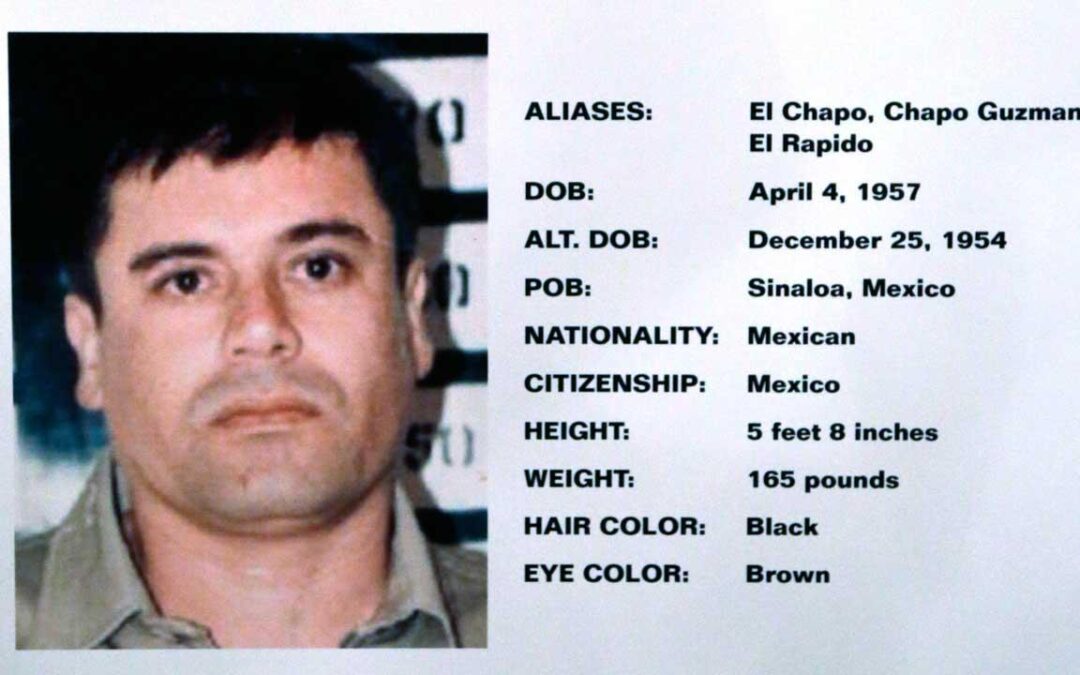
Zambada-Niebla is reportedly a close associate of Sinaloa Cartel kingpin Joaquin “El Chapo” Guzman and the son of Ismael “Mayo” Zambada-Garcia, both of which remain fugitives, likely because of the deal made with the DEA, federal court documents allege.
Based on the alleged agreement ”the Sinaloa Cartel under the leadership of defendant’s father, Ismael Zambada-Niebla and ‘Chapo’ Guzman, were given carte blanche to continue to smuggle tons of illicit drugs into Chicago and the rest of the United States and were also protected by the United States government from arrest and prosecution in return for providing information against rival cartels which helped Mexican and United States authorities capture or kill thousands of rival cartel members,” states a motion for discovery filed in U.S. District Court by Zambada-Niebla’s attorney in July 2011.
A source in Congress, who spoke to TheBlaze on the condition of anonymity, said that some top congressional investigators have been keeping “one eye on the case.” Another two members of Congress, both lead Fast and Furious Congressional investigators, told TheBlaze they had never even heard of the case.
One of the Congressmen, who also spoke to TheBlaze on the condition of anonymity because criminal proceedings are still ongoing, called the allegations “disturbing.” He said Congress will likely get involved once Zambada-Niebla’s trial has concluded if any compelling information surfaces.
“Congress won’t get involved in really any criminal case until the trial is over and the smoke has cleared,” he added. “If the allegations prove to hold any truth, there will be some serious legal ramifications.”
Earlier this month, two men in Texas were sentenced to 70 and 80 months in prison after pleading guilty to attempting to export 147 assault rifles and thousands of rounds of ammunition to Mexico’s Los Zetas cartel. Compare that to the roughly 2,000 firearms reportedly “walked” in Fast and Furious, which were used in the murders of hundreds of Mexican citizens and U.S. Border Agent Brian Terry, and some U.S. officials could potentially face jail time if they knowingly armed the Sinaloa Cartel and allowed guns to cross into Mexico.
If proven in court, such an agreement between U.S. law enforcement agencies and a Mexican cartel could potentially mar both the Bush and Obama administrations. The federal government is denying all of Zambada-Niebla’s allegations and contend that no official immunity deal was agreed upon.
To be sure, Zambada-Niebla is a member of one of the most ruthless drug gangs in all of Mexico, so there is a chance that he is saying whatever it takes to reduce his sentence, which will likely be hefty. However, Congress and the media have a duty to prove without a reasonable doubt that there is no truth in his allegations. So far, that has not been achieved.
Zambada-Niebla was reportedly responsible for coordinating all of the Sinaloa Cartel’s multi-ton drug shipments from Central and South American countries, through Mexico, and into the United States. To accomplish this, he used every tool at his disposal: Boeing 747 cargo planes, narco-submarines, container ships, speed boats, fishing vessels, buses, rail cars, tractor trailers and automobiles. But Guzman and Zambada-Niebla’s overwhelming success within the Sinaloa Cartel was largely due to the arrests and dismantling of many of their competitors and their booming businesses in the U.S. from 2004 to 2009 — around the same time ATF’s gun-walking operations were in full swing. Fast and Furious reportedly began in 2009 and continued into early 2011.
According Zambada-Niebla, that was a product of the collusion between the U.S. government and the Sinaloa Cartel.
Soldiers and police officers guard packages of seized marijuana during a presentation for the media in Tijuana, Mexico. (AP Photo/Guillermo Arias)
The claims seem to fall in line with statements made last month by Guillermo Terrazas Villanueva, a spokesman for the Chihuahua state government in northern Mexico who said U.S. agencies ”don’t fight drug traffickers,“ instead ”they try to manage the drug trade.”
Also, U.S. officials have previously acknowledged working with the Sinaloa Cartel through another informant, Humberto Loya-Castro. He is also allegedly a high-ranking member of the Sinaloa Cartel as well as a close confidant and lawyer of “El Chapo” Guzman.
Loya-Castro was indicted along with Chapo and Mayo in 1995 in the Southern District of California in a massive narcotics trafficking conspiracy (Case no. 95CR0973). The case was dismissed in 2008 at the request of prosecutors after Loya became an informant for the United States government and subsequently provided information for years.
In 2005, “the CS (informant Loya-Castro) signed a cooperation agreement with the United States Attorney’s Office for the Southern District of California,” states an affidavit filed in the Zambada-Niebla case by Loya-Castro’s handler, DEA agent Manuel Castanon.
“Thereafter, I began to work with the CS. Over the years, the CS’ cooperation resulted in the seizure of several significant loads of narcotics and precursor chemicals. The CS’ cooperation also resulted in other real-time intelligence that was very useful to the United States government.”
Under the alleged agreement with U.S. agencies, “the Sinaloa Cartel, through Loya-Castro, was to provide information accumulated by Mayo, Chapo, and others, against rival Mexican Drug Trafficking Organizations to the United States government,” a motion for discovery states.
In return, the United States government allegedly agreed to dismiss the charges in the pending case against Loya-Castro (which they did), not to interfere with his drug trafficking activities and those of the Sinaloa Cartel and not actively prosecute him or the Sinaloa Cartel leadership.
“This strategy, which he calls ‘Divide & Conquer,’ using one drug organization to help against others, is exactly what the Justice Department and its various agencies have implemented in Mexico. In this case, they entered into an agreement with the leadership of the Sinaloa Cartel through, among others, Humberto Loya-Castro, to receive their help in the United States government’s efforts to destroy other cartels.”
“Indeed, United States government agents aided the leaders of the Sinaloa Cartel.”
The government has denied this and says the deal did not go past Loya-Castro.
Zambada-Niebla was arrested by Mexican soldiers in late March of 2009 after he met with DEA agents at a Mexico City hotel in a meeting arranged by Loya-Castro, though the U.S. government was not involved in his arrest. He was extradited to Chicago to face federal drug charges on Feb. 18, 2010. He is now being held in a Michigan prison after requesting to be moved from Chicago.
“Classified Materials”
During his initial court proceedings, Zambada-Niebla continually stated that he was granted full immunity by the DEA in exchange for his cooperation. The agency, however, argues that an “official” immunity deal was never established though they admit he may have acted as an informant.
Zambada-Niebla and his legal council also requested records about Operation Fast and Furious, which permitted weapons purchased in the United States to be illegally smuggled into Mexico, sometimes by paid U.S. informants and cartel leaders. Their request was denied. From the defense motion:
“It is estimated that approximately 3,000 people were killed in Mexico as a result of ‘Operation Fast and Furious,’ including law enforcement officers in the state of Sinaloa, Mexico, the headquarters of the Sinaloa cartel. The Department of Justice’s leadership apparently saw this as an ingenious way of combating drug cartel activities.”
“It has recently been disclosed that in addition to the above-referenced problems with ‘Operation Fast & Furious,’ the DOJ, DEA, and the FBI knew that some of the people who were receiving the weapons that were being allowed to be transported to Mexico, were in fact informants working for those organizations and included some of the leaders of the cartels.”
Zambada’s attorney has filed several motions for discovery to that effect in Illinois Federal District Court, which were summarily denied by the presiding judge who claimed the defendant failed to make the case that he was actually a DEA informant.
In April, 2012, a federal judge refused to dismiss charges against him.
From a Chicago Sun Times report: “According to the government, [Zambada-Niebla] conveyed his interest and willingness to cooperate with the U.S. government, but the DEA agents told him they ‘were not authorized to meet with him, much less have substantive discussions with him,’” the judge wrote.
In this courtroom artist’s drawing Jesus Vincente Zambada-Niebla appears before U.S. District Judge Ruben Castillo Tuesday, Feb. 23, 2010, in Chicago. (AP Photo/Verna Sadock)
In their official response to Zambada-Niebla’s motion for discovery, the federal government confirmed the existence of “classified materials” regarding the case but argued they “do not support the defendant’s claim that he was promised immunity or public authority for his actions.”
Experts have expressed doubts that Zambada-Niebla had an official agreement with the U.S. government, however, agree Loya Castro probably did. Either way, the defense still wants to obtain DEA reports that detail the agency’s relationship with the Sinaloa Cartel and put the agents on the stand, under oath to testify.
The documents that detail the relationship between the federal government and the Sinaloa Cartel have still not been released or subjected to review — citing matters of national security.
NSA Tracking Capabilities – Everything means Everything
Diego Garcia – USA’s Secret Military Base
The Clone Plane in Tel Aviv
Freescale Semiconductor – Classified Technology
China vs USA Black Ops?
The Military Drills! Cope Tiger / Cobra Gold
Man in the Middle Attack? Hit? Kidnapping?
The Phillip Wood Picture Message – Legit Exif data?
Fake Girlfriend of Phillip Wood in Media!?
In a somewhat disturbing case of life imitating art, it seems that real world turmoil is catching up with classic science fiction projections of a dystopian future as envisioned by writers like George Orwell and Ray Bradbury — a world where the general populace is under constant surveillance, and the technology that we’ve become overly dependent on has become our greatest liability.
If the recent NSA debacle wasn’t alarming enough for you, Google recently acquired Nest, the smart device firm and home automation pioneer. Home automation, of course, means having multiple devices (kitchen appliances, thermostats, locks and security cameras, etc.) equipped with wireless capability and controllable through an app on a smart device. Your phone, in essence, becomes a remote control for your entire house. Some systems, like the one which Samsung recently premiered at CES 2014, will only enable the company’s own products to interact with one another, and the more glitzy products like the ADT home security systems allow homeowners to control their thermostats and other electronics (regardless of brand) with their smart phone.
If it sounds too good to be true…that’s because it potentially is, as this article from Trend Labs explains. The IP configuration on the devices is simple and the security options are quite limited, leaving them easily penetrable by hackers and thieves. Part of the risk, of course, is that if you have a home security system that can be entirely disabled through a smartphone, a thief could hack into your accounts, deactivate your entire security system with the push of a mere button, and enter your home freely. All of your data becomes more accessible to hackers, and now Google will have even more comprehensive data to sell to third party candidates who can market products even more aggressively to you.
Orwell and Bradbury basically called the whole thing…
One of the great things about science-fiction is that, whatever paranoid projections it makes about future global conditions, it’s always very much a product of its own time.This news raises all sorts of issues for an overly imaginative person.
The situation is like George Orwell’s 1984, where the general public can’t even so much as think in privacy. Everyone is under constant surveillance, and the entire system is under the pretense that this is somehow what’s best for society.
The citizens of Orwell’s fictional Oceania all have “telescreens” in their apartments, which enables Big Brother (whether that’s merely a governmental agency monitoring the public or one chief observer is never entirely clear) to supervise every given moment of everyone’s lives, and to possess an absurd level of intel on every given person under the jurisdiction of their central government. Replace telescreens with tablets, and Big Brother with Facebook and Google, and ask yourself how much of a deviation this setup is from life as we know it today.
It also calls to mind a particularly eerie story penned by Ray Bradbury 1950 entitled August 2026: There Will Come Soft Rains. The story focuses on “a-day-in-the-life” of a fully automated home after the extinction of the human race. The house prepares meals, recites important dates and reminders through an intercom system with a pre-recorded voice. We come to learn, throughout the course of the story, that the family who owned the house have been wiped out. We hear about silhouettes permanently fixed unto the side of the homes, in a manner that evoked the victims of Hiroshima and Nagasaki who were vaporized in an atomic blast.
So Bradbury’s grim musings couldn’t have been more fitting for his time, and they are startlingly relevant now. Just as humans channel their ingenuity and creativity into constructive things, or things which enhance life for humanity (all of the advancements in home technology, for instance) the misapplication of that creativity — and the misapplication of technology itself– can have dire, even catastrophic, consequences on humanity.
Is it really as bad as all of that?
Only time will tell, but it does seem more and more likely that whatever minor conveniences the technology yields will hardly justify the potential security risks.
You would hope that, in some cases, paranoid science-fiction literature would help prevent future atrocities from occurring by anticipating them. It’s sort of comforting that we’ve not yet reached the place anticipated by Arthur C. Clarke, where computers have superior intellect to humans and can function, not only with autonomy, but willfully against people. It’s pretty disconcerting, however, that we seem to be drawing nearer and nearer to those imagined realities, not merely a novel thought and fodder for pop literature, but a grim facet of our day to day lives.
Hmm. Hold up. So if we go by this Wikipedia entry..
“Founded as an independent company in 1982, RSA Security, Inc. was acquired by EMC Corporation in 2006 for US$ 2.1 billion and operates as a division within EMC.[5]”
People need to understand, this means RSA took around 2% of what they’d make in one year. FOR A BACK-DOOR OMG. Does this not sound more like a tax, than a payment (never mind a bribe!)? How much would you care about an extra 2% per year? Exactly. Thats all I got. Someone else needs to close that gap. -Max
What’s an encryption backdoor cost? When you’re the NSA, apparently the fee is $10 million.
Intentional flaws created by the National Security Agency in RSA’s encryption tokens werediscovered in September, thanks to documents released by whistleblower Edward Snowden. It has now been revealed that RSA was paid $10 million by the NSA to implement those backdoors, according to a new report in Reuters.
Two people familiar with RSA’s BSafe software told Reuters that the company had received the money in exchange for making the NSA’s cryptographic formula as the default for encrypted key generation in BSafe.
“Now we know that RSA was bribed,” said security expert Bruce Schneier, who has been involved in the Snowden document analysis. “I sure as hell wouldn’t trust them. And then they made the statement that they put customer security first,” he said.
RSA, now owned by computer storage firm EMC Corp, has a long history of entanglement with the government. In the 1990s, the company was instrumental in stopping a government plan to include a chip in computers that would’ve allowed the government to spy on people.
The new revelation is important, Schneier said, because it confirms more suspected tactics that the NSA employs.
“You think they only bribed one company in the history of their operations? What’s at play here is that we don’t know who’s involved,” he said.
Other companies that build widely-used encryption apparatus include Symantec, McAfee, and Microsoft. “You have no idea who else was bribed, so you don’t know who else you can trust,” Schneier said.
RSA did not return a request for comment, and did not comment for the Reuters story.
Competing with the US during the Arms Race, the Soviet Union put extensive effort in unconventional research seeking to outflank its rival in understanding behavior control, remote influencing and parapsychology, a new survey by Cornell University Library has revealed.
The survey published by Cornell University Library is based on open scientific and journalistic materials and provides an overview of unconventional research in the USSR and then in its successor, Russia, in the period between 1917 and 2003 – as compared to the USA.
The report by Serge Kernbach showed that unconventional weapons took the scientists in both countries to areas bordering sci-fi which nowadays would be seen in TV programs featuring UFOs, the supernatural and superpowers.
Due the Iron Curtain, Soviet and American scientists knew little about each other’s secret work – still, they focused on same themes.
In the Soviet Union, among the areas of particular interest, were, for instance, “the impact of weak and strong electromagnetic emission on biological objects, quantum entanglement in macroscopic systems, nonlocal signal transmission based on the Aharonov-Bohm effect, and ‘human operator’ phenomena,” the survey says.
Soviet scientists were developing a field they dubbed “psychotronics.” The country spent between $0.5-1 billion on research of the phenomena, Kernbach who works, at the Research Center of Advanced Robotics and Environmental Science in Stuttgart, Germany, found out.
Some of the programs in psychotronic research – even those launched decades ago – have not been officially published.
“For instance, documents on experiments performed in OGPU and NKVD – even 80 years after – still remain classified,” Kernbach noted. The OGPU (Joint State Political Directorate) was the Soviet secret police and the NKVD (The People’s Commissariat for Internal Affairs) was the main law enforcing body, which was later transformed into the Internal Ministry and a security organization which was part of it – into the KGB.
According to the survey, Soviet and American areas of interest often mirrored each other. In particular, Kernbach recalls the Central Intelligence Agency’s (CIA) scandalous human research program MKUltra which involved the use of various methods to manipulate an individual’s mental states and alter brain functions.
“As mentioned in the public documents, the program to some extent was motivated by the corresponding NKVD’s program, with similar strategies of using psychotropic (e.g. drugs) substances and technical equipment,” Kernbach said.
In the 60s and the 70s, the Soviet Union was actively researching the influence of electromagnetic fields on human physiological and psychological conditions. Several authors point to the application of research results in the form of new weapons in the USA and the Soviet Union.
“Over the past years, US researchers have confirmed the possibility of affecting functions of the nervous system by weak electromagnetic fields (EMFs), as it was previously said by Soviet researchers. EMFs may cause acoustic hallucination (’radiosound’) and reduce the sensitivity of humans and animals to some other stimuli, to change the activity of the brain (especially the hypothalamus and the cortex), to break the processes of formation processing and information storage in the brain. These nonspecific changes in the central nervous system can serve as a basis for studying the possibilities of the direct influence of EMFs on specific functions of CNS,” read an article in Nauka (Science) magazine in 1982.
A US Marine Corps truck is seen carrying a palletized version of the Active Denial System, March 9th, 2012, at the US Marine Corps Base Quantico, Virginia. It is a US DoD non-lethal weapon that uses directed energy and projects a beam of man-sized millimeter waves up to 1000 meters that when fired at a human, delivers a heat sensation to the skin and generally makes humans stop what they are doing and run. (AFP Photo/Paul J. Richards)
Kernbach’s analysis lacks details on practical results of unconventional research in the USSR.
He mentions though a device invented by Anatoly Beridze-Stakhovsky – the torsion generator ‘Cerpan’. The exact structure of the device is unknown, as the scientist feared it would be put to unethical uses. Cerpan was designed on the “shape effect” produced by torsion fields. Some sources claim that the device – a 7-kilo metal cylinder – was used to heal people, including Kremlin senior officials.
Kernbach’s overview of unconventional research in USSR and Russia suggests that following the collapse of the USSR in 1991, these programs were first reduced and then completely closed in 2003.
“Due to academic and non-academic researchers, the instrumental psychotronics, denoted sometimes as torsionics, still continue to grow, but we cannot speak about government programs in Russia any longer,” he said.
However, based on the number of participants at major conferences, the number of psychotronics researchers in Russia is estimated between 200 and 500, the report said.
Last year, the now-fired Defense Minister Anatoly Serdyukov said his ministry was working on futuristic weaponry.
“The development of weaponry based on new physics principles; direct-energy weapons, geophysical weapons, wave-energy weapons, genetic weapons, psychotronic weapons, etc., is part of the state arms procurement program for 2011-2020,”Serdyukov said at a meeting with the then Prime Minister Vladimir Putin, cited RIA Novosti.
That followed a series of Putin’s presidential campaign articles, one of which focused on national security guarantees. Speaking about new challenges that Russia may face, and which armed forces should be ready to respond to, he wrote:
“Space-based systems and IT tools, especially in cyberspace, will play a great, if not decisive role in armed conflicts. In a more remote future, weapon systems that use different physical principles will be created (beam, geophysical, wave, genetic, psychophysical and other types of weapons). All this will provide fundamentally new instruments for achieving political and strategic goals in addition to nuclear weapons.”
“Facts do not cease to exist because they are ignored.” — Aldous Huxley
So who really controls the world?
The Illuminati? Freemasons? The Bilderberg Group?
Or are these all red herrings to distract your prying eyes from the real global elite? The answer, like most topics worth exploring, is not quite so simple. Have no doubt, there aresecretive global powers whose only goal is to keep and grow that power. But it really may not be as secretive as you’d think. And that’s what makes it even more nefarious…
But don’t take my word for it, we have both science and insider testimony to back it up…
We’re going to break this down into three categories: Financial, Political and Media. This is a harder task than you may imagine, since they all work in concert by design.
Financial Elite
Thanks to the science of complex system theory, the answer may actually be right in front of our faces.
This scientific process sheds light on the dark corners of bank control and international finance and pulls some of the major players out from the shadows.
And it goes back to the old credo: Just follow the money…
Systems theorist James B. Glattfelder did just that.
From a massive database of 37 million companies, Glattfelder pulled out the 43,060 transnational corporations (companies that operate in more than one country) that are all connected by their shareholders.
Digging further, he constructed a model that actually displays just how connected these companies are to one another through ownership of shares and their corresponding operating revenues.
The 1318 transnational corporations that form the core of the economy.
Superconnected companies are red, very connected companies are yellow. The size of the dot represents revenue.
I’ll openly admit that this graphic almost scared me off. Complex scientific theories are not my forte, and this looks like some sort of intergalactic snow globe.
But Glattfelder has done a remarkable job of boiling these connections down to the main actors — as well as pinpointing how much power they have over the global market. These “ownership networks” can reveal who the key players are, how they are organized, and exactly how interconnected these powers are.
From New Scientist: Each of the 1318 had ties to two or more other companies, and on average they were connected to 20. What’s more, although they represented 20 per cent of global operating revenues, the 1318 appeared to collectively own through their shares the majority of the world’s large blue chip and manufacturing firms — the “real” economy — representing a further 60 per cent of global revenues.
When the team further untangled the web of ownership, it found much of it tracked back to a “super-entity” of 147 even more tightly knit companies — all of their ownership was held by other members of the super-entity — that controlled 40 per cent of the total wealth in the network.
According to his data, Glattfelder found that the top 730 shareholders control a whopping 80% of the entire revenue of transnational corporations.
And — surprise, surprise! — they are mostly financial institutions in the United States and the United Kingdom.
That is a huge amount of concentrated control in a small number of hands…
Here are the top ten transnational companies that hold the most control over the global economy (and if you are one of the millions that are convinced Big Banks run the world, you should get a creeping sense of validation from this list):
1) Barclays plc
2) Capital Group Companies Inc.
3) FMR Corporation
4) AXA
5) State Street Corporation
6) JPMorgan Chase & Co.
7) Legal & General Group plc
8) Vanguard Group Inc.
9) UBS AG
10) Merrill Lynch & Co Inc.
Some of the other usual suspects round out the top 25, including JP Morgan, UBS, Credit Suisse, and Goldman Sachs.
What you won’t find are ExxonMobil, Microsoft, or General Electric, which I found shocking. In fact, you have to scroll all the way down to China Petrochemical Group Company at number 50 to find a company that actually creates something.
The top 49 corporations are financial institutions, banks, and insurance companies — with the exception of Wal-Mart, which ranks at number 15…
The rest essentially just push money around to one another.
Here’s the interconnectedness of the top players in this international scheme:
Here’s a fun fact about the number one player, Barclays:
Barclays was a main player in the LIBOR manipulation scandal, and were found to have committed fraud and collusion with other interconnected big banks. They were fined $200 million by the Commodity Futures Trading Commission, $160 million by the United States Department of Justice and £59.5 million by the Financial Services Authority for “attempted manipulation” of the Libor and Euribor rates.
Despite their crimes, Barclays still paid $61,781,950 in bonuses earlier this year, including a whopping $27,371,750 to investment banking head Rich Ricci. And yes, that’s actually his real name…
These are the guys that run the world.
It’s essentially the “too big to fail” argument laid out in a scientific setting — only instead of just the U.S. banks, we’re talking about an international cabal of banks and financial institutions so intertwined that they pose a serious threat to global economics.
And instead of “too big to fail,” we’re looking at “too connected to fail”…
Glattfelder contends that “a high degree of interconnectivity can be bad for stability, because stress can spread through the system like an epidemic.”
Industrialist Henry Ford once quipped, “It is well enough that people of the nation do not understand our banking and money system, for if they did, I believe there would be a revolution before tomorrow morning.”
It’s one thing to have suspicions that someone is working behind the scenes to control the world’s money supply. It’s quite another to have scientific evidence that clearly supports it.
But these guys can only exist within a political system that supports their goals. And those political systems are pretty much operating in the open…
POLITCAL ELITE
For the sake of brevity, let’s cut right to the chase. Every major geopolitical decision of the last few decades has been run through one of these three organizations: the Trilateral Commission, the Council on Foreign Relations and the World Bank/International Monetary Fund (IMF).
The Trilateral Commission
In 1973, the infamous David Rockefeller created a group of the world’s power brokers to work together — outside of any official governmental or political allegiance — to bring about cooperation of North America, Western Europe and Japan.
They launched under the guise of working together to solve the world’s problems. A noble goal — but “problems” are very subjective.
Here’s the rundown of members:
The North American continent is represented by 120 members (20 Canadian, 13 Mexican and 87 U.S. citizens). The European group has reached its limit of 170 members from almost every country on the continent; the ceilings for individual countries are 20 for Germany, 18 for France, Italy and the United Kingdom, 12 for Spain and 1–6 for the rest. At first, Asia and Oceania were represented only by Japan. However, in 2000 the Japanese group of 85 members expanded itself, becoming the Pacific Asia group, composed of 117 members: 75 Japanese, 11 South Koreans, 7 Australian and New Zealand citizens, and 15 members from the ASEAN nations (Indonesia, Malaysia, Philippines, Singapore and Thailand). The Pacific Asia group also included 9 members from China, Hong Kong and Taiwan. Currently, the Trilateral Commission claims “more than 100″ Pacific Asian members.
It’s a global who’s-who of power brokers. And while the Trilateral Commission excludes anyone currently holding public office from membership, it serves as a revolving door of the rich and powerful from the financial, political and academic elite.
Most suspicions of the group began during the Jimmy Carter administration, when Carter — himself a member of the Trilateral Commission — made Zbigniew Brzezinski his National Security advisor. Brzezinski was the Trilateral Commission’s first executive director. Carter’s Vice President Walter Mondale was also a member.
And perhaps most importantly, Trilateral member Paul Volker served as Carter’s Chair of the Federal Reserve. He is still the North American Honorary Chairman.
Such a concentration of power in a U.S. president’s cabinet obviously made people nervous,
Notable recent additions include Austan Goolsbe — former chairman for Obama’s Council of Economic Advisors. I’d suggest you familiarize yourselves with the entire member list here.
You’ll be shocked at who else is part of this secretive organization.
Follow the Outsider Club for Part II of this important subject.
One Bank to Rule Them All: World Bank Whistle-blower Reveals Bank Conspiracy
If you had any doubt, we now have science and first-hand testimony to prove it.
Note: This is not some wild conspiracy theory. It’s systems theory, a serious scientific discipline, used by researcher James B. Gladfelder to prove that a small group of banks essentially control the world’s finances.
Gladfelder’s research proved that the top 730 shareholders control a whopping 80% of the entire revenue of transnational corporations.
But the truth is the global banking elite simply cannot maintain a stranglehold on the world’s power all by themselves. And so, while they run off with the money, their lackeys in the political sphere acts as gatekeepers.
Again, we’re not relying on labyrinthine explanations and vague fears of domination; we’re looking at the matter through scientific discipline and actual admissions from the power brokers themselves.
The fact is we simply cannot talk about global control without talking about the World Bank…
The World Bank represents 188 different countries from Albania to Zimbabwe. However, it is controlled by a small number of powerful countries, each with its own serious economic interests.
Since there is no voting for the leadership and chief economists at the bank, the United States and other large countries have complete control to appoint who they’d like to do their bidding — and they have appointed some highly questionable folks to run the behemoth:
Robert McNamara – JFK’s former secretary of defense and president of Ford Motor Company was chosen to lead the Bank in 1968, fresh off his disastrous handling of the Vietnam War.
Lewis T. Preston – a bank executive with J.P. Morgan. We all know J.P. Morgan doesn’t have the interest of the working poor at heart, as evidenced by years of abuse of regular folks, culminating in their record $13 billion fine this year.
Robert Zoellick – a bank executive with Goldman Sachs. Again, if the head of Goldman Sachs is at the helm, you know the bidding of the powerful will get its due… After all, you don’t earn a nickname like “The Great Vampire Squid” for your altruism.
Paul Wolfowitz – Much like McNamara, Wolfowitz was handed the reigns to the World Bank after helping orchestrate George Bush’s outrageous war on Iraq. While president of the Bank, he gave his girlfriend massive pay raises — more than double what she was entitled to! The fact that the head of the World Bank could engage in such petty corruption doesn’t bode well for the bank at large, considering the immense power they wield. Wolfowitz was eventually forced to resign.
Perhaps more alarmingly, the World Bank also receives complete immunity from any and all countries it does “business” with, so it cannot be held legally accountable for its actions.
The United States has complete veto power over the Bank’s actions as well, which it can use to block any action by the Bank that may threaten national interests — and the interests of the global financial powers that control them.
The World Bank’s stated purpose is to help poor and developing countries by providing loans.
The catch? To obtain one of these loans, you have to comply with the Bank’s draconian wish lists.
Examples of the conditions countries must meet to gain access to a loan include suppressing wages, cutting programs like education and health care, and easing limits on foreign investment.
How do the results stack up with its stated mission?
Not well. In fact, data shows most countries that have taken the World Bank’s money and agreed to its terms are no better off today then they were when they received their first loan — and many are actually worse off.
From the Heritage Foundation:
Of the 66 less-developed countries receiving money from the World Bank for more than 25 years (most for more than 30 years), 37 are no better off today than they were before they received such loans.
Of these 37 countries, most (20 in all) are actually poorer today than they were before receiving aid from the Bank.
Former less-developed countries that have prospered over the past 30 years did so by freeing up the productive forces of their economies. The best examples are Hong Kong and Singapore: Even though a country like Singapore received a small amount of money from the World Bank, the evidence shows that what most affected economic growth was not World Bank aid, but economic freedom.
What’s more, an ex-World Bank employee described something far more nefarious than ineptitude…
Karen Hudes watched first-hand as the World Bank manipulated and covered up corruption in its economic development projects.
It’s important to know Hudes wasn’t some disgruntled lackey; she served as Senior Counsel and worked for the bank for 20 years. During those two decades at the World Bank, Hudes saw systematic and widespread corruption.
“It’s a mafia,” she told the New American.
“These culprits that have grabbed all this economic power have succeeded in infiltrating both sides of the issue, so you will find people who are supposedly trying to fight corruption who are just there to spread disinformation and as a placeholder to trip up anybody who manages to get their act together. Those thugs think that if they can keep the world ignorant, they can bleed it longer.”
Hudes saw large-scale enrichment of the powerful, while the poor the Bank was supposed to be helping were getting stiffed.
“I realized we were now dealing with something known as state capture, which is where the institutions of government are co-opted by the group that’s corrupt,” she noted.
Hudes was eventually fired after she spoke out against the Bank’s attempt to cover up a botched bailout of a crooked bank in the Philippines.
Here are a few choice examples of what happens to the $2.5 billion in U.S. taxpayer money that is funneled into the World Bank each and every year, from the American Enterprise Institute:
38 countries have amassed $71 billion in unpayable multilateral loans, encouraged by the Bank’s self-serving projections of country growth, on which rich-country taxpayers must now make good.
Corruption has been exposed both within the World Bank and in its programs, and is now estimated at more than $100 billion.
Protest is rising among leading African scholars who seek to stop all aid because it serves only to entrench and enrich a series of corrupt elites. Massive anecdotal evidence of waste, ineptitude, and outright theft can no longer be ignored.
Not exactly the poverty-fighting superhero the institution makes itself out to be.
The World Bank works in conjunction with the International Monetary Fund, which operates in the same vein of enriching Wall Street and supporting dictators. We’ll pull the curtain back on the IMF next week.
Jimmy is a managing editor for Outsider Club and the Investment Director of the personal finance advisory The Crow’s Nest. You may also know him as the architect behind the wildly popular finance and investing website Wealth Wire, where he’s brought readers the stories behind the mainstream financial news each and every day. For more on Jimmy, check out his editor’s page.
Perhaps Edward Snowden’s hoodie should have raised suspicions.
The black sweatshirt sold by the civil libertarian Electronic Frontier Foundation featured a parody of the National Security Agency’s logo, with the traditional key in an eagle’s claws replaced by a collection of AT&T cables, and eavesdropping headphones covering the menacing bird’s ears. Snowden wore it regularly to stay warm in the air-conditioned underground NSA Hawaii Kunia facility known as “the tunnel.”
His coworkers assumed it was meant ironically. And a geek as gifted as Snowden could get away with a few irregularities.
But an NSA staffer who contacted me last month and asked not to be identified–and whose claims we checked with Snowden himself via his ACLU lawyer Ben Wizner—offered me a very different, firsthand portrait of how Snowden was seen by his colleagues in the agency’s Hawaii office: A principled and ultra-competent, if somewhat eccentric employee, and one who earned the access used to pull off his leak by impressing superiors with sheer talent.
The anonymous NSA staffer’s priority in contacting me, in fact, was to refute stories that have surfaced as the NSA and the media attempt to explain how a contractor was able to obtain and leak the tens of thousands of highly classified documents that have become the biggest public disclosure of NSA secrets in history. According to the source, Snowden didn’t dupe coworkers into handing over their passwords, as one report has claimed. Nor did Snowden fabricate SSH keys to gain unauthorized access, he or she says.
Instead, there’s little mystery as to how Snowden gained his access: It was given to him.
“That kid was a genius among geniuses,” says the NSA staffer. “NSA is full of smart people, but anybody who sat in a meeting with Ed will tell you he was in a class of his own…I’ve never seen anything like it.”
When I reached out to the NSA’s public affairs office, a spokesperson declined to comment, citing the agency’s ongoing investigation into Snowden’s leaks.
But over the course of my communications with the NSA staffer, Snowden’s former colleague offered details that shed light on both how Snowden was able to obtain the NSA’s most secret files, as well as the elusive 30-year old’s character:
Before coming to NSA Hawaii, Snowden had impressed NSA officials by developing a backup system that the NSA had widely implemented in its codebreaking operations.
He also frequently reported security vulnerabilities in NSA software. Many of the bugs were never patched.
Snowden had been brought to Hawaii as a cybersecurity expert working for Dell’s services division but due to a problem with the contract was reassigned to become an administrator for the Microsoft intranet management system known as Sharepoint. Impressed with his technical abilities, Snowden’s managers decided that he was the most qualified candidate to build a new web front-end for one of its projects, despite his contractor status. As his coworker tells it, he was given full administrator privileges, with virtually unlimited access to NSA data. “Big mistake in hindsight,” says Snowden’s former colleague. “But if you had a guy who could do things nobody else could, and the only problem was that his badge was green instead of blue, what would you do?”
As further evidence that Snowden didn’t hijack his colleagues’ accounts for his leak, the NSA staffer points to an occasion when Snowden was given a manager’s password so that he could cover for him while he was on vacation. Even then, investigators found no evidence Snowden had misused that staffer’s privileges, and the source says nothing he could have uniquely accessed from the account has shown up in news reports.
Snowden’s superiors were so impressed with his skills that he was at one point offered a position on the elite team of NSA hackers known as Tailored Access Operations. He unexpectedly turned it down and instead joined Booz Allen to work at NSA’s Threat Operation Center.
Another hint of his whistleblower conscience, aside from the telltale hoodie: Snowden kept a copy of the constitution on his desk to cite when arguing against NSA activities he thought might violate it.
The source tells me Snowden also once nearly lost his job standing up for a coworker who was being disciplined by a superior.
Snowden often left small, gifts anonymously at colleagues’ desks.
Snowden’s former colleague says that he or she has slowly come to understand Snowden’s decision to leak the NSA’s files. “I was shocked and betrayed when I first learned the news, but as more time passes I’m inclined to believe he really is trying to do the right thing and it’s not out of character for him. I don’t agree with his methods, but I understand why he did it,” he or she says. “I won’t call him a hero, but he’s sure as hell no traitor.”
A fox raids a chicken coop, killing all the chickens. With feathers sticking out of the sides of his mouth, stinking of blood, he swears he didn’t do it. He wasn’t even there! Days later, in response to sustained cries of protest from the animals, the farmer commissions an investigation to determine who was responsible for the grisly scene. To the shock and horror of the farm animals, he appoints the fox to lead the investigation. The fox issues a statement pledging to regain the public trust.
The government is the farmer, we are the farm animals, and James Clapper is the fox.
Director of National Intelligence James Clapper, the all-powerful spy infamous for lying to congress about the Section 215 bulk metadata program, will establish a “review group to examine intelligence collection,” the government tells us. This incredible turn of events comes, as Marcy Wheeler points out, only 72 hours after President Obama promised a thorough review of intelligence programs conducted by “outside,” “independent” actors.
James Clapper is about as inside as it gets. As Jameel Jaffer observed on Twitter, appointing Clapper to oversee a review of intelligence programs is akin to assigning the author of the Bush administration torture memos, John Yoo, “to lead [an] independent inquiry into the CIA torture program.”
That’s bad enough. But it gets worse.
When the government announced the Clapper ‘review,’ it offered us this quote from the perjurer himself, describing what his ‘review group’ sets out to do:
The review group will assess whether, in light of advancements in communications technologies, the United States employs its technical collection capabilities in a manner that optimally protects our national security and advances our foreign policy while appropriately accounting for other policy considerations, such as the risk of unauthorized disclosure and our need to maintain the public trust.
Read that sentence very carefully. Completely absent from the passage is any reference to the legality, democratic compatibility, or constitutionality of the surveillance programs.
Not only is the fox set to investigate the incident at the hen house. He has told us up front that the programs’ impact on civil liberties is not even up for discussion. Instead, the review will assess whether US surveillance programs are thorough enough, and whether they’ll continue ‘advanc[ing] our foreign policy’ interests amidst ‘the risk of unauthorized disclosure.’ (This, I imagine, is code for: How can we keep these programs secret so as not to thoroughly piss off our allies?)
Instead of looking at the ways in which his spy programs kill democracy and obliterate any possibility for political freedom, Clapper admits at the outset that his ‘review group’ will seek to determine whether and how the intelligence agencies can keep a tighter lid on their global surveillance operations.
And then there’s the horrifying kicker. The review group will seek to ‘account for’ one last ‘policy consideration,’ he says: ‘our need to maintain the public trust.’
The public trust! James Clapper!
At least Clapper isn’t totally unaware of what’s going on around him; it’s true that the public does not trust the intelligence apparatus. But while public trust in government is important, more important than trust is a transparent and accountable architecture that deserves to be trusted. Clapper’s announcement of his intention to figure out how to regain the public trust in the absence of even one mention of reforming the spy programs to conform with constitutional or democratic principles is positively chilling. It is an acknowledgement that our government is more interested in appearances than it is in actual accountability. And it suggests that the primary lesson the establishment has learned in the past few months has been that it should do a better job lying to the public — not that it should roll back the monstrous surveillance state.
This statement about ‘the public trust’ makes clear that the administration views the fallout from the Snowden leaks, and American and global outrage over NSA surveillance and government mendacity, as just another public relations war. That’s too bad, because the leaks have in fact ignited a war over the soul of this country, raising absolutely critical questions about the possibility for democracy in the 21st century.
Clapper is set to deliver his interim findings to the President within two months, and will publish a report with recommendations by mid-December. When those recommendations become public, don’t forget who put them together, and what his intentions were from the outset: not to examine the programs’ constitutionality, but rather to figure out how to spin, entrench, and prolong them.
UPDATE: In a bizarre about-face, the Obama administration is now fiercely denying that Clapper will control the “review group.” Maybe this Huffington Post page pushed them over the edge:
If you had a business selling something that made you well over a hundred billion dollars per year, would you take steps to eradicate the need for your business? Or would you make every effort for that money continue rolling in?
Take cancer, for example. Don’t let all the media hype about “The Cure” fool you. No one who is in a position to do so wants to end cancer because they are all making a killing on the big business of treatment, while ordinary people go broke, suffer horribly, and die.
There will never be a “cure” brought to market because there just isn’t enough profit in eradicating the disease entirely. There will never be a governing body that protects consumers from being subjected to known carcinogens, because that, too, will stop the cash from rolling in. A great deal of research is covered up and many potential cures are ignored and discredited because there is far more money in perpetuating illness than in curing it. In 2012, the reported spending on cancer treatment was 124.6 billion dollars. Blood money.
The Grim Statistics
Just the word “cancer” sends a frisson of fear down the spine of the most stalwart optimist. Terrifyingly, almost one in two people will get the dreaded disease, and the numbers are only getting worse. Here are some quick stats for background:
Nearly half of all Americans will develop cancer in their lifetime. (source) Quick math tells us that is an astonishing 157 million victims.
Over half a million people in America died of cancer in 2012. (source)
In 2011, cancer was the #1 cause of death in the Western world, and #2 in developing countries. (source)
Cancer is the #1 cause of childhood death in the United States. (source)
This is a fairly recent increase. A hundred years ago, the number was far different. At that time, 1 in 33 people was stricken with the disease. And despite billions of dollars being spent to find “the cure”, the World Health Organization predicts that deaths from cancer will DOUBLE by the year 2030.
It’s being normalized. The news is full of photos of babies who are missing an eye, of beautiful bald children who have lost their hair to chemo, and of people who have had to have body parts removed in order to survive a few more years. But cancer is NOT normal. It isn’t something that “just happens.” Researchers know the things that cause cancer. Government protection agencies do, too, but they do nothing to limit these toxins in the marketplace.
Why?
Because, cancer is big business and those who are profiting have great financial interest in seeing the deadly trend continue to increase.
Poisoned for Profit
So what has changed? How did we go from a 3% chance of contracting cancer to a 41% chance?
It’s the advent of Big Pharma, Big Agri and Big Business. They are getting rich off of poisoning Americans through the manufacture of toxic elements that we are exposed to on a daily basis.
Unless you live in a bubble and have no contact with manufactured items, outside air, or the sun, you are exposed to a staggering number of known and suspected carcinogens every day. (Check out THIS LIST to see the known and suspected carcinogens that are readily available in the United States.)
The statistics support that the cumulative build up of all these different toxins in the human body eventually results in cancer in many people.
First, the manufacturers and the “food” producers profit when we buy their poisoned goods.
Then the medical system and pharmaceutical companies profit when we become ill and must fight cancer.
The drugs alone can cost over $100,000 per year, and that is on top of exorbitant costs for radiation, chemotherapy, and physicians’ bills. In the United States, cancer is the #1 most expensive “per person” illness to treat. (source)
Why would those who profit want to prevent cancer when 95.5 BILLION DOLLARS PER YEAR is spent on treating it? There is a vested interest in this increase in illness and the people benefiting from it have no intention of reducing the cases of cancer.
Don’t Count on Obamacare
Don’t look to Obamacare to be the saving grace of cancer victims, either. With this type of government-controlled medicine, budgets will be strictly adhered to and the decisions on how to proceed and what will be paid for will NOT be in the hands of the ill person. Treatments, medications, and funds will be strictly allocated through what many people are referring to as “death panels.”
Furthermore, Obamacare only covers 60% of your medical costs in most cases (after a hefty deductible) and none of your medication is covered. If you don’t have $50,000 or more kicking around for your co-pay, you will be out of luck, despite diligently paying your worthless monthly premiums.
Prevention: Your Only Defense
Avoiding carcinogens as diligently as possible is your best defense against becoming the “1 in 3″, but it isn’t easy. Furthermore, you’ll be considered an “extremist” or a “kook” by those around you who have buried their heads in the sand.
Basically, a spending day in the Western world is a like spending a day running a gauntlet of toxins and carcinogens. Big Pharma, Big Agri and Big Business are getting rich off of poisoning Americans.
There are steps you can take to limit your exposure but be prepared for many people to consider your actions extreme. Very few people are committed enough to their health and the health of their family to do the research required to identify the dangers around them and then go against the current to avoid those perils. (source)
Since most of us don’t live in a bubble, we will be subjected to some of these toxins – they’re impossible to avoid entirely. However, you can limit your exposure by taking the following steps to reduce your exposure to everyday poisons. (This list is expanded from the article, “The Great American Cancer Cluster” with permission from The Daily Sheeple.)
Purchase organic foods as often as possible.GMOs and pesticides are proven carcinogens.
Load your plate with colorful antioxidants. Opt for organic versions of foods like berries, colorful veggies, dark chocolate, and coffee, to name a few, are loaded with powerful, cancer-fighting antioxidants and will boost your immune system against other types of illness and disease as well.
Avoid processed foods. Many of the additives and preservatives featured abundantly in North America are banned in other countries precisely because of the health risks they represent.
Select non-toxic cookware. Nonstick cookware contains Teflon and perfluorooctanoic acid (PFOA), which emit at least toxic gases within 5 minutes of heating up that nonstick pan. Once the pans become scratched, toxic particles are leached directly into the food you’re preparing. Aluminum cookware is also potentially toxic. Cast iron, ceramic, glass, and clay are all better cookware options.
Don’t smoke.
Consume alcohol only in moderation.
Limit the use of plastic in your home. BPA or Bisphenol-A are petrochemical plastics that are a major component of many water bottles, lines the inside of canned goods, and makes up the hard material of many reusable food containers, including some brands of baby bottles. They leach cancer causing endocrine disruptors into food, especially if the food is hot. Use glass containers whenever possible.
Select personal care products that do not contain petrochemicals. Many cosmetics and other health and beauty aids contain petrochemicals. The danger of this is their byproduct, 1,4-dioxane, a proven carcinogen. The U.S. Environmental Protection Agency classifies dioxane as a probable human carcinogen California state law has classified dioxane to cause cancer. Animal studies in rats suggest that the greatest health risk is associated with inhalation of vapors. Avoid the following ingredients:
Paraffin Wax
Mineral Oil
Toluene
Benzene
Phenoxyethanol
Anything with PEG (polyethylene glycol)
Anything ending in ‘eth’ indicates that it required ethylene oxide (a petrochemical) to produce e.g. myreth, oleth, laureth, ceteareth
Anything with DEA (diethanolamine) or MEA (ethanolamine)
Butanol and any word with ‘butyl’ – butyl alcohol, butylparaben, butylene glycol
Ethanol and word with ‘ethyl’ – ethyl alcohol, ethylene glycol, ethylene dichloride, EDTA (ethylene-diamine-tetracetatic acid), ethylhexylglycerin
Any word with “propyl” – isopropyl alcohol, propylene glycol, propylalcohol, cocamidopropyl betaine
Methanol and any word with ‘methyl’ – methyl alcohol, methylparaben, methylcellulose
Parfum or fragrance – 95% of chemicals used in fragrance are from petroleum
Opt for natural, biodegradable food grade cleaning products. According to the website Natural Pure Organics, the average household contains up to 25 gallons of toxic materials, most of which are in cleaning products. When you use these cleaners, they linger in the air and on the surfaces, increasing your exposure to carcinogens as you inhale the toxins into your lungs or absorb them through your skin.
Avoid artificial sweeteners.Aspartame, for example, is a known carcinogen that breaks down into formaldehyde in the human body.
Refuse vaccines. Many vaccines contain formaldehyde and mercury, both of which are known carcinogens. By the age of two, if a child has received all of the recommended vaccines, he or she has received 2,370 times the “allowable safe limit” for mercury (if there is such a thing as a safe level of poison). The HPV vaccine can actually increase the risk of reproductive cancer. The polio vaccine most recently came under fire for its cancer-causing ingredients. (Learn more about the cancer causing ingredients in vaccines HERE.)
Avoid tap water. If you have municipal water, drink it at the risk of ingesting loads of toxins. First, there is the willful addition of sodium fluoride, a pesticide which is labeled as “deadly to humans.” Not only has the consumption of fluoride been linked to cancer, but it also lowers IQs, causes infertility, and causes hardening of the arteries. Then there is the addition of chlorine, which is used to kill bacteria that could make us sick. Unfortunately, according to Dr. Michael J. Plewa, a genetic toxicology expert at the University of Illinois, chlorinated water is carcinogenic. “Individuals who consume chlorinated drinking water have an elevated risk of cancer of the bladder, stomach, pancreas, kidney and rectum as well as Hodgkin’s and non-Hodgkin’s lymphoma.”
Maintain a healthy body weight. Obesity has been linked to increased risks of cancers of the esophagus, breast, endometrium, uterus, colon and rectum, kidney, pancreas, thyroid, and gallbladder.
Exercise daily.
The mindboggling thing is that those who strictly avoiding carcinogens and toxins are labeled “crazy” or “hysterical”. I can’t tell you how many times I have watched people roll their eyes or scoff when I refuse to partake in things that are hazardous. Somehow, drinking water from my own BPA-free water bottle is considered to be “extreme”. Not taking my children to McDonald’s or feeding them hot-dogs and Doritos is “mean”. Making our body care products and cleaning products from wholesome, non-toxic ingredients is “silly”.
I believe that knowingly ingesting toxic ingredients is “crazy”. I believe that rubbing carcinogens on my body or spraying them around my house is “ridiculous”. I think that having poison injected into my defenseless children or feeding it to them on a colorful plate is “mean”.
Never forget that the bottom line is profit. Don’t expect the FDA or the EPA to step in. They’ve proven time and again that their purpose is to serve the interests of Big Business, not the consumers.
Cancer represents big money to the pharmaceutical companies and the health industry. They do NOT have a vested interest in prevention. So, maybe, just maybe, subjecting your body to the tender mercies of Big Pharma and the AMA and lining their already loaded pockets is just a little bit sillier than taking steps to avoid illness altogether.
This article is dedicated to some beloved people in my life, one of whom fought it and won and the other who is fighting the good fight and will not go quietly… much love to SD and JS, and all who are touched by this icy finger.
Daisy Luther is a freelance writer and editor. Her website, The Organic Prepper, where this article first appeared, offers information on healthy prepping, including premium nutritional choices, general wellness and non-tech solutions. You can follow Daisy on Facebook and Twitter, and you can email her at [email protected]
This story has been reported in partnership between The New York Times, the Guardian and ProPublica based on documents obtained by The Guardian.
Not limiting their activities to the earthly realm, American and British spies have infiltrated the fantasy worlds of World of Warcraft and Second Life, conducting surveillance and scooping up data in the online games played by millions of people across the globe, according to newly disclosed classified documents.
Fearing that terrorist or criminal networks could use the games to communicate secretly, move money or plot attacks, the documents show, intelligence operatives have entered terrain populated by digital avatars that include elves, gnomes and supermodels.
The spies have created make-believe characters to snoop and to try to recruit informers, while also collecting data and contents of communications between players, according to the documents, disclosed by the former National Security Agency contractor Edward J. Snowden. Because militants often rely on features common to video games — fake identities, voice and text chats, a way to conduct financial transactions — American and British intelligence agencies worried that they might be operating there, according to the papers.
Takeaways: How Spy Agencies Operate In Virtual Worlds
GATHERING INTELLIGENCE: U.S. and British intelligence agencies — including the Central Intelligence Agency, Defense intelligence agency and Britain’s Government Communications Headquarters — have operated in virtual worlds and gaming communities to snoop and try to recruit informants. For example, according to Snowden documents, the U.S. has conducted spy operations in Second Life (pictured), where players create human avatars to socialize, buy and sell goods and explore exotic virtual destinations. (Second Life image via Linden Lab)
Online games might seem innocuous, a top-secret 2008 NSA document warned, but they had the potential to be a “target-rich communication network” allowing intelligence suspects “a way to hide in plain sight.” Virtual games “are an opportunity!,” another 2008 NSA document declared.
But for all their enthusiasm — so many CIA, FBI and Pentagon spies were hunting around in Second Life, the document noted, that a “deconfliction” group was needed to avoid collisions — the intelligence agencies may have inflated the threat.
The documents do not cite any counterterrorism successes from the effort, and former American intelligence officials, current and former gaming company employees and outside experts said in interviews that they knew of little evidence that terrorist groups viewed the games as havens to communicate and plot operations.
Games “are built and operated by companies looking to make money, so the players’ identity and activity is tracked,” said Peter W. Singer of the Brookings Institution, an author of “Cybersecurity and Cyberwar: What Everyone Needs to Know.” “For terror groups looking to keep their communications secret, there are far more effective and easier ways to do so than putting on a troll avatar.”
The surveillance, which also included Microsoft’s Xbox Live, could raise privacy concerns. It is not clear exactly how the agencies got access to gamers’ data or communications, how many players may have been monitored or whether Americans’ communications or activities were captured.
One American company, the maker of World of Warcraft, said that neither the NSA nor its British counterpart, the Government Communications Headquarters, had gotten permission to gather intelligence in its game. Many players are Americans, who can be targeted for surveillance only with approval from the nation’s secret intelligence court. The spy agencies, though, face far fewer restrictions on collecting certain data or communications overseas.
“We are unaware of any surveillance taking place,” said a spokesman for Blizzard Entertainment, based in Irvine, Calif., which makes World of Warcraft. “If it was, it would have been done without our knowledge or permission.”
A spokeswoman for Microsoft declined to comment. Philip Rosedale, the founder of Second Life and a former chief executive officer of Linden Lab, the game’s maker, declined to comment on the spying revelations. Current Linden executives did not respond to requests for comment.
A Government Communications Headquarters spokesman would neither confirm nor deny any involvement by that agency in gaming surveillance, but said that its work is conducted under “a strict legal and policy framework” with rigorous oversight. An NSA spokeswoman declined to comment.
Intelligence and law enforcement officials became interested in games after some became enormously popular, drawing tens of millions of people worldwide, from preteens to retirees. The games rely on lifelike graphics, virtual currencies and the ability to speak to other players in real time. Some gamers merge the virtual and real worlds by spending long hours playing and making close online friends.
In World of Warcraft, players share the same fantasy universe — walking around and killing computer-controlled monsters or the avatars of other players, including elves, animals or creatures known as orcs. In Second Life, players create customized human avatars that can resemble themselves or take on other personas — supermodels and bodybuilders are popular — who can socialize, buy and sell virtual goods, and go places like beaches, cities, art galleries and strip clubs. In Microsoft’s Xbox Live service, subscribers connect online in games that can involve activities like playing soccer or shooting at each other in space.
According to American officials and documents that Mr. Snowden provided to The Guardian, which shared them with The New York Times and ProPublica, spy agencies grew worried that terrorist groups might take to the virtual worlds to establish safe communications channels.
In 2007, as the NSA and other intelligence agencies were beginning to explore virtual games, NSA officials met with the chief technology officer for the manufacturer of Second Life, the San Francisco-based Linden Lab. The executive, Cory Ondrejka, was a former Navy officer who had worked at the NSA with a top-secret security clearance.
He visited the agency’s headquarters at Fort Meade, Md., in May 2007 to speak to staff members over a brown bag lunch, according to an internal agency announcement. “Second Life has proven that virtual worlds of social networking are a reality: come hear Cory tell you why!” said the announcement. It added that virtual worlds gave the government the opportunity “to understand the motivation, context and consequent behaviors of non-Americans through observation, without leaving U.S. soil.”
Ondrejka, now the director of mobile engineering at Facebook, said through a representative that the NSA presentation was similar to others he gave in that period, and declined to comment further.
Even with spies already monitoring games, the NSA thought it needed to step up the effort.
“The Sigint Enterprise needs to begin taking action now to plan for collection, processing, presentation and analysis of these communications,” said one April 2008 NSA document, referring to “signals intelligence.” The document added, “With a few exceptions, NSA can’t even recognize the traffic,” meaning that the agency could not distinguish gaming data from other Internet traffic.
By the end of 2008, according to one document, the British spy agency, known as GCHQ, had set up its “first operational deployment into Second Life” and had helped the police in London in cracking down on a crime ring that had moved into virtual worlds to sell stolen credit card information. The British spies running the effort, which was code-named “Operation Galician,” were aided by an informer using a digital avatar “who helpfully volunteered information on the target group’s latest activities.”
Though the games might appear to be unregulated digital bazaars, the companies running them reserve the right to police the communications of players and store the chat dialogues in servers that can be searched later. The transactions conducted with the virtual money common in the games, used in World of Warcraft to buy weapons and potions to slay monsters, are also monitored by the companies to prevent illicit financial dealings.
In the 2008 NSA document, titled “Exploiting Terrorist Use of Games & Virtual Environments,” the agency said that “terrorist target selectors” — which could be a computer’s Internet Protocol address or an email account — “have been found associated with Xbox Live, Second Life, World of Warcraft” and other games. But that document does not present evidence that terrorists were participating in the games.
Still, the intelligence agencies found other benefits in infiltrating these online worlds. According to the minutes of a January 2009 meeting, GCHQ’s “network gaming exploitation team” had identified engineers, embassy drivers, scientists and other foreign intelligence operatives to be World of Warcraft players — potential targets for recruitment as agents.
At Menwith Hill, a Royal Air Force base in the Yorkshire countryside that the NSA has long used as an outpost to intercept global communications, American and British intelligence operatives started an effort in 2008 to begin collecting data from World of Warcraft.
One NSA document said that the World of Warcraft monitoring “continues to uncover potential Sigint value by identifying accounts, characters and guilds related to Islamic extremist groups, nuclear proliferation and arms dealing.” In other words, targets of interest appeared to be playing the fantasy game, though the document does not indicate that they were doing so for any nefarious purposes. A British document from later that year said that GCHQ had “successfully been able to get the discussions between different game players on Xbox Live.”
By 2009, the collection was extensive. One document says that while GCHQ was testing its ability to spy on Second Life in real time, British intelligence officers vacuumed up three days’ worth of Second Life chat, instant message and financial transaction data, totaling 176,677 lines of data, which included the content of the communications.
For their part, players have openly worried that the NSA might be watching them.
In one World of Warcraft discussion thread, begun just days after the first Snowden revelations appeared in the news media in June, a human death knight with the user name “Crrassus” asked whether the NSA might be reading game chat logs.
“If they ever read these forums,” wrote a goblin priest with the user name “Diaya,” “they would realize they were wasting” their time.
Even before the American government began spying in virtual worlds, the Pentagon had identified the potential intelligence value of video games. The Pentagon’s Special Operations Command in 2006 and 2007 worked with several foreign companies — including an obscure digital media business based in Prague — to build games that could be downloaded to mobile phones., according to people involved in the effort. They said the games, which were not identified as creations of the Pentagon, were then used as vehicles for intelligence agencies to collect information about the users.
The SAIC headquarters in McLean, Va., and the company’s island in Second Life. (The Meridian Group, SAIC)
Eager to cash in on the government’s growing interest in virtual worlds, several large private contractors have spent years pitching their services to American intelligence agencies. In one 66-page document from 2007, part of the cache released by Mr. Snowden, the contracting giant SAIC promoted its ability to support “intelligence collection in the game space,” and warned that online games could be used by militant groups to recruit followers and could provide “terrorist organizations with a powerful platform to reach core target audiences.”
It is unclear whether SAIC received a contract based on this proposal, but one former SAIC employee said that the company at one point had a lucrative contract with the CIA for work that included monitoring the Internet for militant activity. An SAIC spokeswoman declined to comment.
In spring 2009, academics and defense contractors gathered at the Marriott at Washington Dulles International Airport to present proposals for a government study about how players’ behavior in a game like World of Warcraft might be linked to their real-world identities. “We were told it was highly likely that persons of interest were using virtual spaces to communicate or coordinate,” said Dmitri Williams, a professor at the University of Southern California who received grant money as part of the program.
After the conference, both SAIC and Lockheed Martin won contracts worth several million dollars, administered by an office within the intelligence community that finances research projects.
It is not clear how useful such research might be. A group at the Palo Alto Research Center, for example, produced a government-funded study of World of Warcraft that found “younger players and male players preferring competitive, hack-and-slash activities, and older and female players preferring noncombat activities,” such as exploring the virtual world. A group from the nonprofit SRI International, meanwhile, found that players under age 18 often used all capital letters both in chat messages and in their avatar names.
Those involved in the project were told little by their government patrons. According to Nick Yee, a Palo Alto researcher who worked on the effort, “We were specifically asked not to speculate on the government’s motivations and goals.”
I’m finishing up a novel, a piece of speculative fiction in a genre you could call “economic-thriller”.
The Mark of the Beast?
In the book, the dollar crashes in a hyperinflationary fire (natch), replaced by a new currency called the american. The exchange rate at the time of the changeover is $1,000 equals ₳1. To illustrate its purchasing power, ₳1 buys you a candy bar.
However, americans don’t exist as physical currency. There are no “american bills” like there are dollar bills, and no coins either. Instead, americans are a fully digital currency: They exist in the ether. You need a card—be it a credit card, debit card, or EBT card—to spend americans. And to receive americans, either from employers, customers, government, etc., you need a “central account” which is tethered to your Social Security number.
The rationale for these measures is convenience—but the implication is, no one can earn, save or spend money without the government being aware of exactly what you are doing.
Since the government can easily access all your spending and earning of americans, no one can launder money, or evade taxes, or even so much as fail to pay all their bills on time. Law-makers and politicians and pundits say it’s no big deal that the government will know everything about the citizen’s finances, because, “If you’re not doing anything wrong, you’ve got nothing to hide! If you’re paying all your bills and your taxes and your loans, you got nothing to worry about!”
Another feature of this virtual currency: With americans, you can never again be late with your bills. Payments you have to make are automatically deducted from your central account. And if you take out a loan for whatever purpose, not only is that information in your central account, but your ability to spend money is automatically prioritized: Taxes get paid first, followed by private loans, then bills, then food, then “etc.”
In the novel, law-makers use this compulsory “compliance” as a selling point for the american. “Think of the convenience! No more worrying about paying your bills—your bills are all paid for you!”
However, if you don’t have enough money for “etc.”—entertainment, booze, an ice-cream sundae with the kids, what have you—you don’t get any. And if after paying off your loans and bills there isn’t enough left over for food—then no food for you. Ditto with bills: No money for electricity, or water, or heat? Then no electricity, or water, or heat for you. And if perchance you can’t fully pay off your loans, then you are declared in “non-compliance”. And if you can’t pay off your taxes, then you are charged as being in “criminal non-compliance”—and then woe is you.
In the language of the novel, it is a “fully-compliant currency”—and it forces the people to be “fully-compliant citizens” of the dictates of the government and the banksters.
This is of course a fiction I invented for my upcoming novel—but I couldn’t help notice how lawmakers and banks are all of a sudden getting on the bitcoin bandwagon.
For something that was supposed to be a threat to the established order, which is what bitcoin and the other cryptocurrencies promised to be, the established order sure seems to be happy with it: The U.S. Senate hearings on bitcoins were pretty much ofa success for bitcoins, and banks are starting to thrownothing but lovein bitcoin’s direction. The mainstream media isn’t putting down bitcoins, as it did a few years back.
In short, and unlike what a lot of cryptocurrency proselytizers have been saying—that the powers that be would beagainstbitcoins—the establishment seems to be fullyin favor—or at least accepting—of bitcoins.
Makes you goHmm . . ., now doesn’t it?
Me, I’ve already explainedhereandherewhy I think that bitcoins are in a bubble, and why bitcoins and other cryptocurrencies will never be currencies per se, only an asset class. My thinking is, cryptocurrencies represent a new class of assets whose value is highly unstable so long as they are not actually tethered to some good or service people both need to buy and have to sell. Until that day happens, cryptocurrencies are nothing but speculative investments that can plummet to zero at a moment’s notice.
However, thinking about cryptocurrencies from the point of view of the Federal Reserve, or a senator on the Banking Committee, or a trader at a bank’s prop desk, cryptocurrencies such as bitcoin have a lot of advantages—they’re not something to be dismissed out of hand.
All of bitcoin’s benefits to the establishment revolve around its blockchain.
In simple terms, a blockchain is a registry of all transactions carried out in bitcoins. Thus is resolved the problem of double-spending one particular bitcoin: It can’t be done (at least in theory) due to the blockchain.
But the blockchain is in fact a register—a trail—of bitcoins. So it’s a relative cinch to piece together each and every transaction of any particular wallet in the bitcoin universe. And since exchanges need detailed personal information about a bitcoin user in order to comply with money-laundering laws before issuing a new user with a wallet, the government or other interested parties could determine what any one particular person has been doing in the bitcoin marketplace.
In other words: Imagine that the government knew each and every cent you earned and spent, without a single exception.
That cannot be done with dollars, at least not easily. The dollar’s inefficiencies when compared to bitcoin or any other cryptocurrency are exactly what make tracking dollar transactions so hard. That’s why money-laundering in fact exists: Criminals are taking advantage of inefficiencies in the dollar to hide their profits and thus not get caught.
But with bitcoins as they currently exist, it is asnapto keep people compliant. Once some simple baseline limitations are imposed on users of bitcoins—such as the rules implemented by exchanges so as to comply with money-laundering laws—a user’s transactions are as transparent as glass.
Which is what a government would want, in order to get every bit of tax revenue it wants. Which is what a bank would want, in order to properly gauge the risk of a loan it is extending, and thereby maximize its profits.
Not only that, being able to track people’s spending completely, in real time, as can be done with bitcoin and conceivably every cryptocurrency, the government could easily rescind someone’s ability to earn money.
Witness how the government shut off WikiLeaks’ source of funding—took them less than a week. WikiLeaks depended exclusively on donations made via credit card payments—so by “encouraging” the credit card companies, Visa and Mastercard, to refuse to process donations to the organization, the U.S. government shut down Wikileaks justdaysafter the first big document leaks of 2010.
With bitcoin or some similar cryptocurrency, the government wouldn’t even need to take the step of contacting credi card companies to “encourage them to do the right thing”: The government could simply make any payment to a targeted group invalid. (And perhaps get a notice of whoever it was who donated to the targeted group?)
All this is to say, bitcoins and other cryptocurrencies are potentially a great step forward for a government looking to impose a Panopticon society on the American people. We can’t travel without TSA’s approval, so why not extend that power to people’s ability to interact in the economy as well? Due to the fact that, with bitcoins, there is a trail from people to their bitcoin wallet to their bitcoin usage, a trail that is relatively easy to read, the government could have this power over each and every citizen—the power to monitor and control our interactions with the economy.
Which is why bitcoin—far from being a threat—might just prove to be the fully-compliant currency the U.S. government can come to love. A currency that will let it have unfettered access to each and every financial transaction you carry out.
Is that something that we as a people want? More power to the government? Because that’s the promise of bitcoin.
With evidence growing that training the mind or inducing specific modes of consciousness can have beneficial health effects, scientists have sought to understand how these practices physically affect the body. A new study by researchers in Wisconsin, Spain, and France reports the first evidence of specific molecular changes in the body following a period of intensive mindfulness practice. The study investigated the effects of a day of intensive mindfulness practice in a group of experienced meditators, compared to a group of untrained control subjects who engaged in quiet non-meditative activities. After eight hours of mindfulness practice, the meditators showed a range of genetic and molecular differences, including altered levels of gene-regulating machinery and reduced levels of pro-inflammatory genes, which in turn correlated with faster physical recovery from a stressful situation. “To the best of our knowledge, this is the first paper that shows rapid alterations in gene expression within subjects associated with mindfulness meditation practice,” says study author Richard J. Davidson, founder of the Center for Investigating Healthy Minds and the William James and Vilas Professor of Psychology and Psychiatry at the University of Wisconsin-Madison. “Most interestingly, the changes were observed in genes that are the current targets of anti-inflammatory and analgesic drugs,” says Perla Kaliman, first author of the article and a researcher at the Institute of Biomedical Research of Barcelona, Spain (IIBB-CSIC-IDIBAPS), where the molecular analyses were conducted.
Mindfulness-based trainings have shown beneficial effects on inflammatory disorders in prior clinical studies and are endorsed by the American Heart Association as a preventative intervention. The new results provide a possible biological mechanism for therapeutic effects.
Gene Activity Can Change According To Perception
According to Dr. Bruce Lipton, gene activity can change on a daily basis. If the perception in your mind is reflected in the chemistry of your body, and if your nervous system reads and interprets the environment and then controls the blood’s chemistry, then you can literally change the fate of your cells by altering your thoughts.
In fact, Dr. Lipton’s research illustrates that by changing your perception, your mind can alter the activity of your genes and create over thirty thousand variations of products from each gene. He gives more detail by saying that the gene programs are contained within the nucleus of the cell, and you can rewrite those genetic programs through changing your blood chemistry.
In the simplest terms, this means that we need to change the way we think if we are to heal cancer. “The function of the mind is to create coherence between our beliefs and the reality we experience,” Dr. Lipton said. “What that means is that your mind will adjust the body’s biology and behavior to fit with your beliefs. If you’ve been told you’ll die in six months and your mind believes it, you most likely will die in six months. That’s called the nocebo effect, the result of a negative thought, which is the opposite of the placebo effect, where healing is mediated by a positive thought.”
That dynamic points to a three-party system: there’s the part of you that swears it doesn’t want to die (the conscious mind), trumped by the part that believes you will (the doctor’s prognosis mediated by the subconscious mind), which then throws into gear the chemical reaction (mediated by the brain’s chemistry) to make sure the body conforms to the dominant belief. (Neuroscience has recognized that the subconscious controls 95 percent of our lives.)
Now what about the part that doesn’t want to die–the conscious mind? Isn’t it impacting the body’s chemistry as well? Dr. Lipton said that it comes down to how the subconscious mind, which contains our deepest beliefs, has been programmed. It is these beliefs that ultimately cast the deciding vote.
“It’s a complex situation,” said Dr. Lipton. People have been programmed to believe that they’re victims and that they have no control. We’re programmed from the start with our mother and father’s beliefs. So, for instance, when we got sick, we were told by our parents that we had to go to the doctor because the doctor is the authority concerning our health. We all got the message throughout childhood that doctors were the authority on health and that we were victims of bodily forces beyond our ability to control. The joke, however, is that people often get better while on the way to the doctor. That’s when the innate ability for self-healing kicks in, another example of the placebo effect.
Mindfulness Practice Specifically Affects Regulatory Pathways
The results of Davidson’s study show a down-regulation of genes that have been implicated in inflammation. The affected genes include the pro-inflammatory genes RIPK2 and COX2 as well as several histone deacetylase (HDAC) genes, which regulate the activity of other genes epigenetically by removing a type of chemical tag. What’s more, the extent to which some of those genes were downregulated was associated with faster cortisol recovery to a social stress test involving an impromptu speech and tasks requiring mental calculations performed in front of an audience and video camera.
Biologists have suspected for years that some kind of epigenetic inheritance occurs at the cellular level. The different kinds of cells in our bodies provide an example. Skin cells and brain cells have different forms and functions, despite having exactly the same DNA. There must be mechanisms–other than DNA–that make sure skin cells stay skin cells when they divide.
Perhaps surprisingly, the researchers say, there was no difference in the tested genes between the two groups of people at the start of the study. The observed effects were seen only in the meditators following mindfulness practice. In addition, several other DNA-modifying genes showed no differences between groups, suggesting that the mindfulness practice specifically affected certain regulatory pathways.
The key result is that meditators experienced genetic changes following mindfulness practice that were not seen in the non-meditating group after other quiet activities — an outcome providing proof of principle that mindfulness practice can lead to epigenetic alterations of the genome.
Previous studies in rodents and in people have shown dynamic epigenetic responses to physical stimuli such as stress, diet, or exercise within just a few hours.
“Our genes are quite dynamic in their expression and these results suggest that the calmness of our mind can actually have a potential influence on their expression,” Davidson says.
“The regulation of HDACs and inflammatory pathways may represent some of the mechanisms underlying the therapeutic potential of mindfulness-based interventions,” Kaliman says. “Our findings set the foundation for future studies to further assess meditation strategies for the treatment of chronic inflammatory conditions.”
Subconscious Beliefs Are Key
Too many positive thinkers know that thinking good thoughts–and reciting affirmations for hours on end–doesn’t always bring about the results that feel-good books promise.
Dr. Lipton didn’t argue this point, because positive thoughts come from the conscious mind, while contradictory negative thoughts are usually programmed in the more powerful subconscious mind.
“The major problem is that people are aware of their conscious beliefs and behaviors, but not of subconscious beliefs and behaviors. Most people don’t even acknowledge that their subconscious mind is at play, when the fact is that the subconscious mind is a million times more powerful than the conscious mind and that we operate 95 to 99 percent of our lives from subconscious programs.
“Your subconscious beliefs are working either for you or against you, but the truth is that you are not controlling your life, because your subconscious mind supersedes all conscious control. So when you are trying to heal from a conscious level–citing affirmations and telling yourself you’re healthy–there may be an invisible subconscious program that’s sabotaging you.”
The power of the subconscious mind is elegantly revealed in people expressing multiple personalities. While occupying the mind-set of one personality, the individual may be severely allergic to strawberries. Then, in experiencing the mind-set of another personality, he or she eats them without consequence.
The new science of epigenetics promises that every person on the planet has the opportunity to become who they really are, complete with unimaginable power and the ability to operate from, and go for, the highest possibilities, including healing our bodies and our culture and living in peace.
About the Author
Michael Forrester is a spiritual counselor and is a practicing motivational speaker for corporations in Japan, Canada and the United States.
Hackers Chris Valasek and Charlie Miller have demonstrated from the backseat of a Toyota Prius that all you need is a Macbook and a USB cable in order to hack into a computer-controlled car.
Valasek is the director of security intelligence for IOActive and Miller is a security engineer for Twitter.
These two security researchers showed that they can turn off the breaks, for example, even if the driver is at the helm.
Using a grant from the Defense Advanced Research Projects Agency (DARPA), Miller and Valasek have been researching computerized car vulnerabilities since 2012 and will be displaying their findings at DEF CON, a hacker’s conference in Las Vegas next month.
Miller asserted that they “had full control of braking” and that they “disengaged the brakes so if you were going slow and tried to press the brakes they wouldn’t work. We could turn the headlamps on and off, honk the horn. We had control of many aspects of the automobile.”
• Turn off power to the steering
• Have the onboard GPS give incorrect directions
• Change the numbers on the speedometer
• Force the car to change direction
Miller explained: “At the moment there are people who are in the know, there are nay-sayers who don’t believe it’s important, and there are others saying it’s common knowledge but right now there’s not much data out there. We would love for everyone to start having a discussion about this, and for manufacturers to listen and improve the security of cars.”
Using the vehicle’s electronic control unit (ECU) and the on-board diagnostics port (OBD), Miller and Valasek gained control over a 2010 Ford Escape and Toyota Prius.
ECUs are embedded systems that “controls one or more of the electrical system or subsystems in a motor vehicle.”
The OBD is the “vehicle’s self-diagnostic and reporting” apparatus that “gives the vehicle owner or repair technician access to the status of the various vehicle sub-systems.”
A representative from Toyota explained that the hacker would have to be in the car to manipulate its systems.
He said: “Altered control can only be made when the device is connected. After it is disconnected the car functions normally. We don’t consider that to be ‘hacking’ in the sense of creating unexpected behavior, because the device must be connected – ie the control system of the car physically altered. The presence of a laptop or other device connected to the OBD [on board diagnostics] II port would be apparent.”
Hacking into cars that are remotely controlled, such as Google’s self-driving vehicles, is a concern and this researcher could uncover implications for security purposes.
In 2010, teams from the University of Washington (UW) and the University of California (UC) were able to breach the computer systems of cars using cellular phone connections, Bluetooth headsets and a CD.
Stefan Savage from UC explained that their research “explores how hard it is to compromise a car’s computers without having any direct physical access to the car.”
Computerized cars “contain cellular connections and Bluetooth wireless technology” that could be tapped into remotely and used to take over the controls of the vehicle, listen into the conversations taking place in the cab of the car and completely compromise the safety of the vehicle.
Because computer connections to cars are virtually indistinguishable from internet-connected computers, their propensity toward vulnerabilities from outside influences are similar.
Using an On-Star navigation unit, a hacker could utilize the controls a remote technician at the GPS corporation’s on-call center because they are fully capable of controlling a vehicle in the event of an accident or call from a customer.
With complete disregard for driver privacy, the Obama administration gave their consent to the National Highway Traffic Safety Administration (NHTSA) to mandate black box event data recorders (EDR) be installed in all new cars in the US.
The NHTSA says that by September 2014 all car and light trucks will be equipped with EDRs that will silently “record the actions of drivers and the responses of their vehicles in a continuous information loop.”
The information recorded by EDRs includes:
• vehicle speed
• whether the brake was activated in the moments before a crash
• crash forces at the moment of impact
• information about the state of the engine throttle
• air bag deployment timing and air bag readiness prior to the crash
• whether the vehicle occupant’s seat belt was buckled
The NHTSA claims that “EDRs do not collect any personal identifying information or record conversations and do not run continuously.”
Advanced EDRs can collect detailed information about drivers and their driving habits; including the size and weight of the driver, the seat position, the habits of the driver as well as passengers.
The excuse is the EDRs gather information about car crashes in the moments leading up to the accident that manufacturers can use to improve their safety measures when constructing vehicles. However, the government regulation utilizes surveillance technology with policies that do not outline the expressed use of the data collected in the EDRs.
As part of his promises regarding better oversight of the National Security Agency, President Obama called for expert external opinion on where the lines of privacy should be drawn:
Fourth, we’re forming a high-level group of outside experts to review our entire intelligence and communications technologies. We need new thinking for a new era. We now have to unravel terrorist plots by finding a needle in the haystack of global telecommunications. And meanwhile, technology has given governments — including our own — unprecedented capability to monitor communications. – President Obama.
And yet, no. Obama’s panel is not a set of outsiders in the slightest. As some have pointed out in recent days, the group is instead a slurry of insiders, former insiders, and a previous colleague of the president’s.
Member Michael Morell is from the CIA, Richard Clarke is former national security, Cass Sunstein is ex-Obama White House, Peter Swire was part of the Clinton administration, and Geoffrey Stone is also University Chicago stock, same as the president.
Stone, at a minimum, is part of the ACLU, and thus might have a bit of a backbone on the privacy side of things. But the group is surprisingly un-outsidery, and hardly undogmatic. This has not gone unnoticed. However, something that fewer have noticed is that the group contains no technology or telecom folk.
This is almost comical, as we are arguing over digital and telephonic surveillance. PRISM, tapping of fiber-optic cables, storing the nation’s phone records, and forcing telcos to send huge swatches of the Internet to the NSA, and yet not a single voice from the industries impacted will take part.
In the age of cynicism, this must be a high point.
The group is in fact a good mix of people from the establishment who have perspectives on security, but it is utterly incomplete. To exclude from the conversation companies that are directly impacted by the NSA — bullied is probably a better word — is to silence possible dissent. And that is the opposite of open, or fair.
Not that in this discussion there has been much proffered openness of fairness, but when the president assembles a panel of “outsiders” to examine current policy, one could hope for a bit of each. In the assembled group, those in favor of curtailing the NSA’s surveillance activities couldn’t win a voice vote. That’s not so good, really.
If we are going to legally force tech and telco firms to hand over private information of regular folks, they deserve a hand in the discussion. Unless, naturally, the meetings are a sham in the hopes of quieting public outrage and dissent. In that case, a few former insiders can be tossed together for a chat that will mean little and accomplish less. Which appears to be the case.
At each stage of the NSA revelation saga, the government has obfuscuated or offered little. This is another example of the latter.
Throughout history, one of the ways in which the human spirit has overcome or dealt with the brutish forces of authoritarian regimes has been through the use of humor. As such, it is no surprise that clever Americans from sea to shining sea have figured out ways to mock the NSA while also making a dollar or two. One of these folks is Dan McCall, founder of politically themed T-shirt company Liberty Maniacs. Several days after the spy scandal erupted, Dan created a shirt that read NSA: The only part of the government that actually listens. See below:
Pretty hilarious right? Well, the NSA didn’t find it particularly funny and, in fact, according to the Daily Dot this is what happened:
“Within an hour or two,” as McCall told the Daily Dot, Zazzle emailed him to say the shirt had been removed from the Zazzle site. (Zazzle didn’t respond to the Daily Dot’s request for comment, nor did the NSA.
Zazzle’s first email, which McCall forwarded to the Daily Dot, said in part:
Unfortunately, it appears that your product, The NSA, contains content that is in conflict with one or more of our acceptable content guidelines.
We will be removing this product from the Zazzle Marketplace shortly. …
Result: Not Approved
Policy Notes: Design contains an image or text that may infringe on intellectual property rights. We have been contacted by the intellectual property right holder and we will be removing your product from Zazzle’s Marketplace due to infringement claims.
McCall, who says he’d worked with Zazzle for five years, asked for an explanation, but when the company responded June 11, the distributor didn’t share much more:
Unfortunately, it appears that your product, ” the nsa”, does not meet Zazzle Acceptable Content Guidelines. Specifically, your product contained content which infringes upon the intellectual property rights of National Security Agency.
We have been contacted by legal representatives from the National Security Agency, and at their request, have removed the product from the Zazzle Marketplace.
The NSA: Protecting Americans from terrorists, nuclear war and funny t-shirts since 1952.
As the hearing continues, our ace photographer Melina Mara reports she spotted Sen. John McCain (R-Ariz.) “passing the time by playing poker on his iPhone during the hearing.”
We eagerly await the photographic proof, but generally trust Melina’s sharp eye.
Update 5:55 p.m.: And here’s the proof:
Update 6:38 p.m.: After the photo made the rounds on Twitter, McCain tweeted the following in response:
In 2008, the National Security Agency illicitly—if accidentally—intercepted a “large number” of phone calls from Washington, D.C. because an error confused Egypt’s country code—“20”—with, yes, “202.”
That fact, one of many startling ones from Barton Gellman’s new blockbuster Washington Post story based on documents given to him by Edward Snowden, is so catchy and memorable that I almost worry about it. That is, I worry people will just think of that and fail to grasp that this was actually one of the more anodyne NSA abuses revealed by these newly disclosed top-secret documents, including an internal audit. In fact, in the year preceding the May 2012 audit, there were 2,776 violations (another eye-grabber, suggestively alike the totemic 1,776).
I think more troubling is that the NSA deliberately fed international communications (which it is permitted to monitor in certain ways) through U.S. fiber-optic cables, commingling those kosher foreign emails with domestic ones—which the secret Foreign Intelligence Surveillance Court (or FISC, and it is generally a rubber stamp) ruled unconstitutional.
I also think more troubling is that last year, the NSA retained more than 3,000 files of telephone call records in defiance of an FISC order (!). How many calls involving how many people were on each file is unknown, by the way.
I think it is pretty messed up that all of this information solely concerns violations that occurred at the NSA’s headquarters in Maryland. “Three government officials, speaking on the condition of anonymity to discuss classified matters, said the number [of violations] would be substantially higher if it included other NSA operating units and regional collection centers,” Gellman reports.
Here’s the audit, for those not faint of heart or jargon (an appendix is provided).
There is a valuable, vital debate to be had over how much the federal government, in its intelligence programs, ought to be permitted to violate Americans’ privacy in an effort to protect Americans from a dangerous world that includes people who want to kill Americans. There are many different places where the important red lines can be drawn in this debate. It is a debate strewn with well-intentioned, conscientious people who would draw those lines at very different places. Let’s even be generous and stipulate that the question of whether the statutorily provided oversight of these programs is sufficient belongs, as well, to that debate.
The terrifying thing is that we are not having that debate. As these documents are the latest things to demonstrate, the various overseers as well as the public do not have access to the information that even the current rules assert they should have. That is how I can state with certainty that we are not having that vital debate: We do not have the means to have that debate with any kind of authority; therefore, no matter how much we discuss these issues, we are not having that debate.
The most important thing about the Egypt-D.C. confusion isn’t that U.S. calls were collected in violation of rules, for instance. It is that, after this violation was uncovered, it was not reported to oversight staff.
In a separate, in many ways equally important Post article, Carol D. Leonnig reports that FISC’s chief judge is hopelessly dependent on the NSA in order for it to perform its statutorily mandated oversight. “The FISC does not have the capacity to investigate issues of noncompliance,” the judge, Reggie B. Walton, told her, “and in that respect the FISC is in the same position as any other court.” Obama, Leonnig noted, has explicitly held FISC up as assurance that the programs do have strong oversight. But it should be obvious that outside oversight that depends on the purely internal machinations of the thing that is supposed to be overseen is not accountable oversight.
Lawmakers are not blameless. They may access unredacted documents, albeit in a secure room where they lack the ability to take notes. They might theoretically then, even, pull a Mike Gravel and read the results into the record on the House or Senate floor. Gellman reports that “fewer than 10 percent of lawmakers” presently have the ability actually to do this in practice. Sen. Dianne Feinstein, the Senate Intelligence Committee chairwoman, was unaware of the May 2012 audit until she was contacted for the Post story.
But mainly this is on the NSA, which is to say, on the administration. President Obama pledged last Friday to make these surveillance programs “more transparent.” He argued, “It’s not enough for me as president to have confidence in these programs. The American people need to have confidence in them, as well.”
Yet the administration did not disclose, say, the lapses Gellman reported. In fact, the NSA retroactively placed an on-the-record interview with its director of compliance off the record, according to Gellman. It did this after Obama’s speech extolling the importance of and promising transparency. In a sense, we got his wished-for transparency. We can see right through him now.
The US Patriot Act has suddenly scared an entire nation, and it’s not the US itself this time. The Netherlands is currently going nuts about the US government being able to request medical details of all its citizens when the Dutch Electronic Patient Database (EPD) is implemented next month. This will not be the only country that freaks out because of the Patriot Act, as this sort of thing is likely to happen a lot more often. A recent study explained that US government agencies can secretly request anyone’s data if they are using a cloud-computing service which ‘conducts systematic business in the US’. It is already sufficient when the service provider is somehow a subsidiary of a US company.
That turns out to be a problem in the Netherlands, because the company that has developed the EPD and will be hosting the patients’ data on its cloud computing systems is the US-based CSC. The Dutch government and the organization responsible for implementing the EPD are convinced there is no problem, because there are clear contracts which have assigned Dutch jurisdiction, and fortunately the Dutch have stringent data protection laws that will protect patients’ sensitive data. Because that’s what data protection laws do, right?
False! At least with regard to information law, researchers from Amsterdam University warn that this analysis is way too simplistic. According to the scholars, it is quite possible the US government agencies can circumvent data protection laws and could easily request access to medical information of every single person in the Netherlands. The study doesn’t just cover the Netherlands (though it is especially timely for that), but rather looks at how these risks may apply more globally. Here are just a few of the findings that should raise eyebrows across the globe:
“When using a cloud service provider that is subject to U.S. jurisdiction, data may be requested directly from the company in question in the United States. […] From a legal point of view, access to such information cannot be denied and cloud service providers can give no guarantees in this respect. […] The possibility that foreign governments request information is a risk that cannot be eliminated by contractual guarantees. Nor do Dutch privacy laws offer any safeguards in this respect. […] It is a persistent misconception that U.S. jurisdiction does not apply if the data government requests for information do not apply to Dutch users of the cloud. […] legal protection under specific U.S. laws applies primarily to U.S. citizens and residents. […] Given the nature of intelligence work, it is not possible to gain insight into actual requests for information by the U.S. authorities […] Cloud providers will typically not be able to disclose whether such requests are made”
If the above doesn’t yet lead to a new international outrage against the US Patriot Act, then the following sentence on the extra-territorial effects of the Patriot Act should at least send shivers down the spines of sovereignty-loving non-US government officials:
“The transition to cloud computing will, in principle, result in a lower degree of autonomy […]”
The short but profitable tale of how 483,000 private individual have “top secret” access to the nation’s most non-public information begins in 2001. “After 9/11, intelligence budgets were increased, new people needed to be hired, it was a lot easier to go to the private sector and get people off the shelf,” and sure enough firms like Booz Allen Hamilton – still two-thirds owned by the deeply-tied-to-international-governments investment firm The Carlyle Group – took full advantage of Congress’ desire to shrink federal agencies and their budgets by enabling outside consultants(already primed with their $4,000 cost ‘security clearances’) to fulfill the needs of an ever-more-encroaching-on-privacy administration.
Booz Allen (and other security consultant providing firms) trade publicly with a cloak of admitted opacity due to the secrecy of their government contracts (“you may not have important information concerning our business, which will limit your insight into a substantial portion of our business”) but the actions of Diane Feinstein who promptly denounced “treasonous” Edward Snowden, “have muddied the waters,” for the stunning 1.1 million (or 21% of the total) private consultants with access to “confidential and secret” government information.
Perhaps the situation of gross government over-spend and under-oversight is summed up best, “it’s very difficult to know what contractors are doing and what they are billing for the work — or even whether they should be performing the work at all.”
First, Diane Feinstein’s take on it all…
“I don’t look at this as being a whistleblower. I think it’s an act of treason,” the chairwoman of the Senate Intelligence Committee told reporters. The California lawmaker went on to say that Snowden had violated his oath to defend the Constitution. “He violated the oath, he violated the law. It’s treason.”
The reliance on contractors for intelligence work ballooned after the 9/11 attacks. The government scrambled to improve and expand its ability to monitor the communication and movement of people who might threaten another attack.
“After 9/11, intelligence budgets were increased, new people needed to be hired,” Augustyn said. “It was a lot easier to go to the private sector and get people off the shelf.”
The reliance on the private sector has grown since then, in part because of Congress’ efforts to limit the size of federal agencies and shrink the budget.
Which has led to what appears to be major problems.
But critics say reliance on contractors hasn’t reduced the amount the government spends on defense, intelligence or other programs.
Rather, they say it’s just shifted work to private employers and reduced transparency. It becomes harder to track the work of those employees and determine whether they should all have access to government secrets.
“It’s very difficult to know what contractors are doing and what they are billing for the work — or even whether they should be performing the work at all,”
… And to the current PRISMgate whistleblowing situation:
Of the 4.9 million people with clearance to access “confidential and secret” government information, 1.1 million, or 21 percent, work for outside contractors, according to a report from Clapper’s office.
Of the 1.4 million who have the higher “top secret” access, 483,000, or 34 percent, work for contractors.
…
Because clearances can take months or even years to acquire, government contractors often recruit workers who already have them.
Why not – it’s lucrative!!
Snowden says he accessed and downloaded the last of the documents that detailed the NSA surveillance program while working in an NSA office in Hawaii for Booz Allen, where he says he was earning $200,000 a year.
Analysts caution that any of the 1.4 million people with access to the nation’s top secrets could have leaked information about the program – whether they worked for a contractor or the government.
For individuals and firms alike.
Booz Allen has long navigated those waters well.
The firm was founded in 1914 and began serving the U.S. government in 1940, helping the Navy prepare for World War II. In 2008, it spun off the part of the firm that worked with private companies and abroad. That firm, called Booz & Co., is held privately.
Booz Allen was then acquired by the Carlyle Group, an investment firm with its own deep ties to the government. In November 2010, Booz Allen went public. The Carlyle Group still owns two-thirds of the company’s shares.
Or, a full-majority stake.
Curiously once public, The Booz Allens of the world still operate like a psuedo-private company, with extensive confidential cloaks preventing the full disclosure of financial data. But don’t worry – we should just trust them. Via Bloomberg’s Jonathan Weil.
Psst, here’s a stock tip for you. There’s a company near Washington with strong ties to the U.S. intelligence community that has been around for almost a century and has secret ways of making money — so secret that the company can’t tell you what they are. Investors who buy just need to have faith.
To skeptics, this might seem like a pitch for an investment scam. But as anyone who has been paying attention to the news might have guessed, the company is Booz Allen Hamilton Holding Corp.
…
“Because we are limited in our ability to provide information about these contracts and services,” the company said in its latest annual report, “you may not have important information concerning our business, which will limit your insight into a substantial portion of our business, and therefore may be less able to fully evaluate the risks related to that portion of our business.”
This seems like it would be a dream arrangement for some corporations: Not only is Booz Allen allowed to keep investors uninformed, it’s required to. I suppose we should give the company credit for being transparent about how opaque it is.
And while the media and popular attention is currently focused on who, if anyone else, may be the next Snowden struck by a sudden pang of conscience, perhaps a better question is what PE behemoth Carlyle, with a gargantuan $170 billion in AUM, knows, and why it rushed to purchase Booz Allen in the months after the Bear Stearns collapse, just when everyone else was batting down the hatches ahead of the biggest financial crash in modern history.
Carlyle Group, the private-equity firm run by David Rubenstein, agreed to acquire Booz Allen Hamilton Inc.’s U.S. government-consulting business for $2.54 billion, its biggest buyout since the credit markets collapsed in July.
The purchase would be Carlyle’s biggest since it agreed to buy nursing-home operator Manor Care Inc. last July for $6.3 billion. Deal-making may be rebounding from a 68 percent decline in the first quarter as investment banks begin writing new commitments for private-equity transactions. Buyouts ground to a halt last year because of a global credit freeze triggered by record U.S. subprime-mortgage defaults.
The Booz Allen government-consulting unit has more than 18,000 employees and annual sales of more than $2.7 billion. Its clients include branches of the U.S. military, the Department of Homeland Security and the World Bank.
Carlyle, based in Washington, manages $81.1 billion in assets [ZH: that was 5 years ago – the firm now boasts $170 billion in AUM]. Rubenstein founded the firm in 1987 with William Conway and Daniel D’Aniello. The trio initially focused on deals tied to government and defense.
Carlyle and closely held Booz Allen have attracted high-level officials from the government. Carlyle’s senior advisers have included former President George H.W. Bush, former British Prime Minister John Major, and Arthur Levitt, the ex-chairman of the U.S. Securities and Exchange Commission.
R. James Woolsey, who led the U.S. Central Intelligence Agency from 1993 to 1995, is a Booz Allen executive. Mike McConnell, the U.S. director of national intelligence, is a former senior vice president with the company.
…
Carlyle last year sold a minority interest in itself to Mubadala Development Co., an investment fund affiliated with the government of Abu Dhabi, capital of the United Arab Emirates.
And in addition to the UAE, who can possibly forget Carlyle’s Saudi connection. From the WSJ circa 2001:
If the U.S. boosts defense spending in its quest to stop Osama bin Laden’s alleged terrorist activities, there may be one unexpected beneficiary: Mr. bin Laden’s family.
Among its far-flung business interests, the well-heeled Saudi Arabian clan — which says it is estranged from Osama — is an investor in a fund established by Carlyle Group, a well-connected Washington merchant bank specializing in buyouts of defense and aerospace companies.
Through this investment and its ties to Saudi royalty, the bin Laden family has become acquainted with some of the biggest names in the Republican Party. In recent years, former President Bush, ex-Secretary of State James Baker and ex-Secretary of Defense Frank Carlucci have made the pilgrimage to the bin Laden family’s headquarters in Jeddah, Saudi Arabia. Mr. Bush makes speeches on behalf of Carlyle Group and is senior adviser to its Asian Partners fund, while Mr. Baker is its senior counselor. Mr. Carlucci is the group’s chairman.
Osama is one of more than 50 children of Mohammed bin Laden, who built the family’s $5 billion business, Saudi Binladin Group, largely with construction contracts from the Saudi government. Osama worked briefly in the business and is believed to have inherited as much as $50 million from his father in cash and stock, although he doesn’t have access to the shares, a family spokesman says. Because his Saudi citizenship was revoked in 1994, Mr. bin Laden is ineligible to own assets in the kingdom, the spokesman added.
…
People familiar with the family’s finances say the bin Ladens do much of their banking with National Commercial Bank in Saudi Arabia and with the London branch of Deutsche Bank AG. They also use Citigroup Inc. and ABN Amro, the people said.
“If there were ever any company closely connected to the U.S. and its presence in Saudi Arabia, it’s the Saudi Binladin Group,” says Charles Freeman, president of the Middle East Policy Council, a Washington nonprofit concern that receives tens of thousands of dollars a year from the bin Laden family. “They’re the establishment that Osama’s trying to overthrow.”
…
A Carlyle executive said the bin Laden family committed $2 million through a London investment arm in 1995 in Carlyle Partners II Fund, which raised $1.3 billion overall. The fund has purchased several aerospace companies among 29 deals. So far, the family has received $1.3 million back in completed investments and should ultimately realize a 40% annualized rate of return, the Carlyle executive said. But a foreign financier with ties to the bin Laden family says the family’s overall investment with Carlyle is considerably larger. He called the $2 million merely an initial contribution. “It’s like plowing a field,” this person said. “You seed it once. You plow it, and then you reseed it again.”
The Carlyle executive added that he would think twice before accepting any future investments by the bin Ladens. “The situation’s changed now,” he said. “I don’t want to spend my life talking to reporters.”
We can clearly see why. We can also clearly see why nobody has mentioned Carlyle so far into the Booz Allen fiasco.
A U.S. inquiry into bin Laden family business dealings could brush against some big names associated with the U.S. government. Former President Bush said through his chief of staff, Jean Becker, that he recalled only one meeting with the bin Laden family, which took place in November1998. Ms. Becker confirmed that there was a second meeting in January 2000, after being read the ex-president’s subsequent thank-you note. “President Bush does not have a relationship with the bin Laden family,” says Ms. Becker. “He’s met them twice.”
Mr. Baker visited the bin Laden family in both 1998 and 1999, according to people close to the family. In the second trip, he traveled on a family plane. Mr. Baker declined comment, as did Mr. Carlucci, a past chairman of Nortel Networks Corp., which has partnered with Saudi Binladin Group on telecommunications ventures.
As one can imagine the rabbit hole just gets deeper and deeper the more one digs. For now, we will let readers do their own diligence. We promise the results are fascinating.
Going back to the topic at hand, we will however ask just how much and what kind of confidential, classified, and or Top Secret information is shared “behind Chinese walls” between a Carlyle still majority-owned company and the private equity behemoth’s employees and advisors, among which are some of the most prominent political and business luminaries currently alive. The following is a list of both current and former employees and advisors. We have used Wiki but anyone wishing to comb through the firm’s full blown roster of over 1,000 employees and advisors, is welcome to do so at the firm’s website.
Olivier Sarkozy (half-brother of Nicolas Sarkozy, former President of France) – co-head and managing director of its recently launched global financial services division, since March 2008.
Luis Téllez Kuenzler, Mexican economist, former Secretary of Communications and Transportation under the Felipe Calderón administration and former Secretary of Energy under the Zedillo administration.
Anand Panyarachun, former Prime Minister of Thailand (twice), former member of the Carlyle Asia Advisory Board until the board was disbanded in 2004
Fidel V. Ramos, former president of the Philippines, Carlyle Asia Advisor Board Member until the board was disbanded in 2004
Peter Chung, former associate at Carlyle Group Korea, who resigned in 2001 after 2 weeks on the job after an inappropriate e-mail to friends was circulated around the world
Thaksin Shinawatra, former Prime Minister of Thailand (twice), former member of the Carlyle Asia Advisory Board until 2001 when he resigned upon being elected Prime Minister.
Media
Norman Pearlstine – editor-in-chief of Time magazine from (1995–2005), senior advisor telecommunications and media group 2006-
Perhaps Bloomberg’s Jonathan Weil sums it up best:
There’s no easy solution here, aside from the obvious point that the government keeps way too many secrets.
So what happens when one corporation, owned and controlled by the same government’s former (and in some cases current) top power brokers, potentially has access to all of the same government’s secrets?
The Obama regime which was already in the midst of three high profile scandals now has a fourth one to deal with. Top secret documents were recently leaked to the Washington Post and the London Guardian detailing a vast government surveillance program code named PRISM. According to the leaked documents, the program allows the National Security Agency (NSA) back door access to data from the servers of several leading U.S. based Internet and software companies. The documents list companies such as Google, Facebook, Yahoo, Microsoft, AOL and Apple as some of the participants in the program. There have also been other reports indicating that the NSA is able to access real-time user data from as many as 50 separate American companies. Under the program, the NSA is able to collect information ranging from e-mails, chats, videos, photographs, VoIP calls and more. Most importantly is the fact that PRISM allows the NSA to obtain this data without having to make individual requests from the service providers or without having to obtain a court order. To say that this is a violation of the Fourth Amendment which forbids unreasonable searches and seizures would be a gross understatement. This is actually much more than that. This is a program designed specifically to serve as a Big Brother like control grid and to end privacy as we know it.
The NSA is quickly building a real life version of 1984’s Big Brother.
It is now painfully obvious that James Clapper the Director of National Intelligence when testifying before the Senate this past March blatantly lied when asked by Senator Ron Wyden if the NSA was involved in collecting data from the American people. Clapper flatly denied that the NSA was engaged in these types of domestic surveillance activities. What makes the situation such a joke is that the Obama regime is not focused on the fact that Clapper lied to the Senate which in of itself is unlawful. Instead they have been more focused on determining the source of the leak that exposed these broad abuses of power. This is probably not surprising considering that this is a regime that rewards corruption by promoting people involved in all sorts of questionable activity. The promotion of Susan Rice as Obama’s new National Security Advisor is a perfect example of this considering her involvement in spreading bogus Benghazi related talking points. On the other hand, the Obama regime has severely punished a variety of whistleblowers who have dared to expose any wrong doing.
At least the Obama regime won’t have to spend much time and energy trying to identify the whistleblower as this person who leaked these documents has already come forward publically. At his own request the Guardian revealed his identity as Edward Snowden a 29-year old Information Technology specialist who has been working at the NSA for different contractors including Booz Allen Hamilton and Dell. Snowden had previously worked at an NSA office in Hawaii but boarded a flight to Hong Kong a few weeks ago where he has stayed since turning over these documents to the media. He expects that he will never set foot on U.S. soil again and may possibly seek political asylum in a country like Iceland. The Guardian interviewed Snowden over several days and has recently posted an interview transcript that provides more detail on the abuses he became aware of and why he decided to come forward as a whistleblower. In the interview Snowden confirms that the NSA has the infrastructure that allows them to intercept almost any type of data that you can imagine from phone records, e-mails to credit cards. He also reveals how the U.S. government is engaged in hacking systems everywhere around the world and how the NSA has consistently lied to Congress about their activities. There is little doubt that Snowden is thus far one of the most important whistleblowers to come along in the 21st century and he will likely face retaliation considering the vast reach and capabilities of the U.S. intelligence community.
Many individuals within the Obama regime including Obama himself have claimed that this type of widespread data collection is needed to fight terrorism and is used for national security purposes. Even if we were to assume that the war on terror is real, this claim is ridiculous and absurd on its face. It would be one thing if they were collecting information based upon a specific criteria identified by legitimate human intelligence. Instead they are collecting indiscriminate amounts of information which makes it much more difficult to analyze and target anything that might indicate a potential threat. If the NSA’s goal is really to detect and target terrorism than all they are doing is making their job more difficult by vastly increasing the noise they have to filter through. Either the people running the NSA are incredibly stupid or the goal of this program is to establish the infrastructure necessary to centrally collect data from communications everywhere around the world.
Other evidence to support this notion is the fact that the NSA is building a huge new facility in Utah that is being designed to store an enormous amount of data. A Fox News report indicates that when completed the facility will be able to store billions of terabytes worth of information. It is hard to fathom how the NSA would need this much storage space unless it was being used to collect and store any and all communications.
The Obama regime has tried to justify all of this by saying that PRISM helped stop an alleged New York City subway bomb plot back in 2009. This has been proven to be factually incorrect as regular police work and help from the British were larger factors in stopping the plot. This is assuming you even believe the official story of this terror plot to begin with. The government and more specifically the FBI have manufactured so many fake terror plots that it is difficult to determine fact from fiction at this point. So with this said, there is really no proof that PRISM has even helped to stop any so-called terror plot. They are collecting information simply for the sake of collecting information with no probable cause or reasonable justification.
At this point it is an undeniable fact that the NSA has been illegally collecting information on the American people. For years what has been dismissed as conspiracy theory is now without question a conspiracy fact. It is laughable that Obama and his assorted cronies are even trying to defend this program as a useful tool to fight terrorists. It is more likely that this program is being used to help find people domestically who dislike the government and would potentially fight back against it. A striking similarity to what is depicted in George Orwell’s dystopic novel 1984 where political dissidents are identified as thought criminals. A tool the NSA uses called Boundless Informant which counts and categorizes the information they collect shows that more data is actually gathered from domestic sources in the U.S. than from Russia. So based off of this one could argue that the NSA almost seems to view the American people as more of a threat to national security than the Russians.
The three scandals the Obama regime was dealing with prior to this new scandal are all grounds for impeachment and one could easily argue that this one is many times worse than the previous three. Obama should resign in disgrace but being that he’s a narcissist who seems unwilling to admit making any mistakes it is highly doubtful he will do this. Obama and the rest of the useful idiots in his regime who have tried to defend and justify this and other criminal programs need to be forcibly removed from office and put on trial. The criminal activity from the Obama regime is so vastly transparent it has become a complete and total joke to anyone who is even remotely paying attention.
Will we ever learn the full truth about the Boston Marathon bombing? Personally, I have been looking into this attack for days, and I just keep coming up with more questions than answers. At this point, I honestly have no idea what really happened. Why was a bomb drill being held on the day of the attack? Why have authorities denied that a bomb drill was taking place? Were Tamerlan and Dzhokhar Tsarnaev acting alone? What was the nature of their previous contacts with the FBI and other federal agencies? Why did the FBI at first deny that they had been in contact with the Tsarnaev brothers previously? Why was the investigation of a mysterious Saudi national with familial links to al-Qaeda suddenly dropped shortly after the Saudi ambassador held an unscheduled meeting with Barack Obama? Why did Michelle Obama subsequently visit that mysterious Saudi national in the hospital? If you are looking for answers to these questions, I am afraid that I don’t have them at this point. But what alarms me is that the mainstream media seems to be afraid to ask any of the hard questions that they should be asking. They just seem to swallow whatever the authorities tell them hook, line and sinker without following up on any of the things in this case that simply do not seem to make sense.
So what kinds of questions should they be asking? The following are 17 unanswered questions about the Boston Marathon bombing that the media appears to be afraid to ask…
#1 Why were runners being told that a bomb squad drill was taking place during the Boston Marathon? The following is from an article by Natural News…
Alastair Stevenson is a veteran marathon runner who has competed in dozens of marathons around the world, including the London Marathon. He’s very familiar with the security typically found at marathons, and he immediately noticed something odd about the Boston marathon security.
“They kept making announcements on the loud speaker that it was just a drill and there was nothing to worry about. It seemed like there was some sort of threat, but they kept telling us it was just a drill,” he was quoted as saying by Local15TV.com.
In the interview, you’ll hear Stevenson say:
“At the start at the event, at the Athlete’s Village, there were people on the roof looking down onto the Village at the start. There were dogs with their handlers going around sniffing for explosives, and we were told on a loud announcement that we shouldn’t be concerned and that it was just a drill. And maybe it was just a drill, but I’ve never seen anything like that — not at any marathon that I’ve ever been to. You know, that just concerned me that that’s the only race that I’ve seen in my life where they had dogs sniffing for explosions, and that’s the only place where there had been explosions.”
#2 Why did authorities deny that a bomb squad drill was being held?
#3 According to The Mirror, the FBI is reportedly “hunting” a 12-strong terrorist “sleeper cell” that Tamerlan and Dzhokhar Tsarnaev were allegedly a part of…
A source close to the investigation said: “We have no doubt the brothers were not acting alone. The devices used to detonate the two bombs were highly sophisticated and not the kind of thing people learn from Google.
“They were too advanced. Someone gave the brothers the skills and it is now our job to find out just who they were. Agents think the sleeper cell has up to a dozen members and has been waiting several years for their day to come.”
If that is the case, why are authorities in Boston adamantly insisting that the two brothers were acting alone?
#4 CBS News is reporting that the FBI interviewed Tamerlan Tsarnaev back in 2011. The mother of the two Tsarnaev brothers insists that the FBI had been in contact with them for up to five years. At first, the FBI denied any previous contact with the two suspects. Will we ever learn the true scope of the previous relationship between the FBI and the Tsarnaev brothers?
#5 Debka is reporting that the Tsarnaev brothers were “double agents” which had been “hired by US and Saudi intelligence to penetrate the Wahhabi jihadist networks which, helped by Saudi financial institutions, had spread across the restive Russian Caucasian.” Could this possibly be true? If so, will the American people be told the truth about these links?
#6 According to their uncle, there were “mentors” that “radicalized” the Tsarnaev brothers. So precisely who were those “mentors”?
#8 Were the Tsarnaev brothers in contact with a rebel leader named Doku Umarov who is known as “Russia’s Bin Laden”?
#9 Did Tamerlan Tsarnaev post a video on YouTube last summer that expresses a belief that the 12th Imam, Mahdi, will soon come and that an Islamic army with black flags with arise out of a province in Iran known as Khorasan?
#10 Why aren’t we being told that the “pressure cooker bombs” used in the Boston Marathon attacks are very similar to the kind of pressure cooker bombs that are commonly used in the Middle East?…
The Daily Beast has confirmed with U.S. counter-terrorism officials that the bombs placed Monday at the marathon were made from pressure cookers, a crude kind of explosive favored by insurgents in Pakistan and Afghanistan. A recipe for a bomb that uses the pressure cooker was part of the debut issue of Inspire, the English-language online magazine of al Qaeda in the Arabian Peninsula.
#11 Initially we were told that Saudi national Abdulrahman Ali Alharbi was a “person of interest” in the case. But now he is scheduled to leave the country with the full blessing of the U.S. government. Why is there such a rush to get him out of the United States?
#12 Why aren’t we being told that Abdulrahman Ali Alharbi was photographed with two other Saudis in the vicinity of the Boston marathon bombings?
#13 Why aren’t we being told of the shocking familial links that Abdulrahman Ali Alharbi has to known members of al-Qaeda? The following is from research complied by Walid Shoebat…
Many from Al-Harbi’s clan are steeped in terrorism and are members of Al-Qaeda. Out of a list of 85 terrorists listed by the Saudi government shows several of Al-Harbi clan to have been active fighters in Al-Qaeda:
#15 Badr Saud Uwaid Al-Awufi Al-Harbi
#73 Muhammad Atiq Uwaid Al-Awufi Al-Harbi
#26 Khalid Salim Uwaid Al-Lahibi Al-Harbi
#29 Raed Abdullah Salem Al-Thahiri Al-Harbi
#43 Abdullah Abdul Rahman Muhammad Al-Harbi (leader)
#60 Fayez Ghuneim Humeid Al-Hijri Al-Harbi
Source: http://aalhameed1.net/vb/showthread.php?t=1565
There are specific Saudi clans that are rife with members of Al-Qaeda, which makes it quite alarming as to why nearly a hundred thousand student visas are issued to these. Americans are clueless as to clan ties when it comes to terrorism.
#14 Why did U.S. Secretary of State John Kerry have a private meeting with a Saudi foreign minister shortly after Abdulrahman Ali Alharbi was identified as a potential suspect?
#15 Why did Barack Obama hold an unscheduled meeting with the ambassador from Saudi Arabia shortly after Abdulrahman Ali Alharbi was identified as a potential suspect?
#16 Why did Michelle Obama visit Abdulrahman Ali Alharbi in the hospital?
#17 Why did numerous mainstream media outlets openly suggest that “right-wing extremists” were behind the bombings in the immediate aftermath of the attack?