The official story surrounding the events of September 11, 2012 in Benghazi, Libya which left four Americans dead, has now officially fallen apart.
After numerous flips and flops by the Obama administration, which originally attempted to paint the incident as a Muslim outcry over an anti-Islamic video, whistle blowers throughout the U.S. government, including within the White House, the State Department, national intelligence agencies and the U.S.military have made available stunning details that suggest not only did operational commanders have live visual and audio communications from drones overhead and intelligence assets on the ground, but that some commanders within the military were prepared to go-it-alone after being told to “stand down.”
Africom commanding officer U.S. General Carter Ham, after being ordered to essentially surrender control of the situation to alleged Al Queda terrorists and let Americans on the ground die, made the unilateral decision to ignore orders from the Secretary of Defense and activated special operations teams at his disposal for immediate deployment to the area.
According to reports, once the General went rogue he was arrested within minutes by his second in command and relieved of duty.
“(The) basic principle is that you don’t deploy forces into harm’s way without knowing what’s going on; without having some real-time information about what’s taking place,” Panetta told Pentagon reporters. “And as a result of not having that kind of information, the commander who was on the ground in that area, Gen. Ham, Gen. Dempsey and I felt very strongly that we could not put forces at risk in that situation.”
The information I heard today was that General Ham as head of Africom received the same e-mails the White House received requesting help/support as the attack was taking place. General Ham immediately had a rapid response unit ready and communicated to the Pentagon that he had a unit ready.
General Ham then received the order to stand down. His response was to screw it, he was going to help anyhow. Within 30 seconds to a minute after making the move to respond, his second in command apprehended General Ham and told him that he was now relieved of his command.
The question now is whether the American people will hold to account the chain of command responsible for leaving our people behind, fabricating a politically expedient story, and continuing to sell the now defunct lie(s) even after all of their variations of the story were found to be false and misleading.
A General who made the decision to assist diplomatic and intelligence assets on the ground has been arrested and will likely be retired or worse, while those who ordered the removal of embassy security details and ordered U.S. forces to stand-down are left to go on about their business and likely risk more American lives in the future.
In some circles the actions of those at the very top of the command structure during the Bengzahi attacks would be considered traitorous.
Officials who apparently thwarted an alleged terror plot against Europe used voiceprinting technology to catch several suspects.
The British Government Communications Headquarters, which snoops on criminal suspects and works with MI6 spies, used voice identification technology to help uncover the plot, AP says. Several of the voices were recorded along the Pakistan-Afghanistan border.
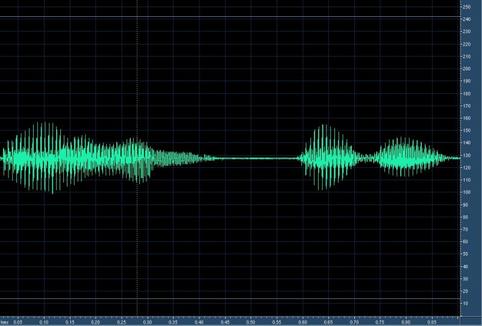
Voiceprinting compares known voice recordings to new conversations to determine who is speaking. It involves recording words to capture the frequencies associated with a person’s voice, and using statisical models to extrapolate speech patterns. Advocates say it is as accurate as a fingerprint, and can be more useful especially for monitoring overseas suspects.
“Advances in these types of technology have been key in thwarting plots and catching suspects,” an anonymous British government official said.
Critics say voiceprints can be inaccurate, however, because a person’s voice is affected by variables like mood and health.
The reputed plot involved Britain, France and Germany, sparking travel warnings this week. Suspects reportedly spoke of a Mumbai-style shooting spree, recalling the 2008 attacks that killed 166 people.
Police in southern France arrested 12 suspects Tuesday, AP reports.
The recent arrests are the not the first time criminals’ own voices have betrayed them. In 2007, police arrested Colombian drug kingpin Juan Carlos Ramirez Abadia, who used plastic surgery and multiple aliases to dodge authorities, after the US Drug Enforcement Agency matched his voice to a tape recording made by Colombian authorities. The Pentagon even uses voiceprinting in Iraq.
Law enforcement agencies are reportedly considering how a voice database could help prevent future plots, AP says. An Interpol official said voice samples could be stored and shared with its 188 member countries.
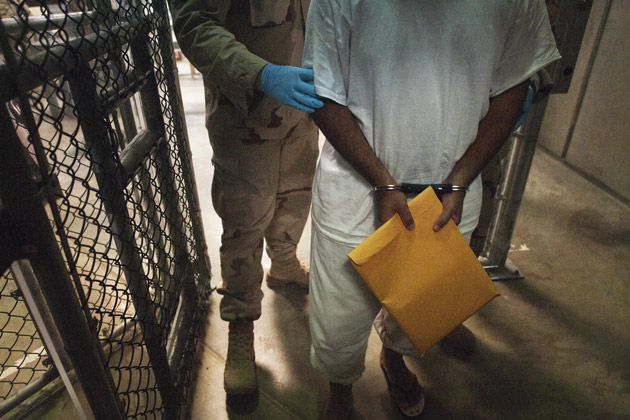
U.S. military guards move a detainee at Guantanamo Bay, Cuba, on March 30, 2010. In a motion unsealed last week, the government doubled down on its position that detainees’ observations and experiences of their time in U.S. custody are classified. (Paul J. Richards/AFP/Getty Images)
In a motion unsealed last week, the government proposed new ground rules for classified information in the trial of Khalid Sheikh Mohammed and four others charged with planning the 9/11 attacks.
The new order says the accused can’t talk about their “observations and experiences” of being held by the CIA, including “the enhanced interrogation techniques that were applied to the Accused” — that is, waterboarding and other abuse.
As we reported earlier this year, the government maintains that many details of the CIA’s detention program are still classified, despite widespread disclosures and an official acknowledgement by President George W. Bush in 2006. “Due to these individuals’ exposure to classified sources, methods, or activities of the United States,” an order filed in April read, anything the men say is “presumed to contain information classified as TOP SECRET / SCI.”
That sentence would have required defense attorneys to get the approval of a security officer to disclose even mundane information such as a date of birth, if it came from the defendant.
The new protective order — which is pending a judge’s approval — eliminates the line that all statements by the accused are presumed classified. In proposing the change, the government wrote it intended to “alleviate defense concerns” about the burden that presumptive classification added to their interactions with their clients. The government’s new motion says that attorneys would only need a review of information “they know or have a reason to know is classified.”
But when it comes to the CIA’s detention program, the new order states explicitly that “the term ‘information’ shall include without limitation observations and experiences of the Accused.”
A Pentagon spokesman did not return requests for comment about the new order.
The American Civil Liberties Union, news organizations, and James Connell, a lawyer representing one of the defendants, have challenged the government’s authority to declare something presumptively classified, and to extend classification to a detainee’s own statements. The ACLU filed a motion this spring arguing that the government forcibly “exposed” the detainees to this classified information, and that therefore the detainees couldn’t be bound to a non-disclosure agreement.
The group also argues that because the CIA program is now outlawed and has been so widely discussed, there is no compelling national security need to keep the details secret. The ACLU and media groups oppose the 40-second delay the government has imposed on broadcasting case proceedings. The government says the delay simply allows the commission to censor classified information. (That’s how the arraignments proceeded in May.)
The defense lawyer Connell said that in terms of the attorney-client relationship, the new proposal was an “important start.” But as far as public access goes, the ACLU’s lead lawyer on the case, Hina Shamsi, says that the new order “makes explicit what the government is seeking to do — prevent the public from hearing from the defendant’s own mouths their experiences of CIA torture.”
The judge presiding over the military commission, Army Col. James Pohl, would have to accept the government’s proposal for it to go into effect in the case. Pohl approved a similar protective order last year in the case of Abd al Rahim al Nashiri, who was allegedly behind the 2000 attack on the U.S.S. Cole. (That order has also been challenged by news organizations).
Hearings on the public access issue and Connell’s opposition to presumptive classification are scheduled for next week. Originally intended for August, they were postponed due to Hurricane Isaac.
How do you make matters worse for an elusive intelligence company that has been forced to scramble for explanations about their ownership of an intricate, widespread surveillance program? Just ask Cubic, whose troubles only begin with TrapWire.
Days after the international intelligence gathering surveillance system called TrapWire was unraveled by RT, an ongoing investigation into any and all entities with ties to the technology has unturned an ever-increasing toll of creepy truths. In only the latest installment of the quickly snowballing TrapWire saga, a company that shares several of the same board members as the secret spy system has been linked to a program called Tartan, which aims to track down alleged anarchists by specifically singling out Occupy Wall Street protesters and the publically funded media — all with the aid of federal agents.
Tartan, a product of the Ntrepid Corporation, “exposes and quantifies key influencers and hidden connections in social networks using mathematical algorithms for objective, un-biased output,” its website claims. “Our analysts, mathematicians and computer scientists are continually exploring new quantification, mining and visualization techniques in order to better analyze social networks.” In order to prove as such, their official website links to the executive summary of a case study dated this year that examines social network connections among so-called anarchists, supposedly locating hidden ties within an underground movement that was anchored on political activists and even the Public Broadcasting Station [.pdf].
“Tartan was used to reveal a hidden network of relationships among anarchist leaders of seemingly unrelated movements,” the website claims. “The study exposed the affiliations within this network that facilitate the viral spread of violent and illegal tactics to the broader protest movement in the United States.”
Tartan is advertised on their site as a must-have application for the national security sector, politicians and federal law enforcement, and makes a case by claiming that “an amorphous network of anarchist and protest groups,” made up of Occupy Oakland, PBS, Citizen Radio, Crimethinc and others, relies on “influential leaders,” “modern technology” and “illegal tactics” to spread a message of anarchy across America.
“The organizers of Occupy Wall Street and Occupy DC have built Occupy networks through online communication with anarchists actively participating in the movements’ founding,” the executive summary reads. On the chart that accompanies their claim, the group lists several political activism groups and broadcast networks within a ring of alleged anarchy, which also includes an unnamed FBI informant.
Although emails uncovered in a hack last year waged at Strategic Forecasting, or Stratfor, suggested that Occupy groups had been under private surveillance, the latest discovery of publically available information implies that the extent to which the monitoring of political activists on American soil occurred may have extended what was previously imagined.
Things don’t end there, though. While the TrapWire tale is still only just beginning, the Ntrepid Corporation made headlines last year after it was discovered by the Guardian that the company was orchestrating an “online persona management” program, a clever propaganda mill that was touted as a means “to influence regional and international audiences to achieve U.S. Central Command strategic objectives,” according, at least, to the Inspector General of the US Defense Department [.pdf]. The investigation eventually revealed that the US Central Command awarded Ntrepid $2.76 million worth of taxpayer dollars to create phony Internet “sock puppets” to propagate US support.
One year later, the merits of Tartan’s analytics are now being brought into question, but so are the rest of the company’s ties. A trove of research accumulated by RT, Project PM founder Barrett Brown, PrivacySOS.org and independent researchers Justin Ferguson and Asher Wolf, among others, has linked Tartan with an even more unsettling operation.
Margaret A. Lee of Northern Virginia is listed on several websites as serving on the Ntrepid board of directors as secretary, a position she held alongside Director Richard Helms, CFO Wesley R Husted and President Michael Martinka. And although several parties are going to great lengths to deny the ties, a paper trail directly links Lee and company to Abraxas — and thus Cubic — and, of course, TrapWire, the very surveillance system that is believed to be blanketing the United States.
According to the Commonwealth of Virginia’s State Corporation Commission, TrapWire Inc. was registered to Margaret A Lee on March 7, 2009. Other publically available information reveals that, at least at one point, Wesley Husted served as chief financial officer for TrapWire, Inc., where Richard H Helms held the title of CEO.
Various sources have since claimed that Helms, a former CIA agent that once ran the agency’s European division, has severed ties with TrapWire, yet the other connections remain intact.
In RT’s earlier research in the TrapWire case, it was revealed that TrapWire’s parent company, Cubic Corporation, acquired an online identity masking tool called Anonymzer in a 2010 merger, and also controls the fare card system at some of the biggest public transportation systems in the world. According to the latest findings, Cubic’s control extends beyond just that, though. Under their Ntrepid branch, Cubic controlled an operation that spied on political activists with FBI informants and attempted to link them to crimes across America.
Whether or not the TrapWire system was implemented in such operations is unclear, and Cubic continues to maintain that they are not involved with the surveillance network.
Last week, Cubic Corporation issued a press release claiming, “Abraxas Corporation then and now has no affiliation with Abraxas Applications now known as Trapwire, Inc.”
“Abraxas Corp., a risk-mitigation technology company, has spun out a software business to focus on selling a new product,” the article reads. “The spinoff – called Abraxas Applications – will sell TrapWire, which predicts attacks on critical infrastructure by analyzing security reports and video surveillance.”
Not only does a 2007 report in the Washington Business Journal insist that the companies are practically one in the same, though, but a 2006 article in the same paper reveals that Abraxas had just acquired software maker Dauntless. Researchers at Darkernet have since linked Lee, Husted and Helms to the Abraxas Dauntless Board of Directors as well.
Justin Ferguson, the researcher who first exposed TrapWire two weeks ago, has noted that Lee, Helms and Husted were listed on Abraxas Dauntless’ filings with Virginia as recently as December 2011. They also are all present on the TrapWire filings dated September 2011 and the latest annual filing made with the Florida Department of State, Division of Corporations on behalf of Ntrepid.
Nevertheless, in a conversation this week with Project PM’s Barrett Brown, Cubic Corp. Communication Director Tim Hall dismisses this tie again.
“There is no connection at all with Abraxas Applications and Trapwire and or Ntrepid,” Hall allegedly insists, according to audio uploaded to YouTube.
Brown, on his part, says he has obtained Cubic’s 2010 tax filings that show that Ntrepd, like Abraxas, is “wholly owned” by Cubic.
Other trademark information publically available online says that the Abraxas Corporation first filed to claim the name TrapWire in 2004 and was granted a license for such in January of 2007.
TrapWire Training Courses Reveal Possible Purpose for its Creation
Although certain people reportedly playing key roles in the web-like leadership structure of TrapWire deny their involvement with the massive surveillance system, there is evidence that the engine driving this global company runs on the ambition of a common core of officers and directors.
Given the potential flood of legal challenges to its constitutionality, the corporation believed to be behind TrapWire is heading for higher ground, denying any association with the surveillance technology.
In a statement published on its website on August 13, Cubic Corporation attempted to sever the ties binding it to TrapWire. “Cubic Corporation (NYSE: CUB) acquired Abraxas Corporation on December 20, 2010. Abraxas Corporation then and now has no affiliation with Abraxas Applications now known as Trapwire, Inc. Erroneous reports have linked the company with Trapwire, Inc.,” the company insisted.
Despite such denials, many are rightly worried about any corporate connection — no matter how tenuous — between Cubic and TrapWire given the former’s access to the personal data of Americans through its other corporate interests. The synergy of such access with a massive surveillance apparatus could threaten the privacy of millions, as well as the freedom from unwarranted searches and seizures protected by the Fourth Amendment.
As for the scope and significance of TrapWire, the size of it cannot be exaggerated.
TrapWire is a massive and technologically advanced surveillance system that has the capacity to keep nearly the entire population of this country under the watchful eye of government 24 hours a day. Using this network of cameras and other surveillance tools, the federal government is rapidly constructing an impenetrable, inescapable theater of surveillance, most of which is going unnoticed by Americans and unreported by the mainstream media.
Unlike other elements of the central government’s cybersurveillance program, word about TrapWire was not leaked by Obama administration insiders. The details of this nearly unbelievable surveillance scheme were made public by WikiLeaks, the anti-secrecy group founded by Julian Assange. The TrapWire story percolated from the millions of e-mails from the Austin, Texas-based private intelligence-gathering firm Stratfor, published this year by WikiLeaks. Covering correspondence from mid-2004 to 2011, these documents expose Stratfor’s “web of informers, pay-off structure, payment-laundering techniques and psychological methods.”
This coterie of Stratfor co-conspirators is apparently angry about the leaks, considering that the WikiLeaks servers have been under near-constant Distributed Denial of Service (DDoS) attacks since the TrapWire revelations began attracting the notice of alternative journalists. Some outlets report that the cyberattacks are being carried out by agents of the American intelligence community determined to prevent the full depth of this scandal from being explored by reporters.
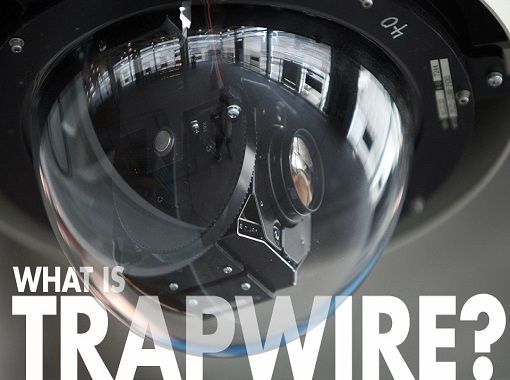
Exactly what is TrapWire? According to one description of the program, from Russia Today:
Former senior intelligence officials have created a detailed surveillance system more accurate than modern facial recognition technology — and have installed it across the US under the radar of most Americans, according to emails hacked by Anonymous.
Every few seconds, data picked up at surveillance points in major cities and landmarks across the United States are recorded digitally on the spot, then encrypted and instantaneously delivered to a fortified central database center at an undisclosed location to be aggregated with other intelligence.
Although many of the details remain undisclosed, it is known that the infrastructure of TrapWire was designed and deployed by Abraxas, an intelligence contractor based in northern Virginia headed and run by dozens of former American surveillance officers. As one article described it: “The employee roster at Abraxas reads like a who’s who of agents once with the Pentagon, CIA and other government entities according to their public LinkedIn profiles, and the corporation’s ties are assumed to go deeper than even documented.”
The network is believed to be immense. An article published by transparency advocacy group Public Intelligence claims that Stratfor e-mails suggest that TrapWire is in use by the U.S. Secret Service, the British security service MI5, the Royal Canadian Mounted Police, as well as counterterrorism divisions in both the Los Angeles and New York Police Departments and the LA fusion center. The e-mails also suggest that TrapWire is in use at military bases around the country. A July 2011 e-mail from a “Burton” to others at Stratfor describes how the U.S. Army, Marine Corps, and Pentagon have all begun using TrapWire and are “on the system now.” Burton described the Navy as the “next on the list.”
A survey of WikiLeaks e-mails containing information about TrapWire reveals another facet of this ever-expanding tool for tracking and targeting individuals.
The first course listed in the darkernet article is called the Surveillance Awareness Workshop. This class is reportedly “designed to instruct network and security personnel to use and navigate the TrapWire software system to familiarize themselves with the indicators of surveillance, terrorist surveillance methodologies, facility vulnerabilities, and the identification of probable surveillance zones that exist within each facility.”
The goal is that those with their fingers on the buttons and eyes on the consoles will learn to “view their facility the same way as would a terrorist, and then to be alert to the indicators of pre-attack surveillance.”
Pre-attack is a statist way of saying “guilty until proven innocent.” These agents — typically law enforcement or federal intelligence officers — reportedly will learn to spot suspicious behavior that points to the target’s propensity for participation in illegal activities.
This sort of advance profiling is eerily similar to the philosophy undergirding the signature strike that is becoming the go-to tactic in the Obama administration’s drone war.
A signature strike is not a strike on a particular suspect, but rather an attack on a person or group of people demonstrating behavior that is typical of those who might be associated with terror.
Perhaps the TrapWire “pre-attack surveillance” and the drone war “signature strike” are just two identifiable examples of a wider, more insidious government movement toward a society where one can be found guilty in advance of any crime based solely on one’s likelihood to act unlawfully and then be summarily executed based on that probability alone.
The second class offered by the makers of TrapWire according to the Internet investigation is designed along similar lines. It is called the Terrorist Pre-Attack Operations Course (TPOC).
Darkernet reports that participation in TPOC “will enhance overall security awareness and improve participants’ understanding of terrorist and criminal pre-attack surveillance and intelligence collection operations.”
Once again, the watchers are taught to better understand “terrorists” and what behavior they display just prior to the commission of a crime.
Unlike actual laws, these technologies and the courses improving their capabilities in the hands of users do not offer definitions of “terrorist” or “criminal.” One is left to one’s own understanding, it would seem, in the matter of conceiving of who is and is not a terrorist.
Today, the typical target might be a Muslim seen frequenting a subway station, for example. However, as the gulf separating the rulers and the ruled widens, perhaps a future TrapWire operator will target a gun-owner or attendant at a rally opposing a government policy as a potential threat and will initiate the requisite “intelligence collection operations.” The end result of those operations may be indefinite detention or death by Hellfire missile.
Finally, the last class listed in the darkernet article is called the Deception Detection and Eliciting Responses (DDER) course. This class will “teach students to detect deception and elicit responses in individuals including those which have been identified by TrapWire as having been engaged in suspicious behavior.”
So, once the target’s image pops up on one of the myriad cameras tracking the movements of every citizen (all are targets and potential terrorists, apparently) and the intelligence officers are called in to begin building a dossier on the target, the responding agents will use their newly-acquired interrogation skills to get the truth out of the target. “We have ways of making you talk,” in other words.
Given the aversion of the wizards running the surveillance state to allowing the curtain to be pulled back exposing the incredible extent of its domestic surveillance activities, it is more likely than not that TrapWire’s use in the tracking of Americans is wider and more institutional than most of us would like to believe.
A link to a complete listing of all TrapWire courses and the associated material is found here.
Find Out If You Are Doing Things Which Might Be Considered Suspicious
There have been so many anti-terrorism laws passed since 9/11 that it is hard to keep up on what kinds of things might get one on a “list” of suspected bad guys.
We’ve prepared this quick checklist so you can see if you might be doing something which might get hassled.
The following actions may get an American citizen living on U.S. soil labeled as a “suspected terrorist” today:
A blind man in the dark with ear muffs on knows that something happened in Benghazi, Libya more than a spontaneous angry mob pissed off over a Grade Z video attacked an American Consulate and killed the US Ambassador to Libya.
I hate internet conspiracy theories, and loathe slinging a new one into the mix, but the evidence available adds up one way: the attack, well-planned, was surgical payback for CIA activity in the area. Stevens wasn’t the target at all, he was just a celebrity in the wrong place at the wrong time. The guff about the dumb Prophet movie was the first cover story for the US Government and when that fell apart like cardboard in the rain, the State Department shifted the meme to flag waving over Stevens’ death.
Let’s see what we know:
– The attack was not spontaneous. It involved a large number of men, perhaps as many as 125, fighting in a coordinated fashion, using weapons such as RPGs and mortars on multiple targets. Yes, yes, lots of people carry guns around Libya, but not RPGs and certainly not crew served weapons like mortars. It appears also that the so-called Libyan security forces assigned to protect the Consulate either conveniently disappeared on cue or saw the smack coming down and ran to save themselves. This information is widely available from media outside the US, but scare in US media sources for some reason.
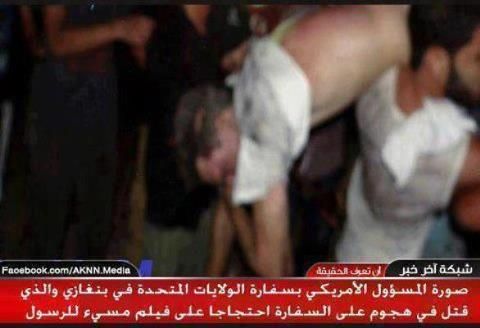
– The attack did not target Stevens. Indeed, famously, his body was only pulled from the ruins of the Consulate by a secondary crowd. Whether the crowd abused the body or dragged it to a hospital, it clearly had no idea or concern for who it held. The Consulate attackers went for documents, and ignored the Ambassador. Stevens just happened to be there, wrong place, wrong time.
– Half the US personnel evacuated out of Benghazi were CIA. While it is common knowledge that the CIA stations personnel abroad, it seems very unusual to have half a mission’s complement to be Agency. The New York Times reports that though the Agency has been cooperating with the new post-Qaddafi Libyan intelligence service, the size of the CIA’s presence in Benghazi apparently surprised some Libyan leaders. The deputy prime minister, Mustafa Abushagour, was quoted in The Wall Street Journal last week saying that he learned about some of the delicate American operations in Benghazi only after the attack on the mission, in large part because a surprisingly large number of Americans showed up at the Benghazi airport to be evacuated.
– In its reporting on the large number of CIA personnel in Benghazi, the New York Times agreed to withhold locations and details of Agency operations at the request of Obama administration officials, who said that disclosing such information could jeopardize future sensitive government activities and put at risk American personnel working in dangerous settings.
– The UK’s Independent noted that the Consulate attackers made off with documents listing names of Libyans who were working with Americans, and documents related to oil contracts. This strongly suggests the attack itself may have been a diversion to steal these documents and the Ambassador’s death, in U.S. terms, merely collateral damage. The organized attacking mob did not seem to be primarily interested in looting or stealing computer stuff.
– Many wondered why the media was reporting from early on the deaths of four Americans at the Benghazi Consulate, while Clinton continuously only mentioned two (Ambassador Stevens and computer person Sean Smith). Well, that’s because she did not want to tell us that the other two who lost their lives were “former” Navy SEALS now acting as State Department “contractors.” Even when Clinton finally acknowledged the SEALS’ deaths following widespread press reports, she only mentioned that one’s role was as security for the Ambassador.
Clinton pointedly did not mention what the other SEAL was doing in Libya. That is because the other deceased man was in Libya on an intel mission. The SEAL told ABC News that he was in Libya in the field tracking down and blowing up MANPADS, shoulder-fired surface-to-air missiles. The US saw its way to allowing those weapons to be used against Qaddafi and now wants to take them back so they are not used against us. Such ops are not State Department work and fall cleanly into CIA territory.
– The State Department’s curious mix up over who was providing security at the Benghazi Consulate also may point toward other US government Agencies. State Department spokeswoman Victoria Nuland initially said “at no time did we contract with a private security firm in Libya,” while federal procurement records easily Googleable showed a contract for “security guards and patrol services” on May 3 for $387,413.68. An extension option brought the tab for protecting the consulate to $783,000. The contract lists only “foreign security awardees” as its recipient. Was typically fastidious Nuland’s wrong answer simply because she was misbriefed, or was it in fact an honest answer, that the guards were not State Department contractors at all?
According to Danger Room, the State Department frequently hires security companies to protect diplomats in conflict zones. It usually is done through what’s known as the Worldwide Protective Services contract, in which a handful of approved firms compete to safeguard specific diplomatic installations.
In 2010, State selected eight firms for the most recent contract. Blue Mountain wasn’t among them, and the State Department did not explain why the Benghazi consulate contract did not go to one of those eight firms. How the State Department could have even hired a foreign firm outside that blanket contract is unclear. State’s Inspector General had criticized State’s management of personnel security firms, so unilaterally expanding the pool just for one Libyan Consulate seems off base.
– The US government has had a heck of a time getting its story straight over what happened in Benghazi, most famously in sending UN ambassador and attack dog Susan Rice around to claim the attack was purely spontaneous even as the White House backed away from the idea. We’ve already mentioned Clinton’s duplicity over the identities and roles of the two deceased American “ex-” SEALS. Even long-time State drone Patrick Kennedy, Under-Secretary at the State Department, said at one point he was convinced the assault was planned due to its extensive nature and the proliferation of weapons.
The election-year focus on President Barack Obama meant that the White House had at first been catching most of the heat for the tragedy in Benghazi. It’s certainly true the explanations from White House spokesman Jay Carney and UN Ambassador Susan Rice have strained common sense — mainly, the idea that the attack could be blamed solely on an anti-Islamic video, and that there was a protest outside the consulate at 10 p.m. (there reportedly wasn’t,) among other misleading details. That initial story has crumbled, and it took Robert Gibbs to get the Obama administration back on message on the Sunday shows.
State’s later calling reporter Michael Hastings an “asshole” and telling him to “fuck off” in relation to CNN’s use of Ambassador Steven’s found diary just adds fuel to the make-it-up-as-you-go-along nature of all this.
– Of course, there is a sort of precedent for this, most famously in 1991 when the KGB used a fire in the US Embassy in Moscow as a cover to roam around the building collecting documents,
Look, if all you have to do is tell the truth, it is pretty easy. Making up a cover story on the fly requires revisions. It may not be in our lifetimes that we learn what really happened in Libya, but something more than just a protest gone wild did happen.
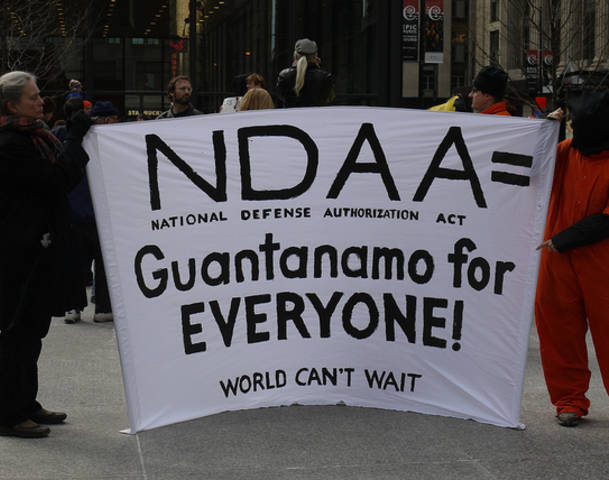
The Obama administration is battling to restore a controversial provision of a new federal law that it admits could have been used to arrest and detain citizens indefinitely – even if their actions were protected by the First Amendment.
A federal judge this week made permanent an injunction against enforcement of Section 1021 of the most recent National Defense Authorization Act, which was declared unconstitutional.
The Obama administration then took only hours to file an appeal of the order from U.S. District Judge Katherine Forrest, and attorneys also asked her to halt enforcement of her order.
In her order, Forrest wrote, “The government put forth the qualified position that plaintiffs’ particular activities, as described at the hearing, if described accurately, if they were independent, and without more, would not subject plaintiffs to military detention under Section 1021.”
But she continued, “The government did not – and does not – generally agree or anywhere argue that activities protected by the First Amendment could not subject an individual to indefinite military detention under Section 1021.”
The case was brought last January by a number of writers and reporters, led by New York Times reporter Christopher Hedges. The journalists contend the controversial section allows for detention of citizens and residents taken into custody in the U.S. on “suspicion of providing substantial support” to anyone engaged in hostilities against the U.S.
The lawsuit alleges the law is vague and could be read to authorize the arrest and detention of people whose speech or associations are protected by the First Amendment. They wonder whether interviewing a member of al-Qaida would be considered “substantial support.”
“Here, the stakes get no higher: indefinite military detention – potential detention during a war on terrorism that is not expected to end in the foreseeable future, if ever. The Constitution requires specificity – and that specificity is absent from Section 1021,” the judge wrote.
“It most definitely tells us something about their intent,” he told WND.
He cited Obama’s signing statement, when the bill was made law, that he would not use the provision allowing detention of American citizens without probable cause in military facilities.
“Just because someone says something doesn’t mean they’re not lying,” he said.
Bloomberg reports the Obama administration also is asking Forrest for a stay of the ruling that found the law violates the First, Fifth and 14th Amendments.
The judge expressed dissatisfaction with what one observer described as the arrogance of the Department of Justice in the case.
Forrest asked the government to define the legal term, noting the importance of how they apply to reporting and other duties.
“The court repeatedly asked the government whether those particular past activities could subject plaintiffs to indefinite military detention; the government refused to answer,” she wrote.
“The Constitution places affirmative limits on the power of the executive to act, and these limits apply in times of peace as well as times of war,” she wrote.
She said the law “impermissibly impinges on guaranteed First Amendment rights and lacks sufficient definitional structure and protection to meet the requirements of due process.”
“This court rejects the government’s suggestion that American citizens can be placed in military detention indefinitely, for acts they could not predict might subject them to detention, and have as their sole remedy a habeas petition adjudicated by a single decision-maker (a judge versus a jury), by a ‘preponderance of the evidence’ standard,” she wrote.
“That scenario dispenses with a number of guaranteed rights,” she said.
The Obama administration already has described those who hold a pro-life position or support third-party presidential candidates or the Second Amendment fit the profile of a domestic terrorist.
Obama stated when he put his signature to the legislative plan that his administration “will not authorize the indefinite military detention without trial of American citizens.”
Virginia already has passed a law that states it would not cooperate with such detentions, and several local jurisdictions have done the same. Arizona, Rhode Island, Maryland, Oklahoma, Tennessee and Washington also have considered similar legislation.
The case was brought on behalf of Christopher Hedges, Daniel Ellsberg, Jennifer Bolen, Noam Chomsky, Alex O’Brien, Kai Warg All, Brigitta Jonsottir and the group U.S. Day of Rage. Many of the plaintiffs are authors or reporters who stated that the threat of indefinite detention by the U.S. military already had altered their activities.
Constitutional expert Herb Titus filed a friend-of-the-court brief on behalf of the sponsor of the Virginia law, Delegate Bob Marshall and others.
Titus, an attorney with William J. Olson, P.C., told WND the judge’s first decision to grant a preliminary injunction halting enforcement of paragraph 1021 “affirms the constitutional position taken by Delegate Marshall is correct.”
The impact is that “the statute does not have sufficient constitutional guidelines to govern the discretion of the president in making a decision whether to hold someone in indefinite military detention,” Titus said.
The judge had noted that the law doesn’t have a requirement that there be any knowledge that an act is prohibited before a detention. The judge also said the law is vague, and she appeared to be disturbed that the administration lawyers refused to answer her questions.
Titus said the judge’s conclusions underscore “the arrogance of the current regime, in that they will not answer questions that they ought to answer to a judge because they don’t think they have to.”
The brief was filed on behalf of Marshall and other individuals and organizations, including the United States Justice Foundation, Downsize DC Foundation, Institute on the Constitution, Gun Owners of America, Western Center for Journalism, the Tenth Amendment Center and Pastor Chuck Baldwin.
Marshall’s HB1160 passed the Virginia House of Delegates by a vote of 87-7 and the Virginia Senate 36-1. Since the vote was on changes recommended by Gov. Bob McDonnell, it was scheduled to take effect without further vote.
Marshall then wrote leaders in state legislatures around the country suggesting similar votes in their states.
Marshall’s letter noted Virginia was the first state in the nation to refuse cooperation “with federal authorities who, acting under the authority of section 1021 of the National Defense Authorization Act of 2012 (NDAA), could arrest and detain American citizens suspected of aiding terrorists without probable cause, without the right to know the charges against them, and without the procedural rights guaranteed by the Bill of Rights.”
He told lawmakers, “While we would hope that the U.S. Senate and U.S. House of Representatives would be vigilant to protect the constitutional rights of American citizens, even when addressing the problem of international terrorism, those efforts in Congress failed at the end of last year, and President Obama signed NDAA into law on December 31, 2011.”
Endorsing Marshall’s plan was the Japanese American Citizens League, which cited the detention of tens of thousands of Japanese Americans during World War II on no authorization other than the president’s signature.
The Obama administration continues to argue the law allows for detention without legal due process only those who “substantially supported” terror groups such as al-Qaida or “associated forces.” But the plaintiffs note that the law does not define those terms.
Instead, they point to the law’s provision that such individuals may be detained “without trial until the end of the hostilities.”
Obama attorneys said the new law simply affirms what already was precedent under the Authorization for Use of Military Force, which was adopted in the dust of the 9/11 terror attacks.
But plaintiffs wrote, “Nowhere does the AUMF convey to the executive the power to detain any person – citizen or otherwise – who ‘substantially supported’ al-Qaida or the Taliban or their associate forces, as section 1021 of the NDAA now provides.”
“No case has ever recognized the government’s contention that the AUMF authorized the detention of noncombatants. … Neither case law nor the actual text of the AUMF supports the government’s contention that such detention power already existed.”
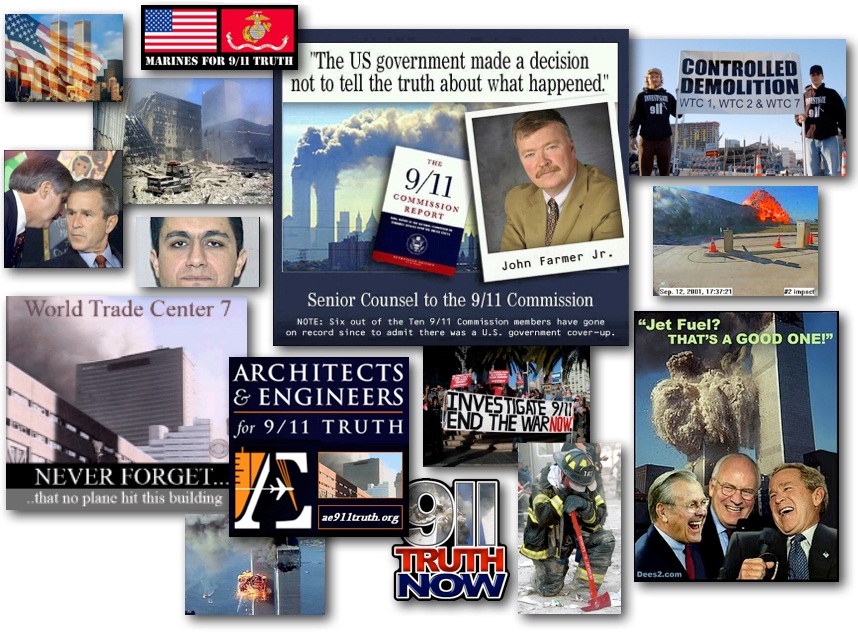
9/11 Events Decrypted: How is it possible that a rag-tag band of half-baked ‘terrorists’ penetrated the most sophisticated military airspace defense system in the WORLD, four times in a single morning? Take a closer look at the actual conspiracy-theory (ie, the ‘Official Version’ as which can not be proven), versus actual reported events which include: multiple explosions, Military planes, strange Orbs, Manipulated news footage, precision targeted airliners with impossible trajectories, suspicious stock trades, emptied Gold Vaults, billion dollar insurance policies and crime scene evidence destroyed immediately with NO investigation. The list goes on — tune in for the full story and little known facts, uncovered.
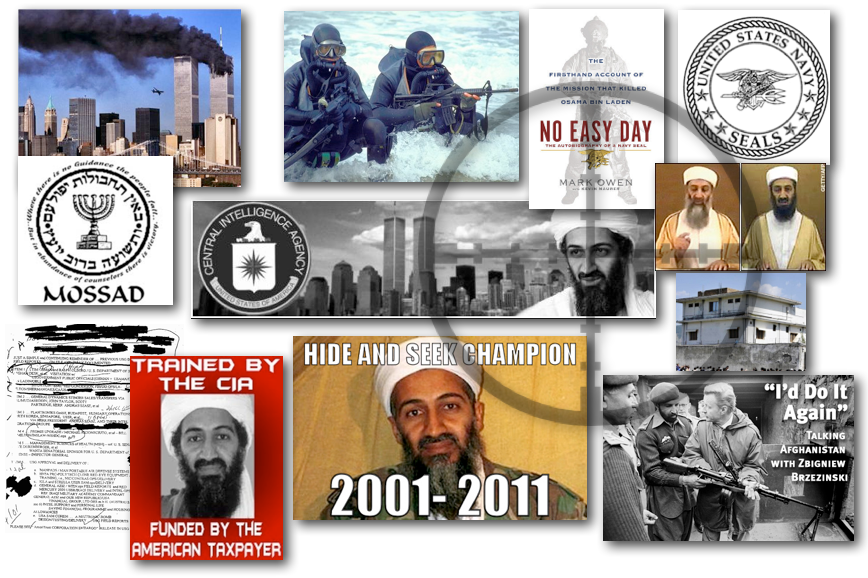
Osama Bin Laden Background & History: CIA Puppet Code Named Tim Osmond, OBL Death in late 2001 – As Reported in Multiple Foreign/Arabic Newspapers, Known Kidney Issues, Mysterious Tapes Showing Bin Laden Growing YOUNGER, His Personal Statements on 9/11 events, Photoshopped Images & Video, Impossible Night Raid In Abbottabad, How the SEAL-raid book & leak issue is a Controversy-by-Design Simply to Help Lament a False Version of History, and Forever Solidify Osama Bin Boogeyman… Hide and Seek World Champion 2001-2011!
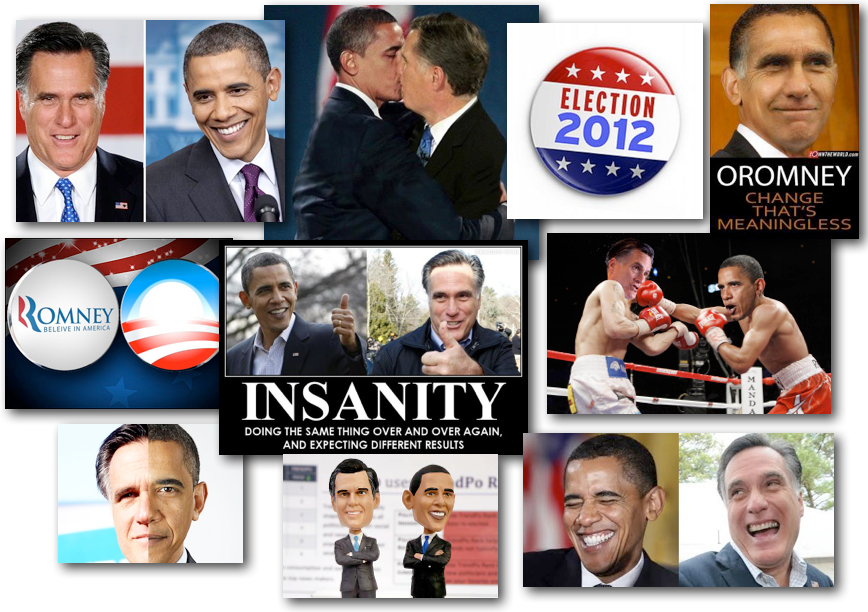
OBAMNEY 2012: Avoid the Puppet Show & Use Critical Thinking to Expose Two Identical Candidates. Barack Obama vs. Mitt Romney Mud-slinging, Their Mossad & CIA Connections, Both Support Drone Killings, NDAA, The Patriot Act, Unconstitutional Surveillance, Wiretapping, Banking Bailouts, Israel’s Oppression of Palestine, War by Design Against Iran, Torture in Guantanamo and that’s just the beginning!
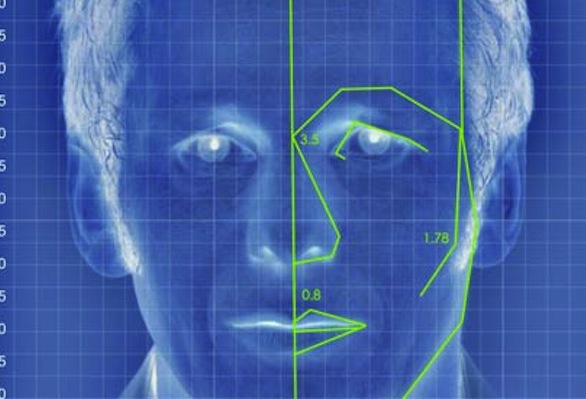
The Next Generation Identification programme will include a nationwide database of criminal faces and other biometrics
“FACE recognition is ‘now’,” declared Alessandro Acquisti of Carnegie Mellon University in Pittsburgh in a testimony before the US Senate in July.
It certainly seems that way. As part of an update to the national fingerprint database, the FBI has begun rolling out facial recognition to identify criminals.
It will form part of the bureau’s long-awaited, $1 billion Next Generation Identification (NGI) programme, which will also add biometrics such as iris scans, DNA analysis and voice identification to the toolkit. A handful of states began uploading their photos as part of a pilot programme this February and it is expected to be rolled out nationwide by 2014. In addition to scanning mugshots for a match, FBI officials have indicated that they are keen to track a suspect by picking out their face in a crowd.
Another application would be the reverse: images of a person of interest from security cameras or public photos uploaded onto the internet could be compared against a national repository of images held by the FBI. An algorithm would perform an automatic search and return a list of potential hits for an officer to sort through and use as possible leads for an investigation.
Ideally, such technological advancements will allow law enforcement to identify criminals more accurately and lead to quicker arrests. But privacy advocates are worried by the broad scope of the FBI’s plans. They are concerned that people with no criminal record who are caught on camera alongside a person of interest could end up in a federal database, or be subject to unwarranted surveillance.
The FBI’s Jerome Pender told the Senate in July that the searchable photo database used in the pilot studies only includes mugshots of known criminals. But it’s unclear from the NGI’s privacy statement whether that will remain the case once the entire system is up and running or if civilian photos might be added, says attorney Jennifer Lynch of the Electronic Frontier Foundation. The FBI was unable to answer New Scientist‘s questions before the magazine went to press.
The FBI hasn’t shared details of the algorithms it is using, but its technology could be very accurate if applied to photographs taken in controlled situations such as passport photos or police shots.
Tests in 2010 showed that the best algorithms can pick someone out in a pool of 1.6 million mugshots 92 per cent of the time. It’s possible to match a mugshot to a photo of a person who isn’t looking at the camera too. Algorithms such as one developed by Marios Savvides’s lab at Carnegie Mellon can analyse features of a front and side view set of mugshots, create a 3D model of the face, rotate it as much as 70 degrees to match the angle of the face in the photo, and then match the new 2D image with a fairly high degree of accuracy. The most difficult faces to match are those in low light. Merging photos from visible and infrared spectra can sharpen these images, but infrared cameras are still very expensive.
Of course, it is easier to match up posed images and the FBI has already partnered with issuers of state drivers’ licences for photo comparison. Jay Stanley of the American Civil Liberties Union urges caution: “Once you start plugging this into the FBI database, it becomes tantamount to a national photographic database.”
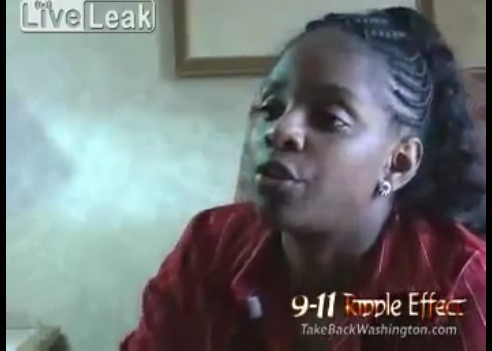
Personal Interview with FBI / Pentagon Employee who Says no Plane hit the building that day, from her professional experience and lack of on site evidence of any plane or wreckage. No jet fuel anywhere, or smell of jet fuel. No one else on site had seen any crash evidence or plane wreckage. Believes government fabricated ‘official’ story.
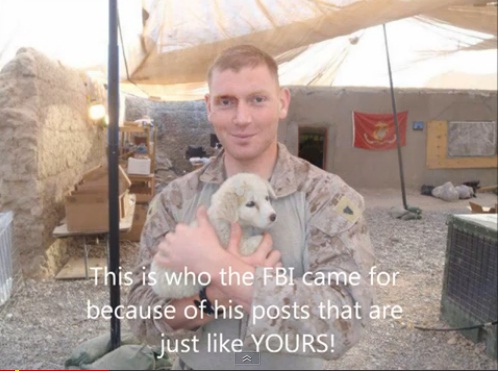
The Police, FBI and Secret Service swarmed in and took Brandon Raub to John Randolph Metal Hospital. This patriotic Marine had posted 5 posts on the Dont-Tread-On.Me blog linked below. Just glancing over them they seem to be of the religious and patriotic fight for truth and justice. He used the blog to have people join his FaceBook group and even did and promoted a Richmond Liberty March.
I looked through my email to see if there was any emails between the two of us and I did not find any, although I am sure there was as I would not have given him access to post on the blog if I did not.
There are a couple of lessons I want everyone to know form what little information we have from this incident.
1. Delete Facebook.I did a video for The Greatest Truth Never Told series called Delete Facebook giving a non conspiracy reason why people should quit FaceBook as it is destroying our lives. Now you should all see the conspiracy reason why you should Delete Facebook. This incident proves that it is just a huge monitoring tool for the Elite to track and build a profile of you. You give willingly the details of your political leaning, friends, interests. The hidden influence of the CIA through In-Q-Tel is becoming more and more visible.
2. This is designed to create a chilling effect to people speaking out and more importantly to keep sheeple from look at us for the Truth. I stated in the 3 Coming False Flags that the Elite would eventually criminalize or restrict our freedom of speech of the Freedom Movement. The Elite know the economic collapse is going to bring about the Anger Phase of the Awakening. They are actively preparing for riots and civil war. The thing that I find amazing is that these .gov people don’t ask why they are preparing for Civil War? What could make people so mad to want to go to war? Well since the Elite know the collapse of the dollar is coming they are conditioning their minions for that collapse. What these people should realize is that their paychecks are going to bounce and their entire life’ savings are going to be robbed.
3. Non violent, non compliance is a smart and effective strategy. Walking away from the paradigm is the best way of resisting the paradigm. Anyone physically pushing back will be taken down as it is of the same consciousness of those that are spreading debt and death throughout the world. Go peacefully if you are arrested, but question them on why and for what reason. You ask the questions and you should give no answers. You still have the right to keep quiet and ask for a lawyer. Unless you are really good under pressure I would suggest you just say nothing accept for asking for your lawyer. Also family members need to shut their mouths too as they immediately go after their friends and family in phone interviews.
4. Video tape everything you can. If you are confronted record every aspect not only to protect yourself, your rights and keep the story straight but also for a future law suit. You have every right to record every confrontation, I would be discreet about it because you don’t want an officer break the law and take your evidence. This is also very important to help keep your narrative straight as you will be told a lot of lies along the way.
5. Apparently questioning the government is a mental condition. Brandon was immediately brought to John Randolph Mental Hospital. The use of psychology was very common to political tool the Soviets and the Nazis to silence political opposition. Look at what Vladimir Putin is doing in Russia.
6. You get more flak the closer you get to the target. We must be coming very close to the collapse date with all of the things that are going on. I recommend that people stock up on food and gear and get ready to ride out the storm.
I hope to get more details as they develop and eventually I hope to thoroughly de-brief Brandon as soon as he can.
Join the Insider mailing list at the top right hand side of the blog for email updates.
Here are the 5 articles from Brandon Raub on the Dont-Tread-On.Me site.
At the heart of the story are two groups: the American neo-conservatives and the radical Islamists.
Both were idealists who were born out of the failure of the liberal dream to build a better world.
These two groups have changed the world but not in the way either intended.
Thoe with the darkest fears became the most powerful
Together they created today’s nightmare vision of an organized terror network.
A fantasy that politicians then found restored their power and authority in a disillusioned age. Those with the darkest fears became the most powerful.
The rise of the politics of fear begins in 1949 with two men whose radical ideas would inspire the attack of 9/11 and influence the neo-conservative movement that dominates Washington.
Both these men believed that modern liberal freedoms were eroding the bonds that held society together.
The two movements they inspired set out, in their different ways, to rescue their societies from this decay. But in an age of growing disillusion with politics, the neo-conservatives turned to fear in order to pursue their vision.
They would create a hidden network of evil run by the Soviet Union that only they could see.
The Islamists were faced by the refusal of the masses to follow their dream and began to turn to terror to force the people to “see the truth”‘.
The Power of Nightmares will be broadcast over three nights from Tuesday 18 to Thursday, 20 January, 2005 at 2320 GMT on BBC Two. The final part has been updated in the wake of the Law Lords ruling in December that detaining foreign terrorist suspects without trial was illegal.
As the Occupy movement carries out massive May Day protests around the country, the FBI Joint Terrorism Task force is trumpeting the arrest of “self-proclaimed anarchists” and “terrorists” who allegedly conspired to destroy a bridge in Ohio. Integral to the development and advancement of this plot, however, were FBI agents themselves and an informant with a drug and robbery record.
Douglas L. Wright, 26; Brandon L. Baxter, 20; and Anthony Hayne, 35, Connor C. Stevens, 20, and Joshua S. Stafford, 23, were arrested by the FBI on April 30, just in time to make the announcement as the nation turns its attention to May Day protests.
The affidavit reveals a plot by the FBI that continues a pattern of behavior in “terrorism” investigations against political activists. Most importantly, undercover FBI agents helped shape the “plot,” offered advice on how and where to use explosives, and allegedly sold explosives to the activists.
Pervasive Use of Informants and Undercover FBI
The informant in the case has been working with the FBI since July 20, 2011, and has a criminal record including possession of cocaine, conviction for robbery, and four convictions for passing bad checks. (The FBI’s proclivity for using down-and-out criminals was a key issue in the “Operation Backfire” Earth Liberation Front cases. The lead arsonist and informant, Jacob Ferguson, had a heroin addiction, and is now back in prison on drug charges).
The informant and the others haphazardly talked about various plans, starting with the use of smoke grenades and destroying bank signs off the top of large buildings.
For instance, on April 10, 2012: ““…BAXTER explained that he does not know what to do with the explosives and he has never considered blowing anything up before.”
Conversation shifted to other outrageous plans. According to the affidavit, “WRIGHT joked that he would wear a suicide vest and walk in and blow himself up, but advised he would have to be very drunk.”
“The CHS [the informant] asked the others what it is they wanted to do… BAXTER said that they had never decided on the bridge, they were just throwing out options and they had never decided on anything.”
FBI Guidance
The defendants flitted between hyperbolic conversations -– some about destroying bank signs, some about destroying a boat, some about a bridge — and various spy tactics such as secret email accounts, wiping computer drives, and disrupting surveillance. At every step of the way, the informant (who was paid nearly $6,000, plus expenses) and undercover FBI agents were there to correct course.
At one point Wright asked the undercover FBI agent “if there was any work he could do… to pay for the items he was going to purchase” from the agent. Later, Connor Stevens told Wright that he no longer wanted to be part of the plan, but wanted to know if the informant might hire him to do some work on his house.
At another point, Wright told the informant that he and others thought one of the individuals involved was an undercover cop (which he was). To allay his fears, the informant said he would help provide the explosives.
Clamoring to Thwart “Terrorist Plots”
U.S. Attorney Dettelbach called this a violent terrorist plot, and said: “The defendants stand charged based not upon any words or beliefs they might espouse, but based upon their own plans and actions.”
What’s troubling is that the government has had a heavy hand in creating the very plot it thwarted.
And on top of that, the defendants, by the admission of the FBI, said repeatedly that they had no intention of harming anyone. At one point Baxter and Wright “stated they don’t want people to think they are terrorists.”
This isn’t an isolated instance.
The criminal complaint reads like the spitting image of the case of Eric McDavid, who was coaxed by an undercover FBI operative named “Anna.” In that case, like this one, the FBI supplied bomb making recipes, bomb making materials, and attempts to distill activist boasting and hyperbole into a coherent plan.
McDavid did nothing, and was arrested on conspiracy charges, like these defendants have been. As readers of this site know, conspiracy charges are the fall-back for the government when there is not enough evidence to get anything else to “stick.”
Demonization of Anarchism
In addition to a continuation of undercover informants and FBI-manufactured plots, this case also reflects on on-going focus on demonizing anarchists.
The government’s press release proclaims that the defendants are “self-proclaimed anarchists.” The affidavit notes that they attended anarchist protests and carried anarchist flags.
The affidavit also says that the defendants talked about anarchists “rioting and destroying each city” that holds May Day protests, and that it will be “off the hook.”
Demonizing anarchists has gone one for over a century, of course, but in recent years the rhetoric has dovetailed with “War on Terrorism” hysteria.
For example, in Scott Demuth’s case, the government argued that: “Defendant’s writings, literature, and conduct suggest that he is an anarchist and associated with the ALF movement. Therefore, he is a domestic terrorist.”
It should come as no surprise, then, that the announcement of these arrests was carefully unveiled yesterday, so that the top news story this May Day would not be about how anarchists are preventing home foreclosures, starting community gardens, teaching collective organizing skills, and re-framing class consciousness, but about how they were part of an FBI-guided “terrorist plot.”
The US Supreme Court unanimously decided that foreign political organizations and multinational corporations cannot be sued for the torture or extrajudicial killing of persons abroad under an anti-torture law passed in 1992. The law only gives people the right to sue “an individual,” “who acted under the authority of a foreign nation,” according to the Los Angeles Times.
The decision came in a lawsuit filed by the family of a US citizen, Azzam Rahim, who was tortured and killed in the Palestinian Territory by Palestine Liberation Organization (PLO) intelligence officers. It was Justice Sonia Sotomayor, who President Barack Obama appointed to the Supreme Court, that spoke for the decision. She explained the text of the Torture Victims Protection Act of 1991 “convinces us that Congress did not extend liability to organizations, sovereign or not. There are no doubt valid arguments for such an extension. But Congress has seen fit to proceed in more modest steps in the Act, and it is not the province of this branch to do otherwise.”
This outcome is not just a blow for the family of Rahim but also those concerned with human rights. If one considers the intent of the law, it seems like Rahim’s family should not have been scoffed at as they were for bringing the lawsuit. (Chief Justice John Roberts laughed at the lawyer for the family, Jeffrey Fisher, during arguments in Court.)
President George H.W. Bush, who signed the law, intended this to be legislation that would push Congress to ratify the Convention Against Torture:
I regret that the legislation proposed by the Administration to implement the United Nations Convention Against Torture and Other Cruel, Inhuman or Degrading Treatment or Punishment has not yet been enacted. This proposed implementing legislation would provide a tougher and more effective response to the problem, putting in place for torturers the same international “extradite or prosecute” regime we have for terrorists. The Senate gave its advice and consent to the Torture Convention on October 27, 1990, but the United States cannot proceed to become a party until the necessary implementing legislation is in place. I again call upon the Congress to take prompt action to approve the Torture Convention implementing legislation.
The law was already considered a law that would not apply to the US Armed Forces or law enforcement operations that were carried out under US law.
UN Special Rapporteur on Torture Juan Mendez submitted a brief to the court in support of Rahim that outlined the fact that the Torture Convention is supposed to help “prevent torture” by “persons who act, de jure or de facto, in the name of, in conjunction with, or at the behest of the State Party.” In other words, being a government official doesn’t make one immune to prosecution. Any person who is complicit or participates in torture is to be criminalized. There are to be civil remedies in place to compensate and give justice to victims of torture. What this ruling does then is undercut the United States’ responsibility to uphold the Torture Convention.
Aside from the reality that the US government finds it has no obligation to do what signatories to the Torture Convention are expected to do, the ruling is troublesome on another level because the comments from Supreme Court justices suggest if the family of Rahim knew the names of people that had tortured and killed him then they might not have had a weak case.
Now, against scholarly understanding of international law, the Court has effectively rendered precedents where non-state actors, like corporations, have been held liable for torture moot. As the Yale Law School Center for Global Legal Challenges demonstrates in a brief, they are contradicting the US State Department policy:
The U.S. State Department has routinely acknowledged that non-state groups and organizations have engaged in torture. See, e.g., U.S. Dep’t of State, Democratic Republic of the Congo: Country Reports on Human Rights Practices (Feb. 23, 2000) (citing credible reports that “Mai Mai groups fighting on the side of the Government committed * * * torture * * * of civilians”); U.S. Dep’t of State, Sri Lanka: Country Reports on Human Rights Practices (Mar. 4, 2002) (“[T]wo former Tamil terrorist organizations aligned with the former PA Government * * * have been implicated in cases involving extrajudicial killing [and] torture.”).
It was already difficult for torture victims to win lawsuits. In December 2011, a federal judge dismissed a lawsuit by a former Guantanamo detainee claiming US military officials had tortured him repeatedly. A federal appeals court dismissed torture cases against Abu Ghraib contractors in September 2011. The Ninth Circuit dismissed a suit against Jeppesen Dataplan that alleged they had “knowingly aided in the rendition and subsequent torture of terror suspects by the CIA,” after the Obama Justice Department invoked a state secrets privilege. A federal appeals court didallow a lawsuit against former Secretary of Defense Donald Rumsfeld for authorizing torture to move forward, but a district court dismissed another lawsuit against him for authorizing the torture of detainees by US military personnel in Iraq and Afghanistan. And, months before that, a lawsuit brought by convicted terrorist Jose Padilla against US Defense Secretary Robert Gates and Rumsfeld for their role in his torture and isolation on a Navy military brig was thrown out and the Obama Justice Department determined that Bush administration lawyers that had crafted legal justification for torture had engaged in no “professional misconduct.”
If torture is illegal, it is only prohibited from being expressly included in policies of agencies or departments. It most certainly is something agents, military personnel and government officials can engage in and avoid prosecution. Given that reality, the narrow interpretation is not necessarily surprising. Using this case to create a precedent that grants cover to corporations that engage in torture is in line with the culture of impunity that has been fostered by US government. Unfortunately, if torture victims want justice, the United States is one of the last countries they should turn to for reparations at this point in history.
LOS ANGELES (CBS) — A bill authored by a Southland lawmaker that could potentially allow the federal government to prevent any Americans who owe back taxes from traveling outside the U.S. is one step closer to becoming law.
Senate Bill 1813 was introduced back in November by Senator Barbara Boxer (D-Los Angeles) to “reauthorize Federal-aid highway and highway safety construction programs, and for other purposes” .
After clearing the Senate on a 74 – 22 vote on March 14, SB 1813 is now headed for a vote in the House of Representatives, where it’s expected to encounter stiffer opposition among the GOP majority.
In addition to authorizing appropriations for federal transportation and infrastructure programs, the “Moving Ahead for Progress in the 21st Century Act” or “MAP-21″ includes a provision that would allow for the “revocation or denial” of a passport for anyone with “certain unpaid taxes” or “tax delinquencies”.
Section 40304 of the legislation states that any individual who owes more than $50,000 to the Internal Revenue Service may be subject to “action with respect to denial, revocation, or limitation of a passport”.
The bill does allow for exceptions in the event of emergency or humanitarian situations or limited return travel to the U.S., or in cases when any tax debt is currently being repaid in a “timely manner” or when collection efforts have been suspended.
However, there does not appear to be any specific language requiring a taxpayer to be charged with tax evasion or any other crime in order to have their passport revoked or limited — only that a notice of lien or levy has been filed by the IRS.
Boxer vowed last week to push House Republicans to pass the bipartisan transportation bill that would keep the Highway Trust Fund from going bankrupt.
“Thousands of businesses are at stake, and eventually we are talking about nearly three million jobs at stake,” she said in a statement. “There are many people on both sides of the aisle in the Senate who want to get our bill, MAP-21, passed into law, and I am going to do everything I can to keep the pressure on the Republican House to do just that.”
The following collection of 25 flyers produced by the FBI and the Department of Justice are distributed to local businesses in a variety of industries to promote suspicious activity reporting. The flyers are not released publicly, though several have been published in the past by news media and various law enforcement agencies around the country. We have compiled this collection from a number of online sources.
To view the documents, click on a threat area in the menu to the left and the PDF will appear on the right side of the page. You can also download the complete collection of files (ZIP Archive, 6.27 MB).
The entire concept of a “Terrorism expert” is invalid, as it is an honorific title typically assigned due to ideology and interests served rather than actual expertise.
In U.S. political and media discourse, Terrorism means little more than: that which America’s Enemies du Jour (generally Muslim Enemies) do to it, but not what America and its allies do to anyone.
Terrorism is not a real concept in which one develops “expertise”; it is, and from its introduction into world affairs always has been, a term of propaganda designed to legitimize violence by some actors while de-legitimizing very similar violence by others.
US Military Drones targeting Rescue Workers and Funerals in Pakistan
The CIA’s drone campaign targeting suspected militants in Pakistan has killed dozens of civilians who had gone to rescue victims or were attending funerals. So concludes a new report by the London-based Bureau of Investigative Journalism. It found that since President Obama took office three years ago, as many as 535 civilians have been killed, including more than 60 children. The investigation also revealed that at least 50 civilians were killed in follow-up strikes when they had gone to help victims. More than 20 civilians have also been attacked in deliberate strikes on funerals and mourners. We speak to Chris Woods, award-winning reporter with the Bureau of Investigative Journalism. “We noted that there were repeated reports at the time, contemporaneous reports in publications like New York Times, news agencies like Reuters, by CNN, that there were these strikes on rescuers, that there were reports that there had been an initial strike and then, some minutes later, as people had come forward to help and pull out the dead and injured, that drones had returned to the scene and had attacked rescuers,” Woods says. “We’ve been able to name just over 50 civilians that we understand have been killed in those attacks. In total, we think that more than 75 civilians have been killed, specifically in these attacks on rescuers and on mourners, on funeral-goers.”
Two major investigations have provided fresh evidence that civilians are continuing to be killed in Pakistan’s tribal areas by CIA drones – despite aggressive Agency denials.
In a study of ten major drone strikes in Pakistan since 2010, global news agency Associated Press deployed a field reporter to Waziristan and questioned more than 80 local people about ten CIA attacks. The results generally confirm the accuracy of original credible media reports – and in two cases identify previously unrecorded civilian deaths.
In a further case, in which an anonymous US official had previously attacked the Bureau’s findings of six civilian deaths in a 2011 strike, AP’s report has confirmed the Bureau’s work.
Anglo-American legal charity Reprieve has also filed a case with the United Nations Human Rights Council, based on sworn affidavits by 18 family members of civilians killed in CIA attacks – many of them children. Reprieve is calling on the UNHRC ‘to condemn the attacks as illegal human rights violations.’
Exclusive: Personal Statement from Kurt Haskell, Delta 253 Passenger
Every victim of a crime in Michigan is entitled to make a statement in open court regarding the impact of the crime on their life. The statement is limited to the victim’s physical, emotional and financial well being as it relates to the crime. Keep that in mind as you read my statement. Below is a copy of the victim impact statement I gave today at the Underwear Bomber sentencing hearing. When reading my statement, keep in mind that I am a practicing attorney in the State of Michigan. In addition, I regularly practice in the Court the hearings are taking place at and therefore, I am somewhat limited as to what I can say. We were limited to 5 minutes each.
I wish to thank the Court for allowing me these 5 minutes to make my statement. My references to the government in this statement refer to the Federal Government excluding this Court and the prosecution. On Christmas Day 2009, my wife and I were returning from an African safari and had a connecting flight through Amsterdam. As we waited for our flight, we sat on the floor next to the boarding gate. What I witnessed while sitting there and subsequent events have changed my life forever. While I sat there, I witnessed Umar dressed in jeans and a white t-shirt, being escorted around security by a man in a tan suit who spoke perfect American English and who aided Umar in boarding without a passport. The airline gate worker initially refused Umar boarding until the man in the tan suit intervened. The event meant nothing to me at the time. Little did I know that Umar would try to kill me a few hours later as our flight approached Detroit. The final 10 minutes of our flight after the attack were the worst minutes of my life. During those 10 minutes I sat paralyzed in fear. Unfortunately, what happened next has had an even greater impact on my life and has saddened me further.
When we landed, I was shocked that our plane taxied up to the gate. I was further shocked that we were forced to sit on the plane for 20 minutes with powder from the so called bomb all over the cabin. The officers that boarded the plane did nothing to ensure our safety and did not check for accomplices or other explosive devices. Several passengers trampled through parts of the bomb as they exited the plane. We were then taken into the terminal with our unchecked carry on bags. Again, there was no concern for our safety even though Umar told the officers that there was another bomb on board as he exited the plane. I wondered why nobody was concerned about our safety, accomplices or other bombs and the lack of concern worried me greatly. I immediately told the FBI my story in order to help catch the accomplice I had seen in Amsterdam. It soon became obvious that the FBI wasn’t interested in what I had to say, which upset me further. For one month the government refused to admit the existence of the man in the tan suit before changing course and admitting his existence in an ABC News article on January 22, 2010. That was the last time the government talked about this man. The video that would prove the truth of my account has never been released. I continue to be emotionally upset that the video has not been released. The Dutch police, meanwhile, in this article (show article), also confirmed that Umar did not show his passport in Amsterdam which also meant that he didn’t go through security as both are in the same line in Amsterdam. It upsets me that the government refuses to admit this fact.
I became further saddened from this case, when Patrick Kennedy of the State Department during Congressional hearings, admitted that Umar was a known terrorist, was being followed, and the U.S. allowed him into the U.S. so that it could catch Umar’s accomplices. I was once again shocked and saddened when Michael Leiter of the National Counter terrorism Center admitted during these same hearings that intentionally letting terrorists into the U.S. was a frequent practice of the U.S. Government. I cannot fully explain my sadness, disappointment and fear when I realized that my government allowed an attack on me intentionally.
During this time, I questioned if my country intentionally put a known terrorist onto my flight with a live bomb. I had many sleepless nights over this issue. My answer came shortly thereafter. In late 2010, the FBI admitted to giving out intentionally defective bombs to the Portland Christmas Tree Bomber,the Wrigley Field Bomber and several others. Further, Mr. Chambers was quoted in the Free Press on January 11, 2011 when he indicated that the government’s own explosives experts had indicated that Umar’s bomb was impossibly defective. I wondered how that could be. Certainly, I thought, Al Qaeda wouldn’t go through all of the trouble to plan such an attack only to provide the terrorist with an impossibly defective bomb.
I attended nearly all of the pretrial hearings. At the hearing on January 28, 2011, I was greatly disappointed by the prosecution’s request to block evidence from Mr. Chambers “as it could then be able to be obtained by third parties, who could use it in a civil suit against the government”. It really bothered me that the government apparently was admitting to wrongdoing of some kind as it admitted that it was concerned it would be sued. It further upset me to know that the government was putting its own interests ahead of those of the passengers.
When I attended the jury selection hearings, I questioned why versions of the same two questions kept coming up, those being:
1. Do you think you’ll be able to tell whether something is actually a bomb? and
2. Do you realize that sometimes the media doesn’t always tell the truth?
I continued to be greatly saddened at this point as I felt the truth continued to be hidden.
When Umar listed me as his only witness, I was happy to testify, not on his behalf, but on behalf of the truth. I never expected to testify, as my eyewitness account would have been too damaging to the myth that the government and media are putting forward. A mere 5 days after I was announced as a witness, there was an inexplicable guilty plea which exasperated me as I no longer would be testifying.
In closing I will just say that regardless of how the media and government try to shape the public perception of this case, I am convinced that Umar was given an intentionally defective bomb by a U.S. Government agent and placed on our flight without showing a passport or going through security, to stage a false terrorist attack to be used to implement various government policies.
The effect this matter has had on my life has been astounding and due to this case, I will never trust the government in any matter, ever.
In regards to sentencing, nothing I’ve said excuses the fact that Umar tried to kill me. He has waived his valid claim to the entrapment defense. Umar, you are not a great Muslim martyr, you are merely a “Patsy”. I ask the court to impose the mandatory sentence.



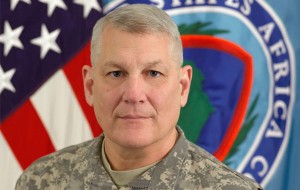

 A General who made the decision to assist diplomatic and intelligence assets on the ground has been arrested and will likely be retired or worse, while those who ordered the removal of embassy security details and ordered U.S. forces to stand-down are left to go on about their business and likely risk more American lives in the future.


















 Thoe with the darkest fears became the most powerful
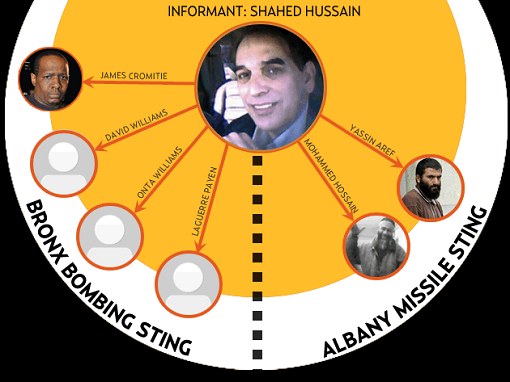


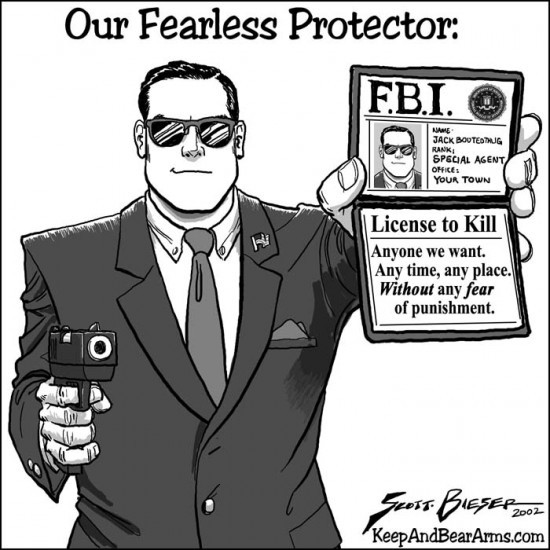
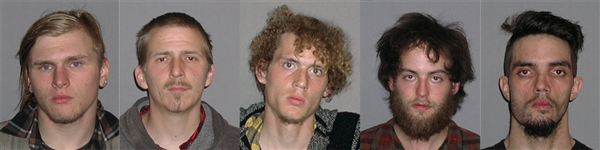
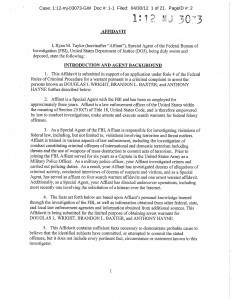

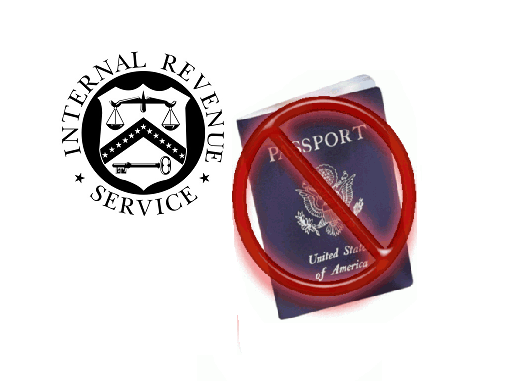


 The following collection of 25 flyers produced by the FBI and the Department of Justice are distributed to local businesses in a variety of industries to promote suspicious activity reporting. The flyers are not released publicly, though several have been published in the past by news media and various law enforcement agencies around the country. We have compiled this collection from a number of online sources.