The Fed’s annual profit surges to $81.7 billion

By Steve Goldstein

WASHINGTON (MarketWatch) — The Federal Reserve released earnings for 2010, with the central bank’s profit growing to $81.7 billion, a record high, from $53.4 billion, mostly due to growing interest earnings on federal agency and government-sponsored enterprise mortgage-backed securities. The Fed’s balance sheet — which also can be monitored monthly — ballooned to $2.43 trillion, up $193 billion from 2009, as holdings of U.S. Treasury and mortgage-backed securities rose. The Fed returned $79 billion to the U.S. Treasury in 2010, up from $47 billion in 2009. (Updates to include that the Fed profits were at a record.)


http://www.marketwatch.com/story/the-feds-annual-profit-surges-to-817-billion-2011-03-22

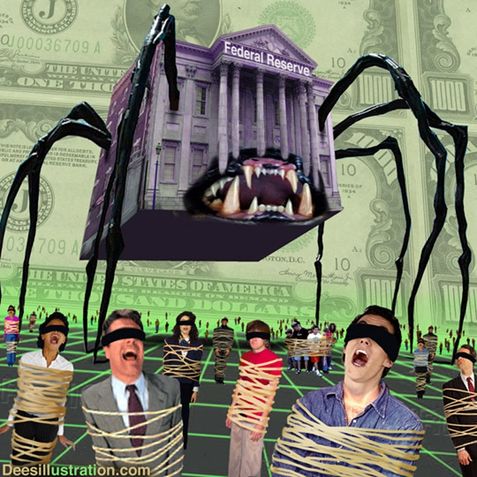
The Federal Reserve Cartel: The Eight Families

The Federal Reserve Cartel: The Eight Families

(Part one of a four-part series)

The Four Horsemen of Banking (Bank of America, JP Morgan Chase, Citigroup and Wells Fargo) own the Four Horsemen of Oil (Exxon Mobil, Royal Dutch/Shell, BP and Chevron Texaco); in tandem with Deutsche Bank, BNP, Barclays and other European old money behemoths. But their monopoly over the global economy does not end at the edge of the oil patch.

According to company 10K filings to the SEC, the Four Horsemen of Banking are among the top ten stock holders of virtually every Fortune 500 corporation.[1]

So who then are the stockholders in these money center banks?

This information is guarded much more closely. My queries to bank regulatory agencies regarding stock ownership in the top 25 US bank holding companies were given Freedom of Information Act status, before being denied on “national security” grounds. This is rather ironic, since many of the bank’s stockholders reside in Europe.

One important repository for the wealth of the global oligarchy that owns these bank holding companies is US Trust Corporation – founded in 1853 and now owned by Bank of America. A recent US Trust Corporate Director and Honorary Trustee was Walter Rothschild. Other directors included Daniel Davison of JP Morgan Chase, Richard Tucker of Exxon Mobil, Daniel Roberts of Citigroup and Marshall Schwartz of Morgan Stanley. [2]

J. W. McCallister, an oil industry insider with House of Saud connections, wrote in The Grim Reaper that information he acquired from Saudi bankers cited 80% ownership of the New York Federal Reserve Bank- by far the most powerful Fed branch- by just eight families, four of which reside in the US. They are the Goldman Sachs, Rockefellers, Lehmans and Kuhn Loebs of New York; the Rothschilds of Paris and London; the Warburgs of Hamburg; the Lazards of Paris; and the Israel Moses Seifs of Rome.

CPA Thomas D. Schauf corroborates McCallister’s claims, adding that ten banks control all twelve Federal Reserve Bank branches. He names N.M. Rothschild of London, Rothschild Bank of Berlin, Warburg Bank of Hamburg, Warburg Bank of Amsterdam, Lehman Brothers of New York, Lazard Brothers of Paris, Kuhn Loeb Bank of New York, Israel Moses Seif Bank of Italy, Goldman Sachs of New York and JP Morgan Chase Bank of New York. Schauf lists William Rockefeller, Paul Warburg, Jacob Schiff and James Stillman as individuals who own large shares of the Fed. [3] The Schiffs are insiders at Kuhn Loeb. The Stillmans are Citigroup insiders, who married into the Rockefeller clan at the turn of the century.

Eustace Mullins came to the same conclusions in his book The Secrets of the Federal Reserve, in which he displays charts connecting the Fed and its member banks to the families of Rothschild, Warburg, Rockefeller and the others. [4]

The control that these banking families exert over the global economy cannot be overstated and is quite intentionally shrouded in secrecy. Their corporate media arm is quick to discredit any information exposing this private central banking cartel as “conspiracy theory”. Yet the facts remain.


The House of Morgan

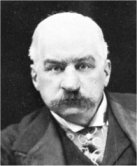
The Federal Reserve Bank was born in 1913, the same year US banking scion J. Pierpont Morgan died and the Rockefeller Foundation was formed. The House of Morgan presided over American finance from the corner of Wall Street and Broad, acting as quasi-US central bank since 1838, when George Peabody founded it in London.

Peabody was a business associate of the Rothschilds. In 1952 Fed researcher Eustace Mullins put forth the supposition that the Morgans were nothing more than Rothschild agents. Mullins wrote that the Rothschilds, “…preferred to operate anonymously in the US behind the facade of J.P. Morgan & Company”. [5]

Author Gabriel Kolko stated, “Morgan’s activities in 1895-1896 in selling US gold bonds in Europe were based on an alliance with the House of Rothschild.” [6]

The Morgan financial octopus wrapped its tentacles quickly around the globe. Morgan Grenfell operated in London. Morgan et Ce ruled Paris. The Rothschild’s Lambert cousins set up Drexel & Company in Philadelphia.

The House of Morgan catered to the Astors, DuPonts, Guggenheims, Vanderbilts and Rockefellers. It financed the launch of AT&T, General Motors, General Electric and DuPont. Like the London-based Rothschild and Barings banks, Morgan became part of the power structure in many countries.

By 1890 the House of Morgan was lending to Egypt’s central bank, financing Russian railroads, floating Brazilian provincial government bonds and funding Argentine public works projects. A recession in 1893 enhanced Morgan’s power. That year Morgan saved the US government from a bank panic, forming a syndicate to prop up government reserves with a shipment of $62 million worth of Rothschild gold. [7]

Morgan was the driving force behind Western expansion in the US, financing and controlling West-bound railroads through voting trusts. In 1879 Cornelius Vanderbilt’s Morgan-financed New York Central Railroad gave preferential shipping rates to John D. Rockefeller’s budding Standard Oil monopoly, cementing the Rockefeller/Morgan relationship.

The House of Morgan now fell under Rothschild and Rockefeller family control. A New York Herald headline read, “Railroad Kings Form Gigantic Trust”. J. Pierpont Morgan, who once stated, “Competition is a sin”, now opined gleefully, “Think of it. All competing railroad traffic west of St. Louis placed in the control of about thirty men.”[8]

Morgan and Edward Harriman’s banker Kuhn Loeb held a monopoly over the railroads, while banking dynasties Lehman, Goldman Sachs and Lazard joined the Rockefellers in controlling the US industrial base. [9]

In 1903 Banker’s Trust was set up by the Eight Families. Benjamin Strong of Banker’s Trust was the first Governor of the New York Federal Reserve Bank. The 1913 creation of the Fed fused the power of the Eight Families to the military and diplomatic might of the US government. If their overseas loans went unpaid, the oligarchs could now deploy US Marines to collect the debts. Morgan, Chase and Citibank formed an international lending syndicate.

The House of Morgan was cozy with the British House of Windsor and the Italian House of Savoy. The Kuhn Loebs, Warburgs, Lehmans, Lazards, Israel Moses Seifs and Goldman Sachs also had close ties to European royalty. By 1895 Morgan controlled the flow of gold in and out of the US. The first American wave of mergers was in its infancy and was being promoted by the bankers. In 1897 there were sixty-nine industrial mergers. By 1899 there were twelve-hundred. In 1904 John Moody – founder of Moody’s Investor Services – said it was impossible to talk of Rockefeller and Morgan interests as separate. [10]

Public distrust of the combine spread. Many considered them traitors working for European old money. Rockefeller’s Standard Oil, Andrew Carnegie’s US Steel and Edward Harriman’s railroads were all financed by banker Jacob Schiff at Kuhn Loeb, who worked closely with the European Rothschilds.

Several Western states banned the bankers. Populist preacher William Jennings Bryan was thrice the Democratic nominee for President from 1896 -1908. The central theme of his anti-imperialist campaign was that America was falling into a trap of “financial servitude to British capital”. Teddy Roosevelt defeated Bryan in 1908, but was forced by this spreading populist wildfire to enact the Sherman Anti-Trust Act. He then went after the Standard Oil Trust.

In 1912 the Pujo hearings were held, addressing concentration of power on Wall Street. That same year Mrs. Edward Harriman sold her substantial shares in New York’s Guaranty Trust Bank to J.P. Morgan, creating Morgan Guaranty Trust. Judge Louis Brandeis convinced President Woodrow Wilson to call for an end to interlocking board directorates. In 1914 the Clayton Anti-Trust Act was passed.

Jack Morgan – J. Pierpont’s son and successor – responded by calling on Morgan clients Remington and Winchester to increase arms production. He argued that the US needed to enter WWI. Goaded by the Carnegie Foundation and other oligarchy fronts, Wilson accommodated. As Charles Tansill wrote in America Goes to War, “Even before the clash of arms, the French firm of Rothschild Freres cabled to Morgan & Company in New York suggesting the flotation of a loan of $100 million, a substantial part of which was to be left in the US to pay for French purchases of American goods.”

The House of Morgan financed half the US war effort, while receiving commissions for lining up contractors like GE, Du Pont, US Steel, Kennecott and ASARCO. All were Morgan clients. Morgan also financed the British Boer War in South Africa and the Franco-Prussian War. The 1919 Paris Peace Conference was presided over by Morgan, which led both German and Allied reconstruction efforts. [11]

In the 1930’s populism resurfaced in America after Goldman Sachs, Lehman Bank and others profited from the Crash of 1929. [12] House Banking Committee Chairman Louis McFadden (D-NY) said of the Great Depression, “It was no accident. It was a carefully contrived occurrence…The international bankers sought to bring about a condition of despair here so they might emerge as rulers of us all”.

Sen. Gerald Nye (D-ND) chaired a munitions investigation in 1936. Nye concluded that the House of Morgan had plunged the US into WWI to protect loans and create a booming arms industry. Nye later produced a document titled The Next War, which cynically referred to “the old goddess of democracy trick”, through which Japan could be used to lure the US into WWII.

In 1937 Interior Secretary Harold Ickes warned of the influence of “America’s 60 Families”. Historian Ferdinand Lundberg later penned a book of the exact same title. Supreme Court Justice William O. Douglas decried, “Morgan influence…the most pernicious one in industry and finance today.”

Jack Morgan responded by nudging the US towards WWII. Morgan had close relations with the Iwasaki and Dan families – Japan’s two wealthiest clans – who have owned Mitsubishi and Mitsui, respectively, since the companies emerged from 17th Century shogunates. When Japan invaded Manchuria, slaughtering Chinese peasants at Nanking, Morgan downplayed the incident. Morgan also had close relations with Italian fascist Benito Mussolini, while German Nazi Dr. Hjalmer Schacht was a Morgan Bank liaison during WWII. After the war Morgan representatives met with Schacht at the Bank of International Settlements (BIS) in Basel, Switzerland. [13]

The House of Rockefeller

BIS is the most powerful bank in the world, a global central bank for the Eight Families who control the private central banks of almost all Western and developing nations. The first President of BIS was Rockefeller banker Gates McGarrah- an official at Chase Manhattan and the Federal Reserve. McGarrah was the grandfather of former CIA director Richard Helms. The Rockefellers- like the Morgans- had close ties to London. David Icke writes in Children of the Matrix, that the Rockefellers and Morgans were just “gofers” for the European Rothschilds. [14]

BIS is owned by the Federal Reserve, Bank of England, Bank of Italy, Bank of Canada, Swiss National Bank, Nederlandsche Bank, Bundesbank and Bank of France.

Historian Carroll Quigley wrote in his epic book Tragedy and Hope that BIS was part of a plan, “to create a world system of financial control in private hands able to dominate the political system of each country and the economy of the world as a whole…to be controlled in a feudalistic fashion by the central banks of the world acting in concert by secret agreements.”

The US government had a historical distrust of BIS, lobbying unsuccessfully for its demise at the 1944 post-WWII Bretton Woods Conference. Instead the Eight Families’ power was exacerbated, with the Bretton Woods creation of the IMF and the World Bank. The US Federal Reserve only took shares in BIS in September 1994. [15]

BIS holds at least 10% of monetary reserves for at least 80 of the world’s central banks, the IMF and other multilateral institutions. It serves as financial agent for international agreements, collects information on the global economy and serves as lender of last resort to prevent global financial collapse.

BIS promotes an agenda of monopoly capitalist fascism. It gave a bridge loan to Hungary in the 1990’s to ensure privatization of that country’s economy. It served as conduit for Eight Families funding of Adolf Hitler- led by the Warburg’s J. Henry Schroeder and Mendelsohn Bank of Amsterdam. Many researchers assert that BIS is at the nadir of global drug money laundering. [16]

It is no coincidence that BIS is headquartered in Switzerland, favorite hiding place for the wealth of the global aristocracy and headquarters for the P-2 Italian Freemason’s Alpina Lodge and Nazi International. Other institutions which the Eight Families control include the World Economic Forum, the International Monetary Conference and the World Trade Organization.

Bretton Woods was a boon to the Eight Families. The IMF and World Bank were central to this “new world order”. In 1944 the first World Bank bonds were floated by Morgan Stanley and First Boston. The French Lazard family became more involved in House of Morgan interests. Lazard Freres- France’s biggest investment bank- is owned by the Lazard and David-Weill families- old Genoese banking scions represented by Michelle Davive. A recent Chairman and CEO of Citigroup was Sanford Weill.

In 1968 Morgan Guaranty launched Euro-Clear, a Brussels-based bank clearing system for Eurodollar securities. It was the first such automated endeavor. Some took to calling Euro-Clear “The Beast”. Brussels serves as headquarters for the new European Central Bank and for NATO. In 1973 Morgan officials met secretly in Bermuda to illegally resurrect the old House of Morgan, twenty years before Glass Steagal Act was repealed. Morgan and the Rockefellers provided the financial backing for Merrill Lynch, boosting it into the Big 5 of US investment banking. Merrill is now part of Bank of America.

John D. Rockefeller used his oil wealth to acquire Equitable Trust, which had gobbled up several large banks and corporations by the 1920’s. The Great Depression helped consolidate Rockefeller’s power. His Chase Bank merged with Kuhn Loeb’s Manhattan Bank to form Chase Manhattan, cementing a long-time family relationship. The Kuhn-Loeb’s had financed – along with Rothschilds – Rockefeller’s quest to become king of the oil patch. National City Bank of Cleveland provided John D. with the money needed to embark upon his monopolization of the US oil industry. The bank was identified in Congressional hearings as being one of three Rothschild-owned banks in the US during the 1870’s, when Rockefeller first incorporated as Standard Oil of Ohio. [17]

One Rockefeller Standard Oil partner was Edward Harkness, whose family came to control Chemical Bank. Another was James Stillman, whose family controlled Manufacturers Hanover Trust. Both banks have merged under the JP Morgan Chase umbrella. Two of James Stillman’s daughters married two of William Rockefeller’s sons. The two families control a big chunk of Citigroup as well. [18]

In the insurance business, the Rockefellers control Metropolitan Life, Equitable Life, Prudential and New York Life. Rockefeller banks control 25% of all assets of the 50 largest US commercial banks and 30% of all assets of the 50 largest insurance companies. [19] Insurance companies- the first in the US was launched by Freemasons through their Woodman’s of America- play a key role in the Bermuda drug money shuffle.

Companies under Rockefeller control include Exxon Mobil, Chevron Texaco, BP Amoco, Marathon Oil, Freeport McMoran, Quaker Oats, ASARCO, United, Delta, Northwest, ITT, International Harvester, Xerox, Boeing, Westinghouse, Hewlett-Packard, Honeywell, International Paper, Pfizer, Motorola, Monsanto, Union Carbide and General Foods.

The Rockefeller Foundation has close financial ties to both Ford and Carnegie Foundations. Other family philanthropic endeavors include Rockefeller Brothers Fund, Rockefeller Institute for Medical Research, General Education Board, Rockefeller University and the University of Chicago- which churns out a steady stream of far right economists as apologists for international capital, including Milton Friedman.

The family owns 30 Rockefeller Plaza, where the national Christmas tree is lighted every year, and Rockefeller Center. David Rockefeller was instrumental in the construction of the World Trade Center towers. The main Rockefeller family home is a hulking complex in upstate New York known as Pocantico Hills. They also own a 32-room 5th Avenue duplex in Manhattan, a mansion in Washington, DC, Monte Sacro Ranch in Venezuela, coffee plantations in Ecuador, several farms in Brazil, an estate at Seal Harbor, Maine and resorts in the Caribbean, Hawaii and Puerto Rico. [20]

The Dulles and Rockefeller families are cousins. Allen Dulles created the CIA, assisted the Nazis, covered up the Kennedy hit from his Warren Commission perch and struck a deal with the Muslim Brotherhood to create mind-controlled assassins. [21]

Brother John Foster Dulles presided over the phony Goldman Sachs trusts before the 1929 stock market crash and helped his brother overthrow governments in Iran and Guatemala. Both were Skull & Bones, Council on Foreign Relations (CFR) insiders and 33rd Degree Masons. [22]

The Rockefellers were instrumental in forming the depopulation-oriented Club of Rome at their family estate in Bellagio, Italy. Their Pocantico Hills estate gave birth to the Trilateral Commission. The family is a major funder of the eugenics movement which spawned Hitler, human cloning and the current DNA obsession in US scientific circles.

John Rockefeller Jr. headed the Population Council until his death. [23] His namesake son is a Senator from West Virginia. Brother Winthrop Rockefeller was Lieutenant Governor of Arkansas and remains the most powerful man in that state. In an October 1975 interview with Playboy magazine, Vice-President Nelson Rockefeller- who was also Governor of New York- articulated his family’s patronizing worldview, “I am a great believer in planning- economic, social, political, military, total world planning.”

But of all the Rockefeller brothers, it is Trilateral Commission (TC) founder and Chase Manhattan Chairman David who has spearheaded the family’s fascist agenda on a global scale. He defended the Shah of Iran, the South African apartheid regime and the Chilean Pinochet junta. He was the biggest financier of the CFR, the TC and (during the Vietnam War) the Committee for an Effective and Durable Peace in Asia- a contract bonanza for those who made their living off the conflict.

Nixon asked him to be Secretary of Treasury, but Rockefeller declined the job, knowing his power was much greater at the helm of the Chase. Author Gary Allen writes in The Rockefeller File that in 1973, “David Rockefeller met with twenty-seven heads of state, including the rulers of Russia and Red China.”

Following the 1975 Nugan Hand Bank/CIA coup against Australian Prime Minister Gough Whitlam, his British Crown-appointed successor Malcolm Fraser sped to the US, where he met with President Gerald Ford after conferring with David Rockefeller. [24]

Next Week: Part II: Freemasons & The Bank of the United States

Notes

[1] 10K Filings of Fortune 500 Corporations to SEC. 3-91

[2] 10K Filing of US Trust Corporation to SEC. 6-28-95

[3] “The Federal Reserve ‘Fed Up’. Thomas Schauf. www.davidicke.com 1-02

[4] The Secrets of the Federal Reserve. Eustace Mullins. Bankers Research Institute. Staunton, VA. 1983. p.179

[5] Ibid. p.53

[6] The Triumph of Conservatism. Gabriel Kolko. MacMillan and Company New York. 1963. p.142

[7] Rule by Secrecy: The Hidden History that Connects the Trilateral Commission, the Freemasons and the Great Pyramids. Jim Marrs. HarperCollins Publishers. New York. 2000. p.57

[8] The House of Morgan. Ron Chernow. Atlantic Monthly Press NewYork 1990

[9] Marrs. p.57

[10] Democracy for the Few. Michael Parenti. St. Martin’s Press. New York. 1977. p.178

[11] Chernow

[12] The Great Crash of 1929. John Kenneth Galbraith. Houghton, Mifflin Company. Boston. 1979. p.148

[13] Chernow

[14] Children of the Matrix. David Icke. Bridge of Love. Scottsdale, AZ. 2000

[15] The Confidence Game: How Un-Elected Central Bankers are Governing the Changed World Economy. Steven Solomon. Simon & Schuster. New York. 1995. p.112

[16] Marrs. p.180

[17] Ibid. p.45

[18] The Money Lenders: The People and Politics of the World Banking Crisis. Anthony Sampson. Penguin Books. New York. 1981

[19] The Rockefeller File. Gary Allen. ’76 Press. Seal Beach, CA. 1977

[20] Ibid

[21] Dope Inc.: The Book That Drove Kissinger Crazy. Editors of Executive Intelligence Review. Washington, DC. 1992

[22] Marrs.

[23] The Rockefeller Syndrome. Ferdinand Lundberg. Lyle Stuart Inc. Secaucus, NJ. 1975. p.296

[24] Marrs. p.53

Dean Henderson is the author of Big Oil & Their Bankers in the Persian Gulf: Four Horsemen, Eight Families & Their Global Intelligence, Narcotics & Terror Network and The Grateful Unrich: Revolution in 50 Countries. His Left Hook blog is at www.deanhenderson.wordpress.com

http://www.globalresearch.ca/index.php?context=va&aid=25080

Release: Why Did the Fed Bail Out the Bank of Libya?

WASHINGTON, March 31 – Sen. Bernie Sanders (I-Vt.) today questioned why the Federal Reserve provided more than $26 billion in credit to an Arab intermediary for the Central Bank of Libya.

The total includes at least $3.2 billion in loans that the Fed was forced to make public today in addition to earlier revelations under a Sanders provision in the Wall Street reform law.

Sanders also asked why the Libyan-owned bank and two of its branches in New York, N.Y., were exempted from sanctions that the United States this month slapped on other Libyan businesses to pressure Col. Moammar Gadhafi’s government.

“It is incomprehensible to me that while creditworthy small businesses in Vermont and throughout the country could not receive affordable loans, the Federal Reserve was providing tens of billions of dollars in credit to a bank that is substantially owned by the Central Bank of Libya,” Sanders said.

In a letter to Federal Reserve Chairman Ben Bernanke and others, Sanders asked why the central bank made at least 46 emergency, low-interest loans to the Arab Banking Corp., in which the Central Bank of Libya owns a 59 percent stake.

In the same letter, Sanders asked Treasury Secretary Timothy Geithner why the Treasury Department on March 4 let the Libya-controlled bank skirt the economic sanctions against Libya.

The senator also questioned why the Bahrain-based Arab Banking Corp. is even allowed to operate branches inside United States. “Why would the U.S. government allow a bank that is predominantly owned by the Central Bank of Libya – an institution on which the U.S. has imposed strict economic sanctions –to operate two banking branches within our own borders?” Sanders asked.

The Fed transactions were made public earlier this year as a result of a Sanders provision in the Wall Street reform law that forced the U.S. central bank to reveal which financial institutions it bailed out during the financial crisis from 2007 to 2010.

In another dubious twist, the Fed loans, at interest rates as low as 0.25 percent, relied on U.S. Treasury securities as collateral.  In other words, at the same time that the Arab Banking Corp. was borrowing money at almost zero interest from one arm of the government, the Fed, it was lending money at a higher interest rate to another arm of the U.S. government, the Treasury Department.


http://www.sanders.senate.gov/newsroom/news/?id=ECE720E4-D5D6-4EFF-937C-DCADA784C3F9

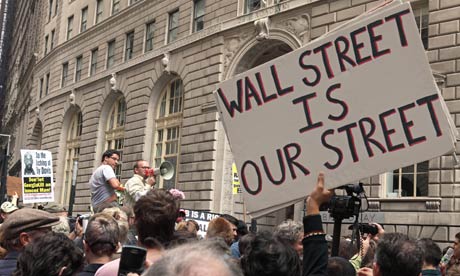
Over 100 NYPD Officers Refuse to Work in Support of Occupy Wall Street Movement

Over 100 NYPD Officers Refuse to Work in Support of Occupy Wall Street Movement

UPDATED Sept. 27, 2011 at 8:29 PM – MSNBC’s Lawrence O’Donnell is siding with the Occupy Wall Street movement and comments about police brutality. Video below.

UPDATED Sept. 28, 2011 at 2:54 am – Celebrities are joining in support of the Occupy Wall Street movement. Details below.

UPDATED Sept 28, 10:26 am – Occupation Together website is helping to organize global occupation protests.

UPDATED Sept. 28, 3:07 pm – NYPD Officer Anthony Bologna’s Second Pepper Spray Assault with Slo-Mo. Internal Affairs are looking into Bologna’s assault.

September 27, 2011 – TAMPA, FL – In a bizarre twist of fate, a growing movement of New York City Police Department officers are banding together with the Occupy Wall Street movement, while the main stream media continues to relatively ignore this escalating event.

The Occupy Wall Street movement issued the following statement on their website:

“Today we received unconfirmed reports that over one hundred blue collar police refused to come into work in solidarity with our movement. These numbers will grow. We are the 99 percent. You will not silence us.”

The news was released shortly after the identity of Deputy Inspector Anthony Bologna was revealed after he allegedly pepper sprayed a deaf woman.


A second video of Officer Bologna has surfaced with yet another pepper spray assault on peaceful protesters. Notice how Officer Bologna weasles himself into the crowd, then scurries away in the hope that he would not be noticed by anyone:

On Wednesday, Police Commissioner Raymond W. Kelly stated that the Internal Affairs Bureau will look into the decision of a high-ranking officer to use pepper spray on a number of female protesters this past Saturday at the Occupy Wall Street demonstration.

 The Occupy Wall Street movement is growing and has expanded to cover other cities, such as Los Angeles, CA and Chicago, IL, with numerous protests scheduled for other cities, such as Sarasota, FL, Washington DC, Lexington, Kentucky and San Francisco, California.

Occupy Washington, D.C. begins on October 6, 2011.

The movement has moved into a global position with the new Occupy Together website, which organizes occupation protests from around the world.

It is with hope and intent that the officers who are using excessive force on peaceful protestors realize that the only ones they are hurting is themselves through the destruction of the Constitution and the right for free speech. As the Occupy Wall Street movement grows, it is hopeful that officers from other cities will join in on the side of humanity and peace.

For news you won’t see on the main stream media, stay tuned to in5d alternative news.

Celebrities have joined forces with the Occupy Wall Street movement, including Noam Chomsky, rap artist Immortal Technique, Michael Moore and actress Susan Sarandon.

In a related story, MSNBC’s Lawrence O’Donnell is siding with the peaceful protesters who have been abused by the New York City Police Department, stating, “This weekend, a few troublemakers turned a peaceful protest against Wall Street greed into a violent burst of chaos. The troublemakers carried pepper spray and guns and were wearing badges… for not doing anything.”


Visit msnbc.com for breaking news, world news, and news about the economy

See also #OccupyWallStreet – What the Cops Are Really Saying Behind Our Backs

Copyright Information: Copyright in5d and Gregg Prescott, M.S.. This content may be freely reproduced in full or in part in digital form with full attribution to the author and a link to www.in5d.com. Please contact us for permission to reproduce this content in other media formats.

Please Google + and Digg this article below to get it the exposure that the main stream media is ignoring by clicking the Digg button and “Digg”. Thanks!


http://www.in5d.com/over-100-nypd-officers-refuse-to-work-in-support-of-occupy-wall-street.html

Occupy Wall Street Demands

The Sovereign People’s Movement, represented nationally through the people occupying the various Liberty Square locations across this great country, have laid out and democratically submitted and are currently voting on the list of following Demands to then be distilled into one Unified Common demand of the people.

First of all. There are no Official Demands of the Occupy Movement.  that being said, multiple factions of the movement have been assembling to discuss and vote on the output and message for the movement.  Below is a LIST OF PROPOSED “DEMANDS FOR THE OCCUPY MOVEMENT” proposed by the website (occupywallstreet.org) which does not entirely represent  the Occupy Wall Street General Assembly.  Below this list is a list of grievance that citizens have provided nationally and have voted on in solidarity of the movement.

Participate in Democracy and Vote on Occupy Wall Street Demands Here to Have Your Voice Heard


*NOTE* Many have been vocal about the demands of the Demands of Occupy Wall Street. From OccupyWallStreet to OccupySF, OccupyDallas and OccupyAustin to OccupyBoston and OccupySeattle. We at Coup Media Group and CoupMedia.Org hear YOU, the 99% We are also of the 99% faction. Some say we need demands, some say it is foolish to have demands of a broken system. This is a key note because it is indeed a realized point. So what do you think? Please voice your oppinion. Whether you are at an Occupy location officially representing the 99% or only able to ‘virtually’ attend, we at CoupMedia.Org believe that it is your right to have your voices heard. So please, SPEAK UP AND BE HEARD. We stand in #SOLIDARITY with all the #Occupy movements.

Vote HERE for All Proposed #Revolution Demands to be included in The Formal Document below.

 Below Is The Original List of Proposed Demands and Voting Links for #Global Revolution

1. Eliminate Corporate Rights as Persons          

Click Here to Vote to Include

Revise the intrepretation of the famous 1886 case where the U.S. Supreme Court supposedly ruled that corporations are “persons” having the same rights as human beings based on the 14th Amendment, which was intended to protect the rights of former slaves. As most lawyers know, the Supreme Court made no such decision. In the case in question – Santa Clara County v. Southern Pacific Railroad Company, the court itself never rules on personhood. A court reporter by the name of J.C. Bancroft Davis (a former railroad president) snuck that “ruling” into the books.

What most people don’t know is that after the above-mentioned 1886 decision, artificial persons were held to have exactly the same legal rights as we natural folk. (Not to mention the clear advantages corporations enjoy: they can be in several places at once, for instance, and at least in theory they’re immortal.) Up until the New Deal, many laws regulating corporations were struck down under the “equal protection” clause of the 14th Amendment–in fact, that clause was invoked far more often on behalf of corporations than former slaves. Although the doctrine of personhood has been weakened since, even now lawyers argue that an attempt to sue a corporation for lying is an unconstitutional infringement on its First Amendment right to free speech. ( Nike v. Kasky.)

Ammendment Dated September 30, 2011 for reasons of consolidation

– Require Corporations to have Labour representatives on their boards of directors.  Has been added to this Demand

Click Here to learn more about Why Corporations have been Granted Human Rights


2. Repeal of the Patriot Act              

Click Here to Vote to Include in Demands


“The right of the people to be secure in their persons, houses, papers, and effects, against unreasonable searches and seizures, shall not be violated, and no Warrants shall issue, but upon probable cause, supported by Oath or affirmation, and particularly describing the place to be searched, and the persons or things to be seized.” — Fourth Amendment to the Constitution

Forty-five days after 9/11, Congress passed the USA PATRIOT Act without reading it. This new law was supposed to protect you from terrorism, but it has really left you unprotected against lawless federal agents. The Patriot Act contains numerous violations of the Fourth Amendment. It gives federal agents vast new powers that have been abused to investigate innocent Americans.

3. Forced Acquisition of the Federal Reserve for $1Billion USD by the US Congress             

Click Here to Vote to Include in Demands

No Congress, no President has been strong enough to stand up to the foreign-controlled Federal Reserve Bank. Yet there is a catch – one that President Kennedy recognized before he was slain – the original deal in 1913 creating the Federal Reserve Bank had a simple backout clause. The investors loaned the United States Government $1 billion. And the backout clause allows the United States to buy out the system for that $1 billion. If the Federal Reserve Bank were demolished and the Congress of the United States took control of the currency, as required in the Constitution, the National Debt would virtually end overnight, and the need for more taxes and even the income tax, itself. Thomas Jefferson was concise in his early warning to the American nation, “If the American people ever allow private banks to control the issuance of their currency, first by inflation and then by deflation, the banks and corporations that will grow up around them will deprive the people of all their property until their children will wake up homeless on the continent their fathers conquered.”

Article I, Section 8, Clause 5, of the United States Constitution provides that Congress shall have the power to coin money and regulate the value thereof and of any foreign coins. But that is not the case. The United States government has no power to issue money, control the flow of money, or to even distribute it – that belongs to a private corporation registered in the State of Delaware – the Federal Reserve Bank.

Recently ammendments to consolidate in this demand

– Outlaw Flash Trading is now included in this Demand

– Provide a real democratic system for US Elections and US Policy is now included in this Demand

Learn More about How Congress has the Right to Take control over the Federal Reserve Here:  How to Gain Control over the Federal Reserve

4. Restructure Campaign Finance Legislation

Click Here to Vote to Include in Demands

Proposal One: Ban corporate donations to political campaigns while limiting individual campaign donations to $100.
Background:Corporations in the U.S. exercise an inordinate amount of influence over the government. The amount of corporate money in elections makes it virtually impossible for people want to serve the public’s interests to be viable candidates. Lowering the individual maximum donation to $100 ensures that the rich won\’t simply buy elections. This demand is offered in order to eliminate the rich’s dominance of elections and subsequent effect on public and foreign policy. America has never had a popular democracy. It began as a country controlled by a handful of white land-owning men. Throughout its history, gains were made in achieving some level of democracy to American citizens. The age of rule by an elite 1% (a tiny minority) can be forced to an end soon.The majority of the American population sees the U.S. as a reasonably fair country and as a popular democracy. This demand challenges that assertion. America is a corporate democracy and it will be eye-opening to many people to witness how undemocratically big business and their political flunkies will fight to deny popular democracy even though those are the values that the elites have professed for so long. This demand forces them to put up or shut up on their fucking principles. The public will support restructuring of campaign finance as the tiny minority has recently collapsed the economy, wasted resources, and destroyed millions of lives in it pursuit of its wars for its own narrow interest. In the past they have been able to point to relatively high wages, a relatively high standard of living, and increasing growth (regardless of the reason) as reasons to uphold the status quo, but these conditions are deteriorating and people are again searching for a remedy. Taking away the tiny majority’s ability to buy every election will usher in popular democracy and with that new policies that may affect all issues and grievances moving forward.</span></p>
more donations to a single person that is seeking or has a position in congress that exceeds $5,000 (five thousand) dollars within the time period of 1 (one) year. And no donations exceeding $25,000 (twenty-five thousand) to a single group, PAC, or super PAC within the time span of 18 (eighteen) months. Also, when a donation is made the persons employer must be listed. And if 25% (twenty-five) of all employees of the stated company donate to the same person or group then the company will stand to be investigated as to whether it is giving its employees the money and</p>

All members of all governments, Federal, state or local, must remain free of influence from outside factors.&nbsp; Lobbyists must remain at arm’s length and not be allowed in any way to provide free meals, trips or gifts of any kind to any politician.&nbsp; All contact must be in written form to prevent influence peddling.


5. Real Health Care Reform Real Health Care Reform         

Click Here to Vote to Include in Demands

Make Healthcare affordable and availablt to all without a “Mandate”.  Nearly all other countries on this planet have a system that works.  Access to adequate health care is a human right not a privelage.  (Accepting additional proposals)


6.  End the War on Drugs          

Click Here to Vote to Include in Demands

The war on drugs has been going on for more than three decades. Today, nearly 500,000 Americans are imprisoned on drug charges. In 1980 the number was 50,000. Last year $40 billion in taxpayer dollars were spent in fighting the war on drugs. As a result of the incarceration obsession, the United States operates the largest prison system on the planet, and the U.S. nonviolent prisoner population is larger than the combined populations of Wyoming and Alaska. Try to imagine the Drug Enforcement Administration erecting razor wire barricades around two states to control crime and you’ll get the picture.

According to the U.S. Dept of Justice, the number of offenders under age 18 imprisoned for drug offenses increased twelvefold from 1985 to 1997. The group most affected by this propensity for incarceration is African-Americans. From 1985 to 1997, the percentage of African-American young people put in prison increased from 53 to 62 percent.

Today, 89 percent of police departments have paramilitary units, and 46 percent have been trained by active duty armed forces. The most common use of paramilitary units is serving drug-related search warrants, which usually involve no-knock entries into private homes.

Because this is a Movement by the People and For the People, We are accepting proposals below in the Comments Section to be added to this formal list of Demands.  Our Legal team will review and formalize those that are selected by a vote of 2/3 majority by the movement.  Please remember you are only voting to include the available Demands into the Formal Demands Document


7. Education Reform 

 Click Here to Vote to Include in Demands

Redraft education financing legislation.  Lower educational expenses for students instead of raising tuition costs.  Pull money form the “WAR” system to refund education and continuing education. Forgive Student Loan Dept or restructure the Student Loan System so that students are not punished for self improvement and made into corporate slaves upon educating themselves.  Standardized testing does not account for stereotype effect or cultural differences in learning styles in elementry schools.  Reform education to make it either free or affordable to all.  Reappropriation of tax to focus on educations subsidies.


Currently Accepting proposals for actual plan


8. National Repeal of Capital Punishment

Click Here to Vote to Include in Demands

Currently Accepting proposals for actual plan


9.  End Gender Discrimination – Equal Pay

Click Here to Vote to Include in Demands

Judge Antone Scailia has stated, and the Supreme Court has reinforced on numerous occasions, that women, by the virtue of the fact that the founding fathers did not specifically use the terms woman, women or female in the Constitution, are not recognized as having the same rights as men.  In a statement last year in Oregon, Judge Scailia specifically addressed this issue and stated that if the founding fathers wanted it, they would have included women in the Constitution.  We want equal rights to men, including equal pay, equal benefits and equal standing under all laws and in all courtrooms where it has been proven in study after study, women are regularly denied their rights.  This does not have to be an issue that requires a Constitutional Amendment, this can and should be ruled on immediately by SCOTUS and deemed to be the law of the land which may not be revoked or overturned by order of the court.  Further, there must be an Amendment to the Constitution insuring these rights and all states must also include these rights in state constitutions.  This is to include equal rights regarding domestic partnership for Homosexual, gar or transgender individuals.

10.  Office of the Citizen

Click Here to Vote to Include in Demands

Who will Guard The Guardians –  Corruption begins at the local level.  The FBI and the DOJ refuse to investigate matters of local corruption when it is their sworn duty of the Federal government.  State and local governments work hand in hand thwarting any investigations of corruption, and do not investigate.  Courts must be investigated for the evidence of local corruption, including drug dealing, protection of criminals, etc. It has been shown that 60% of police readily falsify police reports at the behest of higher ups. Repeated calls, filings in writing, and personal visits produce no investigation, even when evidence is given to them.  Where there have been investigations, it almost always produces a guilty verdict, but those investigations are few and far between and usually limited to situations where those peddling their influence did not share with others in slush funds.  Most of the time it is the public who gathers the evidence leading to prosecution, not the FBI or DOJ.  We want complete investigations of all allegations of corruption, including those allegations at local and state level.  No citizen should be placed in the dangerous situation of having to investigate crimes and collect evidence.  That is the job of the government and one it does not do.  The office of the citizen must be fully funded before funds may be allocated for any department supporting  war, engaging in war or spying, either internally or externally.

11.  The United States Must Comply With International Human Rights Law

Click Here to Vote to Include in Demands

U.S. Ratification of the Rome Statute and Membership in the International Criminal Court. Restructuring the Judicial System.  Human rights should be the right of everyone, inside and outside our borders.  When the US knowingly engages in, or allows others to engage in torture, that is a violation of everyone’s human rights, not just the target.  We want prosecutions for torture, not only of government officials, but those who commit this heinous crime on others within the US.   This would also include bringing all current troops back from over seas where they are fighting wars for corporate profits and interests that the citizens of the United States have not voted to be involved in.

12.  Rights of victims must take precedent in courts.

Click Here to Vote to Include in Demands

Courts in the US not only allow, but expect that human rights will be violated in certain types of cases.  Mental torture is the tool of many sleazy attorneys who intimidate both victims and witnesses. This must end now and the rights of the victim upheld.   We want all Bar Associations investigated and the hold they have on judicial nominees removed.  All judges should hold bench for limited terms and must be subject to ongoing judicial review and all hearings involving judicial reviews must be held in public to insure that human rights as well as Constitutional rights have not violated.  Judicial immunity must be removed, or at best, limited.  Victim blaming  must be limited and strictly investigated before it can be used as a defense.  Rape kits must be provided at no cost to victims claiming rape and any police officer who does not photograph all crime scenes shall be deemed incompetent to act as an officer of the law and shall be removed from duty without possibility of reinstatement in any police department in the country.  Falsified police reports shall also result in immediate removal and barring from any future law enforcement position.  All court rooms must insure that all proceedings are videotaped and that video tapes of all proceedings are given to all plaintiffs, their attorneys, all defendants and their attorneys within at the end of each hearing and without delay and prior to leaving the courtroom.  Videotapes of the judges, to include their desk tops and computer screens, must also be made available.
5.Restitution for previous wrongdoing by courts and police.
Restitution by the US government of property of victims of violence seized by the courts must be made at 100% of value on the date victimization first occurred plus a fine of not less than `100% of that value be imposed on both the court ordering the property removal and the person who benefited from that removal.  All courts must furnish the cases and this restitution is retroactive for the lifetime of the court.  Courts are given no more than 5 business days to produce all files.   Any file not produced or shown to have been tampered with will result in immediate removal from office or employment of any person who had direct contact with that file.

13.  Prosecutions of the guilty

Click Here to Vote to Include in Demands

We want indictments and prosecutions of all crimes committed by banks, brokerage firms and insurance companies.  We want a clear message sent to the entire financial industry, this will no longer be tolerated.  All financial industry executives who had even the remotest of connection to the collapse of our system, must be prosecuted.
Those who are or have been involved in torture, whithersoever dispersed around the globe, weather personally or directing it’s use,  must be prosecuted for their crimes.
Provide incentives for local farming instead of incentives that benefit corporate seed and food produces.
Tax corporations based on “true cost” of international trade forcing them to account for the impact of abuse of absolute and comparative advantages.  This would include the dependency on foreign oil and the enviro-economic cost of  comparative advantage and international trade.
Hold  corporations that take operations overseas accountable for their actions there. If there is a U.S. law that they are violating overseas (e.g. human rights, or environmental regulations), either shut them down or fine them very very heavily.   We must set an example for the rest of the world.
Revoke Patents issued on “life” Do not permit the future patenting of l”life”
(open to additional statements)

15. Repeal Rex84 and H.R. 645 and the procedures to establish Martial Law in the Country

Click Here to Vote to Include

The mechanism for declaring martial law could be quickly implemented and carried out under REX.  The Cheney/Bush administration has a plan which would accommodate the detention of large numbers of American citizens during times of emergency. The plan is called REX 84, short for Readiness Exercise 1984. Through Rex-84 an undisclosed number of concentration camps were set in operation throughout the United States, for internment of dissidents and others potentially harmful to the state.  The Rex 84 Program was originally established on the reasoning that if a “mass exodus” of illegal aliens crossed the Mexican/US border, they would be quickly rounded up and detained in detention centers by FEMA.  Existence of the Rex 84 plan was first revealed during the Iran-Contra Hearings in 1987, and subsequently reported by the Miami Herald on July 5, 1987” These camps are to be operated by FEMA should martial law need to be implemented in the United States and all it would take is a presidential signature on a proclamation and the attorney general’s signature on a warrant to which a list of names is attached.

Note: This demand is in the development process and has had this link placed here so that it might have opportunity to meet Quorum

16.Create a Board of Officers to Manage the Demands

Click Here to Vote to Include

Create a board of officials to monitor the importance of all demands, with experts who are knowledgeable on the proposed policies and necessary amendments.

Note: This demand is in the development process and has had this link placed here so that it might have opportunity to meet Quorum

17.  Re-investigate The  Attacks of September 11th 2001 with full media coverage and disclosure

Click Here to Vote to Include

More and more evidence is being released to the public surrounding the suspicious circumstances surrounding 911. This measure would be included in the list of demands to show that the original investigation was significantly flawed.  Demand investigation into the source of secret funding for CIA occupation programs since WWII, the cover up of the trillions of dollars that aided in the collapse of the Soviet Union and may have ultimately instigated the 911 attacks as well as their cover-up.

Read more on this here

Voting Access to all Demands For Inclusion Into the Formal Document may be done HERE.


LIST OF PROPOSED “DEMANDS FOR CONGRESS


Re investigate the attacks of 911 2001:  according to the Coup Media Poll, over 60,000 people have voted to include the re-investigation of the Septemeber 11th attacks as the number one initiave of the occupy movement.  Althought these votes are not represented by the general assemblies, this demand has become the most popular demand by a significant vote amount that should be considered. Because of overwhelming volume of votes to include, Coup Media is now including this into the official list of Occupy Demands.   Democracy Says…Vote Here for the Re investigation of 911


    1. CONGRESS PASS HR 1489 (“RETURN TO PRUDENT BANKING ACT” http://www.govtrack.us/congress/bill.xpd?bill=h112-1489 ). THIS REINSTATES MANY PROVISIONS OF THE GLASS-STEAGALL ACT. http://en.wikipedia.org/wiki/Glass–Steagall_Act — Wiki entry summary: The repeal of provisions of the Glass–Steagall Act of 1933 by the Gramm–Leach–Bliley Act in 1999 effectively removed the separation that previously existed between investment banking which issued securities and commercial banks which accepted deposits. The deregulation also removed conflict of interest prohibitions between investment bankers serving as officers of commercial banks. Most economists believe this repeal directly contributed to the severity of the Financial crisis of 2007–2011 by allowing Wall Street investment banking firms to gamble with their depositors’ money that was held in commercial banks owned or created by the investment firms. Here’s detail on repeal in 1999 and how it happened: http://en.wikipedia.org/wiki/Glass–Steagall_Act#Repeal .
    1. USE CONGRESSIONAL AUTHORITY AND OVERSIGHT TO ENSURE APPROPRIATE FEDERAL AGENCIES FULLY INVESTIGATE AND PROSECUTE THE WALL STREET CRIMINALS who clearly broke the law and helped cause the 2008 financial crisis in the following notable cases: (insert list of the most clear cut criminal actions). There is a pretty broad consensus that there is a clear group of people who got away with millions / billions illegally and haven’t been brought to justice. Boy would this be long overdue and cathartic for millions of Americans. It would also be a shot across the bow for the financial industry. If you watch the solidly researched and awared winning documentary film “Inside Job” that was narrated by Matt Damon (pretty brave Matt!) and do other research, it wouldn’t take long to develop the list.
    2. CONGRESS ENACT LEGISLATION TO PROTECT OUR DEMOCRACY BY REVERSING THE EFFECTS OF THE CITIZENS UNITED SUPREME COURT DECISION which essentially said corporations can spend as much as they want on elections. The result is that corporations can pretty much buy elections. Corporations should be highly limited in ability to contribute to political campaigns no matter what the election and no matter what the form of media. This legislation should also RE-ESTABLISH THE PUBLIC AIRWAVES IN THE U.S. SO THAT POLITICAL CANDIDATES ARE GIVEN EQUAL TIME FOR FREE AT REASONABLE INTERVALS IN DAILY PROGRAMMING DURING CAMPAIGN SEASON. The same should extend to other media.
    3. CONGRESS PASS THE BUFFETT RULE ON FAIR TAXATION SO THE RICH AND CORPORATIONS PAY THEIR FAIR SHARE & CLOSE CORPORATE TAX LOOP HOLES AND ENACT A PROHIBITION ON HIDING FUNDS OFF SHORE. No more GE paying zero or negative taxes. Pass the Buffet Rule on fair taxation so the rich pay their fair share. (If we have a really had a good negotiating position and have the place surrounded, we could actually dial up taxes on millionaires, billionaires and corporations even higher…back to what they once were in the 50’s and 60’s.
    4. CONGRESS COMPLETELY REVAMP THE SECURITIES AND EXCHANGE COMMISSION and staff it at all levels with proven professionals who get the job done protecting the integrity of the marketplace so citizens and investors are both protected. This agency needs a large staff and needs to be well-funded. It’s currently has a joke of a budget and is run by Wall St. insiders who often leave for high ticket cushy jobs with the corporations they were just regulating. Hmmm.
    5. CONGRESS PASS SPECIFIC AND EFFECTIVE LAWS LIMITING THE INFLUENCE OF LOBBYISTS AND ELIMINATING THE PRACTICE OF LOBBYISTS WRITING LEGISLATION THAT ENDS UP ON THE FLOOR OF CONGRESS.
    6. CONGRESS PASSING “Revolving Door Legislation” LEGISLATION ELIMINATING THE ABILITY OF FORMER GOVERNMENT REGULATORS GOING TO WORK FOR CORPORATIONS THAT THEY ONCE REGULATED. So, you don’t get to work at the FDA for five years playing softball with Pfizer and then go to work for Pfizer making $195,000 a year. While they’re at it, Congress should pass specific and effective laws to enforce strict judicial standards of conduct in matters concerning conflicts of interest. So long as judges are culled from the ranks of corporate attorneys the 1% will retain control.
    7. ELIMINATE “PERSONHOOD” LEGAL STATUS FOR CORPORATIONS. The film “The Corporation” has a great section on how corporations won “personhood status”. http://www.youtube.com/watch?v=8SuUzmqBewg . Fast-forward to 2:20. It’ll blow your mind. The 14th amendment was supposed to give equal rights to African Americans. It said you “can’t deprive a person of life, liberty or property without due process of law”. Corporation lawyers wanted corporations to have more power so they basically said “corporations are people.” Amazingly, between 1890 and 1910 there were 307 cases brought before the court under the 14th amendment. 288 of these brought by corporations and only 19 by African Americans. 600,000 people were killed to get rights for people and then judges applied those rights to capital and property while stripping them from people. It’s time to set this straight. 

To Vote on All #Revolution / Occupy Wall Street Demands – Click Here


(Please click on this link if you haven’t yet read the introduction called “OUR TURN”: https://occupywallst.org/forum/our-turn/ . Feel free to share this link with anyone you like).

TACTICS FOR “DEMANDS FOR CONGRESS” by Occupy Wall Street

We should make the demands below very publicly at a press conference a few days after arriving in DC. When doing so, we should give a clear deadline of 3 days for a firm written commitment with signatures from at least 60% of members of House and 60% of the members of the Senate to pass these bills by the end of the year. If this commitment on the full slate of demands is not met by midnight on the 3rd day (which it won’t be) we should be prepared to non-violently block access to all or part of the Capitol complex the next morning by traditional proven non-violent tactics. The purpose is to bring the leaders of the House and Senate to the negotiating table.

NOTE: There are always entrances because there is always a point where people who work there have to leave the public street and enter secure space. We should focus our non-violent direct action and civil disobedience on those entrances no matter where they move them because these are, by definition, always accessible.

Special Note!!!  Read this before you comment or vote of comment!

This document is a living breathing document updated daily but solely based on the votes for the items included within it.

This is how it works:  After reading the list of publised proposals, if you have a point that is not already proposed that you would like added, simply submit it in the comments section at the bottom.  The Suggestions are added to the ballot found Here so that they can be voted on by the people. This may take up to 72 hours for our legal team to dedupe and combine to exixting demands due to overlapping proposals.

Proposals remain on this official page as long as the vote maintains a 2/3 majority.

You may vote once per IP address and view the current results Here  Proxying IP addresses in attempt will not work, so do not attempt it.

If you disagree with any of the items below, or think they should not be included please click Here to voice your vote and lobby among your friends and contacts to drop the majority below 2/3 majority. Do not add it in the comments section.


Please! Please! Please!    Do not respond or comment to proposed or active demands or on the voting process here, it complicates our legal teams work.

Please submit your proposal as a well thought out proposal that all can understand, this will help it resonate with the audience and meet the minimum quorum for inclusion.

Do not voice opinions here. Opinions do not help our cause.

The numbers in the polling will naturally resolve your feelings democratically.  If you strongly agree or disagree with proposed Demands,  lobby your cause and get the votes up to represent your opinion.  This is what democracy looks like.


After the Closing date, (shown on each Poll Item) and voting has officially closed, the remaining options will be consolidated into one poll on which the people will vote for the 1 ONE Common Demand.


It is also very important that you familiarize yourself with the historical events that have created our present situation, you should read this in its entirety:

September 11th 2001 Cover-Up Leaked – This information was provided to us directly to Coup Media Group by a sympathetic  former US Ambassador to Ronald Regan.


This is a one vote one person Democratic movement. If you do not agree, lobby your case to other likeminded individuals to get the vote.  Eventually the top demands may be split out among the various occupy groups so that different cities may represent additional important common demands.


There is no electoral college. There is no political authority.  There is no ultimatum.  There is no compromise,  There is only;  We the Free people of the world demand the following:


Legal evaluation in reviewing and formalizing this document is provided pro-bono by law-international.orglaw-international.org


Declaration of the Occupation of New York City
As we gather together in solidarity to express a feeling of mass injustice, we must not
lose sight of what brought us together.  We write so that all people who feel wronged by
the corporate forces of the world can know that we are your allies.

As one people, formerly divided by the color of our skin, gender, sexual orientation,

religion, or lack thereof, political party and cultural background, we acknowledge
the reality: that there is only one race, the human race, and our survival requires the
cooperation of its members; that our system must protect our rights, and upon corruption
of that system, it is up to the individuals to protect their own rights, and those of their
brethren; that a democratic government derives its just power from the people, but
corporations do not seek consent to extract wealth from the people and the Earth; and that
no true democracy is attainable when the process is determined by economic power.

We come to you at a time when corporations, which place profit over people, self-interest
over justice, and oppression over equality, run our governments. We have peaceably
assembled here, as is our right, to let these facts be known.
They have taken our houses through an illegal foreclosure process, despite not having the
original mortgage.
They have taken bailouts from taxpayers with impunity, and continue to give CEO’s
exorbitant bonuses.
They have perpetuated gender inequality and discrimination in the workplace.
They have poisoned the food supply, and undermined the farming system through
monopolization.
They have continuously sought to end the rights of workers to negotiate their pay and
make complaints about the safety of their workplace.
They have held students hostage with tens of thousands of dollars of debt on education,
which is itself a human right.
They have consistently outsourced labor and used that outsourcing as leverage to cut
workers’ healthcare and pay.
They have influenced the courts to achieve the same rights as people, with none of the
culpability or responsibility.
They have spent millions of dollars on legal teams that look for ways to get them out of
contracts in regards to health insurance.
They have sold our privacy as a commodity.
They have used the military and police force to prevent freedom of the press.
They have deliberately declined to recall faulty products endangering lives in pursuit of
profit.
They determine economic policy, despite the catastrophic failures their policies have
produced and continue to produce.
They have donated large sums of money to politicians supposed to be regulating them.
They continue to block alternate forms of energy to keep us dependent on oil.
They continue to block generic forms of medicine that could save people’s lives in order
to protect investments that have already turned a substantive profit.
They have purposely covered up oil spills, accidents, faulty book keeping, and inactive
ingredients in pursuit of profit.
They purposefully keep people misinformed and fearful through their control of the
media.
They have perpetuated colonialism at home and abroad.
They have participated in the torture and murder of innocent civilians overseas.
They continue to create weapons of mass destruction in order to receive government
contracts.
They have participated in a directly racist action by accepting the contract from the State
of Georgia to murder Troy Davis.

To the people of the world,
We, the New York City General Assembly occupying Wall Street in Liberty Square, urge
you to assert your power.
Exercise your right to peaceably assemble; occupy public space; create a process to
address the problems we face, and generate solutions accessible to everyone.
To all communities that take action and form groups in the spirit of direct democracy, we
offer support, documentation, and all of the resources at our disposal.
Join us and make your voices heard!

A Message From Occupied Wall Street (Day Five)
Published 2011-09-22 07:51:42 UTC by OccupyWallSt
at OccupyWallStreet.org

This is the fifth communiqué from the 99 percent. We are occupying Wall Street.

On September 21st, 2011, Troy Davis, an innocent man, was murdered by the state of Georgia. Troy Davis was one of the 99 percent.

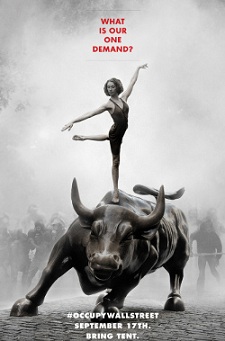
Ending capital punishment is our one demand.

On September 21st, 2011, four of our members were arrested on baseless charges.

Ending police intimidation is our one demand.

On September 21st, 2011, the richest 400 Americans owned more than half of the country’s population.

Ending wealth inequality is our one demand.

On September 21st, 2011, we determined that Yahoo lied about occupywallst.org being in spam filters.

Ending corporate censorship is our one demand.

On September 21st, 2011, roughly eighty percent of Americans thought the country was on the wrong track.

Ending the modern gilded age is our one demand.

On September 21st, 2011, roughly 15% of Americans approved of the job Congress was doing.

Ending political corruption is our one demand.

On September 21st, 2011, roughly one sixth of Americans did not have work.

Ending joblessness is our one demand.

On September 21st, 2011, roughly one sixth of America lived in poverty.

Ending poverty is our one demand.

On September 21st, 2011, roughly fifty million Americans were without health insurance.

Ending health-profiteering is our one demand.

On September 21st, 2011, America had military bases in around one hundred and thirty out of one hundred and sixty-five countries.

Ending American imperialism is our one demand.

On September 21st, 2011, America was at war with the world.

Ending war is our one demand.

On September 21st, 2011, we stood in solidarity with Madrid, San Francisco, Los Angeles, Madison, Toronto, London, Athens, Sydney, Stuttgart, Tokyo, Milan, Amsterdam, Algiers, Tel Aviv, Portland and Chicago. Soon we will stand with Phoenix, Montreal, Cleveland and Atlanta. We’re still here. We are growing. We intend to stay until we see movements toward real change in our country and the world.

You have fought all the wars. You have worked for all the bosses. You have wandered over all the countries. Have you harvested the fruits of your labors, the price of your victories? Does the past comfort you? Does the present smile on you? Does the future promise you anything? Have you found a piece of land where you can live like a human being and die like a human being? On these questions, on this argument, and on this theme, the struggle for existence, the people will speak. Join us.

We speak as one. All of our decisions, from our choice to march on Wall Street to our decision to continue occupying Liberty Square, were decided through a consensus based process by the group, for the group.


“I pledge that if any U.S. troops, contractors, or mercenaries remain in Afghanistan on Thursday, October 6, 2011, as that occupation goes into its 11th year, I will commit to being in Freedom Plaza in Washington, D.C., with others on that day or the days immediately following, for as long as I can, with the intention of making it our Tahrir Square, Cairo, our Madison, Wisconsin, where we will NONVIOLENTLY resist the corporate machine by occupying Freedom Plaza to demand that America’s resources be invested in human needs and environmental protection instead of war and exploitation. We can do this together. We will be the beginning.”


http://coupmedia.org/occupywallstreet/occupy-wall-street-official-demands-2009

Largest Banks Likely Profited By Borrowing From Federal Reserve, Lending To Federal Government

Largest Banks Likely Profited By Borrowing From Federal Reserve, Lending To Federal Government

Largest Banks Likely Profited By Borrowing From Federal Reserve, Lending To Federal Government
Get Business Alerts

A newly-released study from the Congressional Research Service bolsters claims that the nation’s largest banks profited off the Federal Reserve’s financial crisis-era programs by borrowing cash for next to nothing, then lending it back to the federal government at substantially higher rates.

The report reinforces long-held beliefs that the banking system in essence engaged in taxpayer-financed arbitrage: They got money for free, then lent it back to Uncle Sam while collecting juicy returns. Left out of the equation are the millions of everyday borrowers, like households and small businesses, who were unable to secure loans needed to tide them over until the crisis ended.

The Fed released records under pressure in December and March that showed the extent of its largesse. The CRS study shows for the first time how some of the most sophisticated financial firms could have taken the Fed’s money and flipped easy profits simply by lending it back to another arm of the government.

The report was requested by Sen. Bernie Sanders (I-Vt.), who likened the crisis-era emergency loans to “direct corporate welfare to big banks,” in a statement. The cash likely was lent back to Uncle Sam in the form of Treasuries and other debt “instead of using the Fed loans to reinvest in the economy,” Sanders added.

In all, more than $3 trillion was lent to financial institutions from the Fed, and terms were generous. Junk-rated securities were pledged as collateral for taxpayer-backed loans. The Fed did not provide conditions for how the money was to be used.

As part of one Fed program, on 33 separate occasions, nine firms were able to borrow between $5.2 billion and $6.2 billion in U.S. government securities for four-week intervals, paying one-time fees that amounted to the minuscule rate of 0.0078 percent.

In another, financial firms pledged more than $1.3 trillion in junk-rated securities to the Fed for cheap overnight loans. The rates were as low as 0.5 percent.

During one three-month period in 2009, Bank of America borrowed more than $48 billion at rates ranging from 0.25 to 0.5 percent. Meanwhile, the largest U.S. lender tripled its holdings of Treasuries and other taxpayer-backed debt to about $15 billion — securities that yielded 3.5 percent.

During the third quarter of 2009, the bank borrowed $2.9 billion from the Fed through a program that charged 0.25 percent interest. In that same period, Bank of America increased its holdings of taxpayer-backed federal debt by $12 billion, according to the Congressional Research Service. Those securities yielded an average of 3.2 percent.

“Bank of America provided vital support to the economy throughout the financial crisis and we continue to support businesses and individuals today through our lending and capital raising activities,” spokesman Jerry Dubrowski said in an email.

In another period, JPMorgan Chase, the second-largest bank, swelled its holdings of taxpayer-backed federal debt by $20 billion, which yielded 2.1 percent, while at the same time borrowing $29 billion from the Fed at a rate of 0.3 percent.

JPMorgan did not respond to a request for comment.

In contrast, during the first year of the Obama administration, small businesses shuttered due to lackluster sales and a lack of credit, foreclosures surged, and credit contracted at one of the quickest rates on record.

“Why wasn’t the Fed providing these same sweetheart deals to the American people?” asked Warren Gunnels, senior policy adviser to Sanders. “The Fed was practicing socialism for the rich, powerful and the connected, while the federal government was promoting rugged individualism to everyone else.”

At the time, Fed officials said its bailout programs were necessary to restart the flow of credit. If money couldn’t flow to lenders, households and businesses would be next. Even more layoffs and foreclosures could have ensued, officials argued.

Lending, however, decreased, according to Fed and Federal Deposit Insurance Corporation data. Mortgage rates dropped, but mortgages were harder to come by. Credit card lines were slashed. Loans were called in. New financing plunged. In 2009, outstanding credit to U.S. households declined by $234.5 billion. For non-corporate businesses, credit plunged $296.1 billion, Fed data show.

Sanders said the spread between firms’ borrowing rates and their lending rates to Uncle Sam amounted to “free money.” For Bank of America during the third quarter of 2009, the spread was nearly 3 percent.

Dubrowski countered by pointing out that Bank of America “extended $184 billion in credit to individuals and businesses” during that time.

The author of the CRS report, Marc Labonte, cautioned that “correlation does not prove causation.”

“There is no information available on how banks used specific funds borrowed from the Federal Reserve,” he wrote.

The Federal Reserve declined to comment.

http://www.huffingtonpost.com/2011/04/26/fed-lending-helped-wall-street_n_853884.html

J.P. Morgan’s hunt for Afghan gold

J.P. Morgan’s hunt for Afghan gold

A team of bankers starts to tap the country’s vast mineral riches, with help from the Pentagon.

By James Bandler, editor-at-large

Villagers assembled for a ribbon-cutting ceremony at the gold mine in Qara Zaghan. The U.S. government estimates that minerals worth nearly $1 trillion lie beneath Afghanistan’s soil.

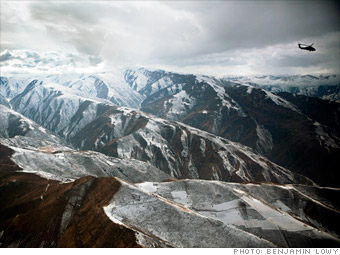
FORTUNE — Qara Zaghan, Afghanistan: The four Black Hawk helicopters sweep down on this remote river valley, flying fast and single file. Snow covers the mountains’ peaks, but the lower slopes look like rust — dry, rocky, and bare. As we bank around the river bend, we see our first flash of green in the fields below and then the rectangular mud huts of the village, where hundreds of Afghans mass to greet us.

“That’s the mine over there,” one of my companions says, pointing to the cliffs rising above the village.

That’s it? That’s the gold mine? It doesn’t look all that different from the forbidding country we’ve been traversing: just another pile of rocks and scree. The jet-lagged man in the seat across from me knows better. His sleepy eyes are suddenly alert. If anyone can wrest a fortune from Afghanistan’s rubble, it is this man, Ian Hannam.

Arriving in a developing nation with his iPad and his enigmatic smile, Hannam personifies the soft side of Western power. He doesn’t bend people to his will with weapons or threats. But there is no mistaking the dealmaker’s impact: In his wake, mountains are razed, villages electrified, schools built, and fortunes made.

To Hannam, chairman of J.P. Morgan Capital Markets, Afghanistan represents a gigantic, untapped opportunity — one of the last great natural-resource frontiers. Landlocked and pinioned by imperial invaders, Afghanistan has been cursed by its geography for thousands of years. Now, for the first time, Hannam believes, that geography could be an asset. The two most resource-starved nations on the planet, China and India, sit next door to Afghanistan, where, according to Pentagon estimates, minerals worth nearly $1 trillion lie buried. True, there is a war under way. And it’s unclear how the death of Osama bin Laden will impact the country’s political and economic environment. But Hannam is not your usual investment banker: A former soldier, he has done business in plenty of strife-torn countries. So have all the members of his team, two of them former special forces soldiers who have fought here.

Attending the ribbon cutting were (from left) mine owner Sadat Naderi; Mining Minister Wahidullah Shahrani; J.P. Morgan’s Ian Hannam; and (behind Hannam) investor Pairoj Piempongsant.

As he flies to the mine for the ribbon-cutting ceremony, Hannam thinks back over the past 12 months. This little mine, where operations have yet to commence, is puny by J.P. Morgan’s (JPM) standards, but he knows it might be the project for which he is remembered. A lot of powerful people, including the commander of U.S. forces in Afghanistan, Gen. David Petraeus, are counting on him to demonstrate that the country is safe for foreign investors. Hannam has chafed at times under the pressure from the Pentagon, and the cold-eyed realist in him wonders whether unrealistic expectations are being placed on this business venture.

Hannam ducks his head and climbs out of the chopper, necktie flapping in the prop wash. As he trudges up the hill, even the jaded, 55-year-old banker seems swept away by the pageantry of the moment: the village elder in a ceremonial robe, the silhouettes of women watching from the ridges, the saluting Afghan soldier. Hannam is enveloped in a crush of local tribesmen chattering excitedly in Dari. One of them puts a garland around his neck. Another hands him a Ziploc bag containing a chunk of Afghan gold. A mullah utters prayers. Afghanistan’s minister of mining gives a long speech.

Hannam and his local partner, Sadat Naderi, walk up the hill to pose for photographs. Naderi points to a narrow band of quartz that runs in an east-west line across the cliff side. It shimmers in the sun. That is the treasure, he says.

“Unless,” Hannam mutters, “it’s fool’s gold.”

Absurd risks vs. amazing rewards

Investing in conflict zones is often thrilling, but the great commodities rush that J.P. Morgan and the Pentagon are trying to spark in Afghanistan creates a risk/reward equation of a different magnitude. It’s extreme at both ends.

When J.P. Morgan launched its Afghan initiative in 2010, violence was at its worst since the American-led occupation began in 2001. The Taliban have made a point of killing Westerners and have specifically said they would attack any companies involved in mining. Before our trip to the mine was done, our group would get a taste of the insurgents’ ability to strike violently and unpredictably.

Then there’s the Afghan infrastructure — or rather, there isn’t. Big mines need power, lots of it. Outside of cities, only 15% of Afghanistan is electrified. The mountain roads — ungraded and often without guardrails — are perilous, I learned the hard way, particularly in winter. Seat belts? No one bothers. You crash, you die.

If the brutal war and roads don’t give a businessperson pause, the country’s governance and corruption problems should. Massive fraud marred recent elections. Transparency International rates Afghanistan as the second most corrupt country on earth after Somalia. The last minister of mining was identified in a Washington Post report as the recipient of a massive bribe, an allegation he denied to Fortune. The current minister, who had been widely described as an honest reformer, has recently had his integrity questioned in State Department cables released by WikiLeaks. He, too, told Fortune he has done nothing improper.

But if the risks are absurd, the potential rewards are off the charts. Hundreds of billions of dollars’ worth of iron, copper, rare earth metals, and, yes, gold are buried beneath Afghanistan’s deserts and mountains. This wealth has lain there mainly undisturbed for thousands of years as armies of Persians, Greeks, Mongols, Britons, Russians, and now Americans tramped above. Invaders have dreamed of exploiting it since the time of Alexander the Great, but no one has yet succeeded on a large scale.

A Chinese company is trying to start a copper operation in strife-torn Logar province, but actual mining is years away.

In an 1841 article in a journal of Asiatic studies, Capt. Henry Drummond, a member of the British 3rd Bengal Light Cavalry, described his rambles through the wildest parts of Afghanistan to conduct the first Western mineral survey of the country. He found “abundant green stains” of copper, some of which rivaled the deposits of Chile, and veins of iron ore that “might no doubt be obtained equal to the Swedish.” While many of his countrymen viewed Afghanistan as an untamable place, where a man could not stray many yards from his home or tent without risk of being murdered, Drummond was smitten. Mining, he felt — not the gun — offered the best hope to pacify the territory and win over Afghans.

“Give them, however, but constant employment, with good wages and regular payment; encourage a spirit of industry, both by precept and example; let strict justice be dealt out to them without respect of persons; and we shall shortly see their swords changed into plowshares, industry take place of licentiousness, and these people be converted into peaceable and useful subjects,” Drummond wrote. But the Afghans weren’t keen on the idea of handing over their minerals to occupiers, or on the British occupation itself, for that matter. A year later they massacred the entire British army, save one English survivor, at Gandamak.

During the Cold War, both Soviet and U.S. geologists conducted surveys. The Russians bored thousands of test holes and identified big deposits of copper, zinc, mercury, tin, fluorite, potash, talc, asbestos, and magnesium. But instability in the countryside put an end to serious mining exploration.

After the toppling of the Taliban by the U.S.-led coalition, the Afghan government, with financial assistance from the U.S. Agency for International Development, commissioned new, high-tech aerial surveys of Afghanistan. The results were stunning: The U.S. Geological Survey identified huge veins of copper, iron, lithium, gold, and silver. The Afghan government solicited bids for one of the biggest of the copper deposits, a site south of Kabul that had been identified by both Drummond and the Soviets. China, offering a rich price, won the bid in 2007, beating out four other mining companies. But the Chinese mining company has yet to extract any copper from the site because of delays clearing land mines from the area, and the discovery of archeological relics.

Then, in 2009, mining in Afghanistan got the push it needed — from the U.S. military. Petraeus had been appointed commander of U.S. Central Command, which had ultimate authority over Afghanistan. He realized that a U.S. exit from Afghanistan depended on getting the country’s economy running. Up to 60% of Afghanistan’s $15 billion GDP comes from foreign aid, according to Pentagon estimates, and another 20% comes from the illicit drug trade — poppies. What Afghanistan needed was the real hope that it might achieve economic sovereignty. “I’m an old economist,” the general says in an interview at his headquarters in Kabul. “And at the end of the day this is about progress for the [Afghan] people and giving them the prospect for a much brighter future for them and their families. That’s what persuades the citizenry to support the government rather than support the Taliban.”

Realizing that conventional foreign-aid organizations weren’t getting the job done, Petraeus moved a crack economic stabilization team from Iraq into Afghanistan. That team quickly realized that mining would be key.

Enter Ian Hannam.

“This is the time in Afghanistan for the adventure venture capitalists — for those who can do business in tough places in the world,” Petraeus says.

From special forces to making billionaires

Villagers at Qara Zaghan hope mining will bring jobs, electricity, schools, and a health clinic.

Ian Charles Hannam seemed bound for a swashbuckling career at an early age. Raised in a working-class neighborhood in South London, the son of a council worker who oversaw a housing and street-repair crew, Hannam grew up knowing that nothing would ever be handed to him. He joined the Territorial Special Air Service at age 17, one of the younger men to pass the service’s grueling selection process.

Hannam’s unit, the Artists Rifles, was a part-time regiment akin to a U.S. National Guard special forces unit. The Artists Rifles had a storied past and a reputation for attracting adventure seekers from all social classes. Since then, Hannam has counted his old SAS cronies as his closest friends, often calling on them to help him in the world’s tougher places.

While serving in the Artists Rifles, Hannam pursued a degree in civil engineering from England’s top school in that field, Imperial College. Upon graduation in 1977, he took a job with Taylor Woodrow, a large British construction firm. His first assignment was to build roads, radar stations, and airstrips in Oman for the SAS, which was in the final stages of crushing a Marxist-led insurgency that had been boiling in the Dhofar region for more than a decade. The experience convinced Hannam that revolts could be beaten with a counterinsurgency program that emphasized developing a country’s infrastructure and natural resources.

Still working for Taylor Woodrow, Hannam went to Nigeria and then back to Oman. Living in a tent, he could not help noticing how well oil-company executives lived. That’s when he decided to go to business school and become rich.

After graduating from the London Business School, Hannam got a job in 1984 in the training program at Salomon Brothers in New York. At the airport on his way home to London for Christmas that year, he was detained by immigration officials because he had no U.S. entry stamp on his passport. The reason: He had parachuted into the U.S. with an SAS unit that was training with American special forces, and then traveled to New York to start the training program.

With a work ethic that former colleagues describe as ferocious and an engineer’s taste for understanding complex financial mechanisms, Hannam was fast-tracked to the bank’s vaunted debt syndicate desk. “His embrace of complexity and change, his indifference to organizational hierarchy and abundant self-confidence born of experience set him apart,” recalls Terry Fitzgerald, founder of Longbow Capital Partners, who was at Salomon with Hannam.

When Salomon was hired to advise media baron Robert Maxwell’s Mirror Group during its public offering, Hannam was one of Salomon’s lead bankers charged with marketing the IPO. Salomon lost money on the deal. Months later Maxwell died and Mirror Group collapsed amid investigations into accounting fraud and raids on its pension fund.

Hannam left Salomon soon after the fiasco and was hired by merchant bank Robert Fleming, a Scottish firm founded by the grandfather of James Bond creator Ian Fleming. By 2000, Hannam was the highest-paid employee at Fleming, making more than the CEO. After the bank was acquired by J.P. Morgan, much of Fleming’s staff was laid off. Not Hannam. He helped engineer a joint venture with, and eventual takeover of, venerated British banking house Cazenove.

Among the old guard at Cazenove — which was subsumed by J.P. Morgan, though the British franchise still bears its name — Hannam was regarded as a bit of a barbarian. He bragged about his wealth. He had appalling table manners. “I’ve got more degrees than I can count, but I still talk like I’m illiterate, and my colleagues hate me for it,” he’d say.

From Congo to Colombia, from Iraq to Sierra Leone, Hannam and his small team of soldiers-turned-bankers and advisers did business with oligarchs, gem dealers, and former mercenaries. He could be bracingly direct. When he landed in Baghdad for a meeting with Iraq’s oil minister, the minister asked, “What are you here for?”

“I’m here to make five new Iraqi billionaires every year for the next 10 years,” Hannam said with a twinkle in his eyes. It was an effective icebreaker, recalled his friend Richard Williams, a former SAS commander who is now CEO of the Afghan gold mine. “They’re all thinking, ‘How can I be one of those?’ Which is not a question that a minister should be thinking.” However crude, Hannam’s point — it would be Iraqis, not Westerners, who were getting rich — worked.

At an emerald mine high above the Panjshir Valley, work is done by kerosene lantern.

Over the years Hannam had starring roles in a string of huge deals, including the combination of BHP and Billiton (BHP) and its listing on the London exchange, the creation of mining group Xstrata, and the formation of Kazakh commodities giant Kazakhmys. In 2007, Hannam’s appetite for risk and intrigue nearly sank him. A group of Omani investors had hired him to explore the possibility of a leveraged buyout and breakup of Dow Chemical. Hannam and another top J.P. Morgan executive held clandestine meetings with two Dow Chemical executives at the Compleat Angler, a luxury hotel on the bank of the Thames.

The only problem: Dow’s CEO had no idea that the meeting was taking place. The scandal attracted front-page notice around the world.

In 2008, Hannam was passed over for the top job at Cazenove in favor of an outsider. Hannam flew to New Zealand for two weeks, turned off the phone, and brooded. But he decided to stay at the bank, and soon he was doing multibillion-dollar deals again, including lead work on the recapitalization of HSBC. With a job that paid bonuses as high as 10 million pounds, Hannam had come a long way from his boyhood in Bermondsey. He had a wife and three children, a townhouse in Notting Hill, a wild game preserve in the Stormberg mountains of South Africa, and a 230-acre estate in Vermont. But the council worker’s son was hungry for something bigger.

In 2009, at a dinner in Baghdad, he met the man who would give him his chance. The name of their meeting place was fitting for a rendezvous that would help touch off a 21st-century version of the Great Game: the Baghdad Hunting Club.

Hannam was at the banquet hall for a reception thrown by the Trade Bank of Iraq to honor J.P. Morgan. Also at the reception was Paul Brinkley, a deputy under secretary of defense charged with jump-starting Iraq’s stalled economy. A former tech company executive, Brinkley served as a matchmaker of sorts between Iraqi entrepreneurs and foreign businessmen. With the blessing of Defense Secretary Robert Gates, he operated outside normal bureaucratic channels, eschewing the bulletproof vests and helmets his civilian colleagues wore in combat zones. In three years he had secured some $8 billion in private investment contracts for Iraq, helping start textile mills, cement factories, and electronics companies. Hannam and Brinkley had heard about each other’s work. J.P. Morgan had been one of the first Western companies to plant the flag in Iraq, overseeing the country’s currency and setting up a big oil project in Iraqi Kurdistan. Hannam and Brinkley fell into conversation about Afghanistan, which was to be Brinkley’s next posting.

“I’ve got a problem in Afghanistan,” Hannam remembers Brinkley saying. Brinkley was talking to the right man.

Soon they were having more meetings, in New York and Washington. Brinkley wanted to know what it would take to get the big international mining companies into Afghanistan. Hannam said it was too early. The giants weren’t likely to leap into Afghanistan until smaller, wildcat operators went first. Copper and iron-ore mines were complicated and required huge infrastructure investments: railroads, roads, power plants, and smelters. Hannam said the first project should be less ambitious. A gold or lithium mine would be perfect. These materials could be transported by helicopter or trucked out by road. Hannam and Brinkley agreed that any such project should be led by an Afghan, lest it be seen as part of a resource grab by foreigners. Hannam pledged to bring entrepreneurial support, technical expertise, and capital. “And I’ll make some Afghans very rich, by the way,” he added.

In February 2010, Hannam flew to Kabul to see the situation on the ground. Brinkley took him to a reception at the American ambassador’s home. There, Hannam met an Afghan businessman named Sadat Naderi. British educated, smooth, and brimming with energy and ambition, Naderi ran a diversified company that included insurance, logistics, and supermarkets. There was one other thing, he said: “I’m one of the first Afghans that has actually won a gold license.”

Hannam’s eyes lit up. Naderi, it turned out, already had a little gold mine in Baghlan province. His family had run a tiny artisanal operation there, even minting some coins, for years. He had won the legal rights to it in formal bidding in 2008. To develop it, he needed technical advice, equipment, and capital.

Naderi was an Ismaili, a member of a Shiite sect. That was a good thing in Hannam’s eyes. Progressive in their views toward women and education, Ismailis are renowned businessmen. The Ismailis’ religious leader, the Aga Khan, presides over a vast charitable and business network that includes the Serena Hotel chain. The sect has a long-standing relationship with the British, dating back to the 1840s, when Ismailis provided British armies in Afghanistan with cavalry and intelligence.

Naderi’s father was the religious leader of all the Ismailis in Afghanistan. The family has several mansions and a palace in their home village, Kayan, which has athletic facilities and a train, and once had a zoo. Naderi’s brother Jafar had been a militia commander during the last days of Soviet occupation, with a 12,000-member private army. A documentary film titled The Warlord of Kayan had shown Jafar fishing with a grenade, riding his motorcycle, and blasting AC/DC. During the Taliban era, the Naderis had fled for their lives, and Osama bin Laden briefly occupied their palace in Kayan.

Sadat Naderi, not surprisingly, was happy to contemplate an investment of working capital raised by J.P. Morgan and backed up by the Pentagon. “The sooner we stand on our own feet, the better it is for us Afghans,” Naderi says. “You cannot be a beggar nation forever.”

“Don’t fall behind.”

Naderi’s gold mine, in Baghlan province, is only 50 miles from Kabul as the crow flies. During winter months it might as well be on the moon. To get there by road you must traverse the dangerous Salang Pass, which cuts through the towering Hindu Kush range. In 2010, in the same month that the J.P. Morgan team first arrived in Afghanistan, 180 travelers were killed on the pass in an avalanche.

I had my own taste of winter travel over the 11,000-foot-high pass when I set out with a convoy led by Richard Williams, the mining company’s CEO. Garrulous, self-deprecating, and brimming with insights about the Muslim world, Williams could be mistaken for an Oxford don. But he remains the hard-charging individual depicted in Mark Urban’s book Task Force Black, which describes Williams’ exploits in Iraq as the leader of an SAS team charged with capturing and killing Hussein loyalists and al Qaeda members. “Richard is a buccaneer, a pirate,” Urban quoted one of Williams’ former associates as saying. “He goes for the opportunities and adrenalin every time.”

Herding and farming are the main economic activities in Qara Zaghan.

It was snowing when we left Kabul early one morning, and by the time we reached the start of the climb, the weather had turned so nasty that police had halted traffic up the road. Nonetheless, our party of VIPs received permission to proceed with a police escort.

Williams and his group were in armored, four-wheel-drive vehicles. There was no room in the caravan for me, a translator, and a photographer, so we hired a driver and a Toyota Corolla. The front-wheel-drive car was soon laboring in the heavy snow. Our chains kept slipping off the tires. The radiator overheated, belching coolant into the snow. When it became apparent that we might not keep up, Williams’ group put a policeman in our car, and then proceeded on ahead without us. Visibility was terrible; the only way our driver could navigate was to crane his neck out a side window. After we passed the summit, the driver lost control of the car, which skidded and spun 180 degrees into a snowbank. Hands trembling, I lit my first cigarette in decades, wheezing on the first puff.

The next day, after spending the night in a hut, we set off on the return trip to Kabul. I begged Williams and his group not to abandon us. But when one of our party was stricken by a stomach ailment and we pulled over to let him relieve himself, the convoy swept on without us. We spun out again, narrowly missing a head-on collision with a truck.

When we caught up with Williams’ convoy near Kabul, we were too furious to wave. “I thought the SAS motto was similar to that of the U.S. Army [Rangers]: ‘Leave no man behind,’ ” I complained to one of Hannam’s soldiers-turned-bankers afterward.

“Leave no man behind?” He laughed. “Where did you get that idea? It’s ‘Don’t fall behind.’ And ‘Don’t forget your Imodium!’ ”

A deal too important to die

Of all the obtacles that could have wrecked the mining project — the murderous roads, the Taliban, the corrupt government — the one that nearly killed it was the most predictable: the profit margin.

In late September, J.P. Morgan CEO Jamie Dimon, Brinkley, and Mining Minister Wahidullah Shahrani met at J.P. Morgan’s headquarters in Manhattan. Dimon pledged J.P. Morgan’s support. On the way down in the elevator, Dimon told Shahrani, “You’re in good hands with Ian. He’s eccentric, but he gets things done.”

But soon Brinkley’s team was wondering. On the day the deal signing was to take place, Hannam’s team stopped acting like former warriors and began behaving like, well, nervous investment bankers. Hannam, after talking about how rich he was going to make his clients, suddenly began to complain that there was no way to make a profit. The 26% royalty rate for the mine, his team claimed, was way too high. Mining Minister Shahrani was bewildered — the rate had been agreed upon years before, when the Naderi family had first bid for the mine. Nothing had changed.

Brinkley’s Pentagon team was deeply frustrated. They felt the bankers had pulled a fast one. Had Hannam’s group not done its homework? Or were they just being bankers, trying to squeeze more money out of the deal with some 11th-hour brinkmanship?

Brinkley lit into the J.P. Morgan group: “When are you going to get this done? You’ve told people you’re going to do it!” The bankers, in turn, felt they were being unfairly pressured by the government, which seemed desperate to get the deal done even if it was uneconomical.

Villagers of Qara Zaghan have been digging for gold for decades.

Everyone recognized, though, that the deal was too important to die. Naderi and Hannam’s team worked out an arrangement with the Ministry of Mines in which the royalty would be deducted from the corporate tax, as it is in many other countries. Soon, helped by rising gold prices, the deal was back on track. J.P. Morgan says it is not charging its usual advisory fees. While Hannam has described his work on the mine as a charitable endeavor, he says he expects a big payoff down the road for clients who invest in it.

J.P. Morgan says it isn’t putting any of its own money into the project. Hannam secured $40 million from investors in the U.S., Asia, and Europe. They included Enso Capital founder Joshua Fink, son of BlackRock’s Larry Fink; British mining titan Peter Hambro; and Thai businessman Pairoj Piempongsant. Hannam created an investment vehicle, Central Asian Resources, to enter into a joint venture with Naderi’s new mining company, Afghan Gold. Sadat Naderi was made chairman of Afghan Gold, and Richard Williams CEO. Their goal is to pull 5.4 metric tons of gold from the mine during the first phase of operation. After that the plan is to go after five other gold sites, and then bid for the rights to other minerals, including copper and rare earths.

This past December, an ecstatic minister of mines announced the deal. Petraeus congratulated President Karzai on the news. “Wonderful,” Petraeus remembers Karzai saying.

“It’s big,” Petraeus told me of the gold mine deal. “It’s very big. I mean, everyone knows who J.P. Morgan is, and what that represents. That’s substantial. It gives real encouragement to our Afghan partners.”

A deceptive peace

After the ceremony to inaugurate the mine in Qara Zaghan, the barren valley rang with a merry hubbub. Hannam’s close friend, Murad Megalli, responsible for J.P. Morgan’s investment banking practice in Central Asia and the Middle East, made portraits of the villagers with a Leica film camera. The minister of mines was exultant. Naderi spoke optimistically of “partnership” with his new investors. Everything seemed to be going right.

Then it wasn’t. At a military base on our way back to Kabul, our BlackBerrys started buzzing with news of a Taliban attack in the capital. Militants had struck one of Naderi’s supermarkets, called Finest, with guns and a bomb, killing eight people. Naderi at first didn’t understand what I was saying when I told him the news of the attacks. “The Finest got hit,” I said. “Hit?” Naderi said. “Finest hit?” He turned ashen.

Megalli and Hannam sat on a bench trying to digest what had happened. Hannam was at first convinced the attack was linked to J.P. Morgan’s presence in the country. It wasn’t. (The Taliban later claimed they were trying to kill an American mercenary who they erroneously claimed was at the store.) Then, Hannam immediately put his banker hat back on. At least the deal was done, he said, and the money was in.

Megalli was struck by how fast things could spiral out of control. “The peace here is so deceptive,” Megalli said. “It is so fragile.”

A week later I returned to my Kabul hotel room to receive this e-mail from Hannam about his colleague and friend: “Murad died in plane in Kurdistan yesterday. Any good photos I can give family?”

Murad Megalli and Hannam had flown out of Afghanistan on a private plane, and then gone their separate ways. Megalli had taken the plane to Kurdistan. The plane crashed in a snowstorm, and Megalli and another J.P. Morgan banker were killed. Hannam was devastated. From the meeting with Brinkley at the Baghdad Hunting Club, Megalli had been a champion of the Afghan venture. He had believed mining could make a difference for the country. His death, and the attack on Naderi’s supermarket, were sobering reminders of the personal risks of frontier capitalism.

Baghlan Province has gold but few roads and no rail service, making it a challenging place to do business.

Other storm clouds hover over the enterprise. Corruption allegations swirl around several key backers of the mining project in the Karzai government. Paul Brinkley’s Pentagon team, which energized the Afghan mining sector and also put hundreds of Afghans to work in manufacturing technology and agriculture, is being disbanded, a casualty of interagency warfare. In April, after the burning of a Koran in Gainesville, Fla., mobs rioted in Afghanistan. The UN compound in Mazar-i-Sharif – a city that is to play a key role in the shipment of gold from the Baghlan mine — was attacked, and 12 people were killed.

The spark that Brinkley and Hannam struck, however, continues to burn. Six major minerals sites are due to be auctioned by the Afghan government over the next year. SRK, a major mining-consulting firm, will advise the Afghan government. Bankers from Morgan Stanley (MS) and executives from Chevron (CVX) have been scouting Afghan natural-resource prospects.

And next January the bulldozers and crushing machines are set to start working in the remote valley where Hannam’s investors have staked their claim. It remains to be seen whether the J.P. Morgan adventure will leave any more indelible a mark on Afghanistan than did Capt. Drummond of the Bengal Light Cavalry 170 years ago. But at least someone will have begun releasing the wealth trapped in Afghanistan’s stones.

http://management.fortune.cnn.com/2011/05/11/jp-morgan-hunt-afghan-gold/?section=magazines_fortune


Houston oil trader provided jet for ill-fated Congo gold mission

Houston oil trader provided jet for ill-fated Congo gold mission


  • Kase and Eileen Lawal at the CAMAC 25th anniversary party at Hobby Center. / HC


A private jet that flew four international businessmen to the Democratic Republic of the Congo where they are being held on gold-smuggling allegations was provided by CAMAC International, a Houston oil-trading company owned by one of the city’s richest men and a brother of one of the passengers.

Kase Lawal, a Nigerian-born immigrant who has overseen CAMAC’s rise to a $2.4 billion private company — said to be the second-largest black-owned business in the U.S. — and who was recently appointed to an advisory post in the Obama administration, is the half-brother of Mukaila Aderemi “Mickey” Lawal, who was detained along with fellow Houstonian Carlos St. Mary and two other businessmen as their plane was preparing to depart from Goma, a city in the mineral-laden eastern half of Congo.

The country recently banned the export of gold and other key minerals in an attempt to decriminalize its mining industries.

A CAMAC spokesman would not explain why Mickey Lawal, a 50-year-old company executive in charge of Nigerian operations, was on the plane or what his role in the transaction may have been.

He also did not say why CAMAC allowed the Gulfstream it leases from a Dallas company to be used in the mysterious mission, which ended on Feb. 3 when Congolese intelligence police arrested the men and flight crew, impounded the plane and seized almost $7 million in U.S. dollars, and gold bars valued at some $20 million.

Letter from attorney

“As long as the crew and passengers are still in the Congo, we don’t want to make any particular comments about the situation,” said spokesman Mike Androvett.

Androvett said St. Mary made the request for the jet.

“He asked for permission to use it,” Androvett said. “His family and the Lawal family are longtime friends.”

For additional background on the deal, Androvett referred to a letter purportedly written by a Kenyan lawyer on behalf of Axiom Trading, St. Mary’s company.

The lawyer, Punit Vadgama, wrote the letter dated Feb. 9 to the president of the Democratic Republic of Congo, claiming that Axiom contacted him in December to set up a Kenyan company to obtain licenses and permits for a legal gold transaction that supposedly began when “a person named David” approached St. Mary in the U.S.

According to Vadgama’s letter, “David” had agreed to sell Axiom 475 kilograms of gold at a certain price, with the deal to take place in Ken­ya and to be legally documented. When the group arrived in Kenya, St. Mary and his partners began to suspect they might be getting duped when they made partial payment and suddenly could no longer contact the Kenyan “owner” of the gold who was orchestrating the deal, E. Michelle D. Malonga.

After notifying Kenyan police of the possible swindle in January, Axiom was again contacted by Malonga and told the gold had been taken out of Kenya to Uganda, and that the deal would have to be done there, according to the letter. The purchasers refused. Then Malonga allegedly said the gold was in Congo and that the deal had to go down in Goma. They agreed, went to Goma, paid Malonga and his associates and had the gold loaded onto the aircraft.

Whose cash was it?

Congolese authorities stepped in before the various parties to the deal could leave. It is not clear from whom almost $7 million in cash was seized.

Early reports from Congo said it was in the possession of men taking it to the residence of Gen. Bosco Ntaganda, who was indicted for alleged war crimes by the International Criminal Court.

Ntaganda denied any involvement, however, and later official reports said the general was involved in stopping an attempt to smuggle Congolese gold out of the country.

Attorney Vadgama insists his clients were the victims of a fraud — not smugglers.

“Had they been smugglers, why would they alert a revenue authority and police body in Kenya to assist them in obtaining goods that they had paid for,” Vadgama wrote. “Our clients have acted within the law and have been victims of a fraud perpetrated upon them.”

Kase Lawal, 56, came to the U.S. in the 1970s and earned degrees from Texas Southern University and Prairie View A&M.

Well-connected politically to members of both major parties, he was named by President Barack Obama to the Advisory Committee on Trade Policy and Negotiations.

http://www.chron.com/business/article/Houston-oil-trader-provided-jet-for-ill-fated-1682988.php

Foreign Banks Tapped Fed’s Secret Lifeline Most at Crisis Peak

U.S. Federal Reserve Chairman Ben S. Bernanke’s two-year fight to shield crisis-squeezed banks from the stigma of revealing their public loans protected a lender to local governments in Belgium, a Japanese fishing-cooperative financier and a company part-owned by the Central Bank of Libya.

Dexia SA (DEXB), based in Brussels and Paris, borrowed as much as $33.5 billion through its New York branch from the Fed’s “discount window” lending program, according to Fed documents released yesterday in response to a Freedom of Information Act request. Dublin-based Depfa Bank Plc, taken over in 2007 by a German real-estate lender later seized by the German government, drew $24.5 billion.

The biggest borrowers from the 97-year-old discount window as the program reached its crisis-era peak were foreign banks, accounting for at least 70 percent of the $110.7 billion borrowed during the week in October 2008 when use of the program surged to a record. The disclosures may stoke a reexamination of the risks posed to U.S. taxpayers by the central bank’s role in global financial markets.

“The caricature of the Fed is that it was shoveling money to big New York banks and a bunch of foreigners, and that is not conducive to its long-run reputation,” said Vincent Reinhart, the Fed’s director of monetary affairs from 2001 to 2007.

Commercial Paper

Separate data disclosed in December on temporary emergency- lending programs set up by the Fed also showed big foreign banks as borrowers. Six European banks were among the top 11 companies that sold the most debt overall — a combined $274.1 billion — to the Commercial Paper Funding Facility.

Those programs also loaned hundreds of billions of dollars to the biggest U.S. banks, including JPMorgan Chase & Co. (JPM), Bank of America Corp. (BAC), Citigroup Inc. and Morgan Stanley. (MS)

The discount window, which began lending in 1914, is the Fed’s primary program for providing cash to banks to help them avert a liquidity squeeze. In an April 2009 speech, Bernanke said that revealing the names of discount-window borrowers “might lead market participants to infer weakness.”

The Fed released the documents after court orders upheld FOIA requests filed by Bloomberg LP, the parent company of Bloomberg News, and News Corp.’s Fox News Network LLC. In all, the Fed released more than 29,000 pages of documents, covering the discount window and several Fed emergency-lending programs established during the crisis from August 2007 to March 2010.

Public Outrage

“The American people are going to be outraged when they understand what has been going on,” U.S. Representative Ron Paul, a Texas Republican who is chairman of the House subcommittee that oversees the Fed, said in a Bloomberg Television interview.

“What in the world are we doing thinking we can pass out tens of billions of dollars to banks that are overseas?” said Paul, who has advocated abolishing the Fed. “We have problems here at home with people not being able to pay their mortgages, and they’re losing their homes.”

David Skidmore, a Fed spokesman, declined to comment. Fed officials have said all the discount window loans made during the worst financial crisis since the 1930s have been repaid with interest.

The Monetary Control Act of 1980 says that a U.S. branch or agency of a foreign bank that maintains reserves at a Fed bank may receive discount-window credit.

“Our job is to provide liquidity to keep the American economy going,” Richard W. Fisher, president of the Federal Reserve’s regional bank in Dallas, told reporters today. “The loans were all paid back and they were well-collateralized.”

Wachovia’s Loans

Wachovia Corp. was the only U.S. bank among the top five discount-window borrowers as the crisis peaked.

The company, based in Charlotte, North Carolina, borrowed $29 billion from the discount window on Oct. 6, in the week after it almost collapsed, the data show. Wachovia agreed in principle to sell itself to Citigroup Inc. on Sept. 29, before announcing a definitive agreement to sell itself to Wells Fargo & Co. (WFC) on Oct. 3. The Wells Fargo deal closed at the end of 2008.

Wells Fargo spokeswoman Mary Eshet declined to comment on Wachovia’s discount-window borrowing.

Bank of Scotland Plc, which had $11 billion outstanding from the discount window on Oct. 29, 2008, was a unit of Edinburgh-based HBOS Plc, which announced its takeover by London-based Lloyds TSB Group Plc in September 2008.

The borrowings in 2008 didn’t involve Lloyds, which hadn’t completed its acquisition of HBOS at the time, said Sara Evans, a spokeswoman for the company, which is now called Lloyds Banking Group Plc. (LLOY)

‘Historic’ Use

“This is historic usage and on each occasion the borrowing was repaid at maturity,” Evans said. “The discount window has not been accessed by the group since.”

Other foreign discount-window borrowers on Oct. 29, 2008, included Societe Generale (GLE) SA, France’s second-biggest bank; and Norinchukin Bank, which finances and provides services to Japanese agricultural, fishing and forestry cooperatives. Paris- based Societe Generale borrowed $5 billion that day, and Tokyo- based Norinchukin borrowed $6 billion.

Jim Galvin, a spokesman for Societe Generale, declined to comment.

“We used it in concert with Japanese and U.S. authorities in the purpose of contributing to the stabilization of the market,” said Fumiaki Tanaka, a spokesman at Norinchukin.

Bank of China

Bank of China, the country’s oldest bank, was the second- largest borrower from the Fed’s discount window during a nine- day period in August 2007 as subprime-mortgage defaults first roiled broader markets. The Chinese bank’s New York branch borrowed $198 million on Aug. 17 of that month.

“It was just routine borrowing,” said Dale Zhu, head of the Bank of China New York branch’s treasury.

Two Deutsche Bank AG divisions borrowed $1 billion each, according to a document released yesterday.

Arab Banking Corp., then 29 percent-owned by the Libyan central bank, used its New York branch to get at least 73 loans from the Fed in the 18 months after Lehman Brothers Holdings Inc. collapsed. The largest single loan amount outstanding was $1.2 billion in July 2009, according to the Fed documents.

The foreign banks took advantage of Fed lending programs even as their host countries moved to prop them up or orchestrate takeovers.

Dexia received billions of euros in capital and funding guarantees from France, Belgium and Luxembourg during the credit crunch.

‘High-Quality’ Collateral

The Fed loans were “secured by high-quality U.S. dollar municipal securities,” and used only to fund U.S. loans, bonds and other financial assets, Ulrike Pommee, a spokeswoman for the company, said in an e-mail.

“The Fed played its role as central banker, providing liquidity to banks that needed it,” she said, adding that Dexia’s outstanding balance at the Fed has been reduced to zero. “This information is backward-looking.”

Depfa was taken over in October 2007 by Hypo Real Estate Holding AG, which in turn was seized by the German government in 2009.

“Since the end of May 2010, Depfa is not making use of the Federal Reserve Discount Window,” Oliver Gruss, a spokesman for the bank, said in an e-mailed statement. He declined to comment further.

Dollar Assets

Many foreign banks own large pools of dollar assets — bonds, securities and loans — funded by short-term borrowings in money markets. The system works when markets are calm, said Dino Kos, former executive vice president at the New York Fed in charge of open-market operations. In times of stress, banks can be subject to sudden liquidity squeezes, he said.

“They are playing with fire,” said Kos, a managing director at Hamiltonian Associates Ltd. in New York, an economic research firm. “When the market dries up, and they can’t roll over their funding — bingo, you have a liquidity crisis.”

The potential for dollar shortages remains. As the Greek fiscal crisis roiled financial markets last year, the Fed had to open swap lines with the European Central Bank, the Swiss National Bank, the Bank of England and two other central banks to make more dollars available around the world. That move was partially the result of U.S. money market funds shrinking their exposure to European bank commercial paper.

Bloomberg News is posting the Fed documents here for subscribers to the Bloomberg Professional Service as well as online at www.bloomberg.com.

To contact the reporters on this story: Bradley Keoun in New York at [email protected]; Craig Torres in Washington at [email protected]

To contact the editor responsible for this story: David Scheer at [email protected]

http://www.bloomberg.com/news/2011-04-01/foreign-banks-tapped-fed-s-lifeline-most-as-bernanke-kept-borrowers-secret.html

Wells Fargo Meeting Today With Philly Homeowner Who “Foreclosed” On Them (Here’s How He Did It)

Wells Fargo Meeting Today With Philly Homeowner Who “Foreclosed” On Them (Here’s How He Did It)

(Kyle Cassidy)

Wells Fargo is meeting today at noon with the Philadelphia homeowner who “foreclosed” on them, The Consumerist has exclusively learned. Patrick says he “received a call from upon high” late yesterday and that he now has an appointment, “with a very senior Wells Fargo person.” It will be interesting to see how this plays out. But how did Patrick go from embattled and ignored homeowner to seated across the negotiating table with leverage? I spoke with him to find out more about both how and why he did what he did. His story is an inspiration to anyone who’s dreamed of going toe-to-toe with the big banks and winning. Turns out that armed with persistence, and a little legal know-how, Davids can take down Goliaths.

BACKGROUND

All Patrick, pictured above along with his house, wanted was for someone from Wells Fargo to talk to him. A single, white, goth and industrial music event promoter who declines to give his age, he wanted someone to explain why they were doubling his premiums and requiring him to insure his century-old house for its full replacement value instead of the market value. Wells Fargo wanted him to take out almost a million dollars worth of insurance His broker told him full replacement value would cost about $1 million to insure in the event his house, a 6-bedroom, 3 bath Tudor he paid $180,000 for in 2002, was reduced to rubble and needed to be rebuilt stone by stone to standards from over a hundred years ago. Though he’s diligently paid his mortgage on time for the past seven years, he couldn’t afford the jack-up in premiums, nor did he see a reason why he should have to accept them.

Besides the increase in premiums, Wells Fargo was also tossing extra and inexplicable fees on his account. For instance, they charged him for two home inspections in one month, even though no inspectors had come out to house.

Throughout the process, Patrick admits there was “about 10% revenge” motivating him, but with each escalating step he took he really thought that okay, this is the one that will catch their attention and make them talk to me.

HOW IT STARTED

About two years ago, after Wells Fargo stopped responding to his letters requesting more information, Patrick boned up and learned about a law called the Real Estate Settlement Procedures Act (RESPA). The law was enacted to safeguard homebuyers from anti-competitive and collusive behavior among the companies and agents involved with buying and selling real estate. One of the protections involves the “Qualified Written Request,” or QWR.

WHAT’S A QWR?

The Qualified Written Request is a specific kind of letter that you can send to your mortgage servicer when you believe there is an error on your mortgage account. You have to make sure to follow the rules for formatting it, but the servicer is bound by federal law to respond within a certain period of time. If they don’t, you can go after them for actual damages, costs and attorneys fees, plus $1000 of additional damages if there is a pattern of noncompliance.

This is a sample QWR as found on the U.S. Department of Housing and Urban Development site:

Attention Customer Service. It’s important to format it exactly like this and to send it in separately from your mortgage payment:Subject: [Your loan number]
[Names on loan documents]
[Property and/or mailing address]

This is a “qualified written request” under Section 6 of the Real Estate Settlement Procedures Act (RESPA).

I am writing because:

Describe the issue or the question you have and/or what action you believe the lender should take.
Attach copies of any related written materials.
Describe any conversations with customer service regarding the issue and to whom you spoke.
Describe any previous steps you have taken or attempts to resolve the issue.
List a day time telephone number in case a customer service representative wishes to contact you.
I understand that under Section 6 of RESPA you are required to acknowledge my request within 20 business days and must try to resolve the issue within 60 business days.

Sincerely,

[Your name]

“Do your research,” says Patrick. When drafting it, besides getting tips on writing one from various consumer sites, he also went to bankingsites and saw how bankers were talking about ways they had rejected various QWRs. He made sure to craft his so it couldn’t get disqualified. “Use the internet as your law library,” says Patrick. With a little Googling, he was quickly about to find official resources and templates that guided him, step by step.More than any site, blog or message board, “Looking at the actual law was a big help,” he said. A lot of websites offered bits and pieces, or their (mis)-interpretation, of the law. The best resources came from going to the official US Government pages and looking at the actual statutes in full. “It took a little bit of time to sit and process the legalese,” but it was worth it.

Within 20 days, the company must say they got the QWR, and they have 60 to take action on it. That action must be to either correct the problem or to respond back with why they think they’re right. They must also give a name and phone number for the borrower to contact with questions about their account.

Wells Fargo did none of these, says Patrick. So he moved on to the next step provided by RESPA: statutory damages, aka, cash money.

DO NOT PASS GO

If a company fails to respond to a QWR, the borrower can take them to court and claim damages. Patrick contacted several attorneys but none wanted to take it on because of the low payout and what they said was the unlikelihood of him winning. So he became his own advocate.

Patrick filed his claim in local municipal court, also known as small claims court. Most of the time it costs less than $100 in filing fees. This post tells you how to get started with your small claims filing. Patrick admits he’s no legal genius. “I couldn’t pass the bar if my life depended on it,” he said, but he found the process wasn’t that hard and it helped that “the courts look kindly on plaintiffs representing themselves pro-se.” If you get in touch with the clerk’s office they can get you started with all the forms and filings you need.

At trial, Wells Fargo didn’t send anyone to represent themselves, so Patrick got a default judgment against them for $1,173. They eventually sent him the amount, but they had still had not responded to his letters or agreed to fix his premiums, as required by law. So he filed for a sheriff’s levy. This directs the sheriff to seize and sell the debtor’s property to pay up. In this case, it was the local branch office of Wells Fargo mortgage, the ones who had been ignoring him all these years.

To get the levy, he presented the court clerk with his default judgment and got the Writ of Execution and the Instructions for Levy which he delivered to the sheriff’s office. He paid them a $50 deposit to cover their administrative costs. A local sheriff then went into the Wells Fargo branch office and took an inventory and posted notice that nothing could be removed. The court also gave him several posters which he was expected to xerox and post around town.

As a music event promoter, he says he’s put up a lot of posters, but these were the most satisfying he’s ever hung. One is reprinted below.

USE THE MEDIA TO TELL YOUR STORY

But far more effective than hanging the posters was emailing the posters along with his press release to local media outlets. Within a day of doing that he had local tv stations and the Philadelphia Inquirer covering his story. Based on his “16 years as a promoter,” Patrick instantly knew the power of “working the PR angle to publicize the sale.”

WHERE IT STANDS

On Tuesday, the court put a temporary hold on the sale and has ordered a hearing on February 23 to figure out the final result. ABC and USA Today have also now picked up his story. Patrick says he’s still owed $50, the fee he paid to initiate the levy, and he’s still in disagreement with them about his premiums being doubled. Wells Fargo is meeting with Patrick today at noon to discuss his situation.

“It does seem to tentatively indicate that someone in the very high ranking position of authority” has finally taken an interest in his case, says Patrick.

“We could have handled Mr. Rodgers very unusual situation better,” said a Wells Fargo spokesperson when reached for comment. “We’re doing our best to resolve everything to everyone’s satisfaction.”

A message left with the Wells Fargo branch manager was not returned.

(Photo: Kyle Cassidy)

http://consumerist.com/2011/02/how-this-philly-homeowner-foreclosed-on-wells-fargo.html

Financial Heist of the Century: Confiscating Libya’s Sovereign Wealth Funds (SWF)

The objective of the war against Libya is not just its oil reserves (now estimated at 60 billion barrels), which are the greatest in Africa and whose extraction costs are among the lowest in the world, nor the natural gas reserves of which are estimated at about 1,500 billion cubic meters. In the crosshairs of “willing” of the operation “Unified Protector” there are sovereign wealth funds, capital that the Libyan state has invested abroad.

The Libyan Investment Authority (LIA) manages sovereign wealth funds estimated at about $70 billion U.S., rising to more than $150 billion if you include foreign investments of the Central Bank and other bodies. But it might be more. Even if they are lower than those of Saudi Arabia or Kuwait, Libyan sovereign wealth funds have been characterized by their rapid growth. When LIA was established in 2006, it had $40 billion at its disposal. In just five years, LIA has invested over one hundred companies in North Africa, Asia, Europe, the U.S. and South America: holding, banking, real estate, industries, oil companies and others.

In Italy, the main Libyan investments are those in UniCredit Bank (of which LIA and the Libyan Central Bank hold 7.5 percent), Finmeccanica (2 percent) and ENI (1 percent), these and other investments (including 7.5 percent of the Juventus Football Club) have a significance not as much economically (they amount to some $5.4 billion) as politically.

Libya, after Washington removed it from the blacklist of “rogue states,” has sought to carve out a space at the international level focusing on “diplomacy of sovereign wealth funds.” Once the U.S. and the EU lifted the embargo in 2004 and the big oil companies returned to the country, Tripoli was able to maintain a trade surplus of about $30 billion per year which was used largely to make foreign investments. The management of sovereign funds has however created a new mechanism of power and corruption in the hands of ministers and senior officials, which probably in part escaped the control of the Gadhafi himself: This is confirmed by the fact that, in 2009, he proposed that the 30 billion in oil revenues go “directly to the Libyan people.” This aggravated the fractures within the Libyan government.

U.S. and European ruling circles focused on these funds, so that before carrying out a military attack on Libya to get their hands on its energy wealth, they took over the Libyan sovereign wealth funds. Facilitating this operation is the representative of the Libyan Investment Authority, Mohamed Layas himself: as revealed in a cable published by WikiLeaks. On January 20 Layas informed the U.S. ambassador in Tripoli that LIA had deposited $32 billion in U.S. banks. Five weeks later, on February 28, the U.S. Treasury “froze” these accounts. According to official statements, this is “the largest sum ever blocked in the United States,” which Washington held “in trust for the future of Libya.” It will in fact serve as an injection of capital into the U.S. economy, which is more and more in debt. A few days later, the EU “froze” around 45 billion Euros of Libyan funds.

The assault on the Libyan sovereign wealth funds will have a particularly strong impact in Africa. There, the Libyan Arab African Investment Company had invested in over 25 countries, 22 of them in sub-Saharan Africa, and was planning to increase the investments over the next five years, especially in mining, manufacturing, tourism and telecommunications. The Libyan investments have been crucial in the implementation of the first telecommunications satellite Rascom (Regional African Satellite Communications Organization), which entered into orbit in August 2010, allowing African countries to begin to become independent from the U.S. and European satellite networks, with an annual savings of hundreds of millions of dollars.

Even more important were the Libyan investment in the implementation of three financial institutions launched by the African Union: the African Investment Bank, based in Tripoli, the African Monetary Fund, based in Yaoundé (Cameroon), the African Central Bank, with Based in Abuja (Nigeria). The development of these bodies would enable African countries to escape the control of the World Bank and International Monetary Fund, tools of neo-colonial domination, and would mark the end of the CFA franc, the currency that 14 former French colonies are forced to use. Freezing Libyan funds deals a strong blow to the entire project. The weapons used by “the willing” are not only those in the military action called “Unified Protector.”

http://www.globalresearch.ca/index.php?context=viewArticle&code=DIN20110424&articleId=24479

Five Things That #OccupyWallStreet Has Done Right

Five Things That #OccupyWallStreet Has Done Right

#OccupyWallStreet protests are now well into their second week, and they are increasingly capturing the public spotlight. This is because, whatever limitations their occupation has, the protesters have done many things right.

I will admit that I was skeptical about the #OccupyWallStreet effort when it was getting started. My main concerns were the limited number of participants and the lack of coalition building. One of the things that was most exciting about the protests in Madison—and the global justice protests of old such as Seattle and A16—was that they brought together a wide range of constituencies, suggesting what a broad, inclusive progressive movement might look like. You had student activists and unaffiliated anarchists, sure; but you also had major institutional constituencies including the labor movement, environmentalists, faith-based organizations, and community groups. The solidarity was powerful. And, in the context of a broader coalition, the militancy, creativity, and artistic contributions of the autonomist factions made up for their lack of an organized membership base.

With #OccupyWallStreet the protest did not draw in any of the major institutional players on the left. Participants have come independently—mostly from anarchist and student activist circles—and turnout has been limited. Some of the higher estimates for the first day’s gathering suggest that a thousand people might have been there, and only a few hundred have been camping out.

That said, this relatively small group has been holding strong. As their message has gained traction—first in the alternative media, and then in mainstream news sources—they have drawn wider interest. On Tuesday night, Cornel West visited the occupied Zuccotti Park and spoke to an audience estimated at 2000. Rallies planned for later in the week will likely attract larger crowds. People will come because the occupation is now a hot story.

#OccupyWallStreet has accomplished a great deal in the past week and a half, with virtually no resources. The following are some of the things the participants have done that allowed what might have been a negligible and insignificant protest to achieve a remarkable level of success:

1. They chose the right target.

The #OccupyWallStreet protesters have been often criticized for not having clear demands. They endured a particularly annoying cheap shot from New York Times writer Ginia Bellafante, who (quoting a stockbroker sympathetically) resurrected the old canard that no one who uses an Apple computer can possibly say anything critical about capitalism. Such charges are as predictable as the tides. Media commentators love to condescend to protesters, and they endlessly recycle criticism of protests being naïve and unfocused.

I am among those who believe that the occupation would have benefited from having clearer demands at the outset—and that these would have been helpful in shaping the endgame that is to come. But protesters have largely overcome the lack of a particularly well-defined messaging strategy by doing something very important: choosing the right target.

Few institutions in our society are more in need of condemnation than the big banks and stockbrokers based where the critics are now camped. “Why are people protesting Wall Street?” For anyone who has lived through the recent economic collapse and the ongoing crises of foreclosure and unemployment, this question almost answers itself.

The protest’s initial call to action repeatedly stressed the need to get Wall Street money out of politics, demanding “Democracy not Corporatocracy.” Since then, many protesters have been emphasizing the idea that “We Are the 99 Percent” being screwed by the country’s wealthiest 1 percent. At Salon, Glenn Greenwald writes:

Does anyone really not know what the basic message is of this protest: that Wall Street is oozing corruption and criminality and its unrestrained political power—in the form of crony capitalism and ownership of political institutions—is destroying financial security for everyone else?
….
So, yes, the people willing to engage in protests like these at the start may lack (or reject the need for) media strategies, organizational hierarchies, and messaging theories.  But they’re among the very few people trying to channel widespread anger into activism rather than resignation, and thus deserve support and encouragement—and help—from anyone claiming to be sympathetic to their underlying message.


Notably, young protesters have been able to convey the idea that their generation, in particular, has been betrayed by our economy. This idea was picked up in remarkably hard-hitting commentary at MarketWatch.com, which reads like more like something you’d expect to find in the socialist press than on a business website:

[A]sk yourself how you might act if you were in school or fresh out of it or young and unemployed. What future has Wall Street, the heart and brain of our capitalist country, promised you? How does it feel to be the sons, daughters and grand kids of a “me” generation that’s run up the debt and run down the economy?Unemployment is between 13% and 25% for people under 25. Student loans are defaulting at about 15% at a time when more young people have no alternative but to borrow to pay for school.

Meanwhile, Wall Street bonuses continue to be paid at close to all-time highs. Lloyd Blankfein, the chief executive of Goldman Sachs Group Inc. (NYSE:GS), took home $13.2 million last year, including a $3.2 million raise.

Such a message resonates with many, and protesters did something important to attract them:

2. They made a great poster.

I write this partially in jest. There is a joke among labor organizers that if you are spending all your time obsessing over the quality of your posters or handouts, rather than going out to actually talk to people, you are in big trouble.

In this case, however, there’s some truth to the idea that posters matter. When you’re not mobilizing an established organizational membership, but rather trying to capture the imagination of unaffiliated activists, protest planning is more akin to promoting a concert than staging a workplace strike. And if you’re doing that kind of promotion, how cool your call to arms is makes a difference.

 #OccupyWallStreet has benefited from a series of great posters and promotional materials. Foremost among them is a lovely depiction of a ballerina dancing on top of Wall Street’s famous bull statue, created by the veteran leftist image-makers at Adbusters. The text below the bull reads simply: “#OccupyWallStreet. September 17th. Bring tent.”

The poster hinted that the event would be exciting and creative and audacious. It suggested that culture jamming and dissident art would be part of the adventure. And it pointed to another thing the protesters did right:

3. They gave their action time to build.

Most protests take place for one afternoon and then are finished. Had #OccupyWallStreet done the same, it would already have been forgotten.

Instead, planners told participants to get ready to camp out. The event operated on the premise that challenging Wall Street would take a while, and that things would build with time. In fact, this is exactly what has happened. It took a few days for alternative press sources to catch on, but now the occupation is a leading story at outlets such as Democracy Now.

The extended timeframe for the protest has allowed for the drama of direct action to deepen, which is my next point about the protesters:

4. They created a good scenario for conflict.

By claiming space in Zuccotti Park (also known as Liberty Plaza), #OccupyWallStreet set up an action scenario that has effectively created suspense and generated interest over time.

Participants there have invoked Tahrir Square. On the one hand, the comparison is silly, but on the other hand, the fact that occupations of public space have taken on a new significance in the past year is another thing that made #OccupyWallStreet a good idea. If the authorities allow them to continue camping out in lower Manhattan, the protesters can claim victory for their experiment in “liberated space.” Of course, everyone expects that police will eventually swoop in and clear the park. But, contrary to what some people think, civil disobedients have long known that arrests do not work against the movement. Rather, they illustrate that participants are willing to make real sacrifices to speak out against Wall Street’s evils.

The fact that police have used undue force (in one now-famous incident, pepper spraying women who were already detained in a mesh police pen and clearly doing nothing to resist arrest) only reinforces this message.

When will the police finally come and clear out the occupation’s encampment? We don’t know. And the very question creates further suspense and allows the protest to continue gaining momentum.

5. They are using their momentum to escalate.

Lastly, but probably most importantly, the #OccupyWallStreet effort is using its success at garnering attention in the past week and a half to go even bigger. Their action is creating offshoots, with solidarity protests (#OccupyBoston, #OccupyLA) now gathering in many other cities. Protesters in Liberty Plaza are encouraging more participants to join them. And they are preparing more people to risk arrest or other police reprisal.

It might seem obvious that a protest movement would treat a successful event as an occasion to escalate. But, in fact, it is quite rare. More established organizations are almost invariably afraid to do so: afraid of legal repercussions, afraid of the resources it would require to sustain involvement, afraid of bad press or other negative outcomes. Such timidity is anathema to strategies of nonviolent direct action.

In this respect, the fact that #OccupyWallStreet has not relied on established progressive organizations ends up being a strength. Its independent participants are inspired by the increasing attention their critique of Wall Street is getting, and they are willing to make greater sacrifices now that their action has begun to capture the public imagination.

This can only be regarded as a positive development. For the more that people in this country are talking about why outraged citizens would set up camp in the capital of our nation’s financial sector, the better off we will be. #OccupyWallStreet protesters have gotten that much right.


http://www.dissentmagazine.org/atw.php?id=563#.Ton_Sg3SZY4.twitter

Breaking down the Black Budget

Breaking down the Black Budget

Dwight Eisenhower

“In the councils of government, we must guard against the acquisition of unwarranted influence, whether sought or unsought, by the military-industrial complex. The potential for the disastrous rise of misplaced power exists and will persist.” – quote from Dwight Eisenhower’s farewell address to the nation delivered on January 17, 1961

With those historic words, President Eisenhower warned the nation of the dangers associated with run-away programs within the military industrial complex. In this world of cloak-and dagger behind the scenes activity, the “Black Budget” has grown exponentially. Having little congressional oversight, and virtually no public scrutiny, programs developed within this black world enjoy almost unlimited access to financial backing regardless of their probability of success. However, what specific details on the black budget can be gleamed from publically available sources? In addition, can some of these programs be declassified without representing any threat to the national security of the United States? In this article, we will examine these questions in light of the public’s constitution right to question the activities of the elected government.

Article 1, Section 9 of the United States Constitution reads as follows: “No Money shall be drawn from the Treasury, but in Consequence of Appropriations made by Law; and a regular Statement and Account of the Receipts and Expenditures of all public Money shall be published from time to time.” In other words, according to the Constitution, it is the law for the government to make available to the public (from time to time) an accounting of how much money is spent. Surprisingly, the government actually indeed does comply with this very important form of “checks and balances”. Every January, the Department of Defense submits its annual budget report for the concurrent fiscal year. The unclassified version of this report is available to the public at the Library of Congress. However, the Constitution never mentioned any details of exactly how the money should be tracked or mandated requirements which would reveal exactly what the money was spent on. Technically, the wording in the constitution is too vague which opens up the possibility for rampant fraud, waste, and abuse.

Budget report redrawn from the Detroit Free Press February 8, 1987
Ronald Reagan

Such abuses have led to the infamous accounts of $700 coffee pots, and $600 screws. By 1987, the Black budget had tripled under the Reagan administration. Procurement funding for the Pentagon’s Black budget for fiscal year 1988 was a staggering $35 billion dollars. During the 1980’s, secrecy appeared to be standard operating procedure, with billions disappearing on projects which may never see the light of day. Indeed, Reagan’s desire to “classify everything” was so prevalent that in 1982, he signed an executive order which essentially revised the procedure for holding on to military secrets. The order stated that in balancing the public’s right to know, against the government’s power to keep secrets, secrecy would carry more weight. However, according to Les Aspin (late House Armed Services Chairman) and ranking minority member William Dickinson, 70% of the Black budget could be declassified without impacting national security. Unfortunately, few federal investigators have the security clearance necessary to audit black programs. According to a statement by Thomas Amlie (Pentagon missile expert) published in the Detroit Free Press on February 8, 1987 there are three primary reasons for Black programs: 1) “you’re doing something that should genuinely be secret” 2) “you’re doing something so damn stupid that you don’t want anybody to know about it” 3) “you want to rip the money bag open and get out a shovel, because there is no accountability whatsoever.” A thirty-one year old systems engineer who was interviewed for the same Detroit Free Press article had this to say about classified programs: “In a black project, people don’t worry about money.” He continued by stating that “if you need more money, you got it, if you screw up and you still need more you got it, you just keep pouring more money into the thing until you get it right. The incentive isn’t there to do it right the first time. Who’s going to question it?” One can only imagine the catastrophic consequences which might occur if government agencies like the FAA, Department of Transportation, or ICBM missile silo contractors operated under the same work ethic.

Another technique employed to conceal black programs is to delete their overall costs from the unclassified budget. They are given vague and non-descript code names which are specifically designed to hide their true purpose. In addition, the Pentagon keeps many black programs secret from congress, from the General Accounting Office, and from its own auditing agencies. According to a report published in Aviation Week and Space Technology (August 17, 1992) the black budget burns through over $100 million dollars per day, every day of the year on intelligence gathering, covert operations, and weapons development with no civilian oversight. Could some of that funding go to support our nation’s faltering infrastructure, or to improving our educational system? Amazingly, a House Armed Services Committee study conducted in 1990, revealed that Congress reviews only 5-10% of programs that have a “Special Access Required” (SAR) designation. This lack of accountability further increases the risk of money hungry defense contractors who are eager to “influence” their high level political insiders within the Washington beltway.

Department of Defense Budget 1994

When examining the annual unclassified Department of Defense budget report, it’s easy to see how some black programs can be concealed. For example, the RDT&E Programs (R-1) budget report for fiscal year 1994 (see above) contains multiple programs with no procurement funding listed. These include such innocuous listings such as: “SENIOR YEAR”, and “FOREST GREEN”. Classifying the name, function or cost of a particular black program automatically forces less privileged legislators to vote “in the dark”.

Monitoring of the black budget increased in 1980, when President Carter leaked information that the United States Air Force was developing a “Stealth Bomber”. Then in 1981, Northrop’s stock soared. During the Reagan administration, funding for the black budget increased to $22.4 billion for fiscal year 1987. Specifically six billion went to four black aircraft programs (three of which were owned by Northrop). These included the following: 1) Northrop B-2 Stealth Bomber, 2) YF-23 Advanced Tactical Fighter, 3) Advanced Tactical Aircraft, 4) Lockheed’s F-117A Stealth Fighter. Ultimately, Northrop lost out on the Advanced Tactical Fighter program, which went to Lockheed in the form of the F-22. They also lost the Advanced Tactical Aircraft (ATA) contract, which went to the ill fated McDonnell Douglas/General Dynamics A-12 Avenger II. In regards to the B-2, the Air Force originally proposed to buy 132 Stealth Bombers at a cost of $277 million apiece, for a total of $36 billion. In the end however, Northrop built only 21 stealth bombers at the staggering cost of $2.3 billion per aircraft.

According to Ben Rich (Lockheed Skunk Works director 1975-1991), keeping programs secret can add anywhere from 10 to 15% to the overall cost. This includes the construction of fortified buildings, extra guards, security clearance logistics, and shuttling works to and from classified facilities. Strangely, some programs are so secret that even our top military Generals may not know what “mystery aircraft” might be lurking inside dimly lighted hangars at Area 51, Edwards North base, or the Tonopah Test Range. Within the murky world of secret defense projects there are three main categories: SAP’s (Special Access Program), USAP (Unacknowledged Special Access Program), and so called “Waived SAPS”. In the case of waived SAP’s, their existence is not known by Congress or possibly the President. Aside from the defense contractors, spending within the intelligence community has also increased dramatically. For fiscal year 1988, the CIA’s budget was 2.5 billion. The secretive NRO (National Reconnaissance Office) consumed four billion. However, this pales into insignificance when compared to the spending by the NSA (National Security Agency) which spent an estimated ten billion. In fact, under a secret directive signed by Reagan, the NSA has access to the computer systems of the IRS, Social Security Administration, and every other civilian government agency. Indeed, no law or charter establishes limits on the power of the NSA since its secret formation by President Truman in 1952. It’s unbridled access to inter-agency documentation makes it a prime candidate for spying on American citizens, and side-stepping the Constitution.

Since the beginning of the cold war, there was indeed a need to classified information, and to create secret programs. For example, the specific mathematical equations used in the formation of the Atomic bomb should always be kept under wraps. In more modern times, the electronic counter-measures used on American Stealth bombers should remain secret as well. In addition, the communication frequencies used by our armed forces in Afghanistan should be concealed. However, the total disregard for the constitution, and the “spending spree” mentality of some political leaders and defense contractors should be more aggressively monitored. Indeed, as reported by CNN, on September 10, 2001 (one day before 9/11), former secretary of defense Donald Rumsfeld testified before Congress that the Pentagon could not account for $2.3 Trillion dollars. Where did all that money go? The American public should demand a more proactive accounting of expenditures within Department of Defense. In the end, even our highest elected political leaders are not “above the law”, and additional public scrutiny would go a long way in increasing faith in both the Constitution, and the current administration.


http://www.openminds.tv/breaking-down-the-black-budget/?utm_source=twitterfeed&utm_medium=twitter

The Big Wall Street Banks Are Already Trying To Buy The 2012 Election

The Big Wall Street Banks Are Already Trying To Buy The 2012 Election

We are never going to restore legitimacy to our political system until we get the money out of politics.  Typically, in federal elections the candidate that raises the most money wins about 90 percent of the time.  In 2008, Barack Obama raised almost twice as much money as John McCain did.  3 of the top 7 donors to Obama’s campaign were big Wall Street banks (Goldman Sachs, JPMorgan Chase and Citigroup).


Now Wall Street is doing it again.  The big Wall Street banks are already trying to buy the 2012 election.  So who do they want to win in 2012?  Based on contribution patterns so far, the overwhelming favorite of the Wall Street banks to win in 2012 is Mitt Romney.  The big Wall Street banks have given to Romney as pile of money that is more than 4 times larger than they have given to anyone else.  Even though most Republicans really don’t want him, if history is any indication this means that Mitt Romney is going to be the Republican nominee for president in 2012.

Posted below are numbers from a recent analysis done by the Center for Responsive Politics.  These numbers reflect monetary donations to presidential candidates by employees of these big Wall Street banks (and their wives) between January and September 2011.

As you can see, somehow Mitt Romney is at the top of each list by a wide margin.  Clearly there is a “consensus” (some would call it a conspiracy) among the Wall Street elite that Romney is the man for the job.

When you want to find out what is really going on in American politics, just follow the money.  If Mitt Romney does not win the Republican nomination, it is going to be a massive upset.  History tells us that it is incredibly difficult to overcome the kind of monetary advantage that Romney is piling up.

Once again, the following numbers were put together by the Center for Responsive Politics.  As you can see, Wall Street is once again trying to buy an election, and they very clearly want Mitt Romney to win the Republican nomination….

Goldman Sachs

Mitt Romney: $352,200
Barack Obama: $49,124
Tim Pawlenty: $25,000
Jon Huntsman: $6,750
Rick Perry: $5,500
Ron Paul: $2,500

Morgan Stanley

Mitt Romney: $184,800
Tim Pawlenty: $41,715
Barack Obama: $28,225
Rick Perry: $20,750
Jon Huntsman: $9,750
Newt Gingrich: $1,000
Ron Paul: $1,000
Herman Cain: $500

Bank of America

Mitt Romney: $112,500
Barack Obama: $46,699
Tim Pawlenty: $12,750
Jon Huntsman: $4,250
Ron Paul: $3,451
Rick Perry: $2,600
Thad McCotter: $2,000
Herman Cain: $750
Michele Bachmann: $500
Newt Gingrich: $250

JPMorgan Chase

Mitt Romney: $107,250
Barack Obama: $38,039
Rick Perry: $27,050
Tim Pawlenty: $16,750
Jon Huntsman: $7,500
Ron Paul: $5,451

Citigroup

Mitt Romney: $56,550
Barack Obama: $36,887
Tim Pawlenty: $5,300
Rick Perry: $3,000
Herman Cain: $1,465
Michele Bachmann: $1,000
Ron Paul: $702

As you can see, no other Republican candidate even comes close to Romney at any of these big Wall Street banks.

  • A d v e r t i s e m e n t

In fact, of the candidates that are left in the Republican race, Mitt Romney has raised 13 times as much Wall Street money as anyone else has.

The following are the overall donation numbers from employees of the big Wall Street banks and their wives….

Mitt Romney: $813,300
Barack Obama: $198,874
Tim Pawlenty: $101,515
Rick Perry: $58,900
Jon Huntsman: $28,250
Ron Paul: $13,104
Herman Cain: $2,715
Michelle Bachmann: $1,500
Newt Gingrich: $1,250

These numbers paint a very disturbing picture.  Even though Romney’s poll numbers are in the mid to low 20s most of the time, employees of the big Wall Street banks gave him $813,300 during the first 9 months of this year and they only gave $105,719 to the rest of the Republican candidates combined.

Hopefully the American people will wake up and will think for themselves.

But we have seen this story play out time after time after time before.

The candidate with the most money almost always wins.  The establishment is almost always able to pick the candidates that they want, and the rest of us are often left with trying to choose between “the lesser of two evils”.

A while back, Dylan Ratigan absolutely lost in on air during a panel discussion on MSNBC.  This epic rant about money in politics is not something that you will often see in the mainstream media, and it contains a lot of truth….

Ratigan is right about this issue.  We do have a bought Congress.  We also have a bought president.

If Mitt Romney wins the Republican nomination and the general election in 2012, we will have yet another bought president.

Until we get the money out of politics, we will continue to have a situation where it seems like nothing ever changes no matter who we send to Washington D.C.

The way that election laws are written right now, the big Wall Street banks and the ultra-wealthy are able to have a much greater say in who gets elected than the rest of us do.

It is fundamentally wrong and it has turned our political process into a giant farce.  Instead of being “elected”, most of the time our politicians are “selected” for us by the establishment.

Please share this information with as many people as you can.  The American people need to understand how things really work in the political world.  Perhaps if they begin to understand how our candidates are “bought”, then perhaps they will start demanding real change.


http://www.infowars.com/the-big-wall-street-banks-are-already-trying-to-buy-the-2012-election/

Robin Hood Tax: Occupy Movement now marching straight into the globalist trap

Robin Hood Tax: Occupy Movement now marching straight into the globalist trap

It was inevitable that a movement which has struggled to agree on a manifesto, would in the end, do the bidding of the very elite globalist powers that they are demonstrating against to begin with.

The Robin Hood Tax is an identical transaction-tax scam to the one proposed by globalists at the 2009 UN COP15 Climate Summit in Copenhagen.

Instead of achieving freedom from Central Bank debt enslavement, naive Occupiers appear to have taken the bait, pulling the mob towards endorsing a global taxation system, and one to be administered… by a brand new global government body.

As the Occupy Movement sets its sights on the upcoming G20 Summit in France on November 3-4, its globalist handlers behind the scenes have succeeded in carefully directing its crowds towards the Holy Grail of all socialist super-states – the celebrity supported, trendy “Robin Hood Tax”, also known as a Tobin Tax, a financial transaction tax levied on all transactions involving shares, bonds and derivatives. It’s likely that such a blanket tax will eventually end up on the end of things like cash withdrawls and the like.

The resulting funds, they claim, counted in the hundreds of billions of dollars per year, would go toward popular Bono-led liberal heart-string fantasy causes like ‘reducing poverty in the third world’, social programs and surprise, surprise… “combating climate change” and perhaps even saving polar bears – a move that would surely please desperate men like Al Gore (but a complete waste of money seeing that man-made global warming has already been thoroughly discredited).

The rallying cry for this globalist wet dream is coming directly from the supposed brain-child of the Occupy Movement, the globalist foundation-funded organization, Ad Busters, quietly shepherding its flock towards one of the biggest revenue spinning and control scams ever conceived.

Reuters reported yesterday:

“Canada-based Adbusters wants the Occupy Wall Street protest movement against economic inequality to take to the streets to call for a 1 percent tax on such deals ahead of a November 3-4 summit of the Group of 20 leading economies in France.

“Let’s send them a clear message: We want you to slow down some of that $1.3 trillion easy money that’s sloshing around the global casino each day — enough cash to fund every social program and environmental initiative in the world,” the activist group said on its website, www.adbusters.org.

Adbusters put out the initial call for Occupy Wall Street and since protesters set up camp in a park in New York City’s financial district on September 17, they have inspired solidarity demonstrations and so-called occupations around the world.”

In many ways, the Robin Hood Tax is an identical transaction-tax scam to the one proposed by globalists at the 2009 UN COP15 Climate Summit in Copenhagen, where a number of new taxes on financial transactions and new carbon taxes would be put into a giant “slush fund” to be handled by none other than the World Bank.

Ultimately, any Robin Hood Tax will most likely end up in a giant fund to “ensure that banks are adequately capitalized”, and one which will be used to bailout, or insure big bank losses and trillions in gambling derivative bets gone bad.

  • A d v e r t i s e m e n t

In reality, a Robin Hood Tax does just the opposite of what its name represents. Rather than stealing from the rich and giving to the poor, it is designed to steal more money through taxation from working people- money which will end up directly in the hands of institutions like the US Federal Reserve and its cartel of Wall Street banks.

OWS losing the plot

It’s very easy for the throngs of young protesters to fall into an obvious socialist, or collectivist trap, as many naive young Americans are unable, or unwilling, to liberate themselves from the Hegelian dialectic which tells them that the government must raise taxes and spending in order  to achieve any social progress.

It’s obvious that the number one and two problems in America are a lack of jobs and creeping inflation, a duel plague which is fueling poverty- and ultimately dissent in the US. Occupiers are not asking why their government allowed US corporations to ship millions of American jobs off shore, and why it never bothered to offer incentives to foreign corporations to relocate in the US. Likewise Occupiers have not identified that their own Federal Reserve is robbing them every day by creating artificial scarcity, driving the kind of boom and bust cycles which ultimately rob Americans of their life saving and assets.

Rather than demand an additional new monster system of taxation, Occupiers should first be asking if any government can be trusted to spend their tax revenue responsibly. Certainly today it seems that pork rules in Washington and Obama’s Administration is presiding over the biggest budget deficit in the history of the US. This should be cause for alarm, yet, it’s hardly mentioned by the Occupy crowd.

They might also consider asking their beloved government in Washington – and elsewhere around the globe too, where all their tax revenue actually goes right now. If they understood that at present, their Federal Income Tax(in some cases, collected at gunpoint by the IRS) goes directly to paying off the debt which their government owes on each and every dollar printed by the privately owned Federal Reserve Bank… then Occupiers would surely be wary of allowing a Federal or global government to erect a new massive taxation system.

The OWS has, to their credit, urged protesters to close their bank accounts and transfer their money to credit unions with a bank transfer day on November 5th, certainly a step in a positive direction. But is it enough?

Disengage with the financial system

OWS protesters should be talking about taking steps to completely disengage from the system that enslaves them- this might include removing their hard-earned liquidity from the system by canceling all credit cards, not taking out student loans, or pointless car and electronic loans.

Another obvious trap of the Robin Hood Tax is that it would target all transactions – including pension funds. Occupiers should instead consider not paying in their pensions and 401K’s into stock market-indexed retirement funds. For older protesters, it might be a case of shifting their IRAs into gold and silver-backed retirement funds, disallowing the speculators and gamblers on Wall Street to decimate their life savings any further.

Has their been any call for a mass protest against the IRS, who continue to defy the US Constitution by robbing each and every working American of their labor and property in order to service their national debt to the Federal Reserve cartel? Certainly this would rock the establishment overnight. The Occupy Movement would have struck the most serious- and the most obvious blow imaginable, one which would finally call into question the legitimacy of a national income tax.

Or even better, Occupiers might consider taking the total expenditure of the US military- domestically and overseas , and divide by the number of working Americans, giving them an individual figure of money which each protester will refuse to hand over to the Federal government- a peace protest combined with an intelligent liberty move by free men and women.

Sadly, none of these kind of truly revolutionary ideas have come out of the Liberty Square protests. Instead, all they could manage in the end up with is to latch on to one of the most misleading and tyrannical ponzi schemes, the Robin Hood Tax, where the 99% end up giving the 1% even more of their hard earned cash over to the banks. Ironic, but this is the current direction which the angry, but naive mob is being led.

If any of the 99% truly believe that the top tier banks would happily give away trillions per year to the new Robin Hood Taxman, then think again. Their new tax will likely be imposed most stringently on small to medium size institutions and fund managers in an effort to drive out any competition to the mega banks- who already enjoy cuts to corporate income tax, and in some cases, pay no tax at all. Big banks are safe, but smaller competition will surely be hit hard by a Robin Hood Tax– ensuring the current hierarchy stays exactly as it is. This has always been the way when blanket government regulations and punitive taxes come into play.

In typically disingenuous fashion, when a mob has no clear objective it normally plays follow the leader. In this case, the leader is foundation-funded Ad Busters, who have supplied the directionless, vague OWS movement with the master plan to its own demise.


http://www.infowars.com/robin-hood-tax-occupy-movement-now-marching-straight-into-the-globalist-trap/


17 Quotes About The Coming Global Financial Collapse That Will Make Your Hair Stand Up

17 Quotes About The Coming Global Financial Collapse That Will Make Your Hair Stand Up


Is the world on the verge of another massive global financial collapse?  Yes.  The western world is drowning in an ocean of debt unlike anything the world has ever seen before, and our financial markets are gigantic casinos that are dependent on huge mountains of risk and leverage remaining very stable.  In the end, this house of cards that has been built on a foundation of sand is going to come crashing down in a horrifying manner.  Usually in this column I go on and on about why things will soon get much worse.  But today I am going to take a bit of a break.  Today, I am going to let some of the top financial professionals in the world tell you why things will soon get much worse.  Many of the quotes that you are about to read just might make the hair on the back of your neck stand up.  Most people out there have no idea what is about to happen.  Most people out there are working hard and are busy preparing for the holidays and they are hopeful that the economy will turn around soon.  But that is not going to happen.  We are heading for another major global financial collapse, and when it happens the U.S. economy is going to get even worse.

The epicenter for the coming global financial collapse is almost certainly going to be in Europe.  As you will see below, financial professionals all over the world are sounding the alarm about Europe.  It is a disaster that everyone can see coming but that nobody seems to be able to prevent.

Of course the failure of the “supercommittee” in the United States certainly is not helping matters.  There is already talk that we may soon see another downgrade for U.S. debt.  It is hard to even describe how incompetent the U.S. Congress is.

There is a tremendous lack of leadership both in the United States and in Europe right now.  The financial world is more interconnected than ever before, and when the financial dominoes start to fall it is going to take a miracle to keep a complete and total disaster from unfolding.

So when the time comes, who is going to step forward and provide that leadership?

That is a really, really good question.

Right now, panic and fear are spreading like wildfire in the financial world and nobody knows for sure what is going to happen next.

But one thing is for certain.  Pessimism is growing stronger by the day.

The following are 17 quotes about the coming global financial collapse that will make your hair stand up….

#1 Credit Suisse’s Fixed Income Research unit: “We seem to have entered the last days of the euro as we currently know it. That doesn’t make a break-up very likely, but it does mean some extraordinary things will almost certainly need to happen – probably by mid-January – to prevent the progressive closure of all the euro zone sovereign bond markets, potentially accompanied by escalating runs on even the strongest banks.”

#2 Willem Buiter, chief economist at Citigroup: “Time is running out fast.  I think we have maybe a few months — it could be weeks, it could be days — before there is a material risk of a fundamentally unnecessary default by a country like Spain or Italy which would be a financial catastrophe dragging the European banking system and North America with it.”

#3 Jim Reid of Deutsche Bank: “If you don’t think Merkel’s tone will change then our investment advice is to dig a hole in the ground and hide.”

#4 David Rosenberg, a senior economist at Gluskin Sheff in Toronto: “Lenders are finding it difficult to finance their day-to-day operations with short-term funding. This is a lot like 2008 but with more twists.”

#5 Christian Stracke, the head of credit research for Pimco: “This is just a repeat of what we saw in 2008, when everyone wanted to see toxic assets off the banks’ balance sheets”

#6 Paul Krugman of the New York Times: “At this point I’d guess soaring rates on Italian debt leading to a gigantic bank run, both because of solvency fears about Italian banks given a default and because of fear that Italy will end up leaving the euro. This then leads to emergency bank closing, and once that happens, a decision to drop the euro and install the new lira. Next stop, France.”

#7 Paul Hickey of Bespoke Investment Group: “More and more, we are hearing anecdotal comments from individual and professionals that this is the most difficult environment they have ever experienced as the market is like a fish flopping around after being taken out of the water.”

#8 Bob Janjuah of Nomura International: “Germany appears to be adamant that full political and fiscal integration over the next decade (nothing substantive will happen over the short term, in my view) is the only option, and ECB monetisation is no longer possible. I really think it is that clear and simple. And if I am wrong, and the ECB does a U-turn and agrees to unlimited monetisation, I will simply wait for the inevitable knee-jerk rally to fade before reloading my short risk positions. Even if Germany and the ECB somehow agree to unlimited monetisation I believe it will do nothing to fix the insolvency and lack of growth in the eurozone. It will just result in a major destruction of the ECB‟s balance sheet which will force an ECB recap. At that point, I think Germany and its northern partners would walk away. Markets always want short, sharp, simple solutions.”

#9 Dan Akerson, CEO of General Motors: “The ’08 recession, which was a credit bubble that manifested itself through primarily the real estate market, that was a serious stress….This is much more serious.”

#10 Francesco Garzarelli of Goldman Sachs: “Pressures on Euro area sovereign bond markets have progressively intensified and spread like a wildfire.”

#11 Jim Rogers: “In 2002 it was bad, in 2008 it was worse and 2012 or 2013 is going to be worse still – be careful”

#12 Dr. Pippa Malmgren, the President and founder of Principalis Asset Management who once worked in the White House as an adviser to President Bush: “Market forces are increasingly determining what the options are and foreclosing on options policymakers thought they had. One option which is now under discussion involves permitting a country to temporarily leave the Euro, return to its native currency, devalue, commit to returning to the Euro at a better debt to GDP ratio, a better exchange rate and a better growth trajectory and yet not sacrifice its EU membership. I would like to say for the record that this is precisely the thought process that I expected to evolve,but when I proposed this possibility back in 2009, and again in September 2010, I had a 100% response from clients and others that this was “impossible” and many felt it was “ridiculous”. They may be right but this is the current state of the discussion. The Handelsblatt in Germany has reported this conversation, but wrongly assumes that the country that will exit is Germany. I think that Germany will have to exit if the Southern European states do not. Germany’s preference is to stay in the Euro and have the others drop out. The problem has been the Germans could not convince the others to walk away. But, now, market pressures are forcing someone to leave. Germany is pushing for that someone to be Italy. They hope that this would be a one off exception, not to be repeated by any other country. Obviously, though, if Italy leaves the Euro and reverts to Lira then the markets will immediately and forcefully attack Spain, Portugal and even whatever is left  of the already savaged Greeks. These countries will not be able to compete against a devalued Greece or Italy when it come to tourism or even infrastructure. But, the principal target will be France. The three largest French banks have roughly 450 billion Euros of exposure to Italian debt. So, further sovereign defaults are certainly inevitable, but that is true under any scenario. Growth and austerity will not do the trick, as ZeroHedge rightly points out. Ultimately, I will not be at all surprised to see Europe’s banking system shut for days while the losses and payments issues are worked out. People forget that the term “bank holiday” was invented in the 1930’s when the banks were shut for exactly the same reason.”

#13 Daniel Clifton, a policy strategist with Strategas Research Partners on the potential for more downgrades of U.S. debt: “We would expect further downgrades, a first downgrade from Moody’s and Fitch and possibly a second downgrade from S&P.”

#14 Warren Buffett on the problems in the eurozone: “The system as presently designed has revealed a major flaw. And that flaw won’t be corrected just by words. Europe will either have to come closer together or there will have to be some other rearrangement because this system is not working”

#15 David Kostin, equity strategist for Goldman Sachs: “The wide range of possible outcomes on both the super committee process and the unstable political economy in Europe drives our view that investors should assume the worst while hoping for the best.”

#16 Mark Mobius, the head of the emerging markets desk at Templeton Asset Management: “There is definitely going to be another financial crisis around the corner”

#17 Gerald Celente, founder of The Trends Research Institute: “The whole system is going down. Pull your money out your Fidelity account, your Scwhab accout, and your ETFs.”

Are you starting to get the picture?

When so many top financial professionals are freaking out like this, perhaps the rest of us should start paying attention.

They are telling us that “time is running out”.

They are telling us that “there is definitely going to be another financial crisis”.

They are telling us that this “is going to be worse” than 2008.

They are telling us that “the whole system is going down”.

Yes, a devastating financial collapse really is coming.  Just like in 2008, it will seem like the “end of the world” while it is happening, but it won’t be.  It will severely damage our financial system and our economy, but it will not finish us off.

Think of it this way.  When you build a sand castle at the beach, it doesn’t get totally wiped out by the first wave or the second wave that hits it.  Each wave does significant damage, but the destruction of your sand castle is a process.

It is the same thing with the U.S. economy.  We once had the most incredible economic machine that the world has ever seen.  It is constantly being guttedand the financial crisis of 2008 hit us really hard, but we are still doing okay.

After this next financial crisis we will be in even worse shape.  But we will still be breathing.

More “waves” will come after this next financial crisis.  If we continue on the road that we are on, our economy will progressively get worse and worse.

Not everyone will agree with this analysis, and that is okay.  In the end, time will reveal the truth to all of us.

Right now, we all need to get ready for the next wave that is about to hit us.  A lot of people are going to lose their jobs over the next few years.  Hopefully you are prepared for that.

http://www.infowars.com/17-quotes-about-the-coming-global-financial-collapse-that-will-make-your-hair-stand-up/

14 Reasons Why We Should Nationalize The Federal Reserve

14 Reasons Why We Should Nationalize The Federal Reserve

One of the most important steps that we could take to bring prosperity back to America would be to nationalize the Federal Reserve.  Doing so would allow the federal government to quit borrowing money, dramatically reduce taxes and eventually pay off the entire U.S. national debt.  Instead of inheriting the largest debt in the history of the world, future generations would actually have a chance at economic prosperity because they would not be forced to pay off the horrific debt of previous generations.  The Federal Reserve is a perpetual debt machine, it has almost completely destroyed the value of the U.S. dollar and it has an absolutely nightmarish track record of incompetence.  There are no good reasons to keep the status quo.  Our current debt-based monetary system will inevitably lead to a complete and total economic collapse.  We desperately need to make a change while we still can.  As you will see below, there are a ton of good reasons why we should nationalize the Federal Reserve.

Right now, most Americans believe that the Federal Reserve is actually an agency of the federal government.  But that is simply not the case.  The truth is that the Federal Reserve is about as “federal” as Federal Express is.

The Federal Reserve openly admits as much.  For example, in defending itself against a Bloomberg request for information under the Freedom of Information Act, the Federal Reserve stated in court that it was “not an agency” of the U.S. government and therefore not subject to the Freedom of Information Act.

So who owns the Federal Reserve?

As the Federal Reserve’s own website describes, it is the member banks that own it….

The twelve regional Federal Reserve Banks, which were established by Congress as the operating arms of the nation’s central banking system, are organized much like private corporations–possibly leading to some confusion about “ownership.” For example, the Reserve Banks issue shares of stock to member banks. However, owning Reserve Bank stock is quite different from owning stock in a private company. The Reserve Banks are not operated for profit, and ownership of a certain amount of stock is, by law, a condition of membership in the System. The stock may not be sold, traded, or pledged as security for a loan; dividends are, by law, 6 percent per year.

The debt-based monetary system established by the Federal Reserve has greatly enriched the big banks and the people that own them.  This has been at the expense of the American people.

A private central bank should not issue our currency, set interest rates and run our economy.  Rather, we need to return control over the currency to the American people where it belongs.

The following are 14 reasons why we should nationalize the Federal Reserve….

#1 The U.S. Constitution says that the federal government is the one that should be issuing our money.

In particular, according to Article I, Section 8 of the U.S. Constitution, it is the U.S. Congress that has been given the responsibility to “coin Money, regulate the Value thereof, and of foreign Coin, and fix the Standard of Weights and Measures”.

#2 Our current debt-based monetary system is a perpetual debt machine.  It is absolutely imperative that we nationalize the Federal Reserve and begin to issue debt-free money.

In a previous article about money and debt, I explained how more government debt is created whenever the U.S. government puts more money into circulation….

When the government wants more money, the U.S. government swaps U.S. Treasury bonds for “Federal Reserve notes”, thus creating more government debt.  Usually the money isn’t even printed up – most of the time it is just electronically credited to the government.  The Federal Reserve creates these “Federal Reserve notes” out of thin air.  These Federal Reserve notes are backed by nothing and have no intrinsic value of their own.

This process creates a huge problem.  When each new dollar is created, the interest owed by the federal government on that new dollar is not also created at the same time.

Therefore, more debt is actually created than the amount of money that the federal government receives from the Federal Reserve.

This is a Ponzi scheme that is designed to drain wealth from the American people and transfer it to the banking system.

This is why I call the Federal Reserve system a perpetual debt machine.  Today, the U.S. national debt is more than 5,000 times larger than it was 100 years ago.

Back in 1910, prior to the passage of the Federal Reserve Act, the national debt was only about $2.6 billion.

By going to a system of debt-free money, the U.S. government would never have to borrow a single dollar ever again.

#3 Our current debt-based monetary system requires very high personal income taxes to pay for it.  It is no accident that the personal income tax was introduced at about the same time that the Federal Reserve system came into existence.

If we nationalized the Federal Reserve and capped federal government spending at a reasonable percentage of GDP, it would be entirely possible to massively cut taxes and still keep our promises regarding Social Security and other important social programs at the same time.

I believe that eventually the entire personal income tax system could be completely wiped out and the IRS could be totally shut down.  This would save our economy billions upon billions of dollars in income tax compliance costs.

However, as an initial first step, I believe that we should eliminate all payroll taxes, all “self-employment taxes” and all taxes on the first $100,000 earned by every American.

This would provide much needed relief to the millions of poor and middle income families that have been hurt so badly by this economic downturn.

Also, I believe that we could instantly reduce the corporate tax rate to levels that would be competitive with the rest of the world, while closing corporate tax loopholes at the same time.  This would remove the temptation for companies to leave the United States in order to escape our brutally high corporate tax rates.

Yes, the proposals above would definitely cut taxes.

So where would we make up the difference?

Well, the U.S. Constitution provides one clue.  According to Article I, Section 8 of the U.S. Constitution, the U.S. Congress has the right to impose “duties, imposts and excises” on goods sold in this country.

For way too long, big corporations have been taking advantage of sweatshops in the third world.  For way too long, other nations have used predatory trade practices to take unfair advantage of us.  For way too long, we have allowed nations with horrific human rights records to ship their goods into our country for free.

Well, we need to bring that to an end.  By raising tariffs we would raise money for the federal government and we could potentially start to reverse the flow of jobs and businesses that have been leaving this country.

Access to the U.S. market is a privilege, not a right.  High tariffs would be imposed on goods from any country that allows slave labor wages to be paid.  Very high tariffs would be imposed on goods from any country that is using predatory trade practices against us.  Extremely high tariffs would be imposed on any nation that does not respect basic human rights.

However, please keep in mind that none of this would work if we did not nationalize the Federal Reserve.  The tax cuts proposed above would be suicidal under our current debt-based monetary system.  But if we nationalize the Fed, we really could do this.  It may sound crazy, but it really would work.

#4 If we nationalize the Federal Reserve, there would be no more budget deficits.  If the federal government was a bit short one year, it would just print up a little bit of extra money in order to make up the difference.

It would also be very important to cap federal government spending as a percentage of GDP so that we don’t have crazy Congress critters creating a lot of inflation by spending us into oblivion.

Just because we would be adopting a debt-free monetary system does not mean that we could throw spending discipline out the window.  Rather, it would actually become more important than ever.

#5 If we nationalize the Federal Reserve, we would instantly reduce the national debt by 1.6 trillion dollars.  That is the amount that is currently on the balance sheet of the Federal Reserve.  The Federal Reserve just created this money out of thin air anyway, so it was never their money to begin with.  Some members of Congress have already proposed cancelling the debt held by the Federal Reserve, and it is a great idea.

#6 If we nationalize the Federal Reserve, we could eventually get rid of the entire national debt.

Under our current system, the U.S. national debt will never, ever be paid off.  We are 15 trillion dollars in debt, and at this point we add more than a trillion dollars to that number every year.

As I have written about previously, if the federal government began right at this moment to repay the U.S. national debt at a rate of one dollar per second, it would take over 440,000 years to pay off the national debt.

But under our current system we are not paying it off.  Rather we keep piling up more debt at an astounding pace.

In a system of debt-free money, there would be no more budget deficits, and we could actually start slowly paying off the national debt with newly issued “United States money”.

This would have to be done very slowly so as to not shock the financial system, but it could be done.  As U.S. debt becomes due, a small percentage of it could be retired each year.

It is entirely conceivable that within 30 to 40 years we could pay it off entirely without causing tremendous damage to the financial system.

#7 If we nationalize the Federal Reserve, we will eventually totally eliminate the interest on the national debt.  Most Americans don’t understand this, but each year we spend hundreds of billions of dollars just on interest on the national debt.  For example, the U.S. government spent over 454 billion dollars on interest on the national debt during fiscal year 2011.

Under a debt-free monetary system, that number would eventually go to zero.  That would save the federal government a ton of money.

#8 While there is certainly a danger that we would have inflation under a debt-free monetary system, the reality is that we are absolutely guaranteed inflation under the Federal Reserve system.

Most Americans believe that inflation is a fact of life, but the sad truth is that the United States has only had a major, ongoing problem with inflation since the Federal Reserve was created back in 1913.

If you do not believe this, just check out this chart.

Sadly, the U.S. dollar has lost well over 95 percent of its value since the Federal Reserve was created.

So, yes, there would be a need for monetary discipline under a debt-free monetary system, but it would be hard to do worse than the Federal Reserve has already been doing.

#9 If we nationalize the Federal Reserve, we would eliminate all of the financial bubbles that the Federal Reserve has been creating.

For example, there would not have been such a bad housing crash if the Federal Reserve had not created such perfect conditions for a housing bubble in the first place.

We should eliminate the Federal Reserve and allow the market to set interest rates.  Having a central authority that sets interest rates is just simply wrong and it creates all sorts of problems.

#10 The Federal Reserve has not been doing a good job.

In case anyone has not noticed, Federal Reserve Chairman Ben Bernanke has a very long track record of incompetence.  Nearly every major judgment that he has made since taking over that position has been dead wrong.

We are always told that we need someone to run the economy and that the Fed is there to keep depressions from happening.

Well, the truth is that the Fed actually greatly contributed to the Great Depression and it was at least partly responsible for the financial crash of 2008.

Now we are right on the verge of yet another massive financial implosion.

If someone keeps wrecking your car, you don’t let them keep driving it, do you?

#11 If we nationalize the Federal Reserve, we could potentially transition to “sound money” at some point.

There is great debate about this of course.  But it is a debate that we need to have.

But before we go to “hard money” we need to do something about this horrific debt that we have piled up for future generations first.  We simply cannot lock this debt in and expect them to pay for our mistakes.

We made this mess, so we need to clean it up.

Going to a debt-free monetary system would allow us to do that.

#12 If we nationalize the Federal Reserve, our local banks will have much more freedom.  Most Americans simply do not understand just how much power the Federal Reserve actually has over our local banks.

For example, just last year Federal Reserve officials walked into one bank in Oklahoma and demanded that they take down all the Bible verses and all the Christmas buttons that the bank had been displaying.

#13 If we nationalize the Federal Reserve, we won’t have trillions of dollars of secret loans being made to big financial institutions on Wall Street and in foreign countries.

Most Americans don’t realize this, but the Federal Reserve made $16.1 trillion in secret loans to their friends during the last financial crisis.

Meanwhile, hundreds of small banks were left out in the cold and the American people got no help.

This is rampant corruption and it needs to be stopped.

#14 The Federal Reserve needs to be nationalized because it is an unelected, unaccountable “fourth branch of government” that has gotten completely and totally out of control.  Even some members of Congress are now openly complaining about how much power the Fed has.  For example, Ron Paul told MSNBC last year that he believes that the Federal Reserve is now more powerful than Congress…..

“The regulations should be on the Federal Reserve. We should have transparency of the Federal Reserve. They can create trillions of dollars to bail out their friends, and we don’t even have any transparency of this. They’re more powerful than the Congress.”

To learn much more about the Federal Reserve and how it is destroying prosperity in America, there is a great animated documentary on YouTube entitled “The American Dream” that you can watch right here.

It is absolutely imperative that the American people get educated about the Federal Reserve and about why a debt-based monetary system is bad for us.

In 1922, Henry Ford wrote the following….

“The people must be helped to think naturally about money. They must be told what it is, and what makes it money, and what are the possible tricks of the present system which put nations and peoples under control of the few.”

The U.S. government does not need to go into debt to anyone.

The U.S. government is a sovereign nation.

So why in the world are we 15 trillion dollars in debt?

We have allowed ourselves to become willingly enslaved.

In the book of Proverbs, it tells us the following….

The rich ruleth over the poor, and the borrower is servant to the lender.

By allowing ourselves to become enslaved to debt, we have become the servants of the international banking system.

Our founding fathers attempted to warn us about this.

For example, Thomas Jefferson strongly believed that when the federal government borrows money in one generation which must be paid back by future generations it is equivalent to stealing….

And I sincerely believe, with you, that banking establishments are more dangerous than standing armies; and that the principle of spending money to be paid by posterity, under the name of funding, is but swindling futurity on a large scale.

Not only that, Thomas Jefferson also once stated that if he could add just one more amendment to the U.S. Constitution it would be a ban on all government borrowing….

I wish it were possible to obtain a single amendment to our Constitution. I would be willing to depend on that alone for the reduction of the administration of our government to the genuine principles of its Constitution; I mean an additional article, taking from the federal government the power of borrowing.

If we had implemented that advice, how much better off would we be today?

We can still do this.

We can take back control of our financial system.

We can nationalize the Federal Reserve.

We can dramatically cut taxes and eventually shut down the IRS.

We can give our children and grandchildren a future that is debt free.

We can escape the tyranny of the international bankers.

The choice, America, is up to you.

http://www.infowars.com/14-reasons-why-we-should-nationalize-the-federal-reserve/

‘The Marines are Coming to PROTECT the Protestors’

‘The Marines are Coming to PROTECT the Protestors’

#OccupyWallStreet – ‘The Marines are Coming to PROTECT the Protestors’

Last updated on October 11, 2011 at 9:47 am EDT by in5d Alternative News

by Gregg Prescott, M.S. .
www.in5d.com
www.maya12-21-2012.com
www.HolisticCancerResearch.com


October 1, 2011 – TAMPA, FL – The Occupy Wall Street movement may have just received an unexpected surprise – United States Army and Marine troops are reportedly on their way to various protest locations to support the movement and to protect the protesters.

Army serviceman  Ward Reilly posted the following on Facebook:

“I’m heading up there tonight in my dress blues. So far, 15 of my fellow marine buddies are meeting me there, also in Uniform.

I want to send the following message to Wall St and Congress:

Will the OWS movement change the world in a positive way?


Yes
No
Undecided

I didn’t fight for Wall St. I fought for America. Now it’s Congress’ turn.

My true hope, though, is that we Veterans can act as first line of defense between the police and the protester. If they want to get to some protesters so they can mace them, they will have to get through the Fucking Marine Corps first. Let’s see a cop mace a bunch of decorated war vets.

I apologize now for typos and errors. Typing this on iPhone whilst heading to NYC. We can organize once we’re there. That’s what we do best.If you see someone in uniform, gather together.

#OccupyWallStreet - "The Marines are Coming to Wall Street to PROTECT the Protestors' | in5d Alternative News | in5d.com |A formation will be held tonight at 10PM.

We all took an oath to uphold, protect and defend the constitution of this country. That’s what we will be doing.

Hope to see you there!!”

Reilly added, “Please note…this is from another veteran, NOT ME. (I was Army, he’s a Marine)…and I am on my way to DC, not NYC. :>) ….but this is fantastic, and he’s not a VFP guy….just a soldier that is outraged by what we have become in this country, as it should be.

Occupy Washington, DC link


“A LOT of veterans get it,” Reilly stated.  “Only one third of one percent of our citizens serve in the military, and we are the ones who sacrifice MUCH, and all we ask in return is that civilians control the people they elect. (miserable failure so far) But …the image of police, or anyone else, pepper spraying veterans or even confronting them, is “priceless” as they say, and will help slap this country into seeing what we have become.(totally insane, politically and police-state-wise). And EXACTLY what I have requested from my brother and sister veterans in DC Oct.6.”

Reilly added an edited statement: “I’m no longer in active duty or in any way contractually indebted to the military. Nor are any of my friends that are joining me.

To the officers’ of this thread: I’m aware of the potential, maybe inevitable trouble I can get in. So too are my friends.

I don’t really care about the debate here, the upvotes, the downvotes or anything in here really. Mental masturbation is awesome and all. But fucking hell people get off reddit and do something about it. The decision is made. I just figured reddit to be a useful tool to get the attention of a good amount of veterans.”

This tipping point could be the defining moment that sends the Occupy Wall Street movement into perpetual motion.

In this writer’s opinion, these servicemen, and any other troops who join in, are heroes, just like the everyday heroes who have been there from day 1 along with those who are now joining in.

JP Morgan Lobbying for Support?

In related news, JP Morgan recently donated the largest gift in their history of $4.6 million to the NYPD. New York City Police Commissioner Raymond Kelly sent CEO and Chairman Jamie Dimon a note expressing “profound gratitude” for the company’s donation.

Additionally, JP Morgan owns $79 TRILLION in derivatives.

Let’s go back in history. In 1893, bankster JP Morgan funded Tesla’s free energy device. When Morgan found out that there was no way of charging people for it, he suppressed this technology. Shortly afterwards, Morgan became one of the founding fathers of the Federal Reserve Ponzi scheme. The corruption between JP Morgan, the individual and JP Morgan, the corporation, is undivided.

This is the latest in5d alternative news headline: Mayor Bloomberg Claims ‘Occupy Wall Street’ Protesters Are Targeting Bankers Who ‘Are Struggling To Make Ends Meet’ Struggling? What about the 300+ million Americans who are “struggling”? What about the numerous “struggling” people who had their homes foreclosed by the banksters? What about the record number of “struggling” unemployed Americans who cannot find a job in this recession? How dare he…

Civil Right Attorney Sam Cohen is also siding with the Occupy Wall Street movement, adding, “We believe that the NYPD has been applying law incorrectly in a deliberate attempt to disrupt the occupation.”


For a GLOBAL list of Occupy Wall Street protests, check out Occupy Together – A Global Occupation Movement

What are your thoughts? Comment below.

Copyright Information: Copyright in5d and Gregg Prescott, M.S.. This content may be freely reproduced in full or in part in digital form with full attribution to the author and a link to www.in5d.com. Please contact us for permission to reproduce this content in other media formats.

Be sure to Google +1 and Digg this article below so it gets the maximum exposure that the main stream media is ignoring.


http://www.in5d.com/occupy-wall-street-the-marines-are-coming-to-protect-the-protestors.html

Unlike: Why Facebook Integration Is Actually Antisocial

Facebook really changed things up last week. Oh sure, it’s as disrespectful of my privacy as ever, but now it’s enlisted the entire web to help. So I’m done with anything that requires a Facebook login.

Facebook made some big changes in terms of how things look and work, but its inexorable drive to drag us all into publicly sharing everything from everywhere with everyone all the time remained consistent. The most noticeable new features that reflect that are Timeline and Ticker. Ticker delivers real-time updates of your friends’ actions, while Timeline archives everything you’ve ever done on Facebook. But the big change, the true assault to your privacy, is under the hood: Open Graph.

Open Graph is a development tool that lets third-party apps and sites report your activities back to Facebook. It’s meant to extend or replace the Like button. It’s a way for sites and services to jack directly into Facebook from anywhere. If companies use Open Graph, they can publish to your Ticker and Timeline, too, effectively sending tattle-tale updates on anything you do to everyone you know, in real time. And then Facebook gets to keep that data forever. It is the ultimate collection tool, a way for Facebook to monitor you, wherever you go.

The thing about Open Graph is that it’s actually very seductive. Now, when I listen to a new song on Spotify (or Rdio, or MOG, for that matter) it shows up on Facebook’s Ticker immediately, as it happens. My friends can play it, right then and there. They can also see trends about my listening habits in my feed. And, damn, that’s actually kind of cool. It delivers on this cool premise of true real time sharing. In return it only asks for what Facebook has always asked for: our privacy.

When Facebook announced all this at its F8 developers’ conference last week, Spotify took center stage. Its demo was a hit, and people applauded! Yay, Spotify!

But the Spotify we knew last week is a fundamentally different business from the one that exists this week for one simple reason: If you want to join Spotify now, you have sign up with your Facebook account. In simple terms, Spotify isn’t asking for access to your data anymore. It’s demanding it. No Facebook account; no Spotify. In essence, Facebook-sharing is no longer a feature for new users, it’s a requirement. It must know that for a company that traffics in what is new and popular and hip, it is taking a decidedly unpopular action. Spotify sold its cool.

Spotify says it’s made the move to promote better music discovery. That’s lame and untrue. Sure, you can help people to discover new music by forcing them to promote your app on Facebook. You can also do it by listening to a jambox turned up to full volume on a crowded bus. Both of those are pretty shitty ways of doing things. Both are forced exposure.

Spotify isn’t the first to offload the account process to Facebook. Hell, it’s not even the first music service to require a Facebook account. Turntable.fm (another F8 presenter) has required Facebook to login from its earliest inception. And obviously there are enough Facebook-only apps to keep you Zynga-ing for the rest of your miserable life.

But seeing a service as huge and hyped as Spotify—especially one that’s in a footrace with competing start-ups like Rdio and established players like Apple for users—go Facebook-only is troubling. Spotify is going all-in with Facebook. It will not gain a single new user from now on who isn’t a Facebook user. Not one. It’s shutting the door on billions of people to rapidly gain millions. Yet, surely it’s done the math, and thinks that price is worth it. So far, it certainly seems to be paying off. And sadly it probably indicates that a Facebook-required policy will only proliferate.

To be clear, Spotify isn’t the big problem. It’s just the spear tip. Having an app rat you out for listening to some shitty song is embarrassing. But it gets much worse when you start extending Open Graph everywhere and it begins tattling on far more personal details like, say, your reading habits.

That’s not even some crazy what-if. It’s already happening at The Washington Post; if you use the Post’s Social Reader app, it automatically reports the stories you read to Facebook. As Michael Donohoe points out, your sudden keen interest in cancer stories might alarm your friends and family.

Given the near ubiquity of Facebook Connect across the Web, and the difficulty of ditching your Facebook cookie, you can easily see how all kinds of sites and services and apps are about to start reporting all kinds of things about your behavior, whether or not you are aware of it.

You can already log into Hulu with Facebook Connect, what happens when it starts reporting every single video you watch? Or if Netflix decides it wants to make the same move Spotify has, and suddenly your viewing history is an open page? Or if Amazon decides to connect its new Kindle social network, revealing the title of every book you read, and your pace within it.

And you know what? Even that’s fine, as long as its an option. Facebook Connect? No thank you. I’d rather disconnect those streams. But once Facebook becomes a requirement to use an app—once giving apps permission to access and update your Facebook data becomes integrated into their terms of service—you have completely surrendered control of how your data is being used, shared, and sold.

Aside from dropping it in Timeline and Ticker, what is Facebook ultimately going to do with all that data? What will become of the profile it builds of your personality, linked to your real name, five years from now? Ten? Twenty?

I know Facebook is going to crap all over my privacy. And I’m oddly okay with that. It’s a Faustian bargain I made with Zuck long ago in exchange for providing me with a platform where I can interact with my parents and in-laws. But I don’t want that deal to extend to the entire Web, to every service I use and each site I log into. I don’t want my every action recorded in perpetuity or worse, broadcast without my explicit permission. I don’t want my humanity commoditized.

And so I’m doing something about it. I’m not Facebook Connecting anything. I’m rigorously monitoring which apps (and holy cow are there a lot of them) have permission to interact with my data.

But mostly, from now on, I’m taking a stand. If an app requires me to sign up (or even sign in) via Facebook—if it requires me to share my data—well then I’m sorry, but I’m going to take my business elsewhere. And I won’t be alone.


http://gizmodo.com/5844044/unlike-why-facebook-integration-is-actually-antisocial

Japan’s Government Threatened With More HAARP Attacks – Pays 60 Trillion Yen to FEDs

The cowardly Japanese Prime Minister Naoto Kan handed 60 trillion yen (about 700 Billion US$) over to the Federal Reserve Board crime syndicate immediately after his country was attacked with HAARP and nuclear terror, according to Japanese security police sources.

The extortion money was paid off following threats to use HAARP to cause Mt. Fuji to erupt.

For those of you still too brainwashed to believe such a thing is possible, please take a look at the following transcript available on the U.S. Defense Department’s home page:


DoD News Briefing – Secretary of Defense William S. Cohen

Presenter: Secretary of Defense William S. Cohen

April 28, 1997 8:45 AM EDT

from USDepartmentOfDefense Website


Cohen’s keynote address at the Conference on “Terrorism, Weapons of Mass Destruction, and U.S. Strategy” at the Georgia Center, Mahler Auditorium, University of Georgia, Athens, Ga.


The event is part of the Sam Nunn Policy Forum being hosted by the University of Georgia. Secretary Cohen is joined by Sen. Sam Nunn and Sen. Richard G. Lugar.]

Secretary Cohen: Senator Nunn, thank you very much. As Senator Nunn has indicated, he and I have worked for many years together, along with Senator Lugar. The two of these gentlemen I feel are perhaps the most courageous and visionary to have served in the Senate. They were largely responsible, of course, for adopting the so-called Nunn/Lugar legislation.

I’ll comment on that later during the course of the morning, but I’ve had occasion to meet with a number of Russian counterparts, and as we go through various translations of the communications that we’re having, the two words they are able to articulate very clearly, they say ‘Nunn/Lugar, Nunn/Lugar. So they know exactly what that means, and that means the Cooperative Thre’at Reduction Act that these two gentlemen were indispensable in shepherding through the United States Congress.

It was Nunn/Lugar I that dealt with the reduction of nuclear weapons between the United States and the Soviet Union in terms of trying to come to grips with how we helped the Russians dismantle hundreds of their nuclear weapons, and also helped them with their destruction of chemical weapons. But they, of course, have looked beyond simply that particular relationship, which is very important, but also looking to the future that we face as far as the rise of terrorism – both international and domestic; and finding ways in which the Department of Defense can become involved in helping local states and local agencies to deal with the threat of terrorism which is quite likely to increase in the coming years.

It’s a pleasure for me to be here. Both Senator Nunn and Senator Lugar are close friends and I look forward to, I think, a very productive seminar. Once again demonstrating that although Senator Nunn has left public service in the Senate, he has not left public service as far as the nation is concerned.

It’s a pleasure for me to be here, Sam.


Senator Nunn: Thank you very much, Bill.

…Let me ask if there are any questions for Secretary of Defense Cohen.


Q: The dual containment policy in Iran and Iraq, do you think that’s conducive to regional stability in that region? And do you think can cause further terrorism in the United States? That type of containment policy in the Middle East.

A: I think Secretary Albright articulated our policy as far as dealing with Iraq, that it’s clear that we have been unable to strike any kind of a productive relationship with Saddam Hussein, and as soon as Saddam Hussein is no longer the head of that government, that there’s new regime that follows him, that we will look forward to finding ways in which we could engage them in a much more productive fashion, particularly after they comply with all of the UN sanctions. There’s an eagerness on our part to do that. But I think as long as he remains in office as the head of that state, it’s unlikely that we could have anything but the current policy in place, with very little prospects for relief.

With respect to Iran, I think Iran continues to present a long term threat to the region. They are acquiring and have acquired weapons of mass destruction, substantial levels of chemicals and we believe biological weapons as well. They have made an effort to acquire nuclear capability. So I think that our policy of dual containment is the right one, and we are going to encourage our allies to support that one.


Q: What does it mean that Clinton (inaudible) proliferation?

A: To the extent that we see the level of communication available today, the Internet and other types of interwoven communicative skills and abilities, we’re going to see information continue to spread as to how these weapons can be, in fact, manufactured in a home-grown laboratory, as such. So it’s a serious problem as far as living in the information age that people who are acquiring this kind of information will not act responsibly, but rather act in a terrorist type of fashion.

We’ve seen by way of example of the World Trade Center the international aspects of international terrorism coming to our home territory. We’ve also seen domestic terrorism with the Oklahoma bombing. So it’s a real threat that’s here today. It’s likely to intensify in the years to come as more and more groups have access to this kind of information and the ability to produce them.


Q: How prepared is the U.S. Government to deal with (inaudible)?

A: I think we have to really intensify our efforts. That’s the reason for the Nunn/Lugar II program. That’s the reason why it’s a local responsibility, as such, but the Department of Defense is going to be taking the lead as far as supervising the interagency working groups, and to make the assessments as to what needs to be done. So we’re going to identify those 120 cities and work with them very closely to make sure that they can prepare themselves for what is likely to be a threat well into the future.


Q: Let me ask you specifically about last week’s scare here in Washington, and what we might have learned from how prepared we are to deal with that (inaudible), at B’nai Brith.

A: Well, it points out the nature of the threat. It turned out to be a false threat under the circumstances. But as we’ve learned in the intelligence community, we had something called — and we have James Woolsey here to perhaps even address this question about phantom moles.


The mere fear that there is a mole within an agency can set off a chain reaction and a hunt for that particular mole which can paralyze the agency for weeks and months and years even, in a search. The same thing is true about just the false scare of a threat of using some kind of a chemical weapon or a biological one.


There are some reports, for example, that some countries have been trying to construct something like an Ebola Virus, and that would be a very dangerous phenomenon, to say the least. Alvin Toeffler has written about this in terms of some scientists in their laboratories trying to devise certain types of pathogens that would be ethnic specific so that they could just eliminate certain ethnic groups and races; and others are designing some sort of engineering, some sort of insects that can destroy specific crops.


Others are engaging even in an eco-type of terrorism whereby they can alter the climate, set off earthquakes, volcanoes remotely through the use of electromagnetic waves.

So there are plenty of ingenious minds out there that are at work finding ways in which they can wreak terror upon other nations. It’s real, and that’s the reason why we have to intensify our efforts, and that’s why this is so important.


Q: What is response to (inaudible)?

A: We hope we will have access to the defector. In fact I was recently in South Korea and talked with various officials in South Korea. As soon as they complete their own interrogation of this defector, we will have access to that individual. But much of what he has said to date is reflected in the writings that he prepared last year. This is prior to his defection. One would not expect a potential defector to be writing about anything other than what the official doctrine or dogma is of the North Korean government at that time. He is saying essentially what we have known for a long, long time.


Namely, that North Korea poses a very serious threat against South Korea, and potentially even Japan, by virtue of having the fourth largest army in the world, by having 600,000 or more troops poised within 100 kilometers of Seoul, of possessing many SCUD missiles, also the potential of chemically armed warheads, the attempt to acquire nuclear weapons.


So we know they have this potential, and the question really is going to be what’s in their hearts and minds at this point? Do they intend to try to launch such an attack in the immediate, foreseeable future? That we can only speculate about, but that’s the reason why we are so well prepared to defend against such an attack to deter it; and to send a message that it would be absolutely an act of suicide for the North Koreans to launch an attack.


They could do great damage in the short run, but they would be devastated in response. So we’re hoping we can find ways to bring them to the bargaining table – the Party of Four Talks – and see if we can’t put them on a path toward peace instead of threatening any kind of devastating attack upon the South.


Q: . ..a little bit about the situation in (inaudible)?

A: I really don’t have much more information than has been in the press at this point. The Department has not been called upon to act in this regard just yet, so I’m not at liberty to give you any more information than you already have.


Q: . ..the Administration’s plans to expand NATO to more European countries. Is there a terrorism element? Or will expanding NATO help you in any way in terms of (inaudible)? Or is it really unrelated?

A: I think the two are unrelated. There is a legitimate debate that will take place in terms of the pace of enlargement or whether there should be enlargement. Secretary Albright and I testified last week before the Senate Armed Services Committee, and it was a very, I think, productive debate. It’s something that Senator Nunn, I think, feels very strongly about as well. The two of us, I think, found ourselves on the Senate Floor last year saying it was time for the American people to start debating this issue.


So it’s very important and there will be legitimate differences of opinion, but it’s important that we bring this to the Senate for full debate and disclosure, and bring it to the American people. But I doubt if it’s related to the spread of terrorism whatsoever.


Senator Nunn: Thank you very much.

It quotes then Secretary of Defense William Cohen as publicly stating in 1997 that:

“Others are engaging even in an eco-type of terrorism whereby they can alter the climate, set off earthquakes, volcanoes remotely through the use of electromagnetic waves.”

The chief suspects in the Earthquake, Tsunami and Nuclear terror attacks against Japan are U.S. Senator J. Rockefeller and the Bush Nazi faction of the U.S. corporate and criminal government.

Rockefeller is a power broker behind GE (General Electric), the company that manufactured the flawed reactors now spewing radiation in Fukushima.

In addition, U.S. Deputy Secretary of State Kurt Campbell, acting as an envoy for Rockefeller, met with Japanese power broker Ichiro Ozawa on March 9th, two days before the earthquake, tsunami and nuclear disaster hit Japan.

During that meeting Campbell promised that if Ozawa cancelled his plans to split the ruling Democratic Party of Japan, Japanese public prosecutors would stop persecuting him, according to Japanese imperial family and Democratic Party sources. Ozawa was also promised control of zeolite deposits in Fukushima Prefecture, the sources said.

Zeolite is used to clean up radioactive waste. It is also worth noting that Senator Rockefeller once wrote an introduction to a book by Ozawa.

In another sign this was a deliberate attack, experts at the University of Tokyo and well as in Italy detected HAARP signals focused on Fukushima in the hours before the earthquake and tsunami struck.

The same signals have since been detected focused on Mt. Fuji where the ground water is heating up.

In addition, over 5 different people have contacted this writer since the earthquake to warn that,

“Japan was about to sink into the ocean.”

To counteract this threat, the White Dragon Society has provided GPS coordinates for all worldwide HAARP facilities to the appropriate parties.

We have also been contacted by agents located within U.S. underground bases who told us the U.S. Seal Beach Underground Base (with a HAARPfacility in it) had seven levels with one entrance located 14,000 feet underground and another located 26,080 feet underground.

There were also entrances to underground bases in,

Despite the cowardly reaction of the Japanese government, the Federal Reserve Board crime syndicate and their corporate subsidiary known as Washington D.C. are still headed for bankruptcy.

This is a fact of nature that cannot be changed with threats and violence, no matter how extreme.

Fortunately, U.S. President Obama and four top Generals have promised to take action against the Satanist Khazarians operating inside the U.S. in exchange for a write off of all U.S. external debt. The debt will, of course, be written off, but only in exchange for a promise of a swords-to-plowshares transition by the military industrial complex.

In a separate development, we published a warning last week from a self-described MI6, FSB and Serbian triple agent using the code name Alexander that the Camp Bondsteel U.S. military base in Kosovo would be hit by a suitcase nuclear bomb at 4:44 PM on April 4th.

We waited to see if this would happen before writing this report and it did not.

As a result, we feel a need to explain why we took Alexander’s warning seriously.

“Alexander” first contacted this writer several years ago after being introduced by a Canadian agent called Steve M. He told me he had 70 kilograms of Thai Stick, that is to say marijuana dipped in opium and said that he would kill me if I did not introduce him to the yakuza. I introduced him to a Japanese right-winger who then took him to see some Yakuza gangsters.

The yakuza told him it was a trap and that the “Thai stick” was tainted with dangerous narcotic chemicals.

In fact, Alexander became increasingly delusional and megalomanic (calling himself the Anti-Christ etc.) after partaking of his own product. Alexander himself is a nice person who means well but he was sent here by some very nasty people connected to George Bush senior et al.

This trap was part of what appears to be a deliberate campaign to discredit this writer. A Japanese public security agent also, around the same period, attempted to get this writer to drink orange juice that had been spiked with amphetamines. There were other such incidents as well that I will not get into.

These attempts to destroy this writers’ mind with drugs were accompanied by a massive smear campaign. Democratic Party of Japan politicians, Japanese publishers and many other influential people have been approached multiple times by people saying “Benjamin Fulford has gone insane.”

Unfortunately for them, my sanity is still here with me (I can see it floating right above my head J).

There is nothing insane about saying that 90% of humanity’s savings should not be spent on a massive military machine engaged in perpetual warfare. It is the current rulers of the West who are acting insanely by invading harmless countries, killing innocent people and stealing their resources.

All the White Dragon society and its allies are saying is that we want the owners of the Federal Reserve Board to appear before a truth and reconciliation committee in exchange for forgiveness and that control of the global financial system be returned to the people of the planet.

We have the ability to end poverty and stop environmental destruction within a matter of months.

Google, target of worldwide surveillance and takedown requests

Google, target of worldwide surveillance and takedown requests

Google continued to demonstrate its commitment to transparency on Monday by releasing fresh statistics on the number of times it has disclosed private user data to a government, or removed content at government request. The country-by-country report covers the second half of 2010.

During that period, the United States was the top requester of user information (4,601 requests), while Brazil was the leader in takedowns, with 263 requests leading to the removal of 12,363 items.

Google has committed to releasing such data at six-month intervals, and the data now goes back 18 months. US data requests were up about 30 percent in the second half of 2010 compared with the same period in 2009. Brazil, which requested the most data in the second half of 2009, actually saw its data requests fall since then.

For the first time, Google is also disclosing the fraction of user data requests it has complied with in addition to the total number of requests (it has always provided compliance statistics on takedowns). It complied with the highest fraction—94 percent—of American requests. It also complied with more than 80 percent of requests in Japan, Singapore, and Australia. At the opposite extreme, Google refused to comply with any of Turkey and Hungary’s information requests, and it complied with fewer than half of the requests in South Korea, Portugal, Argentina, and Poland.

The section on takedown requests provides an interesting window into the different types of censorship that occur around the world. For example, Google complied with a request from the Thai government to block access to 43 items “mocking or criticizing the king,” which is illegal in that country. It removed an Italian video that depicted the assassination of Prime Minister Silvio Berlusconi, but refused to remove videos criticizing politicians in India.

Reasons for US takedown requests

The relative market share of various Google products varies significantly between countries, which makes country-to-country comparisons difficult. For example, Brazil’s high figures are at least partly explained by the phenomenal popularity of Google’s Orkut social network in that country. Without similar statistics from Google’s competitors, such as Facebook in the United States, it’s hard to make an apples-to-apples comparison among countries.

A drop in the bucket

To help us put the report into perspective, Ars talked to Chris Soghoian, a researcher at the Center for Applied Cybersecurity Research at Indiana University who has written extensively about government surveillance in the United States. Soghoian praised Google for supporting transparency.

“No other company regularly releases stats like this,” he said. He urged Google’s competitors, such as Facebook, to follow suit.

But Soghoian also emphasized that the bulk of government surveillance likely isn’t done via Google or its competitors. Rather, law enforcement officials seeking access to private communications primarily go to telecommunications companies like AT&T and Verizon, each of which receive tens of thousands of requests annually. So even if Facebook, Microsoft, and other Internet companies followed Google’s lead, our understanding of government information requests would still be limited.

Soghoian has argued that Congress and the public will not be able to fully understand the scope of government surveillance unless government agencies themselves are required to collect and disclose statistics about the types and numbers of requests they submit to all private companies. Legislation to that effect circulated the halls of Congress last year, but was not formally introduced.


http://arstechnica.com/tech-policy/news/2011/06/google-shines-light-on-censorship-snooping-around-the-world.ars

French woman sues Opus Dei, claims brainwashing

A French woman claiming to have been brainwashed by the secretive Catholic society Opus Dei is suing it for allegedly keeping her illegally as a domestic servant, she told AFP Tuesday.

The statue of the founder of Opus Dei, St Josemaria Escriva de Balaguer is blessed by Pope Benedict XVI in 2005. A French woman claiming to have been brainwashed by the secretive Catholic society is suing it for allegedly keeping her illegally as a domestic servant.

Catherine T., who asked not to be identified by her family name, said she joined a hoteliers’ school in northeastern France in 1985, aged 14, which she later discovered was run by associates of Opus Dei.

http://www.bangkokpost.com/news/world/244467/french-woman-sues-opus-dei-claims-brainwashing