Apr 9, 2014 | 2020 Relevant, Events & Assassinations, Leaks, News
The Blaze A high-ranking Mexican drug cartel operative currently in U.S. custody is making startling allegations that the failed federal gun-walking operation known as “Fast and Furious” isn’t what you think it is.
It wasn’t about tracking guns, it was about supplying them — all part of an elaborate agreement between the U.S. government and Mexico’s powerful Sinaloa Cartel to take down rival cartels.
The explosive allegations are being made by Jesus Vicente Zambada-Niebla, known as the Sinaloa Cartel’s “logistics coordinator.” He was extradited to the Chicago last year to face federal drug charges.
Zambada-Niebla claims that under a “divide and conquer” strategy, the U.S. helped finance and arm the Sinaloa Cartel through Operation Fast and Furious in exchange for information that allowed the DEA, U.S. Immigration and Customs Enforcement (ICE) and other federal agencies to take down rival drug cartels. The Sinaloa Cartel was allegedly permitted to traffic massive amounts of drugs across the U.S. border from 2004 to 2009 — during both Fast and Furious and Bush-era gunrunning operations — as long as the intel kept coming.
This pending court case against Zambada-Niebla is being closely monitored by some members of Congress, who expect potential legal ramifications if any of his claims are substantiated. The trial was delayed but is now scheduled to begin on Oct. 9.
Zambada-Niebla is reportedly a close associate of Sinaloa Cartel kingpin Joaquin “El Chapo” Guzman and the son of Ismael “Mayo” Zambada-Garcia, both of which remain fugitives, likely because of the deal made with the DEA, federal court documents allege.
Based on the alleged agreement ”the Sinaloa Cartel under the leadership of defendant’s father, Ismael Zambada-Niebla and ‘Chapo’ Guzman, were given carte blanche to continue to smuggle tons of illicit drugs into Chicago and the rest of the United States and were also protected by the United States government from arrest and prosecution in return for providing information against rival cartels which helped Mexican and United States authorities capture or kill thousands of rival cartel members,” states a motion for discovery filed in U.S. District Court by Zambada-Niebla’s attorney in July 2011.
A source in Congress, who spoke to TheBlaze on the condition of anonymity, said that some top congressional investigators have been keeping “one eye on the case.” Another two members of Congress, both lead Fast and Furious Congressional investigators, told TheBlaze they had never even heard of the case.
One of the Congressmen, who also spoke to TheBlaze on the condition of anonymity because criminal proceedings are still ongoing, called the allegations “disturbing.” He said Congress will likely get involved once Zambada-Niebla’s trial has concluded if any compelling information surfaces.
“Congress won’t get involved in really any criminal case until the trial is over and the smoke has cleared,” he added. “If the allegations prove to hold any truth, there will be some serious legal ramifications.”
Earlier this month, two men in Texas were sentenced to 70 and 80 months in prison after pleading guilty to attempting to export 147 assault rifles and thousands of rounds of ammunition to Mexico’s Los Zetas cartel. Compare that to the roughly 2,000 firearms reportedly “walked” in Fast and Furious, which were used in the murders of hundreds of Mexican citizens and U.S. Border Agent Brian Terry, and some U.S. officials could potentially face jail time if they knowingly armed the Sinaloa Cartel and allowed guns to cross into Mexico.
If proven in court, such an agreement between U.S. law enforcement agencies and a Mexican cartel could potentially mar both the Bush and Obama administrations. The federal government is denying all of Zambada-Niebla’s allegations and contend that no official immunity deal was agreed upon.
To be sure, Zambada-Niebla is a member of one of the most ruthless drug gangs in all of Mexico, so there is a chance that he is saying whatever it takes to reduce his sentence, which will likely be hefty. However, Congress and the media have a duty to prove without a reasonable doubt that there is no truth in his allegations. So far, that has not been achieved.
Zambada-Niebla was reportedly responsible for coordinating all of the Sinaloa Cartel’s multi-ton drug shipments from Central and South American countries, through Mexico, and into the United States. To accomplish this, he used every tool at his disposal: Boeing 747 cargo planes, narco-submarines, container ships, speed boats, fishing vessels, buses, rail cars, tractor trailers and automobiles. But Guzman and Zambada-Niebla’s overwhelming success within the Sinaloa Cartel was largely due to the arrests and dismantling of many of their competitors and their booming businesses in the U.S. from 2004 to 2009 — around the same time ATF’s gun-walking operations were in full swing. Fast and Furious reportedly began in 2009 and continued into early 2011.
According Zambada-Niebla, that was a product of the collusion between the U.S. government and the Sinaloa Cartel.
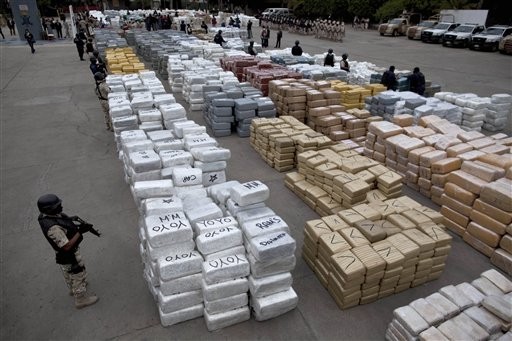
Soldiers and police officers guard packages of seized marijuana during a presentation for the media in Tijuana, Mexico. (AP Photo/Guillermo Arias)
The claims seem to fall in line with statements made last month by Guillermo Terrazas Villanueva, a spokesman for the Chihuahua state government in northern Mexico who said U.S. agencies ”don’t fight drug traffickers,“ instead ”they try to manage the drug trade.”
Also, U.S. officials have previously acknowledged working with the Sinaloa Cartel through another informant, Humberto Loya-Castro. He is also allegedly a high-ranking member of the Sinaloa Cartel as well as a close confidant and lawyer of “El Chapo” Guzman.
Loya-Castro was indicted along with Chapo and Mayo in 1995 in the Southern District of California in a massive narcotics trafficking conspiracy (Case no. 95CR0973). The case was dismissed in 2008 at the request of prosecutors after Loya became an informant for the United States government and subsequently provided information for years.
In 2005, “the CS (informant Loya-Castro) signed a cooperation agreement with the United States Attorney’s Office for the Southern District of California,” states an affidavit filed in the Zambada-Niebla case by Loya-Castro’s handler, DEA agent Manuel Castanon.
“Thereafter, I began to work with the CS. Over the years, the CS’ cooperation resulted in the seizure of several significant loads of narcotics and precursor chemicals. The CS’ cooperation also resulted in other real-time intelligence that was very useful to the United States government.”
Under the alleged agreement with U.S. agencies, “the Sinaloa Cartel, through Loya-Castro, was to provide information accumulated by Mayo, Chapo, and others, against rival Mexican Drug Trafficking Organizations to the United States government,” a motion for discovery states.
In return, the United States government allegedly agreed to dismiss the charges in the pending case against Loya-Castro (which they did), not to interfere with his drug trafficking activities and those of the Sinaloa Cartel and not actively prosecute him or the Sinaloa Cartel leadership.
Taken directly from the motion filed in federal court:
“This strategy, which he calls ‘Divide & Conquer,’ using one drug organization to help against others, is exactly what the Justice Department and its various agencies have implemented in Mexico. In this case, they entered into an agreement with the leadership of the Sinaloa Cartel through, among others, Humberto Loya-Castro, to receive their help in the United States government’s efforts to destroy other cartels.”
“Indeed, United States government agents aided the leaders of the Sinaloa Cartel.”
The government has denied this and says the deal did not go past Loya-Castro.
Zambada-Niebla was arrested by Mexican soldiers in late March of 2009 after he met with DEA agents at a Mexico City hotel in a meeting arranged by Loya-Castro, though the U.S. government was not involved in his arrest. He was extradited to Chicago to face federal drug charges on Feb. 18, 2010. He is now being held in a Michigan prison after requesting to be moved from Chicago.
“Classified Materials”
During his initial court proceedings, Zambada-Niebla continually stated that he was granted full immunity by the DEA in exchange for his cooperation. The agency, however, argues that an “official” immunity deal was never established though they admit he may have acted as an informant.
Zambada-Niebla and his legal council also requested records about Operation Fast and Furious, which permitted weapons purchased in the United States to be illegally smuggled into Mexico, sometimes by paid U.S. informants and cartel leaders. Their request was denied. From the defense motion:
“It is estimated that approximately 3,000 people were killed in Mexico as a result of ‘Operation Fast and Furious,’ including law enforcement officers in the state of Sinaloa, Mexico, the headquarters of the Sinaloa cartel. The Department of Justice’s leadership apparently saw this as an ingenious way of combating drug cartel activities.”
“It has recently been disclosed that in addition to the above-referenced problems with ‘Operation Fast & Furious,’ the DOJ, DEA, and the FBI knew that some of the people who were receiving the weapons that were being allowed to be transported to Mexico, were in fact informants working for those organizations and included some of the leaders of the cartels.”
Zambada’s attorney has filed several motions for discovery to that effect in Illinois Federal District Court, which were summarily denied by the presiding judge who claimed the defendant failed to make the case that he was actually a DEA informant.
In April, 2012, a federal judge refused to dismiss charges against him.
From a Chicago Sun Times report: “According to the government, [Zambada-Niebla] conveyed his interest and willingness to cooperate with the U.S. government, but the DEA agents told him they ‘were not authorized to meet with him, much less have substantive discussions with him,’” the judge wrote.

In this courtroom artist’s drawing Jesus Vincente Zambada-Niebla appears before U.S. District Judge Ruben Castillo Tuesday, Feb. 23, 2010, in Chicago. (AP Photo/Verna Sadock)
In their official response to Zambada-Niebla’s motion for discovery, the federal government confirmed the existence of “classified materials” regarding the case but argued they “do not support the defendant’s claim that he was promised immunity or public authority for his actions.”
Experts have expressed doubts that Zambada-Niebla had an official agreement with the U.S. government, however, agree Loya Castro probably did. Either way, the defense still wants to obtain DEA reports that detail the agency’s relationship with the Sinaloa Cartel and put the agents on the stand, under oath to testify.
The documents that detail the relationship between the federal government and the Sinaloa Cartel have still not been released or subjected to review — citing matters of national security.
via
Feb 6, 2014 | Abuses of Power, Black Technology, News
In a somewhat disturbing case of life imitating art, it seems that real world turmoil is catching up with classic science fiction projections of a dystopian future as envisioned by writers like George Orwell and Ray Bradbury — a world where the general populace is under constant surveillance, and the technology that we’ve become overly dependent on has become our greatest liability.
If the recent NSA debacle wasn’t alarming enough for you, Google recently acquired Nest, the smart device firm and home automation pioneer. Home automation, of course, means having multiple devices (kitchen appliances, thermostats, locks and security cameras, etc.) equipped with wireless capability and controllable through an app on a smart device. Your phone, in essence, becomes a remote control for your entire house. Some systems, like the one which Samsung recently premiered at CES 2014, will only enable the company’s own products to interact with one another, and the more glitzy products like the ADT home security systems allow homeowners to control their thermostats and other electronics (regardless of brand) with their smart phone.
If it sounds too good to be true…that’s because it potentially is, as this article from Trend Labs explains. The IP configuration on the devices is simple and the security options are quite limited, leaving them easily penetrable by hackers and thieves. Part of the risk, of course, is that if you have a home security system that can be entirely disabled through a smartphone, a thief could hack into your accounts, deactivate your entire security system with the push of a mere button, and enter your home freely. All of your data becomes more accessible to hackers, and now Google will have even more comprehensive data to sell to third party candidates who can market products even more aggressively to you.
Orwell and Bradbury basically called the whole thing…
One of the great things about science-fiction is that, whatever paranoid projections it makes about future global conditions, it’s always very much a product of its own time.This news raises all sorts of issues for an overly imaginative person.
The situation is like George Orwell’s 1984, where the general public can’t even so much as think in privacy. Everyone is under constant surveillance, and the entire system is under the pretense that this is somehow what’s best for society.
The citizens of Orwell’s fictional Oceania all have “telescreens” in their apartments, which enables Big Brother (whether that’s merely a governmental agency monitoring the public or one chief observer is never entirely clear) to supervise every given moment of everyone’s lives, and to possess an absurd level of intel on every given person under the jurisdiction of their central government. Replace telescreens with tablets, and Big Brother with Facebook and Google, and ask yourself how much of a deviation this setup is from life as we know it today.
It also calls to mind a particularly eerie story penned by Ray Bradbury 1950 entitled August 2026: There Will Come Soft Rains. The story focuses on “a-day-in-the-life” of a fully automated home after the extinction of the human race. The house prepares meals, recites important dates and reminders through an intercom system with a pre-recorded voice. We come to learn, throughout the course of the story, that the family who owned the house have been wiped out. We hear about silhouettes permanently fixed unto the side of the homes, in a manner that evoked the victims of Hiroshima and Nagasaki who were vaporized in an atomic blast.
So Bradbury’s grim musings couldn’t have been more fitting for his time, and they are startlingly relevant now. Just as humans channel their ingenuity and creativity into constructive things, or things which enhance life for humanity (all of the advancements in home technology, for instance) the misapplication of that creativity — and the misapplication of technology itself– can have dire, even catastrophic, consequences on humanity.
Is it really as bad as all of that?
Only time will tell, but it does seem more and more likely that whatever minor conveniences the technology yields will hardly justify the potential security risks.
You would hope that, in some cases, paranoid science-fiction literature would help prevent future atrocities from occurring by anticipating them. It’s sort of comforting that we’ve not yet reached the place anticipated by Arthur C. Clarke, where computers have superior intellect to humans and can function, not only with autonomy, but willfully against people. It’s pretty disconcerting, however, that we seem to be drawing nearer and nearer to those imagined realities, not merely a novel thought and fodder for pop literature, but a grim facet of our day to day lives.
Dec 21, 2013 | Abuses of Power, Leaks, News
Hmm. Hold up. So if we go by this Wikipedia entry..
“Founded as an independent company in 1982, RSA Security, Inc. was acquired by EMC Corporation in 2006 for US$ 2.1 billion and operates as a division within EMC.[5]”
People need to understand, this means RSA took around 2% of what they’d make in one year. FOR A BACK-DOOR OMG. Does this not sound more like a tax, than a payment (never mind a bribe!)? How much would you care about an extra 2% per year? Exactly. Thats all I got. Someone else needs to close that gap. -Max
What’s an encryption backdoor cost? When you’re the NSA, apparently the fee is $10 million.
Intentional flaws created by the National Security Agency in RSA’s encryption tokens werediscovered in September, thanks to documents released by whistleblower Edward Snowden. It has now been revealed that RSA was paid $10 million by the NSA to implement those backdoors, according to a new report in Reuters.
Two people familiar with RSA’s BSafe software told Reuters that the company had received the money in exchange for making the NSA’s cryptographic formula as the default for encrypted key generation in BSafe.
“Now we know that RSA was bribed,” said security expert Bruce Schneier, who has been involved in the Snowden document analysis. “I sure as hell wouldn’t trust them. And then they made the statement that they put customer security first,” he said.
RSA, now owned by computer storage firm EMC Corp, has a long history of entanglement with the government. In the 1990s, the company was instrumental in stopping a government plan to include a chip in computers that would’ve allowed the government to spy on people.
It has also had its algorithms hacked before, as has RSA-connected VeriSign.
The new revelation is important, Schneier said, because it confirms more suspected tactics that the NSA employs.
“You think they only bribed one company in the history of their operations? What’s at play here is that we don’t know who’s involved,” he said.
Other companies that build widely-used encryption apparatus include Symantec, McAfee, and Microsoft. “You have no idea who else was bribed, so you don’t know who else you can trust,” Schneier said.
RSA did not return a request for comment, and did not comment for the Reuters story.
via CNet
Dec 18, 2013 | Government Agenda, News
Competing with the US during the Arms Race, the Soviet Union put extensive effort in unconventional research seeking to outflank its rival in understanding behavior control, remote influencing and parapsychology, a new survey by Cornell University Library has revealed.
The survey published by Cornell University Library is based on open scientific and journalistic materials and provides an overview of unconventional research in the USSR and then in its successor, Russia, in the period between 1917 and 2003 – as compared to the USA.
The report by Serge Kernbach showed that unconventional weapons took the scientists in both countries to areas bordering sci-fi which nowadays would be seen in TV programs featuring UFOs, the supernatural and superpowers.
Due the Iron Curtain, Soviet and American scientists knew little about each other’s secret work – still, they focused on same themes.
In the Soviet Union, among the areas of particular interest, were, for instance, “the impact of weak and strong electromagnetic emission on biological objects, quantum entanglement in macroscopic systems, nonlocal signal transmission based on the Aharonov-Bohm effect, and ‘human operator’ phenomena,” the survey says.
Soviet scientists were developing a field they dubbed “psychotronics.” The country spent between $0.5-1 billion on research of the phenomena, Kernbach who works, at the Research Center of Advanced Robotics and Environmental Science in Stuttgart, Germany, found out.
Some of the programs in psychotronic research – even those launched decades ago – have not been officially published.
“For instance, documents on experiments performed in OGPU and NKVD – even 80 years after – still remain classified,” Kernbach noted. The OGPU (Joint State Political Directorate) was the Soviet secret police and the NKVD (The People’s Commissariat for Internal Affairs) was the main law enforcing body, which was later transformed into the Internal Ministry and a security organization which was part of it – into the KGB.
According to the survey, Soviet and American areas of interest often mirrored each other. In particular, Kernbach recalls the Central Intelligence Agency’s (CIA) scandalous human research program MKUltra which involved the use of various methods to manipulate an individual’s mental states and alter brain functions.
“As mentioned in the public documents, the program to some extent was motivated by the corresponding NKVD’s program, with similar strategies of using psychotropic (e.g. drugs) substances and technical equipment,” Kernbach said.
In the 60s and the 70s, the Soviet Union was actively researching the influence of electromagnetic fields on human physiological and psychological conditions. Several authors point to the application of research results in the form of new weapons in the USA and the Soviet Union.
“Over the past years, US researchers have confirmed the possibility of affecting functions of the nervous system by weak electromagnetic fields (EMFs), as it was previously said by Soviet researchers. EMFs may cause acoustic hallucination (’radiosound’) and reduce the sensitivity of humans and animals to some other stimuli, to change the activity of the brain (especially the hypothalamus and the cortex), to break the processes of formation processing and information storage in the brain. These nonspecific changes in the central nervous system can serve as a basis for studying the possibilities of the direct influence of EMFs on specific functions of CNS,” read an article in Nauka (Science) magazine in 1982.

A US Marine Corps truck is seen carrying a palletized version of the Active Denial System, March 9th, 2012, at the US Marine Corps Base Quantico, Virginia. It is a US DoD non-lethal weapon that uses directed energy and projects a beam of man-sized millimeter waves up to 1000 meters that when fired at a human, delivers a heat sensation to the skin and generally makes humans stop what they are doing and run. (AFP Photo/Paul J. Richards)
Kernbach’s analysis lacks details on practical results of unconventional research in the USSR.
He mentions though a device invented by Anatoly Beridze-Stakhovsky – the torsion generator ‘Cerpan’. The exact structure of the device is unknown, as the scientist feared it would be put to unethical uses. Cerpan was designed on the “shape effect” produced by torsion fields. Some sources claim that the device – a 7-kilo metal cylinder – was used to heal people, including Kremlin senior officials.
Kernbach’s overview of unconventional research in USSR and Russia suggests that following the collapse of the USSR in 1991, these programs were first reduced and then completely closed in 2003.
“Due to academic and non-academic researchers, the instrumental psychotronics, denoted sometimes as torsionics, still continue to grow, but we cannot speak about government programs in Russia any longer,” he said.
However, based on the number of participants at major conferences, the number of psychotronics researchers in Russia is estimated between 200 and 500, the report said.
Last year, the now-fired Defense Minister Anatoly Serdyukov said his ministry was working on futuristic weaponry.
“The development of weaponry based on new physics principles; direct-energy weapons, geophysical weapons, wave-energy weapons, genetic weapons, psychotronic weapons, etc., is part of the state arms procurement program for 2011-2020,” Serdyukov said at a meeting with the then Prime Minister Vladimir Putin, cited RIA Novosti.
That followed a series of Putin’s presidential campaign articles, one of which focused on national security guarantees. Speaking about new challenges that Russia may face, and which armed forces should be ready to respond to, he wrote:
“Space-based systems and IT tools, especially in cyberspace, will play a great, if not decisive role in armed conflicts. In a more remote future, weapon systems that use different physical principles will be created (beam, geophysical, wave, genetic, psychophysical and other types of weapons). All this will provide fundamentally new instruments for achieving political and strategic goals in addition to nuclear weapons.”
Source: RT
Dec 16, 2013 | Government Agenda, Leaks, News

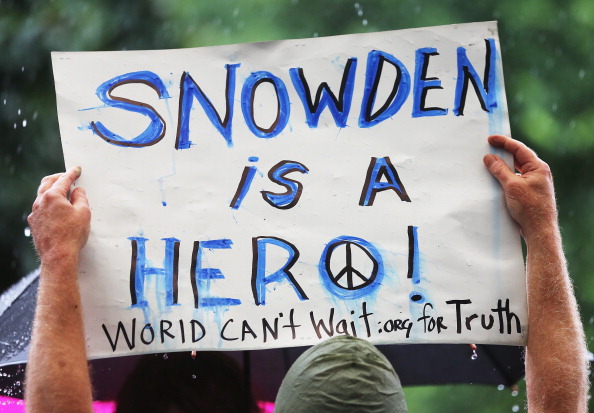
Perhaps Edward Snowden’s hoodie should have raised suspicions.
The black sweatshirt sold by the civil libertarian Electronic Frontier Foundation featured a parody of the National Security Agency’s logo, with the traditional key in an eagle’s claws replaced by a collection of AT&T cables, and eavesdropping headphones covering the menacing bird’s ears. Snowden wore it regularly to stay warm in the air-conditioned underground NSA Hawaii Kunia facility known as “the tunnel.”
His coworkers assumed it was meant ironically. And a geek as gifted as Snowden could get away with a few irregularities.
Months after Snowden leaked tens of thousands of the NSA’s most highly classified documents to the media, the former intelligence contractor has stayed out of the limelight, rarely granting interviews or sharing personal details. A 60 Minutes episode Sunday night, meanwhile, aired NSA’s officials descriptions of Snowden as a malicious hacker who cheated on an NSA entrance exam and whose work computers had to be destroyed after his departure for fear he had infected them with malware.
But an NSA staffer who contacted me last month and asked not to be identified–and whose claims we checked with Snowden himself via his ACLU lawyer Ben Wizner—offered me a very different, firsthand portrait of how Snowden was seen by his colleagues in the agency’s Hawaii office: A principled and ultra-competent, if somewhat eccentric employee, and one who earned the access used to pull off his leak by impressing superiors with sheer talent.
The anonymous NSA staffer’s priority in contacting me, in fact, was to refute stories that have surfaced as the NSA and the media attempt to explain how a contractor was able to obtain and leak the tens of thousands of highly classified documents that have become the biggest public disclosure of NSA secrets in history. According to the source, Snowden didn’t dupe coworkers into handing over their passwords, as one report has claimed. Nor did Snowden fabricate SSH keys to gain unauthorized access, he or she says.
Instead, there’s little mystery as to how Snowden gained his access: It was given to him.
“That kid was a genius among geniuses,” says the NSA staffer. “NSA is full of smart people, but anybody who sat in a meeting with Ed will tell you he was in a class of his own…I’ve never seen anything like it.”
When I reached out to the NSA’s public affairs office, a spokesperson declined to comment, citing the agency’s ongoing investigation into Snowden’s leaks.
But over the course of my communications with the NSA staffer, Snowden’s former colleague offered details that shed light on both how Snowden was able to obtain the NSA’s most secret files, as well as the elusive 30-year old’s character:
- Before coming to NSA Hawaii, Snowden had impressed NSA officials by developing a backup system that the NSA had widely implemented in its codebreaking operations.
- He also frequently reported security vulnerabilities in NSA software. Many of the bugs were never patched.
- Snowden had been brought to Hawaii as a cybersecurity expert working for Dell’s services division but due to a problem with the contract was reassigned to become an administrator for the Microsoft intranet management system known as Sharepoint. Impressed with his technical abilities, Snowden’s managers decided that he was the most qualified candidate to build a new web front-end for one of its projects, despite his contractor status. As his coworker tells it, he was given full administrator privileges, with virtually unlimited access to NSA data. “Big mistake in hindsight,” says Snowden’s former colleague. “But if you had a guy who could do things nobody else could, and the only problem was that his badge was green instead of blue, what would you do?”
- As further evidence that Snowden didn’t hijack his colleagues’ accounts for his leak, the NSA staffer points to an occasion when Snowden was given a manager’s password so that he could cover for him while he was on vacation. Even then, investigators found no evidence Snowden had misused that staffer’s privileges, and the source says nothing he could have uniquely accessed from the account has shown up in news reports.
- Snowden’s superiors were so impressed with his skills that he was at one point offered a position on the elite team of NSA hackers known as Tailored Access Operations. He unexpectedly turned it down and instead joined Booz Allen to work at NSA’s Threat Operation Center.
- Another hint of his whistleblower conscience, aside from the telltale hoodie: Snowden kept a copy of the constitution on his desk to cite when arguing against NSA activities he thought might violate it.
- The source tells me Snowden also once nearly lost his job standing up for a coworker who was being disciplined by a superior.
- Snowden often left small, gifts anonymously at colleagues’ desks.
- He frequently walked NSA’s halls carrying a Rubik’s cube–the same object he held to identify himself on a Hong Kong street to the journalists who first met with him to publish his leaks.
- Snowden’s former colleague says that he or she has slowly come to understand Snowden’s decision to leak the NSA’s files. “I was shocked and betrayed when I first learned the news, but as more time passes I’m inclined to believe he really is trying to do the right thing and it’s not out of character for him. I don’t agree with his methods, but I understand why he did it,” he or she says. “I won’t call him a hero, but he’s sure as hell no traitor.”
via Forbes.com
Dec 12, 2013 | Scientists Re-Booted
Professor Carol Ambruster, 69, University professor and Astronomy and Astrophysics Officers had found nothing in Ambruster’s life or history that appeared suspicious. Philly.com reported; Carol W. Ambruster, 69 was found by her roommate in the kitchen of her apartment in the 5500 block of Wayne Avenue, Germantown with a knife in her neck about 9 p.m., police said. She also had been stabbed in the chest. Ambruster, a tenured professor in the department of astronomy and astrophysics at Villanova, retired in 2011. Ambruster attended Northeastern University, where she majored in physics, and received her doctorate in astronomy from the University of Pennsylvania in 1984. Her research interests included stars and the history of astronomy
Dec 11, 2013 | Abuses of Power, Satire

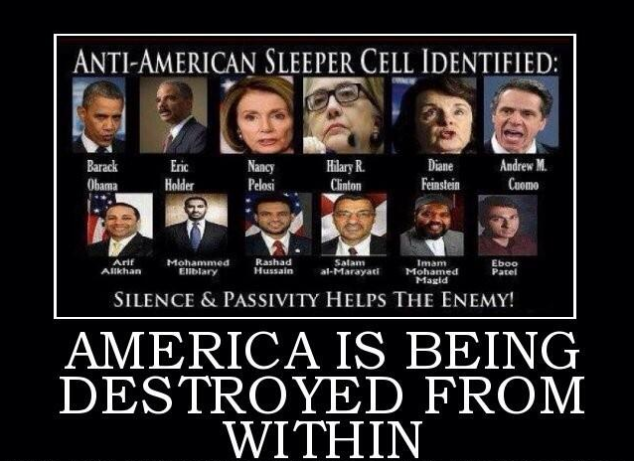
We’re being destroyed from within by a socialistic bureaucracy who’s overriding goal is its own survival at the cost of National Security, which as the historian Thomas Cahill asserts was one of the major reasons for the fall of the Roman Empire.
Dec 9, 2013 | Government Agenda, Leaks, News
This story has been reported in partnership between The New York Times, the Guardian and ProPublica based on documents obtained by The Guardian.
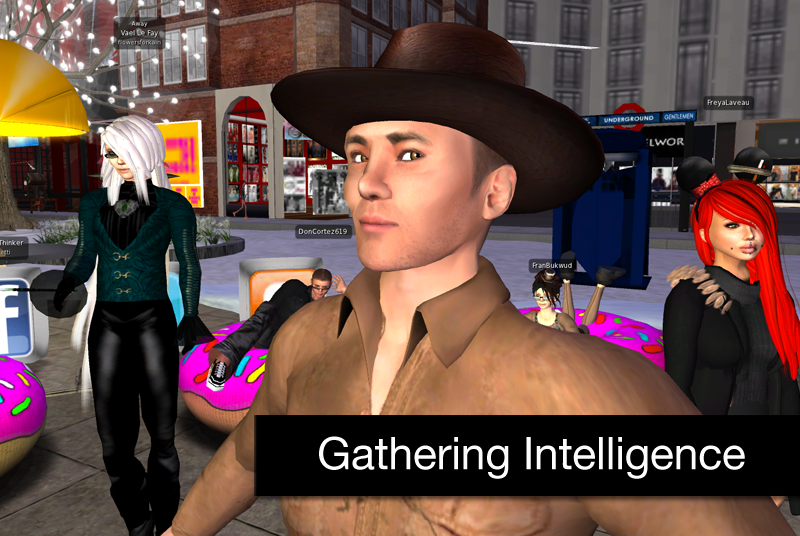
Not limiting their activities to the earthly realm, American and British spies have infiltrated the fantasy worlds of World of Warcraft and Second Life, conducting surveillance and scooping up data in the online games played by millions of people across the globe, according to newly disclosed classified documents.
Fearing that terrorist or criminal networks could use the games to communicate secretly, move money or plot attacks, the documents show, intelligence operatives have entered terrain populated by digital avatars that include elves, gnomes and supermodels.
The spies have created make-believe characters to snoop and to try to recruit informers, while also collecting data and contents of communications between players, according to the documents, disclosed by the former National Security Agency contractor Edward J. Snowden. Because militants often rely on features common to video games — fake identities, voice and text chats, a way to conduct financial transactions — American and British intelligence agencies worried that they might be operating there, according to the papers.
Takeaways: How Spy Agencies Operate In Virtual Worlds
GATHERING INTELLIGENCE: U.S. and British intelligence agencies — including the Central Intelligence Agency, Defense intelligence agency and Britain’s Government Communications Headquarters — . For example, according to Snowden documents, the U.S. has conducted spy operations in Second Life (pictured), where players create human avatars to socialize, buy and sell goods and explore exotic virtual destinations. (Second Life image via Linden Lab)
Online games might seem innocuous, a top-secret 2008 NSA document warned, but they had the potential to be a “target-rich communication network” allowing intelligence suspects “a way to hide in plain sight.” Virtual games “are an opportunity!,” another 2008 NSA document declared.
But for all their enthusiasm — so many CIA, FBI and Pentagon spies were hunting around in Second Life, the document noted, that a “deconfliction” group was needed to avoid collisions — the intelligence agencies may have inflated the threat.
The documents do not cite any counterterrorism successes from the effort, and former American intelligence officials, current and former gaming company employees and outside experts said in interviews that they knew of little evidence that terrorist groups viewed the games as havens to communicate and plot operations.
(Transcript: What are intelligence agencies doing in virtual worlds?)
Games “are built and operated by companies looking to make money, so the players’ identity and activity is tracked,” said Peter W. Singer of the Brookings Institution, an author of “Cybersecurity and Cyberwar: What Everyone Needs to Know.” “For terror groups looking to keep their communications secret, there are far more effective and easier ways to do so than putting on a troll avatar.”
The surveillance, which also included Microsoft’s Xbox Live, could raise privacy concerns. It is not clear exactly how the agencies got access to gamers’ data or communications, how many players may have been monitored or whether Americans’ communications or activities were captured.
One American company, the maker of World of Warcraft, said that neither the NSA nor its British counterpart, the Government Communications Headquarters, had gotten permission to gather intelligence in its game. Many players are Americans, who can be targeted for surveillance only with approval from the nation’s secret intelligence court. The spy agencies, though, face far fewer restrictions on collecting certain data or communications overseas.
“We are unaware of any surveillance taking place,” said a spokesman for Blizzard Entertainment, based in Irvine, Calif., which makes World of Warcraft. “If it was, it would have been done without our knowledge or permission.”
A spokeswoman for Microsoft declined to comment. Philip Rosedale, the founder of Second Life and a former chief executive officer of Linden Lab, the game’s maker, declined to comment on the spying revelations. Current Linden executives did not respond to requests for comment.
A Government Communications Headquarters spokesman would neither confirm nor deny any involvement by that agency in gaming surveillance, but said that its work is conducted under “a strict legal and policy framework” with rigorous oversight. An NSA spokeswoman declined to comment.
Intelligence and law enforcement officials became interested in games after some became enormously popular, drawing tens of millions of people worldwide, from preteens to retirees. The games rely on lifelike graphics, virtual currencies and the ability to speak to other players in real time. Some gamers merge the virtual and real worlds by spending long hours playing and making close online friends.
In World of Warcraft, players share the same fantasy universe — walking around and killing computer-controlled monsters or the avatars of other players, including elves, animals or creatures known as orcs. In Second Life, players create customized human avatars that can resemble themselves or take on other personas — supermodels and bodybuilders are popular — who can socialize, buy and sell virtual goods, and go places like beaches, cities, art galleries and strip clubs. In Microsoft’s Xbox Live service, subscribers connect online in games that can involve activities like playing soccer or shooting at each other in space.
According to American officials and documents that Mr. Snowden provided to The Guardian, which shared them with The New York Times and ProPublica, spy agencies grew worried that terrorist groups might take to the virtual worlds to establish safe communications channels.
In 2007, as the NSA and other intelligence agencies were beginning to explore virtual games, NSA officials met with the chief technology officer for the manufacturer of Second Life, the San Francisco-based Linden Lab. The executive, Cory Ondrejka, was a former Navy officer who had worked at the NSA with a top-secret security clearance.
He visited the agency’s headquarters at Fort Meade, Md., in May 2007 to speak to staff members over a brown bag lunch, according to an internal agency announcement. “Second Life has proven that virtual worlds of social networking are a reality: come hear Cory tell you why!” said the announcement. It added that virtual worlds gave the government the opportunity “to understand the motivation, context and consequent behaviors of non-Americans through observation, without leaving U.S. soil.”
Ondrejka, now the director of mobile engineering at Facebook, said through a representative that the NSA presentation was similar to others he gave in that period, and declined to comment further.
Even with spies already monitoring games, the NSA thought it needed to step up the effort.
“The Sigint Enterprise needs to begin taking action now to plan for collection, processing, presentation and analysis of these communications,” said one April 2008 NSA document, referring to “signals intelligence.” The document added, “With a few exceptions, NSA can’t even recognize the traffic,” meaning that the agency could not distinguish gaming data from other Internet traffic.
By the end of 2008, according to one document, the British spy agency, known as GCHQ, had set up its “first operational deployment into Second Life” and had helped the police in London in cracking down on a crime ring that had moved into virtual worlds to sell stolen credit card information. The British spies running the effort, which was code-named “Operation Galician,” were aided by an informer using a digital avatar “who helpfully volunteered information on the target group’s latest activities.”
Though the games might appear to be unregulated digital bazaars, the companies running them reserve the right to police the communications of players and store the chat dialogues in servers that can be searched later. The transactions conducted with the virtual money common in the games, used in World of Warcraft to buy weapons and potions to slay monsters, are also monitored by the companies to prevent illicit financial dealings.
In the 2008 NSA document, titled “Exploiting Terrorist Use of Games & Virtual Environments,” the agency said that “terrorist target selectors” — which could be a computer’s Internet Protocol address or an email account — “have been found associated with Xbox Live, Second Life, World of Warcraft” and other games. But that document does not present evidence that terrorists were participating in the games.
Still, the intelligence agencies found other benefits in infiltrating these online worlds. According to the minutes of a January 2009 meeting, GCHQ’s “network gaming exploitation team” had identified engineers, embassy drivers, scientists and other foreign intelligence operatives to be World of Warcraft players — potential targets for recruitment as agents.
At Menwith Hill, a Royal Air Force base in the Yorkshire countryside that the NSA has long used as an outpost to intercept global communications, American and British intelligence operatives started an effort in 2008 to begin collecting data from World of Warcraft.
One NSA document said that the World of Warcraft monitoring “continues to uncover potential Sigint value by identifying accounts, characters and guilds related to Islamic extremist groups, nuclear proliferation and arms dealing.” In other words, targets of interest appeared to be playing the fantasy game, though the document does not indicate that they were doing so for any nefarious purposes. A British document from later that year said that GCHQ had “successfully been able to get the discussions between different game players on Xbox Live.”
By 2009, the collection was extensive. One document says that while GCHQ was testing its ability to spy on Second Life in real time, British intelligence officers vacuumed up three days’ worth of Second Life chat, instant message and financial transaction data, totaling 176,677 lines of data, which included the content of the communications.
For their part, players have openly worried that the NSA might be watching them.
In one World of Warcraft discussion thread, begun just days after the first Snowden revelations appeared in the news media in June, a human death knight with the user name “Crrassus” asked whether the NSA might be reading game chat logs.
“If they ever read these forums,” wrote a goblin priest with the user name “Diaya,” “they would realize they were wasting” their time.
Even before the American government began spying in virtual worlds, the Pentagon had identified the potential intelligence value of video games. The Pentagon’s Special Operations Command in 2006 and 2007 worked with several foreign companies — including an obscure digital media business based in Prague — to build games that could be downloaded to mobile phones., according to people involved in the effort. They said the games, which were not identified as creations of the Pentagon, were then used as vehicles for intelligence agencies to collect information about the users.
Eager to cash in on the government’s growing interest in virtual worlds, several large private contractors have spent years pitching their services to American intelligence agencies. In one 66-page document from 2007, part of the cache released by Mr. Snowden, the contracting giant SAIC promoted its ability to support “intelligence collection in the game space,” and warned that online games could be used by militant groups to recruit followers and could provide “terrorist organizations with a powerful platform to reach core target audiences.”
It is unclear whether SAIC received a contract based on this proposal, but one former SAIC employee said that the company at one point had a lucrative contract with the CIA for work that included monitoring the Internet for militant activity. An SAIC spokeswoman declined to comment.
In spring 2009, academics and defense contractors gathered at the Marriott at Washington Dulles International Airport to present proposals for a government study about how players’ behavior in a game like World of Warcraft might be linked to their real-world identities. “We were told it was highly likely that persons of interest were using virtual spaces to communicate or coordinate,” said Dmitri Williams, a professor at the University of Southern California who received grant money as part of the program.
After the conference, both SAIC and Lockheed Martin won contracts worth several million dollars, administered by an office within the intelligence community that finances research projects.
It is not clear how useful such research might be. A group at the Palo Alto Research Center, for example, produced a government-funded study of World of Warcraft that found “younger players and male players preferring competitive, hack-and-slash activities, and older and female players preferring noncombat activities,” such as exploring the virtual world. A group from the nonprofit SRI International, meanwhile, found that players under age 18 often used all capital letters both in chat messages and in their avatar names.
Those involved in the project were told little by their government patrons. According to Nick Yee, a Palo Alto researcher who worked on the effort, “We were specifically asked not to speculate on the government’s motivations and goals.”
Andrew W. Lehren contributed reporting.
Transcript: What are intelligence agencies doing in virtual worlds? ProPublica reporter Justin Elliott, New York Times reporter Mark Mazzetti and The Guardian’s James Ball discussed #SpyGames with our readers. Like this story? Get more great ProPublica journalism by signing up for our email newsletter.
via ProPublica
Dec 7, 2013 | WAR: By Design
Saudi militants were behind the massive car bombing and assault on Yemen’s military headquarters that killed more than 50 people, including foreigners, investigators said in a preliminary report released Friday.
Al-Qaeda claimed responsibility for the attack, saying it was retaliation for US drone strikes that have killed dozens of the terror network’s leaders.
The attack – the deadliest in Sanaa since May 2012 – marked an escalation in the terror network’s battle to undermine the US-allied government and destabilise the impoverished Arab nation despite the drone strikes and a series of US-backed military offensive against it.
US forces also have been training and arming Yemeni special forces, and exchanging intelligence with the central government.
Military investigators described a two-stage operation, saying heavily armed militants wearing army uniforms first blew up a car packed with 500 kilograms of explosives near an entrance gate, then split into groups that swept through a military hospital and a laboratory, shooting at soldiers, doctors, nurses, doctors and patients.
Officials earlier said 11 militants were killed, including the suicide bomber who drove the car. It was not clear if the 12th attacker was captured or escaped.
The investigative committee led by Yemen’s Chief of Staff Gen. Ahmed al-Ashwal, said militants shot the guards outside the gates of the military hospital, allowing the suicide bomber to drive the car inside, but a gunfight forced him to detonate his explosives before reaching his target.
It said the 12 militants killed, included Saudis.
Two military officials told The Associated Press that wounded soldiers had told them the assailants who stormed the hospital separated out the foreigners and shot everybody in the head.
Other military officials said American security agents were helping with the investigations, but that could not be confirmed. All officials spoke on condition of anonymity because they were not allowed to brief reporters.
Yemeni commandos and other security forces besieged the militants before they could reach the ministry’s main building, preventing them from going further than the ministry’s entrance gate. All the attackers were killed by 4:30 pm Thursday, according to the committee.
Yemeni security forces launched a manhunt in the capital to find the perpetrators, sparking gun battles that killed five suspected militants and a Yemeni commando, officials said.
The committee, which sent its report to Yemeni President Abed Rabbo Mansour Hadi, did not explain how it came to its conclusions.
The report, read on state TV, raised the death toll to 56 and said more than 200 people were wounded.
The foreigners killed included two aid workers from Germany, two doctors from Vietnam, two nurses from the Philippines and a nurse from India, according to Yemen’s Supreme Security Commission.
But a spokesman for the Philippines’ Department of Foreign Affairs, Raul Hernandez, said on Friday that seven Filipinos were killed in the attack, including a doctor and nurses, while 11 others were wounded.
The victims were among 40 Filipino workers in the hospital. Hernandez said that the Philippines’ honorary consul reported that the others survived by pretending to be dead.
It was not immediately possible to reconcile the conflicting accounts. But officials from the military hospital said Friday that at least 10 foreigners had been killed.
The United States considers the Yemeni al-Qaeda branch to be the most active in the world and it has escalated drone attacks against the militants in Yemen.
via SkyNews
Oct 18, 2013 | Abuses of Power, Black Technology, News

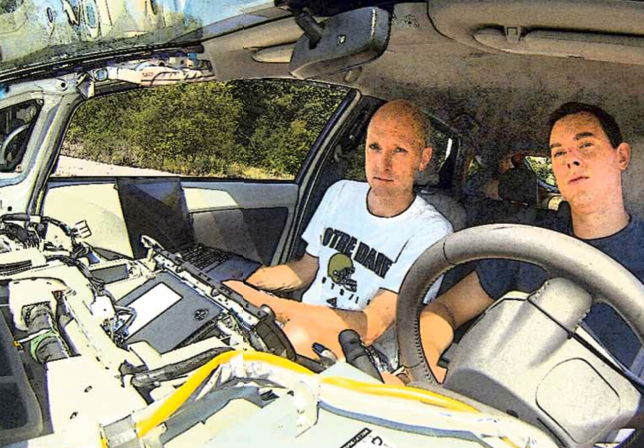
Hackers Chris Valasek and Charlie Miller have demonstrated from the backseat of a Toyota Prius that all you need is a Macbook and a USB cable in order to hack into a computer-controlled car.
Valasek is the director of security intelligence for IOActive and Miller is a security engineer for Twitter.
These two security researchers showed that they can turn off the breaks, for example, even if the driver is at the helm.
Using a grant from the Defense Advanced Research Projects Agency (DARPA), Miller and Valasek have been researching computerized car vulnerabilities since 2012 and will be displaying their findings at DEF CON, a hacker’s conference in Las Vegas next month.
Miller asserted that they “had full control of braking” and that they “disengaged the brakes so if you were going slow and tried to press the brakes they wouldn’t work. We could turn the headlamps on and off, honk the horn. We had control of many aspects of the automobile.”
• Turn off power to the steering
• Have the onboard GPS give incorrect directions
• Change the numbers on the speedometer
• Force the car to change direction
Miller explained: “At the moment there are people who are in the know, there are nay-sayers who don’t believe it’s important, and there are others saying it’s common knowledge but right now there’s not much data out there. We would love for everyone to start having a discussion about this, and for manufacturers to listen and improve the security of cars.”
Using the vehicle’s electronic control unit (ECU) and the on-board diagnostics port (OBD), Miller and Valasek gained control over a 2010 Ford Escape and Toyota Prius.
ECUs are embedded systems that “controls one or more of the electrical system or subsystems in a motor vehicle.”
The OBD is the “vehicle’s self-diagnostic and reporting” apparatus that “gives the vehicle owner or repair technician access to the status of the various vehicle sub-systems.”
A representative from Toyota explained that the hacker would have to be in the car to manipulate its systems.
He said: “Altered control can only be made when the device is connected. After it is disconnected the car functions normally. We don’t consider that to be ‘hacking’ in the sense of creating unexpected behavior, because the device must be connected – ie the control system of the car physically altered. The presence of a laptop or other device connected to the OBD [on board diagnostics] II port would be apparent.”
Hacking into cars that are remotely controlled, such as Google’s self-driving vehicles, is a concern and this researcher could uncover implications for security purposes.
In 2010, teams from the University of Washington (UW) and the University of California (UC) were able to breach the computer systems of cars using cellular phone connections, Bluetooth headsets and a CD.
Stefan Savage from UC explained that their research “explores how hard it is to compromise a car’s computers without having any direct physical access to the car.”
Computerized cars “contain cellular connections and Bluetooth wireless technology” that could be tapped into remotely and used to take over the controls of the vehicle, listen into the conversations taking place in the cab of the car and completely compromise the safety of the vehicle.
Because computer connections to cars are virtually indistinguishable from internet-connected computers, their propensity toward vulnerabilities from outside influences are similar.
Using an On-Star navigation unit, a hacker could utilize the controls a remote technician at the GPS corporation’s on-call center because they are fully capable of controlling a vehicle in the event of an accident or call from a customer.
With complete disregard for driver privacy, the Obama administration gave their consent to the National Highway Traffic Safety Administration (NHTSA) to mandate black box event data recorders (EDR) be installed in all new cars in the US.
The NHTSA says that by September 2014 all car and light trucks will be equipped with EDRs that will silently “record the actions of drivers and the responses of their vehicles in a continuous information loop.”
The information recorded by EDRs includes:
• vehicle speed
• whether the brake was activated in the moments before a crash
• crash forces at the moment of impact
• information about the state of the engine throttle
• air bag deployment timing and air bag readiness prior to the crash
• whether the vehicle occupant’s seat belt was buckled
The NHTSA claims that “EDRs do not collect any personal identifying information or record conversations and do not run continuously.”
Advanced EDRs can collect detailed information about drivers and their driving habits; including the size and weight of the driver, the seat position, the habits of the driver as well as passengers.
The excuse is the EDRs gather information about car crashes in the moments leading up to the accident that manufacturers can use to improve their safety measures when constructing vehicles. However, the government regulation utilizes surveillance technology with policies that do not outline the expressed use of the data collected in the EDRs.
Read More here.
Oct 9, 2013 | WAR: By Design
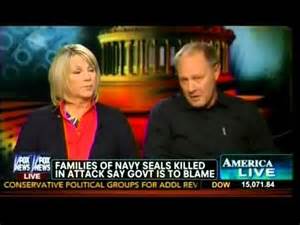
Led by firebrand Rep. Jason Chaffetz (R-Utah), Congress is to launch an official investigation into the mysterious helicopter crash that killed several members of the Navy SEAL team 6 in Afghanistan in 2011.
Back in May, the families of the SEALs went public with concerns that the Obama administration was at least partially responsible for the deaths of their sons.
The family members say that they still have not received satisfactory answers to their questions, and that there are still many inconsistencies and contradictions in the explanations they have been provided.
“We’re going to dive into this.” said Chaffetz, who is acting in his position as chairman of the House Oversight and Government Reform subcommittee on National Security.
30 Americans were killed in the crash on August 6, 2011 when insurgents shot down a U.S. military helicopter during fighting in eastern Afghanistan, making it the largest loss of life in a single incident for the U.S. military during the war. 22 of the victims belonged to the same unit as the Navy SEALS involved in the purported Osama Bin Laden operation, just three months earlier.
US military officials have maintained that none of the individuals involved directly in the Bin Laden mission were killed in the crash. However, sources have claimed that there were at least two SEALs who died on the chopper who had been involved in the Bin Laden raid.
Some of the families feel that the Obama administration’s handling of the death of Bin Laden made retaliatory attacks against SEAL Team 6 more likely. Family members have also expressed concerns that SEALS were sent into battle “without special operations aviation and proper air support.”
Chaffetz has said that he is preparing to send questions to the Pentagon and may hold congressional hearings on the issue. He noted that the families deserve answers: “That’s why you do an investigation. I want to be as factual as I can.” he said.
Larry Klayman of Freedom Watch, who is representing some of the families told reporters “This is a scandal even greater than Benghazi.”
“There we lost four valued American lives; here we sacrificed 30 American soldiers. The big question is were these brave Americans sold out by the Afghani government as payment to the Taliban for the death of bin Laden?” Klayman added.
Klayman’s questions stem from the fact that Afghani forces accompanying the Navy SEAL servicemen on the helicopter were most likely not properly vetted, meaning that they may have disclosed classified information to the Taliban about the mission, resulting in the shoot down of the helicopter.
Pentagon documents have confirmed that immediately prior to the take off of the helicopter, seven Afghan commandos who were listed on the passenger itinerary were mysteriously replaced by other Afghan military officials.
Defense officials have confirmed that all seven names of the Afghan soldiers on the passenger list did not tally with those on board when the chopper took to the air.
The families of the SEALs have noted that their sons did not have trust in Afghan soldiers, with one quoted as saying, “They are loyal to the highest bidder.”
Charlie Strange, the father of one of the killed SEALs also pointed out “There was no eye in the sky tracking [the Chinook]. Why not?”
In addition, pre-assault fire was requested by the team, but was denied by military officials on the ground.
“My son Michael died,” Strange said. “I want to know, who made these calls?”
The Pentagon probe into the shoot down denies that the incident was an “established ambush,” instead claiming that “it was a lucky shot of a low-level fighter that happened to be living [in the area]. He heard all the activity and he happened to be in the right spot.”
Families have countered those suggestions by pointing out that leading militants took to the internet in the immediate aftermath of the attack, to boast that they had successfully ambushed SEAL Team 6.
The Pentagon has also claimed that, despite recovering all the bodies of those killed, the helicopter’s black box was washed away in a flash flood.
The Pentagon told the families that all the bodies were cremated due to the fact that they were badly burned in the crash. However, pictures have emerged that show some deceased SEALs without bad burns.
“The body I saw didn’t need to be cremated,” Rep. Chaffetz said, also noting that the DoD’s explanation regarding the helicopter’s black box is “awfully odd.”
Perhaps even more controversially, family members have also provided evidence that suggests a Muslim cleric attended the funerals of the service members and disparaged them by “damning them as infidels to Allah” during an Islamic prayer.
Refusing to answer specific questions, a DoD spokesperson stated “the operational planning and execution of this mission was consistent with previous missions” and “was thoroughly investigated … we share in the grief of all of the families who lost their loved ones. The loss of 38 U.S. and Afghan military personnel was a tragic loss during a difficult campaign.”
Read More.
Sep 18, 2013 | Scientists Re-Booted
A renowned American engineer was found dead in his hotel room in Salford after his heart suddenly stopped working. Mark Ferri, 59, from Tennessee, had completed two degrees in engineering as well as an MBA before becoming a nuclear engineer. At an inquest into Mr. Ferri’s death at Bolton Crown Court, it was heard that the dad-of-one was visiting Manchester on business on September 18, the day of his death. It was said Mr. Ferri had been under stress from his job. His wife, Michaela, told the inquest, “He said a number of times, this job is killing me.”. Mr. Ferri was originally due to return to the US a week earlier to see his family but was asked to remain in the UK for an extra week. On September 5, Mrs. Ferri spoke to her husband and, “he didn’t sound right”. She said, “He said it was just his work and they were giving him additional assignments and he was feeling overwhelmed and he didn’t think he would be able to complete them”.
Sep 5, 2013 | Government Agenda, News, Satire
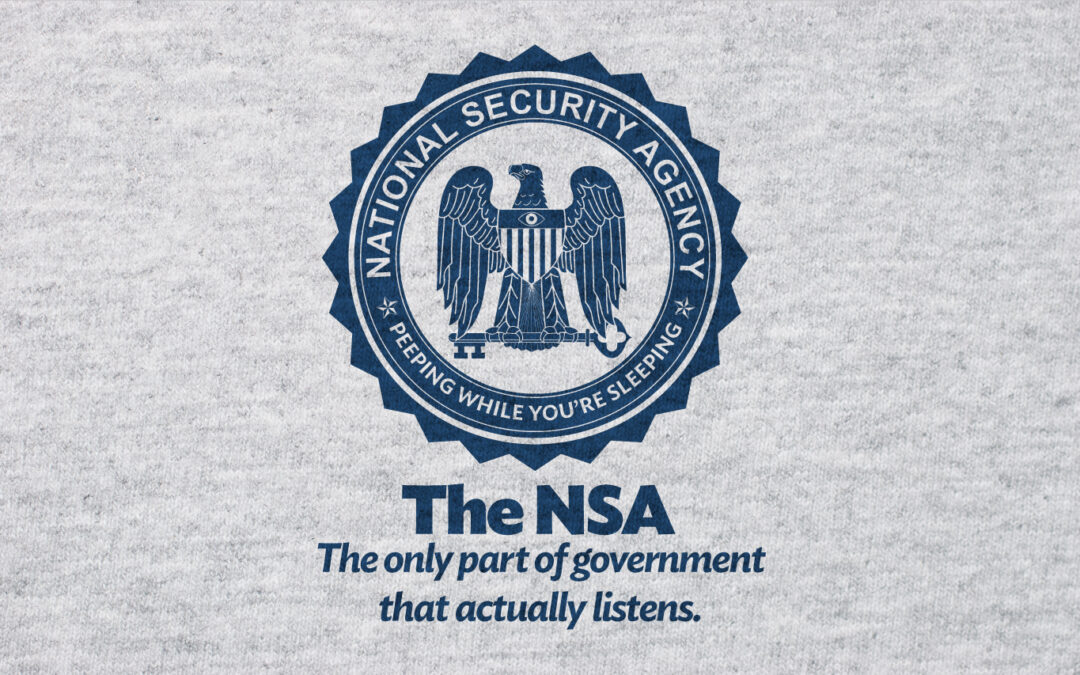
Throughout history, one of the ways in which the human spirit has overcome or dealt with the brutish forces of authoritarian regimes has been through the use of humor. As such, it is no surprise that clever Americans from sea to shining sea have figured out ways to mock the NSA while also making a dollar or two. One of these folks is Dan McCall, founder of politically themed T-shirt company Liberty Maniacs. Several days after the spy scandal erupted, Dan created a shirt that read NSA: The only part of the government that actually listens. See below:

Pretty hilarious right? Well, the NSA didn’t find it particularly funny and, in fact, according to the Daily Dot this is what happened:
“Within an hour or two,” as McCall told the Daily Dot, Zazzle emailed him to say the shirt had been removed from the Zazzle site. (Zazzle didn’t respond to the Daily Dot’s request for comment, nor did the NSA.
Zazzle’s first email, which McCall forwarded to the Daily Dot, said in part:
Unfortunately, it appears that your product, The NSA, contains content that is in conflict with one or more of our acceptable content guidelines.
We will be removing this product from the Zazzle Marketplace shortly. …
Result: Not Approved
Policy Notes: Design contains an image or text that may infringe on intellectual property rights. We have been contacted by the intellectual property right holder and we will be removing your product from Zazzle’s Marketplace due to infringement claims.
McCall, who says he’d worked with Zazzle for five years, asked for an explanation, but when the company responded June 11, the distributor didn’t share much more:
Unfortunately, it appears that your product, ” the nsa”, does not meet Zazzle Acceptable Content Guidelines. Specifically, your product contained content which infringes upon the intellectual property rights of National Security Agency.
We have been contacted by legal representatives from the National Security Agency, and at their request, have removed the product from the Zazzle Marketplace.
The NSA: Protecting Americans from terrorists, nuclear war and funny t-shirts since 1952.
via DailyDot
Aug 24, 2013 | Scientists Re-Booted
Anne Szarewski, 53, pioneered the cervical cancer vaccine.
Mystery: Doctors are still at a loss to explain Dr Anne Szarewski’s death in her Hampstead home in August. Doctors are still at a loss to explain what exactly caused the brilliant researchers death. She was found with high levels of an anti-malarial drug in her bloodstream, but doctors said this was not thought to have caused her death. The scientist who pioneered the cervical cancer vaccine was found dead by her husband at their $2 million home after he warned she was “heading for a crisis” by working too hard. Dr Anne Szarewski, 53, a university lecturer whose discovery has saved thousands of lives, was begged to slow down by her husband, who was becoming increasingly concerned about the pressure she was putting on herself. In August he found her dead in their four-bedroom home in West Hampstead, north London, after he spent two hours drilling through a door she had locked from the inside. Dr. Szarewski is credited with discovering the link between the human papillomavirus and cervical cancer, leading to a vaccine for HPV, the first-ever vaccine against any form of cancer, which is now routinely given to girls across the country.
Aug 16, 2013 | Government Agenda, Leaks, News
In 2008, the National Security Agency illicitly—if accidentally—intercepted a “large number” of phone calls from Washington, D.C. because an error confused Egypt’s country code—“20”—with, yes, “202.”
That fact, one of many startling ones from Barton Gellman’s new blockbuster Washington Post story based on documents given to him by Edward Snowden, is so catchy and memorable that I almost worry about it. That is, I worry people will just think of that and fail to grasp that this was actually one of the more anodyne NSA abuses revealed by these newly disclosed top-secret documents, including an internal audit. In fact, in the year preceding the May 2012 audit, there were 2,776 violations (another eye-grabber, suggestively alike the totemic 1,776).
I think more troubling is that the NSA deliberately fed international communications (which it is permitted to monitor in certain ways) through U.S. fiber-optic cables, commingling those kosher foreign emails with domestic ones—which the secret Foreign Intelligence Surveillance Court (or FISC, and it is generally a rubber stamp) ruled unconstitutional.
I also think more troubling is that last year, the NSA retained more than 3,000 files of telephone call records in defiance of an FISC order (!). How many calls involving how many people were on each file is unknown, by the way.
I think it is pretty messed up that all of this information solely concerns violations that occurred at the NSA’s headquarters in Maryland. “Three government officials, speaking on the condition of anonymity to discuss classified matters, said the number [of violations] would be substantially higher if it included other NSA operating units and regional collection centers,” Gellman reports.
Here’s the audit, for those not faint of heart or jargon (an appendix is provided).
There is a valuable, vital debate to be had over how much the federal government, in its intelligence programs, ought to be permitted to violate Americans’ privacy in an effort to protect Americans from a dangerous world that includes people who want to kill Americans. There are many different places where the important red lines can be drawn in this debate. It is a debate strewn with well-intentioned, conscientious people who would draw those lines at very different places. Let’s even be generous and stipulate that the question of whether the statutorily provided oversight of these programs is sufficient belongs, as well, to that debate.
The terrifying thing is that we are not having that debate. As these documents are the latest things to demonstrate, the various overseers as well as the public do not have access to the information that even the current rules assert they should have. That is how I can state with certainty that we are not having that vital debate: We do not have the means to have that debate with any kind of authority; therefore, no matter how much we discuss these issues, we are not having that debate.
The most important thing about the Egypt-D.C. confusion isn’t that U.S. calls were collected in violation of rules, for instance. It is that, after this violation was uncovered, it was not reported to oversight staff.
In a separate, in many ways equally important Post article, Carol D. Leonnig reports that FISC’s chief judge is hopelessly dependent on the NSA in order for it to perform its statutorily mandated oversight. “The FISC does not have the capacity to investigate issues of noncompliance,” the judge, Reggie B. Walton, told her, “and in that respect the FISC is in the same position as any other court.” Obama, Leonnig noted, has explicitly held FISC up as assurance that the programs do have strong oversight. But it should be obvious that outside oversight that depends on the purely internal machinations of the thing that is supposed to be overseen is not accountable oversight.
Lawmakers are not blameless. They may access unredacted documents, albeit in a secure room where they lack the ability to take notes. They might theoretically then, even, pull a Mike Gravel and read the results into the record on the House or Senate floor. Gellman reports that “fewer than 10 percent of lawmakers” presently have the ability actually to do this in practice. Sen. Dianne Feinstein, the Senate Intelligence Committee chairwoman, was unaware of the May 2012 audit until she was contacted for the Post story.
But mainly this is on the NSA, which is to say, on the administration. President Obama pledged last Friday to make these surveillance programs “more transparent.” He argued, “It’s not enough for me as president to have confidence in these programs. The American people need to have confidence in them, as well.”
Yet the administration did not disclose, say, the lapses Gellman reported. In fact, the NSA retroactively placed an on-the-record interview with its director of compliance off the record, according to Gellman. It did this after Obama’s speech extolling the importance of and promising transparency. In a sense, we got his wished-for transparency. We can see right through him now.
via NewRepublic
Jul 9, 2013 | Abuses of Power, Nature Body Mind

Dr. Lee Hieb explains how medical ‘consensus’ robs patients of their health
No one said it better than Michael Crichton – who, in addition to being a best selling author, was also a physician.
During a lecture at Cal Tech, he said, “Let’s be clear: The work of science has nothing whatever to do with consensus. Consensus is the business of politics. Science, on the contrary, requires only one investigator who happens to be right. … The greatest scientists in history are great precisely because they broke with the consensus.”
The medical community has always been subject to “group-think,” but in recent decades we have become the leaders. Numerous physician-scientists have been ostracized, defrocked, de-licensed and in some cases driven to self-destruction by a medical community that has embraced consensus in science.
In essence, “We don’t care about your data; we all agree you are wrong.”
I once had a paper rejected from a major spine journal with a one line denouement: “Everyone knows you can’t do that.”
With time, ultimately, truth prevails, and renegade but correct physicians are vindicated – but not in time to save those patients who die from the mistaken consensus. Today, this “group-think” is depriving people from some of the best and cheapest medical treatment available – supplementation with adequate Vitamin D3.
Vitamin D deficiency has been associated with childhood rickets – a bone disorder – for over a hundred years. And it has been known since the 1970s that those living on the equator, regardless of particular locale, have lower rates of multiple sclerosis, colon cancer and depression. But more recently, many astute observers have discovered that low Vitamin D leads to many other disorders, including cardiac arrhythmia, breast cancer, adult fractures, dementia, heart attack risk and even diabetes.
Most recently, studies have demonstrated that higher levels of Vitamin D improve longevity and are beneficial at preventing influenza – even better than vaccination. Studies showing beneficial effects of high vitamin D levels are quite convincing. They not only show a correlation between low Vitamin D blood levels and the problem, but show improvement in the disease or prevention of the condition when levels are raised up through supplementation.
As an example, it has been shown in the laboratory that heart muscle does not contract well unless adequate Vitamin D is present. An Italian population study showed that low Vitamin D was proportional to atherosclerotic plaques (clogging of the arteries). Furthermore, a Japanese study of dialysis patients demonstrated that correcting Vitamin D deficiency significantly lowered death from heart attacks and heart disease in general.
These are only a few of the rapidly expanding body of literature supporting the role of Vitamin D in multiple disease prevention. But to achieve the positive effects seen in many diseases, blood levels need to be in the range of 50 to 100 ng/dl, not the 20 ng/dl that laboratories report as the lowest range of “normal” (how labs determine “normal” is the subject of another column). Specifically in the case of breast cancer, if one achieves blood levels above 55 ng/dl, the risk of breast cancer is diminished 85 percent.
It is the observation of many, many practicing clinicians that 1) most patients test in the low 20s, and 2) 400 iu of Vitamin D a day – the government recommended daily allowance doesn’t raise the levels at all. Studies of equatorial inhabitants demonstrate that some of the longest-lived people on the planet obtain 30,000-40,000 iu of Vitamin D (specifically D3) a day from the sunlight – nature’s source of the vitamin. Given that, it is not suprising that supplementing 10,000 iu a day of Vitamin D3 has been shown to have no adverse effects.
As an Orthopaedic Surgeon, I deal with bone disorders daily, and have long been interested in this topic. I quit testing for Vitamin D levels in untreated people after every one of my patients tested in the low 20s. I only tested my husband because he was convinced that golfing in Arizona 18 holes, six days a week would raise his level. It did not – his level was 22 ng/dl.
As a final fact, D3 supplementation is cheap. For less than $12 a month you can easily take 10,000 iu of Vitamin D3 a day.
Now, given all this, what would you do?
I, for one take 10,000 units of Vitamin D3 a day. I have done so for over 7 years, and my levels of 55 ng/dl are barely in the optimal range of 50-100ng/dl. I recommend the same to all my patients. But I must warn them that the government, via the Institute of Medicine and the FDA, disagree and believe people should take only 600-800 iu a day.
Now it doesn’t take a medical degree to figure out that a cheap treatment that has such potential upside with so little (if any) downside is worth doing as real preventive medicine. But the government consensus – developed by intellectuals who feel they are infinitely smarter than we are, and should be able to make our choices for us – is that there is no evidence for the beneficial claims.
Really? If they emerge from their collective basement, they will find pages and pages of references. Don’t believe it? Do a simple Google search. Or just read the newspaper. Besides frequent articles in medical and general science journals supporting Vitamin D3 supplementation, there are monthly news stories about this rapidly advancing science.
Sadly, the government doesn’t just want to discourage you from taking extra Vitamin D, they want to prohibit it. Senator Dick Durban, D-Ill., in 2011 introduced a bill (innocuously labeled the “Supplement Labeling Act”) which would so over-regulate the supplement industry that they could no longer supply products such as Vitamin D3 at a cost affordable to the average consumer.
And state medical boards, which are now populated by many non-physicians, sanction physicians who step out of this approved “consensus” – what they call “standard of care.” According to them, if you are not doing what 90 percent of your colleagues are doing, you are by definition wrong. And they can punish you, even to the extent of taking away your license. So, regardless of progress in science, if 90 percent of doctors are recommending an inadequate dose of Vitamin D, your doctor must give you this wrong advice.
To be a scientific leader in this new world order is to be wrong. If the phone company had this philosophy, we would still be tied to land line rotary dials.
Science and medicine are not a vote. As Dr. Crichton pointed out, voting is for politicians. Science requires freedom to consider the alternatives, and in medicine, the freedom to make our own choices – not have government bureaucrats or the Institute of Medicine make them for us
via WND
Jul 9, 2013 | Government Agenda
Do you know what FOIA is? No? Don’t be alarmed, most Americans don’t. It is better known as the Freedom of Information Act (introduced by Sen. Edward V. Long in 1965 and signed into law by President Lyndon B. Johnson in 1966), and is most often used by Americans looking for answers into the deep mysteries of government activity. There is something else you should know, however: Freedom of Information Act requests aren’t just for those who are seeking information on black ops activities.
You can use it yourself to discover what organizations like the National Security Agency or the Federal Bureau of Investigation have on your file. Amazingly, FIOA can be used by you to get whatever files that the NSA or FBI or any other three letter agency has on you. And with the latest round of leaks covered by Anthony Gucciardi detailing how the NSA is tracking your activity through just about all of the major social websites, this is big news.
Perhaps you are politically active and have gone to a few protests and were arrested, or maybe you post a lot of political articles on your favorite social networking site.
Grabbing Your File
There are two ways you can get your file. Your first option is to get it straight from the source. For the NSA file, you can go to the FOIA request form. Or for the FBI, you can go to their official request form as well. Or perhaps you don’t feel comfortable going through that process and would rather use another party, in which case you can utilize the website Get My FBI File. This website provides the forms for most agencies, CIA, DIA, FBI, NSA, etc.
Since the conception of FOIA in 1966, it has been amended eleven times. Most notably by President Gerald Ford in 1974. At first, President Ford was for bolstering various privacy-related amendments, however he then performed a complete 180 on the issue (after being persuaded by his Chief of Staff Donald Rumsfield, and Deputy Richard Cheney), signing a Presidential veto that was eventually overturned by Congress. This was only one of twelve vetoes that were overturned by congress in regards to President Ford.
Additional Sources:
DailyKos
By Gordon Rupe
Story Leak
Jul 9, 2013 | Government Agenda, Leaks
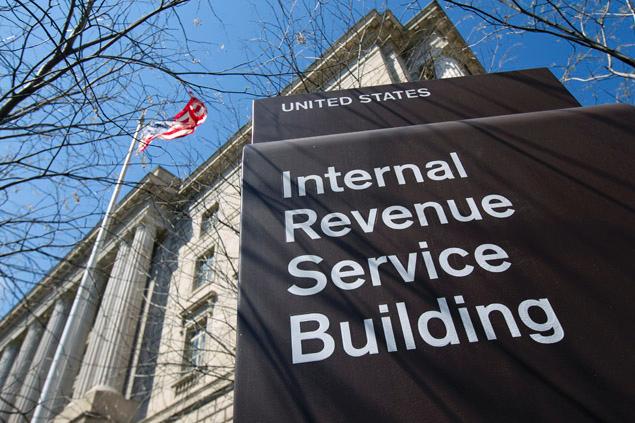
The IRS, currently in the midst of scandals involving the targeting of conservative groups and lavish taxpayer-funded conferences, is ordering surveillance equipment that includes hidden cameras in coffee trays, plants and clock radios.
The IRS wants to secure the surveillance equipment quickly – it posted a solicitation on June 6 and is looking to close the deal by Monday, June 10. The agency already has a company lined up for the order but is not commenting on the details.
“The Internal Revenue Service intends to award a Purchase Order to an undisclosed Corporation,” reads the solicitation.
“The following descriptions are vague due to the use and nature of the items,” it says.
“If you feel that you can provide the following equipment, please respond to this email no later than 4 days after the solicitation date,” the IRS said.
Among the items the agency will purchase are four “Covert Coffee tray(s) with Camera concealment,” and four “Remote surveillance system(s)” with “Built-in DVD Burner and 2 Internal HDDs, cameras.”
The IRS also is buying four cameras to hide in plants: “(QTY 4) Plant Concealment Color 700 Lines Color IP Camera Concealment with Single Channel Network Server, supports dual video stream, Poe [Power over Ethernet], software included, case included, router included.”
Finishing out the order are four “Color IP Camera Concealment with single channel network server, supports dual video stream, poe, webviewer and cms software included, audio,” and two “Concealed clock radio.”
“Responses to this notice must be received by this office within 3 business days of the date of this synopsis by 2:00 P.M. EST, June 10, 2013,” the IRS said. Interested vendors are to contact Ricardo Carter, a Contract Specialist at the IRS.
“If no compelling responses are received, award will be made to the original solicited corporation,” the IRS said.
The original solicitation was only available to private companies for bids for 19 business hours.
The notice was posted at 11:07 a.m. on June 6 and had a deadline of 2:00 p.m. on Monday. Taking a normal 9-to-5 work week, the solicitation was open for bids for six hours on Thursday, eight hours on Friday, and five hours on Monday, for a total of 19 hours.
The response date was changed on Monday, pushed back to 2:00 p.m. on Tuesday, June 11.
The location listed for the solicitation is the IRS’s National Office of Procurement, in Oxon Hill, Md.
“The Procurement Office acquires the products and services required to support the IRS mission,” according to its website.
In recent weeks the IRS has been at the center of multiple scandals, admitting to targeting Tea Party groups and subjecting them to greater scrutiny when applying for non-profit status during the 2010 and 2012 elections.
A report by the Treasury Inspector General for Tax Administration revealed that groups with names like “patriot” in their titles were singled out, required to complete lengthy personal questionnaires (often multiple times) and having their nonprofit status delayed, sometimes for more than three years.
Last week a second Inspector General report detailed nearly $50 million in wasteful spending by the agency on conferences, in which employees stayed at luxurious Las Vegas hotels, paid a keynote speaker $17,000 to paint a picture of U2 singer Bono, and spent $50,000 on parody videos of “Star Trek.”
Requests for comment from the IRS and Mr. Carter were not returned before this story was posted.
CNSNews.com asked IRS spokesmen Dean Patterson and Anthony Burke to explain the reasoning behind the solicitation, where the surveillance equipment will be used, why the request was so urgent, and whether the request has anything to do with the recent scandals at the IRS.
via CNSnews.com
Jun 17, 2013 | WAR: By Design

If twitter is any gauge, a lot of people think this article in Wired about General Keith Alexander is just all kinds of kewl:
General Keith Alexander, a man few even in Washington would likely recognize. Never before has anyone in America’s intelligence sphere come close to his degree of power, the number of people under his command, the expanse of his rule, the length of his reign, or the depth of his secrecy. A four-star Army general, his authority extends across three domains: He is director of the world’s largest intelligence service, the National Security Agency; chief of the Central Security Service; and commander of the US Cyber Command. As such, he has his own secret military, presiding over the Navy’s 10th Fleet, the 24th Air Force, and the Second Army.
Alexander runs the nation’s cyberwar efforts, an empire he has built over the past eight years by insisting that the US’s inherent vulnerability to digital attacks requires him to amass more and more authority over the data zipping around the globe. In his telling, the threat is so mind-bogglingly huge that the nation has little option but to eventually put the entire civilian Internet under his protection, requiring tweets and emails to pass through his filters, and putting the kill switch under the government’s forefinger. “What we see is an increasing level of activity on the networks,” he said at a recent security conference in Canada. “I am concerned that this is going to break a threshold where the private sector can no longer handle it and the government is going to have to step in.”
In its tightly controlled public relations, the NSA has focused attention on the threat of cyberattack against the US—the vulnerability of critical infrastructure like power plants and water systems, the susceptibility of the military’s command and control structure, the dependence of the economy on the Internet’s smooth functioning. Defense against these threats was the paramount mission trumpeted by NSA brass at congressional hearings and hashed over at security conferences.
But there is a flip side to this equation that is rarely mentioned: The military has for years been developing offensive capabilities, giving it the power not just to defend the US but to assail its foes. Using so-called cyber-kinetic attacks, Alexander and his forces now have the capability to physically destroy an adversary’s equipment and infrastructure, and potentially even to kill. Alexander—who declined to be interviewed for this article—has concluded that such cyberweapons are as crucial to 21st-century warfare as nuclear arms were in the 20th.
And he and his cyberwarriors have already launched their first attack. The cyberweapon that came to be known as Stuxnet was created and built by the NSA in partnership with the CIA and Israeli intelligence in the mid-2000s. The first known piece of malware designed to destroy physical equipment, Stuxnet was aimed at Iran’s nuclear facility in Natanz. By surreptitiously taking control of an industrial control link known as a Scada (Supervisory Control and Data Acquisition) system, the sophisticated worm was able to damage about a thousand centrifuges used to enrich nuclear material.
The success of this sabotage came to light only in June 2010, when the malware spread to outside computers. It was spotted by independent security researchers, who identified telltale signs that the worm was the work of thousands of hours of professional development. Despite headlines around the globe, officials in Washington have never openly acknowledged that the US was behind the attack. It wasn’t until 2012 that anonymous sources within the Obama administration took credit for it in interviews with The New York Times.
But Stuxnet is only the beginning. Alexander’s agency has recruited thousands of computer experts, hackers, and engineering PhDs to expand US offensive capabilities in the digital realm. The Pentagon has requested $4.7 billion for “cyberspace operations,” even as the budget of the CIA and other intelligence agencies could fall by $4.4 billion. It is pouring millions into cyberdefense contractors. And more attacks may be planned.
I don’t suppose the American public have any business knowing if their government is launching such attacks. Why would we? What could possibly go wrong?
Inside the government, the general is regarded with a mixture of respect and fear, not unlike J. Edgar Hoover, another security figure whose tenure spanned multiple presidencies. “We jokingly referred to him as Emperor Alexander—with good cause, because whatever Keith wants, Keith gets,” says one former senior CIA official who agreed to speak on condition of anonymity. “We would sit back literally in awe of what he was able to get from Congress, from the White House, and at the expense of everybody else.”
Now 61, Alexander has said he plans to retire in 2014; when he does step down he will leave behind an enduring legacy—a position of far-reaching authority and potentially Strangelovian powers at a time when the distinction between cyberwarfare and conventional warfare is beginning to blur. A recent Pentagon report made that point in dramatic terms. It recommended possible deterrents to a cyberattack on the US. Among the options: launching nuclear weapons.
Like I said, what could possibly go wrong?
When the Guardian revealed this program the other day there was a spirited debate about whether this, unlike the other programs, was something we should welcome and expect. My problem with it wasn’t that the government was creating plans to defend against attacks on US cyber-infrastructure or even war plans in case such a thing happened. What I found questionable was the idea that this was conceived as 21st Century offensive war planning, and and in ways that do not necessarily fall within the traditional “national security” boundaries.
When it comes to cyber issues, I’m afraid we are seeing a confluence of commerce and security that everyone should stop and think about for a minute. How are these people defining the “national interest” and on whose behalf are they planning to launch cyberwar? What are the consequences of doing such a thing and who decides that it must be done?
And what do we think about paying huge amounts of taxpayer dollars to contractors like this?
Defense contractors have been eager to prove that they understand Alexander’s worldview. “Our Raytheon cyberwarriors play offense and defense,” says one help-wanted site. Consulting and engineering firms such as Invertix and Parsons are among dozens posting online want ads for “computer network exploitation specialists.” And many other companies, some unidentified, are seeking computer and network attackers. “Firm is seeking computer network attack specialists for long-term government contract in King George County, VA,” one recent ad read. Another, from Sunera, a Tampa, Florida, company, said it was hunting for “attack and penetration consultants.”
One of the most secretive of these contractors is Endgame Systems, a startup backed by VCs including Kleiner Perkins Caufield & Byers, Bessemer Venture Partners, and Paladin Capital Group. Established in Atlanta in 2008, Endgame is transparently antitransparent. “We’ve been very careful not to have a public face on our company,” former vice president John M. Farrell wrote to a business associate in an email that appeared in a WikiLeaks dump. “We don’t ever want to see our name in a press release,” added founder Christopher Rouland. True to form, the company declined Wired’s interview requests.
[…]
Bonesaw also contains targeting data on US allies, and it is soon to be upgraded with a new version codenamed Velocity, according to C4ISR Journal. It will allow Endgame’s clients to observe in real time as hardware and software connected to the Internet around the world is added, removed, or changed. But such access doesn’t come cheap. One leaked report indicated that annual subscriptions could run as high as $2.5 million for 25 zero-day exploits.
The buying and using of such a subscription by nation-states could be seen as an act of war. “If you are engaged in reconnaissance on an adversary’s systems, you are laying the electronic battlefield and preparing to use it,” wrote Mike Jacobs, a former NSA director for information assurance, in a McAfee report on cyberwarfare. “In my opinion, these activities constitute acts of war, or at least a prelude to future acts of war.” The question is, who else is on the secretive company’s client list? Because there is as of yet no oversight or regulation of the cyberweapons trade, companies in the cyber-industrial complex are free to sell to whomever they wish. “It should be illegal,” says the former senior intelligence official involved in cyberwarfare. “I knew about Endgame when I was in intelligence. The intelligence community didn’t like it, but they’re the largest consumer of that business.”
There are some serious implications to all of this that need to be hashed out by the American people. Of course we need to have defenses against cyber attacks. I don’t think anyone in the country thinks otherwise. But this looks like it could be a monumental financial boondoggle that is in great danger of running amok and causing some very serious problems. Frankly, this scares me much more than the threat that some would-be is going to get a hold of some beauty supplies and blow himself up.
Islamic terrorism is not and never has been an existential threat. This, I’m not so sure about. We should at least have a little chat about it before we let Cyber Buck Turgidson and his friends run wild.
by Digby
Jun 17, 2013 | Government Agenda
A new vaccine for influenza has hit the market, and it is the first ever to contain genetically-modified (GM) proteins derived from insect cells. According to reports, the U.S. Food and Drug Administration (FDA) recently approved the vaccine, known as Flublok, which contains recombinant DNA technology and an insect virus known as baculovirus that is purported to help facilitate the more rapid production of vaccines.
According to Flublok’s package insert, the vaccine is trivalent, which means it contains GM proteins from three different flu strains. The vaccine’s manufacturer, Protein Sciences Corporation (PSC), explains that Flublok is produced by extracting cells from the fall armyworm, a type of caterpillar, and genetically altering them to produce large amounts of hemagglutinin, a flu virus protein that enables the flu virus itself to enter the body quickly.
So rather than have to produce vaccines the “traditional” way using egg cultures, vaccine manufacturers will now have the ability to rapidly produce large batches of flu virus protein using GMOs, which is sure to increase profits for the vaccine industry. But it is also sure to lead to all sorts of serious side effects, including the deadly nerve disease Guillain-Barre Syndrome (GSB), which is listed on the shot as a potential side effect.
“If Guillain-Barre Syndrome (GBS) has occurred within six weeks of receipt of a prior influenza vaccine, the decision to give Flublock should be based on careful consideration of the potential benefits and risks,” explains a section of the vaccine’s literature entitled “Warnings and Precautions.” Other potential side effects include allergic reactions, respiratory infections, headaches, fatigue, altered immunocompetence, rhinorrhea, and myalgia.
According to clinical data provided by PSC in Flublok’s package insert, two study participants actually died during trials of the vaccine. But the company still insists Flublok is safe and effective, and that it is about 45 percent effective against all strains of influenza in circulation, rather than just one or two strains.
FDA also approves flu vaccine containing dog kidney cells
Back in November, the FDA also approved a new flu vaccine known as Flucelvax that is actually made using dog kidney cells. A product of pharmaceutical giant Novartis, Flucelvax also does away with the egg cultures, and can similarly be produced much more rapidly than traditional flu vaccines, which means vaccine companies can have it ready and waiting should the federal government declare a pandemic.
Like Flublok, Flucelvax was made possible because of a $1 billion, taxpayer-funded grant given by the U.S. Department of Health and Human Services (HHS) to the vaccine industry back in 2006 to develop new manufacturing methods for vaccines. The ultimate goal is to be able to quickly manufacture hundreds of millions of vaccines for rapid distribution.
Meanwhile, there are reportedly two other GMO flu vaccines currently under development. One of them, which is being produced by Novavax, will utilize “bits of genetic material grown in caterpillar cells called ‘virus-like particles’ that mimic a flu virus,” according to Reuters.
via GlobalResearch.ca
Jun 17, 2013 | Government Agenda, Leaks, News
The Obama regime which was already in the midst of three high profile scandals now has a fourth one to deal with. Top secret documents were recently leaked to the Washington Post and the London Guardian detailing a vast government surveillance program code named PRISM. According to the leaked documents, the program allows the National Security Agency (NSA) back door access to data from the servers of several leading U.S. based Internet and software companies. The documents list companies such as Google, Facebook, Yahoo, Microsoft, AOL and Apple as some of the participants in the program. There have also been other reports indicating that the NSA is able to access real-time user data from as many as 50 separate American companies. Under the program, the NSA is able to collect information ranging from e-mails, chats, videos, photographs, VoIP calls and more. Most importantly is the fact that PRISM allows the NSA to obtain this data without having to make individual requests from the service providers or without having to obtain a court order. To say that this is a violation of the Fourth Amendment which forbids unreasonable searches and seizures would be a gross understatement. This is actually much more than that. This is a program designed specifically to serve as a Big Brother like control grid and to end privacy as we know it.

The NSA is quickly building a real life version of 1984’s Big Brother.
In some ways this is not really a new story. This is just confirmation of what many people involved in the alternative research community have known for years. Going as far back as the 1990s there were reports revealing how Microsoft provided the NSA with back door access to their Windows operating system. Google’s cozy relationship with the NSA has also been discussed off and on over the past decade. There have even been other whistleblowers that have come forward previously detailing a number of unconstitutional and unlawful abuses conducted by the agency. This includes revelations of how the NSA was spying on American service members stationed overseas. The only difference with this is that these newly leaked documents provide definitive details on just how wide reaching the NSA’s activities have become.
It is now painfully obvious that James Clapper the Director of National Intelligence when testifying before the Senate this past March blatantly lied when asked by Senator Ron Wyden if the NSA was involved in collecting data from the American people. Clapper flatly denied that the NSA was engaged in these types of domestic surveillance activities. What makes the situation such a joke is that the Obama regime is not focused on the fact that Clapper lied to the Senate which in of itself is unlawful. Instead they have been more focused on determining the source of the leak that exposed these broad abuses of power. This is probably not surprising considering that this is a regime that rewards corruption by promoting people involved in all sorts of questionable activity. The promotion of Susan Rice as Obama’s new National Security Advisor is a perfect example of this considering her involvement in spreading bogus Benghazi related talking points. On the other hand, the Obama regime has severely punished a variety of whistleblowers who have dared to expose any wrong doing.
At least the Obama regime won’t have to spend much time and energy trying to identify the whistleblower as this person who leaked these documents has already come forward publically. At his own request the Guardian revealed his identity as Edward Snowden a 29-year old Information Technology specialist who has been working at the NSA for different contractors including Booz Allen Hamilton and Dell. Snowden had previously worked at an NSA office in Hawaii but boarded a flight to Hong Kong a few weeks ago where he has stayed since turning over these documents to the media. He expects that he will never set foot on U.S. soil again and may possibly seek political asylum in a country like Iceland. The Guardian interviewed Snowden over several days and has recently posted an interview transcript that provides more detail on the abuses he became aware of and why he decided to come forward as a whistleblower. In the interview Snowden confirms that the NSA has the infrastructure that allows them to intercept almost any type of data that you can imagine from phone records, e-mails to credit cards. He also reveals how the U.S. government is engaged in hacking systems everywhere around the world and how the NSA has consistently lied to Congress about their activities. There is little doubt that Snowden is thus far one of the most important whistleblowers to come along in the 21st century and he will likely face retaliation considering the vast reach and capabilities of the U.S. intelligence community.
Many individuals within the Obama regime including Obama himself have claimed that this type of widespread data collection is needed to fight terrorism and is used for national security purposes. Even if we were to assume that the war on terror is real, this claim is ridiculous and absurd on its face. It would be one thing if they were collecting information based upon a specific criteria identified by legitimate human intelligence. Instead they are collecting indiscriminate amounts of information which makes it much more difficult to analyze and target anything that might indicate a potential threat. If the NSA’s goal is really to detect and target terrorism than all they are doing is making their job more difficult by vastly increasing the noise they have to filter through. Either the people running the NSA are incredibly stupid or the goal of this program is to establish the infrastructure necessary to centrally collect data from communications everywhere around the world.
Other evidence to support this notion is the fact that the NSA is building a huge new facility in Utah that is being designed to store an enormous amount of data. A Fox News report indicates that when completed the facility will be able to store billions of terabytes worth of information. It is hard to fathom how the NSA would need this much storage space unless it was being used to collect and store any and all communications.
The Obama regime has tried to justify all of this by saying that PRISM helped stop an alleged New York City subway bomb plot back in 2009. This has been proven to be factually incorrect as regular police work and help from the British were larger factors in stopping the plot. This is assuming you even believe the official story of this terror plot to begin with. The government and more specifically the FBI have manufactured so many fake terror plots that it is difficult to determine fact from fiction at this point. So with this said, there is really no proof that PRISM has even helped to stop any so-called terror plot. They are collecting information simply for the sake of collecting information with no probable cause or reasonable justification.
At this point it is an undeniable fact that the NSA has been illegally collecting information on the American people. For years what has been dismissed as conspiracy theory is now without question a conspiracy fact. It is laughable that Obama and his assorted cronies are even trying to defend this program as a useful tool to fight terrorists. It is more likely that this program is being used to help find people domestically who dislike the government and would potentially fight back against it. A striking similarity to what is depicted in George Orwell’s dystopic novel 1984 where political dissidents are identified as thought criminals. A tool the NSA uses called Boundless Informant which counts and categorizes the information they collect shows that more data is actually gathered from domestic sources in the U.S. than from Russia. So based off of this one could argue that the NSA almost seems to view the American people as more of a threat to national security than the Russians.
The three scandals the Obama regime was dealing with prior to this new scandal are all grounds for impeachment and one could easily argue that this one is many times worse than the previous three. Obama should resign in disgrace but being that he’s a narcissist who seems unwilling to admit making any mistakes it is highly doubtful he will do this. Obama and the rest of the useful idiots in his regime who have tried to defend and justify this and other criminal programs need to be forcibly removed from office and put on trial. The criminal activity from the Obama regime is so vastly transparent it has become a complete and total joke to anyone who is even remotely paying attention.
Source: Lee Rogers, Blacklisted News
Apr 23, 2013 | Events & Assassinations, News
Will we ever learn the full truth about the Boston Marathon bombing? Personally, I have been looking into this attack for days, and I just keep coming up with more questions than answers. At this point, I honestly have no idea what really happened. Why was a bomb drill being held on the day of the attack? Why have authorities denied that a bomb drill was taking place? Were Tamerlan and Dzhokhar Tsarnaev acting alone? What was the nature of their previous contacts with the FBI and other federal agencies? Why did the FBI at first deny that they had been in contact with the Tsarnaev brothers previously? Why was the investigation of a mysterious Saudi national with familial links to al-Qaeda suddenly dropped shortly after the Saudi ambassador held an unscheduled meeting with Barack Obama? Why did Michelle Obama subsequently visit that mysterious Saudi national in the hospital? If you are looking for answers to these questions, I am afraid that I don’t have them at this point. But what alarms me is that the mainstream media seems to be afraid to ask any of the hard questions that they should be asking. They just seem to swallow whatever the authorities tell them hook, line and sinker without following up on any of the things in this case that simply do not seem to make sense.
So what kinds of questions should they be asking? The following are 17 unanswered questions about the Boston Marathon bombing that the media appears to be afraid to ask…
#1 Why were runners being told that a bomb squad drill was taking place during the Boston Marathon? The following is from an article by Natural News…
Alastair Stevenson is a veteran marathon runner who has competed in dozens of marathons around the world, including the London Marathon. He’s very familiar with the security typically found at marathons, and he immediately noticed something odd about the Boston marathon security.
“They kept making announcements on the loud speaker that it was just a drill and there was nothing to worry about. It seemed like there was some sort of threat, but they kept telling us it was just a drill,” he was quoted as saying by Local15TV.com.
In the interview, you’ll hear Stevenson say:
“At the start at the event, at the Athlete’s Village, there were people on the roof looking down onto the Village at the start. There were dogs with their handlers going around sniffing for explosives, and we were told on a loud announcement that we shouldn’t be concerned and that it was just a drill. And maybe it was just a drill, but I’ve never seen anything like that — not at any marathon that I’ve ever been to. You know, that just concerned me that that’s the only race that I’ve seen in my life where they had dogs sniffing for explosions, and that’s the only place where there had been explosions.”
#2 Why did authorities deny that a bomb squad drill was being held?
#3 According to The Mirror, the FBI is reportedly “hunting” a 12-strong terrorist “sleeper cell” that Tamerlan and Dzhokhar Tsarnaev were allegedly a part of…
A source close to the investigation said: “We have no doubt the brothers were not acting alone. The devices used to detonate the two bombs were highly sophisticated and not the kind of thing people learn from Google.
“They were too advanced. Someone gave the brothers the skills and it is now our job to find out just who they were. Agents think the sleeper cell has up to a dozen members and has been waiting several years for their day to come.”
If that is the case, why are authorities in Boston adamantly insisting that the two brothers were acting alone?
#4 CBS News is reporting that the FBI interviewed Tamerlan Tsarnaev back in 2011. The mother of the two Tsarnaev brothers insists that the FBI had been in contact with them for up to five years. At first, the FBI denied any previous contact with the two suspects. Will we ever learn the true scope of the previous relationship between the FBI and the Tsarnaev brothers?
#5 Debka is reporting that the Tsarnaev brothers were “double agents” which had been “hired by US and Saudi intelligence to penetrate the Wahhabi jihadist networks which, helped by Saudi financial institutions, had spread across the restive Russian Caucasian.” Could this possibly be true? If so, will the American people be told the truth about these links?
#6 According to their uncle, there were “mentors” that “radicalized” the Tsarnaev brothers. So precisely who were those “mentors”?
#7 What happened during Tamerlan Tsarnaev’s trip to Dagestan and Chechnya last year?
#8 Were the Tsarnaev brothers in contact with a rebel leader named Doku Umarov who is known as “Russia’s Bin Laden”?
#9 Did Tamerlan Tsarnaev post a video on YouTube last summer that expresses a belief that the 12th Imam, Mahdi, will soon come and that an Islamic army with black flags with arise out of a province in Iran known as Khorasan?
#10 Why aren’t we being told that the “pressure cooker bombs” used in the Boston Marathon attacks are very similar to the kind of pressure cooker bombs that are commonly used in the Middle East?…
The Daily Beast has confirmed with U.S. counter-terrorism officials that the bombs placed Monday at the marathon were made from pressure cookers, a crude kind of explosive favored by insurgents in Pakistan and Afghanistan. A recipe for a bomb that uses the pressure cooker was part of the debut issue of Inspire, the English-language online magazine of al Qaeda in the Arabian Peninsula.
#11 Initially we were told that Saudi national Abdulrahman Ali Alharbi was a “person of interest” in the case. But now he is scheduled to leave the country with the full blessing of the U.S. government. Why is there such a rush to get him out of the United States?
#12 Why aren’t we being told that Abdulrahman Ali Alharbi was photographed with two other Saudis in the vicinity of the Boston marathon bombings?
#13 Why aren’t we being told of the shocking familial links that Abdulrahman Ali Alharbi has to known members of al-Qaeda? The following is from research complied by Walid Shoebat…
Many from Al-Harbi’s clan are steeped in terrorism and are members of Al-Qaeda. Out of a list of 85 terrorists listed by the Saudi government shows several of Al-Harbi clan to have been active fighters in Al-Qaeda:
#15 Badr Saud Uwaid Al-Awufi Al-Harbi
#73 Muhammad Atiq Uwaid Al-Awufi Al-Harbi
#26 Khalid Salim Uwaid Al-Lahibi Al-Harbi
#29 Raed Abdullah Salem Al-Thahiri Al-Harbi
#43 Abdullah Abdul Rahman Muhammad Al-Harbi (leader)
#60 Fayez Ghuneim Humeid Al-Hijri Al-Harbi
Source: http://aalhameed1.net/vb/showthread.php?t=1565
Then you have Al-Harbi clan members in Gitmo:
Salim Salman Awadallah Al-Sai’di Al-Harbi
Majid Abdullah Hussein Al-Harbi
Muhammad Abdullah Saqr Al-Alawi Al-Harbi
Ghanem Abdul Rahman Ghanem Al-Harbi
Muhammad Atiq Uwaid Al-Awfi Al-Harbi
Source: http://www.muslm.net/vb/showthread.php?169019-أسماء-(90)-سعودياً-لا-زالوا-محتجزين-في-جوانتانامو
There are specific Saudi clans that are rife with members of Al-Qaeda, which makes it quite alarming as to why nearly a hundred thousand student visas are issued to these. Americans are clueless as to clan ties when it comes to terrorism.
#14 Why did U.S. Secretary of State John Kerry have a private meeting with a Saudi foreign minister shortly after Abdulrahman Ali Alharbi was identified as a potential suspect?
#15 Why did Barack Obama hold an unscheduled meeting with the ambassador from Saudi Arabia shortly after Abdulrahman Ali Alharbi was identified as a potential suspect?
#16 Why did Michelle Obama visit Abdulrahman Ali Alharbi in the hospital?
#17 Why did numerous mainstream media outlets openly suggest that “right-wing extremists” were behind the bombings in the immediate aftermath of the attack?
via EndofTheAmericanDream.com
Apr 9, 2013 | Abuses of Power, News

Many documents produced by the U.S. government are confidential and not released to the public for legitimate reasons of national security. Others, however, are kept secret for more questionable reasons. The fact that presidents and other government officials have the power to deem materials classified provides them with an opportunity to use national security as an excuse to suppress documents and reports that would reveal embarrassing or illegal activities.
I’ve been collecting the stories of unreleased documents for several years. Now I have chosen 11 examples that were created—and buried—by both Democratic and Republican administrations and which cover assassinations, spying, torture, 50-year-old historical events, presidential directives with classified titles and…trade negotiations.
1. Obama Memo Allowing the Assassination of U.S. Citizens
When the administration of George W. Bush was confronted with cases of Americans fighting against their own country, it responded in a variety of ways. John Walker Lindh, captured while fighting with the Taliban in December 2001, was indicted by a federal grand jury and sentenced to 20 years in prison. José Padilla was arrested in Chicago in May 2002 and held as an “enemy combatant” until 2006 when he was transferred to civilian authority and, in August 2007, sentenced to 17 years in prison for conspiring to support terrorism. Adam Gadahn, who has made propaganda videos for al-Qaeda, was indicted for treason in 2006 and remains at large.
After he took over the presidency, Barack Obama did away with such traditional legal niceties and decided to just kill some Americans who would previously have been accused of treason or terrorism. His victims have included three American citizens killed in Yemen in 2011 by missiles fired from drones: U.S.-born anti-American cleric Anwar al-Awlaki, Samir Khan, an al-Qaeda propagandist from North Carolina, and Awlaki’s 16-year-old son, Abdulrahman al-Awlaki.
Obama justified his breach of U.S. and international law with a 50-page memorandum prepared by the Justice Department’s Office of Legal Counsel. Attorney General Eric Holder argued that the killing of Awlaki was legal because he was a wartime enemy and he could not be captured, but the legal justification for this argument is impossible to confirm because the Obama administration has refused to release the memo.
2. The Obama Interpretation of Section 215 of the Patriot Act
Section 215 of the Patriot Act allows the FBI, in pursuit of spies and terrorists, to order any person or entity to turn over “any tangible things” without having to justify its demands by demonstrating probable cause. For example, a library can be forced to reveal who borrowed a book or visited a web site. According to Section 215, the library is prohibited from telling anyone what it has turned over to the FBI.
The Obama administration has created a secret interpretation of Section 215 that goes beyond the direct wording of the law to include other information that can be collected. Democratic Senator Ron Wyden of Oregon, who, as a member of the Senate Intelligence Committee, was briefed about this secret interpretation, urged the president to make it public. “I want to deliver a warning this afternoon,” he said. “When the American people find out how their government has secretly interpreted the Patriot Act, they will be stunned and they will be angry.”
Wyden and Sen. Mark Udall of Colorado, also a Democrat, have implied that the Obama administration has expanded the use of Section 215 to activities other than espionage and terrorism. In a letter to Attorney General Eric Holder, Wyden and Udall wrote that “there is now a significant gap between what most Americans think the law allows and what the government secretly claims the law allows. This is a problem, because it is impossible to have an informed public debate about what the law should say when the public doesn’t know what its government thinks the law says.”
3. 30-page Summary of 9/11 Commission Interview with Bush and Cheney
You would have thought that, in the interests of the nation, the Bush administration would have demanded a thorough investigation of the terrorist attacks of September 11, 2001, the deadliest assault ever on U.S. soil. Instead, they fought tooth and nail against an independent investigation. Public pressure finally forced President George W. Bush to appoint a bipartisan commission that came to be known as the 9/11 Commission. It was eventually given a budget of $15 million…compared to the $39 million spent on the Monica Lewinsky/Bill Clinton investigation. When the commission completed its work in August 2004, the commissioners turned over all their records to the National Archives with the stipulation that the material was to be released to the public starting on January 2, 2009. However, most of the material remains classified. Among the more tantalizing still-secret documents are daily briefings given to President Bush that reportedly described increasingly worried warnings of a possible attack by operatives of Osama bin Laden.
Another secret document that the American people deserve to see is the 30-page summary of the interview of President Bush and Vice-President Dick Cheney conducted by all ten commissioners on April 29, 2004. Bush and Cheney refused to be interviewed unless they were together. They would not testify under oath and they refused to allow the interview to be recorded or transcribed. Instead the commission was allowed to bring with them a note taker. It is the summary based on this person’s notes that remains sealed.
4. Memos from President George W. Bush to the CIA Authorizing Waterboarding and other Torture Techniques
Four days after the terrorist attacks of September 11, 2001, President George W. Bush signed a “memorandum of notification” (still secret) that authorized the CIA to do what it needed to fight al-Qaeda. However the memo did not address what interrogation and torture techniques could be used on captured suspects. By June 2003, Director George Tenet and others at the CIA were becoming worried that if their seemingly illegal tactics became known to the public, the White House would deny responsibility and hang the CIA out to dry. After much discussion, Bush’s executive office handed over two memos, one in 2003 and another in 2004, confirming White House approval of the CIA interrogation methods, thus giving the CIA “top cover.” It is not known if President Bush himself signed the memos.
5. 1,171 CIA Documents Related to the Assassination of President Kennedy
It’s been 49 years since President John F. Kennedy was shot to death in Dallas, yet the National Archives and Records Administration (NARA) insists that more than one thousand documents relating to the case should not be released to the public until NARA is legally required to do so in 2017…unless the president at that time decides to extend the ban. It would appear that some of the blocked material deals with the late CIA agent David Phillips, who is thought to have dealt with Lee Harvey Oswald in Mexico City six weeks before the assassination.
6. Volume 5 of the CIA’s History of the Bay of Pigs Fiasco
In the late 1970s and early 1980s, CIA historian Dr. Jack B. Pfeiffer compiled a multi-volume history of the failed US attempt to invade Cuba in April 1961. In August 2005, the National Security Archive at George Washington University, citing the Freedom of Information Act, requested access to this history. The CIA finally released the information almost six years later, in July 2011. However it refused to release Volume V, which is titled “CIA’s Internal Investigation of the Bay of Pigs Operations.” Although more than 50 years have passed since the invasion, the U.S. District Court for the District of Columbia ruled that Volume V is exempt from the Freedom of Information Act because it “is covered by the deliberative process privilege” which “covers documents reflecting advisory opinions, recommendations and deliberations comprising part of a process by which governmental decisions and policies are formulated.”
7. National Security Decision Directives with Classified Titles
The day before he left the White House on January 20, 1993, President George H. W. Bush issued National Security Directive (NSD) #79, a document so secret that even its title remains classified almost 20 years later. The same goes for National Security Directive #77, issued a few days earlier, as well as four others issued in 1989 (#11, 13a, 19a and 25a). If the “a”s are any indication of the subjects, it is worth noting that NSD 13 dealt with countering cocaine trafficking in Peru; NSD 19 dealt with Libya and NSD 25 with an election in Nicaragua.
President Ronald Reagan also issued six NSDs with classified titles, and President Bill Clinton issued 29. President George W. Bush issued two such NSDs, presumably shortly after the terrorist attacks of September 11, 2001. President Barack Obama has issued at least seven Presidential Policy Directives with classified titles.
8. Major General Douglas Stone’s 700-Page Report on Prisoners Held in Afghanistan
Marine Corps General Douglas Stone earned positive reviews for his revamping of detention operations in Iraq, where he determined that most of the prisoners held by the United States were not actually militants and could be taught trades and rehabilitated. Based on his success in Iraq, Stone was given the task of making an evaluation of detainee facilities in Afghanistan. His findings, conclusions and recommendations were included in a 700-page report that he submitted to the U.S. Central Command in August 2009. According to some accounts of the report, Stone determined that two-thirds of the Afghan prisoners were not a threat and should be released. However, three years after he completed it, Stone’s report remains classified.
9. Detainee Assessment Briefs for Abdullah Tabarak and Abdurahman Khadr
In 2011, WikiLeaks released U.S. military files known as Detainee Assessment Briefs (DABs), which describe the cases of 765 prisoners held at Guantánamo Bay. However, there were actually 779 prisoners. So what happened to the files for the other fourteen? Andy Worthington, author of The Guantanamo Files, has noted that two of the fourteen missing stories are especially suspicious: those of Abdullah Tabarak and Abdurahman Khadr.
Tabarak, a Moroccan, was allegedly one of Osama bin Laden’s long-time bodyguards, and took over bin Laden’s satellite phone in order to draw U.S. fire to himself instead of to bin Laden when U.S. forces were chasing the al-Qaeda leader in the Tora Bora mountains in December 2001. Captured and sent to Guantánamo, Tabarak was mysteriously released, sent back to Morocco in July 2003, and set free shortly thereafter.
Abdurahman Khadr, the self-described “black sheep” of a militant family from Canada, was 20 years old when he was captured in Afghanistan and turned over to American forces. He has said that he was recruited by the CIA to become an informant at Guantánamo and then in Bosnia. When the CIA tried to send him to Iraq, he refused and returned to Canada. His younger brother, Omar, was 15 years old when he was captured in Afghanistan and accused of killing an American soldier, Sergeant First Class Christopher Speer, during a firefight. He was incarcerated at Guantánamo for almost ten years until he was finally released to Canadian custody on September 29, 2012.
10. FBI Guidelines for Using GPS Devices to Track Suspects
On January 23, 2012, in the case of United States v. Jones, the Supreme Court ruled unanimously that attaching a GPS device to a car to track its movements constitutes a “search” and is thus covered by the Fourth Amendment protecting Americans against “unreasonable searches and seizures.” But it did not address the question of whether the FBI and other law enforcement agencies must obtain a warrant to attach a GPS device or whether it is enough for an agent to believe that such a search would turn up evidence of wrongdoing.
A month later, at a symposium at the University of San Francisco, FBI lawyer Andrew Weissman announced that the FBI was issuing two memoranda to its agents to clarify how the agency would interpret the Supreme Court decision. One memo dealt with the use of GPS devices, including whether they could be attached to boats and airplanes and used at international borders. The second addressed how the ruling applied to non-GPS techniques used by the FBI.
The ACLU, citing the Freedom of Information Act, has requested publication of the two memos because they “will shape not only the conduct of its own agents but also the policies, practices and procedures of other law enforcement agencies—and, consequently, the privacy rights of Americans.”
11. U.S. Paper on Negotiating Position on the Free Trade Agreement of the Americas
The subject of international trade negotiations is one that makes most people’s eyes glaze over. So why is the Obama administration fighting so hard to keep secret a one-page document that relates to early negotiations regarding the Free Trade Agreement of the Americas (FTAA), an accord that was proposed 18 years ago and about which public negotiations ended in 2005? All we know is that the document “sets forth the United States’ initial proposed position on the meaning of the phrase ‘in like circumstances.’” This phrase “helps clarify when a country must treat foreign investors as favorably as local or other foreign investors.”
Responding to a Freedom of Information Act lawsuit filed by The Center for International Environmental Law, DC District Judge Richard W. Roberts ordered the Office of the United States Trade Representative (USTR) to release the document, but the Obama administration has refused, claiming that disclosure “reasonably could be expected to result in damage to the national security” because all the nations involved in the failed negotiations agreed to keep all documents secret until December 31, 2013…“unless a country were to object to the release of one of its own documents at that time.” Judge Roberts ruled that the USTR has failed to present any evidence that release of the document would damage national security.
Most likely, the Obama administration is afraid that release of the document would set a precedent that could impede another secret trade negotiation, the Trans-Pacific Partnership (TPP), also known as the Trans-Pacific Strategic Economic Partnership Agreement, which seeks to establish a free trade zone among the U.S., New Zealand, Chile, Singapore, Brunei, Australia, Peru, Vietnam, Malaysia and possibly Canada, Mexico and Japan.
Apr 9, 2013 | Events & Assassinations

New details have emerged that shed light on the chaos that embroiled the Benghazi mission on 9/11/2012 that led to the murder of Ambassador Christopher Stevens and three other Americans at the hands of the very anti-Qaddafi rebels that Stevens formally liaised with for the CIA.
It wasn’t a secret that Ambassador Christopher Stevens played a key role in Libya’s “Arab Spring.” During the course of the revolution that ultimately toppled Muammar Qaddafi, Stevens’ built a relationship with the Libyan rebels and it’s this experience that made him the frontrunner for the Libyan ambassadorship. Stevens’ history of working with Libyan radicals provided the perfect opportunity for the Obama administration to covertly move newly purchased weapons from Libya’s freedom fighters to Syrian insurgents via ships through Turkey.
In March 2011 Stevens became the official U.S. liaison to the al-Qaeda-linked “Libyan opposition, working directly with Abdelhakim Belhadj of the Libyan Islamic Fighting Group—a group that has now disbanded, with some fighters reportedly participating in the attack that took Stevens’ life.”
Former CIA officer Clare Lopez said, “That means Stevens was authorized by the U.S. Department of State and the Obama administration to aid and abet individuals and groups that were, at a minimum, allied ideologically with al-Qaeda, the jihadist terrorist organization that attacked the homeland on the first 9/11, the one that’s not supposed to exist anymore after the killing of its leader, Osama bin Laden, on May 2, 2011.”
Obama’s weapon buyback program in Libya
Couple this with the weapon buyback program offered by the Obama administration and there’s a recipe for catastrophe.
Shortly after the October 2011 death of Qaddafi, Secretary of State Hillary Clinton announced in Tripoli that the U.S. was committing $40 million to help Libya “secure and recover its weapons stockpiles.” Department of State Assistant Secretary Andrew Shapiro confirms DOS had a weapons buy-back program in Libya that was also supported by the UK who gave $1.5 million, the Netherlands gave $1.2 million, Germany gave about $1 million and our neighbor to the north, Canada gave $1.6 million to purchase the deadly arsenal that went missing after the fall of Qaddafi.
The State Department was specifically looking to acquire the 20,000 MANPADS (they are commonly known as man-portable air shoulder-fire missiles) that went missing once Qaddafi was killed.
State Department Assistant Secretary, for Political-Military affairs, Andrew Shapiro said, they did not know how many MANPADs remained missing, but admitted it was a significant number.
“Many militia groups remain reluctant to relinquish them,” Shapiro said. He did say that the U.S. has recovered about 5,000 MANPADs earlier this year.
Repeated calls and emails went unanswered to the State Department and Shapiro regarding an update on the weapon buyback program as well as what the State Department did with the weapons they purchased.
Russia and China complained of U.S. arms trafficking in Syria
Another curious piece to this puzzle is Russia. Did they have a part to play inside Benghazi and was presidential contender, Mitt Romney right that Russia remains a threat to the U.S.? (Story by this reporter here)
The Russian response, under former KGB Cold War foe Valdimir Putin, who was visibly incensed last fall when a jubilant crowd of rebels murdered his ally, Muammar Qaddafi, has described the event as “repulsive and disgusting.”
Shortly after the death of U.S. ambassador in Libya, numerous Russian commentators used social media to describe their position on the destabilization in Libya.
“The democratized residents of Libya thanked the staff of the American Embassy for its support,” one Tweet read. “This is what you call exporting democracy, it seems. America gives Libya a revolution, and Libyans, in return, kill the ambassador.”
Aleksei K. Pushkov, the head of Russia’s parliamentary Foreign Affairs Committee, wrote via Twitter: “Under Qaddafi they didn’t kill diplomats. Obama and Clinton are in shock? What did they expect – ‘Democracy?’ Even bigger surprises await them in Syria,” aNew York Times story read in September.
It is no secret that Putin disagreed with the West’s view of Syrian ruler Assad. When Putin was Prime Minister, he delivered a scathing criticism of the Libya bombing by NATO and left the impression that under his leadership it would have never happened.
It’s also worth pointing out that Russia and China have consistently opposed any military intervention in Syria. Russia and its allies have repeatedly warned the West that efforts to aid Syrian rebels would only bring more bloodshed to an already embattled region. Also, the Russians have been demanding a cessation of U.S. aid to the Syrian rebels fighting President Assad, again noting that any military aid would destabilizes the entire region, and could have serious economic consequences for Russia.
Even Russian Foreign Minister Sergei Lavrov cautioned the West against arming the Syrian rebels. However, theArab Times news agency said, “Western officials say that Russia’s vetoes have abetted the Syrian violence by encouraging Assad to pursue an offensive with his Russian-supplied armed forces to crush the popular revolt. Saudi Arabia and Qatar are believed to have funded arms shipments.”
Case in point, in late August Russia said there was increasing evidence that Syrian rebels were procuring large numbers of Western-made weapons. They even suggested that America and other EU countries were spurring the violence in Syria.
So was Benghazi a message delivered by the Russians to end U.S. gun-running by executing Ambassador Stevens, the kingpin between the armed groups, the Libya stockpiles, and the shipments to Turkey?
Reports are abundant and U.S. acknowledged guns went to Al Qaeda
Despite evidence to the contrary, a State Department spokeswoman rejected the idea of arms trafficking, saying Ambassador Stevens was in Benghazi for diplomatic meetings, and the opening of a new cultural center.
The State Department response rings hollow, however, since the Times of London reported that a Libyan Al Entisar ship was found carrying at least 400 tons of cargo. “Some of it was humanitarian, but also reportedly weapons, described by the report as the largest consignment of weapons headed for Syria’s rebels on the frontlines.”
Middle East expert, Walid Phares confirmed the ship was carrying “a lot of weapons.”
Also former CIA Director Porter Goss told Fox News that some of the weapons from the Libya uprising are making their way to Syria. Goss claimed that the U.S. intelligence is aware of the networking given their presence in Benghazi and throughout the region.
“I think there’s no question that there’s a lot of networking going on. And … of course we know it,” he said. Unfortunately, many of those weapons shipped through Turkey to Syria ended up in the hands of al-Qaeda.
Not so long ago, America armed the Taliban with shoulder-fire missiles to fight a proxy war against the Russians only to find those weapons being used to kill Americans during the “war on terror.” This illustrates once again that arming enemies is never a good idea.
Middle East experts contend the Muslim Brotherhood and its proxy, Libyan Islamic Fighting Group (LIFG) leader Abdulhakim Belhadj, were in direct contact with Stevens and provided information as to which rebel groups in Libya and Syria deserved American trust and more importantly, weapons.
Proof comes from the 2010 classified cablefrom Stevens that read in part: “Development Foundation brokered talks with imprisoned members of the Libyan Islamic Fighting Group (LIFG) that led to the release earlier this year of about 130 former LIFG members. The GOL (Government of Libya) considers the program an important means to signal willingness to reconcile with former enemies, a significant feature of Libya’s tribal culture.”
The Business Insider wrote a story focusing on the export of fighters. “If the new Libyan government was sending seasoned Islamic fighters and 400 tons of heavy weapons to Syria through a port in southern Turkey—a deal brokered by Stevens’ primary Libyan contact during the Libyan revolution—then the governments of Turkey and the U.S. surely knew about it.
Another portion of the 2010 classified cable says, “Libya also cooperates closely with Syria, particularly on foreign fighter flows. Syria has transferred over 100 Libyan foreign fighters to the GOL’s custody over the past two years, including a tranche of 27 in late 2007. Our assessment is that the flow of foreign fighters from Libya to Iraq and the reverse flow of veterans to Libya has diminished due to the GOL’s cooperation with other states and new procedures. Counter-terrorism cooperation is a key pillar of the U.S.-LIBYA bilateral relationship and a shared strategic interest.”
Crowds outside Benghazi mission were presumed buy-back customers
It’s been months since the 9/11 Benghazi attack and no official conclusions have been released. After last week’s Congressional closed-door intelligence briefing, many lawmakers emerged wondering why Ambassador Stevens was not more concerned with the growing boisterous rebel crowd outside the mission’s gates shortly before the attack that would kill him?
Retired Army Lieutenant Colonel and Defense Intelligence Agency operative Anthony Shaffer says he knows the answer. “The Ambassador was expecting a weapon buyback deal shortly before the attack. That knowledge played a role in the slow response and created the initial confusion in Benghazi.”
U.S. rendered no aid to Stevens despite President’s “render all aid” order
While there was no shortage of second-guessing in the White House Situation Room, military leaders in charge of quick response teams a half-a-world away sprang into action upon receipt of the consulate’s 911 call and readied the troops for a real-world rescue.
“As the events were unfolding, the Pentagon began to move special operations forces from Europe to Sigonella Naval Air Station in Sicily. U.S. aircraft routinely fly in and out of Sigonella and there are also fighter jets based in Aviano, Italy. But while the U.S. military was at a heightened state of alert because of 9/11, there were no American forces poised and ready to move immediately into Benghazi when the attack began,” the Military Timesreported.
It’s also been reported that on the fateful day in Libya, CIA/SEALs had a laser target trained on the enemy firing mortar rounds at the compound. The Pentagon has listed numerous explanations as to why the trained SEALs would use the lasers. However, they conveniently omitted the key component—the expectation that U.S. help was seconds away. The “fog of spin” from the Obama administration, no matter how creative, cannot conceal the truth. If fighter aircraft were dispatched to assist Ambassador Chris Stevens and other consulate personnel, a former Naval pilot says, “The paper trail would be a mile long. Not only do the pilots have to file logbook reports, but the ground crew, the crew arming the jets with appropriate weapons and the Italian air controllers would have exhaustive records.”
The President told a KUSA Denver reporter that the minute he found out about the Benghazi attack he directed all available diplomatic and military resources to secure American consular personnel.
Unfortunately for the CIA/SEALs fighting off the Ansar al-Shariah terrorists, the jets would never arrive. The fact, CIA/SEALs were painting their lasers on the enemy targets shortly after midnight, five hours before their eventual deaths, indicates they were expecting air support. And why would they be waiting for air support? Because the trained SEALs knew the oplans (operations plans) and military protocol for this exact operation once they requested the assistance.
U.S. did not undertake an immediate FBI investigation as in USS Cole attack
“There is clear precedence for conducting an investigation into this type of terrorist attack – we faced similar circumstance with the terrorist attack on the USS Cole in October of 2000 in Aden, Yemen,” Shaffer described. “We had to work rapidly to put a qualified team on the ground to investigate one of the most severe acts of terror in the pre-9/11 era. Many of the perpetrators of this attack were eventually killed, captured or eliminated via Predator drone strikes… but in the case of the Benghazi attack there HAS NOT been a rapid or expansive effort made by this White House to establish a clear path forward and begin the hard work of bringing justice to those who died and those who attacked and looted the weapons from the CIA annex -weapons that include Surface to Air missiles that can be used to down civilian airliners.”
The FBI’s own press information concerning the response to the USS Cole bombing in 2000 highlights some key differences between the Benghazi incident and Yemen.
“We quickly sent to Yemen more than 100 agents from our Counterterrorism Division, the FBI Laboratory, and various field offices. Director Louis Freeh arrived soon after to assess the situation and to meet with the President of Yemen. On November 29, a guidance document was signed between the U.S. State Department and the Yemeni government setting protocols for questioning witnesses and suspects. FBI and Yemeni investigators proceeded with interviews, and a large amount of physical evidence was shipped back to the FBI Laboratory for examination.”
So what is the difference between the attack in Yemen against the USS Cole and the terror attack in Benghazi? Shaffer says, “CIA.”
“The CIA and State Department worked to keep FBI out of Benghazi because they knew as soon as the FBI showed up, an aggressive investigation would reveal the details of the CIA mistakes and wrongdoings.”
Was Ambassador Stevens still a CIA agent?
Speculation is nothing new inside the beltway, but several questions surround Ambassador Chris Stevens real/past employer. If he were working as a CIA agent he would be in violation of international diplomatic protocols by running an arms trafficking program under diplomatic cover.
Judge Napolitano offered this scenario to the Washington Times. “Now we can connect some dots. If Stevens was a CIA agent, he was in violation of international law by acting as the U.S. ambassador. And if he and his colleagues were intelligence officials, they are not typically protected by Marines, because they ought to have been able to take care of themselves.”
Further ties to the intelligence world comes from a 2010 leaked Wikileaks classified cable that highlights the topics Mr. Stevens would be discussing to assist Libyans full reintegration to the international community.
The main issues include; Internal political issues, bilateral relations, human rights, counter-terrorism cooperation, Sub-Saharan Africa, regional issues including Iraq and Iran, and energy sector and commercial opportunities.
In the classified cable Stevens describes Libya as a “strong partner in the war against terrorism and cooperation in liaison channels is excellent…Worried that fighters returning from Afghanistan and Iraq could destabilize the regime, the GOL has aggressively pursued operations to disrupt foreign fighter flows, including more stringent monitoring of air/land ports of entry, an blunt the ideological appeal of radical Islam.”
However, since this explanation lends itself to possible criminal actions requiring jail time, and since the CIA doesn’t post a roster of their agents, American’s will undoubtedly remain in the dark.
Congressional hearings have produced no info on the Benghazi attack
Compelling evidence names the Benghazi’s mission as the headquarters for another U.S. arms trafficking business deal gone wrong. The mission is also the scene where U.S. Ambassador Chris Stevens, two former SEALs and one State Department Information Officer were murdered.
Keeping that statement in mind, the Benghazi disaster takes a new angle, one that could have derailed President Obama’s reelection.
Normally international gun trafficking is a punishable crime, but sadly, not only is Benghazi, Libya another U.S. sanctioned-weapons buyback program paying jihadist large sums of money to turn in their stolen arsenal, but it appears that Ambassador Stevens acted as a point man to move those newly-repurchased weapons into the hands of Syrian rebels, many of whom are affiliated with al-Qaeda.
This made for Hollywood movie script includes all the action, violence and drama required for today’s bloodthirsty audience—except it is real. The State Department provided the Benghazi mission with the diplomatic cover, or the comprehensive alibi, required for the Central Intelligence Agency to operate covertly in the jihadi-rich North African region.
If this is true, one could conclude that the attack on the Benghazi mission was a counterinsurgency operation launched by terrorists that opposed another American-installed government in the Middle East.
Conclusion
Other than closed-door hearing leaks from members of Congress, American citizens are still no closer to learning what exactly happened in Benghazi. Nor are they privy to “why” the terrorist organization that worked with the U.S., specifically Ambassador Stevens, would turn their weapons on the mission.
Perhaps Secretary of State Hillary Clinton will provide more details when she testifies before the House and Senate later this month. However most politicos agree she will provide more “fog of spin” the Obama administration is standing by.
The only new update is the arrest of a suspected terrorist this weekend in Egypt.
Most major media outlets reported that Egyptians detained Muhammad Jamal Abu Ahmad, a former Egyptian jihad member that was released from prison in 2011. It’s alleged that he is the leader of Jamal network that operates terror-training camps in Egypt and Libya and who wanted to set up al-Qaeda inside Egypt. But like everything connected to Benghazi, U.S. officials haven’t been cleared to interrogate convicted terrorist who may be responsible for the death of four Americans.
For more Libya stories: http://www.examiner.com/article/barack-you-re-no-ronald-reagan-and-benghazi-is-proof
http://www.washingtonguardian.com/benghazi-predictable
For more stories: http://www.examiner.com/homeland-security-in-national/kimberly-dvorak
© Copyright 2012 Kimberly Dvorak All Rights Reserved.
Apr 9, 2013 | Government Agenda, News

Photographers are still being classified as potential terrorists in a newly released document from the Department of Homeland Security and the FBI.
The “Roll Call Release,” dated November 13, 2012 and titled “Suspicious Activity Reporting: Photography,” gives a vague reference to a single example where a terrorist may have used cameras to plan attacks.
“In late 2000 and early 2001, convicted al-Qaida operative Dhiren Barot took extensive video footage and numerous photographs of sites in downtown New York City and Washington DC in preparation for planned attacks.”
But then it goes on to list three other examples where people were detained for using cameras in airports, parking garages and shopping malls – which the report describes as “consistent with pre-operational activity and attack planning” – that turned out to have nothing to do with terrorist activity.
But the feds still refer to these detainments as a sign of success because they served for “awareness and training purposes” – as if they need any more training to harass innocent photographers.
And although Barot was convicted of planning attacks, authorities could not connect a video he recorded of the World Trade Center to the actual 9/11 terrorist attacks.
Barot undertook reconnaissance missions in the UK and US in 2000 and 2001, during which he filmed buildings including the International Monetary Fund and World Bank headquarters in Washington DC and the Stock Exchange and Citigroup buildings in New York.
Although there was no evidence that he had foreknowledge of the September 11 attacks on the US, one clip, played in court, showed the World Trade Centre with someone imitating the noise of an explosion in the background.
Barot was also known to visit public libraries to plan possible attacks, so perhaps visiting your local library will soon be regarded as suspicious.
Labeling photographers as potential terrorists has been rampant since the 9/11 terrorist attacks, but in 2010, after forcing a man to the ground for video recording a federal courthouse in New York City, the Department of Homeland Security agreed to a settlement, acknowledging that photographing federal buildings is not a crime.
But that still didn’t stop the feds for spreading the message that photographers should be deemed suspicious, including funding municipalities to produce propaganda videos.
Two months ago, it began encouraging citizens to photograph other citizens who take suspicious photographs in order to report them to Homeland Security.
In October, the FBI visited a Houston man at home after he had been seen taking photos near a refinery. He had only been taking pictures of a brewing storm for the National Weather Service.
In 2008, security expert Bruce Schneier wrote his famous “War on Photography” article, in which he stated the following:
Since 9/11, there has been an increasing war on photography. Photographers have been harassed, questioned, detained, arrested or worse, and declared to be unwelcome. We’ve been repeatedly told to watch out for photographers, especially suspicious ones. Clearly any terrorist is going to first photograph his target, so vigilance is required.
Except that it’s nonsense. The 9/11 terrorists didn’t photograph anything. Nor did the London transport bombers, the Madrid subway bombers, or the liquid bombers arrested in 2006. Timothy McVeigh didn’t photograph the Oklahoma City Federal Building. The Unabomber didn’t photograph anything; neither did shoe-bomber Richard Reid. Photographs aren’t being found amongst the papers of Palestinian suicide bombers. The IRA wasn’t known for its photography. Even those manufactured terrorist plots that the US government likes to talk about — the Ft. Dix terrorists, the JFK airport bombers, the Miami 7, the Lackawanna 6 — no photography.
Thanks to Massachusetts Private Eye for the heads up on this story, who found it on an interesting site called Public Intelligence that collects these types of documents, including one from February 2011 where a man was detained in Seattle for “suspicious iPhone photography.”