An unnamed scientific researcher walks out to her mailbox, shuffles through some bills and advertisements, and pulls out an envelope containing a CD of pictures from a recent scientific conference the researcher had attended in Houston. Excited – though maybe a bit nervous – to see the candid photos of herself and her colleagues snapped by an excitable event photographer, the researcher walks inside, casually drops the unopened bills on the kitchen table, opens up her laptop, and slides in the CD. Windows asks if she’d like to open the pictures to view them. She accepts, and the pictures pop up in the photo viewer. One by one she clicks through them, viewing the photos from the event. She reminisces fondly, wincing only at that one photo where she looks either drunk or high, making mental note of the pictures to print out for her lab desk.
What the researcher doesn’t see, however, is a malicious payload – a virus, one of the most sophisticated known to man – secretly installing itself in the background of her computer. This virus would give a certain secret group of individuals complete access to her system, a group which had hijacked the package mid-transit in the mail, replaced the original CD with a copy that included the virus, taped everything back up without evidence of tampering, and sent the package on its way to her. The virus was practically untraceable and completely irremovable; it could map out networks, jump to computers not connected via the Internet, and even selectively target and destroy specific computers much like a bioengineered nano-virus – all at the direction of a secret shadow organization that was covertly infiltrating the world’s most secure computer systems.
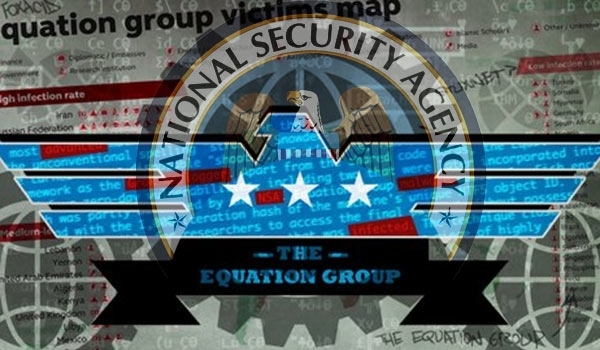
The Equation Group
What may sound like the start to a Tom Clancy novel, or an episode of 24, is, in fact, completely real, the likes of which actually happened to one or more researchers back in 2009. In fact, surreptitious, interdiction-based cyberattacks like this one have apparently been happening since at least the early 2000s and may date back to 1996.
Last Monday, Moscow-based Kaspersky Lab released a cybersecurity report uncovering details about the most sophisticated, covert, and pervasive hacker groups known to man and possibly ever imagined. The organization, dubbed the Equation Group due to the group’s affinity towards sophisticated encryption methods, had operated practically undetected for over a decade, silently infecting computers across the globe and delivering attack payloads still unknown.
“There is nowhere I can’t go. There is nowhere I won’t find you.” – Bane, The Matrix Revolutions
Kaspersky Lab, a cybersecurity firm known primarily for its antivirus software, is no stranger to hackers. The company tracks and documents security breaches of all shapes and sizes.
For years, most high-profile computer hacks had been primarily the work of individuals or small groups motivated by curiosity or, more recently, financial interest – gray-collar criminals who would infiltrate computer systems for credit card numbers to sell on the black market. Usually these attacks are relatively unsophisticated, relying on bad operational cybersecurity practices (dubbed “opsec”) from corporations to create exploitable security holes like those seen in the recent Target and Home Depot security breaches. Only upon the discovery of the Stuxnet virus in June 2010 that sabotaged Iran’s Natanz uranium enrichment facilities have cybersecurity researchers and the public at large turned an eye towards advanced persistent threats (APTs) which use advanced hacking techniques capable of bypassing strong opsec protocols.
What make Equation Group so impressive are their “almost superhuman” technical feats, which include never-before-seen levels of ingenuity in hacking, engineering, and encryption. Those feats include:
using virtual file systems like those found in the Regin (a.k.a. WarriorPride) malware attack used by the NSA to infect overseas computers;
the ability to infect and surveil sensitive air-gapped (i.e. non-Internet connected) networks by piggybacking on USB flash drives, much like the Stuxnet virus;
encrypting malicious files and storing them in multiple branches of the Windows registry, making it immune to detect with antivirus software;
using over 300 Internet domains and 100 servers to command and control malware infrastructure; and
hijacking URL requests on iPhones to spoofed Mac servers, which indicates that Equation Group has compromised the iOS and OSX operating systems.
Hollywood good
Perhaps most impressive is an Equation Group malware platform that rewrites the firmware of infected hard drives, allowing the virus to survive even low-level reformatting that is used to securely wipe a hard drive. All major hard drive manufacturers have drive models that have been compromised, including Western Digital, Seagate, Maxtor, Samsung, IBM, Toshiba, and Micron. Once the drive has been infected, the malware is completely impossible to detect or remove; the drive is compromised forever.
Forensics software displays, in Matrix-like fashion, some of the hard drives Equation Group was able to successfully hijack. (Credit: Kaspersky)
The difference in sophistication between your average Internet hacker and Equation Group cannot be understated. Your run-of-the-mill hacker is more or less equivalent to your run-of-the-mill burglar, who might break into a place with all of the sophistication of opening an unlocked door or busting out a window with a crowbar. APTs are more like museum thieves who might dress up like a guard or clone a keycard to snatch a valuable diamond or painting. Equation Group is an APT well beyond its peers, using super-spy tactics with analogical laser grids, vent shafts, and harnesses to swap a diamond with a perfect replica, remaining entirely undetected. It’s the stuff of Hollywood’s Mission: Impossible, only without the gratuitous explosions and Tom Cruise (…at least as far as anyone knows). And like Mission: Impossible, Equation Group is more than likely a clandestine operation of the U.S. government. via RedOrbit
Israel’s “Smart” Weapons Kill Sabah Abu Jayab, known to her family and friends as Um Ahmad, walked through her home pointing out everything that had to be replaced after Israel’s 2014 assault on the besieged Gaza Strip.
“This is all new,” Um Ahmad, a pharmacist, told The Electronic Intifada. She motioned to a balcony equipped with freshly painted walls and new windowsills. Moving to the living room, she said: “These couches, the chairs over there — all of it is new. We had to replace everything.”
Her home, where she lived with her husband and eight children, was hit by four missiles fired by an Israeli drone during the first week of the Israeli attack. “Only two of them exploded,” she said. “If the others had blown up, we’d have all died.”
Not everyone survived. Her eighteen-year-old daughter Amal, who was disabled and unable to walk, died on 17 July, four days after their house was struck.
“She wasn’t hit by the rocket or debris,” Um Ahmad explained, “but she inhaled a lot of smoke and dust.”
Amal was one of an estimated 2,257 Palestinians killed — including 563 children and 306 women — during Israel’s seven-week attack, according to the United Nations monitoring group OCHA.
“They were all scared”
On 13 July, as missiles pounded their neighbors’ homes during an intensified attack on the Deir al-Balah area in central Gaza, Um Ahmad moved all the children into one room in the back of their house.
“It was hard to explain to them what was happening and they were all scared,” she said, explaining that Amal’s three sisters are also disabled and unable to walk due to genetic birth defects.
“There had been no electricity or water for days, and the little ones would jump every time they heard an explosion,” she said.
Um Ahmad explained that they tried to stay in their home because they had nowhere else to go. “It was hard on the little ones,” she said. “We knew at any minute we could be hit [by an Israeli strike] like our neighbors.”
Muhammad Abu Jayab, 11, stands on the roof of his home. His neighbor’s destroyed house is in the background.
Um Ahmad had to go to her pharmacy to provide medicine for local residents with chronic illnesses and others who had been injured by Israel’s assault. “There was no way I could not show up to work,” she explained. “People with diabetes needed insulin even during times of war [and] others who were hurt needed antibiotics and other medicine.”
The Abu Jayab family home was hit on 13 July. “We had to carry the four children who don’t walk,” she said. “We took Amal to the hospital because she was in shock and having trouble breathing. They put her on oxygen, but her vital signs seemed fine and she didn’t have any external bodily injuries.” Israel’s “Smart” Weapons Kill
Targeting the ill
Amal was unable to eat or speak after the attack and Um Ahmad spent the last four days of her daughter’s life going back and forth between the hospital and the pharmacy where she works. “I showed up that last day and she was dead,” she recounted as she fought back tears.
Israel targeted a medical facility for the disabled on 12 July, the day before the Abu Jayab home was struck. At least four persons were killed and dozens injured when bombs crushed the Mabaret Palestine Society, a center for people with disabilities, in Beit Lahiya, a town in northern Gaza.
On 21 July, Israeli tanks shelled the al-Aqsa hospital in Deir al-Balah, killing three people and injuring forty more, the human rights group Al-Haqreported.
Doctors were forced to evacuate at least fourteen patients who were paralyzed or in a coma at the time, Ma’an News Agency reported.
The Israeli army claimed that Palestinian armed groups used the hospital as a base. However it was revealed that Israel used fabricated satellite imagesto “justify” its bombing of al-Wafa.
Ashraf al-Qidra, a spokesperson for Gaza’s health ministry, said that Israel targeted medical facilities and health workers alike. In addition to the hospitals and clinics, three dozen ambulances were destroyed, he told The Electronic Intifada.
“Israel turned medical centers into unprotected zones, although they are supposed to be protected by international law,” al-Qidra said. “Patients and workers had to always worry whether Israel would target the buildings they were in.”
Al-Qidra added that the medical centers were destroyed or damaged by warplanes, drone strikes and tank shelling alike.
Back in her home, Um Ahmad said, “What are we supposed to do now? We just want to live like everyone else. We need food, water and electricity — and we need to keep our children safe. We cannot do that here.”
Isreal is Getting Away with Murder On January 28th a barrage of Israeli artillery fire struck near the South Lebanese village of Ghajar, killing United Nations peacekeeper Francisco Javier Soria. Soria, 36, was a Spanish citizen deployed with the United Nations Interim Force in Lebanon, a peacekeeping mission tasked with maintaining the ceasefire between Israel and Lebanon in the occupied Golan Heights.
His death came in the midst of a recent flare-up of violence between Israel and Hezbollah, and Spain’s ambassador to the United Nations placed blame for the incident upon the Israeli Defence Forces, citing an “escalation of violence [which] came from the Israeli side.” The exact circumstances which led to Soria’s death are still under investigation; Israeli officials expressed condolences for his death and said their forces were responding to fire in the area.
What is clear however is that Israeli forces have been killing an alarming number of United Nations personnel in the course of their recent military operations — and that UN officials have vociferously criticized the attacks, sometimes saying they appeared deliberate.
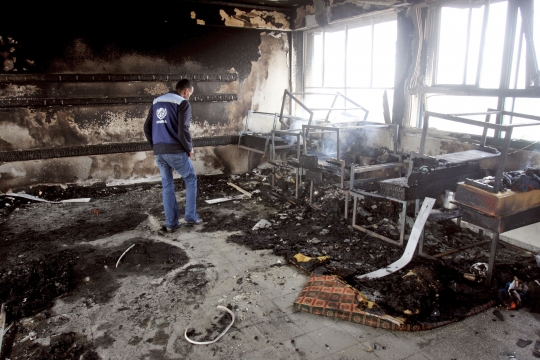
This past summer in the Gaza Strip, Israel forces attacked seven different schools run by the United Nations Relief and Works Agency, schools that had been serving as temporary shelters for the displaced population of the territory. Despite repeated warnings, condemnations and entreaties, United Nations targets were hit again and again by Israeli airstrikes and shelling during the conflict.
As many of 46 civilians are believed to have been killed in these attacks, as well as eleven UNRWA staff members. One particularly lethal strike on a UN-administered elementary school in Beit Hanoun killed 15 civilians and wounded 200 others. That attack reportedly sent shrapnel flying into crowds of families who had been awaiting transportation in the school’s playground.
In the wake of these and other bombings, UNRWA chief Chris Gunness broke down in tears during a live television interview while decrying the “[wholesale] denial” of Palestinian rights by Israeli forces during the operation.
Instead of offering contrition for these deadly incidents, Israeli officials continued to justify them with unsubstantiated, and vigorously deniedallegations that UNRWA schools were near sources of rocket fire and were thus simply caught in the crossfire. An investigation by Human Rights Watch looking at several of Israel’s attacks on these schools said that they, “did not appear to target a military objective or were otherwise unlawfully indiscriminate.”
Indeed, the idea that Israel’s repeated bombing of these schools may have simply been “mistakes” is difficult to countenance.
In one shelling incident which targeted a school in Rafah, United Nations personnel notified the IDF on 33 separate occasions that the facility was being used as a shelter for civilians. United Nations Secretary General Ban Ki-Moon publicly denounced the attack as a “moral outrage and a criminal act”, adding that “nothing is more shameful than attacking sleeping children”.
Even the United States, normally Israel’s most uncritical defender on the world stage, was moved to state that it was was “appalled” by what it described as a “disgraceful” attack on the school.
As egregious as these incidents were however, they are far from the first time in recent years in which Israel has targeted United Nations operations for shelling and airstrikes.
During the 2008-2009 Gaza War, Israeli forces targeted not only UNRWA schools (one of them pictured above) but even the compound housing the headquarters of the agency in the Gaza Strip. That attack, which involved the use of illegal white phosphorus munitions, destroyed tons of vital food aid and medical supplies which the large refugee population of the territory relied upon for basic sustenance.
Isreal is Getting Away with Murder At the time, Israeli officials claimed that they had been responding to rocket fire which had emanated from the compound, a claim which UN officials described as “total nonsense”.
In another notorious incident from Israel’s 2006 war with Lebanon, Israeli aircraft and artillery bombed a single United Nations outpost for upwards of six hours, despite receiving repeated pleas during this time from UN officials to cease fire. Four peacekeepers were killed in what then UN Secretary General Kofi Annan described as an “apparently deliberate” act.
Israel has long had a contentious relationship with United Nations agencies operating in the Middle East. Israeli officials have in past accused UN personnel of offering shelter to militants (a charge the organization strenuously denies), and has also more broadly suggested that the organization is responsible for prolonging the Israel-Palestine conflict due to its provision of refugee status and services to displaced Palestinians and their descendants.
In the wake of the most recent Gaza conflict, some Israeli political figures even called for UNRWA to formally be recognized as a “hostile organization”, an outrageous suggestion which nevertheless provides some insight into the hostility with which the UN is often viewed today in official circles.
Israel’s repeated bombing and shelling of United Nations positions in the region comes against this backdrop, with Soria’s death being only the latest incident in which Israeli forces have been responsible for killing UN personnel. To date, no one has been held legally responsible for any of these attacks.
By way of contrast, imagine the response if Hamas or Hezbollah had repeatedly and unrepentantly killed United Nations officials in the course of their conflict with Israel. Imagine if United Nations schools housing thousands of displaced civilians been struck time and again by militant groups, who in the wake of the bloodshed either denied responsibility outright or sought to justify their actions.
Furthermore, imagine if these attacks inflicted widespread civilian casualties and came despite repeated pleas and entreaties from UN officials to cease fire.
The outcry would rightly be deafening, yet this is exactly what Israel has done again and again in its conflicts in Lebanon and the Gaza Strip without consequence. As a result of this burgeoning culture of impunity, partly enabled by the unprecedented diplomatic protection offered to Israeli officials by the United States, UN personnel and facilities have increasingly been subject to deadly violence from the Israeli military.
As Pierre Krähenbühl, commissioner-general of UNRWA, stated in the aftermath of a deadly bombing against a UN-administered school in Gaza this past summer, “this [attack] is an affront to all of us, a source of universal shame. Today, the world stands disgraced.”
With a rash of “beheadings” sweeping the world, a horrified public is asked to see this depraved barbarity as The New Normal.
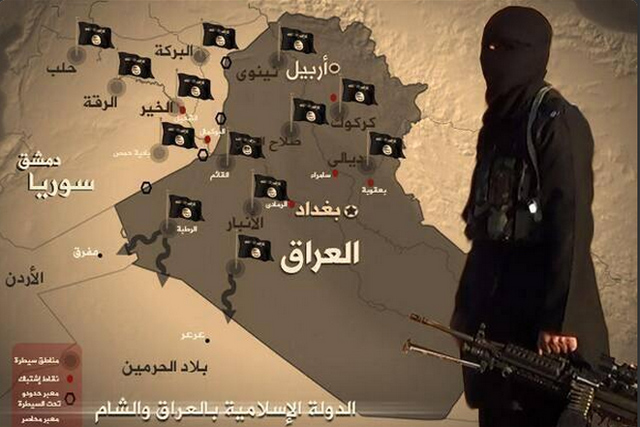
First we had the August “murder” on video of U.S. journalist James Foley, shown kneeling before a black-robed, masked figure brandishing a knife. Yes, even a rather small knife can do it (just as box-cutters can enable the hijacking of commercial airplanes). The perpetrator is identified as a member of the terrorist group ISIS (or IS or ISIL), which supposedly wants to install a new Islamic caliphate based in the region.
However, the video did not actually show the beheading, but faded to black at the appropriate moment. A subsequent frame purports to show Foley’s head propped up on his headless body. This video was staged, however, as proved by numerous researchers, and even admitted in the British press.[1] According to a report in The Telegraph:
…a study of the four-minute 40-second clip, carried out by an international forensic science company which has worked for police forces across Britain, suggested camera trickery and slick post-production techniques appear to have been used…no blood can be seen, even though the knife is drawn across the neck area at least six times.[2]
Nonetheless, the U.S. media continue to report this “beheading” as a real occurrence, over and over again, followed by another “beheading” of an American journalist, Steven J. Sotloff, in a video released in early September. This was supposedly a “second message to America” from ISIS: “Just as your missiles continue to strike our people, our knife will continue to strike the necks of your people.”[3] This video too is problematic, with no blood in evidence before the scene fades to black.[4]
Both Foley and Sotloff have intelligence connections, as does SITE, the media dissemination service behind the release of the videos. SITE [Search for International Terrorist Entities] is an offshoot of Intel Center, both of which have an uncanny ability to produce such material at the most opportune times in support of U.S. foreign policy.[5] A visit to the SITE website is instructive.[6]
The SITE Intelligence Group, founded in 2001 by Rita Katz, is an intelligence gathering operation that monitors jihadists online, often finding terrorist statements and videos as uploads “before they are published,” according to Katz. These are transmitted to U.S. intelligence services, which are curiously beholden to SITE for these sensitive materials, and they are then released to the U.S. media.[7]
All such information obtained by SITE and then broadcast is therefore suspect. Nonetheless, the Foley and Sotloff videos have reportedly gotten the U.S. public on board with the bombing of northern Iraq and Syria in an R-2-P operation (Responsibility To Protect), the real goal being to take out Bashar al-Assad in Syria.
As for the U.K., David Haines was shown in a third “beheading” video released by SITE in mid-September.[8] And the black-robed “killer” has a British accent, which surely indicates that British citizens have gone to Iraq-Syria to join ISIS – and that they could return to wreak havoc in the homeland.
Not to neglect France, which now has its own beheading – of Hervé Gourdel, a mountaineering guide from Nice who was kidnapped in Algeria, shown in a video released by SITE in late September.[9] And certainly Australia should have one as well, but a dastardly ISIS plot in Sydney was reportedly thwarted by the government.[10]
These western countries are instrumental to the U.S.-led coalition to protect the world against ISIS, since the coalition initially included only Middle Eastern client states such as Saudi Arabia, Qatar, Bahrain, United Arab Emirates, and Jordan. As of this writing, France, Australia, Belgium, Denmark, and England have now signed on, with Turkey lining up as well.[11]
Just to drive the point home (as it were) for any “war weary” Americans out there, we now have a home-grown beheading of an employee at a food processing plant in Moore, Oklahoma. The perpetrator, a black man named Alton Nolen, is said to have been fired from his job at Vaughan Foods. Nolen “recently started trying to convert some of his co-workers to the Muslim religion,” according to a police spokesperson.[12]
On “a Facebook page that appears to be his,” Nolen posted the following: “This is the last days… AMERICA AND ISRAEL ARE WICKED. WAKE UP MUSLIMS!!!” The FBI is assisting with the investigation after putting out “an alert to local law enforcement officials across the country to be on the watch for so-called lone wolves who might respond violently” in the wake of U.S. bombing in Syria. Now ask yourself: is this scenario credible?[13]
Nonetheless, the “beheadings”are getting major traction in the U.S. press. Magazines feature articles and editorials, television anchors report with great gravity, and radio hosts banter with listeners about these fake events. WAKE UP AMERICANS!!! As this war propaganda multiplies, with gullible members of the public accepting these psy-ops as fact, at stake are the destruction of the Middle East, continued massive “collateral damage” in Iraq and Syria – and the degrading of our own collective mentality.[14]
Evidence exposing who put ISIS in power, and how it was done.
The Islamic militant group ISIS, formerly known as Al-Qaeda in Iraq, and recently rebranded as the so called Islamic State, is the stuff of nightmares. They are ruthless, fanatical, killers, on a mission, and that mission is to wipe out anyone and everyone, from any religion or belief system and to impose Shari’ah law. The mass executions, beheadings and even crucifixions that they are committing as they work towards this goal are flaunted like badges of pride, video taped and uploaded for the whole world to see. This is the new face of evil.
Would it interest you to know who helped these psychopaths rise to power? Would it interest you to know who armed them, funded them and trained them? Would it interest you to know why?
This story makes more sense if we start in the middle, so we’ll begin with the overthrow of Muammar Gaddafi in 2011.
The Libyan revolution was Obama’s first major foreign intervention. It was portrayed as an extension of the Arab Spring, and NATO involvement was framed in humanitarian terms.
These jihadist militants from Iraq were part of what national security analysts commonly referred to as Al-Qaeda in Iraq. Remember Al-Qaeda in Iraq was ISIS before it was rebranded.
With the assistance of U.S. and NATO intelligence and air support, the Libyan rebels captured Gaddafi and summarily executed him in the street, all the while enthusiastically chanting “Allah Akbar”. For many of those who had bought the official line about how these rebels were freedom fighters aiming to establish a liberal democracy in Libya, this was the beginning of the end of their illusions.
Now after Gaddafi was overthrown, the Libyan armories were looted, and massive quantities of weapons were sent by the Libyan rebels to Syria. The weapons, which included anti-tank and anti-aircraft missiles were smuggled into Syria through Turkey, a NATO ally. The times of Londonreported on the arrival of the shipment on September 14th, 2012. (Secondary confirmation in this NYT article) This was just three days after Ambassador Chris Stevens was killed by the attack on the U.S. embassy in Benghazi. Chris Stevens had served as the U.S. government’s liaison to the Libyan rebels since April of 2011.
While a great deal media attention has focused on the fact that the State Department did not provide adequate security at the consulate, and was slow to send assistance when the attack started, Pulitzer Prize winning journalist Seymour Hersh released an article in April of 2014 which exposed a classified agreement between the CIA, Turkey and the Syrian rebels to create what was referred to as a “rat line”. The “rat line” was covert network used to channel weapons and ammunition from Libya, through southern turkey and across the Syrian border. Funding was provided by Turkey, Saudi Arabia and Qatar.
However as the rebels gained strength, the reports of war crimes and atrocities that they were committing began to create a bit of a public relations problem for Washington. It then became standard policy to insist that U.S. support was only being given to what they referred to as“moderate” rebel forces.
This distinction, however, had no basis in reality.
In an interview given in April of 2014, FSA commander Jamal Maarouf admitted that his fighters regularly conduct joint operations with Al-Nusra. Al-Nusra is the official Al-Qa’ida branch in Syria. This statement is further validated by an interview given in June of 2013 by Colonel Abdel Basset Al-Tawil, commander of the FSA’s Northern Front. In this interview he openly discusses his ties with Al-Nusra, and expresses his desire to see Syria ruled by sharia law. (You can verify the identities of these two commanders here in this document from The Institute for the Study of War)
Moderate rebels? Well it’s complicated. Not that this should really come as any surprise. Reuters had reported in 2012 that the FSA’s command was dominated by Islamic extremists, and the New York Times had reported that same year that the majority of the weapons that Washington were sending into Syria was ending up in the hands Jihadists. For two years the U.S. government knew that this was happening, but they kept doing it.
So to review, the FSA is working with Al-Nusra, Al-Nusra is working with ISIS, and the U.S. has been sending money and weapons to the FSA even though they’ve known since 2012 that most of these weapons were ending up in the hands of extremists. You do the math.
[UPDATE 9.03.14]: Retired Lt. Gen. Tom McInerney admits: “We Helped Build ISIS”:
Note that the first version of this video I uploaded (here) was quickly taken down. To insure that this clip does not disappear we have provided a secondary download link here. So if the video below isn’t playing then use that link and upload it elsewhere.
Syria, we backed I believe, in some cases some of the wrong people and not in the right part of the Free Syrian Army (FSA) that’s a little confusing to people. So I’ve always maintained, and go back quite some time that we were backing the wrong types. I think it’s going to turn out maybe this weekend in a new special that Brett Baer is going to have Friday that’s gonna show some of those weapons from Benghazi ended up in the hands of ISIS. So we helped build ISIS.
After the second sarin gas fiasco, which was also exposed and therefore failed to garner public support for airstrikes, the U.S. continued to increase its the training and support for the rebels.
In February of 2014, Haaretz reported that the U.S. and its allies in the region, Saudi Arabia, Jordan and Israel, were in the process of helping the Syrian rebels plan and prepare for a massive attack in the south. According to Haaretz Israel had also provided direct assistance in military operations against Assad four months prior (you can access a free cached version of the page here).
Then in May of 2014 PBS ran a report in which they interviewed rebels who were trained by the U.S. in Qatar. According to those rebels they were being trained to finish off soldiers who survived attacks.
“They trained us to ambush regime or enemy vehicles and cut off the road,” said the fighter, who is identified only as “Hussein.” “They also trained us on how to attack a vehicle, raid it, retrieve information or weapons and munitions, and how to finish off soldiers still alive after an ambush.”
This is a blatant violation of the Geneva conventions. It also runs contrary to conventional military strategy. In conventional military strategy soldiers are better off left wounded, because this ends up costing the enemy more resources. Executing captured enemy soldiers is the kind of tactic used when you want to strike terror in the hearts of the enemy. It also just happens to be standard operating procedure for ISIS.
One month after this report, in June of 2014, ISIS made its dramatic entry, crossing over the Syrian border into Iraq, capturing Mosul, Baiji and almost reaching Baghdad. The internet was suddenly flooded with footage of drive by shootings, large scale death marches, and mass graves. And of course any Iraqi soldier that was captured was executed.
Massive quantities of American military equipment were seized during that operation. ISIS took entire truckloads of humvees, they took helicopters, tanks, and artillery. They photographed and video taped themselves and advertised what they were doing on social media, and yet for some reason Washington didn’t even TRY to stop them.
U.S. military doctrine clearly calls for the destruction of military equipment and supplies when friendly forces cannot prevent them from falling into enemy hands, but that didn’t happen here. ISIS was allowed to carry this equipment out of Iraq and into Syria unimpeded. The U.S. military had the means to strike these convoys, but they didn’t lift a finger, even though they had been launching drone strikes in Pakistan that same week.
Why would they do that?
Though Obama plays the role of a weak, indecisive, liberal president, and while pundits from the right have had a lot of fun with that image, this is just a facade. Some presidents, like George W. Bush, rely primarily on overt military aggression. Obama gets the same job done, but he prefers covert means. Not really surprising considering the fact that Zbigniew Brzezinski was his mentor.
Those who know their history will remember that Zbigniew Brzezinski was directly involved in the funding and arming the Islamic extremists in Pakistan and Afghanistan in order to weaken the Soviets.
By the way Osama bin Laden was one of these anti-Soviet “freedom fighters” the U.S. was funding and arming.
This operation is no secret at this point, nor are the unintended side effects.
The strategy worked. The Soviets invaded, and the ten years of war that followed are considered by many historians as being one of the primary causes of the fall of the USSR.
This example doesn’t just establish precedent, what we’re seeing happen in Iraq, Afghanistan and Syria right now is actually a continuation of a old story. Al-Nusra and ISIS are ideological and organizational decedents of these extremist elements that the U.S. government made use of thirty years ago.
The U.S. the went on to create a breeding ground for these extremists by invading Iraq in 2003. Had it not been for the vacuum of power left by the removal and execution of Saddam, Al-Qaeda in Iraq, aka ISIS, would not exist. And had it not been for Washington’s attempt at toppling Assad by arming, funding and training shadowy militant groups in Syria, there is no way that ISIS would have been capable of storming into Iraq in June of 2014.
On every level, no matter how you cut it, ISIS is a product of U.S. government’s twisted and decrepit foreign policy.
Now all of this may seem contradictory to you as you watch the drums of war against ISIS begin to beat louder and the air strikes against them are gradually widenedhttp://www.wjla.com/articles/2014/08/president-obama-considers-possible-…). Why would the U.S. help a terrorist organization get established, only to attack them later?
Well why did the CIA put Saddam Hussein in power in 1963?, Why did the U.S. government back Saddam in 1980 when he launched a war of aggression against Iran, even though they knew that he was using chemical weapons? Why did the U.S. fund and arm Islamic extremists in Afghanistan against the Soviets?
There’s a pattern here if you look closely. This is a tried and true geopolitical strategy.
Step 1: Build up a dictator or extremist group which can then be used to wage proxy wars against opponents. During this stage any crimes committed by these proxies are swept under the rug. [Problem]
Step 2: When these nasty characters have outlived their usefulness, that’s when it’s time to pull out all that dirt from under the rug and start publicizing it 24/7. This obviously works best when the public has no idea how these bad guys came to power.[Reaction]
Step 3: Finally, when the public practically begging for the government to do something, a solution is proposed. Usually the solution involves military intervention, the loss of certain liberties, or both. [Solution]
ISIS is extremely useful. They have essentially done Washington dirty work by weakening Assad. In 2014, while the news cycle has focused almost exclusively on Ukraine and Russia, ISIS made major headway in Syria, and as of August they already controlled 35% of the country.
Since ISIS largely based in Syria, this gives the U.S. a pretext to move into Syria. Sooner or later the U.S. will extend the airstrikes into Assad’s backyard, and when they do U.S. officials are already making it clear that both ISIS and the Syrian government will be targeted. That, after all, is the whole point. Washington may allow ISIS to capture a bit more territory first, but the writing is on the wall, and has been for some time now.
The Obama administration has repeatedly insisted that this will never lead to boots on the ground, however, the truth of the matter is that anyone who understands anything about military tactics knows full well that ISIS cannot be defeated by airstrikes alone. In response to airstrikes ISIS will merely disperse and conceal their forces. ISIS isn’t an established state power which can be destroyed by knocking out key government buildings and infrastructure. These are guerrilla fighters who cut their teeth in urban warfare.
To significantly weaken them, the war will have to involve ground troops, but even this is a lost cause. U.S. troops could certainly route ISIS in street to street battles for some time, and they might even succeed in fully occupying Syria and Iraq for a number of years, but eventually they will have to leave, and when they do, it should be obvious what will come next.
The puppets that the U.S. government has installed in the various countries that they have brought down in recent years have without exception proven to be utterly incompetent and corrupt. No one that Washington places in power will be capable of maintaining stability in Syria. Period.
Right now, Assad is the last bastion of stability in the region. He is the last chance they have for a moderate non-sectarian government and he is the only hope of anything even remotely resembling democracy for the foreseeable future. If Assad falls, Islamic extremist will take the helm, they will impose shari’ah law, and they will do everything in their power to continue spreading their ideology as far and wide as they can.
If the world truly wants to stop ISIS, there is only one way to do it:
1. First and foremost, the U.S. government and its allies must be heavily pressured to cut all support to the rebels who are attempting to topple Assad. Even if these rebels that the U.S. is arming and funding were moderate, and they’re not, the fact that they are forcing Assad to fight a war on multiple fronts, only strengthens ISIS. This is lunacy.
2. The Syrian government should be provided with financial support, equipment, training and intelligence to enable them to turn the tide against ISIS. This is their territory, they should be the ones to reclaim it.
Now obviously this support isn’t going to come from the U.S. or any NATO country, but there are a number of nations who have a strategic interest in preventing another regime change and chaotic aftermath. If these countries respond promptly, as in right now, they could preempt a U.S. intervention, and as long this support does not include the presence of foreign troops, doing so will greatly reduce the likelihood of a major confrontation down the road.
3. The U.S. government and its allies should should be aggressively condemned for their failed regime change policies and the individuals behind these decisions should be charged for war crimes. This would have to be done on an nation by nation level since the U.N. has done nothing but enable NATO aggression. While this may not immediately result in these criminals being arrested, it would send a message. This can be done. Malaysia has already proven this by convicting the Bush administration of war crimes in abstentia.
Now you might be thinking: “This all sounds fine and good, but what does this have to do with me? I can’t influence this situation.”
That perspective is quite common, and for most people, it’s paralyzing, but the truth of the matter is that we can influence this. We’ve done it before, and we can do it again.
I’ll be honest with you though, this isn’t going to be easy. To succeed we have to start thinking strategically. Like it or not, this is a chess game. If we really want to rock the boat, we have to start reaching out to people in positions of influence. This can mean talking to broadcasters at your local radio station, news paper, or t.v. station, or it can mean contacting influential bloggers, celebrities, business figures or government officials. Reaching out to current serving military and young people who may be considering joining up is also important. But even if it’s just your neighbor, or your coworker, every single person we can reach brings us closer to critical mass. The most important step is to start trying.
If you are confused about why this is all happening, watch this video we put out on September 11th, 2012
If this message resonates with you then spread it. If you want to see the BIG picture, and trust me we’ve got some very interesting reports coming, subscribe to StormCloudsGathering on Youtube, and follow us on Facebook, twitter and Google plus.
There are very few news stories about government overreach that shock me these days, but this week there were two — both in California. Each came and went with barely a whisper in the media, even from the “liberty” news.
Perhaps we’re so bombarded with mafia tactics by the government that some events just get lost in the chaos. And no, one of these developments is NOT the Los Angeles School District acquiring tanks and grenade launchers, although that’s probably of equal significance. Below is the first of these local stories. The second will be in a follow-up article.
This is probably the scariest development in law enforcement, ever, and I don’t say that lightly. If you thought no-knock SWAT raids to serve warrants for non-violent crimes was the epitome of tyranny, wait until you get a load of private mercenaries conducting special forces-type raids on American citizens.
That’s right, a report out of Mendocino, California admits that Blackwater-like private “security” contractors are now being used to “police pot.” Mysterious soldiers repelled out of unmarked helicopters fully armed for war to raid legal medical cannabis gardens last month. They didn’t identify themselves or present paperwork of any kind. They just destroyed the garden and left. Other witnesses claim this invading army is also “confiscating” product.
This is the ultimate “feeler” story in the unfolding Totalitarian Tip-Toe if I’ve ever seen one. A quirky local story of “mystery men” used to raise the public threshold of acceptable tyranny, a.k.a. legitimizing private-sector soldiers for law enforcement.
The war machine seems to be gauging how much terror they can inflict on peaceful Americans before they say WTF (See Ferguson) and, perhaps more importantly, to see if the public will allow this vast new market for war profiteers.
It should be a massive media story “private war profiteering at home to terrorize citizens fight crime”. Helicopters, weapons of war, and tactical gear are expensive. Who’s seeding these start-ups anyway?
The manipulation continued a day after this story was reported, when Alex Altman of TIME wrote “Californians Turn to Private Security to Police Pot Country” as if all the citizens of California have agreed to this type of policing. Subtle manipulation.
Over the summer, residents claimed men in military gear had been dropping onto private property from unmarked helicopters and cutting down the medicinal pot gardens of local residents. Local law enforcement have conducted helicopter raids in the area, but some worried the culprit this time was different: a private-security firm called Lear Asset Management.
The confusion was easy to understand. In the wildlands of California’s pot country, the workings of law enforcement are hard to track, and the rules for growing pot are often contradictory. To add to the mess, the various local, county, state and federal enforcement efforts don’t always communicate with each other about their efforts. The added possibility of private mercenaries, with faceless employers, fast-roping from helicopters raised alarm bells for many farmers.
TIME legitimizes Lear Asset Management and the practice of private policing with a matter-of-fact job description:
They are hired by large land owners to do the work of clearing trespass gardens from private property, and perform forest reclamation, sometimes funded by government grant. Deep in the woods, they cut down illegal pot plants and scrub the environmental footprint produced by the backwoods drug trade. They carry AR-15 rifles, lest they meet armed watchmen bent on defending their plots.
I really don’t have a problem with securing private property from vandals, but did you catch that slip “sometimes funded by government grant”? That’s when “private security” becomes “law enforcement.” This is the RED ALERT buried in this story. At best our tax dollars are being used to fund private armies for large land owners. At worst, when will we see these warriors policing BLM land (aka National Parks)? Wait for it…
Altman quotes official statistics about how successful Lear and law enforcement are in raiding marijuana farmers, measured in the “street value” of the forbidden crop seized at gunpoint, as if that is still acceptable behavior by society’s peace keepers in the era of legal weed. But Altman just uses it as a segue into a broader “problem” of policing environmental vandalism on large stretches of open land, including “public” land.
More recently, the trespass grow sites have migrated from public land onto the vast plots owned by private citizens and timber companies. Some of them have hired Lear to deal with the problem. The company has run about nine missions across California’s pot country this year, with more planned this fall, Trouette says. And while the company’s special-ops aspect gets much of the attention, most of the work focuses on environmental reclamation.
The public is supposed to believe Lear is merely an environmental clean-up team doing community service who just so happens to have military special ops capability. How quaint. I didn’t know litter maintenance required AR-15s. But who would be opposed protecting the environment? Smart marketing.
TIME goes for the hard close to sell this tyranny by providing legal cover for these raids without warrants, before ending the article as a sponsored post for “regulation” of Lear’s “flourishing” domestic mercenary business as the “best thing for locals.”
Reports of vigilante marijuana raids on private property may simply stem from a lack of legal clarity. Under the so-called “open fields doctrine” set forth by the U.S. Supreme Court, the Fourth Amendment does not protect undeveloped property from warrantless searches. As a result, police may be permitted to cut down private gardens without a warrant. (my emphasis because your need to read and reread every word)
In the meantime, Lear has flourished, despite the concern among some local growers. But like most people in the Emerald Triangle, Trouette thinks thebest thing for the locals would be for the feds to sort out all the confusion. “I think the federal government would do everybody a big favor,” he says, “by regulating this industry.” (my emphasis)
So let me get this straight: a criminal gang of armed thugs commits violence and theft, and the best way to solve that problem is to legalize and regulate those thugs? Sounds like ISIS.
The creepiest thing about this development is that it’s a clever, more professional repackaging of a previous attempt to introduce private police in America. Some of you liberty lovers may recall it being rolled out once before in an eerily similar manner.
In 2009, FOX News wroteU.S. Mystery ‘Police’ Force Has Small Montana City on Edge after a local news report aired showing an extremely well-funded private security contractor going by the name American Police Force (APF) rolling into the town of Hardin in black Mercedes tagged as “Harding Police Department”.
Hiring a private firm for domestic policing caused massive outrage not just locally in Montana but also around the United States. APF is now referred to as a well-funded fraud perpetuated by a petty con man and the event was swiftly dumped into the dustbin of history.
American Police Force (APF), and under its revised name American Private Police Force, was a fraudulent entity claiming to be a private military company. It never possessed any legitimacy to operate in the United States. The company’s previous logo was an exact copy of the Serbian state coat of arms which caused some controversy and resulted in the Serbian government threatening legal action against APF if it did not remove or change the logo.
In September 2009, US government contract databases showed no record of the company, while security industry representatives and federal officials said they had never heard of it.
APF was registered as a corporation in California by convicted con man Michael Hilton on 2 March 2009.
Interestingly, there are absolutely no follow-up reports of “Michael Hilton” or anyone else being prosecuted or convicted in the APF case. They simply vanished. Think about that for a moment. A heavily-armed foreign force invades a small town in America on false pretenses committing dangerous fraud and the U.S. government does absolutely nothing about it. What does that tell you?
Well, we know the U.S. military uses private contractors in foreign wars, and we know the Pentagon is arming and militarizing domestic police, and we know the U.S. Army is training to enter law enforcement. It seems to me that it’s all part of the plan to keep the war machine churning and to control the population.
Now with a more polished version of private security, minus the flashy Mercedes and foreign accents, and sold to us as environmental guardians, this story has gone largely unnoticed. Yet, if these raid allegations are true, Lear’s actions already far exceed anything APF did in Montana.
Stay tuned for my next article on the second unreported tyrannical event that happened in California this past week to be released later today or early tomorrow.
Gaza (along with the West Bank and East Jerusalem) is occupied Palestinian territory under international law, determined by the vast majority of the world, as well as the highest court in the world, the UN’s International Court of Justice. Gaza cannot commit aggression against Israel, since Israel is in constant and continual commission of illegal aggression against Palestine by occupying it (illegally and sadistically blockading it and frequently committing terrorism against its civilians, including by targeting them with chemical weapons provided by US taxpayers – see “Rain of Fire” by Human Rights Watch). As documented by Amnesty Int’l, Human Rights Watch, and many others, Israel intentionally targets and murders civilians, including children, en masse.
But, even ignoring international law and that Gaza is under illegal Israeli occupation, Gaza did not initiate this current round of violence; Israel did:
Western/US/Israeli propaganda says the violence started with the kidnapping and killing of three Israeli youths on June 12th. That is a lie:
On May 20th, the Israeli government murdered 2 unarmed Palestinian teens, one on video, and wounded a third.
The firing of pathetic scrap metal rockets from impoverished Gaza, which have killed no one, were in fact launched in response to earlier Israeli bombings, killings, assassinations, and arrests of Palestinians, including children.
Since the year 2000, Israel has killed 1,500 Palestinian children, while Palestinians have killed 132 Israeli children. That means Israel has killed over 1,000% percent more Palestinian children than vice versa.
According to a landmark, comprehensive study of all of Israel’s wars, by Zeev Maoz, Professor of Political Science at the University of California, Davis, former head of the Graduate School of Government and Policy and of the Jaffee Center for Strategic Studies at Tel Aviv University, and former academic director of the M.A. Program at the Israeli Defense Forces’ National Defense College:
“. most of the wars in which Israel was involved were the result of deliberate Israeli aggressive design . None of these wars – with the possible exception of the 1948 War of independence – was what Israel refers to as Milhemet Ein Berah (war of necessity). They were all wars of choice . ” – Defending the Holy Land, pg. 35, (bold added)
“I review a number of peace-related opportunities ranging from the Zionist-Hashemite collusion in 1947 through the collapse of the Oslo Process in 2000. In all those cases I find that Israeli decision makers – who had been willing to embark upon bold and daring military adventures – were extremely reluctant to make even the smallest concessions for peace . I also find in many cases Israel was engaged in systematic violations of agreements and tacit understandings between itself and its neighbors.” – Defending the Holy Land, pg. 40
Israel has violated more UN resolutions than any other country. That includes Iraq under Hussein.
Hamas is the government elected by Gaza in elections that Jimmy Carter (and many others) observed and said were completely fair and free. Israel constantly says Hamas uses human shields. But in Israel’s biggest massacre of Gaza, the one in 2009, all the human rights organizations, including Amnesty, HRW, and the jurist Richard Goldstone, found that Hamas DID NOT use human shields. On the contrary, Israel used human shields, which is a regular practice for Israel. Israel uses civilians as human shields.
Israel forced Palestinian civilians to dig and lay naked in trenches around Israeli tanks. See here at 6:45.
XIV. THE USE OF PALESTINIAN CIVILIANS AS HUMAN SHIELDS
“The Mission received allegations that in two areas in north Gaza Israeli troops used Palestinian men as human shields… The Mission found the foregoing witnesses to be credible and reliable. It has no reason to doubt the veracity of their accounts and found that the different stories serve to support the allegation that Palestinians were used as human shields.”
Noam Chomsky: “Hamas is regularly described as ‘Iranian-backed Hamas, which is dedicated to the destruction of Israel.’ One will be hard put to find something like ‘democratically elected Hamas, which has long been calling for a two-state settlement in accord with the international consensus’—blocked for over 30 years by the US and Israel. All true, but not a useful contribution to the Party Line, hence dispensable.”
In the history of all rocket and mortar fire into Israel, 26 people, total, have been killed. And remember, Palestine breaks ceasefires far less often than Israel, as documented above.
This number of 26 is in contrast to the minimum number of 1,400 people who were murdered by Israel in a single one of its terrorist atrocities, the 2009 Gaza Massacre.
Noting that in the current massacre, zero Israelis and over 100 Palestinians have thus far been killed, and noting that Gaza is a concentration camp – Israel allows no one to enter or leave – Dan Sanchez gives a perfect description of the disparity in arms between the US/Israeli war machine and Palestinian scrap metal projectiles: “They [the Gazans] are like fish in a barrel, being blasted by a shotgun from above. It’s like some of the fish in the barrel pathetically spitting water at the gunman, and [US media calls] that a “shooting battle.”
The rhetoric and tactics of Hamas and other groups resisting Israeli occupation and colonization can be brutal (though far less so than Israel). Propagandists try to attribute this to anti-Semitism, to distract from the fact that these groups are resisting having their country stolen and their people dispossessed and annihilated. Native American resistance to European colonizers was sometimes extremely brutal, as was their rhetoric, but everyone universally recognizes that this was not because of “anti-White-ism”, or “anti-European-ism”, but because they were having their land stolen and their people massacred, the same thing that Israel is doing to the Palestinians.
Palestinians have the right under international law to resist occupation, ethnic cleansing, colonization, aggression, and annexation. Miko Peled, son of an Israeli general, recently stated that if Israel doesn’t Like rockets, they should decolonize Palestine. Dr. Norman Finkelstein notes that “The Palestinians have the right to use arms to resist an occupation . However, the fact that morally and legally they have that right doesn’t mean that it’s the most prudent strategy. In my opinion, a national Palestinian leadership committed to mobilizing nonviolent resistance can defeat the Israeli occupation if those of us living abroad lend support to it.”
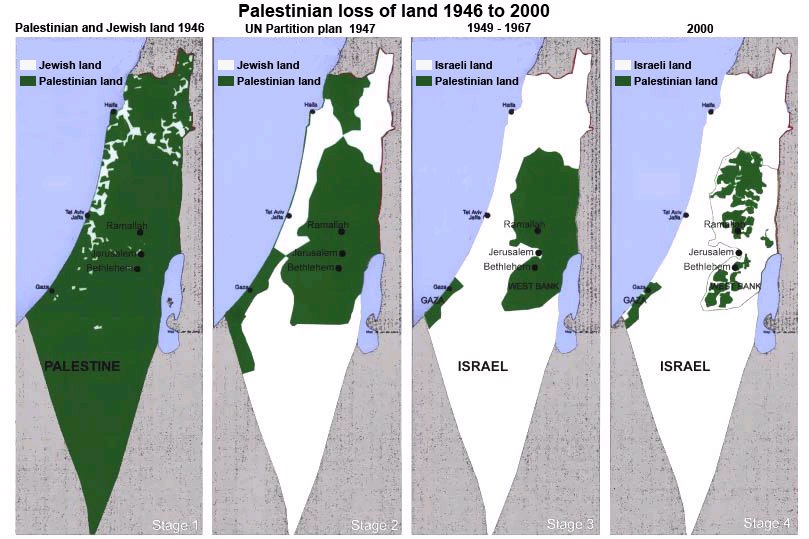
In 1948, the people who wanted to form a Jewish state carried out a massive terror and ethnic cleansing campaign against the occupants of Palestine, expelling about half of them (750,000) from their land and into concentrated areas (Gaza and West Bank). Israel has slowly continued colonizing even those areas, which were specifically reserved by the UN for Palestinians. Israel takes all the best land and resources, such as water. Here is a visualization of what has happened, and is currently happening with massive support from Obama:
Israeli settlement building in Palestine is a war crime under international law. Under Obama, Israeli settlement building is up over 130%.
For about 40 years, there has been an international consensus that Israel must stop colonizing territory outside its 1967 borders. The consensus has been blocked by the United States, in isolation from the international community (much like the USA’s isolated, strong support for South African Apartheid). Every year there is a UN vote on the issue, and every year it goes about 165 to 2, the world against the US and Israel. This continues under Obama. All human rights groups support the consensus, as does Hamas, the Arab League, Iran, the Organization of the Islamic Conference… Virtually everyone, except the US and Israel. (More details on this page.)
Hypocricy Defined
Palestinians are brutalized, repressed and impoverished by Israel. To get a quick visual understanding of the difference between Gaza and Israel, take a look at the images of people and cities being wantonly pummeled by Israeli terrorism when you search the word “Gaza“, and the images of opulence, wealth and luxury that come up when you search “Tel Aviv“.
Israel, whose government intentionally targets, tortures, and murders civilians, including children, including with chemical weapons, and whose government uses Palestinian civilians as human shields, and whose government is the last entity on Earth carrying out old-style ethnic cleansing and colonization of foreign countries, is the single biggest recipient of US aid, at over three billion dollars a year and huge amounts of lethal weaponry such as attack helicopters and white phosphorous chemical explosives.
To reiterate, Obama requested more military aid for Israel than any president ever. This is not because Obama and the USA love Jewish people. Obama was recently an accomplice in a literal neo-Nazi-led coup d’etat in Ukraine, and is currently fully supporting the junta-integrated Ukrainian government, which is staffed with several neo-Nazis in high ministries, and which uses neo-Nazi paramilitaries to carry out massacres (and possibly genocide) against people resistant to the junta. The actual reason the US supports Israel is discussed below.
As Amnesty International has noted, all aid to Israel is illegal under international (and US) law, because Israel is a consistent violator of human rights.
Amnesty International also noted that Israel’s 2009 massacre of Gaza would not have been possible without the illegal funding (money and weapons) and support Israel gets from the USA.
This is also true of the current massacre Israel is committing in Gaza.
However, in a way, that is good news.
That means US citizens can STOP the massacres.
MSM Refuses to Cover Anti-Israel War Crime Protests
If we stop our money and weapons-flow to Israel, which is illegal anyway, we stop Israeli terrorism! All we have to do is stop committing a crime, and we will stop more crimes! That’s great news.
Here is a previous example of how this has worked: When the USA cut its funding for Indonesia’s genocide against East Timor, which the USA was funding almost exclusively, Indonesia was forced to stop and withdraw. All it took was cutting off our illegal flow of money and weapons to the criminals.
The same thing would happen if we cut our illegal funding for Israel’s genocides and acts of terrorism, ethnic cleansing, colonization, and annexation against Palestine.
But since the USA is an anti-democratic country, the only way to stop US plutocrats from using our money to fund Israeli terrorism is to force it through massive, non-violent pressure.
One way it happens is when it becomes too politically costly for the plutocracy to keep funding genocide and terror, meaning the costs of their illegal support outweigh the benefits, as in Indonesia. In that case, massive publicity and indigenous resistance accomplished the goal.
But Israel is the USA’s main imperial – and nuclear – base for controlling the Middle East, which US planners, in 1945, called the greatest material prize in world history, due to the oil and gas. Thus, it might require more, as in non-violently making our country into a democracy so that people control their own institutions and money, and thus the way we operate as a society and interact with the world.
Last note: To be clear, Israel is a legal state, but only within the borders allotted to it by the United Nations – the Pre-1967 borders, which existed before Israel started eating away, through terror, ethnic cleansing, colonization, and annexation, at the areas reserved by the United Nations for Palestinians, as well as areas of other countries, such as Syria (the Golan Heights).
Per international law, US domestic law, and common sense, Israel doesn’t deserve any support until it abandons isolationism and accepts that it can’t steal other people’s countries, and stops blockading and withdraws its soldiers and settlers, all there illegally, from those countries.
Israel is, militarily, the most powerful country in the Middle East, by far. Removing our support for the Israeli government (which we are legally required to do) will not put Israelis in danger. It will pressure the Israeli government to stop doing what endangers Israelis, which is committing aggressive acts against Israel’s neighbors.
If Israel ends its status as a consistent violator of human rights, decolonizes Palestine, and respects its neighbors, it could be a pleasure – and legal – to work with and support Israel.
Germany, Japan, and South Africa went from being the most reviled countries on Earth to being some of the most admired. Maybe Israel could undergo the same transformation, but not unless we, US citizens, help by ceasing to enable Israeli terrorism and war crimes by illegally supporting them.
The militarization of police is harming civil liberties, impacting children, and transforming neighborhoods into war zones.
The “war on terror” has come home–and it’s wreaking havoc on innocent American lives. The culprit is the militarization of the police.
The weapons used in the “war on terror” that destroyed Afghanistan and Iraq have made their way to local law enforcement. While police forces across the country began a process of militarization complete with SWAT teams and flash-bang grenades when President Reagan intensified the “war on drugs,” the post-9/11 “war on terror” has added fuel to the fire.
Through laws and regulations like a provision in defense budgets that authorize the Pentagon to transfer surplus military gear to police forces, local law enforcement are using weapons found on the battlefields of South Asia and the Middle East.
A recent New York Times article by Matt Apuzzoreported that in the Obama era, “police departments have received tens of thousands of machine guns; nearly 200,000 ammunition magazines; thousands of pieces of camouflage and night-vision equipment; and hundreds of silencers, armored cars and aircraft.” The result is that police agencies around the nation possess military-grade equipment, turning officers who are supposed to fight crime and protect communities into what look like invading forces from an army. And military-style police raids have increased in recent years, with one count putting the number at 80,000 such raids last year.
In June, the American Civil Liberties Union (ACLU) brought more attention to police militarization when it issued a comprehensive, nearly 100-page (appendix and endnotes included) report titled, “War Comes Home: The Excessive Militarization of American Policing.” Based on public records requests to more than 260 law enforcement agencies in 26 states, the ACLU concluded that “American policing has become excessively militarized through the use of weapons and tactics designed for the battlefield” and that this militarization “unfairly impacts people of color and undermines individual liberties, and it has been allowed to happen in the absence of any meaningful public discussion.”
The information contained in the ACLU report, and in other investigations into the phenomenon, is sobering. From the killing of innocent people to the lack of debate on the issue, police militarization has turned into a key issue for Americans. It is harming civil liberties, ramping up the “war on drugs,” impacting the most marginalized members of society and transforming neighborhoods into war zones. Here are 11 important–and horrifying–things you should know about the militarization of police.
1. It harms, and sometimes kills, innocent people. When you have heavily armed police officers using flash-bang grenades and armored personnel carriers, innocent people are bound to be hurt. The likelihood of people being killed is raised by the practice of SWAT teams busting down doors with no warning, which leads some people to think it may be a burglary, who could in turn try to defend themselves. The ACLU documented seven cases of civilians dying, and 46 people being injured. That’s only in the cases the civil liberties group looked at, so the number is actually higher.
Take the case of Tarika Wilson, which the ACLU summarizes. The 26-year-old biracial mother lived in Lima, Ohio. Her boyfriend, Anthony Terry, was wanted by the police on suspicion of drug dealing. So on January 4, 2008, a SWAT team busted down Wilson’s door and opened fire. A SWAT officer killed Wilson and injured her one-year-old baby, Sincere Wilson. The killing sparked rage in Lima and accusations of a racist police department, but the officer who shot Wilson, Sgt. Joe Chavalia, was found not guilty on all charges.
2. Children are impacted. As the case of Wilson shows, the police busting down doors care little about whether there’s a child in the home. Another case profiled by the ACLU shows how children are caught up the crossfire–with devastating consequences.
In May, after their Wisconsin home had burned down, the Phonesavanh family was staying with relatives in Georgia. One night, a SWAT team with assault rifles invaded the home and threw a flashbang grenade–despite the presence of kids’ toys in the front yard. The police were looking for the father’s nephew on drug charges. He wasn’t there. But a 19-month-old named Bou Bou was–and the grenade landed in his crib.
Bou Bou was wounded in the chest and had third-degree burns. He was put in a medically induced coma.
Another high-profile instance of a child being killed by paramilitary police tactics occurred in 2010, when seven-year-old Aiyana Stanley-Jones was killed in Detroit. The city’s Special Response Team (Detroit’s SWAT) was looking for Chauncey Owens, a suspect in the killing of a teenager who lived on the second floor of the apartment Jones lived in.
Officers raided the home, threw a flash-bang grenade, and fired one shot that struck Jones in the head. The police agent who fired the fatal shot, Joseph Weekley, has so far gotten off easy: a jury trial ended in deadlock last year, though he will face charges of involuntary manslaughter in September. As The Nation’s Mychal Denzel Smith wrote last year after Weekley was acquitted: “What happened to Aiyana is the result of the militarization of police in this country…Part of what it means to be black in America now is watching your neighborhood become the training ground for our increasingly militarized police units.”
Bou Bou and Jones aren’t the only case of children being impacted.
According to the ACLU, “of the 818 deployments studied, 14 percent involved the presence of children and 13 percent did not.”
3. The use of SWAT teams is unnecessary. In many cases, using militarized teams of police is not needed. The ACLU report notes that the vast majority of cases where SWAT teams are deployed are in situations where a search warrant is being executed to just look for drugs. In other words, it’s not even 100% clear whether there are drugs at the place the police are going to. These situations are not why SWAT was created.
Furthermore, even when SWAT teams think there are weapons, they are often wrong. The ACLU report shows that in the cases where police thought weapons would be there, they were right only a third of the time.
4. The “war on terror” is fueling militarization. It was the “war on drugs” that introduced militarized policing to the U.S. But the “war on terror” has accelerated it.
A growing number of agencies have taken advantage of the Department of Defense’s “1033” program, which is passed every year as part of the National Defense Authorization Act, the budget for the Pentagon. The number of police agencies obtaining military equipment like mine-resistant ambush protected (MRAP) vehicles has increased since 2009,according to USA Today, which notes that this “surplus military equipment” is “left over from U.S. military campaigns in Iraq, Afghanistan and elsewhere.” This equipment is largely cost-free for the police agencies who receive them.
In addition to the Pentagon budget provision, another agency created in the aftermath of 9/11 is helping militarize the police. The Department of Homeland Security’s (DHS) own grants funnel military-style equipment to local police departments nationwide. According to a 2011 Center for Investigative Reporting story published by The Daily Beast, at least $34 billion in DHS grants have gone to police agencies to buy military-style equipment. This money has gone to purchase drones, tactical vests, bomb-disarming robots, tanks and more.
5. It’s a boon to contractor profits. The trend towards police militarization has given military contractors another lucrative market where they can shop their products. Companies like Lockheed Martin and Blackhawk Industries are making big bucks by selling their equipment to agencies flush with Department of Homeland Security grants.
In addition to the actual selling of equipment, contractors also sponsor training events for SWAT teams, like Urban Shield, a major arms expo that has attracted increasing attention from activists in recent years. SWAT teams, police agencies and military contractors converge on Urban Shield, which was held in California last year, to train and to promote equipment to buy.
6. Border militarization and police militarization go hand in hand. The “war on terror” and “war on drugs” aren’t the only wars helping police militarization. There’s also the war on undocumented immigrants.
The notorious Sheriff Joe Arpaio, infamous for brutal crackdowns on undocumented immigrants, is the paradigmatic example of this trend. According to the ACLU, Arpaio’s Maricopa County department has acquired a machine gun so powerful it could tear through buildings on multiple city blocks. In addition, he has 120 assault rifles, five armored vehicles and ten helicopters. Other law enforcement agencies in Arizona have obtained equipment like bomb suits and night-vision goggles.
Then there’s a non-local law enforcement agency on the border: the Border Patrol, which has obtained drones and attack helicopters. And Border Patrol agents are acting like they’re at war. A recent Los Angeles Times investigation revealedthat law enforcement experts had found that that the Border Patrol has killed 19 people from January 2010-October 2012, including some of whom when the agents were under no lethal, direct threat.
7. Police are cracking down on dissent. In 1999, massive protests rocked Seattle during the World Trade Organization meeting. The police cracked down hard on the demonstrators using paramilitary tactics. Police fired tear gas at protesters, causing all hell to break loose.
Norm Stamper, the Seattle police chief at the time, criticized the militarized policing he presided over in a Nation article in 2011. “Rocks, bottles and newspaper racks went flying. Windows were smashed, stores were looted, fires lighted; and more gas filled the streets, with some cops clearly overreacting, escalating and prolonging the conflict,” wrote Stamper.
More than a decade after the Seattle protests, militarized policing to crack down on dissent returned with a vengeance during the wave of Occupy protests in 2011. Tear gas and rubber bullets were used to break up protests in Oakland.Scott Olsen, an Occupy Oakland protester and war veteran, was struck in the head by a police projectile, causing a fractured skull, broken neck vertebrae and brain swelling.
8. Asset forfeitures are funding police militarization. In June, AlterNet’s Aaron Cantuoutlined how civil asset forfeiture laws work.
“It’s a legal fiction spun up hundreds of years ago to give the state the power to convict a person’s property of a crime, or at least, implicate its involvement in the committing of a crime. When that happened, the property was to be legally seized by the state,” wrote Cantu. He went on to explain that law enforcement justifies the seizing of property and cash as a way to break up narcotics rings’ infrastructure. But it can also be used in cases where a person is not convicted, or even charged with, a crime.
Asset forfeitures bring in millions of dollars for police agencies, who then spend the money for their own uses. And for some police departments, it goes to militarizing their police force.
New Yorker reporter Sarah Stillman, who penned a deeply reported piece on asset forfeitures,wrote in August 2013 that“thousands of police departments nationwide have recently acquired stun grenades, armored tanks, counterattack vehicles, and other paramilitary equipment, much of it purchased with asset-forfeiture funds.” So SWAT teams have an incentive to conduct raids where they seize property and cash. That money can then go into their budgets for more weapons.
9. Dubious informants are used for raids. As the New Yorker’s Stillman wrote in another piece,informants are “the foot soldiers in the government’s war on drugs. By some estimates, up to eighty per cent of all drug cases in America involve them.” Given SWAT teams’ focus on finding drugs, it’s no surprise that informants are used to gather information that lead to military-style police raids.
A 2006 policy paper by investigative journalist Radley Balko, who has done the most reporting on militarized policing, highlighted the negative impact using informants for these raids have. Most often, informants are “people who regularly seek out drug users and dealers and tip off the police in exchange for cash rewards” and other drug dealers, who inform to gain leniency or cash from the police. But these informants are quite unreliable–and the wrong information can lead to tragic consequences.
10. There’s been little debate and oversight. Despite the galloping march towards militarization, there is little public debate or oversight of the trend. The ACLU report notes that “there does not appear to be much, if any, local oversight of law enforcement agency receipt of equipment transfers.” One of the group’s recommendations to change that is for states and local municipalities to enact laws encouraging transparency and oversight of SWAT teams.
11. Communities of color bear the brunt. Across the country, communities of color are the people most targeted by police practices. In recent years, the abuse of “stop and frisk” tactics has attracted widespread attention because of the racially discriminatory way it has been applied.
Militarized policing has also targeted communities of color. According to the ACLU report, “of all the incidents studied where the number and race of the people impacted were known, 39 percent were Black, 11 percent were Latino, 20 were white.” The majority of raids that targeted blacks and Latinos were related to drugs–another metric exposing how the “war on drugs” is racist to the core.
Even the mightiest have their come-uppance when their internal logic spews out destructiveness returning on the self—“blowback” in a way perhaps not seen before. I refer to James Risen’s extraordinary article in the New York Times, “Before Shooting in Iraq, a Warning on Blackwater,” (June 30), in which the customary meaning of “blowback” refers to policies, e.g., the invasions of Iraq and Afghanistan, the confrontation with Russia over Ukraine, the “pivot” of military power to the Pacific intent on the encirclement, containment, isolation of China, produce unintended, or if intended, still unwelcome, consequences for the initiator of the policy or action.
Thus: Iraq, out-of-control (from the US standpoint, a raging civil war negating massive intervention and alerting the world to America’s hegemonic purposes); Afghanistan, original support of the Taliban against the Soviet Union, resulting in their material strengthening now turned against the US, endangering its power-position in the region; use of Ukraine as a basis for bringing NATO forces to the Russian border, now an overreach which may disrupt the EU and weaken US dominance over it; and blatant confrontation with China, both military and trade, with potential for war leading to nuclear annihilation. The status and role of world policeman is losing its blackjack, its reputation as global bully being challenged through the rise of multiple power-centers and industrial-commercial-financial patterns no longer defined, supervised, indeed controlled, by American global interests and military implementation.
That is blowback in its familiar guise. Less so, the self-chosen instruments of repression spilling out of behemoth’s mouth because America’s dependence on repression to secure its aims makes it dependent as well on the executors of repression, in this case, given the extreme stress on privatization (the core of the monster’s functional existence), Blackwater at your service, a private army on hire to USG for pursuit of the dirty work, deemed necessary, yet, delegated to official forces, the cause of embarrassment and shame. Browbeating indigenous populations, with an overwhelming swagger and display in the grand tradition of conquerors, in addition to protecting representatives of the conquerors, is a mission worthy, as here, of billion dollar contracts to the private militias (euphemism: “security guards”) as insurance the military victory and occupation will hold.
Here Blackwater is, and is treated as, inseparable from the intervention (read: conquest) itself, at times assisting in the fighting on an informal basis—it has not yet been invited to join NATO(!)—but more to the point, the intimidating presence in the post-military phase, as though instilling the message: You Iraqis think the military is bad, well don’t mess around, for far worse awaits you, we former Navy SEALS know nothing can touch us. Our motto might as well be, A Law Unto Ourselves, even USG—beyond the status-of-forces agreement it forced your government to sign—afraid of us. Blowback: the cancer in the bowels of behemoth rapidly spreading to the extremities, spinal column, brain. Soon we shall all be made over in the image of Blackwater, or rather, as Blackwater would like to see, as its actions show, America become, a nation subservient to its thugs, extolling martial glory for its own sake and for the sake of global dominance. Authoritarianism once off the ground knows no limits and demands the complete adherence of its subjects. America has lived with CIA for decades; Blackwater is icing on the cake.
***
Before turning to the evidence contained in James Risen’s article, it is important to see how events from the past are converging on the present. His credentials as a whistleblower are borne out by his previous record (exposure of CIA dirty tricks, in his book State of War, with respect to Iran’s nuclear program) and current circumstances (he faces a possible jail sentence for refusing to disclose, from that account, the identity of an anonymous source). In the Bush doghouse for exposing the use of warrantless wire taps in 2005, and now, Obama contemplating more serious action, jail time for not complying with a DOJ subpoena, possibly leading to an Espionage Act prosecution, for which Obama excels over all of his predecessors combined (liberals, of course, furiously denying the sordid record), Risen not only stares down his persecutors, Obama, Holder, DOJ, but here presents an exposure in some ways more damning of US baseness from the top down, nurturing a murderous nest in the structure of government.
As for the administration hounding, Jonathan Mahler’s New York Times article, “Reporter’s Case Poses Dilemma for Justice Dept.,” (June 27), implies that Risen’s refusal to be intimidated is causing Obama and Holder second thoughts about pushing for his imprisonment. According to John Rizzo, CIA’s acting general counsel, Bush people wanted State of War kept off the market—too late, however. Risen then was subpoenaed to testify against the suspected leaker—and refused. “More than six years of legal wrangling,” in what Mahler terms “the most serious confrontation between the government and the press in recent history,” is coming to a head. Risen “is now out of challenges. Early this month, the Supreme Court declined to review his case, a decision that allows prosecutors to compel his testimony.”
But The Times, in defending its own man, cannot strongly protest, lest it antagonize the White House. Yes, Obama appears to be in a bind: “Though the court’s decision looked like a major victory for the government, it has forced the Obama administration to confront a hard choice. Should it demand Mr. Risen’s testimony and be responsible for a reporter’s being sent to jail? Or reverse course and stand down, losing credibility with an intelligence community that has pushed for the aggressive prosecution of leaks?” If Obama and USG were truly democratic (small “d”), there should not be a choice but only one course of action, moreover reigning in the “intelligence community” serving under their control.
The reporter, I believe reflecting the paper’s view, however, credits the Obama administration with actually weighing alternatives and being capable of making moral choices: “The dilemma comes at a critical moment for an administration that has struggled to find a balance between aggressively enforcing laws against leaking and demonstrating concern for civil liberties and government transparency.” What balance? What concern? Everything points the other way, on both civil liberties (e.g., due process and habeas corpus rights for detainees) and government transparency (simply, a thick protective shield in place, symbolized by the high art of redaction—and, as with Blackwater’s killing sprees, the refusal or half-heartedness about prosecution). Its reporter’s back against the wall, NYT ignores the Espionage Act prosecutions of whistleblowers.
Mahler succinctly describes the reporting: “The failed C.I.A. action at the heart of Mr. Risen’s reporting was intended to sabotage Iran’s nuclear weapons program. Intelligence officials assigned a former Russian scientist who had defected to the United States to deliver a set of faulty blueprints for a nuclear device to an Iranian scientist. But the Russian scientist became nervous and informed the Iranians that the plans were flawed.” One readily appreciates the dangers to the National Security State, especially revelations of the stupidity and dangerousness of its crown jewel, CIA, posed by investigative journalism. The Times, to its everlasting shame, bowed to Coldoleezza Rice’s request to withhold publication of the article. As a Times spokesperson later declared, “We weighed the government’s concerns and the usual editorial considerations and decided not to run the story.” Hence, James Risen—enemy of National Security; he “broke the story” later in State of War. Yet Bush is not the only culprit in this story; Obama ordered two additional subpoenas to force Risen to testify, his DOJ going after him hammer-and-tongs: “After a trial court largely quashed his third subpoena [the first under Bush] in late 2010, the Justice Department successfully challenged the ruling in a federal appeals court, arguing that the First Amendment does not afford any special protections to journalists.” Enough said about the dedication to civil liberties and freedom of the press: “The administration then urged the Supreme Court not to review Mr. Risen’s case.”
***
I have already discussed the mass killings in Nisour Square, Baghdad, in a previous article. Now we learn that this was part of a pattern in Blackwater’s behavior—again, Risen’s reporting. Even for one who is a seasoned critic, it is painful for me to write about. Organized thuggery knows no limits particularly when working for the highest authority, immunity from punishment worn as a badge of honor, as meanwhile government officials hide their eyes. Risen writes, “Just weeks before Blackwater guards fatally shot 17 civilians in Baghdad’s Nisour Square in 2007, the State Department began investigating the security contractor’s operations in Iraq. But the inquiry was abandoned after Blackwater’s top manager there issued a threat: ‘that he could kill’ the government’s chief investigator and ‘no one could or would do anything about it as we were in Iraq,’ according to department reports.” A private contractor threatens the life of a State Department investigator! No reprisal, punishment, cancellation of the contract, not even disclosure of the threat—yet Blackwater still in place years later, as part of the silence on atrocities in the Obama-Hillary era.
Those 17 killed are on America’s hands, bloody hands. There was a clear warning about what to expect: “After returning to Washington, the chief investigator wrote a scathing report to State Department officials documenting misconduct by Blackwater employees and warning that lax oversight of the company, which had a contract worth more than $1 billion to protect American diplomats, had created ‘an environment full of liability and negligence.’” Even more outrageous, Risen notes, the investigators become the criminals gumming up the security works: “American Embassy officials in Baghdad sided with Blackwater rather than the State Department investigators as a dispute over the probe escalated in August 2007, the previously undisclosed documents show. The officials told the investigators that they had disrupted the embassy’s relationship with the security contractor and ordered them to leave the country, according to the reports.”
Jean Richter, lead investigator, wrote, in a memo to the State Department only weeks prior to Nisour Square: “’The management structures in place to manage and monitor our contracts in Iraq have become subservient to the contractors themselves. Blackwater contractors saw themselves as above the law…. ‘hands off’ [management meant that] the contractors, instead of Department officials, are in command and in control.’” Now, nearly seven years later, four Blackwater guards are on trial, facing, if ever convicted, watered down charges, this being “ the government’s second attempt to prosecute the case in an American court [I wonder how serious the effort under Holder and Obama] after previous charges against five guards were dismissed in 2009.” Much of the time this is on Obama’s watch, yet, “despite a series of investigations in the wake of Nisour Square, the back story of what happened with Blackwater and the embassy in Baghdad before the fateful shooting has never been fully told.”
So much for transparency, civil liberties, and prosecuting the crimes of a predecessor (the cardinal rule of presidents, at least this one, cover-up WAR CRIMES past and present, a solemn command of the National Security State). Silence and deniability, in all matters large and small, characterize the responses of USG and private principals: “The State Department declined to comment on the aborted investigation. A spokesman for Erik Prince, the founder and former chief executive of Blackwater, who sold the company in2010, said Mr. Prince had never been told about the matter.” The $1B contract itself testifies to the fusion of patriotism, secrecy, repression, and yes, corporate profit: “After Mr. Prince sold the company, the new owners named it Academi. In early June, it merged with Triple Canopy, one of its rivals for government and commercial contracts to provide private security. The new firm is called Constellis Holdings.” Like war, private security stands to make a killing (pardon the pun), no doubt in flight from the original name for damage-control and public-relations purposes.
Previous to Nisour Square (Sept. 16, 2007) Blackwater guards “acquired a reputation…for swagger and recklessness,” but complaints “about practices ranging from running cars off the road to shooting wildly in the streets and even killing civilians typically did not result in serious action by the United States or the Iraqi government.” After firing in the Square, there was closer scrutiny, the Blackwater claim that they were fired on even US military officials denied, and “[f]ederal prosecutors later said Blackwater personnel had shot indiscriminately with automatic weapons, heavy machine guns and grenade launchers.” To no avail, given the symbiotic relationship between the company and the government. In fact, Blackwater had itself been run by Prince as a nation in microcosm, its people shortly before Nisour Square gathered by him at company headquarters in Moyock, North Carolina and made to “swear an oath of allegiance” like the one required of enlistees in the US military. They were handed copies of the oath, which, after reciting the words, were told to sign.
The State Department investigation into Blackwater in Iraq, which began Aug. 1, 2007 and was slated for one month, led early to the “volatile” situation (including the death threat), our knowledge coming from “internal State Department documents” furnished “to plaintiffs in a lawsuit against Blackwater that was unrelated to the Nisour Square shootings,” seemingly by accident then and fleshed out by Risen. In that month—or that part of it before being forced to leave– the investigators discovered “a long list of contract violations by Blackwater,” staffing changes of security details “without State Department approval,” reducing the number of guards on details, “storing automatic weapons and ammunition in their private rooms, where they were drinking heavily and partying with frequent female visitors,” and, for many, failing “to regularly qualify on their weapons” or “carrying weapons on which they had never been certified” nor “authorized to use.” Extravagance for mayhem abroad, less than peanuts for critical needs at home, education, health care, employment, beyond the means or reach of Imperial grandeur as the national obsession.
In addition to “overbilling the State Department by manipulating its personnel records, using guards assigned to the State Department contract for other work and falsifying other staffing data on the contract,” (no wonder the investigators’ poor reception by Blackwater’s resident head in Iraq), one of its affiliates forced “third country nationals” who did the dirty work at low wages “to live in squalid conditions, sometimes three to a cramped room with no bed,” according to the investigators’ report. Their conclusion: “Blackwater was getting away with such conduct because embassy personnel had gotten too close to the contractor.”
Ah, the denouement; we have a name to go with the face of the project manager who threatened Richter’s life, Daniel Carroll, who said he could kill him without anything happening to himself “as we were in Iraq” (this was witnessed by Donald Thomas, the other investigator), and Richter, in his memo to the Department stated: “I took Mr. Carroll’s threat seriously. We were in a combat zone where things can happen unexpectedly, especially when issues involve potentially negative impacts on a lucrative security contract.” Nicely put, and corroborated by Thomas, who wrote in a separate memo that “others in Baghdad had told the two investigators to be ‘very careful,’ considering that their review could jeopardize job security for Blackwater personnel.” The wonder perhaps is that Richter and Thomas were not prosecuted under the Espionage Act for spoiling the show. It didn’t matter. No one at State listened.
The two men were ordered to leave (Aug 23), and “cut short their inquiry and returned to Washington the next day.” Finally, on Oct. 5, after the Nisour Square scandal, State Department officials responded to Richter’s “August warning,” and took statements from him and Thomas about “their accusations of a threat by Mr. Carroll, but took no further action.” A special panel convened by Rice on Nisour Square “never interviewed Mr. Richter or Mr. Thomas.” The official who led the panel “told reporters on Oct. 23, 2007, that the panel had not found any communications from the embassy in Baghdad before the Nisour Square shooting that raised concerns about contractor conduct.” Voila, vanished in thin air. This State Department officer deserves the last word: “We interviewed a large number of individuals. We did not find any, I think, significant pattern of incidents that had not—that the embassy had suppressed in any way.” And my last word: fascism. Beyond all structural-cultural-societal considerations about wealth-concentration, industrial-financial consolidation, foreign expansion through preponderant power and the spirit of militarism, the rampaging privatization with government consent witnessed here, which has wreaked havoc on another people, only to be covered over by the state, aka, the National Security State, disregarding its Constitutional protections to the individual, as in sponsoring massive surveillance, is enough for me to satisfy the working definition of that single word.
via Norman Pollack has written on Populism. His interests are social theory and the structural analysis of capitalism and fascism. He can be reached at [email protected].
For those who are completely new to the Palantir Platform or could simply use a refresher, this talk will start from scratch and provide a broad overview of Palantir’s origins and mission. A live demonstration of the product will help to familiarize newcomers with Palantir’s intuitive graphical interface and revolutionary analytical functionality, while highlighting the major engineering innovations that make it all possible. -Palantir
Videos have sprung on YouTube alleging that the US private security service formerly known as Blackwater is operating in the eastern Ukrainian city of Donetsk. Western press is hitting back, accusing Russia of fabricating reports to justify “aggression.”
The authenticity of videos allegedly made in downtown Donetsk on March 5 is hard to verify. In the footage, unidentified armed men in military outfits equipped with Russian AK assault rifles and American М4А1 carbines are securing the protection of some pro-Kiev activists amidst anti-government popular protests.
The regional administration building in Donetsk has changed hands many times, with either pro-Russian protesters or pro-Kiev forces declaring capture of the authority headquarters. In the logic of the tape, at some point the new officials appointed by revolutionary Kiev managed to occupy the administration, but then – as the building was surrounded by angry protesters – demanded to secure a safe evacuation.
This is where the armed professionals come in. The protesters, after several moments of shock, start shouting, “Blackwater!,” and “Mercenaries!,” as well as “Faggots!,” and “Who are you going to shoot at?!” But the armed men drive off in the blink of an eye without saying a word.
Surely these men were not Blackwater – simply because such a company does not exist anymore. It has changed its name twice in recent years and is now called Academi.
The latest article on the case, published by the Daily Mail, claims that though these people did look like professional mercenaries, they conducted the operation too openly.
“On the face of it, the uniforms of the people in the videos are consistent with US mercs – they don’t look like Russian soldiers mercs. On the other hand, why run around in public making a show of it?” said DM Dr Nafeez Ahmed, a security expert with the Institute for Policy Research & Development.
“I think the question is whether the evidence available warrants at least reasonable speculation.”
Ahmed also added that “Of course the other possibility is it’s all Russian propaganda.”
Why would Russia need to make such provocation? The Daily Mail explained that “any suggestion that a US mercenary outfit like Blackwater, known now as Academi, had begun operating in east Ukraine could give Russian President Vladimir Putin the pretext for a military invasion.”
Other western media outlets are maintaining that a “Russian invasion” has already began, because the heavily armed military personnel now controlling all major infrastructure in Crimea are “obviously” Russians.
Armed men march outside an Ukrainian military base in the village of Perevalnoye near the Crimean city of Simferopol March 9, 2014.(Reuters / Thomas Peter )
The Daily Beast media outlet went even further. On the last day of February, it published an article alleging that “polite Russians” in Crimea are actually…employees of Russian security service providers.
While there are indeed several military-oriented security service providers in Russia, it however appears highly unlikely that all of them combined could provide personnel for such a wide-scale operation.
At the beginning of the week, Russian state TV reported that several hundred armed men with military-looking bags arrived to the international airport of Kiev.
It was reported that the tough guys are employees of Greystone Limited, a subsidiary of Vehicle Services Company LLC belonging to Blackwater/XE/Academi.
Greystone Limited mercenaries are part of what is called ‘America’s Secret Army,’ providing non-state military support not constrained by any interstate agreements, The Voice of Russia reported.
But they are not the only ones. A Russian national that took part in clashes in Kiev was arrested in Russia’s Bryansk region this week. He made a statement on record that he met a large number of foreigners taking active part in the fighting with police.
He claimed he saw dozens of military-clad people from Germany, Poland, and Turkey, as well as English speakers who were possibly from the US, Russkaya Gazeta reported earlier this week.
Saudi militants were behind the massive car bombing and assault on Yemen’s military headquarters that killed more than 50 people, including foreigners, investigators said in a preliminary report released Friday.
Al-Qaeda claimed responsibility for the attack, saying it was retaliation for US drone strikes that have killed dozens of the terror network’s leaders.
The attack – the deadliest in Sanaa since May 2012 – marked an escalation in the terror network’s battle to undermine the US-allied government and destabilise the impoverished Arab nation despite the drone strikes and a series of US-backed military offensive against it.
US forces also have been training and arming Yemeni special forces, and exchanging intelligence with the central government.
Military investigators described a two-stage operation, saying heavily armed militants wearing army uniforms first blew up a car packed with 500 kilograms of explosives near an entrance gate, then split into groups that swept through a military hospital and a laboratory, shooting at soldiers, doctors, nurses, doctors and patients.
Officials earlier said 11 militants were killed, including the suicide bomber who drove the car. It was not clear if the 12th attacker was captured or escaped.
The investigative committee led by Yemen’s Chief of Staff Gen. Ahmed al-Ashwal, said militants shot the guards outside the gates of the military hospital, allowing the suicide bomber to drive the car inside, but a gunfight forced him to detonate his explosives before reaching his target.
It said the 12 militants killed, included Saudis.
Two military officials told The Associated Press that wounded soldiers had told them the assailants who stormed the hospital separated out the foreigners and shot everybody in the head.
Other military officials said American security agents were helping with the investigations, but that could not be confirmed. All officials spoke on condition of anonymity because they were not allowed to brief reporters.
Yemeni commandos and other security forces besieged the militants before they could reach the ministry’s main building, preventing them from going further than the ministry’s entrance gate. All the attackers were killed by 4:30 pm Thursday, according to the committee.
Yemeni security forces launched a manhunt in the capital to find the perpetrators, sparking gun battles that killed five suspected militants and a Yemeni commando, officials said.
The committee, which sent its report to Yemeni President Abed Rabbo Mansour Hadi, did not explain how it came to its conclusions.
The report, read on state TV, raised the death toll to 56 and said more than 200 people were wounded.
The foreigners killed included two aid workers from Germany, two doctors from Vietnam, two nurses from the Philippines and a nurse from India, according to Yemen’s Supreme Security Commission.
But a spokesman for the Philippines’ Department of Foreign Affairs, Raul Hernandez, said on Friday that seven Filipinos were killed in the attack, including a doctor and nurses, while 11 others were wounded.
The victims were among 40 Filipino workers in the hospital. Hernandez said that the Philippines’ honorary consul reported that the others survived by pretending to be dead.
It was not immediately possible to reconcile the conflicting accounts. But officials from the military hospital said Friday that at least 10 foreigners had been killed.
The United States considers the Yemeni al-Qaeda branch to be the most active in the world and it has escalated drone attacks against the militants in Yemen.
Led by firebrand Rep. Jason Chaffetz (R-Utah), Congress is to launch an official investigation into the mysterious helicopter crash that killed several members of the Navy SEAL team 6 in Afghanistan in 2011.
Back in May, the families of the SEALs went public with concerns that the Obama administration was at least partially responsible for the deaths of their sons.
The family members say that they still have not received satisfactory answers to their questions, and that there are still many inconsistencies and contradictions in the explanations they have been provided.
“We’re going to dive into this.” said Chaffetz, who is acting in his position as chairman of the House Oversight and Government Reform subcommittee on National Security.
30 Americans were killed in the crash on August 6, 2011 when insurgents shot down a U.S. military helicopter during fighting in eastern Afghanistan, making it the largest loss of life in a single incident for the U.S. military during the war. 22 of the victims belonged to the same unit as the Navy SEALS involved in the purported Osama Bin Laden operation, just three months earlier.
US military officials have maintained that none of the individuals involved directly in the Bin Laden mission were killed in the crash. However, sources have claimed that there were at least two SEALs who died on the chopper who had been involved in the Bin Laden raid.
Some of the families feel that the Obama administration’s handling of the death of Bin Laden made retaliatory attacks against SEAL Team 6 more likely. Family members have also expressed concerns that SEALS were sent into battle “without special operations aviation and proper air support.”
Chaffetz has said that he is preparing to send questions to the Pentagon and may hold congressional hearings on the issue. He noted that the families deserve answers: “That’s why you do an investigation. I want to be as factual as I can.” he said.
Larry Klayman of Freedom Watch, who is representing some of the families told reporters “This is a scandal even greater than Benghazi.”
“There we lost four valued American lives; here we sacrificed 30 American soldiers. The big question is were these brave Americans sold out by the Afghani government as payment to the Taliban for the death of bin Laden?” Klayman added.
Klayman’s questions stem from the fact that Afghani forces accompanying the Navy SEAL servicemen on the helicopter were most likely not properly vetted, meaning that they may have disclosed classified information to the Taliban about the mission, resulting in the shoot down of the helicopter.
Pentagon documents have confirmed that immediately prior to the take off of the helicopter, seven Afghan commandos who were listed on the passenger itinerary were mysteriously replaced by other Afghan military officials.
Defense officials have confirmed that all seven names of the Afghan soldiers on the passenger list did not tally with those on board when the chopper took to the air.
The families of the SEALs have noted that their sons did not have trust in Afghan soldiers, with one quoted as saying, “They are loyal to the highest bidder.”
Charlie Strange, the father of one of the killed SEALs also pointed out “There was no eye in the sky tracking [the Chinook]. Why not?”
In addition, pre-assault fire was requested by the team, but was denied by military officials on the ground.
“My son Michael died,” Strange said. “I want to know, who made these calls?”
The Pentagon probe into the shoot down denies that the incident was an “established ambush,” instead claiming that “it was a lucky shot of a low-level fighter that happened to be living [in the area]. He heard all the activity and he happened to be in the right spot.”
Families have countered those suggestions by pointing out that leading militants took to the internet in the immediate aftermath of the attack, to boast that they had successfully ambushed SEAL Team 6.
The Pentagon has also claimed that, despite recovering all the bodies of those killed, the helicopter’s black box was washed away in a flash flood.
The Pentagon told the families that all the bodies were cremated due to the fact that they were badly burned in the crash. However, pictures have emerged that show some deceased SEALs without bad burns.
“The body I saw didn’t need to be cremated,” Rep. Chaffetz said, also noting that the DoD’s explanation regarding the helicopter’s black box is “awfully odd.”
Perhaps even more controversially, family members have also provided evidence that suggests a Muslim cleric attended the funerals of the service members and disparaged them by “damning them as infidels to Allah” during an Islamic prayer.
Refusing to answer specific questions, a DoD spokesperson stated “the operational planning and execution of this mission was consistent with previous missions” and “was thoroughly investigated … we share in the grief of all of the families who lost their loved ones. The loss of 38 U.S. and Afghan military personnel was a tragic loss during a difficult campaign.”
If twitter is any gauge, a lot of people think this article in Wired about General Keith Alexander is just all kinds of kewl:
General Keith Alexander, a man few even in Washington would likely recognize. Never before has anyone in America’s intelligence sphere come close to his degree of power, the number of people under his command, the expanse of his rule, the length of his reign, or the depth of his secrecy. A four-star Army general, his authority extends across three domains: He is director of the world’s largest intelligence service, the National Security Agency; chief of the Central Security Service; and commander of the US Cyber Command. As such, he has his own secret military, presiding over the Navy’s 10th Fleet, the 24th Air Force, and the Second Army.
Alexander runs the nation’s cyberwar efforts, an empire he has built over the past eight years by insisting that the US’s inherent vulnerability to digital attacks requires him to amass more and more authority over the data zipping around the globe. In his telling, the threat is so mind-bogglingly huge that the nation has little option but to eventually put the entire civilian Internet under his protection, requiring tweets and emails to pass through his filters, and putting the kill switch under the government’s forefinger. “What we see is an increasing level of activity on the networks,” he said at a recent security conference in Canada. “I am concerned that this is going to break a threshold where the private sector can no longer handle it and the government is going to have to step in.”
In its tightly controlled public relations, the NSA has focused attention on the threat of cyberattack against the US—the vulnerability of critical infrastructure like power plants and water systems, the susceptibility of the military’s command and control structure, the dependence of the economy on the Internet’s smooth functioning. Defense against these threats was the paramount mission trumpeted by NSA brass at congressional hearings and hashed over at security conferences.
But there is a flip side to this equation that is rarely mentioned: The military has for years been developing offensive capabilities, giving it the power not just to defend the US but to assail its foes. Using so-called cyber-kinetic attacks, Alexander and his forces now have the capability to physically destroy an adversary’s equipment and infrastructure, and potentially even to kill. Alexander—who declined to be interviewed for this article—has concluded that such cyberweapons are as crucial to 21st-century warfare as nuclear arms were in the 20th.
And he and his cyberwarriors have already launched their first attack. The cyberweapon that came to be known as Stuxnet was created and built by the NSA in partnership with the CIA and Israeli intelligence in the mid-2000s. The first known piece of malware designed to destroy physical equipment, Stuxnet was aimed at Iran’s nuclear facility in Natanz. By surreptitiously taking control of an industrial control link known as a Scada (Supervisory Control and Data Acquisition) system, the sophisticated worm was able to damage about a thousand centrifuges used to enrich nuclear material.
The success of this sabotage came to light only in June 2010, when the malware spread to outside computers. It was spotted by independent security researchers, who identified telltale signs that the worm was the work of thousands of hours of professional development. Despite headlines around the globe, officials in Washington have never openly acknowledged that the US was behind the attack. It wasn’t until 2012 that anonymous sources within the Obama administration took credit for it in interviews with The New York Times.
But Stuxnet is only the beginning. Alexander’s agency has recruited thousands of computer experts, hackers, and engineering PhDs to expand US offensive capabilities in the digital realm. The Pentagon has requested $4.7 billion for “cyberspace operations,” even as the budget of the CIA and other intelligence agencies could fall by $4.4 billion. It is pouring millions into cyberdefense contractors. And more attacks may be planned.
I don’t suppose the American public have any business knowing if their government is launching such attacks. Why would we? What could possibly go wrong?
Inside the government, the general is regarded with a mixture of respect and fear, not unlike J. Edgar Hoover, another security figure whose tenure spanned multiple presidencies. “We jokingly referred to him as Emperor Alexander—with good cause, because whatever Keith wants, Keith gets,” says one former senior CIA official who agreed to speak on condition of anonymity. “We would sit back literally in awe of what he was able to get from Congress, from the White House, and at the expense of everybody else.”
Now 61, Alexander has said he plans to retire in 2014; when he does step down he will leave behind an enduring legacy—a position of far-reaching authority and potentially Strangelovian powers at a time when the distinction between cyberwarfare and conventional warfare is beginning to blur. A recent Pentagon report made that point in dramatic terms. It recommended possible deterrents to a cyberattack on the US. Among the options: launching nuclear weapons.
Like I said, what could possibly go wrong?
When the Guardian revealed this program the other day there was a spirited debate about whether this, unlike the other programs, was something we should welcome and expect. My problem with it wasn’t that the government was creating plans to defend against attacks on US cyber-infrastructure or even war plans in case such a thing happened. What I found questionable was the idea that this was conceived as 21st Century offensive war planning, and and in ways that do not necessarily fall within the traditional “national security” boundaries.
When it comes to cyber issues, I’m afraid we are seeing a confluence of commerce and security that everyone should stop and think about for a minute. How are these people defining the “national interest” and on whose behalf are they planning to launch cyberwar? What are the consequences of doing such a thing and who decides that it must be done?
And what do we think about paying huge amounts of taxpayer dollars to contractors like this?
Defense contractors have been eager to prove that they understand Alexander’s worldview. “Our Raytheon cyberwarriors play offense and defense,” says one help-wanted site. Consulting and engineering firms such as Invertix and Parsons are among dozens posting online want ads for “computer network exploitation specialists.” And many other companies, some unidentified, are seeking computer and network attackers. “Firm is seeking computer network attack specialists for long-term government contract in King George County, VA,” one recent ad read. Another, from Sunera, a Tampa, Florida, company, said it was hunting for “attack and penetration consultants.”
One of the most secretive of these contractors is Endgame Systems, a startup backed by VCs including Kleiner Perkins Caufield & Byers, Bessemer Venture Partners, and Paladin Capital Group. Established in Atlanta in 2008, Endgame is transparently antitransparent. “We’ve been very careful not to have a public face on our company,” former vice president John M. Farrell wrote to a business associate in an email that appeared in a WikiLeaks dump. “We don’t ever want to see our name in a press release,” added founder Christopher Rouland. True to form, the company declined Wired’s interview requests.
[…]
Bonesaw also contains targeting data on US allies, and it is soon to be upgraded with a new version codenamed Velocity, according to C4ISR Journal. It will allow Endgame’s clients to observe in real time as hardware and software connected to the Internet around the world is added, removed, or changed. But such access doesn’t come cheap. One leaked report indicated that annual subscriptions could run as high as $2.5 million for 25 zero-day exploits.
The buying and using of such a subscription by nation-states could be seen as an act of war. “If you are engaged in reconnaissance on an adversary’s systems, you are laying the electronic battlefield and preparing to use it,” wrote Mike Jacobs, a former NSA director for information assurance, in a McAfee report on cyberwarfare. “In my opinion, these activities constitute acts of war, or at least a prelude to future acts of war.” The question is, who else is on the secretive company’s client list? Because there is as of yet no oversight or regulation of the cyberweapons trade, companies in the cyber-industrial complex are free to sell to whomever they wish. “It should be illegal,” says the former senior intelligence official involved in cyberwarfare. “I knew about Endgame when I was in intelligence. The intelligence community didn’t like it, but they’re the largest consumer of that business.”
There are some serious implications to all of this that need to be hashed out by the American people. Of course we need to have defenses against cyber attacks. I don’t think anyone in the country thinks otherwise. But this looks like it could be a monumental financial boondoggle that is in great danger of running amok and causing some very serious problems. Frankly, this scares me much more than the threat that some would-be is going to get a hold of some beauty supplies and blow himself up.
Islamic terrorism is not and never has been an existential threat. This, I’m not so sure about. We should at least have a little chat about it before we let Cyber Buck Turgidson and his friends run wild.
A speech by 85 year old, Austrian born, American Citizen in South Dakota, Kitty Werthmann.
“What I am about to tell you is something you’ve probably never heard or read in history books,” she likes to tell audiences.
“I am a witness to history.
“I cannot tell you that Hitler took Austria by tanks and guns; it would distort history.
If you remember the plot of the Sound of Music, the Von Trapp family escaped over the Alps rather than submit to the Nazis. Kitty wasn’t so lucky. Her family chose to stay in her native Austria. She was 10 years old, but bright and aware. And she was watching.
“We elected him by a landslide – 98 percent of the vote,” she recalls.
She wasn’t old enough to vote in 1938 – approaching her 11th birthday. But she remembers.
“Everyone thinks that Hitler just rolled in with his tanks and took Austria by force.”
Not so.
Hitler is welcomed to Austria
“In 1938, Austria was in deep Depression. Nearly one-third of our workforce was unemployed. We had 25 percent inflation and 25 percent bank loan interest rates.
Farmers and business people were declaring bankruptcy daily. Young people were going from house to house begging for food. Not that they didn’t want to work; there simply weren’t any jobs.
“My mother was a Christian woman and believed in helping people in need. Every day we cooked a big kettle of soup and baked bread to feed those poor, hungry people – about 30 daily.’
“We looked to our neighbor on the north, Germany, where Hitler had been in power since 1933.” she recalls. “We had been told that they didn’t have unemployment or crime, and they had a high standard of living.
Austrian girls welcome Hitler
“Nothing was ever said about persecution of any group – Jewish or otherwise. We were led to believe that everyone in Germany was happy. We wanted the same way of life in Austria. We were promised that a vote for Hitler would mean the end of unemployment and help for the family. Hitler also said that businesses would be assisted, and farmers would get their farms back.
“Ninety-eight percent of the population voted to annex Austria to Germany and have Hitler for our ruler.
“We were overjoyed,” remembers Kitty, “and for three days we danced in the streets and had candlelight parades. The new government opened up big field kitchens and everyone was fed.
Austrians saluting
“After the election, German officials were appointed, and like a miracle, we suddenly had law and order. Three or four weeks later, everyone was employed. The government made sure that a lot of work was created through the Public Work Service.
“Hitler decided we should have equal rights for women. Before this, it was a custom that married Austrian women did not work outside the home. An able-bodied husband would be looked down on if he couldn’t support his family. Many women in the teach- ing profession were elated that they could retain the jobs they previously had been re- quired to give up for marriage.
“Then we lost religious education for kids
Poster promoting “Hitler Youth”
“Our education was nationalized. I attended a very good public school.. The population was predominantly Catholic, so we had religion in our schools. The day we elected Hitler (March 13, 1938), I walked into my schoolroom to find the crucifix replaced by Hitler’s picture hanging next to a Nazi flag. Our teacher, a very devout woman, stood up and told the class we wouldn’t pray or have religion anymore. Instead, we sang ‘Deutschland, Deutschland, Uber Alles,’ and had physical education.
“Sunday became National Youth Day with compulsory attendance. Parents were not pleased about the sudden change in curriculum. They were told that if they did not send us, they would receive a stiff letter of warning the first time. The second time they would be fined the equivalent of $300, and the third time they would be subject to jail.” And then things got worse.
“The first two hours consisted of political indoctrination. The rest of the day we had sports. As time went along, we loved it. Oh, we had so much fun and got our sports equipment free.
“We would go home and gleefully tell our parents about the wonderful time we had.
“My mother was very unhappy,” remembers Kitty. “When the next term started, she took me out of public school and put me in a convent. I told her she couldn’t do that and she told me that someday when I grew up, I would be grateful. There was a very good curriculum, but hardly any fun – no sports, and no political indoctrination.
“I hated it at first but felt I could tolerate it. Every once in a while, on holidays, I went home. I would go back to my old friends and ask what was going on and what they were doing.
A pro-Hitler rally
“Their loose lifestyle was very alarming to me. They lived without religion. By that time, unwed mothers were glorified for having a baby for Hitler.
“It seemed strange to me that our society changed so suddenly. As time went along, I realized what a great deed my mother did so that I wasn’t exposed to that kind of humanistic philosophy.
“In 1939, the war started and a food bank was established. All food was rationed and could only be purchased using food stamps. At the same time, a full-employment law was passed which meant if you didn’t work, you didn’t get a ration card, and if you didn’t have a card, you starved to death.
“Women who stayed home to raise their families didn’t have any marketable skills and often had to take jobs more suited for men.
“Soon after this, the draft was implemented.
Young Austrians
“It was compulsory for young people, male and female, to give one year to the labor corps,” remembers Kitty. “During the day, the girls worked on the farms, and at night they returned to their barracks for military training just like the boys.
“They were trained to be anti-aircraft gunners and participated in the signal corps. After the labor corps, they were not discharged but were used in the front lines.
“When I go back to Austria to visit my family and friends, most of these women are emotional cripples because they just were not equipped to handle the horrors of combat.
“Three months before I turned 18, I was severely injured in an air raid attack. I nearly had a leg amputated, so I was spared having to go into the labor corps and into military service.
“When the mothers had to go out into the work force, the government immediately established child care centers. “You could take your children ages four weeks old to school age and leave them there around-the-clock, seven days a week, under the total care of the government.
“The state raised a whole generation of children. There were no motherly women to take care of the children, just people highly trained in child psychology. By this time, no one talked about equal rights. We knew we had been had.
“Before Hitler, we had very good medical care. Many American doctors trained at the University of Vienna.. “After Hitler, health care was socialized, free for everyone. Doctors were salaried by the government. The problem was, since it was free, the people were going to the doctors for everything.
“When the good doctor arrived at his office at 8 a.m., 40 people were already waiting and, at the same time, the hospitals were full.
“If you needed elective surgery, you had to wait a year or two for your turn. There was no money for research as it was poured into socialized medicine. Research at the medical schools literally stopped, so the best doctors left Austria and emigrated to other countries.
“As for healthcare, our tax rates went up to 80 percent of our income. Newlyweds immediately received a $1,000 loan from the government to establish a household. We had big programs for families.
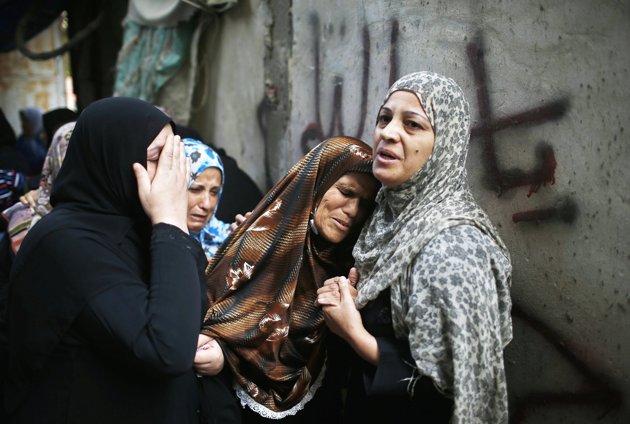
“All day care and education were free. High schools were taken over by the government and college tuition was subsidized. Everyone was entitled to free handouts, such as food stamps, clothing, and housing.
“We had another agency designed to monitor business. My brother-in-law owned a restaurant that had square tables. “ Government officials told him he had to replace them with round tables because people might bump themselves on the corners. Then they said he had to have additional bathroom facilities. It was just a small dairy business with a snack bar. He couldn’t meet all the demands.
“Soon, he went out of business. If the government owned the large businesses and not many small ones existed, it could be in control.
“We had consumer protection, too
Austrian kids loyal to Hitler
“We were told how to shop and what to buy. Free enterprise was essentially abolished. We had a planning agency specially designed for farmers. The agents would go to the farms, count the live-stock, and then tell the farmers what to produce, and how to produce it.
“In 1944, I was a student teacher in a small village in the Alps. The villagers were surrounded by mountain passes which, in the winter, were closed off with snow, causing people to be isolated.
“So people intermarried and offspring were sometimes retarded. When I arrived, I was told there were 15 mentally retarded adults, but they were all useful and did good manual work.
“I knew one, named Vincent, very well. He was a janitor of the school. One day I looked out the window and saw Vincent and others getting into a van.
“I asked my superior where they were going. She said to an institution where the State Health Department would teach them a trade, and to read and write. The families were required to sign papers with a little clause that they could not visit for 6 months.
“They were told visits would interfere with the program and might cause homesickness.
“As time passed, letters started to dribble back saying these people died a natural, merciful death. The villagers were not fooled. We suspected what was happening. Those people left in excellent physical health and all died within 6 months. We called this euthanasia.
“Next came gun registration. People were getting injured by guns. Hitler said that the real way to catch criminals (we still had a few) was by matching serial numbers on guns. Most citizens were law abiding and dutifully marched to the police station to register their firearms. Not long afterwards, the police said that it was best for everyone to turn in their guns. The authorities already knew who had them, so it was futile not to comply voluntarily.
“No more freedom of speech. Anyone who said something against the government was taken away. We knew many people who were arrested, not only Jews, but also priests and ministers who spoke up.
“Totalitarianism didn’t come quickly, it took 5 years from 1938 until 1943, to realize full dictatorship in Austria. Had it happened overnight, my countrymen would have fought to the last breath. Instead, we had creeping gradualism. Now, our only weapons were broom handles. The whole idea sounds almost unbelievable that the state, little by little eroded our freedom.”
“This is my eye-witness account.
“It’s true. Those of us who sailed past the Statue of Liberty came to a country of unbelievable freedom and opportunity.
“America is truly is the greatest country in the world. “Don’t let freedom slip away.
A short interview broadcast by CNN late last week featuring two participants – a Palestinian in Gaza and an Israeli within range of the rocket attacks – did not follow the usual script.
For once, a media outlet dropped its role as gatekeeper, there to mediate and therefore impair our understanding of what is taking place between Israel and the Palestinians, and inadvertently became a simple window on real events.
The usual aim of such “balance” interviews relating to the Israeli-Palestinian conflict is twofold: to reassure the audience that both sides of the story are being presented fairly; and to dissipate potential outrage at the deaths of Palestinian civilians by giving equal time to the suffering of Israelis.
But the deeper function of such coverage in relation to Gaza, given the media’s assumption that Israeli bombs are simply a reaction to Hamas terror, is to redirect the audience’s anger exclusively towards Hamas. In this way, Hamas is made implicitly responsible for the suffering of both Israelis and Palestinians.
The dramatic conclusion to CNN’s interview appears, however, to have otherwise trumped normal journalistic considerations.
The pre-recorded interview via Skype opened with Mohammed Sulaiman in Gaza. From what looked like a cramped room, presumably serving as a bomb shelter, he spoke of how he was too afraid to step outside his home. Throughout the interview, we could hear the muffled sound of bombs exploding in the near-distance. Mohammed occasionally glanced nervously to his side.
The other interviewee, Nissim Nahoom, an Israeli official in Ashkelon, also spoke of his family’s terror, arguing that it was no different from that of Gazans. Except in one respect, he hastened to add: things were worse for Israelis because they had to live with the knowledge that Hamas rockets were intended to harm civilians, unlike the precision missiles and bombs Israel dropped on Gaza.
The interview returned to Mohammed. As he started to speak, the bombing grew much louder. He pressed on, saying he would not be silenced by what was taking place outside. The interviewer, Isha Sesay, interrupted – seemingly unsure of what she was hearing – to inquire about the noise.
Then, with an irony that Mohammed could not have appreciated as he spoke, he began to say he refused to be drawn into a comparison about whose suffering was worse when an enormous explosion threw him from his chair and severed the internet connection. Switching back to the studio, Sesay reassured viewers that Mohammed had not been hurt.
The bombs, however, spoke more eloquently than either Mohammed or Nissim.
If Mohammed had had more time, he might have been able to challenge Nissim’s point about Israelis’ greater fears as well as pointing to another important difference between his and his Israeli interlocutor’s respective plights.
The far greater accuracy of Israel’s weaponry in no way confers peace of mind. The fact is that a Palestinian civilian in Gaza is in far more danger of being killed or injured by one of Israel’s precision armaments than an Israeli is by one of the more primitive rockets being launched out of Gaza.
In Operation Cast Lead, Israel’s attack on Gaza in winter 2008-09, three Israelis were killed by rocket attacks, and six soldiers died in fighting. In Gaza, meanwhile, nearly 1,400 Palestinians were killed, of whom at least 1,000 were not involved in hostilities, according to the Israeli group B’Tselem. Many, if not most, of those civilians were killed by so-called precision bombs and missiles.
If Israelis like Nissim really believe they have to endure greater suffering because the Palestinians lack accurate weapons, then maybe they should start lobbying Washington to distribute its military hardware more equitably, so that the Palestinians can receive the same allocations of military aid and armaments as Israel.
Or alternatively, they could lobby their own government to allow Iran and Hizbullah to bring into Gaza more sophisticated technology than can currently be smuggled in via the tunnels.
The other difference is that, unlike Nissim and his family, most people in Gaza have nowhere else to flee. And the reason that they must live under the rain of bombs in one of the most densely populated areas on earth is because Israel – and to a lesser extent Egypt – has sealed the borders to create a prison for them.
Israel has denied Gaza a port, control of its airspace and the right of its inhabitants to move to the other Palestinian territory recognised by the Oslo accords, the West Bank. It is not, as Israel’s supporters allege, that Hamas is hiding among Palestinian civilians; rather, Israel has forced Palestinian civilians to live in a tiny strip of land that Israel turned into a war zone.
So who is chiefly to blame for the escalation that currently threatens the nearly two million inhabitants of Gaza? Though Hamas’ hands are not entirely clean, there are culprits far more responsible than the Palestinian militants.
First culprit: The state of Israel
The inciting cause of the latest confrontation between Israel and Hamas has little to do with the firing of rockets, whether by Hamas or the other Palestinian factions.
The conflict predates the rockets – and even the creation of Hamas – by decades. It is the legacy of Israel’s dispossession of Palestinians in 1948, forcing many of them from their homes in what is now Israel into the tiny Gaza Strip. That original injustice has been compounded by the occupation Israel has not only failed to end but has actually intensified in recent years with its relentless siege of the small strip of territory.
Israel has been progressively choking the life out of Gaza, destroying its economy, periodically wrecking its infrastructure, denying its inhabitants freedom of movement and leaving its population immiserated.
One only needs to look at the restrictions on Gazans’ access to their own sea. Here we are not considering their right to use their own coast to leave and enter their territory, simply their right to use their own waters to feed themselves. According to one provision of the Oslo accords, Gaza was given fishing rights up to 20 miles off its shore. Israel has slowly whittled that down to just three miles, with Israeli navy vessels firing on fishing boats even inside that paltry limit.
Palestinians in Gaza are entitled to struggle for their right to live and prosper. That struggle is a form of self-defence – not aggression – against occupation, oppression, colonialism and imperialism.
Second culprit: Binyamin Netanyahu and Ehud Barak
The Israeli prime minister and defence minister have taken a direct and personal hand, above and beyond Israel’s wider role in enforcing the occupation, in escalating the violence.
Israel and its supporters always make it their first priority when Israel launches a new war of aggression to obscure the timeline of events as a way to cloud responsibility. The media willingly regurgitates such efforts at misdirection.
In reality, Israel engineered a confrontation to provide the pretext for a “retaliatory” attack, just as it did four years earlier in Operation Cast Lead. Then Israel broke a six-month ceasefire agreed with Hamas by staging a raid into Gaza that killed six Hamas members.
This time, on 8 November, Israel achieved the same end by invading Gaza again, on this occasion following a two-week lull in tensions. A 13-year-old boy out playing football was killed by an Israeli bullet.
Tit-for-tat violence over the following days resulted in the injury of eight Israelis, including four soldiers, and the deaths of five Palestinian civilians, and the wounding of dozens more in Gaza.
On November 12, as part of efforts to calm things down, the Palestinian militant factions agreed a truce that held two days – until Israel broke it by assassinating Hamas military leader Ahmed Jabari. The rockets out of Gaza that followed these various Israeli provocations have been misrepresented as the casus belli.
But if Netanyahu and Barak are responsible for creating the immediate pretext for an attack on Gaza, they are also criminally negligent for failing to pursue an opportunity to secure a much longer truce with Hamas.
We now know, thanks to Israeli peace activist Gershon Baskin, that in the period leading up to Jabari’s execution Egypt had been working to secure a long-term truce between Israel and Hamas. Jabari was apparently eager to agree to it.
Baskin, who was intimately involved in the talks, was a credible conduit between Israel and Hamas because he had played a key role last year in getting Jabari to sign off on a prisoner exchange that led to the release of Israeli soldier Gilad Shalit. Baskin noted in the Haaretz newspaper that Jabari’s assassination “killed the possibility of achieving a truce and also the Egyptian mediators’ ability to function.”
The peace activist had already met Barak to alert him to the truce, but it seems the defence minister and Netanyahu had more pressing concerns than ending the tensions between Israel and Hamas.
What could have been more important than finding a mechanism for saving lives, on both the Palestinian and Israeli sides. Baskin offers a clue: “Those who made the decision must be judged by the voters, but to my regret they will get more votes because of this.”
It seems Israel’s general election, due in January, was uppermost in the minds of Netanyahu and Barak.
A lesson learnt by Israeli leaders over recent years, as Baskin notes, is that wars are vote-winners solely for the right wing. That should be clear to no one more than Netanyahu. He has twice before become prime minister on the back of wars waged by his more “moderate” political opponents as they faced elections.
Shimon Peres, a dove by no standard except a peculiar Israeli one, launched an attack on Lebanon, Operation Grapes of Wrath, that cost him the election in 1996. And centrists Ehud Olmert and Tzipi Livni again helped Netanyahu to victory by attacking Gaza in late 2008.
Israelis, it seems, prefer a leader who does not bother to wrap a velvet glove around his iron fist.
Netanyahu was already forging ahead in the polls before he minted Operation Pillar of Defence. But the electoral fortunes of Ehud Barak, sometimes described as Netanyahu’s political Siamese twin and a military mentor to Netanyahu from their commando days together, have been looking grim indeed.
Barak desperately needed a military rather than a political campaign to boost his standing and get his renegade Independence party across the electoral threshold and into the Israeli parliament. It seems Netanyahu, thinking he had little to lose himself from an operation in Gaza, may have been willing to oblige.
Third culprit: The Israeli army
Israel’s army has become addicted to two doctrines it calls the “deterrence principle” and its “qualitative military edge”. Both are fancy ways of saying that, like some mafia heavy, the Israeli army wants to be sure it alone can “whack” its enemies. Deterrence, in Israeli parlance, does not refer to a balance of fear but Israel’s exclusive right to use terror.
The amassing of rockets by Hamas, therefore, violates the Israeli army’s own sense of propriety, just as Hizbullah’s stockpiling does further north. Israel wants its neighbouring enemies to have no ability to resist its dictates.
Doubtless the army was only too ready to back Netanyahu and Barak’s electioneering if it also provided an opportunity to clean out some of Hamas’ rocket arsenal.
But there is another strategic reason why the Israeli army has been chomping at the bit to crack down on Hamas again.
Haaretz’s two chief military correspondents explained the logic of the army’s position last week, shortly after Israel killed Jabari. They reported: “For a long time now Israel has been pursuing a policy of containment in the Gaza Strip, limiting its response to the prolonged effort on the part of Hamas to dictate new rules of the game surrounding the fence, mainly in its attempt to prevent the entry of the IDF into the ‘perimeter,’ the strip of a few hundred meters wide to the west of the fence.”
In short, Hamas has angered Israeli commanders by refusing to sit quietly while the army treats large areas of Gaza as its playground and enters at will.
Israel has created what it terms a “buffer zone” inside the fence around Gaza, often up to a kilometre wide, that Palestinians cannot enter but the Israeli army can use as a gateway for launching its “incursions”. Remote-controlled guns mounted on Israeli watch-towers around Gaza can open fire on any Palestinian who is considered to have approached too close.
Three incidents shortly before Jabari’s extra-judicial execution illustrate the struggle for control over Gaza’s interior.
On November 4, the Israeli army shot dead a young Palestinian man inside Gaza as he was reported to have approached the fence. Palestinians say he was mentally unfit and that he could have been saved by medics had ambulances not been prevented from reaching him for several hours.
On November 8, as already noted, the Israeli army made an incursion into Gaza to attack Palestinian militants and in the process shot dead a boy playing football.
And on November 10, two days later, Palestinian fighters fired an anti-tank missile that destroyed a Jeep patrolling the perimeter fence around Gaza, wounding four soldiers.
As the Haaretz reporters note, Hamas appears to be trying to demonstrate that it has as much right to defend its side of the “border fence” as Israel does on the other side.
The army’s response to this display of native impertinence has been to inflict a savage form of collective punishment on Gaza to remind Hamas who is boss.
Fourth culprit: the White House
It is near-impossible to believe that Netanyahu decided to revive Israel’s policy of extra-judicial executions of Hamas leaders – and bystanders – without at least consulting the White House. Israel clearly also held off from beginning its escalation until after the US elections, restricting itself, as it did in Cast Lead, to the “downtime” in US politics between the elections and the presidential inauguration.
That was designed to avoid overly embarrassing the US president. A fair assumption must be that Barack Obama approved Israel’s operation in advance. Certainly he has provided unstinting backing since, despite the wildly optimistic scenarios painted by some analysts that he was likely to seek revenge on Netanyahu in his second term.
Also, it should be remembered that Israel’s belligerence towards Gaza, and the easing of domestic pressure on Israel to negotiate with Hamas or reach a ceasefire, has largely been made possible because Obama forced US taxpayers to massively subsidise Israel’s rocket interception system, Iron Dome, to the tune of hundreds of millions of dollars.
Iron Dome is being used to shoot down rockets out of Gaza that might otherwise have landed in built-up areas of Israel. Israel and the White House have therefore been able to sell US munificence on the interception of rockets as a humanitarian gesture.
But the reality is that Iron Dome has swung Israel’s cost-benefit calculus sharply in favour of greater aggression because it is has increased Israel’s sense of impunity. Whatever Hamas’ ability to smuggle into Gaza more sophisticated weaponry, Israel believes it can neutralise that threat using interception systems.
Far from being a humanitarian measure, Iron Dome has simply served to ensure that Gaza will continue to suffer a far larger burden of deaths and injuries in confrontations with Israel and that such confrontations will continue to occur regularly.
Here are the four main culprits. They should be held responsible for the deaths of Palestinians and Israelis in the days and, if Israel expands its operation, weeks ahead.
Jonathan Cook won the Martha Gellhorn Special Prize for Journalism. His latest books are “Israel and the Clash of Civilisations: Iraq, Iran and the Plan to Remake the Middle East” (Pluto Press) and “Disappearing Palestine: Israel’s Experiments in Human Despair” (Zed Books). His new website is www.jonathan-cook.net.
“Disturbing, powerful and emotionally devastating, Tears of Gaza is less a conventional documentary than a record — presented with minimal gloss — of the 2008 to 2009 bombing of Gaza (dubbed ‘Operation Cast Lead’) by the Israeli military. Filmed by several Palestinian cameramen both during and after the offensive, this powerful film by director Vibeke Løkkeberg focuses on the impact of the attacks on the civilian population.
Tears of Gaza makes no overriding speeches or analyses. The situation leading up to the incursion (in which the Jewish state broke a truce unprovoked) is never mentioned. Similar events certainly occurred in Dresden, Tokyo, Baghdad and Sarajevo, but of course Gaza isn’t those places. Tears of Gaza demands that we examine the costs of war on a civilian populace.”
(Excerpt from Steve Gravestock, 2011 Toronto International Film Festival) http://tearsofgazamovie.com/
When Barack Obama took office, drone strikes were a once-in-a-while thing, with an attack every week or two. Now, they’re the centerpiece of a global U.S. counterterrorism campaign. Obama institutionalized the strikes to the point where he could hand off to the next president an efficient bureaucratic process for delivering death-by-robot practically on autopilot. Only now he’s the next president. Welcome to Obama’s second-term agenda for dealing with the world. As the Ramones sang: second verse, same as the first.
Early in the first term, then-CIA director Leon Panetta observed that drones were the “only game in town” for attacking al-Qaida in Pakistan. By that he meant invading a country for the third time in a decade was a nonstarter, and the flesh-and-blood spies needed to do a traditional intelligence operation weren’t available in sufficient numbers. So the Obama administration all but crafted its counterterrorism strategy around the drones, turning their surveillance and lethal operations into a bureaucratic apparatus led by White House aides with minimal outside oversight. The CIA and the Joint Special Operations Command, elite forces that rarely operate visibly, have the lead for implementing the robot-based agenda — and augmenting it with commando raids. Backstopping them are new tools to invade and disrupt enemy data networks.
The strikes have spread from Pakistan to Yemen to Somalia. And now that Obama’s been reelected, expect them to spread to Mali, another country most Americans neither know nor understand. The northern part of the North African country has fallen into militant hands. U.S.-aligned forces are currently plotting to take it back. The coming arrival of Army Gen. David Rodriguez, the former day-to-day commander of the Afghanistan war, as leader of U.S. forces in Africa is a signal that Obama wants someone experienced at managing protracted wars on a continent where large troop footprints aren’t available. Instead, Rodriguez will have to track, check and erode the spread of al-Qaida in northern and eastern Africa using drones and commando forces, available from his expanding bases in places like Djibouti. If all of this seems routine, that’s the point.
The Obama administration is doing something similar with cyber weaponry. It’s trying to make them a normal part of everyday conflict. Gone are the days when senior officers equivocated in public about their ability to disrupt enemy data networks. Now the Air Force talks openly about spending $10 million on new tools “to destroy, deny, degrade, disrupt, deceive, corrupt, or usurp the adversaries [sic] ability to use the cyberspace domain for his advantage.” The Pentagon’s futurists at Darpa have launched a new “Plan X” to routinize the corruption of enemy networks and the exfiltration of data within normal military operations. Routinization may actually be the wrong word: Darpa wants military malware that works like “the auto-pilot function in modern aircraft.” The Stuxnet worm that messed with Iran’s centrifuges was only the beginning.
All this might seem aggressive for a president who liked to say on the campaign trail that “the tide of war is receding.” But the tide of war never actually goes out. And the wicked-hard problems facing Obama’s national security team may only be getting under way.
Next comes Iran. Israel’s Benjamin Netanyahu has suggested that he will feel the need to strike Iran by next summer. Obama has a stronger hand with Netanyahu now that he doesn’t have to worry about reelection, but he’s still committed himself rhetorically to preventing an Iranian nuclear weapon. Even if Obama can avert a war, his clear preference, Iran will continue to consume a tremendous amount of the White House and the Pentagon’s attention. The alternative to a massive bombing campaign might not be so benign, either: the point of Stuxnet was to make the Iranians distrust the industrial controls on their nuclear program’s centrifuges.
Then comes Afghanistan, a war that Obama does not discuss candidly. He’s fond of saying, as he did in one of his final ads, that he plans on “ending the war in Afghanistan, so we can do some nation-building here at home.” His real policy is way more complex than that. Yes, Obama is committed to withdrawing most troops and ending a formal U.S. combat role by 2014. Obama plans to keep a residual troop presence in the country, even after the 2014 “withdrawal,” and negotiations with the Afghans about what shape that presence will take — and for what purpose — are supposed to begin shortly. Among the things Obama is likely to seek: Afghanistan’s permission to keep its air bases as launchpads for drone strikes into Pakistan. The charitable interpretation is to say Obama is caveating his out-of-Afghanistan pledge. The uncharitable interpretation is that he’s misleading the country on it.
The Obama administration is still grappling with the implications of its sprawling, robot-led war. Some of its top officials are just starting to question how long the strikes have to persist. But they haven’t addressed concerns about the precedent the U.S. is setting by sending robots to violate the sovereignty of nations, which are unavoidable as drone technology advances and proliferates. Micah Zenko, a scholar at the Council on Foreign Relations, sees a reckoning with the robots on the horizon.
“There is a recognition within the administration that the current trajectory of drone strikes is unsustainable,” Zenko says. “They are opposed in countries where strikes occur and globally, and that opposition could lead to losing host-nation support for current or future drone bases or over-flight rights.” In other words, tomorrow’s America diplomats may find that drones overshadow the routine geopolitical agenda they seek to advance. The trouble is, the administration’s early search for less-lethal policies to supplement or supplant the drones isn’t promising.
Obama’s broader foreign policy agenda keeps getting derailed. He barely talks about his expansive goal of eliminating global nuclear weapons anymore. Any route to an Israeli-Palestinian peace runs through Netanyahu, who only wants to talk about Iran. The much-heralded “pivot” of the U.S. defense posture toward Asia, a relatively modest goal, keeps getting deferred by the crises of the moment: the Navy’s newest and more advanced ships are going to confront Iran, not to preserve the freedom of the Pacific shipping lanes. A former Obama Pentagon official, Rosa Brooks, recently lamented the Obama team’s chronic inability to shape global events.
Civil libertarians rightly point to Obama’s reversals on expanding warrantless surveillance; the indefinite detention of terrorism suspects; military tribunals at Guantanamo Bay; prosecuting whistleblowers; and embracing an expensive definition of the war on terrorism’s executive powers. But there’s little evidence that Obama will change course. In an insightful blog post, the Brookings Institution’s Benjamin Wittes writes that Obama’s civil-liberties and national security record is best explained by a policy “consensus” in D.C., running through George W. Bush’s second term and Obama’s first, that basically agrees on a definition of executive power that civil libertarians dislike. It’s uncomfortable with torture, but basically comfortable with expansive domestic spying and detention powers.
As Obama’s second term dawns, it’s time to put away ideological illusions about his approach to foreign affairs. Liberals keep waiting for an agenda that’s less killer-robot-y. Conservatives are unable to see him as anything but a peacenik: “We’ll get to see what jimmy carter’s 2nd term would have looked like,” tweeted Jim Carafano, a defense analyst at the conservative Heritage Foundation.
But the evidence is staring everyone in the face. Obama has elevated a practice of stealthy robotic warfare to the tactic of choice for U.S. security priorities, and built around it a system that operates it practically on bureaucratic inertia. Obama has a powerful incentive of all to continue his trajectory: with the one major exception of the Benghazi consulate disaster, Obama’s handling of global affairs has been notably free of high-profile screwups. That’s the sort of thing that propels a foreign policy agenda — to borrow a term — forward.
Palestinian workers line up to get checked by a Palestinian security officer before entering the Israeli controlled industrial zone in Erez area between Israel and the Gaza Strip.
A look at life under occupation.
Gaza has the look of a Third World country, with pockets of wealth surrounded by hideous poverty. It is not, however, undeveloped. Rather it is “de-developed,” and very systematically so, to borrow the term from Sara Roy, the leading academic specialist on Gaza.
Even a single night in jail is enough to give a taste of what it means to be under the total control of some external force.
And it hardly takes more than a day in Gaza to appreciate what it must be like to try to survive in the world’s largest open-air prison, where some 1.5 million people on a roughly 140-square-mile strip of land are subject to random terror and arbitrary punishment, with no purpose other than to humiliate and degrade.
Such cruelty is to ensure that Palestinian hopes for a decent future will be crushed, and that the overwhelming global support for a diplomatic settlement granting basic human rights will be nullified. The Israeli political leadership has dramatically illustrated this commitment in the past few days, warning that they will “go crazy” if Palestinian rights are given even limited recognition by the U.N.
This threat to “go crazy” (“nishtagea”)–that is, launch a tough response–is deeply rooted, stretching back to the Labor governments of the 1950s, along with the related “Samson Complex”: If crossed, we will bring down the Temple walls around us.
Thirty years ago, Israeli political leaders, including some noted hawks, submitted to Prime Minister Menachem Begin a shocking report on how settlers on the West Bank regularly committed “terrorist acts” against Arabs there, with total impunity.
Disgusted, the prominent military-political analyst Yoram Peri wrote that the Israeli army’s task, it seemed, was not to defend the state, but “to demolish the rights of innocent people just because they are Araboushim (a harsh racial epithet) living in territories that God promised to us.”
Gazans have been singled out for particularly cruel punishment. Thirty years ago, in his memoir “The Third Way,” Raja Shehadeh, a lawyer, described the hopeless task of trying to protect fundamental human rights within a legal system designed to ensure failure, and his personal experience as a Samid, “a steadfast one,” who watched his home turned into a prison by brutal occupiers and could do nothing but somehow “endure.”
Since then, the situation has become much worse. The Oslo Accords, celebrated with much pomp in 1993, determined that Gaza and the West Bank are a single territorial entity. By that time, the U.S. and Israel had already initiated their program to separate Gaza and the West Bank, so as to block a diplomatic settlement and punish the Araboushim in both territories.
Punishment of Gazans became still more severe in January 2006, when they committed a major crime: They voted the “wrong way” in the first free election in the Arab world, electing Hamas.
Displaying their “yearning for democracy,” the U.S. and Israel, backed by the timid European Union, immediately imposed a brutal siege, along with military attacks. The U.S. turned at once to its standard operating procedure when a disobedient population elects the wrong government: Prepare a military coup to restore order.
Gazans committed a still greater crime a year later by blocking the coup attempt, leading to a sharp escalation of the siege and attacks. These culminated in winter 2008-09, with Operation Cast Lead, one of the most cowardly and vicious exercises of military force in recent memory: A defenseless civilian population, trapped, was subjected to relentless attack by one of the world’s most advanced military systems, reliant on U.S. arms and protected by U.S. diplomacy.
Of course, there were pretexts–there always are. The usual one, trotted out when needed, is “security”: in this case, against homemade rockets from Gaza.
In 2008, a truce was established between Israel and Hamas. Not a single Hamas rocket was fired until Israel broke the truce under cover of the U.S. election on Nov. 4, invading Gaza for no good reason and killing half a dozen Hamas members.
The Israeli government was advised by its highest intelligence officials that the truce could be renewed by easing the criminal blockade and ending military attacks. But the government of Ehud Olmert–himself reputedly a dove–rejected these options, resorting to its huge advantage in violence: Operation Cast Lead.
The internationally respected Gazan human-rights advocate Raji Sourani analyzed the pattern of attack under Cast Lead. The bombing was concentrated in the north, targeting defenseless civilians in the most densely populated areas, with no possible military basis. The goal, Sourani suggests, may have been to drive the intimidated population to the south, near the Egyptian border. But the Samidin stayed put.
A further goal might have been to drive them beyond the border. From the earliest days of the Zionist colonization it was argued that Arabs have no real reason to be in Palestine: They can be just as happy somewhere else, and should leave–politely “transferred,” the doves suggested.
This is surely no small concern in Egypt, and perhaps a reason why Egypt doesn’t open the border freely to civilians or even to desperately needed supplies.
Sourani and other knowledgeable sources have observed that the discipline of the Samidin conceals a powder keg that might explode at any time, unexpectedly, like the first Intifada in Gaza in 1987, after years of repression.
A necessarily superficial impression after spending several days in Gaza is amazement, not only at Gazans’ ability to go on with life but also at the vibrancy and vitality among young people, particularly at the university, where I attended an international conference.
But one can detect signs that the pressure may become too hard to bear. Reports indicate that there is simmering frustration among young people–a recognition that under the U.S.-Israeli occupation the future holds nothing for them.
Gaza has the look of a Third World country, with pockets of wealth surrounded by hideous poverty. It is not, however, undeveloped. Rather it is “de-developed,” and very systematically so, to borrow the term from Sara Roy, the leading academic specialist on Gaza.
The Gaza Strip could have become a prosperous Mediterranean region, with rich agriculture and a flourishing fishing industry, marvelous beaches and, as discovered a decade ago, good prospects for extensive natural gas supplies within its territorial waters. By coincidence or not, that’s when Israel intensified its naval blockade. The favorable prospects were aborted in 1948, when the Strip had to absorb a flood of Palestinian refugees who fled in terror or were forcefully expelled from what became Israel – in some cases months after the formal cease-fire. Israel’s 1967 conquests and their aftermath administered further blows, with terrible crimes continuing to the present day.
The signs are easy to see, even on a brief visit. Sitting in a hotel near the shore, one can hear the machine-gun fire of Israeli gunboats driving fishermen out of Gaza’s territorial waters and toward land, forcing them to fish in waters that are heavily polluted because of U.S.-Israeli refusal to allow reconstruction of the sewage and power systems they destroyed.
The Oslo Accords laid plans for two desalination plants, a necessity in this arid region. One, an advanced facility, was built: in Israel. The second one is in Khan Yunis, in the south of Gaza. The engineer in charge at Khan Yunis explained that this plant was designed so that it can’t use seawater, but must rely on underground water, a cheaper process that further degrades the meager aquifer, guaranteeing severe problems in the future.
The water supply is still severely limited. The U.N. Relief and Works Agency (UNRWA), which cares for refugees but not other Gazans, recently released a report warning that damage to the aquifer may soon become “irreversible,” and that without quick remedial action, Gaza may cease to be a “livable place” by 2020.
Israel permits concrete to enter for UNRWA projects, but not for Gazans engaged in the huge reconstruction efforts. The limited heavy equipment mostly lies idle, since Israel does not permit materials for repair.
All this is part of the general program that Dov Weisglass, an adviser to Prime Minister Olmert, described after Palestinians failed to follow orders in the 2006 elections: “The idea,” he said, “is to put the Palestinians on a diet, but not to make them die of hunger.”
Recently, after several years of effort, the Israeli human rights organization Gisha succeeded in obtaining a court order for the government to release its records detailing plans for the “diet.” Jonathan Cook, a journalist based in Israel, summarizes them: “Health officials provided calculations of the minimum number of calories needed by Gaza’s 1.5 million inhabitants to avoid malnutrition. Those figures were then translated into truckloads of food Israel was supposed to allow in each day … an average of only 67 trucks–much less than half of the minimum requirement–entered Gaza daily. This compared to more than 400 trucks before the blockade began.”
The result of imposing the diet, Middle East scholar Juan Cole observes, is that “about 10 percent of Palestinian children in Gaza under age 5 have had their growth stunted by malnutrition. … In addition, anemia is widespread, affecting over two-thirds of infants, 58.6 percent of schoolchildren, and over a third of pregnant mothers.”
Sourani, the human-rights advocate, observes that “what has to be kept in mind is that the occupation and the absolute closure is an ongoing attack on the human dignity of the people in Gaza in particular and all Palestinians generally. It is systematic degradation, humiliation, isolation and fragmentation of the Palestinian people.”
This conclusion has been confirmed by many other sources. In The Lancet, a leading medical journal, Rajaie Batniji, a visiting Stanford physician, describes Gaza as “something of a laboratory for observing an absence of dignity,” a condition that has “devastating” effects on physical, mental and social well-being.
“The constant surveillance from the sky, collective punishment through blockade and isolation, the intrusion into homes and communications, and restrictions on those trying to travel, or marry, or work make it difficult to live a dignified life in Gaza,” Batniji writes. The Araboushim must be taught not to raise their heads.
There were hopes that Mohammed Morsi’s new government in Egypt, which is less in thrall to Israel than the western-backed Hosni Mubarak dictatorship was, might open the Rafah Crossing, Gaza’s sole access to the outside that is not subject to direct Israeli control. There has been a slight opening, but not much.
The journalist Laila el-Haddad writes that the reopening under Morsi “is simply a return to status quo of years past: Only Palestinians carrying an Israeli-approved Gaza ID card can use Rafah Crossing.” This excludes a great many Palestinians, including el-Haddad’s own family, where only one spouse has a card.
Furthermore, she continues, “the crossing does not lead to the West Bank, nor does it allow for the passage of goods, which are restricted to the Israeli-controlled crossings and subject to prohibitions on construction materials and export.”
The restricted Rafah Crossing doesn’t change the fact that “Gaza remains under tight maritime and aerial siege, and continues to be closed off to the Palestinians’ cultural, economic and academic capitals in the rest of the (Israeli-occupied territories), in violation of U.S.-Israeli obligations under the Oslo Accords.”
The effects are painfully evident. The director of the Khan Yunis hospital, who is also chief of surgery, describes with anger and passion how even medicines are lacking, which leaves doctors helpless and patients in agony.
One young woman reports on her late father’s illness. Though he would have been proud that she was the first woman in the refugee camp to gain an advanced degree, she says, he “passed away after six months of fighting cancer, aged 60 years.
“Israeli occupation denied him a permit to go to Israeli hospitals for treatment. I had to suspend my study, work and life and go to sit next to his bed. We all sat, including my brother the physician and my sister the pharmacist, all powerless and hopeless, watching his suffering. He died during the inhumane blockade of Gaza in summer 2006 with very little access to health service.
“I think feeling powerless and hopeless is the most killing feeling that a human can ever have. It kills the spirit and breaks the heart. You can fight occupation but you cannot fight your feeling of being powerless. You can’t even ever dissolve that feeling.”
A visitor to Gaza can’t help feeling disgust at the obscenity of the occupation, compounded with guilt, because it is within our power to bring the suffering to an end and allow the Samidin to enjoy the lives of peace and dignity that they deserve.
Noam Chomsky is Institute Professor & Professor of Linguistics (Emeritus) at the Massachusetts Institute of Technology, and the author of dozens of books on U.S. foreign policy. He writes a monthly column for The New York Times News Service/Syndicate.
When it comes to corruption in Afghanistan, the time may be now for the United States to look in the mirror and see what lessons can be learned from contracting out parts of that war.
On Sept. 30, Afghan President Hamid Karzai told CBS’s “60 Minutes” that the corruption wracking his government and its people has been at a level “not ever before seen in Afghanistan.”
In the 1980s, when the Soviets ran the country, the government was “not even 5 percent as corrupt,” Karzai said.
“ The Soviets didn’t give contracts to the relatives, brothers and the kin of the influential and high ups,” he said. “The Americans did, and they continue to do, but we get blamed for it.”
It’s easy to disregard what Karzai told CBS. He has often blamed the United States and its allies for corrupting his country and certainly will again. And his complaint about U.S. contracts going to relatives of influential Afghans rings hollow when you go down the list that includes many members of his own family as well as cabinet ministers.
But the record shows Karzai has a point with which others agree.
“It is time that we as Americans — in government, in the media, and as analysts and academics — took a hard look at the causes of corruption in Afghanistan. The fact is that we are at least as much to blame for what has happened as the Afghans, and we have been grindingly slow to either admit our efforts or correct them.”
That was written in September 2010 by Anthony H. Cordesman, national security expert and a former Reagan Pentagon official, in a Center for Strategic and International Studies report, “How America Corrupted Afghanistan.”
Cordesman, who spent a good deal of time in Afghanistan, wrote: “We can probably do more to fight the worst causes of Afghan corruption by changing our own actions than by any amount of effort to encourage Afghan anti-corruption drives.”
He particularly criticized the military contracting process, saying, “The bulk of the money actually spent inside Afghanistan went through poorly supervised military contracts and through aid projects where the emphasis was speed, projected starts, and measuring progress in terms of spending rather than results.”
That process led to what Karzai is complaining about now — as Cordesman did two years ago. “U.S. and foreign contractors poured money into a limited number of Afghan powerbrokers who set up companies that were corrupt and did not perform. . . . In many cases, they also paid off insurgents to let them operate,” Cordesman wrote.
He suggested that the government “tightly control the influx of outside money, limit its flow to honest and capable Afghans at every level of government, and provide the transparency to allow Afghans to see how honestly and effectively the money is used.”
I thought of the 2010 Cordesman report last week after reading an interim report sent to Defense Secretary Leon E. Panetta and top Pentagon officers associated with Afghanistan. The report criticized how the U.S. military is preparing to turn over to the Afghan National Army the buying of petroleum, oil and lubricants that is estimated next year to involve $343 million in U.S taxpayer funds and another $123 million from international donors.
The funding is based on an estimate of the Afghan National Army’s needs. However, the report, by the Special Inspector General for Afghanistan Reconstruction (SIGAR), found that the program after transition will be “vulnerable to theft and waste” because the United States and its allies do not have a “valid method for estimating [Afghan army] fuel needs,” nor records on its past “fuel purchases, deliveries and consumption.”
Corruption was evident in the past when the United States supervised the buying and delivery of fuel in Afghanistan. John F. Sopko, the special inspector general, told a House Oversight subcommittee on Sept. 13 that fuel “is a valuable commodity that is vulnerable to theft.”
Just last month, an Army sergeant pleaded guilty to approving fake documents that allowed truckers to steal $1.5 million of fuel from a forward operating base in 2010. In August, a former Army sergeant pleaded guilty to soliciting $400,000 in a similar plot that involved stealing $1.4 million of fuel in 2010 from another forward operating base.
In June, two Army servicemen pleaded guilty in a plot to steal jet fuel from a base and getting $6,000 for clandestinely filling 3,000-gallon trucks owned by an Afghan contractor.
Sopko told the House panel that his office has 20 active criminal investigations looking into the theft and diversion of fuel or bribery or bid-rigging on fuel contracts involving more than $100 million.
Perhaps worse, the SIGAR inquiry found that U.S. coalition financial records covering $475 million in fuel purchases and payments from October 2006 to February 2011 had been shredded. This was done “in violation of DOD [Department of Defense] and Department of the Army policies,” according to the SIGAR report.
In addition, SIGAR auditors were not given half the records sought for the March 2011 to March 2012 period. And although June 2012 Afghan army fuel purchases and payments were reconciled, the command “still could not account for the amount of fuel delivered and consumed,” SIGAR said.
A July SIGAR report found that because the military command did not “file claims for damaged or missing equipment, it was providing fuel for vehicles that had been destroyed.”
Sopko said his audit found that in one case “as much as 1 million gallons of fuel had been stolen over a four-month period without causing any red flags to be raised in the system.”
In short, corruption involves Americans and Afghans.
Now, according to SIGAR, the U.S.-NATO command “does not have accurate or supportable information on how much U.S. funds are needed for ANA [Afghan National Army] fuel, where and how the fuel is actually used, or how much fuel has been lost or stolen.”
The command has taken actions “to improve controls over fuel purchases, vendor deliveries, and the payment of invoice amounts,” but SIGAR maintains there is still a need to ensure “all fuel activity is tracked and accounted for.”
There may be a history of corruption in Afghanistan, but the United States is continuing to create tempting, rich, new targets such as fuel, and apparently enough Americans are willing to join in the illegal action.
The official story surrounding the events of September 11, 2012 in Benghazi, Libya which left four Americans dead, has now officially fallen apart.
After numerous flips and flops by the Obama administration, which originally attempted to paint the incident as a Muslim outcry over an anti-Islamic video, whistle blowers throughout the U.S. government, including within the White House, the State Department, national intelligence agencies and the U.S.military have made available stunning details that suggest not only did operational commanders have live visual and audio communications from drones overhead and intelligence assets on the ground, but that some commanders within the military were prepared to go-it-alone after being told to “stand down.”
Africom commanding officer U.S. General Carter Ham, after being ordered to essentially surrender control of the situation to alleged Al Queda terrorists and let Americans on the ground die, made the unilateral decision to ignore orders from the Secretary of Defense and activated special operations teams at his disposal for immediate deployment to the area.
According to reports, once the General went rogue he was arrested within minutes by his second in command and relieved of duty.
“(The) basic principle is that you don’t deploy forces into harm’s way without knowing what’s going on; without having some real-time information about what’s taking place,” Panetta told Pentagon reporters. “And as a result of not having that kind of information, the commander who was on the ground in that area, Gen. Ham, Gen. Dempsey and I felt very strongly that we could not put forces at risk in that situation.”
The information I heard today was that General Ham as head of Africom received the same e-mails the White House received requesting help/support as the attack was taking place. General Ham immediately had a rapid response unit ready and communicated to the Pentagon that he had a unit ready.
General Ham then received the order to stand down. His response was to screw it, he was going to help anyhow. Within 30 seconds to a minute after making the move to respond, his second in command apprehended General Ham and told him that he was now relieved of his command.
The question now is whether the American people will hold to account the chain of command responsible for leaving our people behind, fabricating a politically expedient story, and continuing to sell the now defunct lie(s) even after all of their variations of the story were found to be false and misleading.
A General who made the decision to assist diplomatic and intelligence assets on the ground has been arrested and will likely be retired or worse, while those who ordered the removal of embassy security details and ordered U.S. forces to stand-down are left to go on about their business and likely risk more American lives in the future.
In some circles the actions of those at the very top of the command structure during the Bengzahi attacks would be considered traitorous.
Greenwald is that increasingly rare commodity in the US, a true journalist. I don’t agree with him on a lot of things, but he is definitely correct here in debunking the hogwash about “humanitarian” wars. Nobody goes to war for humanitarian reasons. There may be an unplanned byproduct of humanitarianism, but it is never the objective. The objective of war is always the acquisition of land and resources or the defense thereof. That’s it.
Andrew Sullivan says he’ll use it less scrupulously than the president. But based on what evidence? Current policy is plenty unscrupulous already.
Asked about drone strikes during Monday’s foreign policy debate, Mitt Romney basically said that President Obama is right to use them. Expect more drone warfare in 2013 regardless of who wins the election. Does that mean that the two candidates are indistinguishable on the issue? My friend and former boss Andrew Sullivan doesn’t think so. “Memo to Conor Friedersdorf,” he wrote while live-blogging at The Dish. “You think Romney would be as scrupulous in drone warfare as Obama?” Implicit is the judgment that Obama has been “scrupulous.”
But it isn’t so.
Sullivan and I agree that Obama won last night’s debate, and that he’d be likely to preside over a more prudent, reality-based foreign policy than Romney, based on the respective campaigns that they’ve run. On drones, however, Romney appears to have the exact same position as Obama. And Obama has been egregiously unscrupulous. I don’t want to hear the dodge about how drone strikes are necessary. It’s beside the point. This is about the specific ways Obama has waged the drone war. Even if you agree in theory with drone strikes, Obama’s actions ought to bother you.
Let me be specific:
As Jane Mayer noted when describing the CIA’s drone strikes, “The program is classified as covert, and the intelligence agency declines to provide any information to the public about where it operates, how it selects targets, who is in charge, or how many people have been killed.”
The Obama Administration avoids judicial accountability by arguing that the drone program is secret, even as it acknowledges the existence of the program when bragging about killing terrorists.
As the Mayer article goes on to state, “because of the C.I.A. program’s secrecy, there is no visible system of accountability in place, despite the fact that the agency has killed many civilians inside a politically fragile, nuclear-armed country with which the U.S. is not at war. Should something go wrong in the C.I.A.’s program — last month, the Air Force lost control of a drone and had to shoot it down over Afghanistan — it’s unclear what the consequences would be.”
According to The New York Times, “Mr. Obama embraced a disputed method for counting civilian casualties that did little to box him in. It in effect counts all military-age males in a strike zone as combatants, according to several administration officials, unless there is explicit intelligence posthumously proving them innocent.”
The Obama Administration permits the CIA to carry out “signature strikes” even though they don’t know the identity of the people they’re trying to kill!
As Glenn Greenwald explained, “In February, the Bureau of Investigative Journalism documented that after the U.S. kills people with drones in Pakistan, it then targets for death those who show up at the scene to rescue the survivors and retrieve the bodies, as well as those who gather to mourn the dead at funerals.”
As a report published by the law clinics at NYU and Standford document, innocent people in Waziristan are being terrorized and traumatized daily by Obama’s drone war. And the policy has killed, at minimum, hundreds of innocent people, a judgment that is supported even by data from the New America Foundation, whose methods almost certainly under-count dead innocents.
So to sum up, Obama has implemented a global killing program with zero checks and balances; he’s operated it out of the CIA rather than the Department of Defense; he invokes the state-secrets privilege to avoid defending it in court, even as he brags about its efficacy; it includes killing people whose identities we don’t even know; all military-aged males we kill are presumed to be “militants”; the Pakistani government reportedly gets to pick some of the targets; at minimum, hundreds of innocents have been killed, including rescuers and funeral-goers; a 16-year-old American citizen was among those killed; and Sullivan, having been exposed many times to all the information I’ve just included, thinks its accurate to call Obama’s drone program “scrupulous,” though it could easily be made more transparent, accountable, and lawful.
What really gets me is that, in addition to arguing that Obama has run this program scrupulously (something implied in Sullivan’s question, and explicitly argued in threads like this one), Sullivan has also himself articulated almost all of the reasons why the program has been unscrupulous — that is to say, why Obama’s drone policy “disregards, or has contempt for, laws of right or justice with which he is perfectly well acquainted, and which should restrain his actions.”
“One thing I’ve learned this past decade is that the CIA is pretty much its own judge, jury and executioner,” Sullivan wrote. “It is much less accountable to the public, more likely to break the laws of war and destroy the evidence, more likely to do things that could escalate rather than ameliorate a conflict.” Is it scrupulous to pick an organization like that to run your drone program?
Says Sullivan’s post from June of 2011 (emphasis added):
Obama is now engaged in two illegal wars — in Libya and in Yemen. There was no Congressional debate or vote on these wars — and one is being waged by the CIA with unmanned drones. I think we have learned a little about what happens when you give the CIA carte blanche to run a war with no accountability except to a president who has a vested interest in covering up errors.
Said Sullivan on another occasion, “Put drones in the hands of an executive who is empowered to do anything without any input from the other branches of government … and we have a problem indeed.” He is also on record stating that “counting every military-age man in the vicinity of a Jihadist as a terrorist is a total cop-out,” and he even wrote that “if the CIA, based on its own intelligence, can launch a war or wars with weapons that can incur no US fatalities, the propensity to be permanently at war, permanently making America enemies, permanently requiring more wars to put out the flames previous wars started, then the Founders’ vision is essentially over. I think it’s a duty to make sure their vision survives this twenty-first century test.”
So let’s get back to Sullivan’s debate night question. “You think Romney would be as scrupulous in drone warfare as Obama?” My best guess is that, on drone warfare, their policies would be about the same — that is to say, alarmingly unscrupulous, with unpredictable consequences. That’s what happens when you give someone the power to kill without checks in secret.
I have no reason to think one or the other would predictably kill more innocent people with drones. Does Sullivan? If Romney wins, what odds would Sullivan give on the proposition that Romney ultimately kills more civilians with drones than Obama has? Based on what evidence? Obama has already killed an American citizen without trial and conducted drone strikes in a country where no war has been declared, so I don’t see how Romney would set any precedents that are even more alarming. (What precedent would that be?) Overall, I have no idea whose drone war would be more damaging. Having watched Sullivan strongly denounce and other times defend Obama’s drone war in posts that cannot be reconciled with one another, I don’t think he knows either.
So what if Romney is elected and turns out to be much worse on drones? It could totally happen. I wouldn’t be surprised. I’ll be opposing his unaccountable killing policy from day one regardless, just as I’ve opposed Obama’s policy due to its manifold flaws. And if Romney’s drone policy turns out to have all sorts of catastrophic consequences? I hope Sullivan remembers that Obama established the bipartisan consensus behind a worldwide drone-strike strategy and set all the necessary precedents without losing the support of backers like Sullivan. (He didn’t even lose support for continuing his current drone policy itself.) A Romney drone fleet, operating in numerous countries with zero oversight from the judiciary or Congress, with American citizens in the crosshairs? Obama and his supporters built that. It would be ready for President Romney on day one.
Ex-Marine who threw back his medals, Jon Michael Turner, speaks the raw hard truth about merciless & indiscriminate killing PROMOTED by Staff Sgts and other Top Military Brass during modern war and middle eastern conflict.
The Defense Advanced Research Projects Agency’s (DARPA) new director, Dr. Arati Prabhakar, will share her vision Oct. 22 at the Office of Naval Research (ONR) 2012 Naval Science and Technology Partnership Conference and ASNE Expo.
Prabhakar, who took the helm at DARPA on July 30, will take the podium at 11:30 a.m. on the event’s opening day in Crystal City, Va. Her participation underscores the importance of research partnerships to national security and the commitment to collaboration shared by DARPA, ONR and other Department of Defense research organizations.
”Technology is a critical lever for our national security in today’s complex world,” said DARPA Director Dr. Arati Prabhakar. ”At DARPA, along with our partners at ONR and the broad national research-and-development community, we aim to change what is possible with new technology.”
ONR and DARPA have partnered on a variety of research projects, including multiple endeavors to promote education in the science, technology, engineering and mathematics fields.
This year, the agencies teamed to co-sponsor the RevCon Challenge, a competition among college students to design connectors that more effectively conduct heat from radars and other military electronic systems. Based on the success of the competition, ONR and DARPA will host a second challenge in May.
Previously, the agencies also collaborated on the Second Language Learningprogram, which will reduce the time it takes for Sailors and Marines to learn other languages and cultures through virtual interaction with avatars.
Prabhakar is no stranger to interest areas shared by ONR, having first joined DARPA in 1986 as a program manager in advanced semiconductor technology and flexible manufacturing. She founded the agency’s microelectronics technology office before being appointed in 1993 by President Bill Clinton to lead theNational Institute of Standards and Technology.
She also has spent several years in the private sector, including a stint working with start-up companies and entrepreneurs in energy and efficiency technologies, consumer electronics components and semiconductor process and design technology.
Dr. Charles Wessner, director of Technology, Innovation and Entrepreneurship at theNational Academy of Sciences, also has been confirmed to speak at the conference. He and Prabhakar join a roster of heavy hitters for the conference that includes White House Office of Science & Technology Policy Director Dr. John P. Holdren, Assistant Secretary of the Navy for Research, Development and Acquisition Sean Stackley, Vice Chief of Naval Operations Adm. Mark Ferguson and Commandant of the Marine Corps Gen. James Amos, and others representing the domestic and international scientific community.
Focus areas at this year’s event include: autonomy and unmanned systems; assuring access to maritime battle space; expeditionary and irregular warfare; power projection and integrated defense; power and energy; warfighter performance; and total ownership cost.
Innovative Naval Prototypes (INPs) push the boundaries of our nation’s technical talent to deliver transformational warfighting capabilities to the U.S. Navy and Marine Corps. INPs reduce the acquisition risk of disruptive technologies and capabilities.Innovative Naval Prototypes explore high 6.2 and 6.3 technologies that can dramatically change the way naval forces fight. Programs in this category may be disruptive technologies which, for reasons of high risk or radical departure from established requirements and concepts of operation, are unlikely to survive without top leadership endorsement, and, unlike Future Naval Capabilities, are initially too high risk for a firm transition commitment from the acquisition community. INPs should be identified based on a balanced combination of naval need and technology exploitation. Investments should be planned with the critical mass needed to achieve a level of technology maturity suitable for transition in four to eight years.
Current INPs:
Autonomous Aerical Cargo/Utility System (AACUS): This Innovative Naval Prototype program explores advanced autonomous capabilities for reliable resupply/retrograde and, in the long term, casualty evacuation by an unmanned air vehicle under adverse conditions. Key features of AACUS include a vehicle autonomously avoiding obstacles while finding and landing at an unprepared landing site in dynamic conditions, with goal-directed supervisory control by a field operator with no special training.
Electromagnetic Railgun (EMRG): The Electromagnetic Railgun (EMRG) is a revolutionary long-range naval gun that will fire precision-guided hypervelocity projectiles to ranges greater than 200 nautical miles. Rather than gunpowder and rocket motors, the railgun will use electrical power to propel the projectiles. Its delivery of persistent, time-critical precision strikes without the use of propellants or explosive warheads will revolutionize warfighting capabilities from the sea.
Free Electron Laser (FEL): ONR is exploring the development of a laser capable of operating in a maritime environment and consistent with the Navy’s planned all-electric ship. The high average power infrared Free Electron Laser (FEL) provides intense beams of laser light that can be tuned to atmosphere-penetrating wavelengths.
Integrated Topside (InTop): The Integrated Topside (InTop) program provides an integrated, multi-function, multi-beam top-side aperture construct that has modular open radio frequency (RF) architecture, software defined functionality, synchronization, and optimization of RF functions for mission support electromagnetic interface mitigation.
Large Displacement Unmanned Undersea Vehicle (LDUUV): The LDUUV program will develop fully autonomous, long-endurance, land-launched unmanned undersea vehicles capable of operating near shore. It will extend and augment the current Navy platform capability. The LDUUV program will develop new air independent energy systems and core vehicle technologies to extend unmanned undersea vehicles endurance into months of operation time. Advanced autonomy and sensing will enable operation in the cluttered littoral environment.
Persistant Littoral Undersea Surveillance (PLUS): The Persistent Littoral Undersea Surveillance (PLUS) program provides effective, adaptive and persistent undersea surveillance of multiple quiet targets over large littoral areas.
Sea Base Enablers: The Transformable Craft (T-Craft) – one example of a Sea Base Enabler – is a vessel which can operate in multiple modes. It can self-deploy from an intermediate support base to the sea base and then be used as a high-speed connector from the sea base to the shore. It can transport wheeled and tracked vehicles and other heavy cargo through the surf zone and onto the beach, where it can discharge its cargo without the need for a port.
Tactical Satellite (TACSAT): With the Tactical Satellite (TACSAT), ONR is issuing in a new era of small, responsive and flexible satellites. the TACSAT program will demonstrate communication relay, electronic intelligence and maritime domain awareness capabilities – all of which will enable tactical radios to communicate theatre-wide and facilitate effective command and control of distributed assets.