Whistleblower Who Revealed CIA Torture Sentenced to Prison

Whistleblower Who Revealed CIA Torture Sentenced to Prison

Former CIA agent John Kiriakou pleaded guilty Tuesday morning to crimes related to blowing the whistle on the US government’s torture of suspected terrorists and was sentenced to two-and-a-half years in prison.

The Wall Street Journal reports that Kiriakou, 48, agreed to admit to one count of disclosing information identifying a covert agent early Tuesday, just hours after his attorney entered a change of plea in an Alexandria, Virginia courtroom outside of Washington, DC.

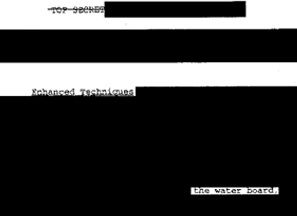
Kiriakou was originally charged under the Espionage Act of 1917 after he went public with the Central Intelligence Agency’s use of waterboarding on captured insurgents in the wake of the September 11, 2001 terrorist attack. On Monday morning, though, legal counsel for the accused former CIA agent informed the court that Kiriakou was willing to plead guilty to a lesser crime.

Initially, Kiriakou pleaded not guilty to the charge that he had outted two intelligence agents directly tied to the drowning-simulation method by going to the press with their identities.

As RT reported last week, defense attorneys had hoped that the government would be tasked with having to prove that Kiriakou had intent to harm America when he went to the media. Instead, however, prosecutors were told they’d only need to prove that the former government employee was aware that his consequences had the potential to put the country in danger.

Had Kiriakou been convicted under the initial charges filed in court, he could have been sentenced to upwards of five decades behind bars.

“Let’s be clear, there is one reason, and one reason only, that John Kiriakou is taking this plea: for the certainty that he’ll be out of jail in 2 1/2 years to see his five children grow up,” Jesselyn Raddack, a former Justice Department official who blew the whistle on Bush administration’s mishandling in the case of “American Taliban” John Walker Lindh, wrote Tuesday.

Kiriakou, Raddack wrote, was all but certain to enter the Alexandria courthouse on Tuesday and plead guilty to the lesser charge of violating the Intelligence Identities Protection Act (IIPA), explaining, “there are no reported cases interpreting it because it’s nearly impossible to prove–for “outing” a torturer.”

“’Outing’ is in quotes because the charge is not that Kiriakou’s actions resulted in a public disclosure of the name, but that through a Kevin Bacon-style chain of causation, GITMO torture victims learned the name of one of their possible torturers,” Raddack wrote. “Regardless, how does outing a torturer hurt the national security of the U.S.? It’s like arguing that outing a Nazi guarding a concentration camp would hurt the national security of Germany.”

Speaking on condition of anonymity, a former government official told Firedoglake recently that the CIA was “totally ticked at Kiriakou for acknowledging the use of torture as state policy” and allegedly outing the identity of a covert CIA official “responsible for ensuring the execution” of the water-boarding program.

Kiriakou “outted” to the reporters the identities of the CIA’s “prime torturer” under its Bush-era interrogations, Firedoglake wrote. “For that, the CIA is counting on the Justice Department to, at minimum, convict Kiriakou on the charge of leaking an agent’s identity to not only send a message to other agents but also to continue to protect one of their own.”

Former National Security Agency staffer Thomas Drake suffered a similar fate in recent years after the government went after him for blowing the whistle on the NSA’s poorly handled collection of public intelligence. A grand jury indicted Drake on five counts tied to 1917’s Espionage Act as well as other crimes, but prosecutors eventually agreed to let him off with a misdemeanor computer violation that warranted zero jail time.

Together, Drake and Kirakou are two of six persons charged under the Espionage Act during the administration of US President Barack Obama. The current White House has indicted more people under the antiquated World War 1-era legislation than all previous presidents combined.

via RT

‘Freedom of Information Act’ Processes Increasingly Managed by Private Companies

‘Freedom of Information Act’ Processes Increasingly Managed by Private Companies

A Bloomberg investigation shows that the federal government is paying a military contractor facing allegations of torture to manage some public records work. 

The Freedom of Information Act allows ordinary people to learn about behind the scenes functions of our government. There are a number of limited, discrete exemptions to the law, which allow agencies to redact or withhold documents in whole or in part. But generally speaking, the law grants us broad access into the workings of our government — and it is therefore one of the key mechanisms whereby we learn of illegal or inappropriate government activities. FOIA is a necessary transparency mechanism in our democracy.

That’s why it’s shocking to learn, as Bloomberg news reports today, that increasingly the process of managing and responding to our FOIA requests is being handled by private corporations. The investigation shows that at least 25 federal agencies are farming out their FOIA work to private companies, at a cost both to taxpayers and to the integrity of the open records system. As director of the Sunlight Foundation John Wonderlich told Bloomberg:

If I was in charge of an agency and wanted to create an unaccountable FOIA process, the first thing I would do is put an outside contractor in charge of it because fewer of our accountability laws apply to them…It would just be another layer between me and the public.

It gets worse. Not only does the contracting out of FOIA work shield the government from precisely the transparency the law is meant to institute. There could be very serious conflicts of interest involved when private companies are tasked with managing the processes whereby sensitive (and likely embarrassing or damning) government secrets are disclosed to the public.

Case in point is CACI International, a military and intelligence contractor that is facing a lawsuit alleging its employees participated in the torture of detainees at Abu Ghraib prison in Iraq. CACI is one of the companies the federal government has outsourced FOIA work to over the past ten years.

Should a company accused of serious human rights violations in a war zone have any involvement with open government processes designed to disclose precisely such abuses?

via PrivacySOS

American Holocaust of Native American Indians (FULL Documentary)

American Holocaust of Native American Indians (FULL Documentary)

http://youtu.be/gTrbVf6SrCc

The powerful and hard-hitting documentary, American Holocaust, is quite possibly the only film that reveals the link between the Nazi holocaust, which claimed at least 6 million Jews, and the American Holocaust which claimed, according to conservative estimates, 19 million Indigenous People.

It is seldom noted anywhere in fact, be it in textbooks or on the internet, that Hitler studied Americas Indian policy, and used it as a model for what he termed the final solution.

He wasnt the only one either. Its not explicitly mentioned in the film, but its well known that members of the National Party government in South Africa studied the American approach before they introduced the system of racial apartheid, which lasted from 1948 to 1994. Other fascist regimes, for instance, in South and Central America, studied the same policy.

Noted even less frequently, Canadas Aboriginal policy was also closely examined for its psychological properties. America always took the more wide-open approach, for example, by decimating the Buffalo to get rid of a primary food source, by introducing pox blankets, and by giving $1 rewards to settlers in return for scalps of Indigenous Men, women, and children, among many, many other horrendous acts. Canada, on the other hand, was more bureaucratic about it. They used what I like to call the gentlemans touch, because instead of extinguishment, Canada sought to remove the Indian from the Man and the Women and the Child, through a long-term, and very specific program of internal breakdown and replacement call it assimilation. America had its own assimilation program, but Canada was far more technical about it.

Perhaps these points would have been more closely examined in American Holocaust if the film had been completed. The films director, Joanelle Romero, says shes been turned down from all sources of funding since she began putting it together in 1995.

Perhaps its just not good business to invest in something that tells so much truth? In any event, Romero produced a shortened, 29-minute version of the film in 2001, with the hope of encouraging new funders so she could complete American Holocaust. Eight years on, Romero is still looking for funds.

American Holocaust may never become the 90-minute documentary Romero hoped to create, to help expose the most substantial act of genocide that the world has ever seen one that continues even as you read these words.

watch – Native American Holocaust Exterminate Them! The California Story (FULL)

DARPA And Navy Reveal Advanced Technology For Naval Warfare

DARPA And Navy Reveal Advanced Technology For Naval Warfare

The Defense Advanced Research Projects Agency’s (DARPA) new director, Dr. Arati Prabhakar, will share her vision Oct. 22 at the Office of Naval Research (ONR) 2012 Naval Science and Technology Partnership Conference and ASNE Expo.
Prabhakar, who took the helm at DARPA on July 30, will take the podium at 11:30 a.m. on the event’s opening day in Crystal City, Va. Her participation underscores the importance of research partnerships to national security and the commitment to collaboration shared by DARPA, ONR and other Department of Defense research organizations.

”Technology is a critical lever for our national security in today’s complex world,” said DARPA Director Dr. Arati Prabhakar. ”At DARPA, along with our partners at ONR and the broad national research-and-development community, we aim to change what is possible with new technology.”

ONR and DARPA have partnered on a variety of research projects, including multiple endeavors to promote education in the science, technology, engineering and mathematics fields.

This year, the agencies teamed to co-sponsor the RevCon Challenge, a competition among college students to design connectors that more effectively conduct heat from radars and other military electronic systems. Based on the success of the competition, ONR and DARPA will host a second challenge in May.

Previously, the agencies also collaborated on the Second Language Learningprogram, which will reduce the time it takes for Sailors and Marines to learn other languages and cultures through virtual interaction with avatars.

Prabhakar is no stranger to interest areas shared by ONR, having first joined DARPA in 1986 as a program manager in advanced semiconductor technology and flexible manufacturing. She founded the agency’s microelectronics technology office before being appointed in 1993 by President Bill Clinton to lead theNational Institute of Standards and Technology.

She also has spent several years in the private sector, including a stint working with start-up companies and entrepreneurs in energy and efficiency technologies, consumer electronics components and semiconductor process and design technology.

Dr. Charles Wessner, director of Technology, Innovation and Entrepreneurship at theNational Academy of Sciences, also has been confirmed to speak at the conference. He and Prabhakar join a roster of heavy hitters for the conference that includes White House Office of Science & Technology Policy Director Dr. John P. Holdren, Assistant Secretary of the Navy for Research, Development and Acquisition Sean Stackley, Vice Chief of Naval Operations Adm. Mark Ferguson and Commandant of the Marine Corps Gen. James Amos, and others representing the domestic and international scientific community.

Focus areas at this year’s event include: autonomy and unmanned systems; assuring access to maritime battle space; expeditionary and irregular warfare; power projection and integrated defense; power and energy; warfighter performance; and total ownership cost.

Innovative Naval Prototypes (INPs) push the boundaries of our nation’s technical talent to deliver transformational warfighting capabilities to the U.S. Navy and Marine Corps. INPs reduce the acquisition risk of disruptive technologies and capabilities.Innovative Naval Prototypes explore high 6.2 and 6.3 technologies that can dramatically change the way naval forces fight. Programs in this category may be disruptive technologies which, for reasons of high risk or radical departure from established requirements and concepts of operation, are unlikely to survive without top leadership endorsement, and, unlike Future Naval Capabilities, are initially too high risk for a firm transition commitment from the acquisition community. INPs should be identified based on a balanced combination of naval need and technology exploitation. Investments should be planned with the critical mass needed to achieve a level of technology maturity suitable for transition in four to eight years.

Current INPs:
Autonomous Aerical Cargo/Utility System (AACUS): This Innovative Naval Prototype program explores advanced autonomous capabilities for reliable resupply/retrograde and, in the long term, casualty evacuation by an unmanned air vehicle under adverse conditions. Key features of AACUS include a vehicle autonomously avoiding obstacles while finding and landing at an unprepared landing site in dynamic conditions, with goal-directed supervisory control by a field operator with no special training.
Electromagnetic Railgun (EMRG): The Electromagnetic Railgun (EMRG) is a revolutionary long-range naval gun that will fire precision-guided hypervelocity projectiles to ranges greater than 200 nautical miles. Rather than gunpowder and rocket motors, the railgun will use electrical power to propel the projectiles. Its delivery of persistent, time-critical precision strikes without the use of propellants or explosive warheads will revolutionize warfighting capabilities from the sea.
Free Electron Laser (FEL): ONR is exploring the development of a laser capable of operating in a maritime environment and consistent with the Navy’s planned all-electric ship. The high average power infrared Free Electron Laser (FEL) provides intense beams of laser light that can be tuned to atmosphere-penetrating wavelengths.
Integrated Topside (InTop): The Integrated Topside (InTop) program provides an integrated, multi-function, multi-beam top-side aperture construct that has modular open radio frequency (RF) architecture, software defined functionality, synchronization, and optimization of RF functions for mission support electromagnetic interface mitigation.
Large Displacement Unmanned Undersea Vehicle (LDUUV): The LDUUV program will develop fully autonomous, long-endurance, land-launched unmanned undersea vehicles capable of operating near shore. It will extend and augment the current Navy platform capability. The LDUUV program will develop new air independent energy systems and core vehicle technologies to extend unmanned undersea vehicles endurance into months of operation time. Advanced autonomy and sensing will enable operation in the cluttered littoral environment.
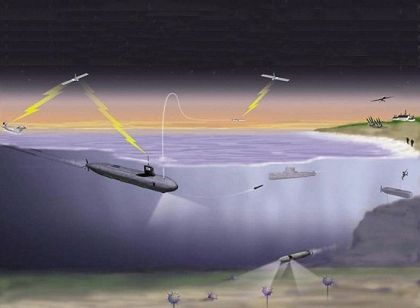
Persistant Littoral Undersea Surveillance (PLUS): The Persistent Littoral Undersea Surveillance (PLUS) program provides effective, adaptive and persistent undersea surveillance of multiple quiet targets over large littoral areas.
Sea Base Enablers: The Transformable Craft (T-Craft) – one example of a Sea Base Enabler – is a vessel which can operate in multiple modes. It can self-deploy from an intermediate support base to the sea base and then be used as a high-speed connector from the sea base to the shore. It can transport wheeled and tracked vehicles and other heavy cargo through the surf zone and onto the beach, where it can discharge its cargo without the need for a port.
Tactical Satellite (TACSAT): With the Tactical Satellite (TACSAT), ONR is issuing in a new era of small, responsive and flexible satellites. the TACSAT program will demonstrate communication relay, electronic intelligence and maritime domain awareness capabilities – all of which will enable tactical radios to communicate theatre-wide and facilitate effective command and control of distributed assets.
TACSAT
Credit: ONR
A full agenda for the conference, which runs from Oct. 22-24, is available online athttp://www.onr.navy.mil/Conference-Event-ONR/science-technology-partnership/2012-partnership-conference-agenda.aspx.Register for the event at http://www.onr.navy.mil/Conference-Event-ONR/science-technology-partnership.aspx or visit ONR’s Facebook and Twitter pages regularly for updates.

9/11 Plane or Missle That Hit WTC 2 – Slow Motion

9/11 Plane or Missle That Hit WTC 2 – Slow Motion

There have been numerous videos that show a missile hitting WTC 2. The UFO or whatever it is is also seen in many of them.

UPDATE: Flight 175, according to pilotsfor911 truth, was a Boeing 767-222. The length was 159 ft. 2″. The object in this video was much shorter as can be seen by comparing it to the building face, approx. 208 ft.

Missile…..Definition:

Though a missile may be any thrown or launched object, it colloquially almost always refers to a self-propelled guided weapon system.

Types of precision-guided ammunition 1 Radio-controlled weapons 2 Infrared-guided weapons 3 Laser-guided weapons 4 Radar, infrared, IR imaging and electro-optical guided weapons 5 Millimeter-wave radar 6 Satellite-guided weapons 7 Advanced guidance concepts 8 Cannon Launched Guided Projectiles 9 Guided small arms

Texas Schools Punish Students Who Refuse To Be Location Tracked With RFID Microchips

Texas Schools Punish Students Who Refuse To Be Location Tracked With RFID Microchips

A school district in Texas came under fire earlier this year when it announced that it would require students to wear microchip-embedded ID cards at all times. Now students who refuse to be monitored say they are feeling the repercussions.

Since October 1, students at John Jay High School and Anson Jones Middle School in San Antonia, Texas have been asked to attend class clasping onto photo ID cards equipped with radio-frequency identification chips to keep track of each and every pupil’s personal location. Educators insist that the endeavor is being rolled out in Texas to relax the rampant truancy rates devastating the state’s school and the subsequent funding they are failing to receive as a result, and pending the program’s success the RFID chips could soon come to 112 schools in all and affect nearly 100,000 students.

Some pupils say they are already seeing the impact, though, and it’s not one they are very anxious to experience. Students who refuse to walk the schoolhouse halls with a location-sensitive sensor in their pocket or around their neck are being tormented by instructors and being barred from participating in certain school-wide functions, with some saying they are even being turned away from common areas like cafeterias and libraries.

Andrea Hernandez, a sophomore at John Jay, says educators have ignored her pleas to have her privacy respected and have told her she can’t participate in school elections if she doesn’t submit to the tracking program.

To Salon, Hernandez says subjecting herself to constant monitoring by way of wearing a RFID chip is comparable to clothing herself in the “mark of the beast.” When she reached out to WND.com to reveal the school’s response, though, she told them that she was threatened with exclusion from picking a homecoming king and queen for not adhering to the rules.

“I had a teacher tell me I would not be allowed to vote because I did not have the proper voter ID,” Hernandez told WND. “I had my old student ID card which they originally told us would be good for the entire four years we were in school. He said I needed the new ID with the chip in order to vote.”

Even after Hernandez politely refused to wear an RFID chip, Deputy Superintendent Ray Galindo offered a statement that suggests that both the student’s religious and civil liberty-anchored arguments will only allow her some leeway for so long.

“We are simply asking your daughter to wear an ID badge as every other student and adult on the Jay campus is asked to do,” Galindo wrote to the girl’s parents, WND reports. If she is allowed to forego the tracking now, he continued, it could only be a matter of time before the school signs off on making location-monitoring mandatory and the repercussions will be more than just revoking voting rights for homecoming contests.

“I urge you to accept this solution so that your child’s instructional program will not be affected. As we discussed, there will be consequences for refusal to wear an ID card as we begin to move forward with full implementation,” Galindo continued.

The girl’s father, Steve Hernandez, tells WND that the school has been somewhat willing to work with the daughter’s demands, but insists that her family “would have to agree to stop criticizing the program” and start publically supporting it.

“I told him that was unacceptable because it would imply an endorsement of the district’s policy and my daughter and I should not have to give up our constitutional rights to speak out against a program that we feel is wrong,” Mr. Hernandez responded.

By reversing the poor attendance figures, the Northside Independent School District is expected to collect upwards of $2 million in state funding, with the program itself costing around one-quarter of that to roll out and another $136,005 annually to keep it up and running. The savings the school stands to make in the long run won’t necessarily negate the other damages that could arise: Heather Fazio, of Texans for Accountable Government tells WND that for $30 she filed a Freedom of Information Act request and received the names and addresses of every student in the school district.

“Using this information along with an RFID reader means a predator could use this information to determine if the student is at home and then track them wherever they go. These chips are always broadcasting so anyone with a reader can track them anywhere,” she says.

Kirsten Bokenkamp of the ACLU told the San Antonio Express-News earlier this year that her organization was expecting to challenge the board’s decision this to roll out the tracking system, but the school has since gone ahead anyway. Steve Hernandez tells WND that he approached the ACLU for possible representation in his daughter’s case, but Rebecca Robertson of a local branch of the organization said, “the ACLU of Texas will not be able to represent you or your daughter in this matter,” saying his daughter’s case in particular fails to meet the criteria they use to pick and choose civil liberties cases to take on.

New Book Details the NSA’s Warrantless Wiretapping Program, As Government Moves to Avoid All Accountability in Court

New Book Details the NSA’s Warrantless Wiretapping Program, As Government Moves to Avoid All Accountability in Court

Former New York Times reporter Kurt Eichenwald’s new book, published last week, provides yet more details about how the the NSA’s unconstitutional warrantless wiretapping program came about, and confirms that even top Bush Administration lawyers felt there was a “strong argument” that the program violated the law. “Officials might be slammed for violating the Fourth Amendment as a result of having listened in on calls to people inside the country and collecting so much personal data,” Eichenwald wrote, and “in the future, others may question the legality” of their actions.

Yet even today, eleven years later, the government continues to claim that no court can judge the program’s legality. In the next month, the government will argue—in EFF’s case in federal district court and ACLU’s case in the Supreme Court—that courts must dismiss the legal challenges without ever coming to a ruling on the merits.

Eichenwald’s book, 500 Days: Secrets and Lies in the Terror Wars, describes how the NSA’s illegal program—what he calls “the most dramatic expansion of NSA’s power and authority in the agency’s 49 year history”— was devised just days after 9/11 to disregard requirements in the Foreign Intelligence Surveillance Act (FISA). Instead of getting individualized warrants to monitor Americans communicating overseas, the Bush administration unilaterally gave the NSA the power to sweep up millions of emails and phone calls into a database for analysis without court approval:

Connections between a suspect e-mail address and others—accounts that both sent and received messages there, whether in the United States or not—would be examined. At that point, a more detailed level of analysis would be applied creating something of a ripple effect. The suspect e-mail address would lead to a second, the second to the accounts it contacted.

In other words, the NSA was given the green light to warrantlessly spy of Americans communications on American soil—a power that was illegal under FISA. And the government—instead of finding probable cause for surveillance like the Constitution requires—started using a burden of proof akin to the game Six Degrees from Kevin Bacon.

Eichenwald’s reporting, focused on the immediate aftermath of 9/11, unfortunately overlooks the NSA’s longstanding desire to live “on the network” reflected in its presentations to the incoming Bush Administration officials in December, 2000. The idea that the NSA only came up with this idea after 9/11 isn’t really accurate.1 But regardless, Eichenwald’s reporting makes clear that Bush administration officials were terrified that this program would become public.

Of course, after several years, much of the NSA’s program did become public when the New York Times exposed its existence in their 2005 Pulitzer Prize winning investigation. Virtually every major news organization in the US subsequently reported on the NSA and its mass spying programs, which led to congressional investigations and a multitude of lawsuits—two which will be argued in the coming month.

In EFF’s lawsuit, in addition to a mountain of public information including many governmental admissions, the court will see evidence from AT&T whistleblower Mark Klein showing blueprints and photographs of the NSA’s secret room in AT&T’s facility in San Francisco. Three more NSA whistleblowers, including William Binney a former high ranking official involved with the program during its infancy, also submitted affidavits laying out how the NSA illegally spied on Americans in the aftermath of 9/11.

Despite this all of this, the government recently filed a motion in the Northern District of California invoking the controversial “state secrets” privilege. Essentially, the government argues that—even if all of the allegations are true—the case should be dismissed entirely because admitting or denying any fact would potentially endanger national security, even in the face of the government’s own craftily wordsmithed  “denials” before Congress and elsewhere.

In the ACLU’s case going before the Supreme Court this term, a group of journalists, lawyers, and human rights activists has sued over surveillance conducted after the passage of the FISA Amendments Act (FAA). The FAA was passed in 2008 and formalized some of the admitted portions of NSA’s program, allowing emails and phone calls to and from from overseas to continue to be acquired without a warrant. The government only needs one general court order to target large groups of people—even entire countries—communicating to Americans for an entire year.

The plaintiffs, given that their professions, regularly talk to people who are almost certainly spied on. They argue that surveillance of them without warrants  renders the statute unconstitutional. But the government contends the case must be dismissed on “standing” grounds because the plaintiffs can’t prove with certainty they have been surveilled, because, in a perfectly circular argument, the government won’t “admit” they have been surveilled, as if public admissions by the government is the only way to prove illegal wiretapping.

As the ACLU writes, “The government theory of standing would render real injuries nonjusticiable and insulate the government’s surveillance activities from meaningful judicial review.” The same can be said of the ‘state secrets’ privilege in EFF’s case. The government is contending they can use government secrecy as a sword to terminate judicial accountability. It doesn’t matter how much evidence is in the public domain, just by telling the Court that the information implicates “national security,” they can wall off entire subject matters from judicial oversight, effectively hiding illegality, unconstitutionality along with embarrassing or overreaching acts by NSA spooks and others.

Eichenwald is just the latest in a long line of journalists to discuss and organize details about the NSA’s unconstitutional program. At this point the American people are well aware of the NSA’s actions – only the courts have been kept in the dark.  And if the courts go along with blinding themselves, the government will have been given a license to violate the law and constitution long into the future.

via EFF.org

Still Classified: Terror Suspects’ Own Accounts of Their Abuse

Still Classified: Terror Suspects’ Own Accounts of Their Abuse

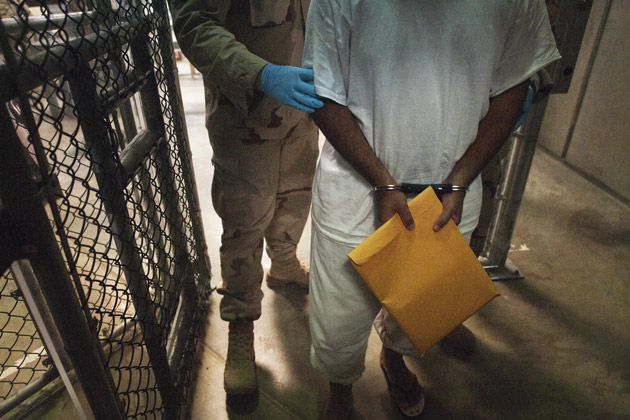
U.S. military guards move a detainee at Guantanamo Bay, Cuba, on March 30, 2010. In a motion unsealed last week, the government doubled down on its position that detainees’ observations and experiences of their time in U.S. custody are classified. (Paul J. Richards/AFP/Getty Images)

In a motion unsealed last week, the government proposed new ground rules for classified information in the trial of Khalid Sheikh Mohammed and four others charged with planning the 9/11 attacks.

The new order says the accused can’t talk about their “observations and experiences” of being held by the CIA, including “the enhanced interrogation techniques that were applied to the Accused” — that is, waterboarding and other abuse.

As we reported earlier this year, the government maintains that many details of the CIA’s detention program are still classified, despite widespread disclosures and an official acknowledgement by President George W. Bush in 2006. “Due to these individuals’ exposure to classified sources, methods, or activities of the United States,” an order filed in April read, anything the men say is “presumed to contain information classified as TOP SECRET / SCI.”

That sentence would have required defense attorneys to get the approval of a security officer to disclose even mundane information such as a date of birth, if it came from the defendant.

The new protective order — which is pending a judge’s approval — eliminates the line that all statements by the accused are presumed classified. In proposing the change, the government wrote it intended to “alleviate defense concerns” about the burden that presumptive classification added to their interactions with their clients. The government’s new motion says that attorneys would only need a review of information “they know or have a reason to know is classified.”

But when it comes to the CIA’s detention program, the new order states explicitly that “the term ‘information’ shall include without limitation observations and experiences of the Accused.”

A Pentagon spokesman did not return requests for comment about the new order.

The American Civil Liberties Union, news organizations, and James Connell, a lawyer representing one of the defendants, have challenged the government’s authority to declare something presumptively classified, and to extend classification to a detainee’s own statements. The ACLU filed a motion this spring arguing that the government forcibly “exposed” the detainees to this classified information, and that therefore the detainees couldn’t be bound to a non-disclosure agreement.

The group also argues that because the CIA program is now outlawed and has been so widely discussed, there is no compelling national security need to keep the details secret. The ACLU and media groups oppose the 40-second delay the government has imposed on broadcasting case proceedings. The government says the delay simply allows the commission to censor classified information. (That’s how the arraignments proceeded in May.)

The defense lawyer Connell said that in terms of the attorney-client relationship, the new proposal was an “important start.” But as far as public access goes, the ACLU’s lead lawyer on the case, Hina Shamsi, says that the new order “makes explicit what the government is seeking to do — prevent the public from hearing from the defendant’s own mouths their experiences of CIA torture.”

The judge presiding over the military commission, Army Col. James Pohl, would have to accept the government’s proposal for it to go into effect in the case. Pohl approved a similar protective order last year in the case of Abd al Rahim al Nashiri, who was allegedly behind the 2000 attack on the U.S.S. Cole. (That order has also been challenged by news organizations).

Hearings on the public access issue and Connell’s opposition to presumptive classification are scheduled for next week. Originally intended for August, they were postponed due to Hurricane Isaac.

by Cora Currier

Banned in USA: Interview of Iranian President Amadinejad “We Want Peace for Humanity, Not Bombs”

Banned in USA: Interview of Iranian President Amadinejad “We Want Peace for Humanity, Not Bombs”

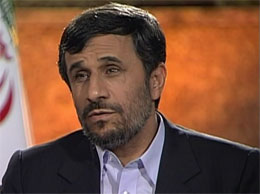
Kim Bildsoe Lassen, a Danish journalist from the Public Service TV station Danmarks Radio interviewed President Mahmoud Ahmadinejad shortly before he was to arrive in Copenhagen for the COP15 summit. English subtitles not part of original broadcast. Full transcript in English provided below.   This is likely to change how you feel about Iran.

http://youtu.be/8z81GVHI1_I

http://youtu.be/5aJli5XcOVI

http://youtu.be/TCLSpaUmUdk

http://youtu.be/15NwDX7fEhQ


Transcript of YouTube video 1

Kim Bildsoe Lassen: First of all Mr. President, thank you very much for taking your time, and letting us coming here to your office, and speak to you about the world and important matters.

And eh, if we can begin with exactly how you look at the world.
Now let’s say that the world is a little sick, you are the doctor, what do you think should be done?

Mahmoud Ahmadinejad: You have asked a very difficult question. I think that is the basis of all other questions. How do we look at the world?

I think the world is very beautiful, God created a beautiful world. He created mankind to live beautiful lives. He would want people to love each other. That they would create brotherhood and justice among themselves. God has not created mankind to be unjust towards each other. To injure each others rights. To humiliate each other. To commit terror, to engage in actions which destroy the security and identity of others. God wants people to create a beautiful world.

We don’t think this objective has been reached. For several reasons. We can look at the situation in the world. There is distrust. There is war and occupation. There is the desire to conquer. Some feel they are better than others. And they want to have more rights than others. They don’t respect others. They create wars. They send their armies and occupy territory of others. They are not even compassionate towards the environment. You can see what problems there are with the climate.

We think it can be helped. The conditions for this are to recreate justice and respect for others.

Kim Bildsoe Lassen: But when you say that it, maybe obvious for me that you are talking about America. What do you think should be done today about America?

Mahmoud Ahmadinejad: We think the government of the USA should change for the better. Everywhere where there are problems the US is present. Why is that?

America has a geographical territory. They have to live in their own territory. Who says America should rule the world? Can you tell us what they are doing in Iraq and Afghanistan? Do you know how many have been killed? Hundreds of thousands. Every one of them was a human being, with families and big wishes.

Kim Bildsoe Lassen: but the Danish government and the Danish soldiers are also in Afghanistan, do you also think we are making a great mistake?

Mahmoud Ahmadinejad: Of course! The situation has not become any better since NATO went into Afghanistan. Do you think that the situation is better than seven years ago? Every day people die! It is not important who is being killed.

Afghanis, Danes, Americans or English. The importance is that people are being killed. The security situation has not improved. The narcotics situation has not improved either. Terrorism is not under control either. On the contrary, it has spread to Pakistan. Don’t you think this strategy has been wrong? We think it has been wrong. There are No military solutions for the human problems..

[End of part 1 of 4]

Transcript of video 2 (Ahmadinejad only)

Humane solutions are needed.

It can be resolved without loss of human life.

We have not said that they should be destroyed When have we said that America and Denmark should be destroyed? We have said that NATOpolicies in Afghanistan are wrong.

And these policies have ledto a situation which is worse.

And these policies should be reconsidered There are humane solutions.

Why use a military solution? Why kill people? What we are saying is in the interests of Denmark and America It is in NATO’s interest.

Let me tell you one more thing.

NATO doesn’t know our area.

We also don’t know Denmark’s internal situation.

Is it you or us who has the best solutions to Denmarks problems? You don’t know the area, and therefore make the wrong decicions.

And your wrong decisions cause loss of human life.

Which is the worst that can happen.

If the US and NATO had the correct historical information They would not have gone into Afghanistan During the last 100 yearsAfghanistan has been occupied three times. A hundred years ago, the British occupied the country.

A hundred years ago, England was a world empire.

England’s power was greaterthan the power of the US today.

Its power was even greater than NATO’s power today.

Could Britain stay in Afghanistan and be victorious? They left Afghanistan humiliated But they hurt the Afghan people Many of their soldiers were killed 35 years ago, the Russians came to Afghanistan.

Where is the Soviet Union today? Where is the Soviet Union today? Did the Soviet Army gain victory? How can NATO believe, they can be victorious in Afghanistan? Historical experience says they will fail! And the last seven years have also shown that it ends with failure.

Now Iran tells them that they are making a mistake.

Should they thank, or attack Iran for that? We don’t need their gratitude.

We think they should act differently.

Short edited version Transcript Part 1: (Kim Bildsoe Lassen only transcribed partly)

Kim Bildsoe Lassen:

I would like to ask you a very forward frank question…

Would you like to have a nuclear bomb?

Mahmoud Ahmadinejad What do you think yourself?

Do you think a bomb is a good thing?

Would you like Denmark to have one?

Kim Bildsoe Lassen: I don’t know but I know…

Mahmoud Ahmadinejad You are a person, and I am a person, we are having a dialogue now.

We think atomic bombs are a bad thing.

What are atomic bombs used for?

To kill others..

We are against killing other people.

Kim Bildsøe Lassen: But somebody would also say it’s also for security…

Mahmoud Ahmadinejad We have enemies, but we don’t need atomic bombs.

There are two reasons for this.

The first has to do with the atomic bomb.

We think it is the most inhuman weapon in history.

Because they kill many people.

It is not meant for defense, but for attack.

So the first reason is the bomb itself.

Our religion causes us to be against the atomic bomb.

That’s why we say the world must be disarmed.

The bombs of the nuclear powers are at this moment a threat to mankind.

But there is also another reason, which is secondary

Today, is there anybody who can use the bomb?

And if they use it, will it then give them the upper hand?

Can bombs save anybody?

Could the a-bomb save the Soviet Union?

So you can tell me, the whole world, and all viewers in Denmark and Europe

(subtitles missing?)

(subtitles missing?)

Today the atomic bomb has lost its purpose.

Those who think the a-bomb gives power, are politically retarded.

Kim Bildsoe Lassen: So you can say to me, to all the people in Denmark and in Europe watching, that you will never engage in creating an atomic bomb? You can just say no.

Mahmoud Ahmadinejad I gave you a clear answer to your question.

I want you to be aware of to whom you’re talking.

We speak clearly and direct.

I want it to be completely clear.

Kim Bildsøe Lassen: I Know, I just want to be very clear

Mahmoud Ahmadinejad It was not directed at you, but at all the viewers.

Whatever we do, we have the courage to say it.

We said we would begin enriching Uranium, and we did.

We said we would start a production, and we did..

We said we didn’t fear resolutions, and we didn’t.

We said we didn’t accept unjust resolutions, and we didn’t.

And we said we would build 10 new enrichment plants and we will also do that.

Kim Bildsoe Lassen: There has been since your reelection.. demonstrations in the streets..

End transcript part 1


Transcript part 2:

Kim Bildsoe Lassen: Since you have been reelected there have been demonstrators in the streets. Some have called them also lately, for traitors, that they don’t understand Iran.

Do you think that the young people on the street demonstrating, making trouble will some say, that they are traitors?

Mahmoud Ahmadinejad: We should keep things apart from each other.

The elections in Iran, are very free.

It is the highest imaginable degree of freedom.

We don’t have a party based system.

It is a free government. Very close to the people.

We had a very high turnout at the elections.

85% that’s unique.

Then there were some who came with protests.

That’s very natural.

Kim Bildsoe Lassen: Do you think that young people in Iran today have the freedom to express their opinions? That as you see it that there is the freedom for the young people, for the people who want to express their meaning [opinions] in Iran today that is fair and just?

And the people that are saying, we have, we are being pressed by the police, by the secret police, that they are wrong?

Mahmoud Ahmadinejad: I said the law rules in Iran.

Wouldn’t the police in Denmark interfere when somebody crosses the street when the lights are red?

Wouldn’t the police do that?

The police must maintain peace and order.

But the police acts inside the boundaries of the law,

And the Courts keep an eye in the police.

Everybody must uphold the law. Protests also have to happen inside the boundaries of the law. You have probably seen the demonstrations in Copenhagen the day before yesterday.

Kim Bildsøe Lassen: (Nods)

Mahmoud Ahmadinejad: Why did the police take action against the demonstrators?

Mace [tear gas], batons, why did the police do that?

That’s because there is law and order in Denmark.

People are free to protest, but they have to respect the law, they have to.

What happened in Copenhagen, also was what happened in Teheran.

Kim Bildsoe Lassen: Now you go to Denmark, and you go as President Ahmadinejad, I think a lot of people in Denmark only know you as that, and maybe if you could tell a little bit about the man Ahmadinejad.

What are the things that you enjoy most in life?

I know that you are a religious man, but beside that, where do you find your energy and where do you find your inspiration?

Mahmoud Ahmadinejad: Can you tell me why you are here?

Why did you travel so far?

You must have had a tough trip; you have been 5 to 6 hours in the air.

Kim Bildsoe Lassen: To get to know you better.

Mahmoud Ahmadinejad: You probably have good intentions.

I think that if one loves people, being tired doesn’t mean anything.’

Kim Bildsoe Lassen: I’m sorry if I’m being trivial, but I’m also wondering, are you sort of a person who likes to come home late, and watch a film with your family or take a walk with your wife and your kids..

How do you find pleasure beside working and saving the world?

Mahmoud Ahmadinejad: Yes, I do all of these things. I have a warm family.

We talk every evening.. we also watch films, but not every evening.

We read books and speak with each other.

We go out for walks and visit our relatives and friends.

We practice sports,

Kim Bildsoe Lassen: Do you have a favorite film?

Mahmoud Ahmadinejad: I normally watch Iranian films

Kim Bildsoe Lassen: Mr. President thank you very much, we look forward to seeing you in Denmark, and wish you a pleasant trip to Denmark and we, I guess I look forward to see you. Thank you very much.

Michael Jarlner (Danish journalist sitting next to Lassen): Yes, thank you for meeting us.

Mahmoud Ahmadinejad: Inshallah, and greet the Danish people from me.

Thank you, thank you very much..

End of transcript part 2.

I am not a Muslim, but if I were I would swear Ahmadinejad is the new Mahdi….

After this interview there can be absolutely no more doubt anymore about the peaceful intentions of the gentle Iranian president, who will be honoring us all by his coming visit to the Copenhagen Climate Hoax Summit.

In the conversation about the event with another journalist, Kim Bildoe Lassen said that he had never seen such pitch black eyes. Eyes he said, which certainly would have the ability to frighten some people.

TrapWire Tied to Anti-Occupy Internet-spy Program Tartan by NTrepid Abraxas Cubic

TrapWire Tied to Anti-Occupy Internet-spy Program Tartan by NTrepid Abraxas Cubic

How do you make matters worse for an elusive intelligence company that has been forced to scramble for explanations about their ownership of an intricate, widespread surveillance program? Just ask Cubic, whose troubles only begin with TrapWire.

Days after the international intelligence gathering surveillance system called TrapWire was unraveled by RT, an ongoing investigation into any and all entities with ties to the technology has unturned an ever-increasing toll of creepy truths. In only the latest installment of the quickly snowballing TrapWire saga, a company that shares several of the same board members as the secret spy system has been linked to a program called Tartan, which aims to track down alleged anarchists by specifically singling out Occupy Wall Street protesters and the publically funded media — all with the aid of federal agents.

Tartan, a product of the Ntrepid Corporation, “exposes and quantifies key influencers and hidden connections in social networks using mathematical algorithms for objective, un-biased output,” its website claims. “Our analysts, mathematicians and computer scientists are continually exploring new quantification, mining and visualization techniques in order to better analyze social networks.” In order to prove as such, their official website links to the executive summary of a case study dated this year that examines social network connections among so-called anarchists, supposedly locating hidden ties within an underground movement that was anchored on political activists and even the Public Broadcasting Station [.pdf].

“Tartan was used to reveal a hidden network of relationships among anarchist leaders of seemingly unrelated movements,” the website claims. “The study exposed the affiliations within this network that facilitate the viral spread of violent and illegal tactics to the broader protest movement in the United States.”

Tartan is advertised on their site as a must-have application for the national security sector, politicians and federal law enforcement, and makes a case by claiming that “an amorphous network of anarchist and protest groups,” made up of Occupy Oakland, PBS, Citizen Radio, Crimethinc and others, relies on “influential leaders,” “modern technology” and “illegal tactics” to spread a message of anarchy across America.

“The organizers of Occupy Wall Street and Occupy DC have built Occupy networks through online communication with anarchists actively participating in the movements’ founding,” the executive summary reads. On the chart that accompanies their claim, the group lists several political activism groups and broadcast networks within a ring of alleged anarchy, which also includes an unnamed FBI informant.

Although emails uncovered in a hack last year waged at Strategic Forecasting, or Stratfor, suggested that Occupy groups had been under private surveillance, the latest discovery of publically available information implies that the extent to which the monitoring of political activists on American soil occurred may have extended what was previously imagined.

Things don’t end there, though. While the TrapWire tale is still only just beginning, the Ntrepid Corporation made headlines last year after it was discovered by the Guardian that the company was orchestrating an “online persona management” program, a clever propaganda mill that was touted as a means “to influence regional and international audiences to achieve U.S. Central Command strategic objectives,” according, at least, to the Inspector General of the US Defense Department [.pdf]. The investigation eventually revealed that the US Central Command awarded Ntrepid $2.76 million worth of taxpayer dollars to create phony Internet “sock puppets” to propagate US support.

One year later, the merits of Tartan’s analytics are now being brought into question, but so are the rest of the company’s ties. A trove of research accumulated by RT, Project PM founder Barrett Brown, PrivacySOS.org and independent researchers Justin Ferguson and Asher Wolf, among others, has linked Tartan with an even more unsettling operation.

Margaret A. Lee of Northern Virginia is listed on several websites as serving on the Ntrepid board of directors as secretary, a position she held alongside Director Richard Helms, CFO Wesley R Husted and President Michael Martinka. And although several parties are going to great lengths to deny the ties, a paper trail directly links Lee and company to Abraxas — and thus Cubic — and, of course, TrapWire, the very surveillance system that is believed to be blanketing the United States.

According to the Commonwealth of Virginia’s State Corporation Commission, TrapWire Inc. was registered to Margaret A Lee on March 7, 2009. Other publically available information reveals that, at least at one point, Wesley Husted served as chief financial officer for TrapWire, Inc., where Richard H Helms held the title of CEO.

Various sources have since claimed that Helms, a former CIA agent that once ran the agency’s European division, has severed ties with TrapWire, yet the other connections remain intact.

In RT’s earlier research in the TrapWire case, it was revealed that TrapWire’s parent company, Cubic Corporation, acquired an online identity masking tool called Anonymzer in a 2010 merger, and also controls the fare card system at some of the biggest public transportation systems in the world. According to the latest findings, Cubic’s control extends beyond just that, though. Under their Ntrepid branch, Cubic controlled an operation that spied on political activists with FBI informants and attempted to link them to crimes across America.

Whether or not the TrapWire system was implemented in such operations is unclear, and Cubic continues to maintain that they are not involved with the surveillance network.

Last week, Cubic Corporation issued a press release claiming, “Abraxas Corporation then and now has no affiliation with Abraxas Applications now known as Trapwire, Inc.”

“Abraxas Corp., a risk-mitigation technology company, has spun out a software business to focus on selling a new product,” the article reads. “The spinoff – called Abraxas Applications – will sell TrapWire, which predicts attacks on critical infrastructure by analyzing security reports and video surveillance.”

Not only does a 2007 report in the Washington Business Journal insist that the companies are practically one in the same, though, but a 2006 article in the same paper reveals that Abraxas had just acquired software maker Dauntless. Researchers at Darkernet have since linked Lee, Husted and Helms to the Abraxas Dauntless Board of Directors as well.

Justin Ferguson, the researcher who first exposed TrapWire two weeks ago, has noted that Lee, Helms and Husted were listed on Abraxas Dauntless’ filings with Virginia as recently as December 2011. They also are all present on the TrapWire filings dated September 2011 and the latest annual filing made with the Florida Department of State, Division of Corporations on behalf of Ntrepid.

Nevertheless, in a conversation this week with Project PM’s Barrett Brown, Cubic Corp. Communication Director Tim Hall dismisses this tie again.

“There is no connection at all with Abraxas Applications and Trapwire and or Ntrepid,” Hall allegedly insists, according to audio uploaded to YouTube.

Brown, on his part, says he has obtained Cubic’s 2010 tax filings that show that Ntrepd, like Abraxas, is “wholly owned” by Cubic.

Other trademark information publically available online says that the Abraxas Corporation first filed to claim the name TrapWire in 2004 and was granted a license for such in January of 2007.


TrapWire Training Courses Reveal Possible Purpose for its Creation

Although certain people reportedly playing key roles in the web-like leadership structure of TrapWire deny their involvement with the massive surveillance system, there is evidence that the engine driving this global company runs on the ambition of a common core of officers and directors.

Given the potential flood of legal challenges to its constitutionality, the corporation believed to be behind TrapWire is heading for higher ground, denying any association with the surveillance technology.

In a statement published on its website on August 13, Cubic Corporation attempted to sever the ties binding it to TrapWire. “Cubic Corporation (NYSE: CUB) acquired Abraxas Corporation on December 20, 2010. Abraxas Corporation then and now has no affiliation with Abraxas Applications now known as Trapwire, Inc. Erroneous reports have linked the company with Trapwire, Inc.,” the company insisted.

Despite such denials, many are rightly worried about any corporate connection — no matter how tenuous — between Cubic and TrapWire given the former’s access to the personal data of Americans through its other corporate interests. The synergy of such access with a massive surveillance apparatus could threaten the privacy of millions, as well as the freedom from unwarranted searches and seizures protected by the Fourth Amendment.

As for the scope and significance of TrapWire, the size of it cannot be exaggerated.

TrapWire is a massive and technologically advanced surveillance system that has the capacity to keep nearly the entire population of this country under the watchful eye of government 24 hours a day. Using this network of cameras and other surveillance tools, the federal government is rapidly constructing an impenetrable, inescapable theater of surveillance, most of which is going unnoticed by Americans and unreported by the mainstream media.

Unlike other elements of the central government’s cybersurveillance program, word about TrapWire was not leaked by Obama administration insiders. The details of this nearly unbelievable surveillance scheme were made public by WikiLeaks, the anti-secrecy group founded by Julian Assange. The TrapWire story percolated from the millions of e-mails from the Austin, Texas-based private intelligence-gathering firm Stratfor, published this year by WikiLeaks. Covering correspondence from mid-2004 to 2011, these documents expose Stratfor’s “web of informers, pay-off structure, payment-laundering techniques and psychological methods.”

This coterie of Stratfor co-conspirators is apparently angry about the leaks, considering that the WikiLeaks servers have been under near-constant Distributed Denial of Service (DDoS) attacks since the TrapWire revelations began attracting the notice of alternative journalists. Some outlets report that the cyberattacks are being carried out by agents of the American intelligence community determined to prevent the full depth of this scandal from being explored by reporters.

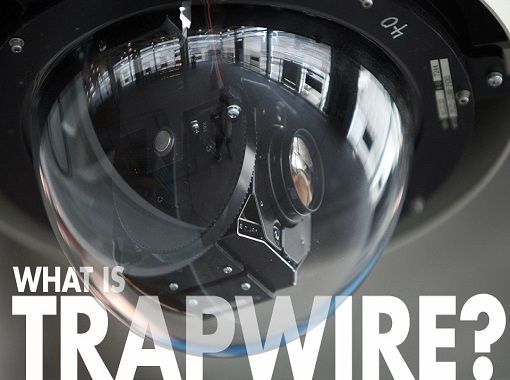
Exactly what is TrapWire? According to one description of the program, from Russia Today:

Former senior intelligence officials have created a detailed surveillance system more accurate than modern facial recognition technology — and have installed it across the US under the radar of most Americans, according to emails hacked by Anonymous.

Every few seconds, data picked up at surveillance points in major cities and landmarks across the United States are recorded digitally on the spot, then encrypted and instantaneously delivered to a fortified central database center at an undisclosed location to be aggregated with other intelligence.

Although many of the details remain undisclosed, it is known that the infrastructure of TrapWire was designed and deployed by Abraxas, an intelligence contractor based in northern Virginia headed and run by dozens of former American surveillance officers. As one article described it: “The employee roster at Abraxas reads like a who’s who of agents once with the Pentagon, CIA and other government entities according to their public LinkedIn profiles, and the corporation’s ties are assumed to go deeper than even documented.”

The network is believed to be immense. An article published by transparency advocacy group Public Intelligence claims that Stratfor e-mails suggest that TrapWire is in use by the U.S. Secret Service, the British security service MI5, the Royal Canadian Mounted Police, as well as counterterrorism divisions in both the Los Angeles and New York Police Departments and the LA fusion center. The e-mails also suggest that TrapWire is in use at military bases around the country. A July 2011 e-mail from a “Burton” to others at Stratfor describes how the U.S. Army, Marine Corps, and Pentagon have all begun using TrapWire and are “on the system now.” Burton described the Navy as the “next on the list.”

A survey of WikiLeaks e-mails containing information about TrapWire reveals another facet of this ever-expanding tool for tracking and targeting individuals.

In a report filed by online news gathering site darkernet.in, a list of the training courses offered to end users shines a little light on the otherwise purposefully obscured goals of this global monitoring behemoth.

The first course listed in the darkernet article is called the Surveillance Awareness Workshop. This class is reportedly “designed to instruct network and security personnel to use and navigate the TrapWire software system to familiarize themselves with the indicators of surveillance, terrorist surveillance methodologies, facility vulnerabilities, and the identification of probable surveillance zones that exist within each facility.”

The goal is that those with their fingers on the buttons and eyes on the consoles will learn to “view their facility the same way as would a terrorist, and then to be alert to the indicators of pre-attack surveillance.”

Pre-attack is a statist way of saying “guilty until proven innocent.” These agents — typically law enforcement or federal intelligence officers — reportedly will learn to spot suspicious behavior that points to the target’s propensity for participation in illegal activities.

This sort of advance profiling is eerily similar to the philosophy undergirding the signature strike that is becoming the go-to tactic in the Obama administration’s drone war.

A signature strike is not a strike on a particular suspect, but rather an attack on a person or group of people demonstrating behavior that is typical of those who might be associated with terror.

Perhaps the TrapWire “pre-attack surveillance” and the drone war “signature strike” are just two identifiable examples of a wider, more insidious government movement toward a society where one can be found guilty in advance of any crime based solely on one’s likelihood to act unlawfully and then be summarily executed based on that probability alone.

The second class offered by the makers of TrapWire according to the Internet investigation is designed along similar lines. It is called the Terrorist Pre-Attack Operations Course (TPOC).

Darkernet reports that participation in TPOC “will enhance overall security awareness and improve participants’ understanding of terrorist and criminal pre-attack surveillance and intelligence collection operations.”

Once again, the watchers are taught to better understand “terrorists” and what behavior they display just prior to the commission of a crime.

Unlike actual laws, these technologies and the courses improving their capabilities in the hands of users do not offer definitions of “terrorist” or “criminal.” One is left to one’s own understanding, it would seem, in the matter of conceiving of who is and is not a terrorist.

Today, the typical target might be a Muslim seen frequenting a subway station, for example. However, as the gulf separating the rulers and the ruled widens, perhaps a future TrapWire operator will target a gun-owner or attendant at a rally opposing a government policy as a potential threat and will initiate the requisite “intelligence collection operations.” The end result of those operations may be indefinite detention or death by Hellfire missile.

Finally, the last class listed in the darkernet article is called the Deception Detection and Eliciting Responses (DDER) course. This class will “teach students to detect deception and elicit responses in individuals including those which have been identified by TrapWire as having been engaged in suspicious behavior.”

So, once the target’s image pops up on one of the myriad cameras tracking the movements of every citizen (all are targets and potential terrorists, apparently) and the intelligence officers are called in to begin building a dossier on the target, the responding agents will use their newly-acquired interrogation skills to get the truth out of the target. “We have ways of making you talk,” in other words.

Given the aversion of the wizards running the surveillance state to allowing the curtain to be pulled back exposing the incredible extent of its domestic surveillance activities, it is more likely than not that TrapWire’s use in the tracking of Americans is wider and more institutional than most of us would like to believe.

A link to a complete listing of all TrapWire courses and the associated material is found here.

SHOCKING REPORT: Homeland Security ‘Fusion Centers’ Collect Worthless, Illegal Info, Don’t Catch Terrorists

SHOCKING REPORT: Homeland Security ‘Fusion Centers’ Collect Worthless, Illegal Info, Don’t Catch Terrorists

The ranking Republican on a Senate panel on Wednesday accused the Department of Homeland Security of hiding embarrassing information about its so-called “fusion” intelligence sharing centers, charging that the program has wasted hundreds of millions of dollars while contributing little to the country’s counterterrorism efforts.

In a 107-page report released late Tuesday, the Senate Permanent Subcommittee on Investigations said that Homeland Security has spent up to $1.4 billion funding fusion centers — in effect, regional intelligence sharing centers–  that have produced “useless” reports while at the same time collecting information on the innocent activities of American Muslims that may have violated a federal privacy

The fusion centers, created under President George W. Bush and expanded under President Barack Obama, consist of  special   teams of  federal , state and local officials collecting and analyzing  intelligence on suspicious activities throughout the country.  They have been hailed by Homeland Security Secretary Janet Napolitano as “one of the centerpieces”  of the nation’s counterterrorism efforts.

But Sen. Tom Coburn of Oklahoma,  the ranking Republican on the panel, charged Wednesday that Homeland Security had tried to bury evidence of problems at the centers.

“Unfortunately, DHS has resisted oversight of these centers,” he said. “The Department opted not to inform Congress or the public of serious problems plaguing its fusion centers and broader intelligence efforts.  When this subcommittee requested documents that would help it identify these issues, the department initially resisted turning them over, arguing that they were protected by privilege, too sensitive to share, were protected by confidentiality agreements, or did not exist at all. The American people deserve better. I hope this report will help generate the reforms that will help keep our country safe.”

A spokesman for Homeland Security said in a statement to NBC News Tuesday that the Senate report was “out of date, inaccurate and misleading.” Matt Chandler, a spokesman for Napolitano, said the Senate panel “refused to review relevant data, including important intelligence information pertinent to their findings.”  Another Homeland Security official, who spoke with NBC News on condition of anonymity, said the department has made improvements to the fusion centers and that the skills of officials working in them are “evolving and maturing.”

The American Civil Liberties Union also issued a statement saying the report underscores problems that it and other civil liberity groups have been flagging for years. “The ACLU warned back in 2007 that fusion centers posed grave threats to Americans’ privacy and civil liberties, and that they needed clear guidelines and independent oversight,” said Michael German, ACLU senior policy counsel. “This report is a good first step, and we call upon Congress to hold public hearings to investigate fusion centers and their ongoing abuses.”

In addition to the value of much of the fusion centers’ work, the Senate panel  found  evidence of what  it called  “troubling” reports by some  centers that may have violated the civil liberties and privacy of U.S. citizens.  The evidence cited in the report could fuel a continuing controversy over claims that the FBI and some local police departments, notably New York City’s, have spied on American Muslims without a justifiable law enforcement reason for doing so. Among the examples in the report:

  • One fusion center drafted a report on a list of reading suggestions prepared by a Muslim community group, titled “Ten Book Recommendations for Every Muslim.” The report noted that four of the authors were listed in a terrorism database, but a Homeland Security reviewer in Washington chastised the fusion center,  saying, “We cannot report on books and other writings” simply because the authors are  in a terrorism database. “The writings themselves are protected by the First Amendment unless you can establish that something in the writing indicates planning or advocates violent or other criminal activity.”
  • A fusion center in California prepared a report about a speaker at a Muslim center in Santa Cruz who was giving a daylong motivational talk—and a lecture on “positive parenting.” No link to terrorism was alleged.
  • Another fusion center drafted a  report on a U.S. citizen speaking at a local mosque that speculated that —  since the speaker had been listed in a terrorism data base — he may have been  attempting “to conduct fundraising and recruiting” for a foreign terrorist group.

“The number of things that scare me about this report are almost too many to write into this (form),” a Homeland Security reviewer wrote after analyzing the report. The reviewer noted that “the nature of this event is constitutionally protected activity (public speaking, freedom of assembly, freedom of religion.)”

The Senate panel found 40 reports — including the three listed above — that were drafted at fusion centers by Homeland Security officials, then later “nixed” by officials in Washington after reviewers “raised concerns the documents potentially endangered the civil liberties or legal privacy protections of the U.S. persons they mentioned.”

Despite being scrapped, however, the Senate report concluded that “these reports should not have been drafted at all.” It also noted that the reports were stored at Homeland Security headquarters in Washington, D.C., for  a year or more after they had been  canceled —a potential violation of the U.S. Privacy Act, which prohibits federal agencies from storing information on U.S. citizens’ First Amendment-protected activities if there is no valid reason to do so.

The report said the retention of these reports also appears to contradict Homeland Security’s own guidelines, which state that once a determination is made that a document should not be retained, “The U.S  person identifying information is to be destroyed immediately.”

The investigation was led by the Republican staff of the subcommittee but the report was approved by chairman Sen. Carl Levin, D-Mich and Coburn.  It stated that much basic information about the fusion centers – including exactly how much they cost the federal government — was difficult to obtain. Although the fusion centers are overseen by Homeland Security, they are funded primarily through grants to local governments by the Federal Emergency Management Agency. Although Homeland Security “was unable to provide an accurate tally,” the panel estimated the federal dollars spent on the centers between 2003 and 2011 at between $289 million and $1.4 billion.

The panel’s criticism of the fusion centers was shared in part by Michael Leiter, the former director of the National National Counter-Terrorism Center and now an NBC News analyst. “Since 9/11, the growth of state and local fusion centers has been exponential and regrettably in many instances it has produced an ill-planned mishmash rather than a true national system that is well-integrated with existing organizations like the FBI-led Joint Terrorism Task Forces,” Leiter wrote in an email when asked about the report.

In its response to the Senate panel , Homeland Security said that the canceled reports could still be retained “for administrative purposes such as audit and oversight.”

The report cited multiple examples of what it called fusion center reports that had little if any value to counterterrorism efforts.

One fusion center report cited described how a certain model car had folding rear seats to the trunk, a feature that it said could be useful to human traffickers. This prompted a Homeland Security reviewer to note that such folding rear seats are “featured on MANY different  makes and model of vehicles” and “there is nothing of any intelligence value in this report.”

Another fusion center report, entitled “Possible Drug Smuggling Activity,”  recounted the experiences of two state wildlife officials who spotted a pair of men  in a bass boat “operating suspiciously” in the body of water off the U.S.-Mexico border. The report noted that the fishermen “avoided eye contact” and that their boat appeared to be low in the water, “as if it were laden with cargo” with high winds and choppy waters.

“The fact that some guys were hanging out in a boat where people normally do not fish MIGHT be an indicator of something abnormal, but does not reach the threshold of something we should be reporting,” a Homeland Security reviewer wrote, according to the Senate panel. “I … think that this should never have been nominated for production, nor passed through three reviews.”

In the Homeland Security Department’s response, spokesman Matt Chandler said the Senate subcommittee “refused to review relevant data, including important intelligence information pertinent to their findings.”

The senior Homeland Security official who spoke to NBC News said that, while the Senate panel reviewed fusion center reports from 2009 and 2010, a more recent June 2011 case in Seattle shows that a fusion center played a key role in helping to thwart a terrorist plot against a local U.S. military processing center.

Chandler added:  “The (Senate) report  fundamentally misunderstands the role of the federal government in supporting fusion centers and overlooks the significant benefits of this relationship to both state and local law enforcement and the federal government. Among other benefits, fusion centers play a key role by receiving classified and unclassified information from the federal government and assessing its local implications, helping law enforcement on the frontlines better protect their communities from all threats, whether it is terrorism or other criminal activities.”

via NBCnews

Court Extends Stop on Order Blocking NDAA Indefinite Detention ‘Law’

Court Extends Stop on Order Blocking NDAA Indefinite Detention ‘Law’

A federal appeals court has extended a temporary stay of a district court judge’s order barring the government from using an indefinite detention provision in a defense bill passed by Congress and signed by President Barack Obama late last year.

A three-judge motions panel of the U.S. Court of Appeals for the 2nd Circuit issued the order Tuesday afternoon, indicating they saw flaws with the scope and rationale for U.S. District Court Judge Katherine Forrest’s original order blocking the disputed provision of the National Defense Authorization Act of 2011.

“We conclude that the public interest weighs in favor of granting the government’s motion for a stay,” Appeals Court Judges Denny Chin, Raymond Lohier and Christopher Droney wrote in a three-page order that also expedited the appeal.

The judges continue:

First, in its memorandum of law in support of its motion, the government clarifies unequivocally that, ‘based on their stated activities,’ plaintiffs, ‘journalists and activists[,] . . . are in no danger whatsoever of ever being captured and detained by the U.S. military.’

Second, on its face, the statute does not affect the existing rights of United States citizens or other individuals arrested in the United States. See NDAA § 1021(e) (‘Nothing in this section shall be construed to affect existing law or authorities relating to the detention of United States citizens, lawful resident aliens of the United States, or any other persons who are captured or arrested in the United States.’).

Third, the language of the district court’s injunction appears to go beyond NDAA § 1021 itself and to limit the government’s authority under the Authorization for Use of Military Force…

Last month, Lohier alone temporarily blocked Forrest’s order, using a so-called administrative stay.

The case will go forward now before what will likely be a different trio of judges, but the stay will likely remain in place pending resolution of the government’s appeal.

The import of the law is disputed. Proponents say it simply reinforced authority a federal appeals court in Washington had already accorded to the U.S. government, at least as far as foreigner are concerned. Critics say the measure exposes journalists and human rights activists who meet with alleged terrorists to the prospect of open-ended detention.

All three judges on the motions panel were appointed to the appeals court by President Barack Obama.

A copy of the panel’s order is posted here.

CLARIFICATION (Tuesday, 4:08 P.M): This post has been revised to indicate that Lohier’s administrative stay was issued last month.

CLARIFICATION 2 (Tuesday, 5:01 P.M.): This post has been revised to clarify that all three judges were appointed to the appeals court by Obama.

via Politico

Who Stopped Police Helicopter From Pursuing Norwegian Terrorist Anders Breivik?

Who Stopped Police Helicopter From Pursuing Norwegian Terrorist Anders Breivik?

Despite having his number plate phoned in the Oslo police failed to follow Anders Breivik on 22/7 from Oslo to Utoya island. But was that a genuine error or part of a wider operation to paralyse national police reaction including spies and agents within the Norwegian security forces?

Oslo Police Department’s Operation Leader Britt Børve, Britt Borve – it appears blocked the anti-terror DELTA force pursuit of pro-Zionist, anti-Muslim ‘crusader’ terrorist Anders Breivik. Her identity has been hidden from press and public, only her initials were revealed, but looks likely according to those in the know that it was indeed her that twice blocked requests for the helicopter.

Oslo policewoman Britt Borve

Operation Leader Britt Børve at the Oslo Police Department operation HQ on 22/7 had the very highest authority and did not have to ask anyone before sounding the national alarm system, alerting the media and activating the helicopters. She denied twice the DELTA anti-terror force’s requests to use the police helicopter, she didn’t mobilise any other helicopters that could come to the AUF Labour Youth’s rescue at Utøya island, and she didn’t forward the tip from a member of the public about the Fiat Duplo van with the green registration plates and the number VH24605 to the region’s police districts, the radio, TV & newspapers. She repeatedly denied neighbouring police districts’ offers to support the Oslo PD operation, and she did not order roadblocks and control posts. All in all I find it very suspicous that the mass media protects her identity, by not naming her in piblic. Who is to say that she was NOT a part of the terror operation, when she acts in such a high degree as a supporter of Anders Breivik?

Norwegian: Operasjonsleder Britt Børve ved Oslopolitiets operasjonssentral 22/7 var altså aller høyeste myndighet og trengte ikke spørre noen om lov til å slå riksalarm, varsle mediene og sende opp helikoptrene. Hun avslo to ganger DELTA-troppens anmodning om bruk av politihelikoptret, hun mobiliserte heller ingen andre helikoptre som kunne komme AUF-erne på Utøya til unnsetning, og hun videresendte ikke publikumstipset om varebilen med de grønne skiltene merket VH24605 til Østlandets politidistrikter, radio, TV & aviser. Hun avslo flere ganger nabodistriktenes tilbud om politistøtte, og hun satte ikke opp veisperringer. Summa summarum syns jeg det er meget suspekt at massemediene beskytter hennes identitet, ved ikke å navngi henne. Hvem sier at hun IKKE var en del av terroroperasjonen, når hun i så sterk grad opptrer som støttespiller for Anders Breivik?


You Might Be Considered a “Potential Terrorist” By Government Officials If….

You Might Be Considered a “Potential Terrorist” By Government Officials If….

Find Out If You Are Doing Things Which Might Be Considered Suspicious

There have been so many anti-terrorism laws passed since 9/11 that it is hard to keep up on what kinds of things might get one on a “list” of suspected bad guys.

We’ve prepared this quick checklist so you can see if you might be doing something which might get hassled.

The following actions may get an American citizen living on U.S. soil labeled as a “suspected terrorist” today:

Holding the following beliefs may also be considered grounds for suspected terrorism:

Many Americans assume that only “bad people” have to worry about draconian anti-terror laws.

But as the above lists show, this isn’t true.

When even Supreme Court Justices and congressmen worry that we are drifting into dictatorship, we should all be concerned.

via WashingtonsBlog

National Geographic : CIA Secret Experiments Documentary

National Geographic : CIA Secret Experiments Documentary

http://youtu.be/prQpG1k9UcY

It’s the height of the Cold War and the United States government is desperate to combat the spread of Communism. The CIA launches a highly classified, top secret research program into the covert use of biological and chemical agents. In simulated attacks on enemy populations, entire cities in America are contaminated with bacteria, exposing millions of Americans to germ warfare. But the real focus of the research is on mastering the art of mind control. Psychiatrists at top academic institutions work under secret contract with the agency. Psychiatric patients, prisoners, even unwitting members of the public are exposed to a startling array of experiments designed to facilitate interrogations, induce amnesia and program in new behavior. Every psychological technique is explored, including hypnosis, electroshock therapy and lethal cocktails of drugs. What was the extent of these brainwashing experiments? How did the CIA become involved in such far-reaching and disturbing research? Join us as National Geographic presents: CIA Secret Experiments.

Aurora Theater Shooting Court Documents Blows Inside Job Conspiracy Wide Open

Aurora Theater Shooting Court Documents Blows Inside Job Conspiracy Wide Open

Newly released court documents in the Aurora, CO theater “Batman massacre” case reveals startling inside accusations about who may actually be behind the shootings that left at least 70 people either dead or injured in the early morning hours of July 20th.

Friday’s report by the online version of Denver’s Westword Magazine details shocking claims made by, what appears to be, a new victim in a case that has throttled a community still in mourning over the tragic events. According to the court documents an individual, whose name has been officially redacted from the documents, came forward to file a “Motion to Intervene” for the right to be reasonably heard under the Crime Victims’ Rights Act (a)(4), for the purposes of presenting newly discovered evidence to the court.

Corroborating much of a recent Conspiracy Examiner story maintaining the situation as potentially being another horrific (rogue government faction) conspiracy and possible false-flag event, the newly discovered evidence, thrown out of court by Judge William Sylvester days later, details stunning accusations against billionaire Philip Anschutz, Police Chief Dan Oates, Arapaho County Dist. Atty. Carol Chambers and, according to the alleged victim, the Illuminati as being potential co-conspirators in the crime.

The stunning accusations, dated August 27, reveal a startling story by the claimant as having been visited at home by police chief Dan Oates and Dist. Atty. Carol Chambers where they forced the unnamed individual to testify as a fake victim of the shootings, under the threat of being arrested for prostitution and escort services and charity fraud, for the purposes of garnering an easy conviction against alleged shooter James Holmes. But not before being shot by the police chief in “non-life-threatening areas” of the body, according to the motion, to appear as having been shot by James Holmes himself. The motion also claims that it is likely some of the victims in the theater were merely paid actors working on behalf of the conspirators and wants multiple individuals involved in the situation to take polygraph tests to prove their innocence.

Claiming that their conscience will not let fraudulent testimony contribute to an improper conviction of James Holmes, the new mystery victim asked that the judge submit the case to the FBI and the US Congress for further investigation into the alleged conspiracy. The judge, however, instead of taking a closer look, decided to strike down the motion as fraudulent, claiming the motion as likely forged by an individual or individuals unassociated with the events. The judge also suggested the situation be investigated by the Arapahoe County Sheriff’s office and those responsible for the motion be taken into custody by the Arapahoe County Department of Human Services and “referred to the appropriate mental health agency.”

But it may in fact be the judge that needs the mental attention as all the evidence collected in the case thus far seems to point toward mostly agreeing with the individual who filed the claim, despite the media and the court’s attempts to suppress any evidence that doesn’t support the official story. Multiple and corroborating eyewitness testimony stated what appeared to be multiple individuals involved in the shooting, including supporting official dispatch audio. Individuals interviewed by local media immediately after the event also claimed to have seen teargas canisters being deployed in the theater simultaneously from two different directions, in addition to side-by-side images of James Holmes prior to the shootings and the orange haired individual taken into custody as the alleged lone gunmen after the event looks startlingly like two different individuals. There also seems to have been two different gas masks found at the scene, in addition to other damning evidence that doesn’t jive with the official version of the events.

The individual who filed the motion also added that they wanted their portion of the charity to be donated to James Holmes’ prison commissary, after using the money to find Mr. Holmes “real” attorneys who are actually willing to act in the honest defense of James Holmes, or the individual in custody for the crime.

The motion, as certified by the Arapahoe County Dist. Atty. and public defenders offices, was sent via the United States Postal Service, then was quickly denied and subsequently released days ago to the public for reasons yet to be determined.

Perhaps one of the most telling aspects of the circumstances, however, happens to be the creepy dead silence about the motion by the media, especially considering every little detail about a situation like this is normally scrutinized at every angle after being groomed with a fine tooth comb and examined under a microscope.

It was just weeks ago that certain local media outlets were considering suing for access to court records because, according to those outlets, the community had a right to know so the victims and the community could more easily begin the healing process and find some semblance of closure. Perhaps information that may open new wounds, however, regardless of how accurate or important that information may be, may not be the kind of information they were looking for.

Subscribe to: Receive automatic updates from the Conspiracy Examiner!

Supporting Medium:

Westword: Aurora theater shooting: Court filing blames massacre on police chief, Illuminati

via Examiner

Former Israeli Soldiers Disclose Routine Mistreatment of Palestinian Children

Former Israeli Soldiers Disclose Routine Mistreatment of Palestinian Children

Most of the soldiers have given testimonies anonymously. One, who spoke to the Guardian, said that he had been given no guidance during his training for military service on how to deal with minors. He said children were sometimes arrested and interrogated, not because they were suspected of an offense, but to try to elicit information about older family members or neighbors.

He had given a witness statement to Breaking the Silence because: “I thought that people who don’t see this on an everyday basis should know what’s going on.” He said many Israelis were unwilling to acknowledge the reality of the military occupation in the West Bank. “It’s very easy [for the Israeli public] to be completely detached. It’s a hard thing to handle — stuff like that being done in your name.”

According to Gerard Horton, of Defense for Children International — Palestine (DCI), the testimonies reflect and confirm a pattern of behavior uncovered by his organization’s extensive research into the treatment of Palestinian children by the Israeli security forces.

DCI and other human rights organizations say Palestinian children are routinely arrested at night, handcuffed, blindfolded, mistreated and denied access to their parents or a lawyer.

He had given a witness statement to Breaking the Silence because: “I thought that people who don’t see this on an everyday basis should know what’s going on.” He said many Israelis were unwilling to acknowledge the reality of the military occupation in the West Bank. “It’s very easy [for the Israeli public] to be completely detached. It’s a hard thing to handle — stuff like that being done in your name.”

According to Gerard Horton, of Defence for Children International — Palestine (DCI), the testimonies reflect and confirm a pattern of behaviour uncovered by his organisation’s extensive research into the treatment of Palestinian children by the Israeli security forces.


Micro-Drone: Mosquito Cyborg Spy with On-Board RFID NanoTech

Micro-Drone: Mosquito Cyborg Spy with On-Board RFID NanoTech


You are looking at an insect spy drone for urban areas, already in production, funded by the US Government. It can be remotely controlled an is equipped with a Camera and Microphone.  It can land on you and may have the potential to take a DNA sample, or leave RFID tracking nano-technology on (or in) your skin.  It can fly through an open window, or it can attach to your clothing until you take it in your home.


DEA Told To Back Off From The Brother Of Afghan President Hamid Karzai

DEA Told To Back Off From The Brother Of Afghan President Hamid Karzai

Newly released internal emails from the U.S. private security firm Stratfor state that in 2007 the Bush Administration and CIA ordered the Drug Enforcement Agency to back off a major drug trafficking investigation of Afghan President Hamid Karzai’s half brother.

Ahmed Wali Karzai was an influential power broker in Afghanistan before he was assassinated in July 2011.

In June 6, 2007 email, titled “RE: Humint – Afghanistan – Karzai (Strictly Protect – Confidential,” Stratfor vice president of intelligence Fred Burton wrote:

The brother of President Karzai of Afghanistan is under investigation by DEA as a major narcotics trafficker. For political reasons, DEA has been told to backoff [sic] by the White House and CIA. DEA is seeing a direct nexus between terrorism and narcotics in Afghanistan with narcotics sales being used to fund jihadist operations.

After a Stratfor analyst asks “how close is karzai to this brother?” Burton replies:

Was described to me as close. Karzai will end up being another Noreiga.
Off the record —
DEA will proceed and take ’em (both?) down anyway, once this White House disappears. 
As I’ve said before, every country we have touched, turns to shit.

The crackdown on narcotics in Afghanistan has not yet occurred as opium production rose by about 61 percent from 2010 to 2011 and continued to rise in 2012 as U.S. troops have patrolled the poppy fields during this time.

WikiLeaks has published 2,694 out of what it says is a cache of 5 million internal Stratfor emails (dated between July 2004 and December 2011) obtained by the hacker collective Anonymous around Christmas.

UPDATE: As redditor WhoShotJR notes, current and former American officials told the New York Times in 2009 that Ahmed Karzai received regular payments from the CIA since 2001.

Read more: BusinessInsider
Barrett Brown – Communiqué from Prison 9/20/12

Barrett Brown – Communiqué from Prison 9/20/12

It is hard for me to express how much I appreciate your letter, which is the first I have received here, along with the support I’ve reportedly gotten from others so far. Before I forget, let me request that you also send a tweet of support to Jenna, @ElviraXMontana on Twitter; as my girlfriend, she had to watch as the FBI crushed my ribs (which I believe will be healed in time even if I’ve had trouble acquiring medical attention due to me under Geneva; put in formal request for X-ray last night here at Mansfield, whereas last week at Lew Sterrett I was sent to medic by an officer Tamer before being instead re-directed to what is intended as a temporary holding cell for those about to be released on bond, this change of plan being instigated by an officer Roeun (sic?) whom I have since reported to the proper authorities. Despite my having explained her mistake politely twice over the course of the next seven hours, and despite my condition having been serious enough to have prompted other inmates to suggest I check for internal bleeding, I was screamed at and then later simply ordered to lay down, all of which was witnessed by two other inmates, one of whom promised to inform Tim Rogers of D Magazine that I was potentially dying and needed intervention ASAP as soon as he himself was released a few minutes hence (again, this was the temporary outgoing holding cell, not meant for housing inmates for anything longer than an hour or so as their bond is processed; as such, I was not fed, either, much less given my medication, suboxone. Note that none of the treatment I received at Lou Sterrit had anything to do with who I am or what I am accused of, – it is simply the natural result of the inhumane and degenerate mentality found within the Texas “corrections” system, something I first described in a 2005 article for Towards Freedom. It is something we will have to address more firmly over the coming years, just as we have addressed North Africa and the intelligence contracting industry since late 2010. And I note all of this not merely to complain—although to complain is among the few vices I have been left aside from bragging to my fellow inmates – but to illustrate the fundamental problem that so many of us have sacrificed or risked to combat. This problem, which even Richard Nixon recognized and spoke about on that famed evening at the Lincoln Memorial, is that a republic built with the blood of giants has since become a “wild animal.” – one that now feeds upon us all.
 
I try to avoid metaphors, which can illuminate but in practice are too often used to obscure. Like many aspects of language, the false metaphor kills and enslaves. And at any rate, there will be time to discuss these broader issues later. For now, I must ask you to publish this on pastebin, Anonpaste, piratepad.de, and all other available venues, and that you also send it to some of the journalists that have been kind enough to follow my work as well as the consequences thereof, particularly my friend Michael Hastings, Barry Eisler, Michael Riley (Bloomberg), Ryan Gallagher (Guardian), and Josh at Daily Caller (forgot his last name) – plus the former editor of The Yemen Times who’s now at Global Times or some such and who, along with a certain Washington Times correspondent known to Gregg Housh, plus one or two others that I know of, who are now looking into Romas/COIN due in part to my release of the NYT e-mails earlier this month. Along with others in both the mainstream and independent media, these are most likely to report accurately on this matter. Having been mischaracterized at least a hundred times by “professional” journalists since I first appeared on Fox News in January 2009 to denounce Obama’s association with the goofy fascist Rick Warren – and was introduced as being spokesman for the non-existent “American Atheist Society” rather than GAMPAC. This would be a good time to note, particularly for the benefit of certain journalists, that I am not and never have been the spokesman for Anonymous, nor its “public face” or, worse, “self-proclaimed” “face” or “spokesperson” or “leader” (as the CIA-funded Radio Free Europe called me last year when I felt compelled to “quit” the non-group that I’d never technically joined in the first place, but rather gradually attached myself to as Wikileaks and Tunisia went down in December of 2010). Anyone who cares to learn what happens to a person who decides to help deal with such issues at the request and with the knowledge of active Anons can search my name in conjunction with those terms, and then see the article “Barrett Brown is Anonymous” from April 2011 in which I explain clearly, as I have countless times since, that no one has the authority to designate me as such. It is known to some of those who worked out of Anonops or were otherwise particularly active in the beginning of 2011 that I wrote or edited a number of the press releases of that time, and that the al-Jazeera article written in the first few days of January and which appeared later that month under the title “Anonymous and the Global Correction” was also my work – something I revealed privately to the brilliant cyberpunk essayist Bruce Sterling after he openly speculated as to the author’s background in Wired, noting the sentiments to be that of a true revolutionary. Among those who now agree with him are the FBI, which has since responded accordingly – and unethically.
 
Contrary to the countless claims to the effect that I hold some official role in Anonymous, I can think of only one occasion in which any Anon has come close to actually deeming me as such, that being the day on which HBGary was hacked in retaliation for HBGary Federal CEO Aaron Baar’s claim – shown to be entirely false – that he had identified Anon’s “lieutenants” and “co-founder” and that he had been contacted by the FBI about this. In fact, he had conflated three different people including a professional gardener and, as shown in the notes Anon released along with the e-mails taken from HBGary Federal, had made a huge number of additional mistakes – something since confirmed by everyone concerned including Barr himself. (That the Financial Times writer who had bought Barr’s self-promotion would again essay to write about Anonymous months later, this time taking the claims of a Dutch kid at face value in the course of “reporting” various negative things about how the movement operates, is only one of numerous bizarre and depressing twists to this story; I myself would later encounter him on Canada television as a panelist during a discussion in which he accused Anon of being particularly anti-“American interest”, to which I responded that it is difficult to avoid stepping on the empire’s toes when one assists North Africans in fighting off dictatorships that the US has supported for years.) (Oh snap!) On that day, as recorded on pastebin from the discussion on the #OPHBGary channel at Anonops, I was referred to in passing as “our public face” to a journalist. I was on the phone to HBGary President Penny Hoglund at the time, apologizing that HBGary’s e-mails had been seized by Sabu in addition to HBGary Federal’s, instructing her on how to get on IRC in order to make her case directly to the hackers, and promising to remove the link I had put up to the 70,000 e-mails acquired in the operation, a link I had placed upon a Daily Kos post put up to explain the situation to the great many who would miss the “makeover” done to HBGary.com. Had I known that Penny was lying to me about what she and husband Greg Hoglund had known about Barr’s irresponsible attempt to save his own career at the expense of the innocent and heroic alike, I would have simply hung up. Instead, I was polite – but I recorded the call, just as I recorded the next call with Barr, the next call with HBGary exec Jim Butterworth, and finally the drunken call I received months later from Greg Hoglund himself. “Trust but verify,” as Reagan said in the context of a different set of villains.
 
With the exception of the ten minute convo I released between myself and Aaron Barr, all of the other recordings – and plenty of others – are in the possession of the FBI, which raided my apartment as well as my mother’s home on March 6th. For more on those events, as well as the criminal conspiracy to which I have been subjected by elements of the FBI, HBGary, and paid informant/contractor Jennifer Emick (among other parties both known and undiscovered), please see the last 3 videos I uploaded to my YouTube account, as well as documents I linked to on my Twitter account @BarrettBrownLOL in the final days before my most recent (and dramatic!) arrest. Not everything is released; I was interrupted by armed, mediocre federal agents and DPD officers (“No complicity in assassination of a chief executive since 1963!”) before I could finish making my case, which was to be done over several days before the entirety would be sent to the FBI and the judge who signed my March search warrant. This was to be followed by the instigation of a civil suit against HBGary and other parties to be named in the next 2 months. My plan has been disrupted – plans often are, as history tells us – but it has not been rendered obsolete. It will evolve, just as ProjectPM itself has evolved steadily since 2009, when this war became evident to me, when I first realized that my future as a political satirist would have to be abandoned in favor of this dirty, grueling struggle.
But why was I arrested this time? I would love to tell you. But the prosecution wouldn’t like that. I, and everyone else in the court room, were ordered to refrain from discussing the complaint, affidavits, and warrant, all of which are sealed at the request of the author, one FBI special agent whom I shall not name lest I give him cause for fright (or pretend fright – I am allegedly a danger to one especially skittish special agent whom I shall be careful not to name again until such time as I am prepared to list him in the civil suit I’ve been preparing for weeks now). Frankly, I do not blame this other special agent for requesting that the document be sealed – if I had written something of such low quality and demonstrable untruth, I would burn it and ask forgiveness of every deity invented by man and the higher apes/dolphins/whales. Likewise, if I were the US attorney who signed the Motion for Detention dated September 13 2012 – the document that, after having been approved by Judge Paul D. Stickney, ensured I would not only be prevented from discussing what I’m being accused of but also made a prisoner of the state until such time as a trial or some such can be concocted out of the jurisprudential magick I struggle to follow, in my innocence. Apparently I am not just a danger to the fragile FBI agents who have taken to threatening my mother and fracturing my ribs in the course of heavily-armed raids on my uptown Dallas apartment, but must be prevented from explaining to my associates, followers, and even enemies why I have again been subjected to violence and indignity.
 
I explained the first raid against me (March 6th, 6:30 a.m. CST) and the second against my mother (about six hours later) in several pastebin messages at that time. It was not until 2 months ago that I learned how a judge had been tricked into permitting this raid on me – how the disgraced contracting firm HBGary hired the paid FBI informant Jennifer Emick to, in their words, “find something to get [me] picked up on,” even as this bizarre former Anon made public accusations against me under both her real name and her adopted contractor persona: “FakeGreggHoush” on Twitter (now “AsherahResearch”) and Asherah on IRC – particularly the 2600 server where she frequented the #jester channel alongside various ex-military men and current “security’ contractors who all found themselves inclined to associate with the admitted criminal hacker th3J35T3R, one of several parties who have taken credit for DoS attacks on Wikileaks. I should not have to remind anyone that 40 U.S. homes were raided in January 2011 due to a similar but less effective series of DDoS attacks on Visa, MasterCard, PayPal, and Amazon which were clearly an act of protest against an unprecedented economic blockade ordered by the U.S. regime. 14 of the “criminals” in question are being charged such that they face up to 15 years in prison. Thanks largely to Jay Leiderman the California attorney and John Penley the NYC activist and veteran, many of them are being represented for free. Likewise, I will seek and accept only pro bono assistance from this point on, though with the stipulation that I will pay any such lawyers what I can from the defense funds that have been set up for me thus far by well-wishers. As of this writing I dismiss Tom Mills, whom I retained for $3,500 after receiving bad advice from a well-meaning person. I will also expect that money returned within 60 days of the publication of this missive online (ProjectPM participants, please ensure that he receives this message, which I have also delivered through my mother – whom he falsely claimed to be representing on the matter of the FBI threats against her despite having been paid by me, not her). And as I had noted both publicly and privately earlier this month, I am still seeking additional attorneys with skill in civil litigation to pursue at least two suits I’ll be filing by the end of the year. Those interested may write to me at my new home, Some Jail in Texas. I am able to arrange for phone conversations with any applicants (or anyone else who is either especially interesting or who is able to accept a collect call or contribute $5 to my commissary/phone fund, that being the cost of a 15-minute call instigated by me). Anyone who writes me without us having been formerly introduced, I will guarantee a response if you send self-addressed stamped envelope. Also I believe that only mail with a return address will be delivered to me, though I’m not sure.
 
I hate that I have spent so much time in conflict over the past two years, and that so much of this has involved my fellow American citizens rather than the Middle Eastern dictators that I got involved in this to combat. I feel sorrow at the lost opportunities, and as for the way it has changed me as a person… I like to think that I am wiser and less naïve than I was, but I know too well how foolish and unsophisticated I was to begin with. I cannot excuse the mistakes I myself have made on both the strategic and tactical levels in my short career. I shudder when I look back on some of the things I wrote or said when I got my first real taste of power at the dawn of 2011, and I continue to bring shame upon myself and upon my family and work by some of the things I say even lately. In particular I have made comments about the U.S. military that I do not mean and which are obviously not entirely accurate. Along with other nonsense I have said, felt, written throughout my life, many of these things originate from my own fears and weaknesses. I am humiliated at not being able to protect my own mother from the FBI, or to shield my own girlfriend from watching heavily-armed men step on my spine as I scream in pain. I cannot forget how my mom cried on March 6th after the FBI had left with my equipment and hers, and how she whispered through tears that she wanted to be able to protect me from prison but couldn’t; I will never forget the look on Jenna’s face as the federal thugs swept through my efficiency apartment with guns drawn and safeties off, in search of hidden assailants and non-existent weapons. That these things are unjust and increasingly insane does not change the fact that they are the result of my own behavior, my own miscalculations, my own choices.
 
Having said that, I regret nothing. For the last week I was denied opiates and thus forced to feel not just rage, hatred, all the primal things, but forced to endure them while sicker than most humans can imagine and in a jail that is overcrowded and filled with common criminals. I have gained something extraordinary in that process, which ended this morning when I was given the first of 30 days of suboxone. I will personally thank everyone on the outside who has helped me and this movement particularly at this critical time, when I have regained the freedom that I did nothing to lose. For now, and until that time, it is war, on paper as always, but war.
 
Barrett Brown
Founder
ProjectPM
Prisoner #35047177
Mansfield Law Enforcement Center
1601 Heritage Parkway
Mansfield, TX 76063
 
Postscript-
[redacted], if you are able to relay this message to the Anons, my ProjectPM people, journalists, etc, you will have done me a finer deed than most men ever have occasion to do for another. I am transmitting a copy of this to another individual to ensure that the FBI does not manage to silence me on this (incidentally, the local jail here in Mansfield has proven to be run by honorable, trustworthy, even friendly people, but it is nonetheless subject to the Yankee boot (no offense)). Tell journalists, etc that they may contact [redacted]. My future and that of ProjectPM depends on you and a handful of others. Thank you for your loyalty at this time. Finally, please include this PS when forwarding and ask people to see my original search warrant as published on Buzzfeed a few months back. Echelon2.org is part of the key to this affair, but not all. More to be revealed when all is prepared. Good luck to you.

Obama Fights for Power of Indefinite Military Detention

Obama Fights for Power of Indefinite Military Detention

Obama lawyers file a breathless, angry appeal against the court ruling that invalidated the NDAA’s chilling 2011 detention law

Bagram airbase was used by the US to detain its ‘high-value’ targets during the ‘war on terror’ and is still Afghanistan’s main military prison. Photograph: Dar Yasin/AP

In May, something extremely rare happened: a federal court applied the US constitution to impose some limits on the powers of the president. That happened when federal district court judge Katherine Forrest of the southern district of New York, an Obama appointee, preliminarily barred enforcement of the National Defense Authorization Act (NDAA), the statute enacted by Congress in December 2011 with broad bipartisan support and signed into law by President Obama (after he had threatened to veto it).

That 2011 law expressly grants the president the power to indefinitely detain in military custody not only accused terrorists, but also their supporters, all without charges or trial. It does so by empowering the president to indefinitely detain not only al-Qaida members, but also members of so-called “associated forces”, as well as anyone found to “substantially support” such forces – whatever those terms might mean. I wrote about that decision and the background to this case when it was issued.

What made Judge Forrest’s ruling particularly remarkable is that the lawsuit was brought by eight journalists and activists, such as former New York Times reporter Chris Hedges, Daniel Ellsberg, Noam Chomsky, and Birgitta Jónsdóttir, who argued that their work, which involves interactions with accused terrorists, could subject them to indefinite detention under the law’s broad and vague authority, even for US citizens on US soil. The court agreed, noting that the plaintiffs presented “evidence of concrete – non-hypothetical – ways in which the presence of the legislation has already impacted those expressive and associational activities”. The court was particularly disturbed by the Obama DOJ’s adamant refusal to say, in response to being asked multiple times, that the law could not be used to indefinitely detain the plaintiffs due to their journalistic and political activities.

Last week, Judge Forrest made her preliminary ruling permanent, issuing a 112-page decision explaining it. Noting that the plaintiffs “testified credibly to having an actual and reasonable fear that their activities will subject them to indefinite military detention”, she emphasized how dangerous this new law is given the extremely broad discretion it vests in the president to order people detained in military custody with no charges:

forest rulingThe court also brushed aside the Obama DOJ’s prime argument, echoing the theories of John Yoo: namely, that courts have no business “interfering” in the president’s conduct of war. After acknowledging that the president is entitled to deference in the national security realm, Judge Forrest dispensed with the Obama DOJ’s claim with this vital observation: one that should be unnecessary but, in the 9/11 era, is all too commonly ignored:

forest ruling 2In other words: while the president is entitled to deference in his conduct of war, he’s not entitled to wield the power to order people, including American citizens, indefinitely imprisoned in military detention. Regardless of how he claims he intends to exercise this power, the mere act of vesting it in him so chills the exercise of first amendment and other protected rights that the constitution can have no meaning if courts permit it to stand.

In response to this ruling, the Obama administration not only filed an immediate appeal, but they filed an emergency motion asking the appeals court to lift the injunction pending the appeal. Obama lawyers wrote a breathless attack on the court’s ruling, denouncing it as “vastly troubling” and claiming that it “threatens tangible and dangerous consequences in the conduct of an active military conflict” and “threatens irreparable harm to national security”.

The Obama DOJ also objected that the decision “was entered against the president as commander-in-chief in his conduct of ongoing military operations, is unprecedented and exceeded the court’s authority”: how irreverent. And they argued that the broad detention power claimed by President Obama “has been endorsed by two presidents [meaning him and George W Bush], by the [rightwing] DC circuit in habeas litigation brought by Guantánamo detainees, and by the Congress in Section 1021(b)(2).”

I’ve written at length before about why indefinite detention is so dangerous, and why a statute such as the NDAA – which purposely (as the court here found) leaves open the question of whether it applies to US citizens – is one of the most pernicious laws enacted in some time. I won’t rehash that here, but I do want to make two points about the Obama administration’s new fight in defense of this law.

First, the Obama administration’s unhinged claim that Judge Forrest’s ruling imperils national security gives the lie to the central excuse for the NDAA: namely, that it does not expand the president’s detention powers beyond what is already vested by the 2001 Authorization to Use Military Force (AUMF). Judge Forrest’s ruling leaves the 2001 AUMF in place and did not purport to nullify any prior decisions applying it. Therefore, if the NDAA does nothing that the 2001 AUMF did not already do – as Obama defenders relentlessly claimed to justify his signing of this odious bill – then it cannot possibly be the case that Judge Forrest’s ruling harms national security, since Obama already has all the detention power he claims he needs under the 2001 AUMF.

The reality is that the NDAA did indeed wildly expand the president’s detention powers beyond what the 2001 AUMF provided. In contrast to the 2001 AUMF – which empowered the president to act against a relatively narrow category: those “he determines planned, authorized, committed, or aided the terrorist attacks that occurred on 11 September 2001, or harbored such organizations or persons” – the NDAA empowers him to act against a much broader range of people: not only those who perpetrated 9/11, but also “associated forces”, and not only those who are members of such groups, but those who “substantially support” them.

While the Bush and Obama DOJs have long absurdly interpreted the 2001 AUMF to apply to this broader range, and while some courts have accepted that interpretation, the law itself vested no such power. The NDAA did. That is why civil liberties groups such as the ACLU denounced Obama’s signing of it so vociferously, and it is why the Obama DOJ is so horrified, obviously, by the prospect that it will be invalidated: precisely because it so drastically expands their detention power. Both the court’s ruling and the Obama DOJ’s reaction to that ruling prove that the NDAA does indeed provide the president with significantly enhanced authority of indefinite detention.

Second, to see the sorry and wretched state of liberties in the US under President Obama, let us look to Afghanistan. The US is currently attempting to turn over to the Afghan government control of the lawless prison system the US has long maintained in Bagram and other parts of that country. But that effort is running into a serious problem: namely, the US wants the prisoners to remain there in cages without charges, but the Afghans are insisting that indefinite detention violates their belief in due process. From an Associated Press article Monday headlined “Afghans reject US-favored administrative detention”:

“An Afghan judicial panel ruled Monday that administrative detention violates Afghan law, potentially thwarting a US plan to hand over Afghan detainees that American officials believe should continue to be held without a trial.

“President Hamid Karzai’s office announced in a statement that a top-level judicial panel met earlier in the day and decided that the detention of Afghan citizens without a court trial ‘has not been foreseen in Afghan laws’ and therefore could not be used.

“The US government has long held Afghans captured in operations inside the country without trial, arguing that they are enemy combatants and therefore can be detained for as long as their release might pose a danger to the international coalition …

“A US official confirmed that the transfer of detainees had paused because of the dispute.”

Is that not amazing? On the very same day that the Obama DOJ fights vigorously in US courts for the right to imprison people without charges, the Afghan government fights just as vigorously for basic due process.

Remember: the US, we’re frequently told, is in Afghanistan to bring democracy to the Afghan people and to teach them about freedom. But the Afghan government is refusing the US demand to imprison people without charges on the ground that such lawless detention violates their conceptions of basic freedom. Maybe Afghanistan should invade the US in order to teach Americans about freedom.

This is not the first time this has happened. In 2009, the Obama administration decided that it wanted to target certain Afghan citizens for due process-free assassinations on the ground that the targets to be executed were drug “kingpins”. They were to be killed based solely on US accusations, with no trial, just as the Obama administration does with its own citizens. But again, that plan ran into a roadblock: Afghan leaders were horrified by the notion that their citizens would be extrajudicially executed based on unproven suspicions [my emphasis]:

“A US military hit list of about 50 suspected drug kingpins is drawing fierce opposition from Afghan officials, who say it could undermine their fragile justice system and trigger a backlash against foreign troops.

“The US military and Nato officials have authorized their forces to kill or capture individuals on the list, which was drafted within the past year as part of Nato’s new strategy to combat drug operations that finance the Taliban …

“General Mohammad Daud Daud, Afghanistan’s deputy interior minister for counternarcotics efforts, praised US and British special forces for their help recently in destroying drug labs and stashes of opium. But he said he worried that foreign troops would now act on their own to kill suspected drug lords, based on secret evidence, instead of handing them over for trial.

“‘They should respect our law, our constitution and our legal codes,’ Daud said. ‘We have a commitment to arrest these people on our own’

“There is a constitutional problem here. A person is innocent unless proven guilty,” [former Afghan interior minister Ali Ahmad Jalali] said. “If you go off to kill or capture them, how do you prove that they are really guilty in terms of legal process?”

In other words, the Obama administration has received far more resistance to its due process-free imprisonments and assassinations from Afghans than it has from its own citizens in the US. If only more Americans, including progressives, were willing to point out the most basic truths in response to these Obama power seizures, such as: “If you go off to kill or capture them, how do you prove that they are really guilty in terms of legal process?”

Instead, many Americans, particularly in the age of Obama, are content to assume that anyone whom the US government accuses of being a terrorist should, for that reason alone, be assumed to be guilty, and as a result, any punishment the president decides to dole out – indefinite imprisonment, summary execution – is warranted and just; no bothersome, obsolete procedures such as “trials” or “indictments” are necessary.

It is that mindset that will ensure that Obama’s vigorous fight to preserve the power of indefinite detention will provoke so little objection: among Americans, that is – though obviously not among Afghans, who seem to have an actual understanding of, and appreciation for, the value of due process.

via Glenn Greenwald Guardian UK

Free Speech Zones Alert: Secret Service Refused to Let College Students Protest Biden

Free Speech Zones Alert: Secret Service Refused to Let College Students Protest Biden

Secret Service officials refused to allow protesting students at Wright State University to assemble within one-quarter mile of Vice President Joe Biden during his visit last week.

“The Secret Service respects everyone’s right to freedom of speech but we also have a duty to provide a safe and secure environment,” Secret Service spokesman Max Millien told Campus Reform, which reported that students rallying against Biden and President Obama in support of Mitt Romney moved twice at the orders of the Secret Service until they reached a designated “free speech zone.”

“After the students complied with the first request to move, they were again instructed to move – this time to the middle of a field, about a quarter mile away from the area where Biden planned to speak,” Campus Reform explains.

In July, the Secret Service shut down a student-led “fire Eric Holder” protest outside the White House, citing the discovery of a “suspicious package” just as the protest was getting underway.

via Washington Examiner

Keeping the Government Out of Your Smartphone

Keeping the Government Out of Your Smartphone

Smartphones can be a cop’s best friend. They are packed with private information like emails, text messages, photos, and calling history. Unsurprisingly, law enforcement agencies now routinely seize and search phones. This occurs at traffic stops, during raids of a target’s home or office, and during interrogations and stops at the U.S. border. These searches are frequently conducted without any court order.

Several courts around the country have blessed such searches, and so as a practical matter, if the police seize your phone, there isn’t much you can do after the fact to keep your data out of their hands.

However, just because the courts have permitted law enforcement agencies to search seized smartphones, doesn’t mean that you—the person whose data is sitting on that device—have any obligation to make it easy for them.

Screen unlock patterns are not your friend

The Android mobile operating system includes the capability to lock the screen of the device when it isn’t being used. Android supports three unlock authentication methods: a visual pattern, a numeric PIN, and an alphanumeric password.

The pattern-based screen unlock is probably good enough to keep a sibling or inquisitive spouse out of your phone (providing they haven’t seen you enter the pattern, and there isn’t a smudge trail from a previous unlock that has been left behind). However, the pattern-based unlock method is by no means sufficient to stop law enforcement agencies.

After five incorrect attempts to enter the screen unlock pattern, Android will reveal a “forgot pattern?” button, which provides the user with an alternate way method of gaining access: By entering the Google account email address and password that is already associated with the device (for email and the App Market, for example). After the user has incorrectly attempted to unlock the screen unlock pattern 20 times, the device will lock itself until the user enters a correct username/password.

What this means is that if provided a valid username/password pair by Google, law enforcement agencies can gain access to an Android device that is protected with a screen unlock pattern. As I understand it, this assistance takes the form of two password changes: one to a new password that Google shares with law enforcement, followed by another that Google does not share with the police. This second password change takes place sometime after law enforcement agents have bypassed the screen unlock, which prevents the government from having ongoing access to new email messages and other Google account-protected content that would otherwise automatically sync to the device.

Anticipatory warrants

As The Wall Street Journal recently reported, Google was served with a search warrant earlier this year compelling the company to assist agents from the FBI in unlocking an Android phone seized from a pimp. According to the Journal, Google refused to comply with the warrant. The Journal did not reveal why Google refused, merely that the warrant had been filed with the court with a handwritten note by a FBI agent stating, “no property was obtained as Google Legal refused to provide the requested information.”

It is my understanding, based on discussions with individuals who are familiar with Google’s law enforcement procedures, that the company will provide assistance to law enforcement agencies seeking to bypass screen unlock patterns, provided that the cops get the right kind of court order. The company insists on an anticipatory warrant, which the Supreme Court has defined as “a warrant based upon an affidavit showing probable cause that at some future time, but not presently, certain evidence of crime will be located at a specific place.”

Although a regular search warrant might be sufficient to authorize the police to search a laptop or other computer, the always-connected nature of smartphones means that they will continue to receive new email messages and other communications after they have been seized and searched by the police. It is my understanding that Google insists on an anticipatory warrant in order to cover emails or other communications that might sync during the period between when the phone is unlocked by the police and the completion of the imaging process (which is when the police copy all of the data off of the phone onto another storage medium).

Presumably, had the FBI obtained an anticipatory warrant in the case that the Wall Street Journal wrote about, the company would have assisted the government in its attempts to unlock the target’s phone.

Praise for Google

The fact that Google can, in some circumstances, provide the government access to data on a locked Android phone should not be taken as evidence that Google is designing government backdoors into its software. If anything, it is a solid example of the fact that when presented with a choice between usability and security, most large companies offering services to the general public tend to lean towards usability (for example, Apple and Dropbox can provide law enforcement agencies access to users’ data stored with their respective cloud storage services).

The existence of the screen unlock pattern bypass is likely there because a large number of consumers forget their screen unlock patterns. Many of those users are probably glad that Google lets them restore access to their device (and any data on it), rather than forcing them to perform a factory reset whenever they forget their password.

However, as soon as Google provides a feature to consumers to restore access to their locked devices, the company can be forced to provide law enforcement agencies access to that same functionality. As the old saying goes, “If you build it, they will come.”

In spite of the fact that Google has prioritized usability over security, Google’s legal team has clearly put their customers’ privacy first.

First, the company has insisted on a stricter form of court order than a plain-vanilla search warrant, and then refused to provide assistance to law enforcement agencies that seek assistance without the right kind of order.
Second, by providing the government access to the Android device via a (temporary) change to the users’ Gmail password, Google has ensured that the target of the surveillance receives an automatic email notice that their password has been changed. Although the email they receive won’t make it explicit that the government has been granted access to their mobile device, it will still serve as a hint to the target that something fishy has happened.
Third, by changing the user’s password a second time, Google has prevented the government from having ongoing, real-time access to the surveillance target’s emails. There is, I believe, no law requiring Google to take this last step—Google has done it to protect the privacy of the user, and to deny the government what would otherwise be an indefinite email wiretap not approved by the courts.

For real protection you need full-disk encryption

Of the three screen lock methods available on Android (pattern, PIN, password), Google only offers a username/password based bypass for the pattern lock. If you’d rather that the police not be able to gain access to your device this way (and are comfortable with the risk of losing your data if you are locked out of your phone), I recommend not using a pattern-based screen lock, and instead using a PIN or password.

However, it’s important to understand that while locking the screen of your device with a PIN or password is a good first step towards security, it is not sufficient to protect your data. Commercially available forensic analysis tools can be used to directly copy all data off of a device and onto external media. To prevent against such forensic imaging, it is important to encrypt data stored on a device.

Since version 3.0 (Honeycomb) of the OS, Android has included support for full disk encryption, but it is not enabled by default. If you want to keep your data safe, enabling this feature is a must.

Unfortunately, Android currently uses the same PIN or password for both the screen unlock and to decrypt the disk. This design decision makes it extremely likely that users will pick a short PIN or password, since they will probably have to enter their screen unlock dozens of time each day. Entering a 16-character password before making a phone call or obtaining GPS directions is too great of a usability burden to place on most users.

Using a shorter letter/number PIN or password might be good enough for a screen unlock, but disk encryption passwords must be much, much longer to be able to withstand brute force attacks. Case in point: A tool released at the Defcon hacker conference this summer can crack the disk encryption of Android devices that are protected with 4-6 digit numeric PINs in a matter of seconds.

Hopefully, Google’s engineers will at some point add new functionality to Android to let you use a different PIN/password for the screen unlock and full disk encryption. In the meantime, users who have rooted their device can download a third-party app that will allow you to choose a different (and hopefully much longer) password for disk encryption.

What about Apple?

The recent Wall Street Journal story on Google also raises important questions about the phone unlocking assistance Apple can provide to law enforcement agencies. An Apple spokesperson told the Journal that the company “won’t release any personal information without a search warrant, and we never share anyone’s passcode. If a court orders us to retrieve data from an iPhone, we do it ourselves. We never let anyone else unlock a customer’s iPhone.”

The quote from Apple’s spokesperson confirms what others have hinted at for some time: that the company will unlock phones and extract data from them for the police. For example, an anonymous law enforcement source told CNET earlier this year that Apple has for at least three years helped police to bypass the lock code on iPhones seized during criminal investigations.

Unfortunately, we do not know the technical specifics of how Apple retrieves data from locked iPhones. It isn’t clear if they are brute-forcing short numeric lock codes, or if there exists a backdoor in iOS that the company can use to bypass the encryption. Until more is known, the only useful advice I can offer is to disable the “Simple Passcode” feature in iOS and instead use a long, alpha-numeric passcode.

By Chris Soghoian, Principal Technologist and Senior Policy Analyst, ACLU Speech, Privacy and Technology Project at 11:48am

Private Investigator Steven Rambam’s Privacy Post-Mortem: OWS Attendee’s ID’d by Cell Phone Sniffers

Private Investigator Steven Rambam’s Privacy Post-Mortem: OWS Attendee’s ID’d by Cell Phone Sniffers

While we in the civil liberties community disagree strongly with private investigator Steven Rambam‘s admonition to “Get Over It,” after listening to him describe electronic surveillance powers it’s hard to disagree with the first part of the title of his talk: “Privacy Is Dead.” (Part two of the talk is below.)

“Where you work, what your salary is, your criminal history, all the lawsuits you’ve been involved in, real property…everything you’ve ever purchased, everywhere you’ve ever been…Your information is worth money. Your privacy today isn’t being invaded by big brother — it’s being invaded by big marketer,” he told an audience of hackers and privacy activists at HOPE 9 in New York during the summer of 2012.

Lots of the talk is about big corporations and their insatiable hunger for data about all of us, but Ramdam also addresses government spying:

One of the biggest changes is the ability to track your physical location. I’m sorry I came in at the end of the previous talk. I heard them talk about surveying cell phones with a drone, in a wide area — this is something that is done routinely now. [Note: Is that what these microwave antennas were used for at Occupy Wall Street in mid September?] I can tell you that everybody that attended an Occupy Wall Street protest, and didn’t turn their cell phone off, or put it — and sometimes even if they did — the identity of that cell phone has been logged, and everybody who was at that demonstration, whether they were arrested, not arrested, whether their photos were ID’d, whether an informant pointed them out, it’s known they were there anyway. This is routine.

I can tell you that if you go into any police station right now, the first thing they do is tell you, “Oh I’m sorry you’re not allowed to bring a cell phone in there. We’ll hold it for you.” Not a joke. And by the way it’s a legitimate investigatory technique. But cell phones are now the little snitch in your pocket. Cell phones tell me where you are, what you do, who you talk to, everbody you associate with. Cell phone tells me [sic] intimate details of your life and character, including: Were you at a demonstration? Did you attend a mosque? Did you demonstrate in front of an abortion clinic? Did you get an abortion?

Watch to hear more on drones and open source intelligence. Part two of Rambam’s talk: