Reuters’ Chris Francescani has written a detailed article that paints a far more sympathetic portrait of George Zimmerman than most media coverage to date.
Francescani visited the Twin Lakes neighborhood in Sanford, Florida where Zimmerman shot unarmed teenager Trayvon Martin in February.
He talked to many residents of the neighborhood, who provided details about Zimmerman and a recent crime spree that had plagued the neighborhood in the months before the shooting.
The George Zimmerman that Francescani describes is quite different from the “violent racist vigilante” that many have made him out to be.
The background information doesn’t make what happened any less tragic, but it does provide more color about Zimmerman’s behavior.
Here are some of the details that Francescani reports:
Zimmerman grew up in a mixed-race household
He was an altar boy at his Caltholic church from age 7-17
He is bilingual
After he finished high school, he studied for and got an insurance license
In 2004, Zimmerman and a black friend opened an Allstate insurance office (which soon failed)
Zimmerman’s 2005 arrest for “resisting arrest, violence, and battery of an officer” occurred after he shoved an under-cover alcohol control agent at a bar when the agent was trying to arrest an underage friend of his (he was 22 at the time)
Zimmerman married his wife, Shellie, in 2007. They rented a house in Twin Lakes. Twin Lakes is about 50% white, 20% Hispanic, and 20% black.
In 2009, Zimmerman enrolled in Seminole State College
In the fall of 2009, a pit bull broke free twice and once cornered Shellie in the Zimmermans’ yard. George Zimmerman asked a police officer whether he should buy pepper spray. The cop told him pepper spray wasn’t fast enough and recommended that he get a gun.
By the summer of 2011, Twin Lakes “was experiencing a rash of burglaries and break-ins.” In several of the cases, witnesses said the robbers were young black men
In July 2011, a black teenager stole a bicycle off the Zimmermans’ porch
In August of 2011, a neighbor of the Zimmermans, Olivia Bertalan, was home during the day when two young black men entered her house. She hid in a room upstairs and called the police. When the police arrived, the two men, who had been trying to take a TV, fled. One of them ran through the Zimmermans’ yard.
After the break-in, George Zimmerman stopped by the Bertalans and gave Olivia a card with his name and number on it. He told her to visit his wife Shellie if she felt unsafe.
The police recommended that Bertalan get a dog. She moved away instead. Zimmerman got a second dog–a Rottweiler.
In September, several concerned residents of the neighborhood, including Zimmerman, asked the neighborhood association to create a neighborhood watch. Zimmerman was asked to run it.
In the next month, two more houses in the neighborhood were robbed.
A community newsletter reminded residents to report any crimes to the police and then call “George Zimmerman, our captain.”
On February 2, 2012, Zimmerman spotted a young black man looking into the windows of a neighbor’s empty house. He called the police and said “I don’t know what he’s doing. I don’t want to approach him, personally.” The police sent a car, but by the time they arrived, the man was gone.
On February 6th, another house was burglarized. Witnesses said two of the robbers were black teenagers. One, who had prior burglary convictions, was soon caught with a laptop stolen from the house.
Two weeks later, Zimmerman spotted Travyon Martin and called the police. The last time he had done this, the suspect got away. This time, he disregarded police instructions and followed. A few minutes later, Martin was dead.
Again, none of this makes Trayvon Martin’s death any less tragic. But doesn’t it make you feel a bit differently about Zimmerman?
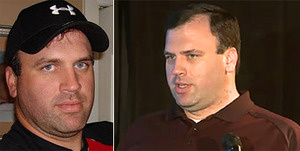
(Left) Tom Vanden Brook (on C-Span in 2010), a senior reporter for USA Today apparently targeted by a cyber-attack of misinformation and harassment. Photograph: guardiannews.com
In the case that the guilty party is found, and does indeed turn out to be one of the private firms that the Pentagon has hired to provide “information operations” for use in Afghanistan, what are the consequences likely to be?
To judge from the last known incident in which several government contractors were actually caught planning a far more sophisticated campaign of intimidation against yet another journalist, the consequences will not be so bad as to prevent others from doing the same thing. It’s easy enough, especially for those firms that are encouraged by their government clients to produce new and better ways by which to lie and discredit. And there’s money in it.
Early in 2011, four contracting firms with strong government ties – HBGary Federal, Palantir, Berico and Endgame Systems – decided to combine their capabilities and set up a high-end private info warfare unit called Team Themis. Bank of America asked them to write a proposal for a covert campaign against WikiLeaks. Aside from hacking the group’s European servers, the team raised the possibility of going after Salon contributor Glenn Greenwald, a prominent WikiLeaks supporter. “These are established professionals that have a liberal bent, but ultimately most of them if pushed will choose professional preservation over cause, such is the mentality of most business professionals,” wrote HBGary Federal CEO Aaron Barr. He resigned with a severance package a few weeks after the affair was exposed by Anonymous; soon afterwards, he got a new job with another government contractor.
What of the others? Berico simply broke ties with HBGary Federal, as if it were merely a bad influence. Endgame Systems, whose execs explicitly noted in internal emails that their government clients didn’t want its name appearing in a press release, was barely noted by the press at all – until, a few months later, Business Week discovered that their shyness may stem from the fact that they have the capability to take out West European airports via cyber attacks (if you’ve got a couple of million dollars to pay for that).
Palantir, which received seed money from the CIA’s investment arm, In-Q-Tel, and shares founders with PayPal, made a public apology to the effect that the cyber-plotting did not reflect the company’s values, and put one of the employees involved, Matthew Steckman, on leave. A few months later, when the press had lost interest, Palantir brought him back on. Nothing at all seems to have happened to another employee, Eli Bingham, who was also heavily involved. When Palantir throws its annual convention, it still attracts keynote speakers like former DHS Secretary Michael Chertoff – who happens to be on the board of another huge contractor, BAE Systems, which, in turn, happened to have done some business with HBGary Federal, as well.
To be fair, these sorts of companies provide valuable services to the US and its allies. For instance, when US Central Command (CentCom)needed software that would allow 50 of its information warfare people to pretend to be 500 entirely fake people who don’t exist outside the internet, it had the USAF put out a call for bids. A number of contractors were up for the job – including the ethically challenged HBGary Federal – but only one of them could actually win.
Perhaps the others can provide this sort of “persona management” capability to other, private clients with a need to discredit their enemies in a clandestine fashion. I can think of about a dozen journalists they might want to go after. The rest won’t be a problem.
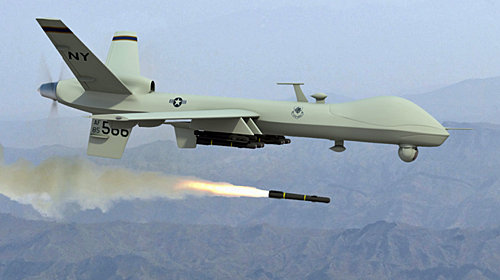
TEHRAN (FNA)- Senior Iranian military officials announced that the country’s experts have decoded the intelligence gathering system and memory hard discs of the United States’ highly advanced RQ-170 Sentinel stealth aircraft that was downed by Iran in December after violating the country’s airspace.
Speaking to FNA, Commander of the Islamic Revolution Guards Corps (IRGC) Aerospace Forces Brigadier General Amir Ali Hajizadeh revealed some data taken from the aircraft’s intelligence system to discourage his counterparts in Pentagon who had alleged that Iranians would not succeed in decoding the spy drone’s memory and intelligence devices.
“This plane is seen as a national capital for us and our words should not disclose all the information that we have very easily.”
“Yet, I provide four cues in here to let the Americans know how deep we could penetrate into (the intelligence systems and devices of) this drone,” he added.
Hajizadeh stated that the drone parts had been transferred to California for technical works in October 2010, adding that the drone was later transferred to Kandahar, Afghanistan in November 2010 and had a flight in there.
The commander said that the drone had experienced some technical flaws in its Kandahar flight in November, but the US experts failed resolve the problems at the time.
Hajizadeh added that the RQ-170 was then sent back to an airfield near Los Angeles in December 2010 for tests on its censors and parts, adding that the drone had a number of test flights in there.
As a forth cue to prove Iran’s access to the drone’s hidden memory, the commander mentioned that the spy drone’s memory device has revealed that it had flown over Al-Qaeda Leader Osama bin Laden’s hideout in Pakistan two weeks before his death.
“Had we not accessed the plane’s soft wares and hard discs, we wouldn’t have been able to achieve these facts,” Hajizadeh said, reiterating that Iran’s military experts are in full command of the drone intel and hold a good knowledge of the drone parts and programs.
The unmanned surveillance plane lost by the United States in Iran was a stealth aircraft being used for secret missions by the CIA.
The aircraft is among the highly sensitive surveillance platform in the CIA’s fleet that was shaped and designed to evade enemy defenses.
The drone is the first such loss by the US.
The RQ-170 has special coatings and a batwing shape designed to help it penetrate other nations’ air defenses undetected. The existence of the aircraft, which is made by Lockheed Martin, has been known since 2009, when a model was photographed at the main US airfield in Kandahar, Afghanistan.
The revelation came after Russia and China asked Tehran to provide them with information on the capture US drone.
Ahmad Karimpour, an adviser to Iran’s defense minister, said on Friday that Tehran has received requests from many countries for information on the RQ-170 Sentinel, but Moscow and Beijing have been most aggressive in their pursuit of details on the drone.
It turns out that tearing through the atmosphere at 20 times the speed of sound is bad for the skin, even if you’re a super high-tech aircraft developed by the government’s best engineers at its far-out research agency.
DARPA, the Defense Advanced Research Project Agency, has made public its best guess about what might have caused its unmanned arrowhead-shaped Hypersonic Technology Vehicle (HTV-2) to suddenly lose contact and crash in the Pacific just a few minutes after slicing through the sky at Mach 20 last August: it was going so fast its skin peeled off.
After an eight-month investigation, DARPA concluded that even though the HTV-2 was expected to lose some of its skin mid-flight, “larger than anticipated portions of the vehicle’s skin peeled from the aerostructure,” the agency said in a statement Friday.
The agency said it expected the HTV-2, which goes so fast it can make the commute from New York to Los Angeles in 12 minutes, to experience “impulsive shock waves” at such speeds, but shocks it experienced last August were “more than 100 times what the vehicle was designed to withstand.”
While the test was very public, the details of the HTV-2′s design, stability system and potential purpose remain highly classified.
Bottlenose dolphins appear to engage in formal greeting ceremonies while at sea.
The ceremonies involve exchanges of signature whistles, which likely contain information such as name, sex, age, health status, intent and more.
Bottlenose Dolphin (Tursiops truncatus) in Caribbean Sea near Roatan Island. – Corbis
Bottlenose dolphins swap signature whistles with each other when they meet in the open sea, a new study reports, suggesting that these marine mammals engage in something akin to a human conversation.
Earlier research found that signature whistles are unique for each dolphin, with the marine mammals essentially naming themselves and communicating other basic information.
A signature dolphin whistle in human speak, might be comparable to, “Hi, I’m George, a large, three-year-old dolphin in good health who means you no harm.”
The latest study, published in the Proceedings of the Royal Society B, is the first to show how free-ranging dolphins in the wild use these whistles at sea. The findings add to the growing body of evidence that dolphins possess one of the most sophisticated communication systems in the animal kingdom, perhaps even surpassing that of humans.
“In my mind, the term ‘language’ describes the human communication system; it is specific to us,” co-author Vincent Janik of the University of St. Andrews Sea Mammal Research Unit, told Discovery News. “It is more fruitful to ask whether there are communication systems with similar complexity. I think the dolphin system is probably as complex as it gets among animals.”
Janik and colleague Nicola Quick studied how bottlenose dolphins in St. Andrews Bay, off the coast of northeast Scotland, communicate with each other. While in a small, quiet boat, the researchers followed the wild dolphins and recorded their vocalizations.
Analysis of the observations and recordings found that the dolphins usually swam together in a group moving slowly and relatively quietly.
“When another group approaches, usually one or more animals start to produce their signature whistles,” Janik said. “We then hear dolphins from the other group calling back with their own signatures, and after or during this counter-calling the animals get together as one group and continue swimming together. Shortly after the union of the groups, they become much more quiet again.”
Most animals have some sort of communication system that allows them to make similar introductions and meetings, but dolphins are unique in that they can invent and copy new sounds. This is “unlike non-human primates, who are stuck with their species-specific repertoire,” he said.
The researchers also noticed that usually just one dolphin from each group would emit a signature whistle before the other group members would join the second group. This might mean that dolphins elect a “spokesman” to represent the entire group during meetings. Such an individual may be an older dolphin, Janik said, but he thinks the other dolphins are not fully silent, and may be using echolocation instead of whistles.
“We don’t know whether echolocation works in this way, but it seems like a viable hypothesis,” he said. “In that case, the whistle exchange is more of a greeting ceremony that communicates a friendly intention and is perhaps not needed to identify the group after the first introduction.”
Dolphins at a distance may rely more upon sounds and echolocation for their communications than visual, scent and other signals. This is likely due to their marine environment and social structure. A dolphin can hear the whistle of another dolphin over a distance of about six miles and with lots of noise in the background.
Heidi Harley, a bottlenose dolphin expert who is a professor of psychology at the New College of Florida, told Discovery News that she believes the findings are key to understanding how dolphins use signature whistles.
“Now we know that dolphins in groups use signature whistles before they join each other,” Harley said. “This is an important piece in the puzzle that we’ve been constructing about signature whistles.”
She added, “I was surprised to learn that the exchanges appeared to be between only a single individual in each group.”
In 2008, Congress enacted a statute that authorized the National Security Agency to carry out dragnet surveillance of Americans’ international communications. Almost four years later, the statute — called the FISA Amendments Act — has yet to be reviewed by the courts, and, if the Obama administration has its way, the courts are unlikely ever to review it. In February, the administration asked the Supreme Court to overturn acourt of appeals decision that would allow an ACLU challenge to the statute to go forward. Today we filed our brief in opposition, which asks the Supreme Court to let the appeals court’s decision stand.
As we explain in our brief, the statute gives the NSA extraordinary power:
[The FISA Amendments Act] allows the government to collect [Americans’ international communications] en masse without specifying the individuals or facilities to be monitored; without observing meaningful limitations on the retention, analysis, and dissemination of acquired information; without individualized warrants based on criminal or foreign intelligence probable cause; and without prior judicial or even administrative determinations that the targets of surveillance are foreign agents or connected in any way, however remotely, to terrorism.
We argue that the appeals court was right to rule that our plaintiffs have standing to challenge the statute, and we ask the Supreme Court to leave that ruling in place. We write:
In the end, what the government disguises as a narrow, technical argument about justiciability reveals itself to be this sweeping proposition: The courts have no meaningful role to play in protecting Americans’ international communications from wholesale government surveillance, or even in determining whether that surveillance is consistent with the Constitution. For sound strategic reasons, the government avoids stating the proposition forthrightly, but it is the inescapable consequence of the argument it advances. Nothing in this Court’s precedents countenances such a result.
The plaintiffs in the case include Amnesty International USA, the Global Fund for Women, Human Rights Watch, the International Criminal Defence Attorneys Association, The Nation Magazine, PEN American Center, Service Employees International Union, and the Washington Office on Latin America.
You can find more information about the FISA Amendments Act here, and more information about the case — called Clapper v. Amnesty International USA et al. —here.
Monsanto only cares about bee’s so they can figure out how to make them only pollinate Monsanto GMO crops. Whistle-blower testimony and supporting evidence will confirm that Monsanto seeks ultimate agricultural world domination through most incomprehensible and nefarious means. -Anonymous
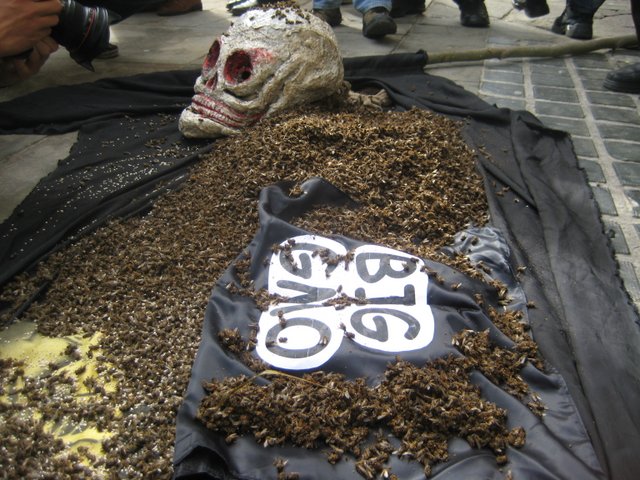
Monsanto, the massive biotechnology company being blamed for contributing to the dwindling bee population, has bought up one of the leading bee collapse research organizations. Recently banned from Poland with one of the primary reasons being that the company’s genetically modified corn may be devastating the dying bee population, it is evident that Monsanto is under serious fire for their role in the downfall of the vital insects. It is therefore quite apparent why Monsanto bought one of the largest bee research firms on the planet.
It can be found in public company reports hosted on mainstream media that Monsanto scooped up the Beeologics firm back in September 2011. During this time the correlation between Monsanto’s GM crops and the bee decline was not explored in the mainstream, and in fact it was hardly touched upon until Polish officials addressed the serious concern amid the monumental ban. Owning a major organization that focuses heavily on the bee collapse and is recognized by the USDA for their mission statement of “restoring bee health and protecting the future of insect pollination” could be very advantageous for Monsanto.
In fact, Beelogics’ company information states that the primary goal of the firm is to study the very collapse disorder that is thought to be a result — at least in part — of Monsanto’s own creations. Their website states:
While its primary goal is to control the Colony Collapse Disorder (CCD) and Israeli Acute Paralysis Virus (IAPV) infection crises, Beeologics’ mission is to become the guardian of bee health worldwide.
What’s more, Beelogics is recognized by the USDA, the USDA-ARS, the media, and ‘leading entomologists’ worldwide. The USDA, of course, has a great relationship with Monsanto. The government agency has gone to great lengths to ensure that Monsanto’s financial gains continue to soar, going as far as to give the company special speed approval for their newest genetically engineered seed varieties. It turns out that Monsanto was not getting quick enough approval for their crops, which have been linked to severe organ damage and other significant health concerns.
Steve Censky, chief executive officer of the American Soybean Association, states it quite plainly. It was a move to help Monsanto and other biotechnology giants squash competition and make profits. After all, who cares about public health?
“It is a concern from a competition standpoint,” Censky said in a telephone interview.
It appears that when Monsanto cannot answer for their environmental devastation, they buy up a company that may potentially be their ‘experts’ in denying any such link between their crops and the bee decline.
NSA whistleblower William Binney said some pretty explosive things during his interview with DemocracyNow! late last week, but arguably his most newsworthy comments have thus far elicited hardly any reaction among the mainstream press.
One of the most disturbing revelations Binney provided is that the Bush administration’s NSA had already begun deploying its “Total Information Awareness” (TIA) program well before it sent the program’s director, John Poindexter, to the public to leak evidence of the project. We’ll get to that in a moment.
But first, listen to Binney describe why he became a whistleblower, risking his entire life — forty years in government service, his family, everything — to tell the truth about a problem he saw as fundamentally threatening to our society.
First of all it was a very depressing thing to have happen that they would turn their capabilities that I built for them to do detection of foreign threats, to have that turned on the people of the United States, that was an extremely depressing thing for me. And that made it all the more important for me to try to do things to get the government to correct its own criminal activity.
Binney then describes what he did initially, how he spoke out:
And I did that by going to the House intelligence committees. I also attempted to see Chief Justice Renquist, to try to address that issue to him. And I also visited the Department of Justice Inspector General’s office, after Obama came in to office, by the way, to no avail.
Now that was before the 2009 joint IG report on surveillance. Which basically said you need to have better and more active monitoring of these surveillance programs. It didn’t say anything else, so, it just did simply, absolutely nothing.Because the oversight that’s given to the intelligence community is virtually nonexistent from Congress. I mean they are totally dependent because they have no way of really knowing what’s happening inside the agencies involved unless they have people come forward to tell them, like me. They would not know those things.
Binney says that he blew the whistle to a Justice on the Supreme Court, to the House intelligence committees that are supposedly tasked with oversight of the 16 secretive intelligence agencies, and to the DOJ’s Inspector General. The results?He was investigated, and the FBI busted into his house, guns drawn.
But what of the information he leaked?
Much has been made over the past few days about his admittedly stunning statement to the effect that the NSA has copies of every email in the United States, but hardly anyone has talked about something equally stunning: evidence of rank manipulation of the press and the public.
In the DN! interview embedded above, Amy Goodman asks Binney to compare the system the NSA was running when he blew the whistle to the infamous “Total Information Awareness” program, which John Poindexter — formerly a convicted felon — oversaw at the Department of Defense. (TIA aimed to do just what it sounds like: collect every bit of information about every single person and store it in vast databases, producing digital dossiers on all of us, all without warrants or anything approaching probable cause.)
Binney elaborates:
[Poindexter] was actually pushed out, to test the waters, to see how Congress would be receptive to what they were already doing. In other words that process of building that information about everybody, getting ‘total information’, was already happening. And they threw Poindexter out with DARPA…but it was actually already happening. And the question was, would it be acceptable to Congress, because they were keeping it very closely held in Congress, calling it a covert program. So that would make it a process to find out what the reaction would be if they expose to Congress what they were already doing.
In other words, the DoD sent Poindexter out to “test the waters” in the House intelligence committee, to see what the reaction would be to the Total Information Awareness program that they were already running.
The New York Timespiece that broke the TIA story to the public on November 9, 2002 told us that the program “will” and “would” do a host of unsavory things:
As the director of the effort, Vice Adm. John M. Poindexter, has described the system in Pentagon documents and in speeches, itwill provide intelligence analysts and law enforcement officials with instant access to information from Internet mail and calling records to credit card and banking transactions and travel documents, without a search warrant.
…
In order to deploy such a system, known as Total Information Awareness, new legislation would be needed, some of which has been proposed by the Bush administration in the Homeland Security Act that is now before Congress. That legislation would amend the Privacy Act of 1974, which was intended to limit what government agencies could do with private information.
…
The system would permit a team of intelligence analysts to gather and view information from databases, pursue links between individuals and groups, respond to automatic alerts, and share information efficiently, all from their individual computers.
The project calls for the development of a prototype based on test data that would be deployed at the Army Intelligence and Security Command at Fort Belvoir, Va. Officials would not say when the system would be put into operation.
According to Binney, the NSA was already providing this information to “intelligence analysts” and police, all without warrants, judicial oversight, or Congressional authorization. The program had been developed and it was already operating when Poindexter told Congress that the DoD was developing it. The NYTimes might want to correct that story.
Binney’s remarks raise the question: if the DoD and the federal government were lying about TIA then, having already implemented the program, should we trust the government when it says that it disbanded the operation after the public said “hell no”?
No, it’s probably unwise to trust the DoD in light of this revelation.
Should we therefore assume that NSA has been spying on our digital data for the past ten years, all without warrants, Congressional or judicial oversight, or Constitutional blessing? Stranger things have happened.
Another important piece of the interview describes the means by which the FBI, collaborating with the NSA in its investigations of William Binney and Thomas Drake, built its case against the whistleblowers.
Juan Williams asked Binney: “The NSA is a huge agency, aren’t there others who are disturbed by this?”
Binney:
I’m sure there are. And I know a number of them that are but they’re so, they’re so afraid to do anything. I mean, they’ve seen what happened to us — they sent the FBI to us. So they’re afraid of being indicted, prosecuted, and even if you win the case if you’re indicted, you’re still going to lose, because you’ve had to hire a lawyer and all like Tom [Drake] did and we did. So you lose anyway you speak of it. When they have unlimited funds to do whatever they want, and you don’t, they can indict you on any number of things like they tried to do with us.
Binney says that the FBI was monitoring his and Drake’s communications, and had prepared indictments against them alleging a conspiracy to leak classified information. The FBI apparently backed off when Binney told Drake, over a phone line that Binney assumed the FBI was monitoring, that he had evidence of illegal FBI investigatory tactics. Spy v. Spy, indeed.
If the Pentagon gets its way, the gentleman doodling on his notepad as your next overseas business trip goes on endlessly could be a soldier, sailor, airman or marine in disguise.
This extraordinary redefinition of the U.S. military’s authorities for clandestine action overseas is officially part of a Pentagon wish list for revisions to its legal authorities recently sent to Congress.
There’s another change the proposal would make — one that seems boring and bureaucratic, but explains a great deal. Authority for overseeing the Defense Department’s human spying lies with the Defense Intelligence Agency. The proposal would give it instead to the Undersecretary of Defense for Intelligence, the top aide for intel to the secretary of defense. And that undersecretary, Michael Vickers, is one of the Pentagon’s leading advocates of the transformation of special operations forces into elite intelligence operatives. Basically, Vickers would take control of a broad expansion in clandestine military activity.
Notice how the proposal says that using the cover of “commercial activities” would “provide an important safeguard for U.S. military forces.” Perhaps it would. But it would also place businessmen in danger. Once civilian commercial activities become a front for U.S. military spying, then foreign governments will likely view normal businessmen as targets for their own counterspying, or even detention.
This is why medical aid workers had such a negative reaction to the CIA’s use of a Pakistani doctor tocollect DNA in the town where Osama bin Laden was hiding under the cover of a vaccination program. If civilian activities become tied up with military activities, then the civilians who perform them will be seen as military targets, even if they have nothing to do with the military themselves.
“Additional classified background information regarding the Department’s conduct of its commercial cover program will be made available to the armed services committees,” the Pentagon promises in the proposal. Perhaps the generals will brief congressional staff in business suits.
It looks like the power of the IRS to revoke passports is merely a drop in the tyrannical bucket.
The Senate has voted to approve Bill 1813, which is now on its way to the House. The insidious bill has so many attacks on freedom that the most serious one has been largely overlooked.
There are two attacks on gun ownership in this bill. The text of the bill, all 1676 pages of it, can be found HERE.
The first attack on the right to bear arms is found on page 1323.
The Secretary may modify, suspend, or terminate a special permit or approval if the Secretary determines that—(1) the person who was granted the special permit or approval has violated the special permit or approval or the regulations issued under this chapter in a manner that demonstrates that the person is not fit to conduct the activity authorized by the special permit or approval; or (2) the special permit or approval is unsafe.
In the ambiguous language that the Congress so loves to employ in all things unconstitutional, we can translate that to the parental favorite, “Because I said so.”
The second attack on gun ownership is more subtle.
First, if this bill passes, the IRS will have the authority to take away the passports of those whom they say owe more than $50,000 in taxes. (The tax debt doesn’t have to be proven, mind you, the IRS simply has to accuse you of owing the money.) You can find this section on page 1447 of the Bill.
When your passport is revoked by the government, you are suddenly on the “no-fly list”.
Membership in the no-fly club puts you on yet another list, as a potential domestic terrorist.
Domestic terrorists are not allowed to have guns.
Don’t believe me? Listen to Raul Emanuel gloat of it. He eloquently states “If you are known as maybe a possible terrorist you cannot buy a handgun in America.” (1:13 of the video)
Emanuel, the Mayor of Chicago and former Obama Chief of Staff, makes the top of my personal treason list for this statement. In his own words, “maybe a possible terrorist” means you shouldn’t be allowed the rights guaranteed to you as an American. No proof necessary.
Bill 1813, ‘‘Moving Ahead for Progress in the 21st Century Act’’, is chock full of new ways to take away our personal freedoms. The bill would require “stalker boxes” on our vehicles, puts a huge number of restrictions on travel and transportation within the US, allows the government to revoke documents and licenses in ambiguous language and is, in essence, nearly 1700 pages of new restrictions. (You can find a summaryHERE if you don’t want to read all 1676 pages).
A Call to Action
Did your Senator vote for this bill? There’s a good chance he or she did, as only 22 Senators voted against it. You can find out how your senator voted HERE.
The bill was sponsored by Barbara Boxer (California) and co-sponsored by Max Baucus (Montana), James N. Inhofe (Oklahoma), and David Vitter (Louisiana). For your convenience, I’ve included links to the contact information for each of these Senators. Be sure and send an email to let them know how you feel about this new attack on freedom.
Email your Representatives and make it very clear that you consider this Bill an act of treason against the Constitution. This directory contains email addresses and contact information for all members of Congress.
Every bill that goes through Congress right now appears to hold another threat to the Constitution (if not multiple threats). Every word needs to be carefully analyzed so we can fight these attacks.
NEW YORK, NY — Brian Amento gripped the deadbolted door handle on the display next to him and with a click, the door unlocked at his touch. In his other hand, he was pinching a small metal disk called a piezoelectric transducer — like the ones used in guitar pickups — that was wired to his smartphone. The phone sent a digital key, identifying Amento as the homeowner, through his body and into the door.
Amento is a computer scientist at AT&T Labs. He talked with InnovationNewsDaily Thursday at a research fair AT&T held for reporters. Though for this display, the piezoelectric transducer connected to Amento’s phone with a large wire, eventually such sensors would be embedded directly in phones or perhaps wristwatches, Amento said. People’s smartphones would become their door keys, too.
In this prototype, Amento’s phone produced several frequencies of vibrations that humans can’t feel, but can hear, if the room is very quiet. In other words, as Amento said, “It’s an acoustic signal.”
The frequencies travel from the phone and through the skeleton, in the way that sound waves vibrate bones in the skull and inner ear. At the other end, the door handle has another piezoelectric transducer to detect the vibrations coming through a person’s hand. If this technology comes to market, different phones and door handles would have different vibration signatures that need to match for the door to unlock.
Amento switched the settings on his phone, demonstrating that his demo door would also open for the vibrations from a friend’s phone. On the other hand, it would send an alert to the homeowner if a stranger touched the door handle.
Amento and his colleagues think they can add another layer of security to the smartphone key, too — one that’s based on the unique properties of people’s skeletons. Because of differences in bone lengths and density, people’s skeletons should carry vibrations differently, they think. “If the signal goes through my body, it degrades in a different way than if it goes through your body,” Amento said. Among the five people he has tested, all of their skeletons transmitted vibrations differently. Of course, he’ll have to test more people to check if everyone is unique, but if that’s true, then the smartphone key will only work when the right person is using it.
The key is still in its prototype stage, Amento said, so he couldn’t say when people might be able to unlock their front doors with their own unique cellphone vibes. Once such systems work, however, people could start transmitting much more than their door keys through their bones. Amento and his colleagues are also working to see if people can exchange contact information just by shaking hands. The data would flow from one phone, through one person’s skeleton, into the next person’s and finally, into the recipient’s phone.
They also think a person’s unique vibes might help other smart devices identify them. A piezoelectric couch, for example, could sense who’s sitting there and offer her favorite channels. A piezoelectric car driver’s seat could identify the driver and adjust the mirrors accordingly.
A witness is someone who has firsthand knowledge about an event. An expert witness is a person who, by virtue of education, training or experience, is believed to have expertise in a particular area. A different type of witness is an eyewitness, who is a person that saw a specific event first hand. A witness can be extremely important for court proceedings. They are vital for news articles that expose government secrets. In some cases, investigative journalists can become an expert witness after conducting deep research into a controversial subject. This article will examine ten famous witnesses that suddenly died. In every case, the deaths are suspicious and have spawned a collection of conspiracy theories.
10 – David Wherley Jr.
Witnessed Event: U.S. Response to September 11, 2001
On September 11, 2001, David Wherley Jr. was the commander in charge of the 113th Fighter Wing at Andrews Air Force base, in Maryland. After the attack on New York City he took orders from the Secret Service to dispatch a fleet of aircraft to protect the White House and the Capitol. Wherley was an important 9/11 witness. He played a role in ordering the tactics used by the U.S. government in response to the terrorist activity. Wherley was mentioned on multiple occasions in the 9/11 Commission report. He later acted as the commanding general of the District of Columbia National Guard, from 2003 to 2008.
On June 22, 2009, David Wherley and his wife Ann boarded a Red Line Washington Metro train (#214) in Northeast Washington, D.C. While waiting for their train to leave Fort Totten station, it was struck by an oncoming Red Line train. The Wherley’s train was rear-ended at a high speed. Nine people were killed in the accident, including David Wherley and his wife. It was the deadliest crash in the history of the Washington Metro. Several survivors were trapped in the rubble for hours, and approximately 80 people were injured.
A preliminary investigation found that the accident occurred when the replacement of a track circuit component failed, which prevented certain signals from being reported. Survivors described the crash as like “hitting a concrete wall.” According to Daniel Kaniewski, a former Bush administration homeland security official, the overall emergency response to the event was “calm and ordered.” He indicated that the U.S. response “during extraordinary incidents has significantly improved” since September 11, 2001.
9 – Dwight Dixon
Witnessed Event: North Philadelphia Shooting
On April 29, 2008, a convicted drug dealer named Dwight Dixon got into an altercation with former NFL star Marvin Harrison, at a North Philadelphia car wash named Chuckie’s Garage. The two men had previously gotten into an argument when Harrison denied Dixon entry into a sports bar he owned and operated. On the day in question, Dixon and Harrison got into a fight outside the car wash. Someone pulled out a gun and started shooting. A collection of witnesses at the scene, including Dwight Dixon, said that it was Marvin Harrison who was firing with two separate weapons. Three people were injured in the gunfire. Dixon was shot in the left hand. A man named Robert Nixon was struck in his back and a child sitting in a nearby car suffered an eye injury from shattered glass.
Robert Nixon initially told police he knew nothing about what happened, but four days after the shooting he signed a statement saying he was positive that he saw Harrison with a gun in his hand at the time of the altercation. After an investigation, ballistics tests confirmed that five of the shell casings found at the crime scene had come from a high-powered Belgian handgun owned by Marvin Harrison. The gun was recovered from Harrison’s car wash.
After the story reached ESPN, Marvin Harrison’s personality was reported in a different light. For 12 NFL seasons, Marvin was one of most prolific wide receivers in the league. He was a true professional that rarely celebrated after any of his 128 touchdowns. Harrison stepped away from the game after the 2008 season.
In the spring of 2009, Dwight Dixon gave an interview to the ESPN program E:60, claiming that Harrison was the man that shot him. A few months later on July 21, 2009, Dwight Dixon was shot and killed in the Fairmount section of Philadelphia. A gunman approached the driver’s side of his Toyota Camry and fired four times through the back window and then fired three more times into the passenger side. Dwight Dixon was shot 7 times. Moments after the shooting, he told police that he believed the incident was related to the April 2008 assault. Dixon fell into a coma shortly after being shot and died a few months later. His murder remains unsolved.
In the summer of 2010, Marvin Harrison was pulled over by the police for traveling the wrong way down a one-way street. The officers claimed to have seen Harrison conceal a gun in the car. They searched his vehicle and found a 9mm weapon that was tested against three spent 9mm shell casings that were found inside the truck driven by the late Dwight Dixon at the scene of an April 2008 shooting. Since the discovery, the FBI has become involved in the investigation, with no recent news to report.
8 – Barbara Olson
Witnessed Event: American Airlines Flight 77
Barbara Olson was a lawyer, author and conservative American television commentator. In 1994, she joined the United States House of Representatives, becoming chief investigative counsel for the House Government Reform and Oversight Committee. In that position, Olson led a number of different investigations into the Clinton administration. She exposed the White House travel office scandal and the FBI files controversy. Olson published a collection of books that examine the history of Hillary Clinton and the actions of Bill Clinton in the final days of his presidency. Some of her accusations include unlawful pardons by Bill Clinton, the looting of the White House and executive orders that were sheer abuses of presidential power. On January 20, 2001, Bill Clinton pardoned 140 people in the final hours of his presidency.
In 1996, Barbara Olson married a man named Ted Olson. Ted successfully represented presidential candidate George W. Bush in the Supreme Court case of Bush v. Gore, which effectively determined the final result of the contested 2000 Presidential election. He subsequently served as United States Solicitor General in the Bush administration. On September 11, 2001, Barbara Olson boarded American Airlines Flight 77 traveling from Virginia to Los Angeles. She was visiting Los Angeles for a taping of Politically Incorrect with Bill Maher.
On September 11, 2001, Flight 77 was hijacked at 8:54. Between 9:16 and 9:26, Olson called her husband. According to him, she reported that the flight had been hijacked, and that the hijackers had knives and box-cutters. A minute into the conversation, the call was cut off. Shortly after, Barbara reached her husband again. Ted Olson asked for her location and she replied that the plane was flying over houses. Ted informed Barbara of the two previous hijackings and crashes. She didn’t display signs of panic over the phone. American Airlines Flight 77 crashed into the western side of the Pentagon at 09:37 EDT. All 64 people on board were killed, including Barbara Olson. Following her death, Politically Incorrect host, Bill Maher, left a panel seat vacant for a week.
The two phone calls Barbara Olson made from Flight 77 are an important factor to the accepted story of 9/11. They provide evidence that American 77 had been aloft after it had disappeared from FAA radar around 9:00 AM. The calls are also the only source of the widely accepted idea that the hijackers had box cutters. The story has been scrutinized by a collection of researchers, who have accused Ted Olson of changing his account. He originally indicated that Barbara used a cell phone to call him, but later said she called using an airline phone. The technology to enable cell phone calls from high-altitude flights wasn’t developed until 2004.
7 – Milton William Cooper
Witnessed Event: U.S. Naval Intelligence Gathering
After graduating from high school, William Cooper joined the U.S. Air Force and later the U.S. Navy. He served in the Vietnam War and then worked for Naval Security and Intelligence. Cooper gained notoriety after publishing a book titled Behold a Pale Horse. The text documents various UFO and paranormal activities he encountered while serving for Naval Intelligence. It examines government corruption, secret societies, and a collection of conspiracy theories. In the 1990s, William Cooper became a popular speaker on the UFO lecture circuit. He was the host of a worldwide shortwave radio show named Hour of the Time.
William Cooper was the first person to provide evidence of explosive material inside the Murrah Building in Oklahoma City on April 19, 1995. He publicly identified the type of explosives used in the Oklahoma City bombing. In his early writings, Cooper was convinced that the United States was hiding evidence of alien technology. Towards the end of his life Cooper turned his attention towards covert government programs and the militia movement. He became an outspoken critic of U.S. government abuses. William Cooper felt that the UFO phenomenon was a misinformation campaign organized to hide secret military operations. He asserted that the Internal Revenue Service (IRS) is actually the same organization as the Bureau of Alcohol, Tobacco and Firearms. Cooper felt the two organizations were involved in a broad, premeditated conspiracy to defraud the Citizens of the United States of America.
William Cooper produced several documentaries covering subjects such as the John F. Kennedy assassination and government black projects. He felt that JFK was shot and killed by his driver, a man named William Greer. In the Zapruder film Greer can be seen turning towards Kennedy the moment before he receives the fatal head wound. Following the death of her husband, Jacqueline Kennedy was bitterly critical of William Greer’s performance. William Cooper suggested that Jacqueline was attempting to get away from William Greer when she famously jumped on the back of the vehicle following the assassination. In the Zapruder film, Greer’s recorded front to back movement is extremely abnormal. The tape shows evidence of possible tampering.
In June 2001, three months before 9/11, William Cooper warned publicly about an important terrorist attack on United States, that would be blamed on Osama Bin Laden. During his June 28 broadcast, William Cooper said “I’m telling you be prepared for a major attack. But it won’t be Osama Bin Laden. It will be those behind the New World Order.” On 9/11 Cooper said “what we’re witnessing today is most probably the herald of the, at least, the redefinition of freedom, and probably its death.”
William Cooper was charged with various crimes in his lifetime, including tax evasion from 1992 to 1994, and bank fraud for giving false information on a loan application. In July and September 2001, Cooper was accused of brandishing a handgun near his home in Eagar, Arizona. On November 6, 2001, two months after September 11, William Cooper was fatally shot by a large collection of Arizona deputies who were attempting to serve him an arrest warrant. According to police accounts, Cooper, who was physically disabled, fled officers and pulled out a weapon. A gun fight ensued and William Cooper was killed. A deputy was critically injured in the incident.
6 – Kenneth Johannemann
Witnessed Event: Collapse of the Twin Towers
Kenny Johannemann worked as a part-time janitor in the World Trade Center when it was attacked and destroyed on September 11, 2001. He was in the North Tower waiting for an elevator when the first explosion occurred. The blast created a fireball that engulfed the elevator shaft. Johannemann responded by saving the life of a man that was badly burned in the event. He was in a similar position as William Rodriguez, who was also a janitor in the WTC North Tower, and who became internationally recognized for his heroic efforts on September 11. Rodriguez was the last person to leave the collapsing North Tower alive.
Following the events of September 11, 2001, Kenneth Johannemann and William Rodriguez provided a detailed account of their experience. One aspect of their stories is similar, but contradicts the official report presented by the 9/11 commission. Both men reported that they heard loud explosions in the basement of the North Tower immediately before and after the plane impacted. Kenneth Johannemann was adamant about the fact that he heard explosions not associated with the crash. William Rodriguez also claimed to have heard a massive rumble in the basement of the North Tower, seconds before the plane hit.
On August 31, 2008, Kenneth Johannemann committed suicide by way of a gunshot wound to the head. Mr Johannemann’s suicide note stated that he was depressed after being evicted from his residence. The testimony given by Kenneth Johannemann and William Rodriguez are identical in the fact that they describe large explosions in the WTC towers. Before his death, Johannemann regularly told his story to public crowds. His death was a surprise to everyone and instantly raised suspicion amongst 9/11 researchers.
5 – Gary Webb
Witnessed Event: Research into the Cocaine Trade
Gary Webb was a Pulitzer prize-winning American investigative journalist. In August of 1996, the San Jose Mercury News published Webb’s Dark Alliance, a 20,000 word, three-part investigative series which alleged that Nicaraguan drug traffickers had sold and distributed crack cocaine in Los Angeles during the 1980s. Webb alleged that drug profits were used to fund the CIA-supported Nicaraguan Contras. He never asserted that the CIA directly aided drug dealers to raise money for the Contras, but he did document that the CIA was aware of the cocaine transactions and the large shipments of cocaine into the U.S. by the Contra personnel.
According to the Columbia Journalism Review, the Dark Alliance series became “the most talked-about piece of journalism in 1996, and arguably the most famous set of articles of the decade.” Webb supported his research with documents obtained through the Freedom of Information Act. He investigated Nicaraguans linked to the CIA-backed Contras who had allegedly smuggled cocaine into the U.S. Their product was distributed as crack cocaine in Los Angeles. Webb also alleged that this influx of Nicaraguan-supplied cocaine sparked, and significantly fueled, the widespread crack cocaine epidemic that swept through many U.S. cities during the 1980s. He charged that the Reagan administration shielded inner-city drug dealers from prosecution in order to raise money for the Contras.
Gary Webb’s research generated fierce controversy around the world, and the San Jose Mercury News backed away from the story, effectively ending Webb’s career as a mainstream media journalist. On December 10, 2004, Gary Webb was found dead from two gunshot wounds to the head. The Sacramento County coroner Robert Lyons asserted that it was suicide. He said that a suicide note was found at the scene, although Lyons was unable to explain how Webb could shoot himself twice in the head with a .38 caliber pistol. Since the publication of Dark Alliance, many of Gary Webb’s accusations have been validated. Journalist George Sanchez wrote that “the CIA’s internal investigation by Inspector General Frederick Hitz vindicated much of Gary’s reporting” and observed that, despite the campaign against Webb, “the government eventually admitted to more than Gary had initially reported.”
4 – Ramin Pourandarjani
Witnessed Event: Misconduct at the Kahrizak Jail
Dr. Ramin Pourandarjani was an Iranian physician that worked at the Kahrizak detention center in southern Tehran. Following the 2009 Iranian election protests, Ramin Pourandarjani was made responsible for the medical care of several prisoners believed to have been tortured. One of his patients was Mohsen Ruholamini, a government scientist’s son, who was arrested following his participation in the post-election protests.
Mohsen Ruholamini, who was only 25-years-old, died in prison in July of 2009. His death certificate originally identified the cause of death as multiple blows to the head. A report given by the Iranian judicial authorities stated that Ruholamini died of “physical stress, the effects of being held in bad conditions, multiple blows and severe injuries to the body.”
Dr. Pourandarjani testified before a parliamentary committee investigating misconduct at the Kahrizak jail. The jail was subsequently closed by order of Ayatollah Khamenei. Presidential candidate and cleric, Mehdi Karroubi, publicly accused the Iranian police of having tortured and raped detainees in the prison. In response, the police raided Karroubi’s office, and confiscated names, addresses and testimonies of witnesses.
Following his testimony, Pourandarjani was one of the people arrested. He was interrogated by the Iranian police and released on bail. On November 10, 2009, at the age of 26, Ramin Pourandarjani died of poisoning from a salad laced with an overdose of blood pressure medication. Iranian authorities initially claimed Pourandarjani had died in a car accident, committed suicide, or died of a heart attack. They prohibited Pourandarjani’s family from performing an autopsy. The judiciary unit in Iran remains reluctant to investigate the sudden death of Dr. Ramin Pourandarjani.
3 – Lee Bowers Jr.
Witnessed Event: John F. Kennedy Assassination
Lee Bowers Jr. was a key witness to the assassination of John F. Kennedy. At the moment of the shooting he was operating the Union Terminal Company’s two-story interlocking tower, which was overlooking the parking lot just north of the grassy knoll and west of the Texas School Book Depository. Bowers had an unobstructed view of the stockade fence atop the knoll. He gave a detailed account of the assassination saying he had witnessed two unfamiliar men standing near the grassy knoll at the edge of the parking lot, within 10 or 15 feet of each other, “one man was middle-aged, fairly heavy-set, in a white shirt and dark trousers. The other was a younger man, about mid-twenties, in either a plaid shirt or a plaid coat or jacket.”
Lee Bowers also described a strange truck that was parked in the location of the assassination seven to ten minutes before Kennedy arrived. When the shots rang out, Bowers’ attention was drawn to the grassy knoll where he had witnessed the two men. He observed “some commotion” at that spot, “…something out of the ordinary, a sort of milling around…which attracted my eye for some reason, which I could not identify.” In an interview that Lee Bowers gave with attorney Mark Lane, he explained that the “commotion” that caught his eye may have been “a flash of light or smoke.”
Lee Bowers testified that immediately following the assassination a motorcycle policeman left the presidential motorcade and roared up the grassy knoll straight to where the two mysterious gentlemen were standing behind the fence. The policeman dismounted, but then climbed on his motorcycle and drove off. On the morning of August 9, 1966, Lee Bowers was driving south from Dallas on business. He was two miles from Midlothian when his brand new company car veered from the road and hit a bridge abutment. Bowers was killed in the accident. There was no autopsy performed and he was cremated soon afterward. A doctor from Midlothian, who rode in the ambulance with Bowers, noticed something peculiar about the victim. “He was in a strange state of shock. I’ve never seen anything like it.”
2 – Barry Jennings
Witnessed Event: Collapse of the Twin Towers
On the morning of September 11, 2001, Barry Jennings, who was a housing authority official in New York City, was near the World Trade Center Towers when they were attacked. Following the incident Barry reported to the city’s command center, which was located on the 23rd floor of the 7 World Trade Center structure. After reaching the office, Jennings and a man named Michael Hess realized that the room was completely empty. In an interview taped for the Loose Change film series, Jennings discussed the moment. “There was steaming coffee and sandwiches on the tables. It seemed that the room had recently been vacated.”
After getting word to evacuate, Jennings and Hess started to move down the staircase of 7 WTC. When the pair reached the 6th floor they were hit by a large explosion. The stairs underneath the men gave way and they were forced to climb over rubble to reach the 8th floor. While on the 8th floor Barry Jennings reported the sound of multiple loud explosions from below. Jennings and Hess were eventually saved by a collection of New York City firefighters and taken to an area called the “lobby.” The area was completely obliterated. While traveling through the lobby, Barry Jennings commented on dead bodies.
“And the firefighter who took us down kept saying, “Do not look down.” I kept saying, “Why?” We were stepping over people. And you know when you can feel when you are stepping over people.”
At 5:21 on the evening of September 11, 2001, the 7 World Trade Center building suffered a complete failure. The official cause of the collapse was due to damage sustained when the nearby North Tower of the WTC collapsed. The debris ignited fires, which continued to burn throughout the afternoon. The building’s internal fire suppression system lacked water pressure to fight the fires, and the building collapsed. The destruction of 7 WTC is a controversial subject among conspiracy theorists. Along with the Twin Towers, 7 WTC was the first steel building to experience a complete failure due to fire. The structure didn’t crumble as you might expect from fire damage. Instead it fell in an absolute free-fall (about 8 seconds).
Barry Jennings finished his interview for Loose Change by saying “I’m just confused about one thing, why World Trade Center 7 went down in the first place – I’m very confused about that – I know what I heard, I heard explosions.” Barry Jennings challenged the official 9/11 report. He said that while in the building he heard multiple explosions and witnessed damage not caused by fire. For this reason, many people found the testimony of Jennings contradictory to the official story of what happened on 9/11. Barry Jennings died on August 19, 2008, from an unknown cause. He passed away only a couple days before a report was to be released by the National Institute of Standards and Technology’s (NIST) on the collapse of 7 WTC.
1 – David Kelly
Witnessed Event: Biological Warfare Research in Iraq
David Kelly was a British scientist and expert on biological warfare. He was employed by the British Ministry of Defense, and served as a United Nations weapons inspector in Iraq. The Iraq War began on March 20, 2003. After the end of the initial ground attack, David Kelly was involved with a team attempting to find any trace of weapons of mass destruction in Iraq.
After analyzing photographs of two alleged mobile weapons laboratories in Iraq, Kelly was unhappy with the presented results. In response, he organized an interview with The Observer. On June 15, 2003, the newspaper published an article using Kelly as a confidential source. It said that “a British scientist and biological weapons expert who examined the trailers in Iraq said they are not mobile germ warfare laboratories. You could not use them for making biological weapons. They do not even look like them. They are exactly what the Iraqis said they were. Facilities for the production of hydrogen gas to fill balloons.”
On May 22, 2003, David Kelly met with Andrew Gilligan, a BBC journalist. A few weeks later, using information provided by Kelly, Gilligan published a series of articles about the British government’s dossier on weapons of mass destruction in Iraq. He said that the government had “sexed up” the military capabilities of Iraq in order to bolster the argument for going to war with the country. Gilligan quoted his source, David Kelly, as identifying Alastair Campbell, the former Prime Minister’s Director of Communications and Strategy, as being responsible for the suppressions. He suggested that the claim that Iraq was able to deploy biological weapons within 45 minutes was false.
On July 15, 2003, David Kelly was called before the parliamentary foreign affairs select committee. He was questioned aggressively about his actions. Two days later, on July 17, David Kelly went missing near his home in Oxfordshire. His body was discovered in area of woodlands known as Harrowdown Hill, about a mile away from his home. David Kelly had ingested up to 29 tablets of painkillers. He also slashed his left wrist with a knife. After an investigation, Kelly’s death was ruled a suicide. Since that time, a collection of medical experts have raised concerns over his cause of death.
Doctors have argued that the autopsy finding of a transected ulnar artery could not have caused a degree of blood loss that would kill someone, particularly when outside in the cold. In December 2010, The Times reported that Dr. Kelly had a rare abnormality in his arteries which could have contributed to his death. On December 5, 2009, six doctors began legal action to demand a formal inquest into the death of David Kelly, saying there was “insufficient evidence to prove beyond reasonable doubt he killed himself.” In January 2010, it was disclosed that Lord Hutton had requested that all files relating to his postmortem remain secret for 70 years. Hutton explained that he had done so to protect David Kelly’s wife and daughters from the distress of further media reports.
Psilocybin, the active ingredient in hallucinogenic mushrooms, shuts down parts of the brain that are responsible for regulating a sense of self.
In controlled settings, the drug may be a useful therapeutic tool for treating depression, anxiety and other psychiatric problems.
In the study, the rush of the first 10 to 30 seconds induced some fear, he added, but positive feelings then immediately swept over them.
After a psychedelic trip on magic mushrooms, people often describe the experience as mind-expanding, consciousness altering, emotionally insightful and even spiritually transcendent. Now, scientists have peered into the brains of people tripping on psilocybin — the active ingredient in mushrooms — and their results revealed a few surprises.
Instead of opening lines of communication between sensory-oriented regions of the brain, psilocybin appears to shut down activity in two key areas of the brain that regulate our sense of self and integrate our sense of awareness with our sense of the present.
The drug also decreases activity in something called the default mode network, which is believed to be involved in maintaining a balanced sense of consciousness and ego through self-reflection, though scientists still don’t entirely understand the network or agree about what it does.
The more these brain areas were suppressed, the researchers report today in Proceedings of the National Academy of Sciences, the more intense people reported their changes in perception to be.
Besides helping explain how magic mushrooms induce hallucinogenic adventures of the mind, the results suggest that, in controlled settings, psilocybin might be a useful tool for treating depression and other psychiatric problems.
“One of the parts of the brain that is markedly switched off [with psilocybin] is the anterior cingulate cortex, which is particularly overactive in people with depression,” said David Nutt, professor of neuropsychopharmacology at Imperial College, London. Some researchers “put electrodes in that part of the brain to switch it off. It would be a lot simpler and safer to use psilocybin instead of electrodes.”
In British author Aldous Huxley’s ruminations on the effects of mescaline, a psychedelic compound that occurs naturally in the Peyote cactus, he expressed the sense that the hallucinogenic drug removed natural constraints that keep the brain focused on the inputs and tasks necessary for normal functioning. By removing those constraints, Huxley speculated, hallucinogenic drugs create an otherworldly sense of reality and a mystical state of transcendence and transformation.
From subjective descriptions like those, scientists have long assumed that hallucinogens, like mescaline and psilocybin, work in the brain by increasing blood flow and creating new kinds of connections. Research on psychedelic effects in the brain, however, has been limited and hard to get approval for.
For the new study, Nutt and colleagues recruited 15 healthy people with previous experience taking hallucinogenic substances. Over two days, the researchers monitored activity in participants’ brains as they lay in a scanner for up to an hour. On the first day, participants received an intravenous shot of a placebo solution. The next day, they got a shot of psilocybin that was dosed to peak after about four minutes and was mostly over after about 30 minutes.
No one had trouble figuring out which shot contained the real drug. Afterwards, they talked at length about their experiences.
All of the participants described kaleidoscopic vision with images of bright and angular shapes, Nutt said. The rush of the first 10 to 30 seconds induced some fear, he added, but positive feelings then immediately swept over them. Many participants said that the benefits of the experience were profound and that they felt they had moved on from where they had been. Others said the experience was interesting, though not necessarily life-changing. None described the trip as negative.
“They mostly got the sense that they were going somewhere else, that they were being transmuted into space and being fragmented or stretched,” Nutt said. “One guy found himself kneeling at the feet of God. Some described being at one with the universe.”
In brain scans, the researchers saw a decrease in both blood flow and metabolism in several key areas after injection with the drug, including the anterior cingulate cortex, the medial prefrontal cortex and the posterior cingulate cortex. Also reduced was connectivity and communication between some of these areas.
The findings offer some potentially exciting opportunities to use psilocybin in therapeutic settings, said Roland Griffiths, a neuroscientist and pscyhopharmacologist at Johns Hopkins University in Baltimore.
His research has shown some long-lasting cognitive benefits of psilocybin, with study subjects reporting that they feel happier, calmer and more at peace more than a year after taking a carefully measured dose of the drug in an experimental setting. He is currently conducting a trial with cancer patients who are anxious or depressed.
Nutt plans next to see if the hallucinogen, combined with therapy, might be able to help calm hyperactive brain regions in people with enduring depression who are locked into obsessively negative mindsets.
There is reason to believe it might work. In another study, also published today in The British Journal of Psychiatry, Nutt and colleagues report that guiding people to think positively about events in their past while they were under the influence of psilocybin led to a greater sense of well-being two weeks later.
While the research offers tantalizing evidence that psilocybin can be safe and helpful in clinical settings, Griffiths said, the hallucinogen still carries risks when people take it on their own. Depending on the dose and the situation, the drug can lead to panic and cause people to harm themselves or others.
“From a cultural point of view, there may be some applications that are useful and therapeutic,” Griffiths said. “But I’m not sure we’re ever going to be able to go to the drug store, pick it up and bring it home.”
LOS ANGELES (CBS) — A bill authored by a Southland lawmaker that could potentially allow the federal government to prevent any Americans who owe back taxes from traveling outside the U.S. is one step closer to becoming law.
Senate Bill 1813 was introduced back in November by Senator Barbara Boxer (D-Los Angeles) to “reauthorize Federal-aid highway and highway safety construction programs, and for other purposes” .
After clearing the Senate on a 74 – 22 vote on March 14, SB 1813 is now headed for a vote in the House of Representatives, where it’s expected to encounter stiffer opposition among the GOP majority.
In addition to authorizing appropriations for federal transportation and infrastructure programs, the “Moving Ahead for Progress in the 21st Century Act” or “MAP-21″ includes a provision that would allow for the “revocation or denial” of a passport for anyone with “certain unpaid taxes” or “tax delinquencies”.
Section 40304 of the legislation states that any individual who owes more than $50,000 to the Internal Revenue Service may be subject to “action with respect to denial, revocation, or limitation of a passport”.
The bill does allow for exceptions in the event of emergency or humanitarian situations or limited return travel to the U.S., or in cases when any tax debt is currently being repaid in a “timely manner” or when collection efforts have been suspended.
However, there does not appear to be any specific language requiring a taxpayer to be charged with tax evasion or any other crime in order to have their passport revoked or limited — only that a notice of lien or levy has been filed by the IRS.
Boxer vowed last week to push House Republicans to pass the bipartisan transportation bill that would keep the Highway Trust Fund from going bankrupt.
“Thousands of businesses are at stake, and eventually we are talking about nearly three million jobs at stake,” she said in a statement. “There are many people on both sides of the aisle in the Senate who want to get our bill, MAP-21, passed into law, and I am going to do everything I can to keep the pressure on the Republican House to do just that.”
Here is the breif introduction. I’m using the alias Isaac, and used to work in what was called the CARET program in the 80’s. During my time there, I worked with a lot of the technology that is clearly at work in the recent drone/strange craft sightings, most notably the “language” and diagrams seen on the underside of each craft. What follows is a lengthy letter about who I am, what I know, and what these sightings are (probably) all about.
The appearance of these photos has convinced me to release at least some of the numerous photographs and photocopied documents I still possess some 20 years later that can explain a great deal about these sightings. On this site you will find some of these. They are available as high resolution scans that I am giving away free, PROVIDED THEY ARE NOT MODIFIED IN ANY WAY AND ARE KEPT TOGETHER ALONG WITH THIS WRITTEN MATERIAL.
I am also trying to get in touch with the witnesses so far, such as Chad, Rajman, Jenna, Ty, and the Lake Tahoe witness (especially Chad). I have advice for them that may be somewhat helpful in dealing with what they’ve seen and what I would recommend they do with what they know. If you are one of these witnesses, or can put me in touch with them, please contact Coast to Coast AM and let them know.
FAN MADE VIDEO – DRAGONFLY DRONE TECHNO REMIX
My Experience with the CARET Program and Extra-terrestrial Technology Isaac, June 2007
This letter is part of a package I’ve assembled for Coast to Coast AM to distribute to its audience. It is a companion to numerous document and photo scans and should not be separated from them.
You can call me Isaac, an alias I’ve chosen as a simple measure of protection while I release what would be called tremendously sensitive information even by todays standards. “Sensitive” is not necessarily synonymous with “dangerous”, though, which is why my conscience is clear as I offer this material up for the public. My government has its reasons for its continual secrecy, and I sympathize with many of them, but the truth is that I’m getting old and I’m not interested in meeting my maker one day with any more baggage than necessary! Furthermore, I put a little more faith in humanity than my former bosses do, and I think that a release of at least some of this info could help a lot more than it could hurt, especially in today’s world.
I should be clear before I begin, as a final note: I am not interested in making myself vulnerable to the consequences of betraying the trust of my superiors and will not divulge any personal information that could determine my identity. However my intent is not to deceive, so information that I think is too risky to share will be simply left out rather than obfuscated in some way (aside from my alias, which I freely admit is not my real name). I would estimate that with the information contained in this letter, I could be narrowed down to one of maybe 30-50 people at best, so I feel reasonably secure.
Some Explanation for the Recent Sightings
For many years I’ve occasionally considered the release of at least some of the material I possess, but the recent wave of photos and sightings has prompted me to cut to the chase and do so now.
I should first be clear that I’m not directly familiar with any of the crafts seen in the photos in their entirety. I’ve never seen them in a hangar or worked on them myself or seen aliens zipping around in them. However, I have worked with and seen many of the parts visible in these crafts, some of which can be seen in the Q3-85 Inventory Review scan found at the top of this page. More importantly though, I’m very familiar with the “language” on their undersides seen clearly in photos by Chad and Rajman, and in another form in the Big Basin photos.
One question I can answer for sure is why they’re suddenly here. These crafts have probably existed in their current form for decades, and I can say for sure that the technology behind them has existed for decades before that. The “language”, in fact, (I’ll explain shortly why I keep putting that in quotes) was the subject of my work in years past. I’ll cover that as well.
The reason they’re suddenly visible, however, is another matter entirely. These crafts, assuming they’re anything like the hardware I worked with in the 80’s (assuming they’re better, in fact), are equipped with technology that enables invisibility. That ability can be controlled both on board the craft, and remotely. However, what’s important in this case is that this invisibility can also be disrupted by other technology. Think of it like radar jamming. I would bet my life savings (since I know this has happened before) that these craft are becoming visible and then returning to invisibility arbitrarily, probably unintentionally, and undoubtedly for only short periods, due to the activity of a kind of disrupting technology being set off elsewhere, but nearby. I’m especially sure of this in the case of the Big Basin sightings, were the witnesses themselves reported seeing the craft just appear and disappear. This is especially likely because of the way the witness described one of the appearances being only a momentary flicker, which is consistent with the unintentional, intermittent triggering of such a device.
It’s no surprise that these sightings are all taking place in California, and especially the Saratoga/South Bay area. Not far from Saratoga is Mountain View/Sunnyvale, home to Moffett Field and the NASA Ames Research center. Again, I’d be willing to bet just about anything that the device capable of hijacking the cloaking of these nearby craft was inadvertently triggered, probably during some kind of experiment, at the exact moment they were being seen. Miles away, in Big Basin, the witnesses were in the right place at the right time and saw the results of this disruption with their own eyes. God knows what else was suddenly appearing in the skies at that moment, and who else may have seen it. I’ve had some direct contact with this device, or at least a device capable of the same thing, and this kind of mistake is not unprecedented. I am personally aware of at least one other incident in which this kind of technology was accidentally set off, resulting in the sudden visibility of normally invisible things. The only difference is that these days, cameras are a lot more common!
The technology itself isn’t ours, or at least it wasn’t in the 80’s. Much like the technology in these crafts themselves, the device capable of remotely hijacking a vehicle’s clacking comes from a non-human source too. Why we were given this technology has never been clear to me, but it’s responsible for a lot. Our having access to this kind of device, along with our occasionally haphazard experimentation on them, has lead to everything from cloaking malfunctions like this to full-blown crashes. I can assure you that most (and in my opinion all) incidents of UFO crashes or that kind of thing had more to do with our meddling with extremely powerful technology at an inopportune time than it did mechanical failure on their part. Trust me, those things don’t fail unless something even more powerful than them makes them fail (intentionally or not). Think of it like a stray bullet. You can be hit by one at any time, without warning, and even the shooter didn’t intent to hit you. I can assure you heads are rolling over this as well. If anyone notices a brilliant but sloppy physicist patrolling the streets of Baghdad in the next couple weeks, I’d be willing to guess how he got there. (I kid, of course, as I certainly hope that hasn’t actually happened in this case)
I’d now like to explain how it is that I know this.
The CARET Program
My story begins the same as it did for many of my co workers, with graduate and post-graduate work at university in electrical engineering. And I had always been interested in computer science, which was a very new field at the time, and my interest piqued with my first exposure to a Tixo during grad school. In the years following school I took a scenic route through the tech industry and worked for the kinds of companies you would expect, until I was offered a job at the Department of Defense and things took a very different turn.
My time at the DoD was mostly uneventful but I was there for quite a while. I apparently proved myself to be reasonably intelligent and loyal. By 1984 these qualities along with my technical background made me a likely candidate for a new program they were recruiting for called “CARET”.
Before I explain what CARET was I should back up a little. By 1984, Silicon Valley had been a juggernaut of technology for decades. In the less than 40 years since the appearance of Shockley’s transistor this part of the world had already produced a multi billion dollar computer industry and made technological strides that were unprecedented in other fields, from hypertext and online collaboration in ’68 to the Alto in ’73.
Private industry in Silicon Valley was responsible for some of the most incredible technological leaps in history and this fact did not go unnoticed by the US government and military. I don’t claim to have any special knowledge about Roswell or any of the other alleged early UFO events, but I do know that whatever the exact origin, the military was hard at work trying to understand and use the extra-terrestrial artifacts it had in its possession. While there had been a great deal of progress overall, things were not moving as quickly as some would have liked. So, in 1984, the CARET program was created with the aim of harnessing the abilities of private industry in silicon valley and applying it to the ongoing task of understanding extra-terrestrial technology.
One of the best examples of the power of the tech sector was Xerox PARC, a research center in Palo Alto, CA. XPARC was responsible for some of the major milestones in the history of computing. While I never had the privilege of working there myself I did know many of the people who did and I can say that they were among the brightest engineers I ever knew.
XPARC served as one of the models for the CARET program’s first incarnation, a facility called the Palo Alto CARET Laboratory (PACL, lovingly pronounced “packle” during my time there). This was where I worked, along with numerous other civilians, under the auspices of military brass who were eager to find out how the tech sector made so much progress so quickly. My time at the DoD was a major factor behind why I was chosen, and in fact about 30+ others who were hired around the same time had also been at the Department about as long, but this was not the case for everyone. A couple of my co-workers were plucked right from places like IBM and, at least two of them came from XPARC itself. My DoD experience did make me more eligable for positions of management, however, which is how I have so much of this material in my possession to begin with.
So in other words, civilians like myself who had at–at most–some decent experience working for the DoD but no actual military training or involvement, were suddenly finding ourselves in the same room as highly classified extra-terrestrial technology. Of course they spent about 2 months briefing us all before we saw or did anything, and did their best to convince us that if we ever leaked a single detail about what we were being told, they’d do everything short of digging up our ancestors and putting a few slugs in them too just for good measure. It seemed like there was an armed guard in every corner of every room. I’d worked under some pretty hefty NDAs in my time but this was so far out of my depth I didn’t think I was going to last 2 weeks in an environment like that. But amazingly things got off to a good start. They wanted us, plain and simple, and our industry had shown itself to be so good at what it did that they were just about ready to give us carte blanche.
Of course, nothing with the military is ever that simple, and as is often the case they wanted to have their cake and eat it too. What I mean by this is that despite their interest in picking our brains and learning whatever they could from our way of doing things, they still wanted to do it their way often enough to frustrate us.
At this point I’m going to gloss over the emotional side of this experience, because this letter isn’t intended to be a memoir, but I will say that there’s almost no way to describe the impact this kind of revelation has on your mind. There are very few moments in life in which your entire world view is turned forever upside down, but this was one of them. I still remember that turning point during the briefing when I realized what he’d just told us, and that I hadn’t heard him wrong, and that it wasn’t some kind of joke. In retrospect the whole thing feels like it was in slow motion, from that slight pause he took just before the term “extra-terrestrial” came out for the first time, to the way the room itself seemed to go off kilter as we collectively tried to grasp what was being said. My reflex kept jumping back and forth between trying to look at the speaker, to understand him better, and looking at everyone else around me, to make sure I wasn’t the only one that was hearing this. At the risk of sounding melodramatic, it’s a lot like a child learning his parents are divorcing. I never experienced that myself, but a very close friend of mine did when were boys, and he confided in me a great deal about what the experience felt like. A lot of what he said would aptly describe what I was feeling in that room. Here was a trusted authority figure telling you something that you just don’t feel ready for, and putting a burden on your mind that you don’t necessarily want to carry. The moment that first word comes out, all you can think about it is what it was like only seconds ago, and knowing that life is never going to be as simple as it was then. After all that time at the DoD, I thought I at least had some idea of what was going on in the world, but I’d never heard so much as a peep about this. Maybe one day I’ll write more on this aspect, because it’s the kind of thing I really would like to get off my chest, but for now I’ll digress.
Unlike traditional research in this area, we weren’t working on new toys for the air force. For numerous reasons, the CARET people decided to aim its efforts at commercial applications rather than military ones. They basically wanted us to turn these artifacts into something they could patent and sell. One of CARET’s most appealing promises was the revenue generated by these product-ready technologies, which could be funneled right back into black projects. Working with a commercial application in mind was also yet another way to keep us in a familiar mind state. Developing technology for the military is very different than doing so for the commercial sector, and not having to worry about the difference was another way that CARET was very much like private industry.
CARET shined in the way it let us work the way we were used to working. They wanted to recreate as much of the environment we were used to as they could without compromising issues like security. That meant we got free reign to set up our own workflow, internal management structure, style manuals, documentation, and the like. They wanted this to look and feel like private industry, not the military. They knew that was how to get the best work out of us, and they were right.
But things didn’t go as smoothly when it came to matters like access to classified information. They were exposing what is probably their single biggest secret to a group of people who had never even been through basic training and it was obvious that the gravity of this decision was never far from their minds. We started the program with a small set of extra-terrestrial artifacts along with fairly elaborate briefings on each as well as access to a modest amount of what research had already been completed. It wasn’t long before we realized we needed more though, and getting them to provide even the smallest amount of new material was like pulling teeth. CARET stood for “Commercial Applications Research for Extra-terrestrial Technology”, but we often joked that it should have stood for “Civilians Are Rarely Ever Trusted.”
PACL was located in Palo Alto, but unlike XPARC, it wasn’t at the end of a long road in the middle of a big complex surrounded by rolling hills and trees. PACL was hidden in an office complex owned entirely by the military but made to look like an unassuming tech company. From the street, all you could see was what appeared to be a normal parking lot with a gate and a guard booth, and a 1-story building inside with a fictitious name and logo. What wasn’t visible from the street was that behind the very first set of doors was enough armed guards to invade Poland, and 5 additional underground stories. They wanted to be as close as possible to the kinds of people they were looking to hire and be able to bring them in with a minimum of fuss.
Inside, we had everything we needed. State of the art hardware and a staff of over 200 computer scientists, electrical engineers, mechanical engineers, physicists and mathematicians. Most of us were civilians, as I’ve said, but some were military, and a few of them had been working on this technology already. Of course, you were never far from the barrel of a machine gun, even inside the labs themselves (something many of us never got used to), and bi-weekly tours were made by military brass to ensure that not a single detail was out of line. Most of us underwent extensive searches on our way into and out of the building. There it was, probably the biggest secret in the world, in a bunch of parts spread out on laboratory tables in the middle of Palo Alto so you can imagine their concern.
One downside to CARET was that it wasn’t as well-connected as other operations undoubtedly were. I never got to see any actual extra-terrestrials (not even photos), and in fact never even saw one of their compete vehicles. 99% of what I saw was related to the work at hand, all of which was conducted within a very narrow context on individual artifacts only. The remaining 1% came from people I met through the program, many of which working more closely with “the good stuff” or had in the past.
In fact, what was especially amusing about the whole affair was the way that our military management almost tried to act as if the technology we were essentially reverse engineering wasn’t extra-terrestrial at all. Aside from the word “extra-terrestrial” itself, we rarely heard any other terms like “alien” or “UFO” or “outer space” or anything. Those aspects were only mentioned briefly when absolutely necessary to explain something. In many cases it was necessary to differentiate between the different races and their respective technology, and they didn’t even use the word “races”. They were referred to simply as different “sources”.
The Technology
A lot of the technology we worked on was what you would expect, namely antigravity. Most of the researchers on the staff with backgrounds in propulsion and rocketry were military men, but the technology we were dealing with was so out of this world that it didn’t really matter all that much what your background was because none of it applied. All we could hope to do was use the vocabulary of our respective fields as a way to model the extremely bizarre new concepts we were very slowly beginning to understand as best we could. A rocket engineer doesn’t usually rub elbows much with a computer scientist, but inside PACL, we were all equally mystified and were ready to entertain any and all ideas.
The physicists made the most headway initially because out of all of our skills, theirs overlapped the most with the concepts behind this technology (although that isn’t saying much!) Once they got the ball rolling though, we began to find that many of the concepts found in computer science were applicable as well, albeit in very vague ways. While I didn’t do a lot of work with the antigrav hardware myself, I was occasionally involved in the assessment of how that technology was meant to interface with its user.
The antigrav was amazing, of course, as were the advances we were making with materials engineering and so on. But what interested me most then, and still amazes me most to this day, was something completely unrelated. In fact, it was this technology that immediately jumped out at me when I saw the Chad and Rajman photos, and even moreso in the Big Basin photos.
The “Language”
I put the word Language in quotes because calling what I am about to describe a “language” is a misnomer, although it is an easy mistake to make.
Their hardware wasn’t operated in quite the same way as ours. In our technology, even today, we have a combination of hardware and software running almost everything on the planet. Software is more abstract than hardware, but ultimately it needs hardware to run it. In other words, there’s no way to write a computer program on a piece of paper, set that piece of paper on a table or something, and expect it to actually do something. The most powerful code in the world still doesn’t actually doanything until a piece of hardware interprets it and translates its commands into actions.
But their technology is different. It really did operate like the magical piece of paper sitting on a table, in a manner of speaking. They had something akin to a language, that could quite literally executeitself, at least in the presence of a very specific type of field. The language, a term I am still using very loosely, is a system of symbols (which does admittedly very much resemble a written language) along with geometric forms and patterns that fit together to form diagrams that are themselves functional. Once they are drawn, so to speak, on a suitable surface made of a suitable material and in the presence of a certain type of field, they immediately begin performing the desired tasks. It really did seem like magic to us, even after we began to understand the principles behind it.
I worked with these symbols more than anything during my time at PACL, and recognized them the moment I saw them in the photos. They appear in a very simple form on Chad’s craft, but appear in the more complex diagram form on the underside of the Big Basin craft as well. Both are unmistakable, even at the small size of the Big Basin photos. An example of a diagram in the style of the Big Basin craft is included with this in a series of scanned pages from the [mistitled] “Linguistic Analysis Primer”. We needed a copy of that diagram to be utterly precise, and it took about a month for a team of six to copy that diagram into our drafting program!
Explaining everything I learned about this technology would fill up several volumes, but I will do my best to explain at least some of the concepts as long as I am taking the time to write all this down.
First of all, you wouldn’t open up their hardware to find a CPU here, and a data bus there, and some kind of memory over there. Their hardware appeared to be perfectly solid and consistent in terms of material from one side to the other. Like a rock or a hunk of metal. But upon [much] closer inspection, we began to learn that it was actually one big holographic computational substrate – each “computational element” (essentially individual particles) can function independently, but are designed to function together in tremendously large clusters. I say its holographic because you can divide it up into the smallest chunks you want and still find a scaled-down but complete representation of the whole system. They produce a nonlinear computational output when grouped. So 4 elements working together is actually more than 4 times more powerful than 1. Most of the internal “matter” in their crafts (usually everything but the outermost housing) is actually this substrate and can contribute to computation at any time and in any state. The shape of these “chunks” of substrate also had a profound effect on its functionality, and often served as a “shortcut” to achieve a goal that might otherwise be more complex.
So back to the language. The language is actually a “functional blueprint”. The forms of the shapes, symbols and arrangements thereof is itself functional. What makes it all especially difficult to grasp is that every element of each “diagram” is dependant on and related to every other element, which means no single detail can be created, removed or modified independently. Humans like written language because each element of the language can be understood on its own, and from this, complex expressions can be built. However, their “language” is entirely context-sensitive, which means that a given symbol could mean as little as a 1-bit flag in one context, or, quite literally, contain the entire human genome or a galaxy star map in another. The ability for a single, small symbol to contain, not just represent, tremendous amounts of data is another counter-intuitive aspect of this concept. We quickly realized that even working in groups of 10 or more on the simplest of diagrams, we found it virtually impossible to get anything done. As each new feature was added, the complexity of the diagram exponentially grew to unmanageable proportions. For this reason we began to develop computer-based systems to manage these details and achieved some success, although again we found that a threshold was quickly reached beyond which even the supercomputers of the day were unable to keep up. Word was that the extra-terrestrials could design these diagrams as quickly and easily as a human programmer could write a Fortran program. It’s humbling to think that even a network of supercomputers wasn’t able to duplicate what they could do in their own heads. Our entire system of language is based on the idea of assigning meaning to symbols. Their technology, however, somehow merges the symbol and the meaning, so a subjective audience is not needed. You can put whatever meaning you want on the symbols, but their behavior and functionality will not change, any more than a transistor will function differently if you give it another name.
Here’s an example of how complex the process is. Imagine I ask you to incrementally add random words to a list such that no two words use any of the same letters, and you must perform this exercise entirely in your head, so you can’t rely on a computer or even a pen and paper. If the first in the list was, say, “fox”, the second item excludes all words with the letters F, O and X. If the next word you choose is “tree”, then the third word in the list can’t have the letters F, O, X, T, R, or E in it. As you can imagine, coming up with even a third word might start to get just a bit tricky, especially since you can’t easily visualize the excluded letters by writing down the words. By the time you get to the fourth, fifth and sixth words, the problem has spiraled out of control. Now imagine trying to add the billionth word to the list (imagine also that we’re working with an infinite alphabet so you don’t run out of letters) and you can imagine how difficult it is for even a computer to keep up. Needless to say, writing this kind of thing “by hand” is orders of magnitude beyond the capabilities of the brain.
My background lent itself well to this kind of work though. I’d spent years writing code and designing both analog and digital circuits, a process that at least visually resembled these diagrams in some way. I also had a personal affinity for combinatorics, which served me well as I helped with the design of software running on supercomputers that could juggle the often trillions of rules necessary to create a valid diagram of any reasonable complexity. This overlapped quite a bit with compiler theory as well, a subject I always found fascinating, and in particular compiler optimization, a field that wasn’t half of what it is today back then. A running joke among the linguistics team was that Big-O notation couldn’t adequately describe the scale of the task, so we’d substitute other words for “big”. By the time I left I remember the consensus was “Astronomical-O” finally did it justice.
Like I said, I could go on for hours about this subject, and would love to write at least an introductory book on the subject if it wasn’t still completely classified, but that’s not the point of this letter so I’ll try to get back on track.
The last thing I’d like to discuss is how I got copies of this material, what else I have in my possession, and what I plan to do with it in the future.
My Collection
I worked at PACL from 1984 to 1987, by which time I was utterly burned out. The sheer volume of details to keep in mind while working with the diagrams was enough to challenge anyone’s sanity, and I was really at the end of my rope with the military’s attitude towards our “need to know”. Our ability to get work done was constantly hampered by their reluctance to provide us with the necessary information, and I was tired of bureaucracy getting in the way of research and development. I left somewhere in the middle of a 3-month bell curve in which about a quarter of the entire PACL staff left for similar reasons.
I was also starting to disagree with the direction the leadership wanted to take as far as the subject of extra-terrestrials went. I always felt that at least some form of disclosure would be beneficial, but as a lowly CARET engineer I wasn’t exactly in the position to call shots. The truth is, our management didn’t even want us discussing non-technical aspects of this subject (such as ethical or philosophical issues), even among ourselves, as they felt it was enough of a breach of security to let civilians like us anywhere near this kind of thing in the first place.
So, about 3 months before I resigned (which was about 8 months before I was really out, since you don’t just walk out of a job like that with a 2 week notice). I decided to start taking advantage of my position. As I mentioned earlier, my DoD experience got me into an internal management role sooner than some of my colleagues, and after about a year of that kind of status, the outgoing searches each night became slightly less rigorous. Normally, we were to empty out any containers, bags or briefcases, then remove our shirt and shoes and submit to a kind of frisking. Work was never allowed to go home with you, no matter who you were. For me, though, the briefcase search was eventually enough.
Even before I actually decided to do it, I was sure that I would be able to sneak certain materials out with me. I wanted to do this because I knew the day would come when I would want to write something like this, and I knew I’d regret it until the day I died if I didn’t at least leave the possibility open to do so. So I started photocopying documents and reports by the dozen. I’d then put the papers under my shirt around my lower back, tucked enough into my belt to ensure they wouldn’t fall out. I could do this in any one of a few short, windowless hallways on some of the lower floors, which were among the few places that didn’t have an armged guard watching my every move. I’d walk in one end with a stack of papers large enough that when I came out the other end with some of them in my shirt, there wouldn’t be a visible difference in what I was holding. You absolutely cannot be too careful if you’re going to pull a stunt like this. As long as I walked carefully they wouldn’t make a crinkling noise. In fact, the more papers I took, the less noise they made, since they weren’t as flimsy that way. I’d often take upwards of 10-20 pages at once. By the time I was done, I’d made out with hundreds of photocopies, as well as a few originals and a large collection of original photographs.
With this initial letter I have attached high resolution scans of the following:
A page from an inventory review with a photo that appears to depict one of the parts found in the Rajman sighting and parts very similar to the Big Basin craft
The first 9 pages of one of our quarterly research reports
Scans of the original photographs used in that report, since the photocopies obscure most of the details
5 pages from a report on our ongoing analysis of the “language” (inappropriately titled “linguistic analysis”), depicting the kind of diagram just barely visible on the underside of the Big Basin craft
This material is the most relevant and explanatory I could find on short notice. Now that these are up, IF I decide to release more in the future, I’ll be able to take my time and better search this rather large collection of mine that I’ve sadly never organized. I’m not sure what I’ll be doing with the rest of the collection in the future. I suppose I’ll wait and see how this all plays out, and then play it by ear. There are certainly risks involved in what I’m doing, and if I were to actually be identified and caught, there could be rather serious consequences. However, I’ve taken the proper steps to ensure a reasonable level of anonymity and am quite secure in the fact that the information I’ve so far provided is by no means unique among many of the CARET participants.
Besides, part of me has always suspected that the government relies on the occasional leak like this, and actually wants them to happen, because it contributes to a steady, slow-paced path towards revealing the truth of this matter.
Since Leaving CARET
Like I said, I left PACL in ’87, but have kept in touch with a great many of my friends and coworkers from those days. Most of us are retired by now, except of course for those of us that went on to get teaching jobs, but a few of us still hear things through the grapevine.
As for CARET itself, I’m not sure what’s become of it. Whether it’s still known by the same name, I’m quite sure it’s still active in some capacity, although who knows where. I heard from a number of people that PACL closed up shop a few years after I left, but I’ve still yet to get a clear answer on why exactly that happened. But I’m sure the kind of work we did there is still going strong. I’ve heard from a lot of friends that there are multiple sites like PACL in Sunnyvale and Mountain View, also disguised to look like unremarkable office space. But this is all second-hand information so you can make of it what you will.
Around 2002 or so I came across Coast to Coast AM and have been hooked ever since. I admit, I don’t take most of the show’s content as anything more than entertainment, but there have been occasions when I could be sure a guest was clearly speaking from experience or a well-informed source. For me, there’s just something very surreal about hearing all this speculation and so-called inside information about UFOs and the like, but being personally able to verify at least some of it as being true or false. It’s also a nightly reminder of how hectic things were in those days, which helps me enjoy my retirement all the more. Knowing I’m not part of that crazy world anymore really is something I enjoy on a daily basis, as much as I miss some of it.
Conclusion
What I’ve shared so far is only a very small portion of what I have, and what I know. Despite the very sheltered and insulated atmosphere within CARET, I did ultimately learn a great deal from various colleagues, and some of what I learned is truly incredible. I’d also like to say that for what it’s worth, during my time there I never heard anything about invasions, or abductions, or many of the more frightening topics that often pop up on Coast to Coast AM. That’s not to say that none of it is true, but in my time working alongside some of the most well-connected people in this field, it never came up. So at the very least I can say my intent is not to scare anyone. My view on the extra-terrestrial situation is very much a positive, albiet still highly secretive one.
One thing I can definitely say is that if they wanted us gone, we would have been gone a very, verylong time ago, and we wouldn’t even have seen it coming. Throw out your ideas about a space war or anything silly like that. We’d be capable of fighting back against them about as much as ants could fight back against a stampede of buffalo. But that’s OK. We’re the primitive race, they’re the advanced races, and that’s just the way it is. The other advanced races let them live through their primitive years back in their day, and there’s no reason to think it will be any different for us. They aren’t in the market for a new planet, and even if they were, there are way too many planets out there for them to care about ours enough to take it by force.
To reiterate my take on the recent sightings, I’d guess that experimentation done in the last couple months on a device that, among other things, is capable of interfering with various crafts onboard invisibility has resulted in a sudden wave of sightings. It may not explain all of the recent events, but like I said, I’d bet my life that’s exactly what happened at Big Basin at least, and it’s probably related in some way to the Chad, Rajman and Tahoe sightings. So, despite all the recent fanfare over this, I’d say this doesn’t mean much. Most importantly, they aren’t suddenly “here”. They’ve been here for a long time, but just happened to turn unintentionally visible for brief periods recently.
Lastly, there are so many people selling books, and DVDs, and doing lectures, and all that, that I would like to reiterate the fact that I am not here to sell anything. The material I’m sharing is free to distribute provided it’s all kept intact and unmodified, and this letter is included. I tend to question the motives of anyone charging money for their information, and will assure you that I will never do such a thing. And in the future, just to cover all the bases, anyone claiming to be me who’s selling a DVD or book is most certainly not going to be me.
Any future releases from me will come from the email address I’ve used to contact Coast to Coast AM, and will be sent to them only. I’d like to make this clear as well to ensure that people can be sure that any future information comes from the same source, although I must be clear: at this time I do not have any future plans for additional information. Time will tell how long I will maintain this policy, but do not expect anything soon. I’d really like to let this information “settle” for a while and see how it goes. If I find out I’m getting an IRS audit tomorrow, then maybe this wasn’t too smart. Until then, I’m going to take it slow. I hope this information has been helpful
The following collection of 25 flyers produced by the FBI and the Department of Justice are distributed to local businesses in a variety of industries to promote suspicious activity reporting. The flyers are not released publicly, though several have been published in the past by news media and various law enforcement agencies around the country. We have compiled this collection from a number of online sources.
To view the documents, click on a threat area in the menu to the left and the PDF will appear on the right side of the page. You can also download the complete collection of files (ZIP Archive, 6.27 MB).
Over the past year, the U.S. government has begun to think of Anonymous, the online network phenomenon, as a threat to national security. According to The Wall Street Journal, Keith Alexander, the general in charge of the U.S. Cyber Command and the director of the National Security Agency, warned earlier this year that “the hacking group Anonymous could have the ability within the next year or two to bring about a limited power outage through a cyberattack.” His disclosure followed the U.S. Department of Homeland Security’s release of several bulletins over the course of 2011 warning about Anonymous. Media coverage has often similarly framed Anonymous as a threat, likening it to a terrorist organization. Articles regularly refer to the Anonymous offshoot LulzSec as a “splinter group,” and a recent Fox News report uncritically quoted an FBI source lauding a series of arrests that would “[chop] off the head of LulzSec.”
This is the wrong approach. Seeing Anonymous primarily as a cybersecurity threat is like analyzing the breadth of the antiwar movement and 1960s counterculture by focusing only on the Weathermen. Anonymous is not an organization. It is an idea, a zeitgeist, coupled with a set of social and technical practices. Diffuse and leaderless, its driving force is “lulz” — irreverence, playfulness, and spectacle. It is also a protest movement, inspiring action both on and off the Internet, that seeks to contest the abuse of power by governments and corporations and promote transparency in politics and business. Just as the antiwar movement had its bomb-throwing radicals, online hacktivists organizing under the banner of Anonymous sometimes cross the boundaries of legitimate protest. But a fearful overreaction to Anonymous poses a greater threat to freedom of expression, creativity, and innovation than any threat posed by the disruptions themselves.
Hackers inserted a prank article on the PBS Web site declaring that the deceased rapper Tupac Shakur was “alive and well” in New Zealand.
No single image better captured the way that Anonymous has come to signify the Internet’s irreverent democratic culture than when, in the middle of a Polish parliamentary session in February 2012, well-dressed legislators donned Guy Fawkes masks — Anonymous’ symbol — to protest their government’s plan to sign the Anti-Counterfeiting Trade Agreement (ACTA). The treaty, designed to expand intellectual-property protection, involved years of negotiation among the United States, Japan, and the European Union, which are all like-minded on copyright law. It had the support of well-organized and well-funded companies, particularly in Hollywood and the recording industry. Although originally negotiated in secret, its contents were exposed by WikiLeaks in 2008. As a result, public pressure caused the treaty’s negotiators to water down many of its controversial provisions. But the final version still mimicked the least balanced aspects of U.S. copyright law, including its aggressive approach to asset seizure and damages. And so a last-minute protest campaign across Europe, using the symbolism of Anonymous, set out to stop the agreement from coming into force. So far, it has succeeded; no signatory has ratified it.
That is power — a species of soft power that allows millions of people, often in different countries, each of whom is individually weak, to surge in opposition to a given program or project enough to shape the outcome. In this sense, Anonymous has become a potent symbol of popular dissatisfaction with the concentration of political and corporate power in fewer and fewer hands.
It is only in this context of protest that one can begin to assess Anonymous’ hacking actions on the Internet. Over the last several years, the list of Anonymous’ cyber targets has expanded from more-or-less random Web sites, chosen for humor’s sake, to those with political or social meaning. In 2010, Anonymous activists launched a distributed denial of service (DDoS) attack — an action that prevents access to a Web site for several hours — against Web sites of the Motion Picture Association of America and the International Federation of the Phonographic Industry, the major trade groups for the film and music industries. The action came in response to revelations that several Indian movie studios had used an Indian company called Aiplex to mount vigilante DDoS attacks against illegal file-sharing sites.
With food prices hitting record highs, people are rioting and political regimes are crumbling. We can only imagine what it will be like when the global population rises to nine billion in 2050 from just under seven billion now. More riots, more deforestation, more hunger, more revolutions? How are these people going to be fed? The unequivocal answer we so often hear: biotechnology.
Let’s ignore for the moment the cause of rising food prices, which has been attributed to everything from bad weather and poor harvests to higher oil prices that push up the cost of fertilizers, the rise of biofuels, even commodity index funds (which are bidding up futures, though I’m skeptical they are leading the parade). The thing I get hung up on is the “nine billion.” It makes a great sound bite but what’s behind the figure?
So far the vast resources of commercial biotechnology have gone to commodity crops such as corn and soybeans (and soon alfalfa). The majority ends up as animal feed, and thus meat, which is the least efficient way to produce calories. Meat also happens to be available to the richest people, not the poorest. So, we haven’t really used GMOs to “feed the world.” Instead we’ve used them bring down the cost of industrial meat production and incentivize a transition to a meat-centric diet. The loss of calories that result from feeding grains to animals instead of humans represents the annual calorie needs of more than 3.5 billion people, according to the UN Environmental Program. In short, GMOs arguably are making matters worse by fueling the production of more animal feed and food-competing biofuels.
Be that as it may, we’re still stuck with the nine billion problem. Population is like compounding interest, with small changes producing big results down the road. So the growth rate is hugely important and it doesn’t always do what’s expected.National Geographic had an interesting take on this, showing that the argument popular in the 1960s about a “population bomb” largely turned out to be a fiction. By the early 1970s, fertility rates around the world had begun dropping faster than anyone had anticipated. Since then, the population growth rate has fallen by more than 40 percent.
In industrialized countries it took generations for fertility to fall to the replacement level or below. As that same transition takes place in the rest of the world, what has astonished demographers is how much faster it is happening there. …
“The problem has become a bit passé,” Hervé Le Bras (a French demographer) says. Demographers are generally confident that by the second half of this century we will be ending one unique era in history—the population explosion—and entering another, in which population will level out or even fall.
This is why numbers are important. On that score, Andrew Revkin had an interesting exchange on the dot earth blog at the Times that showed a range of opinion on what it would take to “feed the world.” Revkin’s post noted that Douglas Southgate, an agricultural economist at Ohio State University, “argues that a low growth scenario for population, leading to just under 8 billion people by 2050, could see a 26-percent drop in food prices even with substantial rise in consumption.” This is considered the low-range for 2050, but considering how off the mark Malthusians were in the past, it shouldn’t be entirely discounted.
But, let’s say, we do get to nine billion. The impact on resources, it turns out, depends a lot on what we eat. Vaclav Smil, a University of Manitoba analyst,pointed out to Revkin “a menu of possible food lifestyles,” which for a world of nine billion meant either bountiful supplies or scarcity. Here’s the spectrum:
1) eating enough to survive with reduced lifespans (Ethiopia),
2) eating enough to have some sensible though limited choices and to live near-full lifespans when considering other (hygienic, health care) circumstances (as in the better parts of India today),
3) having more than enough of overall food energy but still a limited choice of plant foods and only a healthy minimum of animal foods and live close to or just past 70 (China of the late 1980s and 1990s),
4) not wanting more carbohydrates and shifting more crop production and imports to [livestock] feed, not food, to eat more animals products, having overall some 3,000 kcal/capita a day and living full spans (China now),
5) having gross surpluses of everything, total supply at 3,500-3,700 kcal/day, eating too much animal protein, wasting 35-40% of all food, living record life spans, getting sick (U.S. and E.U. today).
Obviously, we want to avoid option one and two, as much as possible. Option three and four would mean one billion people who lack enough food today would be better off. But Smil says, “The world eating between levels 3-4 would not know what to do with today’s food.” In other words, we have enough already. But, he also adds, “the world at 5 is impossible.” Nor is it desirable, considering the obesity crisis and health risks.
So really, the question isn’t how will we feed nine billion by 2050? The question is how many people will we really have and what will they be eating?
Poverty of course plays a big role in both these issues because, as Juergen Voegele, director, agriculture and rural development, the World Bank, pointed out to Revkin: “We already have close to one billion people who go hungry today, not because there is not enough food in the world but because they cannot afford to buy it.”
Raising incomes, or course, is a difficult nut — one that doesn’t succumb to a solution hatched in a lab. But more income means better-educated families, and even declining population growth. The flip side, though, is that rising incomes are also associated with higher meat consumption, which can get us closer to option five on Smil’s lifestyle if we are not careful. So the best case: to raise incomes and to incentivize less resource-intensive food consumption.
But we don’t need to become vegans to save the world (which would doom us even if we did because so few would go along). In many developing countries, such an approach would amount to culinary imperialism, given the importance of meat for both income generation, the result of having a cow or goat or two, and as a source of much-needed calories for children from milk and scant meat. Never mind the use of manure to grow crops. We’re not talking about factory farms here, but animals that play a central role in cultures and livelihoods.
As the Nat Geo article concluded:
… it will be a hard thing for the planet if … people are eating meat and driving gasoline-powered cars at the same rate as Americans now do. It’s too late to keep the new middle class of 2030 from being born; it’s not too late to change how they and the rest of us will produce and consume food and energy.
F.B.I. targets peaceful anti-fracking and Rising Tide activists, Washington Post reveals
Rising Tide North Texas subject of intimidation campaign by federal government
In today’s Washington Post, it was revealed that the Federal Bureau of Investigation (FBI) has been investigating peaceful climate and anti-fracking activists as a threat. In response to anonymous complaints Rising Tide North Texas, a part of the Rising Tide North America network, has been the subject of an ongoing FBI investigation. The FBI has visited and called for an interview Rising Tide organizer, University of North Texas (UNT) student and a marine veteran of the Afghan war Ben Kessler, as well as UNT philosophy professor Adam Briggle.
“If all I have done to be investigated as a threat is to peacefully express my opinions, then we are in serious trouble,” said Ben Kessler. “Activism is not terrorism. The only dangerous threat in North Texas is the threat that hydro-fracturing, or “fracking,” has on the health and lives of the residents of our communities.”
The article also revealed cooperation between the F.B.I. and local police in Moscow Idaho around repeated protests organized by Wild Idaho Rising Tide around the tar sands heavy haul truck shipments.
Here is the article:
As eco-terrorism wanes, governments still target activist groups seen as threat
By Juliet Eilperin, Updated: Saturday, March 10, 5:12 PM
Ben Kessler, a student at the University of North Texas and an environmental activist, was more than a little surprised that an FBI agent questioned his philosophy professor and acquaintances about his whereabouts and his sign-waving activities aimed at influencing local gas drilling rules.“It was scary,” said Kessler, who is a national organizer for the nonviolent environmental group Rising Tide North America. He said the agent approached him this past fall and said that the FBI had received an anonymous complaint and were looking into his opposition to hydraulic fracturing, also known as “fracking.” The bureau respected free speech, the agent told him, but was “worried about things being taken to an extreme level.”
Even as environmental and animal rights extremism in the United States is on the wane, officials at the federal, state and local level are continuing to target groups they have labeled a threat to national security, according to interviews with numerous activists, internal FBI documents and a survey of legislative initiatives across the country.
Iowa Gov. Terry Brandstad (R) signed a law this month, backed by the farm lobby, that makes it a crime to pose as an employee or use other methods of misrepresentation to get access to operations in an attempt to expose animal cruelty. Utah passed a similar bill, nicknamed an “ag-gag” law, on Wednesday. Last month, Victor VanOrden, an activist in his mid-20s, received the maximum sentence of five years in prison under a separate Iowa law for attempting to free minksfrom one of the state’s fur farms.
At the same time, though, acts that might be defined as eco-terrorism are down. In recent years, the broad definition has included arson, setting mink free at fur farms, campaigns to financially bankrupt animal testing firms and protests in front of the homes of some of those firms’ executives.
Michael Whelan, executive director of Fur Commission USA, estimated that in the 1990s “there were close to 20 attacks per year on our farmers” and that since 2003 there have been fewer than two attacks a year on American mink farms.
“Overall we’ve seen a decline in activity, in terms of violent criminal activity,” FBI intelligence analyst Erin Weller said in an interview.
FBI officials say two factors contribute to the reduced threat.
One is their successful prosecutions of several activists, in particular the 15 convictions in 2007 for members of the Earth Liberation Front. The national sweep of radical environmentalists was chronicled in the Oscar-nominated 2011 documentary “If a Tree Falls.” Not only did several ELF members get long prison sentences — Stanislas Meyerhoff got 13 years — but also many activists testified against others to get lighter punishments.
“That’s had an impact on the movement as a whole,” Weller said.
The second factor is that environmental and animal rights activists may view a Democratic administration as more sympathetic to their goals and be less inclined to take radical steps.
“Obviously if you think there is going to be support for your position, you’re going to use legal means rather than illegal means,” Weller said.
Despite the decline in activity, the level of scrutiny has continued, say several who track state and federal enforcement.“There’s been very little change under the Obama administration,” said Will Potter, author of the book “Green is the New Red: An Insider’s Account of a Movement Under Siege.” After factoring in several state initiatives on top of federal enforcement, Potter said, “The political climate as a whole has gotten a lot worse.”
Some defended Goldman, however, there really is no defense. Worse yet, the problem goes far beyond Goldman to Merrill Lynch, Citigroup, Bank of America, Morgan Stanley, and for that matter everywhere else one looks.
I will get into specifics in a bit, but first consider an email from Timothy who writes
Hello Mish,
I just had to comment on your post. My dad lost 100’s of thousands in GM bonds. He was a 30 year client of Merrill Lynch.
His portfolio is always 100% invested. That’s the Wall Street psychology.
Timothy
Yes Timothy, that is the philosophy because it benefits Wall Street, not the client. Moreover, I am not surprised in the least by the pimping of GM.
Underwriters get paid to pimp garbage. They do not care what fools, pension plans, or widows on their last dime they sucker in. All they are concerned with is pimping the bond, pimping the IPO, and pimping whatever “trading” portfolio the corporation has to whatever suckers they can find.
On June 25, 2007, Wall Street powerhouse Morgan Stanleyput out a “buy” recommendation with respect to General Motors’ common stock. Robert Barry, Morgan Stanley’s star analyst, proclaimed a 52-week target price of $42 per share. Less than five months later, on November 7, 2007, Wall Street analysts were stunned by General Motors’ staggering third-quarter (9/30/07) loss of $39 billion — one of the largest bookkeeping losses in history, which was mostly related to the writedown of deferred tax assets.
Fifty-three weeks after Morgan Stanley’s buy recommendation, GM’s stock hit a 54-year low of $9.98 per share — on July 2, 2008, after Merrill Lynch’s recommendation had gone from a “buy” to “underperform” (i.e., sell) on that day. In one sweeping move overnight, Merrill Lynch analyst John Murphy cut his target price on GM by a whopping 75%, reducing the target price from $28 to $7. So how is it that GM suddenly went from respectability to mediocrity — in one analyst’s mind — overnight? In fact, why did it take until July 2008 to concede that GM was on life support? Wall Street, belatedly, is willing to acknowledge the fact that General Motors is teetering on theverge of bankruptcy.
Accordingly, key questions come to the forefront. How did any stock analyst, worth his salt, get blindsided by the aforementioned $38.3 billion writedown of deferred tax assets? Are Wall Street’s Ivy League-educated MBAs able to comprehend advanced accounting and finance? Has rigorous security analysis, on Wall Street, been supplanted by self-serving cheerleading and inane platitudes with the objective of transferring wealth from the masses to the Wall Street elites?
For Wall Street analysts to claim “surprise” at GM’s massive deferred tax asset writedown, during fiscal year 2007, and to finally discuss (in mid-2008) General Motors’ financial condition in terms of a possible bankruptcy, indicate that low-level fluff is easily passed on to Main Street “investors” under the guise of serious analysis.
The point here is that GM is so unprofitable that its top-level management realized they had to come clean and write down the value of its deferred tax assets because it became completely unpredictable as to when the company would actually return to making a profit, and thus use that tax asset against any future tax liability it incurs.
So, just how savvy are some of Wall Street’s best and brightest analysts? Nine days before GM’s deferred tax asset writedown bombshell, UBS upgraded its rating of GM to a “buy.” On September 13, 2007, Citigroup initiated coverage and issued a buy recommendation. Other Wall Street heavyweights, in 2007, that had weighed in with “upgraded” opinions of GM included Banc of America Securities, Goldman Sachs, J.P. Morgan, Lehman Brothers, and Deutsche Securities. One must heed Graham and Dodd’s words as to what purpose is behind a securities analyst’s recommendation. But then again, Wall Street analysts long ago abandoned their roles of providing independent expertise, and instead turned to selling their firm’s investment banking services.
Blatant Fraud, Not Rampant Stupidity
I invite you to read the rest of that damning exposé because there is plenty more to the story. Moreover, the story goes far beyond what is credible for a simple “stupidity” explanation.
Unfortunately, the pimping of GM stocks and bonds when GM was clearly headed towards bankruptcy is exactly the kind of “semi-soft fraud” that no one can prove.
A Word on Conflict of Interest and Bias
I am biased. So is John Hussman; So is Barry Ritholtz; So is Marc Faber; So is Jim Chanos; So is everyone else. We all are. It’s impossible to not be biased by something.
However, no one in the above group gets paid to underwrite securities. No one in the above group to the best of my knowledge gets paid commissions on transactions.
Therein lies the rub. Wall Street pimps and whores have no fiduciary responsibility to clients but they do have a vested interest to peddle compete garbage to anyone and everyone.
For that reason, I am strongly in favor of a “hard” wall between giving investment advice and offering securities to trade. Clearly the “soft promise” by Wall Street that “we won’t do it” is insufficient.
Some may suggest this goes against my Libertarian principles. I disagree. No Libertarian should be against laws that preserve property rights and no Libertarian should be against laws designed for the explicit purpose of preventing fraud.
Interestingly, independent investment advisors such as myself do have a hard legal requirement of fiduciary responsibility.
However, Wall Street pimps and whores do not have a legal requirement for fiduciary responsibility. Instead they duck and hide under “suitability” clauses.
That does not mean I will always be right, and indeed I guarantee you in advance I won’t be. However, I will guarantee you that I will not recommend anything I do not believe to be in the best interest of clients.
GM bonds, rating agency garbage, IPO mania, Beat-the-Street hype, and “Strong Buy” hysteria while insiders unload and firms actually bet against advice given to clients are proof of the pudding.
It’s a story that has circulated in and out of the UFO community for years: Did former U.S. President Dwight D. Eisenhower have three meetings with extraterrestrials?
An ex-government consultant says the story is true that the 34th commander in chief chatted, if you will, with aliens at a New Mexico air base, according to reports.
No definitive proof has ever surfaced to confirm this president-meets-aliens tale. However, according to Timothy Good, Eisenhower and FBI officials arranged for the out-of-this-world summit at Holloman Air Force Base.
Good claims that governments of the world have had ongoing contacts with ETs over many years.
The story about Eisenhower’s close encounter of the very personal kind — where he reportedly met with Nordic-looking aliens — supposedly unfolded while the president was vacationing in Palm Springs, Calif., in February 1954.
Whether you believe this story or not, an interesting related side-story reared its head in 2010. A retired New Hampshire state representative, Henry McElroy Jr., taped an intriguing video announcement in which he revealed seeing a secret briefing document intended for Eisenhower.
“To the best of my memory, this brief was pervaded with a sense of hope, and it informed President Eisenhower of the continued presence of extraterrestrial beings here in the United States of America,” McElroy said on the video.
“The tone of the brief indicated to me that there was no need for concern, since these visitors were in no way causing any harm or had any intentions whatsoever of causing any disruption then or in the future,” he explained.
McElroy goes on to say that, although he couldn’t verify times or places where any meetings might have taken place between Eisenhower and “off-world astronauts,” he believed that there were such meetings.
While it’s certainly difficult to prove any of these things, we’re left with the same question that always follows such stories: Who do you believe?
WATCH REP. HENRY MCELROY JR. DELIVER HIS TAPED STATEMENT ABOUT EISENHOWER AND ALIENS:
The development of a Human being is a feat of engineering brilliance which goes beyond the comprehension of the average person. The blueprint for this understated and yet stunning design begins to unfold when 23 chromosomes containing DNA information carried by Male sperm unites with 23 chromosomes contained in the Female egg – it is this combination of 46 chromosomes that will prompt the primitive heart (which consists of just two basic tubes at this stage) to form in the new embryo no less than 18 days after conception, incredibly, just four days later, around day 22, this primitive heart is animated by an ‘electric’ spark and begins beating.
Even though this primitive heart is the first organ to develop in the body it doesn’t resemble a heart in appearance as you can see by looking at the picture above, personally, I have to wonder if the left & right endocardial tubes materialize because (sub)atomic particles are attracted to and then structure themselves around two electric currents already in existence, likewise, is the moment the heart begins beating the moment a prototype ‘consciousness’ emerges and the proto-body becomes a living but not yet (consciously aware) intelligent being that has the potential to evolve into something quite extraordinary.
At the beginning and center of this brilliance is the heart. The heart develops before the brain. Furthermore, the institutionalized belief that the Heart is merely a pump has been shown to be wrong, in fact, it can be shown to be a twin opposing vortex which embodies the physical capacity to be considered a mini-brain and it communicates with the brain and body in four ways, these are through neurological communication (nervous system), biophysical communications (pulse wave), biochemical communication (hormones) andenergetic communication through the interaction of electromagnetic fields.
It is no longer viable to argue the brain is the driving seat of consciousness or that communication between the heart and brain is a one-way process… the belief that the brain speaks and the heart does as its told has been thrown out the window.
After extensive research, one of the early pioneers in neurocardiology, Dr. J. Andrew Armour, introduced the concept of a functional “heart brain” in 1991. His work revealed that the heart has a complex intrinsic nervous system that is sufficiently sophisticated to qualify as a “little brain” in its own right. The heart’s brain is an intricate network of several types of neurons, neurotransmitters, proteins and support cells like those found in the brain proper. Its elaborate circuitry enables it to act independently of the cranial brain – to learn, remember, and even feel and sense. The recent book Neurocardiology, edited by Dr. Armour and Dr. Jeffrey Ardell, provides a comprehensive overview of the function of the heart’s intrinsic nervous system and the role of central and peripheral autonomic neurons in the regulation of cardiac function.
Although we may not have the capacity as a developing embryo or foetus or baby to understand much of anything (at least that we can remember) every single cell in our body is being enveloped by an electric (informational) field which is emanating from the Mothers heart. This field oscillates with emotions, in other words, it can change frequencies and these changes can influence those coming into contact with it. Furthermore, others that comes into close proximity with the Mothers field will generate an interaction where information can be transferred energetically. Without even realizing we are an integral part of our Mothers conscious experiences… both good and bad. The same principle applies to adults.
Something else to consider as well is the phenomenon of water memory. When you consider we are water-based right down to the molecular level one has to ponder how much of an influence thoughts and feelings of the Mother and those that interact with the Mothers heart field have on cellular development. If words or emotions projected in anger distorts water at a molecular level what kind of distortion is being manifest to water-based (sub)atomic structures?
Sound frequencies are information in that they either carry or are instructions to organize matter – we can see this in Cymatics. Different frequencies structure matter into different shapes. We decode these frequencies and hear a noise that is the frequency – we basically tune in. Frequencies are energy/force information. Beethoven’s 9th symphony for example is harmonic frequencies or oscillating energies/force. Thoughts and emotions, which define human experience contain all kinds of information depending on what we are thinking and how we are feeling. This information or knowledge is intangible even though its coherent, organized, intelligent. Love and Hate will have unique frequencies and an entire spectrum of frequencies can manifest from Love and Hate when you consider the kind of feelings we can “will” into experience.
Thoughts and feelings are not only chemical-based but they are (electrical) energy or frequency based as well.
The final two studies in this section are concerned with energetic communication by the heart, which we also refer to as cardio-electromagnetic communication. The heart is the most powerful generator of electromagnetic energy in the human body, producing the largest rhythmic electromagnetic field of any of the body’s organs. The heart’s electrical field is about 60 times greater in amplitude than the electrical activity generated by the brain. This field, measured in the form of an electrocardiogram (ECG), can be detected anywhere on the surface of the body. Furthermore, the magnetic field produced by the heart is more than 5,000 times greater in strength than the field generated by the brain, and can be detected a number of feet away from the body, in all directions, using SQUID-based magnetometers. Prompted by our findings that the cardiac field is modulated by different emotional states (described in the previous section), we performed several studies to investigate the possibility that the electromagnetic field generated by the heart may transmit information that can be received by others.
Everything that is tangible in nature has dimension. This is an inescapable fact. The length of something reveals how long that something is. This is information. The width of something determines how wide that particular something is. This is information. Likewise the depth of some-thing establishes the height of an object – all of these tangible qualities define three dimensional information.
But what dimension(s) do thoughts and emotions have if they are transmitted energetically… do thoughts and feelings have dimension in that they are imprinted on/in/around indivisible (sub)atomic particles or are they attached to or are they an integral part of the energy associated with brain waves and electric fields.
Thus, the last two studies summarized in this section explore interactions that take place between one person’s heart and anothers brain when two people touch or are in proximity. This research elucidates the intriguing finding that the electromagnetic signals generated by the heart have the capacity to affect others around us. Our data indicate that one person’s heart signal can affect anothers brainwaves, and that heart-brain synchronization can occur between two people when they interact. Finally, it appears that as individuals increase psychophysiological coherence, they become more sensitive to the subtle electromagnetic signals communicated by those around them. Taken together, these results suggest that cardioelectromagnetic communication may be a little-known source of information exchange between people, and that this exchange is influenced by our emotions.
The highlighted section of energetic communication is the most fascinating and intriguing aspect of this research. This explores (energy) information being transferred between electric fields. We experience these types of interactions when we walk into a room and are able to “sense” something is wrong. We can’t quite put our finger on it. We feel bad vibes but we don’t know why and more often than not we will dismiss the vibes even though we know we were probably the topic of conversation moments before or that a heated exchange has just taken place between two people who are now sitting with fake smiles on flustered faces. It’s easier to tow the line of ignorance and dismiss the phenomenon despite the obvious static or electrical fluctuations lingering in the air.
The concept of intelligent energy gets even fuzzier because energy is defined through theconservation of energy.
“Energy can neither be created nor destroyed it can only be transformed from one state to another”
Think about the above for a moment. If thoughts, memories and emotions which can be measured via ‘brain-waves’ and electric fields, then these electric projections can only exist as part of something that cannot be created or destroyed.
Does the fact that the Heart field is massively more powerful than the brain field confirm which organ has the influence on the body. Does the presence of electric fields confirm the presence of at least two electric currents “pinched” at points we can call nodes. The nodes being the brain and heart. Let’s not forget the human body is designed as a near-perfect conductor of electricity because it is very much water-based… it is the perfect medium (entity) for facilitating this mysterious force.
When the heart stops beating or the brain ceases to function the Human body becomes inanimate or dead. What has happened… the body is no longer being animated and electricity (and consciousness) are no longer present in the flesh. Matter becomes lifeless, there is no magnetic field, the body cannot function when the electrical forces have departed. Where does this life-giving force or Fohat go if it cannot be created or destroyed. Some suggest the events (memories) that constitute to your life becomes part of theAkashic records or the eternal library.
Thoughts manifest within an ethereal part of our-self that we call the Mind. Memories, like thoughts, are energy-based and are “seen” in the Mind and not before our eyes. They are intangible. Where does this “information” disappear too, the brain is flesh and blood, it is tissue that consists of molecules, which are atoms fused together… they are indivisible particles… pieces of matter.
There are no flesh and blood filing cabinets hidden away in that drab grey organ we call a brain.
A YORKSHIRE councillor with bigger political aspirations claims he has had hundreds of encounters with aliens and even says he has a 9ft-tall green “mother”.
Coun Simon Parkes, who was elected to Whitby Town Council in February as a Labour Party candidate, claims he has been visited by extra-terrestrial beings throughout his life.
He says he has also been the subject of “horrific” alien operations, and had an implant put into his hand by the creatures.
Coun Parkes, who may stand for Scarborough Council in North Yorkshire, speaking in a YouTube video, said his first encounter was seeing a kite-shaped face when he was a foetus in the womb.
He adds that the first direct encounter he recalls with an alien came when he was a six-month-old baby.
“I was in the cot,” he said. “Two green stick things came in. I was aware of some movement over my head. I thought ‘they’re not mummy’s hands, mummy’s hands are pink’.”
Coun Parkes said he was then picked up by the creature, which was 9ft tall, had huge eyes, two holes for a nose and was wearing a purple cloak.
“I was looking straight into its face,” he said. “It enters my mind through my eyes and it sends a message down my optic nerve into my brain. It says ‘I’m your real mother, I’m your more important mother’.”
Coun Parkes says he then encountered aliens as a three-and-a-half year old, when 8ft tall “doctors” came to see him and armed “human enforcement” officers appeared through his wardrobe.
As an 11-year-old, he claims he was taken on board a craft by his alien “mother”, and made an agreement with the beings to gain knowledge about the past and future.
The agreement, according to the councillor, allowed his soul to be transported into extra-terrestrials. He also says he has been given an insight into the origins of the human race, which he believes was genetically altered by an advanced other-worldly civilisation to “dumb down” the species.
He said: “I’m only telling you what I’ve seen, they could be lying to me. The reason extra-terrestrials are interested in me is not because of my physical body, but because of what is inside me. My soul.
“These reptiles are guilty as hell. They have apologised several times to me.
They have said they are sorry for what they have done to your people.”
He said that only last week, a mysterious black car rammed into his while he was returning from a meeting with other believers.
“It was a horrendous crash,” he said. “The black car just zoomed up and rammed me, it went straight into the side of my car.
“The driver walked straight up to me, holding Coca-Cola, and said ‘I’m sorry, I had to do that’.
“I’m lucky to be alive.”
A North Yorkshire Police spokesperson confirmed that a four-vehicle pile-up had occurred on the A64 near Tadcaster, North Yorks. The spokesperson said it was caused when a car braked suddenly and that minor injuries were caused.
Coun Parkes added that his close encounters do not affect his work as a town councillor and claimed his extra-terrestrial beliefs “did not come up on the doorstep” while he was campaigning for the Whitby Town Council seat in the Stakesby ward.
Coun Parkes, who was a councillor in Hackney during the 1990s and says he often met with Tony Blair, went on to gain 229 votes in the Whitby election and was comfortably elected.
“For many people who don’t experience it, it’s very hard to accept it,” he said. “We are taught to only see and believe what we can touch, but it’s acceptable to believe in religion.
“It’s a personal matter and it doesn’t affect my work. I’m more interested in fixing someone’s leaking roof or potholes. People don’t want me to talk about aliens.
“I get more common sense out of the aliens than out of Scarborough Town Hall.
The aliens are far more aware of stuff. People in the Town Hall seem not to be aware of the needs of Whitby.”